

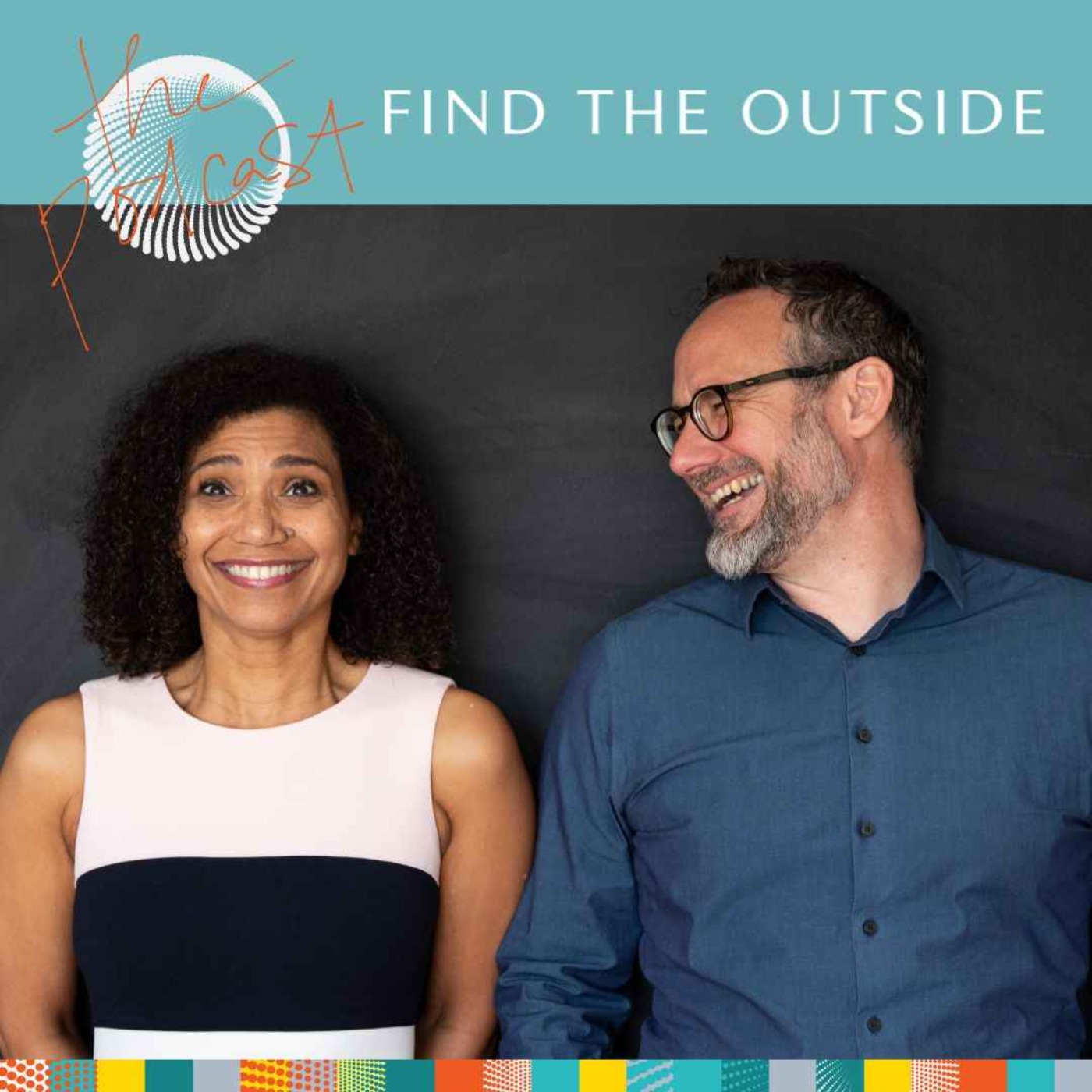
Find The Outside
Tim Merry & Tuesday Rivera
A lively, off-the-cuff conversation hosted by Tuesday Rivera and Tim Merry on large-scale systems change and equity. Together, Tim and Tuesday are THE OUTSIDE - systems change and equity facilitators who bring the fresh air necessary to organize movements, organizations, and collaborators forward for progress, surfacing new mindsets for greater participation and shared impact.In this podcast, we’ll share our greatest light-bulb moments as we advance our own understanding of this work. We’re doing it live, and inviting you in. Welcome! As Tim says in the first episode: reflection is too important to leave to chance. These conversations give us (and you!) a chance to slow down, catch our breath, and see our space and our work more clearly. Hosted on Acast. See acast.com/privacy for more information.
Episodes
Mentioned books

Jun 11, 2019 • 34min
1.20: Data: How Data Underpins Clarity-of-Reality And Pathfinding To Better Futures
In episode twenty, Tim and Tuesday dig into the substance of change—how to cultivate the kind of big-picture view that validates a good forward path.1.20 —— SHOW NOTESTim: We’ve been learning a lot about data, particularly over the last 12 months, as we work with major initiatives that bring in large consultancy firms who are generating data for us. There’s a real opportunity to combine the process expertise that we bring in with the data and analysis that comes out of evaluation work to support really powerful interventions in very large systems.Tues: There’s a really honest reaction to deductive reasoning that so often accompanies data capture. It is a legitimate reaction but for us as we get into bigger and bigger systems change, where data is simply part of the environment, we had to figure out how we would work with it and use it. We’ve been learning about marrying these two different streams (narrative and data). Tim: Because people think data has the answer, there can be a misconception that if we do really good data analysis we are going to know what to do. In our experience, the more data analysis we do, the better informed your decisions are but they are not easier to make. Tues: The request for data, or more data, is often a block to get to work. But good data pushes you further into inquiry and allows you to meet the system where they are.Tim: To provoke, exhilarate and inform where we take action.Tues: Developmental Evaluation moves beyond summative evaluation as it supports a shift in mindset towards experimentation, learning as you go, to iterate.Tues: Summative and Developmental Evaluation walk together quite well. It’s not a good or bad, an either/or, it’s a both/and. They need to be aligned and work together.Tim: The Hunger Project that Tues worked on is an incredible summary of multiple iterations into a highly complex intervention into food systems.Tues: Developmental Evaluation provides us with a much fuller way to support these processes and support the leaders that allow them to try something new.Tim: If data is shared and evolving overtime could it become a ‘shared currency’ — could it unite us in a fragmented system that is struggling to meet the needs of the people it is trying to serve?Poem: “Endymion, Book I” by John KeatsA thing of beauty is a joy for ever:Its loveliness increases; it will neverPass into nothingness; but still will keepA bower quiet for us, and a sleepFull of sweet dreams, and health, and quiet breathing.Therefore, on every morrow, are we wreathingA flowery band to bind us to the earth,Spite of despondence, of the inhuman dearthOf noble natures, of the gloomy days,Of all the unhealthy and o'er-darkened waysMade for our searching: yes, in spite of all,Some shape of beauty moves away the pallFrom our dark spirits. Such the sun, the moon,Trees old and young, sprouting a shady boonFor simple sheep; and such are daffodilsWith the green world they live in; and clear rillsThat for themselves a cooling covert make'Gainst the hot season; the mid forest brake,Rich with a sprinkling of fair musk-rose blooms:And such too is the grandeur of the doomsWe have imagined for the mighty dead;All lovely tales that we have heard or read:An endless fountain of immortal drink,Pouring unto us from the heaven's brink.(continue reading here)Song: “Happy Birthday” by Stevie WonderDuration: 34:06Produced by: Mark Coffin @ Sound Good StudiosTheme music: Gary BlakemoreEpisode cover image: source Hosted on Acast. See acast.com/privacy for more information.

May 28, 2019 • 41min
1.19: The Circle: From The Floor: A New Process To Tackle The Underpinnings Of Systems That Need Change
In episode nineteen, Tim and Tuesday tell the story of an improvised process in the middle of a three-day session. As facilitators, how can we orchestrate memorable, game-changing breakthroughs or surges ahead in understanding?1.19 —— SHOW NOTESTues: Today we’ve got a story to share from the middle of a three-day strategic event. Things had shifted and we discovered that the needs were different. The day before we had gotten a lot of information in and we needed to turn the corner into developing strategy. We were missing depth. It was time to shake things up.Tim: I tend toward strategy. I had a gut feeling that if we went straight into strategy we would replicate what we heard the day before. Needed to make it human and ‘felt’ in the room. So much of our lead up to this retreat was around beliefs. We need to deal with some of the fundamental beliefs that underpin the current system and tackle them. If not, it’s highly likely that we are going to replicate the very things we are trying to change. Tues: A depth of feeling was in the room but no collective sense of depth. And we were looking at a group of folks who had very deep, structural divisions within them. To move to strategy would have kept us in our camps. Tim: Idea of a fish bowl — it would enable people to witness each other from the different perspectives they were bringing in from the different parts of the system and then we began to think about working with that structure. Tues: I’d previously used fish bowls in anti-racism / anti-sexism work. They can bring perspective that you don’t hear often, however in North America it can really entrench people back into how they know how to talk about their experience. We asked them to speak from themselves and brought a different kind of question to fish bowl.Tues: Physical set-up of fish bowl is a group of people in a circle in the centre and a second outer circle of people. For those of us in the centre, we were the circle. The conversation was only in the inner circle.Tim: Part of working with groups is the ability to be strategic and being able to be tuned into the individual and people in the room and another bit that is energetic. Tim: Experience of holding the outer circle — if felt important for me to be incredibly grounded so I would close my eyes for long periods of time and open them for long periods of time. Very deliberate entering and grounding of myself in the room. The other thing that happened as I was sitting there I was getting a lot of really intense visual images with water. It was an important experience for me as a host.Tues: We did the circle three times — started with the medium power group, least amount of power group and ended with the group with the most amount of power. In every group there was something incredibly moving. In the second group (least amount of power) at one point someone said “I think this group has the most pain” and that was a really important moment as it threatened to bring us back into ourselves and our typical divisions. So I stepped in and said there is a lot of pain in this circle and there was a lot of pain in the first circle as well. It allowed the whole group to feel the wholeness and reject fragmentation. Then at the end of that group, I had the inner circle stand up and face the outer circle and said “when we talk about these people” we are no longer talking in abstraction, we are talking about each other (these people) in this room. It was another moment of re-knitting into our wholeness. Tim: This process led us into a completely different quality of depth.Tues: Depth and strategy are inextricable.Poem: The Travelling Onion by Naomi Shihab NyeWhen I think how far the onion has traveledjust to enter my stew today, I could kneel and praiseall small forgotten miracles,crackly paper peeling on the drainboard,pearly layers in smooth agreement,the way the knife enters onionand onion falls apart on the chopping block,a history revealed.And I would never scold the onionfor causing tears. It is right that tears fallfor something small and forgotten.How at meal, we sit to eat,commenting on texture of meat or herbal aromabut never on the translucence of onion,now limp, now divided,or its traditionally honorable career:For the sake of others, disappear.Song: Waterfall by The Stone RosesDuration: 40:50Produced by: Mark Coffin @ Sound Good StudiosTheme music: Gary BlakemoreEpisode cover image: source Hosted on Acast. See acast.com/privacy for more information.

May 14, 2019 • 35min
1.18: Teamwork: People Apart But Together: The Tactics and Strategy of Growing a Business of Change
In episode eighteen, Tim and Tuesday explore how we work with distributed teams: as ‘managers of one’, how can we keep a strong connection? How can we navigate highly complex issues and change processes of a rapidly-growing and remote business?1.18 —— SHOW NOTESTues: Managers of one are often used to going off and doing their own thing. I am very accustomed to managing and navigating on my own, so the added dimension of additional people adds a wrinkle: how to keep everyone connected and intersecting, both strategically and tactically?Tim: One of the great benefits of working with a team is that we get to see a bigger picture we couldn’t see otherwise, allowing for strategic direction and prioritization. As a naturally productive person, there is a piece of me that measures myself relative to my production rather than relative to my connection.Tues: The benefit of a team can allow us to hold production and connection but can also be a challenge.Tim: Inherent to teams can be the connection you build. There’s something about our team for the ability to be really human with each other and practical, get shit done.Tues: Worth being quite vigilant to connection as we can tilt to one side which is production. Really loving using WhatsApp with our team—a living, breathing space for us to connect with each other.Tim: The focus of our work / approach and theory to change is that we put Shared Work in the middle. I wonder if that also leads to the tendency to put the work over relationships? We also both come from a highly relational field so maybe we take it for granted?Tues: Because we put work in the centre, does that pull us in a direction? Could be a danger to this work. All of the stances around it are relational. How do we live our rhetoric? Being in relationship, staying in connection, taking care of each other—all of that feeds our results and moves the work into the centre.Tim: Shared Work is the compelling centre that has the gravitational pull to attract ideas, people, resources. The thing everything begins to orbit around. The stances or principals of these agreements become the container. This is Art of Hosting 101.Tim: We’re finding with our clients that we are constantly negotiating between our dearest-held beliefs about the work and our circumstances. It’s a tango. That’s happening in our teams as well. If we don’t meet regularly as a team, people start to feel fragmented and disconnected.Tues: There’s a sense of belonging to team and the work and that we are not alone in it. What does power have to do with that? How do power and belonging knit together? Do those of us with more power have a responsibility to create places and spaces for people to belong?Tim: We also need places of belonging. I want my teams to feel like a fun place to be and I want to create that for others. But it’s not about connection for the sake of connection. This is about creating places of belonging both for ourselves and for the teams we bring together.Poem: “Green Gulch Farm” by Stephanie KazaWe live by the sun, We feel by the moon, We move by the stars,We live in all things, All things live in us,We eat from the earth, We drink from the rain, We breathe of the air,We live in all things, All things live in us,We call to each other, We listen to each other, Our hearts deepen with love and compassion,We live in all things, All things live in us,We depend on the trees and animals, We depend on the earth, Our minds open with wisdom and insight,We live in all things, All things live in us,We dedicated our practice to others, We include all forms of life, We celebrate the joy of living-dying,We live in all things, All things live in us,We are full of life, We are full of death, We are grateful for all beings and companions.Song: Pumped Up Kicks by Foster The PeopleDuration: 34:49Produced by: Mark Coffin @ Sound Good StudiosTheme music: Gary BlakemoreEpisode cover image: source Hosted on Acast. See acast.com/privacy for more information.

Apr 30, 2019 • 43min
1.17: Personal Practice: Tactics to keep calm and not panic in the face of big change
In episode seventeen, Tim & Tuesday talk about being clear versus having a feeling of clarity - even through confusion. How can we train ourselves to stay open and keep moving forward in rooms electric with uncertainty?1.17 —— SHOW NOTESTim: How do I hold my own centre and clarity the midst of it all? How not to get caught up in it or lost in it. Brings us back to personal practice. Keeps coming up again and again.Tues: Personal practice is key to navigate both the clarity and uncertainty. Tim: The difference between my brain feeling clear and having a feeling of clarity even though I’m incredibly confused. How can we train ourselves to sit in rooms where all of that is happening?Tues: Sinking down below some of thoughts into something different and that place is always quiet, still and settled when I get there. Meditation has given me this.Tim: Personal training directly translates into the ability to work in diverse rooms. Some of the best training in this work is being able to go inside and sit with that kind of inherent confusion of being a human being without freaking out.Tues: Is that maybe why we cling to models so tightly so we don’t have to enter into that confusion?Tim: Beyond self-care, personal practice is one of the things that bring you home to yourself. We all have personal practices available to us. When you choose to step into a world of action and change-making, that is inherently unpredictable, suddenly what is a personal practice for you needs to become a disciple that enables you to do the work.Tues: It’s about turning it on and bringing intention to it / see it as such. There can be a million ways to do it. What is accessible to you now?Tim: What if personal practice was integrated into our idea of what it means to be a parent, a friend, a son, a coach, a leader in my faith community? What if the idea of personal practice was fundamentally connected to our understanding of what it means to be a leader / professionalTues: There is some healing, cleansing, knowing, understanding, amazing thing that can happen in personal practice.Song: “River” by IbeyiPoem: “Radical empathy” by Kate TempestDuration: 43:05Produced by: Mark Coffin @ Sound Good StudiosTheme music: Gary BlakemoreEpisode cover image: source Hosted on Acast. See acast.com/privacy for more information.

Apr 16, 2019 • 45min
1.16: Bridges: Reflections on how to convene for multi-sector, multi-stakeholder change
In episode sixteen, Tim and Tuesday speak with change makers at Forward Malmö, a movement uniting for multi-sector, multi-stakeholder change. How can we best share the work on shared problems?A conversation with Joel Veborg and Rodolfo Zuniga of Save The Children and Sabina Dethorey from the City of Malmö. Forward Malmö is a movement that brings together a number of organizations with shared and overlapping mandates to multi-sector, multi-stakeholder change. How can we best convene to change the conditions that impact shared problems?1.16 —— SHOW NOTESTues: We’ve been working with these three on an initiative/movement called Forward Malmö for about a year now. It was initiated by Save the Children (develop a systemic view of how to change the conditions that impact children), but pretty quickly it became apparent that we needed a multi-stakeholder/sector response to what is happening to children.Tim: The City of Malmö is dealing with a 30% child poverty rate. There are massive amounts of upheaval and uncertainty in Malmö. We are hoping to do something that impacts things nationally, pointing to the future of Sweden as a whole.Rodolfo: Save the Children - Sweden will be a 100-year organization soon. We are taking a big step to become part of a solution (i.e. migration crisis in 2015). The big eureka for us was that we cannot do it alone. That’s when we contacted The Outside.Joel: We found different people that understood us and wanted to figure things out with us. Sabina: Malmö is prepared for this because we’ve been working together with NGOs and other stakeholders for quite some time. Malmö has been a city of change for the last two decades. We are used to developing when in-crisis. This last decade was focused on social sustainability. For me, this initiative feels like home. This is the right way to work. Tim: What’s amazing to me is that people, in fundamentally different sectors, are having the same realization and somehow finding each other to do this work of transformation.Joel: This is true as we’ve been searching for answers outside of our organization—lots of conversations over many years. The private sector is new to us.Tues: There is some momentum that is attracting the private sector to Forward Malmö. Tim: The quality of relationship-building and care for each other creates fertile ground for our work to turn up and have a proper impact.Rodolfo: The invitation to our workshop [and this work] was built upon the relationship and trust from invitees. We are designing a long conversation here where we will see a lot of outputs and outcomes. This is imprinted in the cultural DNA of Swedes. When there is a problem, we gather and try to build a solution. Sabina: What I learned from the NGO I started was believing in yourself. We had people with power telling us ‘that won’t work / you won’t succeed’.Tim: We’ve decided to acknowledge that this is long-term work. It’s about connecting action so that we have a leadership cohort to carry us into the future. Just this change of narrative has attracted people to us.Joel: Think this is brilliant! People need this fragmented space to see and think.Rodolfo: We saw that there was a clear need for leadership and capacity-building.Sabina: During the last year, others also identified leadership as a crucial thing to work with. The Malmö Commission final report also pointed to this. Need to work with it in so many layers. This could really have an impact on our future work.Tim: People believe in the “how” even though they don’t know the destination. We are going to figure it out together and that’s what makes it trustworthy. It’s simple, but it’s powerful.Poem: Sabina shared a Swedish poem—we’ll upload the English version as soon as we have our hands on it.Song (Joel): “The Weight” (“The Last Waltz” LIVE version) by The BandSubscribe to the podcast now—in Apple Podcasts, Spotify, Stitcher or anywhere else you find podcasts. New episodes will be available every second Tuesday. If you’d like to get in touch with us about something you heard on the show, reach us at podcast@findtheoutside.com.Find the song we played in today’s show—and every song we’ve played in previous shows—on the playlist. Just search ‘Find the Outside’ on Spotify.Duration: 44:57Produced by: Mark Coffin @ Sound Good StudiosTheme music: Gary BlakemoreEpisode cover image: source Hosted on Acast. See acast.com/privacy for more information.

Apr 2, 2019 • 32min
1.15: From Experimentation to Actualization: With Gratitude On Our First Anniversary Of Change
In episode fifteen, Tim & Tuesday share insights on their many rapid-pace leaps and lessons over the last year. The Outside’s team, delivery, story, and facilitation is a constant iteration.1.15 —— SHOW NOTESTues: We are one year into The Outside as a business.Tim: We started this [The Outside] saying, ‘We’ll give it two years and see how it goes and run some little experiments…’ We have landed four really significant, major, long-term pieces of work. Two in Europe, one in Canada and one in the United States.At the end of this calendar year, I hope our calendars give us just enough of a breather to stop and be like: Where are we at? Where did we come from? and Where are we going?Tues: Okay, questions for us on our one year:What are one or two highlights from the first year of The Outside?How has this launch year felt?What are you most looking forward to or trembling about?Favourite podcast from the year?What advice would you give yourself on this date last year?Tim: Genuinely wake up everyday with a feeling of tiredness and excitement.Tues: I feel like I am changing shape - getting bigger, wider and deeper.Tim: How do we structure the business? How do we not become a big studio? How do we really stay nimble, adaptive and network-based? Pulling together teams of outrageously competent and brilliant people. What’s just enough structure to hold that?Getting a sense of what it means to be “Outsiders” beyond just you and me. Trembling at the scale and speed at which we are growing. Looking forward to determining our organizational structure. Excited for the building of this thing.Tues: Trembling at the pace and travel of this work but the work is exciting. Tim: A core principal of The Outside was around family. We’re having to figure this out and continue to make part of our organizational design.Tues: We have to hold each other in the overwhelm of things to do and share that but we also have a tendency towards excitement. Then we have to be like “wait a second; hold on.” Both of us have to do that for each other. My favourite thing about this podcast is that it gives us time to reflect together out loud. Time to understand my own knowing about what’s happening and to share that with you in a really ongoing way. Tim: Eat well! Sleep well! Enjoy your children!Tues: Relax. You won’t have it all figured out but you will have just enough figured out to go forward.Poem of the day: Won’t You Celebrate With Me by Lucille CliftonWon’t You Celebrate With Mewon't you celebrate with mewhat i have shaped intoa kind of life? i had no model.born in babylonboth nonwhite and womanwhat did i see to be except myself?i made it uphere on this bridge betweenstarshine and clay,my one hand holding tightmy other hand; come celebratewith me that everydaysomething has tried to kill meand has failed.Song: “Functions On The Low” by Rough SqwadSubscribe to the podcast now—in Apple Podcasts, Spotify, Stitcher or anywhere else you find podcasts. New episodes will be available every second Tuesday. If you’d like to get in touch with us about something you heard on the show, reach us at podcast@findtheoutside.com.Find the song we played in today’s show—and every song we’ve played in previous shows—on the playlist. Just search ‘Find the Outside’ on Spotify.Duration: 32:17Produced by: Mark Coffin @ Sound Good StudiosTheme music: Gary BlakemoreEpisode cover image: source Hosted on Acast. See acast.com/privacy for more information.

Mar 19, 2019 • 45min
1.14: Togetherness: Challenging our thinking as change facilitators to level-up the possibility in the room
When we intentionally practice what it means to be together, we increase the possibility of levelling-up. In episode fourteen, Gibrán Rivera joins us for a conversation about how to co-create the space to tackle insurmountable problems.1.14 —— SHOW NOTESTues: Today we’re talking to one of my favourite people in the world, Gibrán Rivera, a facilitator also working in systems change. Gibrán is an internationally renowned master facilitator who has devoted his life to the development of leaders and organizational transformation.Gibrán: My great friend (RIP), Jake Brewer, said to me “our only known response to increasing complexity is exhilaration.” All we know how to do is go faster. As we go faster, we do less of what matters. I’m interested in a different response because complexity will keep increasing regardless. We’ve reached the upper threshold of exhilaration. What I’m interested in is what is an evolutionary response to this moment. How do we learn to be in this together better? Tues: Can you talk about this ‘leap’ that you can see us making?Gibrán: Is this going to be our evolutionary crash or our evolutionary leap? The only way to meet this moment is a leap. Linear action is doomed. We need to literally leap. I want to orient my work, my life and my spirit around that possibility. That’s what I am talking about.Tim: There is some undefinable confidence in the face of what looks like catastrophe. We’ve defined this at the heart of The Outside - there is always a way.Gibrán: If we can make order out of VUCA—volatility, uncertainty, complexity, ambiguity— we may make things feel more “normal” or stable, but we will be projecting a confidence not based on truth.Gibrán: I feel like there is a wakefulness, a part of us that knows what is true in each of us. I think looking at someone like that’s true. Interacting with someone like they know what they know, they are capable of what they are capable of. It’s integral. See people’s greatness.Tues: That brings up two things for me: 1) the charismatic facilitator and how we’re often made the maker of miracles; and 2) the quality of courage.Gibrán: Important for all of us to become aware of how much we bring to the spaces we’re in by cultivating that in ourselves - wellness or steadiness. It impacts our space. Tim: What happens when facilitators are not in the room anymore? When it’s back to work? There’s an attachment that facilitators have to epiphany.Gibrán: I am familiar with a discourse that warns against charisma because we know it can lead people astray. I think about my work as helping nurture a state experience of being together. I believe that as we become familiar with what it feels like to be together, then we can become more masterful, we can create more ease in entering those states of being together.Tim: We often talk about referential experiences—we know we can do it because we’ve did this. They illuminate possible futures.Gibrán: When we talk about the evolutionary leap, two things are integral: 1) Pattern of a web or network - connection is alive as any of us are. 2) Sense of self is decentralized. We need to ask: “What is the thing that I am cultivating?” “What is the seed that I am holding?” “What is the wisdom and the prayer I will transmit to my descendants, to my next generation?” Human-to-human in a world that we know is coming up against some real serious suffering. That is my orientation.Poem of the day: Everywhere by HafizEverywhereRunningThrough the streetsScreaming,Throwing rocks through windows,Using my own head to ringGreat bells,Pulling out my hair,Tearing off my clothes,Tying everything I ownTo a stick,And setting it onFire.What else can Hafiz do tonightTo celebrate the madness,The joy,Of seeing GodEverywhere!Song of the day: El Farsante (Remix) by Ozuna · Romeo SantosSubscribe to the podcast now—in Apple Podcasts, Spotify, Stitcher or anywhere else you find podcasts. New episodes will be available every second Tuesday. If you’d like to get in touch with us about something you heard on the show, reach us at podcast@findtheoutside.com.Find the song we played in today’s show—and every song we’ve played in previous shows—on the playlist. Just search ‘Find the Outside’ on Spotify.Duration: 45: 28Produced by: Mark Coffin @ Sound Good StudiosTheme music: Gary BlakemoreEpisode cover image: source Hosted on Acast. See acast.com/privacy for more information.

Mar 5, 2019 • 40min
1.13: Ancestors II: Examining yesterday's actions to understand today's reality
In episode thirteen, Tim and Tuesday continue their conversation around history, impact, and our world — since context fundamentally alters how we relate to each other in the work of change, we delve in.1.13 —— SHOW NOTESTim: Vulnerability is about revealing something of yourself, which invites others to do the same. Tues: Vulnerability feels like something we, as a people, are seeking and need to search out. This podcast is on-air vulnerability; it’s a way of walking our talk. Brené Brown does incredible work around vulnerability for those listening who are interested.Tues: On both sides of my family, not one of us had wealth or resources or access to power. That’s why, in some ways, I can look back on my lineage and feel unafraid and only pride.Tim: When I think of my ancestors, it’s coming from a place of “Who bares the blame?”Questions from Tim:1. What is the source of pride and awe?2. What do you mean by the legacy of brutality?3. What is it like to have no written history/context?Tues: Pride and awe comes from understanding our survivorship and the enslavement of my people—what it took to physically survive being taken from our lands and stacked like wood in the bottom of ships. That legacy of treatment and building the economy of North America on our backs continues today.Tues: You can look up forever the impact of generational trauma and enslavement on Black parenting. When you are brutalized, you in turn, brutalize others. Then there’s also the brilliance of a diamond being crushed so hard which can also make you shine, at least in my experience.Tues: A lot of black folks in this country have done a lot of work to refine and reclaim their roots. I have not done that work. It’s a big, gaping wound. A big part of my practice is actively reclaiming the land I am on. My only ancestry are enslaved people. There’s a huge loss in not knowing what came before.Tim: Do you ever feel your ancestors? Tues: Yes, 100%. That pride, awe and understanding is automatically accessible to me. That is something about feeing it in my blood. I think about myself as the culmination and not an obligation to them. I am in this life to dance and be joyful, and make change.Tues: I want to leave listeners aware of my huge amounts of gratitude and I hope that that infuses my work and our work. And I hope I can stand strong in that.Poem: W.S. Merwin, "Thanks" from Migration: New and Selected PoemsListenwith the night falling we are saying thank youwe are stopping on the bridges to bow from the railingswe are running out of the glass roomswith our mouths full of food to look at the skyand say thank youwe are standing by the water thanking itstanding by the windows looking outin our directionsback from a series of hospitals back from a muggingafter funerals we are saying thank youafter the news of the deadwhether or not we knew them we are saying thank youover telephones we are saying thank youin doorways and in the backs of cars and in elevatorsremembering wars and the police at the doorand the beatings on stairs we are saying thank youin the banks we are saying thank youin the faces of the officials and the richand of all who will never changewe go on saying thank you thank youwith the animals dying around ustaking our feelings we are saying thank youwith the forests falling faster than the minutesof our lives we are saying thank youwith the words going out like cells of a brainwith the cities growing over uswe are saying thank you faster and fasterwith nobody listening we are saying thank youthank you we are saying and wavingdark though it isSong: “Family of Aliens” by TelemanSubscribe to the podcast now—in Apple Podcasts, Spotify, Stitcher or anywhere else you find podcasts. New episodes will be available every second Tuesday. If you’d like to get in touch with us about something you heard on the show, reach us at podcast@findtheoutside.com.Find the song we played in today’s show—and every song we’ve played in previous shows—on the playlist. Just search ‘Find the Outside’ on Spotify.Duration: 39:53Produced by: Mark Coffin @ Sound Good StudiosTheme music: Gary BlakemoreEpisode cover image: source Hosted on Acast. See acast.com/privacy for more information.

Feb 19, 2019 • 38min
1:12: Ancestors I: Examining yesterday's actions to understand today's reality
In episode twelve, Tim and Tuesday talk about how we honour and interpret our ancestors’ actions, roles, and impacts — think reverberations of colonialism and class — to grasp the underpinnings of our current world.1.12 —— SHOW NOTESTim: I’ve been doing a lot of work around what it means to have been raised and educated within my class. I realized the need to own the impacts of my ancestry on me and my life, my brother, my sister, parents and friends. This provided a new invitation to see it and take it in—not only how I’m often approached which is colonizer-based. Tues: We are talking about ancestors on two levels: our direct ancestors and their impact on our families and ancestors at large (our people and their impacts). That’s not always a straight line. Tim: We are already ancestors by virtue of being alive. We need to begin to think of ourselves as ancestors.Tues: For me it’s the whole view that says, ‘can I soften my heart to let in that whole view; while very much holding that right now our pasts, our presents and our future is absolutely impacted by our positioning related to that colonialism.’Tim: This is about analyzing our own society with the same rigor we apply to other areas of our society. What is the emotional and psychological state of the people in senior leadership positions? How is that playing out?Tues: The systems aren’t broken. They are doing what they were designed to do.Tim: This ends with how I raise my own children. The power to change is in my house. And something else also starts here, which is what so much of our work and friendship is—the ability to be in whatever happens next and knowing what has come before.POEM: ‘The Boxer’ by Tim MerryThey abandoned meThey should have been thereI was leftBereftAloneCurled up under a duvet cover from homeWishing to not be seenHeart beating, scared“Why did you leave me here?”Fear PulsingRed, jagged and spiralling From solar plexus outRunning frantic energy through my bodyAll the way to my fingers and toesBut nowhere to run, nobody I knowTo run to“Where were you?”This was meant to be grand adventureNot traumaNot weeping at 43Only feeling meWhen the tears flowHand on heartWe never should have been apartOur familyYou and meIn the empty spaceStepped the boxer, bracedFor any attackCome one, come allI am ready, poised, watchfulWeavingFists up, back to the wall, there is no leavingSadness turned to angerReading to explodeUnloadWhen things get beyond controlProtecting my soulWhen you did notI surrounded myself with a team of defendersBoxerCharmerActorFixerWorkerJokerLoverAngerServerConnectorAll to keep the world at bayBecause it was not safe To come out and playNow slowly I am peeping outMy blurry eyed headOver parapet wallsThere is me Looking inTo the place I protectedWhere I am not longer connected Meeting eye to eyeStarting to cryMore tears to flowMore of myself to knowIf I dare go slowWith the flowOf what the wisdom of my psycheIs unveiling to me nowAt 43I am coming back home, to meSong of the day: Oppression, Ben HarperSubscribe to the podcast now—in Apple Podcasts, Spotify, Stitcher or anywhere else you find podcasts. New episodes will be available every second Tuesday. If you’d like to get in touch with us about something you heard on the show, reach us at podcast@findtheoutside.com.Find the song we played in today’s show—and every song we’ve played in previous shows—on the playlist. Just search ‘Find the Outside’ on Spotify.Duration: 38:24Produced by: Mark Coffin @ Sound Good StudiosTheme music: Gary BlakemoreEpisode cover image: source Hosted on Acast. See acast.com/privacy for more information.

Feb 5, 2019 • 31min
1.11: Sporting: Setting up to support winning, delight, and formative goodness
In episode eleven, Tim and Tuesday deconstruct the change journey of a piece of work that rings bells across the spectrum. Using sport as a container, what can the rest of us learn about breaking through to ‘win’?1.11 — SHOW NOTESTues: This piece of work represents an intersection between our growing up, our current physical activity, and our work.Tim and Tues reflect on their own connection to sport as a coping and processing mechanism, identity, and pathway out of poverty for many young people.Tues: In this piece of work with Sport Nova Scotia (‘sport for social change’), we share the desire of helping more people experience the gift of sport—confidence and courage. In this collaboration, we’re figuring out how to re-engineer the system so more people can experience this.Tim: How can the culture of sport be more accessible? How can we shift the economy and structure of it in terms of who it prioritizes (colour, race, ethnicity, how long your family has been in the province, who they know)? Accessibility is huge.Tues: It’s a question common to all people seeking to collaborate for all kinds of change, beyond just sport: how much of our efforts simply make tweaks within a broken system? What’s stopping us from creating a completely new and equitable system from the ground up? As change facilitators, we work inside this tension all the time.Tim: Keeping the doors open on the dominant system buys us time to create the new. Part of our hypothesis is that we need people who are helping the old system stay open, and help it die and help to detoxify it as much as we need people meeting the new. These are all change leadership roles.Tues: Let’s be intentional because some of our efforts will be towards the old system. Our children, adults and seniors are in that old system now. Also, only choosing to look toward the new can leave a lot of people behind.POEM: “Dark Testament: Verse 8” by Pauli MurrayHope is a crushed stalkBetween clenched fingersHope is a bird’s wingBroken by a stone.Hope is a word in a tuneless ditty —A word whispered with the wind,A dream of forty acres and a mule,A cabin of one’s own and a moment to rest,A name and place for one’s childrenAnd children’s children at last . . .Hope is a song in a weary throat.Give me a song of hopeAnd a world where I can sing it.Give me a song of faithAnd a people to believe in it.Give me a song of kindlinessAnd a country where I can live it.Give me a song of hope and loveAnd a brown girl’s heart to hear it.SONG: “In My View” by Young FathersSubscribe to the podcast now—in Apple Podcasts, Spotify, Stitcher or anywhere else you find podcasts. New episodes will be available every second Tuesday. If you’d like to get in touch with us about something you heard on the show, reach us at podcast@findtheoutside.com. Find the song we played in today’s show—and every song we’ve played in previous shows—on the playlist. Just search ‘Find the Outside’ on Spotify.Duration: 30:36Produced by: Mark Coffin @ Sound Good StudiosTheme music: Gary BlakemoreEpisode cover image: Source Hosted on Acast. See acast.com/privacy for more information.

