

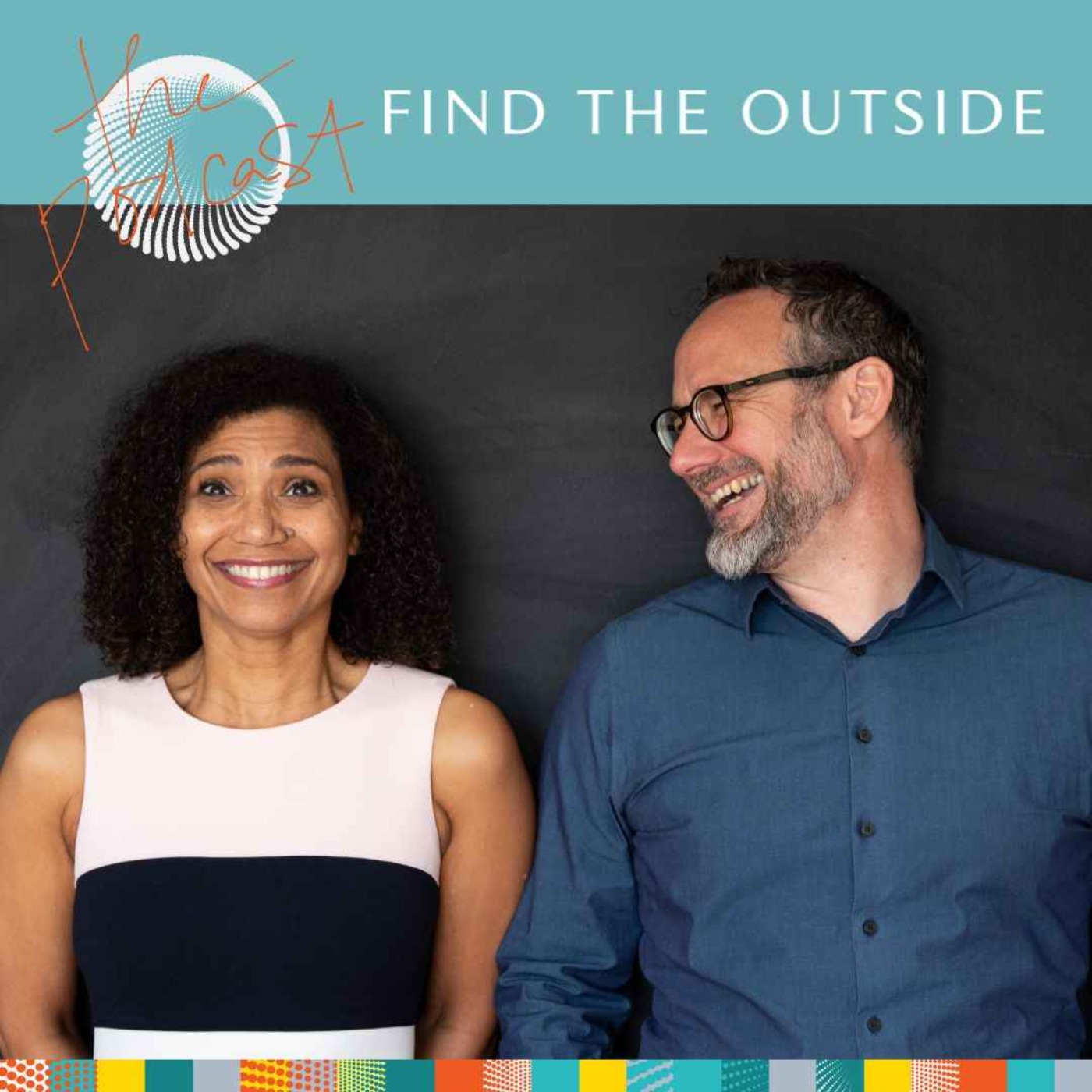
Find The Outside
Tim Merry & Tuesday Rivera
A lively, off-the-cuff conversation hosted by Tuesday Rivera and Tim Merry on large-scale systems change and equity. Together, Tim and Tuesday are THE OUTSIDE - systems change and equity facilitators who bring the fresh air necessary to organize movements, organizations, and collaborators forward for progress, surfacing new mindsets for greater participation and shared impact.In this podcast, we’ll share our greatest light-bulb moments as we advance our own understanding of this work. We’re doing it live, and inviting you in. Welcome! As Tim says in the first episode: reflection is too important to leave to chance. These conversations give us (and you!) a chance to slow down, catch our breath, and see our space and our work more clearly. Hosted on Acast. See acast.com/privacy for more information.
Episodes
Mentioned books

Feb 4, 2020 • 37min
2.09: Building Blocks: Laying The Structure For Equity In Change Work: Under The Hood Of Building A Business
Together, Tim Merry and Tuesday Ryan-Hart are THE OUTSIDE—systems change and equity facilitators who bring the fresh air necessary to organize movements, organizations, and collaborators forward for progress, surfacing new mindsets for greater participation and shared impact.2.09 - SHOW NOTESTim: As we grow, we’re putting in place legal structures to support our work and build the principals of our organization.Tues: It’s the idea that we are a fractal of what we are trying to do in the world. In this period of year-turning, there is always a space of reflection and putting your mind to where you want to be going forward. Often, with our clients, there is a pace and urgency. We could be swept along by the work and if we don’t pause and reflect and be intentional, we’ll just get more of what we are seeking to shift in our clients. Inner reflection for the organization cannot be left to chance.Tim: We often find ourselves asking for things that the professionals we are working with are like, “what?” One that was interesting for me recently was when we were sitting down with the lawyers to pull together our subcontractor contracts. We are getting to draw up contracts that reflect our values and the relationships we are building with our subcontractors.Tues: We want this to happen to everyone we work with. I hope their work gets better and deeper and more nuanced.Tim: One of our principals is generosity and we are trying to institutionalize / legalize it.Tues: One of the things we’ve done recently was brought The Outside principals to our team - how we want to be as an organization: Generosity, Love, Clarity, A society that serves all & Collective.Tues: I am not building a white organization; that is not what I am here to do. This is a declaration so folks know what we are intending, which is not a white organization. I am here to build an organization that actually knows how to work in difference because we are deeply different from each other. And very explicitly, that means racially.Tim: We’ve been actively seeking senior members for our team that are people of colour and building apprentices into The Outside.Tues: We are still looking for folks who have the capacity to be ‘managers of one’ and even that is evolving. I can feel like we are weaving something that is far more than individual folks doing really great work to deliver a project. We are developing a weaved fabric of people and work that will take a wide net that will move things forward.Tim: We really hope that what we shared today will help you to think about how you form your team(s), how you build out your organization or your practices in relationship to others, how that’s manifested, not just as a set of principals or practices, but how that’s manifested in structures and legality.Poem: “to all you young poets” from the book milk and honey, by Rupi KaurYour artis not about how many peopleIike your workyour artis aboutif your heart likes your workif your soul likes your workit’s about how honestyou are with yourselfand youmust nevertrade honestyfor relatability.Song: Los Ejes De Mi Carreta by Atahualpa YupanquiSubscribe to the podcast now—in Apple Podcasts, Spotify, Stitcher or anywhere else you find podcasts. New episodes will be available every second Tuesday. If you’d like to get in touch with us about something you heard on the show, reach us at podcast@findtheoutside.com. Find the song we played in today’s show—and every song we’ve played in previous shows—on the playlist. Just search ‘Find the Outside’ on Spotify.Duration: 37:48Produced by: Mark Coffin @ Sound Good StudiosTheme music: Gary BlakemoreEpisode cover image: source Hosted on Acast. See acast.com/privacy for more information.

Jan 21, 2020 • 37min
2.08: Problem? Fix It. On The Virtue Of Slowing Down For Understanding: The Relationships And Patterns Of Fix-It Mode
For episode eight of season two, Tim and Tuesday talk about the fix-it phenomenon we all share: on seeing a problem, we rush to fix it. But when we rush to solutions, we’re likely to repeat the very problems that gave us the challenge in the first place. How can we cultivate a new pattern of pause and examination?Together, Tim Merry and Tuesday Ryan-Hart are THE OUTSIDE—systems change and equity facilitators who bring the fresh air necessary to organize movements, organizations, and collaborators forward for progress, surfacing new mindsets for greater participation and shared impact.2.08 —— SHOW NOTESTues: When we feel the problem is urgent, it is much harder for us to wait. The good intention of problem —> fix feels like a generous, well-intended response to something that has urgency.Tim: 'Problem, fix it’ is not inherently bad (i.e. when in a crisis response). The idea that ‘problem, fix it’ makes good leadership is so pervasive in the places we are working… that’s the issue. On its own ‘problem, fix it’ is insufficient. We need better understandings before we act.Tues: We’ve started to respond to everything as a crisis. Part of the discernment is what are we actually in here? That pause before you act is where the possibility will come. This has been rich in my own life practice.Tim: This is a leadership practice. Otto Scharmer, out of MIT, has developed “U-Theory.” It has gained traction and it’s an archetypal process it takes people through. It journeys you through the “U” and I think we can all relate to it. What Tues and Otto are both describing is about pulling us out of the urgent into the important. Pulling us out of the day-to-day, hamster wheel, business as usual to say what a minute, what is actually important?Tues: What we know about shifting approaches is it requires you to let go of some things - beliefs, assumptions, etc. This requires a whole lot of work, thought, practice and understanding.Tim: If you are the ‘problem, fix it’ hero leader, every time you step in and solve people’s problems for them, you remove their ability to solve it themselves. I feel we [The Outside] are a real antidote to that. Answers are out of date so quickly. Inquiries will last you. What happens when we work in this way, is that your decisions become more considered; they do not become easier. We don’t opt for the easy answer, we engage with the nuance.Tues: 'Problem, wait/pause’ takes courage. Wishing people courage to try it out and see where it lands them.Poem: “…is God.” from A Book of Light, by Lucille Cliftonso.having no need to speakYou sent Your tonguesplintered into angels.even I, with my little piece of ithave said too much.to ask You to explainis to deny You.before the wordYou were.You kiss my brother mouth.the rest is silence.Song: Landslide by Tony ClarkeSubscribe to the podcast now—in Apple Podcasts, Spotify, Stitcher or anywhere else you find podcasts. New episodes will be available every second Tuesday. If you’d like to get in touch with us about something you heard on the show, reach us at podcast@findtheoutside.com. Find the song we played in today’s show—and every song we’ve played in previous shows—on the playlist. Just search ‘Find the Outside’ on Spotify.Duration: 37:15Produced by: Mark Coffin @ Sound Good StudiosTheme music: Gary BlakemoreEpisode cover image: source Hosted on Acast. See acast.com/privacy for more information.

Jan 7, 2020 • 44min
E2.07: Isoke Femi: Modes Of Experience, Theoretical Frameworks And Compassion: A Conversation
In episode seven of season two, Tim and Tuesday sit down with colleague Isoke Femi, who brings a beautifully enriching and unique perspective to the work of change. It’s a deeply inspiring transition from one decade to the next — and an invitation to open up to special magic in 2020.Together, Tim Merry and Tuesday Ryan-Hart are THE OUTSIDE—systems change and equity facilitators who bring the fresh air necessary to organize movements, organizations, and collaborators forward for progress, surfacing new mindsets for greater participation and shared impact.2.07 — SHOW NOTESTues: Today, we have Isoke Femi with us. She brings such a beautiful, deep and different perspective to this kind of work we do.Isoke: I started working at BALLE as a consultant in 2008/09. At the time, BALLE was in a partnership with the Academy for the Love of Learning (seeks to advance learning at all kinds of levels). BALLE was trying to change how people think about economy and how to advance local economy. Each of us brought our own theoretical frameworks into the work and somehow we were able to still create a synergistic process through which transformation could happen. For example, one of the theoretical frames I brought was the idea of the “mother-father peer principal” also known as the bureaucratic, symbiotic, and decentralized modes of experience.Tues: We all brought our own theoretical frames. Why do you think these frames worked / that we were able to move them forward?Isoke: When we do inner work, we get unblocked from our rigid attachment to our belief systems, we get more fluid and are free to be more choiceful in any given moment. We also like each other — there is a lot of admiration and respect for one another. There was a way in which we could hold and support the process and work with each other.Tim: Isoke, I am interested to hear more about the positive ascendancy of the masculine. We’re seeing so much of the masculine that is playing out in such negative ways in our societies, worlds and communities.Isoke: When it comes into balance with the mother. All people carry all three of these. So for me, when the father stands shoulder-to-shoulder with the peer (bring discernment).Tues: You just highlighted something that is important that’s illuminating something that is happening in our movement communities. We are so fragile but some of what we need now is sword. We need to stand up with some dignity - not that, this.Isoke: The sword should cut a path, or create a clearing, but what we do is that we take that sword and use it against each other. This is where the peer comes in. How about we try “x.” The father principal, when it’s in its strength, it can make room for the peer, for mutuality. When all three are working in harmony, you have the collaborative mode.Tues: For many years, you did traditional diversity and equity training. What are you learning about the work of liberation?Isoke: One is metaphysical. One is more physiological. One is more personal. Let me start with the metaphysical — we are already free. We were created free. We get to express. That is a very difficult thing for the oppressed and repressed mind to wrap itself around. We are eternal creators. I have been on a kick lately, for the last month, to have everyone watch a video called “How Diablo Became Spirit (13:17).” She helps a leopard to reconnect with the man who brought him to this reserve. It’s a call to all of us that this is where we are headed — honour the being of every single created thing.Isoke: Watch the documentary “The Power of the Heart.” It is about the power of forgiveness.Poem: The Guesthouse by RumiThis being human is a guest-houseEvery morning a new arrivalA joy, a depression, a meanness,Some momentary awareness comesAs an unexpected visitorWelcome and entertain them allEven if they are a crowd of sorrowsWho violently sweep your houseEmpty of its furnitureStill treat each guest honourablyHe may be clearing you out for some new delightThe dark thought, the shame the maliceMeet them at the door laughingAnd invite them inBe grateful for whoever comesBecause each as been sentAs a guide from beyond— Rumi (Say I am You)Song: A song for the suffering soul… sung by Isoke FemiBe still and knowBe still and knowBe still and know, you are one.Be still and knowBe still and knowBe still and know, you are one.Subscribe to the podcast now—in Apple Podcasts, Spotify, Stitcher or anywhere else you find podcasts. New episodes will be available every second Tuesday. If you’d like to get in touch with us about something you heard on the show, reach us at podcast@findtheoutside.com. Find the song we played in today’s show—and every song we’ve played in previous shows—on the playlist. Just search ‘Find the Outside’ on Spotify.Duration: 43:51Produced by: Mark Coffin @ Sound Good StudiosTheme music: Gary BlakemoreEpisode cover image: source Hosted on Acast. See acast.com/privacy for more information.

Dec 10, 2019 • 38min
2.06: Labels: How The Language, Theory, And Models Of The Labels We Use Can Either Restrict Or Give Freedom
In episode six of season two, Tim and Tuesday talk about how adopting or shedding labels — political, economic, ideological, identity — can give us access to change, but can also become limiting in terms of how we might want to grow. How can we become less attached and more open?Together, Tim Merry and Tuesday Ryan-Hart are THE OUTSIDE—systems change and equity facilitators who bring the fresh air necessary to organize movements, organizations, and collaborators forward for progress, surfacing new mindsets for greater participation and shared impact.2.06 —— SHOW NOTESTues: In an Otto Scharmer “Prescencing Workshop,” I had an experience in which I heard, “who you are will inform you, but it will not be who you will become.” This helped me to shed the label of survivor. Personal liberation for me is the freedom to be all of who you are, the freedom to have the life you want, or to try and create the life you want.Tim: I think about some of the labels we use in our systems change work - the incredible epiphany that happens, so often, when we use introduce the idea of “hospicing.” There is a role in change work that helps things die with dignity (beliefs, policy, etc). It is an essential ingredient that needs great care to give us time to build the alternative. At what point do the models we introduce become limiting?Tues: I wonder if it’s stages or more like the chaordic path - maybe it’s an undulation back and forth? Maybe we’ll always be looking for the next group, label or name? When we speak from the place of a ‘label’ we can only give a very narrow perspective. When we are speaking from an expanded version of ourselves, that takes into consideration multiple labels, we can give much better input into a process and maybe even feel much more ownership of a process.Tim: I feel like we do a lot of specific design around people’s personal journey - designing to help people step into labels - to accept and then to let go. I also feel like we are doing that organizationally - to build the analysis and then to let go.Poem: “Vitai Lampada” Henry NewboltNOTE from Tim: This poem was really strong in my school. It was one of the labels you had to live with. It was part of the label indoctrinated into us through the education system that I was a part of.Vitai LampadaThere’s a breathless hush in the Close to-night -Ten to make and the match to win - A bumping pitch and a blinding light, An hour to play and the last man in. And it's not for the sake of a ribboned coat, Or the selfish hope of a season's fame, But his Captain's hand on his shoulder smote "Play up! play up! and play the game!"The sand of the desert is sodden red, -Red with the wreck of a square that broke; -The Gatling's jammed and the colonel dead, And the regiment blind with dust and smoke. The river of death has brimmed his banks, And England's far, and Honour a name, But the voice of schoolboy rallies the ranks,"Play up! play up! and play the game!"This is the word that year by year While in her place the School is set Every one of her sons must hear, And none that hears it dare forget. This they all with a joyful mind Bear through life like a torch in flame, And falling fling to the host behind - "Play up! play up! and play the game!"Song: “Free” by PrinceSubscribe to the podcast now—in Apple Podcasts, Spotify, Stitcher or anywhere else you find podcasts. New episodes will be available every second Tuesday. If you’d like to get in touch with us about something you heard on the show, reach us at podcast@findtheoutside.com. Find the song we played in today’s show—and every song we’ve played in previous shows—on the playlist. Just search ‘Find the Outside’ on Spotify.Duration: 38:12Produced by: Mark Coffin @ Sound Good StudiosTheme music: Gary BlakemoreEpisode cover image: source Hosted on Acast. See acast.com/privacy for more information.

Nov 26, 2019 • 40min
2.05: What's At The Centre, And Why: Adventures In The Seeking Of Equity
In episode five of season two, Tim and Tuesday venture into the heart of their change work: equity. How do we distribute power and wealth? How do we relate across lines of race, class, and gender, and how do we keep these considerations on the table in all of our work and in our working relationships?Together, Tim Merry and Tuesday Ryan-Hart are THE OUTSIDE—systems change and equity facilitators who bring the fresh air necessary to organize movements, organizations, and collaborators forward for progress, surfacing new mindsets for greater participation and shared impact.2.05 —— SHOW NOTESTues: We have different pasts, as groups of people, and those pasts are often based on ways we have been structured unequally. There will be those that work for and those that receive the benefit. Often those divides are quite deep and often you are on one side or the other. These past legacies of inequity that we carry with us that make our current state (the present) very different.Tues: When we say we work for equity, we are working to try to acknowledge and understand how that past impacts the present, see current reality, and then begin to plan and work toward a future where those gaps between people are moving closer together. We need to work with relationships, systems and structures.Tim: The divide between oppressor and oppressed — our work tries to bridge that - the grey area in the middle.Tues: Generally, very few of us fall entirely on one side or the other of oppressed and oppressor. We have multiple identities. As a black, biracial woman, I would have the experience of race — being marginalized or oppressed — and yet I am straight and have all of the privileges that come along with that. The grey area that you are talking about, Tim, is how we allow the multiplicity of people to come into the room so that we can work in that grey area. We are trying to get people to see each other’s complexity. We need to see both sides of the divide to actually move forward.Tues: There is beauty in the oppressed experience and hardiness and resiliency. When I look for strength, I am looking to my Black ancestors.Tim: There is also a real “leaning in” that we bring. When issues of equity arise in our work, or in the teams we are working in, we often perk up and dig in when normally it’s the other way around - people try to move over it or move through it. We never avoid it.Tues: We have an unwavering belief that we’ll find a way forward together.Song: “B.L.M,” by The SpecialsPoem: “The Tree Did Not Die” an essay by Omid Safi“Hundreds of years ago a single large redwood grew here. Then disaster struck. The trunk of the large redwood was killed, perhaps by repeated and severe wildfire. From here you can see the original tree trunk still standing upright, now a dead and blackened snag.Despite such terrible damage, the tree did not die. Below the ground, its massive root system was full of vitality. Before long, hundreds of young, bright green burl sprouts began to come up around the circle formed by the root crown of the original tree. Some of those sprouts have grown into the full-sized trees that today stand in a circle around the original trunk.”We are this charred tree and the family of trees ground around it. We are the roots, the burning, the healing, and the regrowth. May we see this family circle around us, friends.May it be that despite such terrible damage, the tree of our life does not die.May it be that there is a vitality in our roots, and that the charred tree of our experiences gives birth to a hundred new blooms dancing around us, newer versions of ourselves that leap to life from what we would have deemed to be our death.The tree did not die. May our hearts not die.The tree did not die. And may our families not die.I don’t want to die, not yet, not now, not for awhile. I want to dance with my children at their weddings and tell stories of love and resistance to their as of yet unborn children. But my time will come, and so will yours. When that time comes, may I have, may you have, may we have deep and ancient roots that are filled with light and vitality, so that new life, new soul, new light sprouts from the charred portion of our being.The tree did not die. And our ancestors live in us. We are who we are because they loved us, through and after their earthly life. They live in us, through us, long after their bodies are charred and returned to the Earth.The tree did not die. The new trees are the old burned tree, and they grow out of the roots it put down. May we witness this growth out of our being. May there be new loved ones circling us, as we circle our ancestors.Subscribe to the podcast now—in Apple Podcasts, Spotify, Stitcher or anywhere else you find podcasts. New episodes will be available every second Tuesday. If you’d like to get in touch with us about something you heard on the show, reach us at podcast@findtheoutside.com. Find the song we played in today’s show—and every song we’ve played in previous shows—on the playlist. Just search ‘Find the Outside’ on Spotify.Duration: 40:02Produced by: Mark Coffin @ Sound Good StudiosTheme music: Gary BlakemoreEpisode cover image: source Hosted on Acast. See acast.com/privacy for more information.

Nov 12, 2019 • 29min
2.04: The Experiment: On Moving From Starting To Building: Behind-The-Scenes Of Change Work Growth
In episode four of season two, Tim and Tuesday explore the nature of moving from a start-up mindset to next-phase growth. As enthusiastic prototypers and experimenters, how do we know one phase is done and it’s time to capture learning and institutionalize? When do we call it, and how do we grow?Together, Tim Merry and Tuesday Ryan-Hart are THE OUTSIDE—systems change and equity facilitators who bring the fresh air necessary to organize movements, organizations, and collaborators forward for progress, surfacing new mindsets for greater participation and shared impact.2.03 —— SHOW NOTESTues: We started The Outside eighteen months ago with the goal to experiment for two years to see what would happen.Tim: One experiment is done and the next one begins—an increase in scale, sophistication, breadth of relationships drawn into do the work. Now, we want to start building infrastructure that’s an investment into the next five years.Tues: A big part of the experiment: could we build our work around systems change with equity at the centre?Tim: We’ve received a lot of feedback over the years as to the potency of that [our] partnership. We wanted to take this to another level—a deeper commitment to one another and to the learning between us.Tim: We have three long-term, systems change efforts that are in different stages. We’ve realized that The Outside is with clients for a period of 2-5 years. We’re there to help things to get unstuck, lifted and moving.Tues: We don’t parachute in… but it’s not a long-term thing. Our role is to help you get unstuck, get things moving and build a capacity. This is what we’ve learned. We did not know this 18 months ago.Tim: We’re trying to build an ecosystem of different apps and practices that enable us to function effectively as an organization. We are working with a tool called monday.com which allows us to list all of our activities, track movement, have conversation, give each other feedback, attach documents and links. It’s basically a project management tool for across the organization. We also use whatsapp.com, slack.com and zoom.com. This is the infrastructure of how we function. On another level, we use programs like waveapps.com and xero.com to get a financial overview of how the organization is evolving.Song: Stay High by Brittany HowardPoem: Time to awaken, an original by Tim Merry (one of the first poems Tim performed!)We all be learners and teachersWe don't need no preachersTo find the wholesoulforceOf course!It is like riding a horseremaining in the saddleeven when up shit creek without a paddle.Be yourselfEveryone else is takenNo point fakinThe only person you're foolin is youselfYou already got all the wealthDon't need to search no moreKnocking door to doorCause its all in the place you was born inNo more stallin'Listen loudly to the callin'Why you here?It ain't nothing to do with fearThat much is clear.I must confessmy greatest fear was successDaring to shine brightGet into the line of sightStepping into the spotlight.I trained for yearsTo be on stage and hide my fearsIn the character of anotherAlways under coverNever truly the deeper meTime to seeBe freeBeNowFear no moreI am sureI have felt theWholeSoul ForceCourseThrough my veinsI know what it means to be saneLiving in partnership with my brainMy body and bloodAnd the un-nameable floodOf realisationBe SelfEveryone else is takenIt is time to awaken.Are you stirred and shakin'?Are you quakin'?If not why not?Take a look aroundThe world is calling to become profoundThe messages loud and clearDrop the fearThe time is nowThe place is here.It always the occasionDon't get lost in the alien invasionTake actionto let go of distractionFeel the heartIn the breath of the nowKaboom kapowLike a hit on headSit up in bedThe nightmare is overYou just found the four leaf cloverEgo move overI am getting on my horseThe wholeSoulforce of course!No more fakin'be Selfeveryone else is takenIt's time toAwaken.Subscribe to the podcast now—in Apple Podcasts, Spotify, Stitcher or anywhere else you find podcasts. New episodes will be available every second Tuesday. If you’d like to get in touch with us about something you heard on the show, reach us at podcast@findtheoutside.com. Find the song we played in today’s show—and every song we’ve played in previous shows—on the playlist. Just search ‘Find the Outside’ on Spotify.Duration: 29:07Produced by: Mark Coffin @ Sound Good StudiosTheme music: Gary BlakemoreEpisode cover image: source Hosted on Acast. See acast.com/privacy for more information.

Oct 29, 2019 • 41min
2.03: Balance: On Spinning Plates, Keeping Forward Momentum, And Preserving Heart In A Busy Life & World
In episode three of season two, Tim and Tuesday explore the often talked-about, always sought-for, and ultimately elusive ideal of balance. In our journeys to reach ‘success’ — to have the greatest possible impact for a better tomorrow — what can we bring to our daily life to protect and renew our energies today?Together, Tim Merry and Tuesday Ryan-Hart are THE OUTSIDE—systems change and equity facilitators who bring the fresh air necessary to organize movements, organizations, and collaborators forward for progress, surfacing new mindsets for greater participation and shared impact.2.03 —— SHOW NOTESTues: I used to have a boss that would say she hated the word ‘balance’. She would say working moms were always going to drop balls, just make sure that one of the balls you drop is not your children. But sometimes you do. Just be human; sometimes you are going to drop all your balls.Tim: Family and care for family is a core principal of how we work together. It’s a non-negotiable.Tues: Have we equated balance with equal or equilibrium? Balance as a moving target is where we get the heartache.Tim: I’m not sure balance can be achieved without some kind of pivot point for things to move from.Tues: You could just unintentionally move through your life and get to your grave and say, “oh, is that how I spent my time/is that what I did? There is something around intention that at least naming what’s important that makes giving our attention so much more possible.Tues: While we may not ever reach this enlightened state of balance; we do know when we are out of balance.Tim: When we do our work, we talk about the need of striking a balance between just enough order so things can evolve effectively and enough chaos so that we are learning. It’s the whole Dee Hock work around the Chaordic Path.Tim: Just picking up some things here: 1. Clarity & Intention; and 2. Being in-tune with your inner guidance system. My hunger and thirst for balance is heightened by what I am experiencing in the world around me.Tues: I wonder if we are talking about two different things? Balance for me is where I put my attention, energy, action and time; it’s not that place of stillness where I think it’s okay. They are two distinct things for me.Tues: It’s hard to articulate because some of those pressures/expectations are so unspoken for women. The root of this word [balance] has to do with equity. Our experiences of balance are deeply impacted by our social position.Tues: Those of us who are targets of oppression probably get a really good sensitivity to that and see it more easily and more clearly and those of us who would benefit from an imbalance of equity clobber those feelings down.Tim: As a result of my class, family, access to wealth, nationality, race… I feel like from a pretty early age I was witness to a whole series of injustices [familial] and they increased in intensity into my teens. That’s a construct, in my life, of the education of the privileged classes. Through it all, I still knew what was just and what was not. For me, I knew what was right and wrong through my entire childhood. I really fought to protect this as a young man.Tues: We are typically really reinforced for not holding onto it [empathy]. I think it’s why people trust you with this equity work. You keep that awareness in your bones and it makes you trustworthy. Trauma tries to extinguish empathy. It’s about intention. We need to have an intention of being willing to see the pain in others.Tim: I want to acknowledge that there are people within the ruling classes, that recurrently over history, who have maintained that sense of justice despite the context they were raised in.Tues: Two important stances we bring to our work: when we are working with groups of people carrying this acknowledgement around the pain of injustice and lack of equity and that people have will and are working toward ending it feels like two important stances that we bring into our work. Song: “Motion Sickness” by Phoebe BridgersPoem: “Big Brown Dog” by John Fisher-Merritt, Organic Farmer & PoetOn Winter mornings I knowWhen my man is preparing to go outside.He reaches into the closet for his coveralls.I approach him eagerly, wagging myBest tail wags, oblivious to tail pain asI whack chair,desk and closet doorYou seeI have trained this wonderfulSmelling manTo throw his coverallsOver my head,And speak to me in anAffectionate tone of voice as IRevel in the ambrosial scentOf his body odor.Subscribe to the podcast now—in Apple Podcasts, Spotify, Stitcher or anywhere else you find podcasts. New episodes will be available every second Tuesday. If you’d like to get in touch with us about something you heard on the show, reach us at podcast@findtheoutside.com. Find the song we played in today’s show—and every song we’ve played in previous shows—on the playlist. Just search ‘Find the Outside’ on Spotify.Duration: 40:51Produced by: Mark Coffin @ Sound Good StudiosTheme music: Gary BlakemoreEpisode cover image: source Hosted on Acast. See acast.com/privacy for more information.

Oct 15, 2019 • 41min
2.02: Across The Divide: On Finding Unexpected Alliances Across Different Approaches To Change Work
For episode two of season two, Tim and Tuesday interview Jacob Watkins of PricewaterhouseCoopers (PwC) in Zürich, Switzerland. Collaborating with The Outside over the last nine months for the International Committee of the Red Cross, Jacob has brought remarkably point of view on how change happens, resulting in an incredibly rich field of learning between what might have once been thought of as an unlikely trio.Together, Tim Merry and Tuesday Ryan-Hart are THE OUTSIDE—systems change and equity facilitators who bring the fresh air necessary to organize movements, organizations, and collaborators forward for progress, surfacing new mindsets for greater participation and shared impact.2.02 - - SHOW NOTESTues: Jacob is one of the people we are learning with. It’s got us jazzed and excited. Feel like you [Jacob] keep us right on an edge.Jacob: It was a really interesting experience to be in our pitch with a client and be asked the question “would you be up for working with another consultancy on this project?” To be knowledgeable, subject matter people in these topics to then have this question asked… I was kind of intrigued and cautiously optimistic.Tim: In one of our early meetings, you named us as people who bring expertise, process and skill around systems change and what you, particularly, and PwC was bringing into the game was the ability for analysis and organizational assessment and an analytical approach.Tues: This was brave - you made a clear discernment. The client chose to work with both of us. Give them a lot of credit for trying something different.Jacob: What was cool, on both sides, was an openness to try to get under the skin of what is systems thinking.Jacob: I worked in the money market straight out of university. Making money and earning commission and trading was not enough intellectually for me or a meaningful change made. Had an early mid-life crisis — felt grumpy and bored. I was inspired by Tim Ferriss of The 4-Hour Workweek and other folks putting out different ways of thinking. Did a tech start-up and worked with a team that melded together and formed this incredible group. It was the learning journey that got me really excited. In my role with PwC, I am never bored and get to tackle really difficult problems. When I was in that room with you guys, I was thinking how cool it would be to figure out how to make this work. How could we bridge the seeming gap between our two worlds and that seemed like a problem worthy of attention, time and energy.Tim: What is distinct about PwC and Jacob Watkins and The Outside and Tim Merry & Tuesday Ryan-Hart? What’s the divide?Jacob: (1) I think if I can manage my PwC colleagues to keep an open mind around this, I think we can get to a meeting of the minds; and (2) We spoke with different business language. Process for you, means something different for me.Tues: In some ways, we wanted a lot of the same ends but our ways of going about them were completely different (i.e. data analysis vs developmental evaluation). To me, the data piece is where things come together quite beautifully. The data each of us got overlapped — it wasn’t in any way in conflict with each other. That 10% that was different was quite important!Tim: Often the particular worldviews that our two different organizations are coming from, but also we as individuals arrived into this initiative with one another, sets us up as adversaries where one has to win for there to be true progress of the human species or true progress for systems change or true progress for organizational development. … One of the real beauties of this particular initiative is in a very fundamental way we’ve been modelling the practice we’ve been inviting people into and in a very visible way.Jacob: The challenge that I faced in my career, particularly in working with clients when it comes to big-four consulting or strategy house consulting, is you're kind of hired with this underlying assumption that you will have a very clear, mechanical approach, that you will be able to deduce insights that they weren’t already aware of and that you can give answers to the organization that they can take forward… that’s kind of the more traditional consulting USP (Unique Selling Proposition) for the big firms. Traditionally, that is what the market and buyers have wanted but more and more I am seeing a shift, particularly through digital disruption, to new ways of working that challenge the older consulting models.Jacob: The more we can bring our world and your world together, for lack of better words, the greater the innovation and the greater the power of moving forward is going to be.Tues: 100%! Gives us a chance to live our rhetoric. We came up with the conception of a new Operating System together. That was definitely more of a sum of the parts. It results in better work - we developed something that did not exist in the world before.Tim: There are many people who will say that we [Tim & Tuesday] “sold out” by agreeing to work with an organization like PwC. Yet, what we are discovering is quite the opposite - it’s made our work better, it’s increased our capacity to serve the people we are working for.Tim: I’m proud of what we’ve done together, both of the work itself and the breaking down of barriers in our own worldviews and between our own organizations. Our client has talked about the Operating System we developed as “groundbreaking.” I would also say that our combined approach has also been groundbreaking.Poem: “Whereas: An Excerpt” by Layli Long SoldierWHEREAS I heard a noise I thought was a sneeze. At the breakfast table pushing eggs around my plate I wondered if he liked my cooking, thought about what to talk about. He pinched his fingers to the bridge of his nose, squeezed his eyes. He wiped. I often say he was a terrible drinker when I was a child I’m not afraid to say it because he’s different now: sober, attentive, showered, eating. But in my childhood when things were different I rolled onto my side, my hands together as if to pray, locked between knees. When things were different I lay there for long hours, my face to the wall, blank. My eyes left me, my soldiers, my two scouts to the unseen. And because language is the immaterial I never could speak about the missing so perhaps I cried for the invisible, what I could not see, doubly. What is it to wish for the absence of nothing? There at the breakfast table as an adult, wondering what to talk about if he liked my cooking, pushing the invisible to the plate’s edge I looked up to see he hadn’t sneezed, he was crying. I’d never heard him cry, didn’t recognize the symptoms. I turned to him when I heard him say I’m sorry I wasn’t there sorry for many things / like that / curative voicing / an opened bundle / or medicine / or birthday wishing / my hand to his shoulder / it’s okay I said it’s over now I meant it / because of our faces blankly / because of a lifelong stare down / because of centuries in sorrySong: “In Gold” by Submotion OrchestraSubscribe to the podcast now—in Apple Podcasts, Spotify, Stitcher or anywhere else you find podcasts. New episodes will be available every second Tuesday. If you’d like to get in touch with us about something you heard on the show, reach us at podcast@findtheoutside.com. Find the song we played in today’s show—and every song we’ve played in previous shows—on the playlist. Just search ‘Find the Outside’ on Spotify.Duration: 41:02Produced by: Mark Coffin @ Sound Good StudiosTheme music: Gary BlakemoreEpisode cover image: source Hosted on Acast. See acast.com/privacy for more information.

Oct 1, 2019 • 35min
2.01: Generosity: The Heart-Expansion & Opportunity Of Generosity In Change Work
In the first episode of season two, Tim and Tuesday explore one of the most prescient requirements of equitable change: the generosity necessary to successfully work through difference. How can we draw out and celebrate such a critical ingredient when that ingredient cannot be forced, but earned?2.01 —— SHOW NOTESTim: Generosity is one of the core principals of The Outside. It’s how we turn up in our work, our lives and with each other. The overflowing cup of generosity. We are dealing with really tough issues, yet at the same time, there is an incredible humanity turning up in the room as well as professionalism.Tues: When we talk about difference, traditionally, people often contract. This is the exact opposite of it. It’s a heart expansion piece. I am generous because the opportunity is there and I am willing to step into it. It connects us. It feels like a key piece of working in equity and difference is generosity; although you can’t demand it.Tues: Appreciation & Generosity: Wondering what is the role of appreciating that is one of those conditions that supports generosity? The expression of appreciation is part of generosity.Tues: Wondering about the role of generosity in power and privilege… sometimes I find that those in power are less appreciative and have less generosity. Is this true? Let’s talk about it.Tim: I feel like there is a connection between empathy and generosity [to give, to share]. What I know from my own life and upbringing is that a lot of circumstances of wealth and privilege led towards having a significant empathy deficit / a significant lack of ability to put yourself in someone else’s shoes and understand that.Tim: Many of the systems we are working with are designed for siloed, fragmented thinking. A huge piece of our work is about overcoming that. This generosity thing we are talking about is like a backdoor to defragmentation.Tues: Often in rooms when people are brought together, the thinking is that when ‘this’ or ‘that’ happens, then we can be generous. There are often pre-conditions for when we can be generous with one another. We don’t have to wait one moment. There does not have to be the perfect conditions to be generous with one another. We can just start. The backdoor is always open.Tim: What I am loving here is how subversive generosity is to the dominant cultures and structures of decision making. How subversive this can be to the psychology and mindset many of our senior leaders are in. Generosity can invite our senior leaders into working in a different way.Tim: This principal of generosity, particularly in the two really large systems change efforts we are involved in right now in the US and Europe, it has permeated, not just the work and our team, but the contracting. It’s permeated the toughest conversations around contracting which is money and intellectual property. It’s quite remarkable. Generosity can extend into some of the most transactional spaces.Poem: “blessing the boats” by Lucille Clifton (1936-2010)may the tidethat is entering even nowthe lip of our understandingcarry you outbeyond the face of fearmay you kissthe wind then turn from itcertain that it willlove your back may youopen your eyes to waterwater waving foreverand may you in your innocencesail through this to thatSong: “Balade brésilienne (feat. Flavia Coelho)” - Gaël Faye - Des fleurs - EPSubscribe to the podcast now—in Apple Podcasts, Spotify, Stitcher or anywhere else you find podcasts. New episodes will be available every second Tuesday. If you’d like to get in touch with us about something you heard on the show, reach us at podcast@findtheoutside.com. Find the song we played in today’s show—and every song we’ve played in previous shows—on the playlist. Just search ‘Find the Outside’ on Spotify.Duration: 34:41Produced by: Mark Coffin @ Sound Good StudiosTheme music: Gary BlakemoreEpisode cover image: source Hosted on Acast. See acast.com/privacy for more information.

Jun 25, 2019 • 33min
1.21: School's Out: Reflecting On A Year Of Reflection - How To Take Heart & Cultivate Readiness For Bold Change
In season one’s final episode, Tim and Tuesday wrap a year of incredible conversations with a summer assignment: how do we cultivate readiness? Along the road as systems change facilitators, we wonder: are we really doing what we set out to do? And how can we find fertile and steady ground in emergent work?1.21 —— SHOW NOTESTues: This is our Season Finale episode!Tim: The number of people listening has been steadily increasing. I know there are groups listening together. I love the honour and opportunity we’ve had in being in people’s lives. It makes me really happy.Tim: The Outside has exploded. It’s busy and we are still trying to figure out how to deal with that because we did not expect it to grow this fast, this soon. And so, the podcast has become a space to stop, reflect, think bigger, reconnect around the work, challenge each other.Tim: Looking back on our year, what is important to leave with our podcast listeners?Tues: Two things: (1) Work-wise, one of our learnings is that systems change, with equity at the centre, takes a long time to really catch. It can be years into an effort before those pieces really come together. (2) Personal: Keep learning and understanding and moving from your centre. If you do nothing else this summer, except discover more about yourself, you will have done some pretty amazing work and some pretty amazing work in the world.Tim: My personal practice of meditation, of spending time in nature, of being in therapy that allows me to revisit things in my childhood that set fundamental patterns for my behaviour… there’s something in all of that which is about letting go of who I think I am, what I think I am, what I think my work is.Tim: Accessing “readiness” is one of the things I want to start exploring. How to we map the stages of this [client’s] journey over multiple years. When I was in my early 20’s coaching with Meg Wheatley, she used to talk about ‘one step at a time leadership.’ Stop, Re-orient, Re-organize, Move.Tim: My wife and I choose a word or a sentence that sets a tone for the year. The one we landed on for 2019 was ‘balance’. What is the balance I want in my life? Inviting everyone into this — how are we giving all parts of ourselves what we need?Tues: Next season, we’ll interview Jacob Watkins, Trupti Sarode & Gabrielle Donnelly about co-existence of data and analysis. We’ll speak with Alastair Jarvis about Two Loops of Systems Change. We’ll explore balance, and continue to share what we’re learning about equity and systems change. We’ll also feature Ole Qvist-Sørensen from Bigger Picture, around visualizing shifted futures.Tues: We will be back next fall (Date: TBC)! In the meantime, please revisit season one, and share and subscribe!Poem: “Find a Point on the Wall” by our friend, Lex SchroederFind a Point on the Walltry holding your leg out straight from your hipturn outbend, and dippointnow hold it straight outbe longwhere's your corepointturn outbendnow hold it straight outgrow tallertake it to the sidehigherbackwe’ll do 8take it up nowball of the footturn aroundhighergrow 5 inches morearms upturnkick it outtry not to collapse into your standing legwhere’s your coregoodnow try letting your friends feel painlet them live with a steady achelet them bring themselves back from the deadlet your loved ones grow olderkeep going, let people get sicklet someone worry about youtry laughing during a nuclear warlet beauty wash over youfeel loved, try to love somebody welltake up a bit more space, back upwe’ll do 3 sets of 8softenhigherlet it be bigger than yougrow 5 inchessay it straight outdon't rush theseforget yourselftry practicing gracelet your heart break for the worldtry crying after a dry spellroot into the groundsoftennow stay longwe’ll do 3 more setsOccupyand backbackjust 2 morewhere’s your chestdon’t scrunchgrow tallermake more spaceit's ok, be exhaustedlet it be easylook upHello!relax into the breathfind your corethereSong: “Incapable” by Róisín MurphySubscribe to the podcast now—in Apple Podcasts, Spotify, Stitcher or anywhere else you find podcasts. New episodes will be available every second Tuesday. If you’d like to get in touch with us about something you heard on the show, reach us at podcast@findtheoutside.com. Find the song we played in today’s show—and every song we’ve played in previous shows—on the playlist. Just search ‘Find the Outside’ on Spotify.Duration: 33:28Produced by: Mark Coffin @ Sound Good StudiosTheme music: Gary BlakemoreEpisode cover image: source Hosted on Acast. See acast.com/privacy for more information.

