

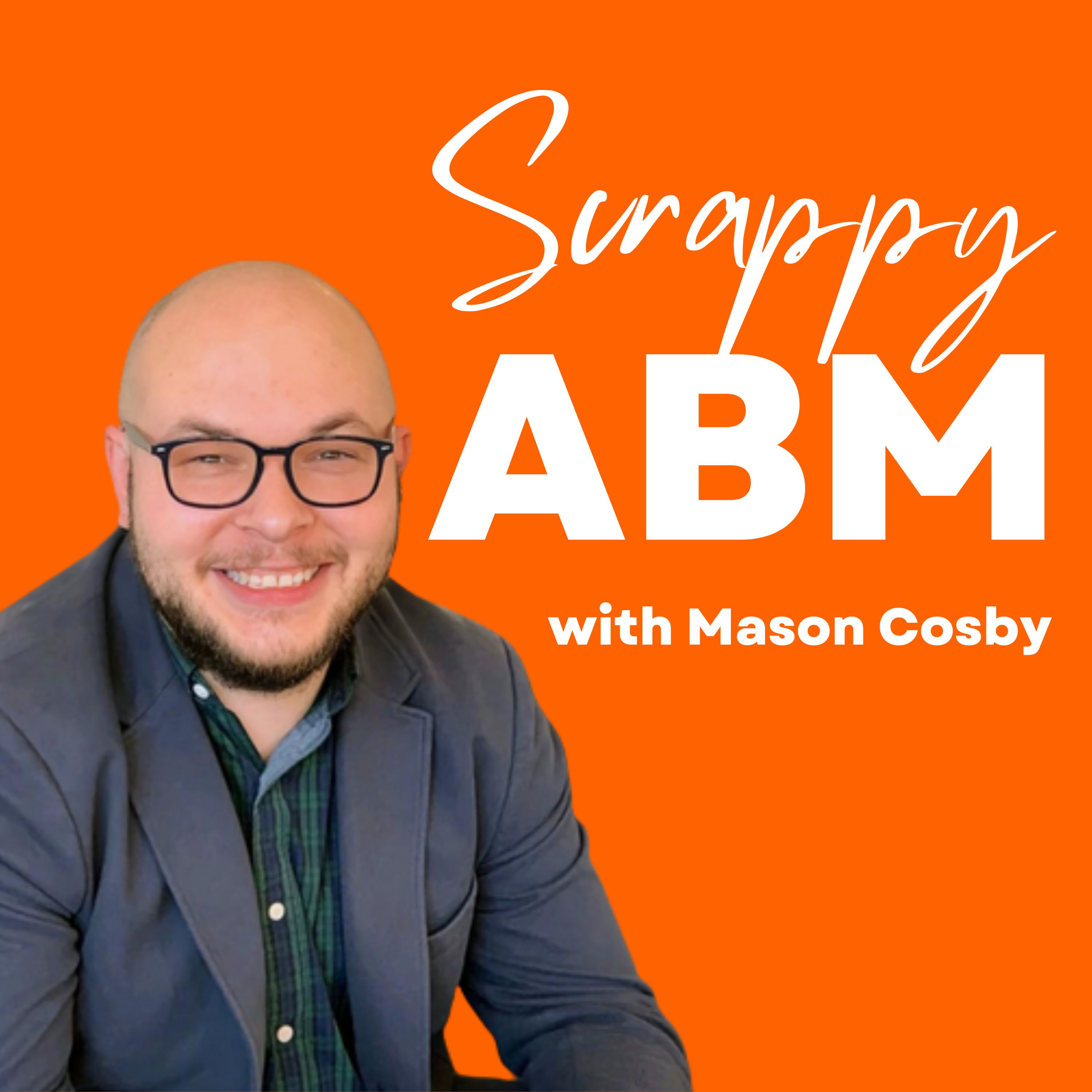
Scrappy ABM
Mason Cosby
Welcome to Scrappy ABM – your source for groundbreaking approaches to ABM that don't break the bank. ABM shouldn't cost $200K in technology to even get started. If you want to get started with ABM or make your program better without a massive budget, you're in the right place.
Each week, you'll hear from some of the brightest minds in the marketing world who are redefining ABM, achieving incredible results with untraditional methods, limited resources, and a whole lot of creativity.
This isn't a show about how much you can spend on fancy tech or overhyped tools. Instead, it's about celebrating creative problem-solving and the scrappiness it takes to get ABM right. We'll dive into how these marketing leaders built robust ABM strategies with limited resources, revealing the actionable insights that led to their biggest wins.
So, if you're a marketer ready to challenge the status quo, or an entrepreneur looking to scale your business through efficient and effective marketing strategies, Scrappy ABM is the show for you.
Get ready to discover ABM strategies that are lean, impactful, and utterly transformative. Remember, it's not about the budget, it's about the mindset. Let's get scrappy!
Each week, you'll hear from some of the brightest minds in the marketing world who are redefining ABM, achieving incredible results with untraditional methods, limited resources, and a whole lot of creativity.
This isn't a show about how much you can spend on fancy tech or overhyped tools. Instead, it's about celebrating creative problem-solving and the scrappiness it takes to get ABM right. We'll dive into how these marketing leaders built robust ABM strategies with limited resources, revealing the actionable insights that led to their biggest wins.
So, if you're a marketer ready to challenge the status quo, or an entrepreneur looking to scale your business through efficient and effective marketing strategies, Scrappy ABM is the show for you.
Get ready to discover ABM strategies that are lean, impactful, and utterly transformative. Remember, it's not about the budget, it's about the mindset. Let's get scrappy!
Episodes
Mentioned books

Feb 2, 2026 • 11min
Why Your Direct Mail Gets Thrown Away | Ep. 248
If you are tired of getting ignored, show up in the one place your prospects cannot ignore you: their mailbox.ㅤIf you have been building a B2B marketing program, direct mail has likely come up. Unfortunately, it is often thrown out immediately—just like the junk mail you get at home. This happens because most marketers treat it as a cold opener or a mass outreach tool. On this episode of Scrappy ABM, Mason Cosby explains why you should never use direct mail to start a conversation with someone who has never heard of you.ㅤInstead, Mason breaks down how to use physical mail to re-engage stalled deals or accelerate existing relationships. He shares why receiving a package is a "delightful interruption" compared to the crowded digital ad space, where you are constantly outbid. You will learn exactly where to insert direct mail into your pipeline, why you should start with a small pilot of 10 to 50 accounts, and why sending your own company swag is usually a mistake.ㅤWhat We CoverThe problem with cold direct mail: Why sending physical items to people who do not know you ends up in the trash.The "Delightful Interruption": How to provide context and excitement when a prospect opens a package.Avoiding the bidding war: Why the mailbox offers less competition than social media feeds.Three specific places to use direct mail: Stalled pipeline opportunities, historical funnel drop-off points (like free trials), and customer renewals.The Nike shoe example: How a personalized gift after a renewal created a lasting positive memory.Starting small: Why a 10-account pilot with a higher budget per gift often yields better ROI than mass sends.The swag rule: Why you should offer your branded gear as an option rather than the default gift.Internal alignment: The critical need for Sales and Customer Success to follow up immediately upon a package's arrival.ㅤResourcesScrappy ABM Newsletter: Get weekly B2B marketing answers and tips. Subscribe here.Dreamdata: Mentioned for their 2025 benchmark report content play. Visit Dreamdata.Visit for more ABM tips and strategiesConnect with Mason on LinkedInㅤIf you enjoyed today's episode and found valuable insights for your business, be sure to subscribe to the Scrappy ABM podcast for more expert discussions. Don't forget to leave a review and share this episode with your team or fellow marketers!
9 snips
Jan 29, 2026 • 27min
Why You Should Not Build Net-New Content for ABM (with Hannah Forson from BambooHR) | Ep. 247
Hannah Forson, Senior Manager of Demand Generation at BambooHR who builds mid-to-bottom-funnel, account-focused programs. She explains how to define target accounts using closed-won data. She breaks down decision-committee messaging for finance vs HR. She shows how to repurpose existing content and earn channel buy-in while handling longer, higher-quality sales cycles.
7 snips
Jan 26, 2026 • 6min
Lead gen is killing your B2B Marketing | Ep. 246
They argue why B2C-style lead volume fails in complex B2B buying scenarios. They call out the obsession with downloads and attendees that leaves pipelines empty. They explain how poor lead quality erodes sales trust and wastes budget. They outline moving from broad ICPs to specific target account lists and using account-based approaches to market only to companies you actually want.
20 snips
Jan 22, 2026 • 19min
Connect LinkedIn Ads Data with your CRM Data (with Adam Holmgren from Fibbler) | Ep. 245
Adam Holmgren, CEO and co-founder of Fibbler, built a tool to connect LinkedIn ads with CRM systems. He talks about proving ad influence without clicks. Topics include sending impressions and engagements into HubSpot/Salesforce, building influence-to-pipeline reporting, account scoring and sales signals, and practical ABM workflows for SMBs and marketers.
7 snips
Jan 19, 2026 • 31min
Stop Scaling ABM. Start Stacking Signals | Ep. 244
They argue most companies already have 75% of what they need for account-based marketing and warn against buying tools before strategy. A practical Account Progression Model and a 4D Framework (Data, Distribution, Destination, Direction) show how to turn scattered tactics into measurable plays. Learn how stage success metrics can trigger the next action and why filling middle-stage engagement gaps matters.
Jan 15, 2026 • 23min
Podcasting as an Account Based Play to Reach a Super Hard Niche Audience (with Kathleen Booth) | Ep. 243
The challenge: selling to a "tight-knit" and "insular" group of ad operations leaders who already have solutions and rarely talk to vendors. Kathleen Booth explains how she broke through this "fortress" audience at clean.io by launching a podcast focused entirely on the buyer's career journey.She shares why she didn't need to be an expert to build trust, how she used a simple referral loop to fill her guest list without cold outreach, and the "scrappy" tactics - like branded baseball jerseys and intimate dinners - that turned listeners into pipeline. Kathleen proves that consistency and curiosity matter more than a massive budget or a complex tech stack.ㅤ👤 Guest BioKathleen Booth is the Senior Vice President of Marketing & Growth at Pavilion, a global community for high-growth commercial executives. A veteran marketer with experience at Sequel.io and clean.io, Kathleen is a long-time podcaster and vocal advocate for Community-Led Growth. She specializes in helping brands build owned media assets to navigate the changing digital world.ㅤ📌 What We CoverFacing a "difficult go-to-market scenario" where the audience was niche and "everyone knew everyone."Creating Ad Ops All Stars as "persona research in the form of a podcast" to spotlight the buyer's careerOvercoming the "expertise myth": being curious and asking good questions instead of trying to be the subject matter expertThe "thread" for finding guests: starting with community leaders and asking "who else" should be interviewed at the end of every callTurning interviews into relationships with a "thank you" package containing a branded baseball jersey and a handwritten noteThe dinner strategy: splitting the guest list 50/50 between happy customers and podcast guests so customers do the sellingFocusing on the "habit" of consistency rather than high production value - using tools like Upwork and Canva to keep it scrappyㅤ🔗 Resources MentionedScrappy ABMMason Cosby on LinkedInKathleen Booth on LinkedInPavilionclean.io (Kathleen's previous company)Ad Ops All Stars (Kathleen's podcast)Canva (Kathleen: "designed graphics in Canva")Upwork (Kathleen: "used Upwork for video clips")Scrappy ABM: Visit for more ABM tips and strategies.Connect with Mason on LinkedIn for a conversation about ABM.ㅤIf you enjoyed today's episode and found valuable insights for your business, be sure to subscribe to the Scrappy ABM podcast for more expert discussions. Don't forget to leave a review and share this episode with your team or fellow marketers!
Jan 14, 2026 • 23min
Why build a podcast? (with Trina Schaetz from Project Insight) | Ep. 242
Hello and welcome to Scrappy ABM—this is your host, Mason Cosby—and today Mason is joined by Trina Schaetz from Project Insight. Brand reach, brand recognition, and “getting something that differentiated us from other software tools” show up fast, along with a show name that makes it hard to say no: Wear Your Cape to Work.ㅤTrina shares why project and program managers are “the superheroes of their organizations,” how real-life conversations at a large organizational conference turned into podcast invitations, and how a prep call helps guests feel comfortable—without giving away the best answers. The conversation also hits “thought leadership and brand awareness,” a “long play,” and the shift where “cold calling now becomes warm calling,” plus a clear warning: “episode one needs to be pretty fantastic.”ㅤ👤 Guest BioTrina Schaetz is the Director of Marketing and UX at Project Insight. She hosts Wear Your Cape to Work, built around the idea that project and program managers are “the superheroes of their organizations.” Trina talks about brand reach, brand recognition, and making something that feels tangible—“there’s real people behind this software and we care about the real people that are using it”—plus how guests who “haven’t been highlighted” become very accessible to invite.ㅤ📌 What We Cover“Why build a podcast?”: brand reach, brand recognition, and “something that differentiated us from other software tools”The story behind “Wear Your Cape to Work” and project managers as “the superheroes of their organizations”Sending guests a “Wear your Cape to Work mug” with a “superhero avatar of themselves”Getting guests from “genuine conversations” at a large organizational conference—customers, prospects, and people you “maybe would never sell our product to”Using LinkedIn when someone “liked something we were doing” or is “connected to someone who we know”Structuring episodes with a “wish list,” boundaries, and a “five or 15” minute prep call so guests don’t “overthink the answers”Internal buy-in: co-hosting with the CEO and business development director, plus “thought leadership role”Revenue and pipeline: “thought leadership and brand awareness,” a “long play,” and when “cold calling now becomes warm calling”ㅤ🔗 Resources MentionedTrina Schaetz on LinkedInProject InsightWear Your Cape to WorkLinkedInA large organizational conferenceNASAA credit union “across your entire country”Universal StudiosJohn Wayne International AirportFairlife milkThe Proximity PrincipleStreamYardscriptBuzzsproutCanvaScrappy ABM: Visit for more ABM tips and strategies.Connect with Mason on LinkedIn for a conversation about ABMㅤIf you enjoyed today's episode and found valuable insights for your business, be sure to subscribe to the Scrappy ABM podcast for more expert discussions. Don't forget to leave a review and share this episode with your team or fellow marketers!
Jan 12, 2026 • 58min
$17M in 2 Years Through Account-Based Podcasting | Ep. 241
Joseph Lewin, head of podcast strategy at Scrappy ABM, reveals how focused, guest-first podcasts can drive significant revenue. He and host Mason Cosby discuss transitioning from being a commoditized agency to a strategic partner through deep conversations with key industry players. They share impressive metrics, like generating millions in sourced pipeline and closed revenue. Discover their practical 30-day launch framework, three podcast types, effective outreach strategies, and post-interview tactics that turn guests into leads—all crucial for accelerating growth.
Jan 8, 2026 • 30min
“Start small and test, test, test.” (with Raymon David from LG) | Ep. 240
“There is no one answer. You have to start small and test, test, test.” On Scrappy ABM, Mason Cosby sits down with Raymon David to talk about what it looks like to build ABM inside “very large, primarily B2C manufacturing” brands—running B2B ABM while educating internally on how even to build ABM.ㅤThe conversation keeps coming back to the same mantra: accounts versus people—because “leads don’t convert… companies convert.” Raymon walks through signals from trade shows, form fields, social media, and “in-market” research, alongside “named account lists” driven by a sales perspective (sometimes “more anecdotal… more emotion”). From there: tiering (“tier one, tier two, tier three”), budget realities, long sales cycles, brand and logo awareness, and what success looks like beyond “the number of meetings.”ㅤ👤 Guest BioRaymon David is the head of web and marketing ops at LG and has worked in very large, primarily B2C manufacturing and hardware companies running B2B ABM, including HP. He talks about building playbooks, staying sensitive to “both sides of the equation” (in-market signals and sales’ named accounts), and focusing on accounts, relationships, and “opening up the door” for conversations—especially when sales cycles can be long.ㅤ📌 What We Cover“There is no one answer”: start small and test, test, testThe shift from lead generation expectations to accounts versus people (“companies convert”)B2B manufacturing reality: contact us forms, spec sheets, product sheets, video, and trade show scansThe “interesting dichotomy” of Fortune 500 end users and SMB/mid-market buying groupsTwo buckets: accounts that are in market vs named account lists (and why both matter)Building a simple pyramid structure: tier one, tier two, tier three—then funding tactics you can’t “do it all”“ABM is just a combination of different marketing channels coming together,” and an integrated approachMeasuring beyond immediate conversion: awareness, relationships, engagement, what happens after they landFailures as “lessons learned”: examine channel, activation, messaging—don’t just call it a failureA trade show example: the press the red button / spin the wheel game, scanning tech, and “teachers are so competitive”ㅤ🔗 Resources MentionedLinkedIn (find Raymon and connect)StoryBrand (mentioned for messaging)B2B MX (where Raymon and Mason met)Excel and PowerPoint (as ways to tell the “visual story”)Scrappy ABM: Visit for more ABM tips and strategies.Connect with Mason on LinkedIn for a conversation about ABMㅤIf you enjoyed today’s episode and found valuable insights for your business, be sure to subscribe to the Scrappy ABM podcast for more expert discussions. Don’t forget to leave a review and share this episode with your team or fellow marketers!
Jan 7, 2026 • 17min
Celebrate Your Customers: We Submitted Our Prospects for Awards (with Jeni Bishop) | Ep. 239
On Scrappy ABM, Mason Cosby shares a “so simple and it seems so impactful” playbook with Jeni Bishop from Cordial: literally celebrating your customers by submitting customers and prospects for awards. It started with customers and “innovation awards,” then moved to prospects through an event award program—because “it’s an incredible touch point.” The nomination email creates a joyous moment: “Congratulations, you’ve been nominated,” followed by a chance to reach out, congratulate them, and “send them a gift… a direct mail… a bottle of champagne… or a card.” The results show up as touchpoints, “brand affinity,” “brand advocates,” and “brand exposure”—while the advice remains clear: start small, keep a calendar, and prioritize “quality over quantity.”ㅤ👤 Guest BioJeni Bishop is the VP of Marketing and head of brand at Cordial. She shares a simple playbook: “We submitted our prospects for awards,” starting with customers and expanding to prospects through an event award program. She recommends starting with “free, simple event-based” awards and says the nomination email is “an incredible touch point.” Jeni points people to LinkedIn: “It’s just Jeni Bishop… Jeni said, “I like the ice cream.”ㅤ📌 What We Cover“Literally celebrating your customers” by submitting customers and prospects for awardsHow it started with customers, “innovation awards,” and “fascinating use cases.”Choosing prospects: “What story did we have to tell?” and sales/team relationship inputThe nomination process: a “paragraph or two,” and a “wide range” of commitment levelsThe nomination email is “another touch point,” plus gifts, direct mail, and messagesResults: “touchpoint is number one,” “brand affinity,” and “brand advocates.”Scaling: start with a calendar, but “quality over quantity” and avoid “robotic or scaled.”Advice: “Don’t start with paid awards… start with the free ones.”ㅤ🔗 Resources MentionedCordialCommerceNextCommerceNext DaysLinkedIn (find Jeni Bishop on LinkedIn)cordial@cordial.comScrappy ABM: Visit for more ABM tips and strategiesConnect with Mason on LinkedIn for a conversation about ABMㅤIf you enjoyed today’s episode and found valuable insights for your business, be sure to subscribe to the Scrappy ABM podcast for more expert discussions. Don’t forget to leave a review and share this episode with your team or fellow marketers!

