

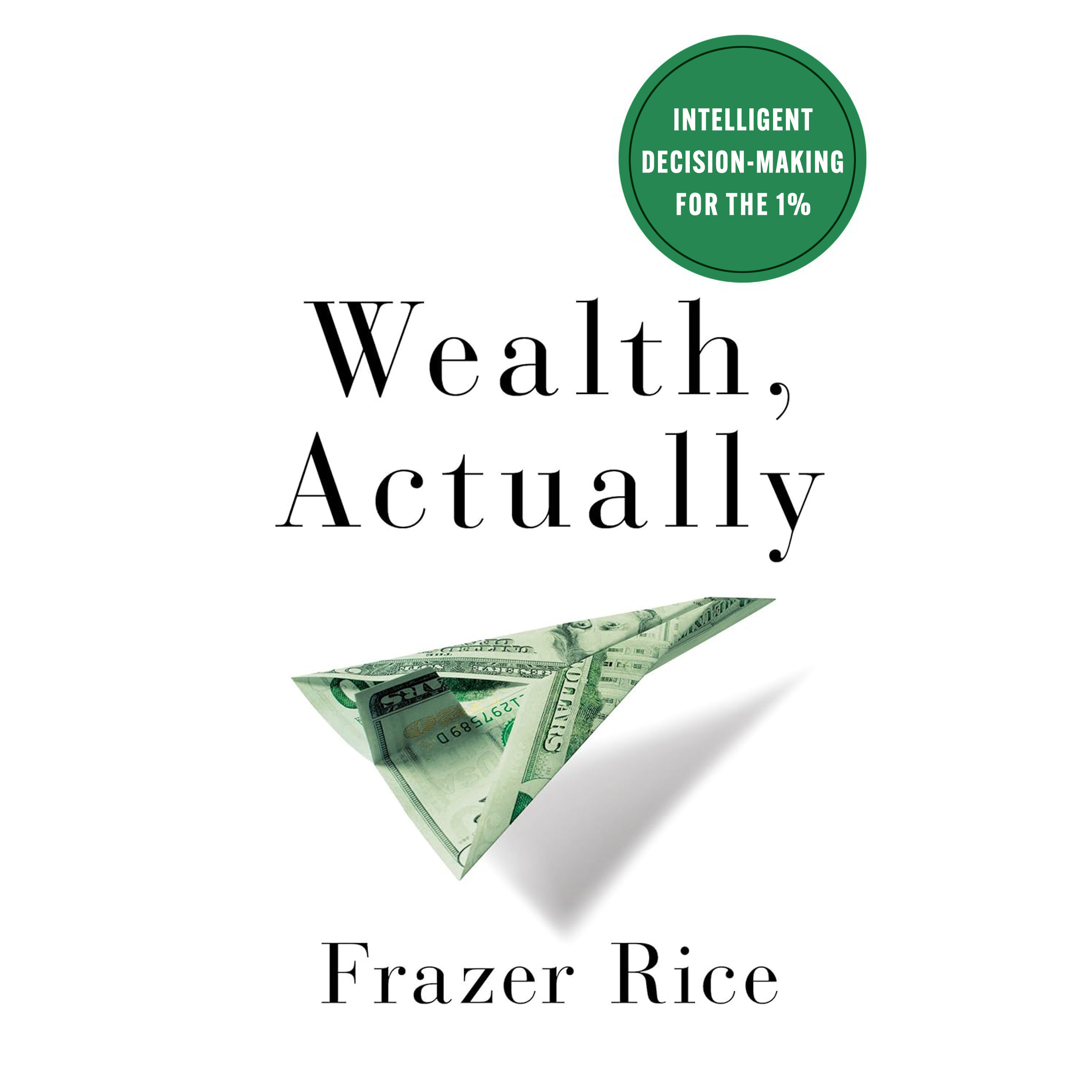
Wealth Actually
Frazer Rice
Covering the issues that affect business, entrepreneurship, wealth, trusteeship and culture.
Episodes
Mentioned books

Aug 24, 2018 • 56min
Frazer Rice, Author of “Wealth, Actually”, on the Josh Jalinski Financial Quarterback show.
Here is something that is a little bit new! I was interviewed on my new book “Wealth, Actually by Josh Jalinksi on his Financial Quarterback show on 710 WOR ad on #iheartradio. We discussed estate planning, family dynamics, investing and a host of tools that could helpful in making good decisions about wealth. Thanks again, Josh!
To buy “WEALTH, ACTUALLY” on AMAZON, click BELOW . . . Feel free to leave Amazon Reviews (hopefully good ones!). They help the algorithm.
https://www.amazon.com/Wealth-Actually-Intelligent-Decision-Making-1-ebook/dp/B07FPQJJQT
Jul 22, 2018 • 27min
Ben Phillips, Chief Investment Officer of Eventshares
With the 2018 midterm elections around the corner, I spoke with Ben Phillips about the impact of policy on the investment world.
Ben Phillips serves as the CIO of EventShares, overseeing research and portfolio management for the U.S. Policy Alpha ETF (PLCY). Mr. Phillips previously worked for Goldman Sachs Asset Management, where he had portfolio management responsibilities across several multi-sector total return funds. Prior to GSAM, he held senior investing roles at Providence Equity Partners and Lord Abbett. Mr. Phillips is a CFA charterholder and received an MBA and BSBA in Finance from the University of Missouri. Mr. Phillips works in the firm’s New York office.
Background:
How do you think about investing at Eventshares? (What is the effect of Policy on the markets)
Government affects everything. How do you break this down and organize your thinking?
Once your themes are established how do you implement your findings into good investment ideas?
Onto the 2018-2019 political environment:
First, what do we make of the general political environment and the effect of Trump?
Second, what is the current thinking on the midterms?
Onto the specific policy themes that affect investments:
Policy themes outlined by Ben:
Trade:Â “Trade continues to be the biggest potential headwind to the market. We expect headline volatility to linger, as markets attempt to decipher if Trump is bluffing on tariffs. While negotiations play out, we prefer to hold U.S. focused companies with minimal foreign currency exposure.”
Immigration:Â “Border arrests trended down in 2017 after Trump assumed office pledging an immigration crackdown. However, 2018 border arrests are increasing as the administration doubles down on its agenda and strengthens border enforcement. We expect this to impact U.S.-Mexico relations and be a defining issue in the midterm elections.”
Trucking:Â “Electronic logging devices (ELDs) continue to be implemented, which we believe will slow trucker productivity. In our view, ELDs are compounding a driver shortage, which will force trucking companies to increase compensation and turn down freight. We prefer to own asset-light companies with exposure to the spot freight market, as well as companies involved in the intermodal and rail markets.”
Defense:Â “The FY 2019 appropriations process is underway in Washington D.C. We continue to expect companies involved in the defense industry to grow their revenues over the upcoming years due to the long lead time of defense contracts and the added tailwind from foreign demand. In our view, aircraft manufacturers and shipbuilders are best positioned to benefit from increased spending.”
Refining Spreads:Â “The U.S. energy boom continues to redefine the energy market. Drilling companies in the Permian Basin are extracting record amounts of oil, but pipeline capacity issues mean not all of it is moving out of the area. Trucking shortages (see above) are exacerbating the issue, causing some drillers to sell at the local Midland spot price to refining companies. The refining companies may then be able to capture the spread by selling the oil at WTI or Brent benchmark prices.”
Financial Deregulation:Â “The Trump administration continues to focus efforts on dismantling the Consumer Financial Protection Bureau (CFPB), which is responsible for consumer protection in the financial sector. In our view, this will continue to benefit specialty finance companies, non-traditional lenders, and select regional banks.”
Healthcare:
“The Affordable Care Act (ACA) continues to be a long-tail policy. After years of fighting the ACA, Republicans appear slightly more willing to expand Medicaid and Medicare, but only under their terms. While risk reduction payments were recently in the headlines after a New Mexico court ruling, we don’t believe they will be stopped under the ACA. In our view, these two items will help stabilize the insurance exchanges and insurer business models.”
“The Trump administration also released its drug pricing plan during Q2 2018. In our view, the plan does little to impact drug prices or pharmaceutical company business models.”
Midterm Volatility: “Campaign season will kick into high gear during Q3 2018. We expect the political environment to be highly charged. In our view, it’s too early to call midterms as control over the recent Supreme Court vacancy and immigration will be contentious items. Plus, Donald Trump is a master campaigner who gets his base.”
Following up with Ben:
How can we keep track of your policy thoughts and their impact on the markets:
WWW.EVENTSHARES.COM
How do we find out more about Eventshares?
How do we keep track of your writings?
***This podcast is a educational discussion about the impacts of governmental policy on investments. It is neither an advertisement, nor an endorsement for Eventshares.***
Apr 23, 2018 • 37min
Bill Yoh, Family Business Expert and Author of “Our Way”
In Podcast #25, I was able to speak with Bill Yoh, the author of “OUR WAY”.
https://www.amazon.com/Our-Way-Life-Story-Spike-ebook/dp/B0786QGZ6K/
In the book, Bill tells the story of Spike Yoh, the driving force behind Day & Zimmermann with un-sugarcoated candor. An embattled son becomes a patriarch. An untested employee becomes a CEO. A husband becomes a caregiver. A student becomes a teacher, and ultimately a student. Spike Yoh’s life story paints a vivid picture of the profound and very human forces that shape leadership. From a troubled childhood that would have propelled most into a cycle of broken relationships and self-doubt, he rewrote the rules of his own life, and in the process built his father’s company into a billion-dollar enterprise.
Author, Bill Yoh serves as a speaker, biographer and strategist, helping other family business owners navigate the opportunities and challenges that inevitably arise when personal and professional lives intersect. As a third-generation owner of Day & Zimmermann, his family’s 43,000-employee, century-old family business, Bill has a rare and personal view of the complex and human dynamics behind today’s multi-generational family businesses.
INTRO
Background:
Tell us a little bit about your background
How did your career evolve?
How did writing become a part of it?
How did the story and the principles of Spike Yoh become a focus?
Day and Zimmerman
Tell us a little about where Day & Zimmermann came from and what they do
Recount some of the fulcrum moments of Spike’s leadership
Importance of the motto
Difficulties that were surmounted
Successes celebrated
Involvement with the community (and family) and its importance to corporate mission
How did Spike first begin to involve the family in the decision-making around the family and the wealth?
What worked and what didn’t?
What moments in his life may have informed some of the choices made?
Process of succession of the business
Operational Succession v. Ownership succession
How was the future management of the business chosen?
Tradition v. Qualification? Inside v. outside?
Tenure v. new blood?
Direction- growth v. income? Focus v. Diversification?
Public v. Private?
How were family members chosen within that context?
Aptitude, Ability, Interest, Capacity, Temperament
Stories around successes and issues here
How was ownership succession chosen? Every one equal or each according to need, none of the above? Was there structure around the wealth to try to prevent bad habits/encourage good ones?
How did you surround yourself with advice around that? You obviously had formal advice (legal, banking, accounting etc . . .). But did you have a shadow cabinet or a set of like-minded executives with similar experiences that you could lean on for their advice? How was the board involved?
Was philanthropy part of the equation?
How were decisions made within the family? How was the process of socialization/buy-in?
Other shareholders?
How were the other stakeholders incorporated in the decision-making? (employees, customers, vendors, community)?
Familytics
What are the issues you see with families with succession issues
What are best practices that you have seen with your family and others that can apply?
What are the various tools and communication practices that can be useful in helping families on that journey?
How does FAMILYTICS work?
Contact
How can we get a hold of “Our Way”?
AMAZON
How do we find out more about Familytics
FAMILYTICS
How do we keep track of your whereabouts?
BILL YOH, AUTHOR
OUTRO-
https://www.amazon.com/Wealth-Actually-Intelligent-Decision-Making-1-ebook/dp/B07FPQJJQT/
Mar 19, 2018 • 31min
Podcast #24: Leslie Danks Burke, Founder and President of Trailblazers PAC
Today we were able to speak with Leslie Danks Burke.
She is a public advocate and the Founder and President of TRAILBLAZERS PAC : a political action committee dedicated to finding and supporting candidates for local political office beyond typical party ideology and structure.
Based in Horseheads, NY, Leslie’s goal is to improve the quality of candidates and the political discourse in this country, one municipality at a time.
Their mission statement states: “Trailblazers PAC reconnects citizens with democracy by moving politics out of the back room and onto the front porch. We educate candidates on building an honest donor relationship with their own voters. We invest in candidates for local office who take action for clean government.”
She is here to help us
make sense of the current political environment,
its impact on the current political apparatus, and
the direction of grass root campaigns going forward
QUESTIONS
Background
Where are you located?
Work Background
Interest in politics
Frustrations with the System
Consensus between parties being thwarted
Quality candidates scared off by a poor process
Lack of new ideas / good ideas thwarted
Entrenched interests
Impact of money
Issues
The Impact of Trump on the Political Industrial Complex
Big gov’t v. small gov’t
Changes in the media and distortions in “story distribution”
Gerrymandering / obstructionist voting laws and other distortions
Lobbying interests
Schisms in voters along income, education and cultural fault lines
The pull of better economics (and weather!) in other states
How do you establish consensus-common ground
The Opportunities for Positive Change
What does Trailblazers seek to do?
What type of races are interesting
What geography?
Is there an ideology?
Improving candidate quality/interparty dialogue?
Predictions for the future
How do we keep track of your progress?
TRAILBLAZERSPAC.COM
FACEBOOK.COM/TRAILBLAZERSPAC
@TRAILBLAZERSPAC
@LDANKSBURKE
https://www.amazon.com/Wealth-Actually-Intelligent-Decision-Making-1-ebook/dp/B07FPQJJQT/
Feb 27, 2018 • 28min
Eiland Glover, CEO and Co-Founder of Cryptocurrency Innovator, Kowala
On Podcast #23, we have Eiland Glover, founder of Kowala.
He helps us sort through the cryptocurrency noise, sets out the problems to be solved, and challenges us to think about cryptocurrencies in the future.
Eiland Glover is the CEO and Cofounder of KOWALA, creator of the world’s first autonomously stabilizing cryptocurrency: kUSD. Eiland has spent his career creating systems and companies at the intersection of finance, technology, education, game theory, and human psychology. He is a firm believer that new technologies must be consciously designed and utilized to empower humans. In 2012, Eiland learned about Bitcoin and wondered why this amazing technology had not become ubiquitous. He co-created Kowala based on his belief that a decentralized stable coin is necessary for the mainstream adoption of cryptocurrencies.
As a lead up to our discussion, we referred to broader issues that affect cryptocurrencies:
Outgrowth of the use of blockchain to add integrity in peer to peer transfers of digital information (and, more specifically, value)
That has led to the development of cryptocurrencies which have exploded in popularity in recent years most acutely in the last year.
Bitcoin, Ether, Dash, Ripple and many others have stormed the headlines as the curious have sought ways build on the promise of crypto currencies (and maybe get rich quick as well!)
However as we have seen in recent weeks, volatility, hacking and generally uncertainty have become a bigger part of the crypto currency picture
KOWALA’S kUSD VIDEO PREVIEW
https://player.vimeo.com/video/252176369
QUESTIONS
Eiland’s background and how he got interested in the space.
A quick history of cryptocurrencies and their function and how we got to this point.
Bitcoin, et al- how did we go from intellectual exercise to solve integrity issues in peer to peer information transfer to intangible value transfer?
Obstacles of mass adoption of cryptocurrency
What does the business person who would like to embrace cryptocurrecy as a method of payment need to be worried about?
What does the casual cryptocurrency investor need to be worried about?
What does the consumer who would like to pay in cryptocurrency need to worry about? (wait for?)
Stable coin – its vital role in next phase of development in blockchain and cryptocurrency sector
Speed of transfer- How do you get the distributed ledger participants to ratify block transactions faster so that commerce can flow more smoothly?
Security of coin storage and value transfer- how does one minimize hacking, theft, double counting, broken hard-drives, lost passwords etc . . .
Non-volatile store of wealth? What is the value in being pegged to a country-backed currency? Why not just be in the currency itself?
Will countries cut out the middle man? And employ crypto currency features in their own currencies? Would that work?
Tipping point for adoption: will it be when it is common place to buy real estate with it? Candy bars? Used as wages?
– Different stable coins models, other coins compare to Kowala
Which ones are out there? What makes them good or bad?
Digital coins melded to different state-backed currency?
What happens if the USD goes haywire? Can that be a source of volatility?
How do miners help kUSD? As important parts of the blockchain ratification process, how do you keep them happy?
-How do we stay in touch with you, KOWALA, and kUSD?
(THERE IS NO INVESTMENT ADVICE IN THIS PODCAST OR POST)
https://www.amazon.com/Wealth-Actually-Intelligent-Decision-Making-1-ebook/dp/B07FPQJJQT/
Jan 22, 2018 • 43min
Wealth Novelist and WSJ Contributor, Norb Vonnegut
Podcast #22 features Norb Vonnegut, wealth management practitioner turned novelist and journalist at the Wall Street Journal. Besides talking finance and the future of wealth management, we talked a lot about his fiction writing. He is the author of three Wall Street thrillers:
The Trust
Top Producer
The Gods of Greenwich
He also works on non-fiction. As a contributing columnist for WSJ.com, Norb probes wealth management issues ranging from
Cybersecurity to
The gender pay gap among industry professionals to
The clash between Wall Street and Silicon Valley for market share of investment management.
Norb knows what he is talking about. He spent ten years in Private Wealth Management in New York City, where he developed an international practice with over $1 billion in assets under management.
QUESTIONS
Background
Norb, we both come from a wealth management background, but you have morphed into a formidable writer covering wealth management and other topics.
Take us through your background and how you got into the industry
How did you scratch the writing bug? Â What were your first experiences in getting published?
Fiction writing
– Your work centers around adventures of wealth managers that get in trouble around their rich clients
Take us through your process in structuring plot and developing your characters?
What is it like to come from an industry and dealing with an editor and customs of the publishing industry?
What was it like to get your first edits and comments from your editor?
Your attention to the details of the industry reminds me of John Grisham or Tom Clancy. How do you research the ins and outs of the wealth details that make your novels vivid and ring true?
What are your plans for the series? Could this be the cornerstone of a movie or TV series?
Non-Fiction
You write a robust wealth management column for the WSJ- what is the process and timing for articles?
How do you and the paper decide what is newsworthy and how does that square with what is intellectually interesting to you? Or what might be a niche issue but could have significant impact?
Any plans for collecting your experiences/research for the broader reader?
Trends in Wealth Management
You must talk to a lot of professionals, clients and commentators- what are the broad trends that the industry is struggling to solve
Evolving business models
Justification for fees / compression issues
Next-Gen
Robo-Advice
Fiduciary roles
Technology
Information asymmetry/synthesis
Active v. Passive (Commoditization of investment management advice)
Impact Investing
Regulation
Demographic shifts (aging advisor population)
Destruction of free agency (Dismantling of Protocol, who owns the client, does this affect advice?)
Others
How do we stay in touch with you and how do we find/buy your work?
WWW.NORBVONNEGUT.COM
https://www.amazon.com/Wealth-Actually-Intelligent-Decision-Making-1-ebook/dp/B07FPQJJQT/
Nov 24, 2017 • 34min
Podcast #21: Blockchain and Bitcoin VC Investor, Bart Stephens
Podcast #21 features a fascinating conversation with Bart Stephens on the emergence of Bitcoin and blockchain.
Bart is the Co-founder and Managing Partner of BLOCKCHAIN CAPITAL, the first VC firm to raise a venture fund through an ICO, and the most active VC investor in the sector, with 72 portfolio companies across three funds. Bart is also a Managing Partner and Co-Founder of Stephens Investment Management, a family owned and operated hedge fund and venture capital firm. Bart has a background of 20 years as both an operating entrepreneur and a venture capitalist. Bart earned a B.A. in Political Science from Princeton University.
We touch on a host of issues as I try to better understand the blockchain, its application to Bitcoin and its impact on industry in general. Interesting stuff as we try to peer into the future.
INTRO-
QUESTIONS-
– Bart, you have a diverse background
You started out at E-Trade and come from a deep background of operating and investing in technology based venture capital.
What lessons did you pick up from your early experiences?
– Now onto the blockchain is a continuously growing list of records, called blocks, which are linked and secured using cryptography.
– The term usually is the second word mentioned after hearing Bitcoin and Etherium and other digital currencies that have become popular in the last 5+ years.
– But it’s the blockchain system of recording and verifying transactions and data that seems to be the exciting game-changer across many industries.
– Bart, perhaps a brief rundown of understanding what the blockchain is and how it works
Help us understand the problem that blockchain helps to solve.
From a 30,000 foot view, “How does it work?
What are the terms we need to be familiar with?
What is the benefit of block chain’s decentralization and affirmation of data by consensus?
How does that disintermediate current manual processes and improve security over the system
Public blockchain systems vs. private systems- can you make money on the public systems or is it the private systems where you have to play?
What will Blockchain impact?
What is the general bottleneck or way of doing things that the blockchain fixes or makes more efficient?
Benefits for recording of events,
Helping with medical records,
Helping with identity management,
Helping with transaction processing
Improvements for provenance or basis tracking
Other examples?
Back to the currencies- where do you see the potential for Bitcoin, etherium and other ICO’s?
Jamie Dimon’s comment
Banking in underserved markets
More frictionless and cheaper e-commerce transactions
Impact on Western Union and traditional banks?
Conflict with money laundering, banking secrecy laws?
Where are blockchain advancements really going to affect financial institutions?
Where are the opportunities?
Describe some of the themes and businesses that are interesting
What are the dangers?
What seems like a fad or a business theme that is going in the wrong direction?
Is there a risk that computational power can’t keep up with the explosion of data?
Without centralized records, is that a problem?
What if we get an EMP?
What is the best way to follow the development of blockchain?
How do we stay in touch with you?
www.blockchain.capital
@pbartstephens
@blockchaincap
OUTRO
https://www.amazon.com/Wealth-Actually-Intelligent-Decision-Making-1-ebook/dp/B07FPQJJQT/
Aug 21, 2017 • 30min
Nickerson PR Technologist and Virtual Reality Expert, Matthew Cooney
I recently spoke to Matt Cooney at NICKERSON PR about the development of Virtual and Augmented Reality. We charted the differences and Matt made predictions about the future of this technology on a variety of industries and businesses including real estate. This is fascinating stuff and vital as we try to understand where the trends in economic growth and employment are going.
Forming and engaging communities has been the common thread in Matthew Cooney’s career path. He has built and scaled social media communities for organizations including the Picower Institute for Learning and Memory at M.I.T., iRobot, and Monster. Prior to joining NICKERSON, an award-winning full service marketing and communications agency, as Director of Social Media and Emerging Technologies, he served as a subject matter expert on virtual reality technology at Dell EMC.
Today, he works at the intersection of real estate and emerging technologies, witnessing firsthand how virtual and augmented reality technologies are disrupting social media and the way we live and interact in both the real and digital worlds.
Samantha Wolfe provides quick definition of Virtual and Augmented Reality HERE and a list of the typical tools and interface points HERE
QUESTIONS
– How did you get started in the technology space?
– VR versus AR: what they are/what’s the difference?
– What are practical applications for both?
– How are they being used? Entertainment, Education, Enhancement
-How can these technological concepts be developed?
-Who are the major players?
-Where are the hotbeds of innovation?
-What are the hurdles to adoption?
-Technological limitations?
-Ethical concerns?
-Are there multiple approaches to the same problem?
-What are the security concerns?
-How does this intersect with the major leaps made recently with Artificial Intelligence? Big Data?
-How does this intersect with the advances made in robotics and exoskeleton/cybernetic technology?
-What does the future hold, both near term and within the next five years, and beyond?
-What is exciting in space?
-What is worrisome?
-What industries are are in the crosshairs?
-What will the impact be on social media?
-Specifically, how we consume and share content, and congregate and interact online?
-How do we keep up to date on NICKERSON and what you are working on?
https://www.amazon.com/Wealth-Actually-Intelligent-Decision-Making-1-ebook/dp/B07FPQJJQT/
Aug 13, 2017 • 31min
Founder of Phace Bioactive, Marisa Arredondo
It is impossible to come away from a conversation with Marisa Arredondo and not be impressed. She is the founder of skincare and lifestyle brand PHACE BIOACTIVE.
After graduating from Stanford University, Marisa worked as an analyst on Wall Street for 12 years to research and invest in cosmetic, drug and biotech companies. There, she learned about skin biology, ingredient technology, and pH balance as it relates to anti-aging. She also graduated from Harvard Business School, where she conceived the business plan for PHACE BIOACTIVE.
You can also check out the brand here: PHACE INSTAGRAM and PHACE FACEBOOK
We touch on a host of topics:
The joys and hardships of entrepreneurship,
When she knew she was ready to give it a go,
The evolution of the business past the startup stage,
The evolution of the brand and using her unique experience to drive the story of the company
Learning how to manage people and processes and when and how to delegate
Getting ones arms around the marketing strategy and the importance of social media and TV.
QUESTIONS
Describe your how you discovered and developed your product-
What need did you see that needed to be filled?
How did your personal experience allow you to see this?
At what point did you see the competition and decide- I have something that’s different and better?
How did you know it was time to take the plunge?
In brushing up on Phace Bioactive, you are involved in every aspect of the company. It’s rare that a person is a good at one or two things, but you seem to be on top of the science, finance, marketing, distribution and many other facets of the company. How did your background inform these different areas of expertise?
When do you decide that it’s time to bring in other experts and delegate?
Once you felt like you had the product right, how did you think about your marketing plan?
Once you have the formula right, how do you make sure it’s manufactured consistently?
You had a great run on QVC where you presented extremely well- how did you get involved with them?
What made them attractive?
How did you prepare for that experience?
How do you know when you have good advisors around you?
How do you select them?
Who has been helpful in mentoring you as you reach various stages of business development?
How has the advice changed since you have gone from planning to liftoff to growth?
As an entrepreneur, what was the thing or things that you ended up being the least prepared for?
Or what was your biggest surprise?
What were you most prepared for?
How has your experience changed as you begin to manage more people?
What are the plans for Phace Bioactive’s future- where do you see your next avenues for growth?
I notice on the site that you have a section that deals with lifestyle branding around the product. Â How does that relate to your future plans?
What is the best way to find PHACE BIOACTIVE?
https://www.amazon.com/Wealth-Actually-Intelligent-Decision-Making-1-ebook/dp/B07FPQJJQT/
Aug 7, 2017 • 20min
Hedge Fund Manager and “Betting On Zero” Producer, John Fichthorn
Podcast #18 gives us a chance to speak with hedge fund manager and documentary producer, John Fichthorn, about his documentary, “Betting on Zero”. John co-founded Dialectic Capital Management, LLC in 2003 and serves as its Portfolio Manager.
“Betting on Zero” offers an inside look at the controversy behind multi-level marketing companies and the gamesmanship that occurs on Wall Street. The documentary follows Bill Ackman, principal of Pershing Square, and the impact on Herbalife after Ackman makes a billion dollar bet against the company. The film documents the short position and the conflict it causes between Ackman, Herbalife CEO Michael Johnson and Wall Street titan, Carl Icahn. BOZ also follows the stories of former distributors and employees of Herbalife and provides examples of the controversial impacts Herbalife has had on the communities it serves. The film is available on iTunes, Google Play and Netflix.
We cover a lot in a short amount of time including what made the story interesting for John and how he and director, Ted Braun, were able to get the amazing access.  Finally, we hear about the business (or lack thereof) of documentaries and some of John’s future plans.
[*THERE IS NO INVESTMENT ADVICE IN THE PODCAST]
QUESTIONS
Bill Ackman is a huge figure in the shadowy world of hedge funds and his flirtation with Herbalife has become the stuff of legends.
How did you become interested in the man and this particular trade?
Why was it important to produce a documentary on the subject?
You have a pretty high stress day job . . . How did you become involved with the project?
How was the team assembled? How was the director, Ted Braun, chosen and who were the other driving factors behind the project?
The film ultimately comes down to two strong-minded characters, Michael Johnson, then CEO of Herbalife, who believes in the promise and growth of Herbalife, and Bill Ackman who has bet a substantial amount of money that company will fail.
In short strokes, take us through why there is such a divergence of opinion as to whether Herbalife is thriving business or a recipe for failure.
The film takes great pains to present the various impacts that Herbalife has on its employees, customers and investors.
How were these constituencies assembled?
In a world of regulations, compliance and other red-tape snarls, I was stunned that Johnson and Ackman provided as much access as the did.
How did you get these two figure heads to agree to appear?
How did you get them comfortable with the idea of a documentary?
One of the key subplots, is there emergence of Carl Ichan, another famous financier, who emerges later in the process and seems to relish, not only profiting on the other side of the Ackman trade, but in embarrassing him as well.
How much of that goes on in finance? When the investments become emotional/personal?
When does it become a bet more than an investment?
Since the film was released, Michael Johnson has left Herbalife.
Governmental investigations haven’t yielded any particular smoking guns.
Without having to get too specific, what are the implications of these events?
What do you see going forward?
The film has a had a nice reception at the Southampton and Tribeca Film festivals.
And it’s now on Netflix . . . What is the plan for the documentary now?
I was part of a low-budget horror movie and I learned first-hand that movie-making isn’t for sissies.
Now that you have one under your belt, has it become an addiction?
Are there any other stories that you would like to see told?
What is the best way for people to see Betting on Zero?
[*THERE IS NO INVESTMENT ADVICE IN THE PODCAST]
https://www.amazon.com/Wealth-Actually-Intelligent-Decision-Making-1-ebook/dp/B07FPQJJQT/

