

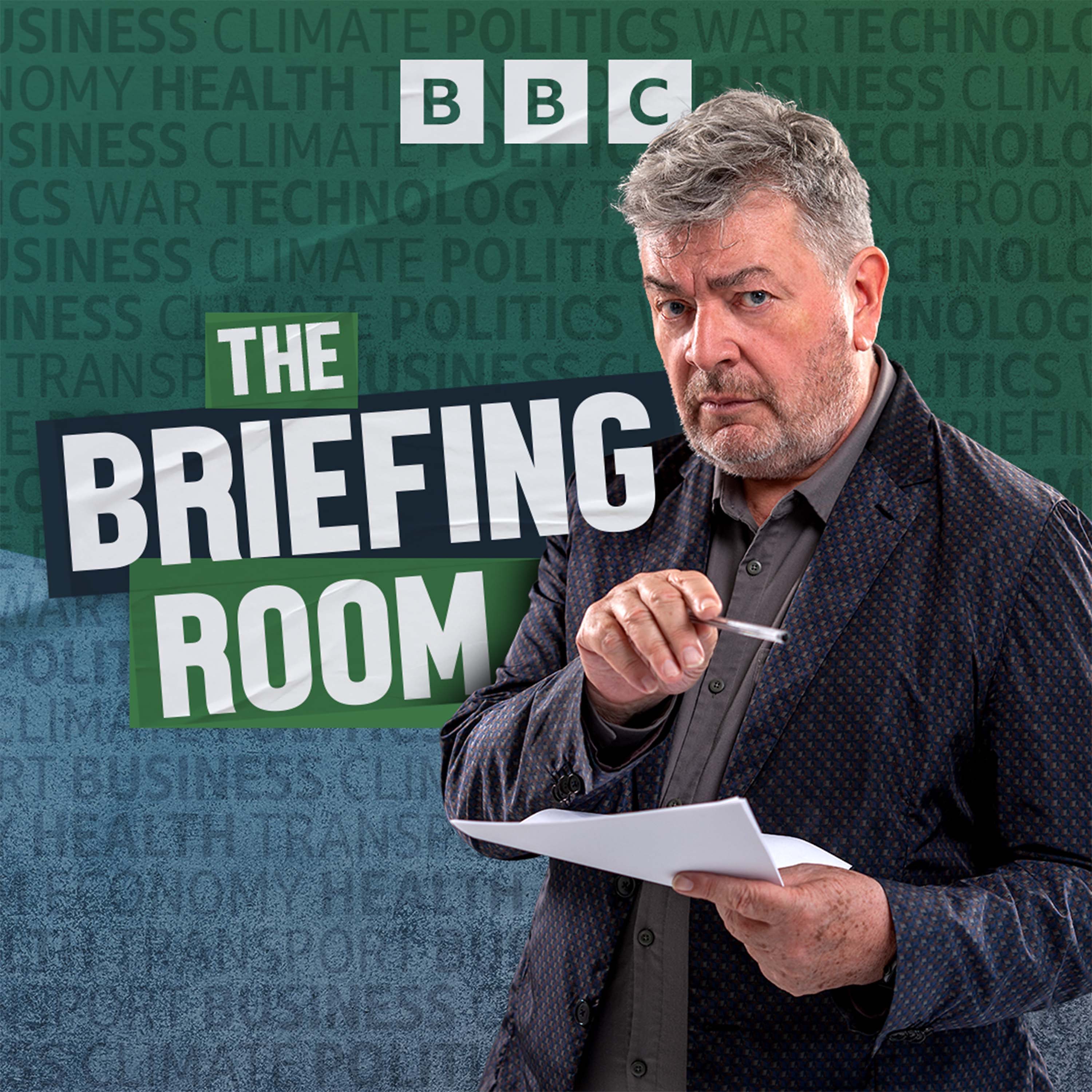
The Briefing Room
BBC Radio 4
David Aaronovitch and a panel of experts and insiders present in-depth explainers on big issues in the news
Episodes
Mentioned books

Dec 18, 2025 • 29min
Should we worry about America’s security strategy?
As both the year and the current series of The Briefing Room draw to a close, Europe and much of the world have been digesting a lengthy document outlining the Trump administration’s view of foreign policy. The National Security Strategy covers much of the globe but extra special vitriol was reserved for Europe with dire warnings that the continent is facing “civilisational erasure” partly due to immigration. At the same time the growing influence of “patriotic European parties” (those on the far right) is welcomed. But there’s more - the US wants to dominate the “Western Hemisphere” - the Americas and countries on its doorstep. It wants more trade with Asia and China, as well as the Middle East. But there are notable absences -there's no talk of a significant threat from either Russia or China. David Aaronovitch and guests discuss what all this means and ask how worried we, in Europe, should be about the current US view of the world?Guests:
Frank Gardner, BBC Security Correspondent
Shashank Joshi, Defence Editor, The Economist
Rebecca Lissner, Senior fellow for U.S. foreign policy at the Council on Foreign Relations and lecturer, Jackson School of Global Affair, Yale University.
Dr Christoph Heusgen, Former Chairman Munich Security Conference and former German Ambassador to United NationsPresenter: David Aaronovitch
Producers: Caroline Bayley, Kirsteen Knight, Cordelia Hemming
Production Co-ordinator: Maria Ogundele
Sound engineer: Neil Churchill
Editor Richard Vadon
Dec 11, 2025 • 29min
Why are early career doctors angry?
In a few days time resident doctors -who used to be known as junior doctors - will go on strike. Just before Christmas and with flu on the rise. This will be the 14th strike by the doctors’ union since March 2023. The ostensible reason is pay but coming up behind it as an issue for younger doctors is the question of their futures- they're very unhappy about their working conditions and their career paths. David Aaronovitch and guests discuss what's going on and ask what the problem is with the way we in Britain train our doctors?Guests:
Hugh Pym, BBC Health Editor
Sir Andrew Goddard, Consultant Gastroenterologist
Professor Martin McKee, Professor of European Public Health, London School of Hygiene and Tropical Medicine
Mark Dayan, Policy Analyst, Nuffield Trust.Presenter: David Aaronovitch
Producers: Caroline Bayley, Kirsteen Knight, Cordelia Hemming
Production Co-ordinator: Maria Ogundele
Sound Engineers: Michael Regaard, Gareth Jones
Editor: Richard Vadon
Dec 4, 2025 • 29min
Are the old robbing the young?
Join Sophie Hale, a Principal Economist at the Resolution Foundation, along with Professor Bobby Duffy from King’s College London, Senior Research Economist Xiaowei Xu, and Professor Jane Falkingham from the University of Southampton. They dive into the generational divide, revealing how baby boomers benefited from post-war assets while Gen X and millennials grapple with stagnant wages and housing crises. The guests also discuss public perceptions of intergenerational inequality, wealth concentration, and propose solutions like housing reforms and 'citizen's inheritances' to bridge the gap.
10 snips
Nov 27, 2025 • 28min
What's happening with the Ukraine peace plan?
Angela Stent, a former U.S. National Intelligence Officer for Russia, discusses the origins and implications of a controversial leaked peace plan for Ukraine. Sir Lawrence Freedman, a war studies expert, analyzes the strategic challenges Europe faces in countering the U.S. draft. Christopher Miller, a Kyiv correspondent, sheds light on Ukrainian perspectives of the war's toll and domestic politics. Sir Laurie Bristow, a former UK ambassador, emphasizes Europe's existential concerns and the long-term implications of the war.
Nov 20, 2025 • 28min
What can the UK learn from the rest of Europe about asylum reform?
Dr. Madeleine Sumption, an immigration policy expert at Oxford, discusses the UK’s tough new asylum proposals aimed at reducing appeal. Professor Andrew Geddes sheds light on Italy's crackdown on smugglers and issues with processing hubs. Susi Dennison evaluates Denmark's stringent asylum model, highlighting its drastic decrease in applications. The guests analyze the implications of these trends across Europe, focusing on returns, legal challenges, and the tensions surrounding the ECHR, revealing complex impacts on asylum seekers.
13 snips
Nov 13, 2025 • 29min
Why does the UK have a problem with productivity?
Chris Giles, an economics commentator at the Financial Times, sheds light on productivity measurement. Helen Miller from the Institute for Fiscal Studies reveals how underinvestment and historical shocks impact growth. Duncan Weldon, an economist, discusses the long-term effects of crises and the potential of AI in productivity, while Greg Thwaites from the Resolution Foundation highlights regional disparities and the need for innovative firms to thrive. Together, they explore ways to revitalize the UK's productivity landscape.
10 snips
Nov 6, 2025 • 28min
What's happening in Venezuela?
Join BBC correspondent Will Grant, an expert on Central America, and Jeremy McDermott, co-founder of InSight Crime, as they dive into Venezuela's tumultuous landscape. They discuss the U.S. military buildup in the Caribbean, the implications of a regime change strategy, and how Maduro's government responds to increasing pressures. Dr. Christopher Sabatini and Dr. Annette Idler add insights on the geopolitical motives behind U.S. actions and the complexities of narco-terrorism. Will Venezuela face instability, or will calm prevail in this charged scenario?
Oct 30, 2025 • 29min
How should we handle historic public inquiries?
When a disaster or serious event happens, such as the Grenfell Tower fire, the Manchester Arena terrorist attack or the Covid pandemic, you can be pretty sure that a public inquiry will follow. They’re popular with the public as a means of investigating serious state failure. And for Governments they can be a good way of kicking a difficult issue into the long grass, as usually by the time the inquiry is finished a different set of politicians will have to deal with the report.There are currently 25 public inquiries in progress in the UK today - the most ever, with six announced so far this year. They range from one into Scottish child abuse, which is the longest current inquiry, to another into a police restraint death which has just lost its chair and the lawyers working for the inquiry, to Covid 19 - the largest currently underway. And which by the end of June this year had cost 177 million pounds. David Aaronovitch and guests discuss how these public inquiries work, what they achieve and who, if anyone, benefits from them?Guests:Judith Moritz: BBC Special Correspondent
Deborah Coles, Executive Director, INQUEST
Emma Norris, Director of Policy and Politics at IPPR think tank,
Professor Lucy Easthope, emergency planner and responder and visiting Professor at the Centre for Death and Society, University of Bath. Presenter: David Aaronovitch
Producers: Caroline Bayley, Kirsteen Knight, Cordelia Hemming.
Sound engineer: Duncan Hannant
Editor: Richard Vadon.
Oct 23, 2025 • 44min
Is there a crash coming?
Some of the biggest figures in finance, from the CEO of JPMorganChase to the Governor of the Bank of England, have been warning of potential shocks to the global economy. As excitement continues to build about the transformative potential of Artificial Intelligence, the US stock market has boomed, potentially forming a fragile bubble. Meanwhile, recent bankruptcies in America have raised worries that a rapid growth in lending by private companies (so-called shadow banks) might be built on shaky ground - and have invoked memories of the subprime mortgage debacle that kicked off the Great Financial Crisis in 2007. And if that wasn’t enough, the threat that Donald Trump might reignite his tariff-driven trade war still looms over the global economy.So how worried should we be? David Aaronovitch speaks to the top experts to find out.Guests:
Katie Martin, markets columnist at the Financial Times
Duncan Weldon, economist and author of Blood and Treasure
Simon French, Chief Economist and Head of Research at investment company Panmure LiberumPresenter: David Aaronovitch
Producers: Nathan Gower, Kirsteen Knight
Editor: Richard Vadon
Programme Coordinator: Maria Ogundele
Sound Engineer: Duncan Hannant
4 snips
Oct 20, 2025 • 29min
Is the UK in a data crisis?
As Rachel Reeves approaches a tricky budget, her job has got that much harder. Some of our most fundamental economic data, statistics that policymakers are used to accepting at face value, suddenly have major question marks over their accuracy.The UK’s top stats agency, the Office for National Statistics, finds itself under considerable pressure as falling response rates to its surveys leave politicians flying blind.
David Aaronovitch asks what this means for government decisions and how the ONS can rebuild confidence in its most vital statistics.Guests:
Georgina Sturge, research affiliate at the Migration Observatory at the University of Oxford
Professor Denise Lievesley, former Principal of Green Templeton College, Oxford
Chris Giles, economics commentator at the Financial Times.
Peter Lynn, Professor of Survey Methodology at the University of EssexPresenter: David Aaronovitch
Production co-ordinator: Maria Ogundele
Producers: Nathan Gower, Kirsteen Knight, Cordelia Hemming
Studio engineer: Duncan Hannant
Editor: Richard Vadon

