

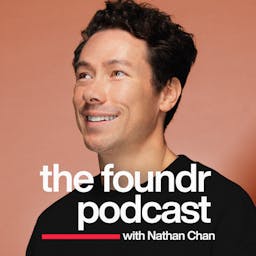
The Foundr Podcast with Nathan Chan
Foundr Media
Hear the stories, learn the proven methods, and accelerate your growth and future through entrepreneurship. Welcome to The Foundr Podcast with Nathan Chan.
About the show:
For over a decade, The Foundr Podcast with Nathan Chan has been a leading entrepreneurship podcast for open-book conversations with, by, and for founders. Whether you're starting, building, or dreaming about your business, The Foundr Podcast is where you can access experienced founders who've been in your shoes to learn their proven methods, lessons from failure, and inspirational stories.
Past guests include Emma Grede, Mark Cuban, Neil Patel, Kendra Scott, Alex Hormozi, Trinny Woodall, Tim Ferriss, Sophia Amoruso, Simon Sinek, Tony Robbins, Amy Porterfield, Ed Mylett, Michelle Zatlyn, Reid Hoffman, Scooter Braun, Dany Garcia, Marc Lore, Ariana Huffington, Pat Flynn, Lewis Howes, Jordan Harbinger, and many more.
About the host:
Nathan Chan is the CEO of Foundr and the creator of The Foundr Podcast. Chan literally started from knowing nothing. He was just an average guy working in a 9-5 job he utterly hated. He knew nothing about entrepreneurship, nothing about startups, nothing about marketing, and nothing about online or how to build a business. In the past decade, Chan's built Foundr into a global leader in entrepreneurial education, helping tens of thousands of aspiring entrepreneurs start and scale their businesses.
Need help with your business?
Visit foundr.com/foundrplustrial to join a global community of entrepreneurs, gain access to proven strategies, and fast-track your business growth confidently.
About the show:
For over a decade, The Foundr Podcast with Nathan Chan has been a leading entrepreneurship podcast for open-book conversations with, by, and for founders. Whether you're starting, building, or dreaming about your business, The Foundr Podcast is where you can access experienced founders who've been in your shoes to learn their proven methods, lessons from failure, and inspirational stories.
Past guests include Emma Grede, Mark Cuban, Neil Patel, Kendra Scott, Alex Hormozi, Trinny Woodall, Tim Ferriss, Sophia Amoruso, Simon Sinek, Tony Robbins, Amy Porterfield, Ed Mylett, Michelle Zatlyn, Reid Hoffman, Scooter Braun, Dany Garcia, Marc Lore, Ariana Huffington, Pat Flynn, Lewis Howes, Jordan Harbinger, and many more.
About the host:
Nathan Chan is the CEO of Foundr and the creator of The Foundr Podcast. Chan literally started from knowing nothing. He was just an average guy working in a 9-5 job he utterly hated. He knew nothing about entrepreneurship, nothing about startups, nothing about marketing, and nothing about online or how to build a business. In the past decade, Chan's built Foundr into a global leader in entrepreneurial education, helping tens of thousands of aspiring entrepreneurs start and scale their businesses.
Need help with your business?
Visit foundr.com/foundrplustrial to join a global community of entrepreneurs, gain access to proven strategies, and fast-track your business growth confidently.
Episodes
Mentioned books

Jun 4, 2019 • 49min
253: How Refinery29 Defied Critics and Became a Digital Media Pioneer, With Co-Founders Christene Barberich and Piera Gelardi
“I think about how little we knew, but how—I believe—how courageous we were,” says Christene Barberich, reflecting on the early days of Refinery29.Before she and co-founder Piera Gelardi were the women at the helm of one of the fastest-growing digital media companies in the world, they were new entrepreneurs working tirelessly on a vision (first sketched on a napkin) that outsiders failed to understand.The Refinery29 founding team formed in 2004, and in those early days (before Twitter had even launched), people struggled to grasp even the concept of digital media. The co-founders’ pitches were met with skepticism.“We would go talk to people, and they would act like we were trying to sell them a carpet or something,” Gelardi says. “They thought it was a scam.”Potential advertisers and brand partners also didn’t think customers would ever want to buy something online. “I just remember thinking, like, ‘I don’t think that’s true,’” Barberich says.That skepticism gave them an advantage, though: It gave Refinery29 the freedom to operate and experiment without the pressure of competition.Today, Refinery29 has an international audience of 550 million and has earned multiple distinctions, including Webby awards and Inc. 500 list mentions.Key Takeaways
How the two met and influenced each other’s decision to go all in on Refinery29
The early days at Refinery29 when wireframes were hand-drawn
The freedom of operating under the radar when digital media was still the Wild West
The critics who doubted the business model and thought it was a scam
What they lose sleep over
How they approach content creation
What they look for when hiring
The advice they would give to entrepreneurs who want to use content to grow their businesses
How they define quality content

Mar 26, 2019 • 46min
243: The 5 Traits That Help Founders Go From Dreamer to Doer, With Kim Perell of Amobee
When Kim Perell landed a job at a hot new internet startup in 1998, she thought she had hit the jackpot.She loved her job and learned a lot, but when the dot-com bubble burst, the startup went bankrupt. What was once a dream company that she recruited many friends to join had become a nightmare when she had to lay off those friends, and then lose her own job too.“In an instant, someone pushed delete on my life, and my future, my identity,” she says. “My multimillion-dollar stock went up in flames and was worth nothing.”Perell turned to the one person she thought might give her a loan to start over: her grandmother. And sure enough, even though Nanny didn’t know what the internet was, she loaned her granddaughter $10,000, which Perell spent on a computer, a GoDaddy account for a website, and a one-way ticket to Hawaii to live with her boyfriend rent-free.Perell launched Frontline Direct, a digital marketing company pairing brands with online advertising. Scarred from the bankruptcy, she was eager to work for herself and get back to basics, which meant focusing on profitability and growth. In 2008, Frontline Direct was acquired for $30 million, and again by Amobee, where Perell now serves as CEO.Through all the ups and downs, Perell has learned many lessons, which she passes on to fellow entrepreneurs in her latest book, The Execution Factor: The One Skill That Drives Success. After investing in over 70 startups, she noticed one thing stood out in particular for those who succeeded: they focused on execution more than anyone else did.For her, writing The Execution Factor was a way to pay it forward.“If I could shortcut the system and share, based on my own experiences, what is important as an entrepreneur, that was really meaningful to me,” Perell says. “And I just felt like my grandma made a bet on me, and I was going to pay that back.”In addition to the book, she established The Execution Factor Fund to provide seed stage funding to execution-driven startups. One hundred percent of the proceeds from her book are contributed to this fund.(And in case you were wondering: Perell paid back the loan to her grandma.)Key Takeaways
The rock bottom moment when the internet startup she worked for went bankrupt in the dot-com bubble burst
What she did with a $10,000 loan from her grandmother
Founding Frontline Direct, a digital marketing company, while living rent-free in Hawaii
Frontline Direct’s multimillion-dollar acquisition
Her new book, The Execution Factor
Why vision, though important, is not enough
The five traits you need to master execution
How to attract and retain great talent
What she looks for when investing in businesses
Thoughts on branding versus direct response
On if she felt a loss of identity after selling her business

Mar 5, 2019 • 53min
240: How to Use Excellent Customer Support to Stand Out in a Crowded Market, With Ross Paquette of Maropost
When Ross Andrew Paquette founded email service provider Maropost in 2011, he never expected it to take off.“The plan was to have 10 customers and maybe sit by the pool a little more often than not,” he says with a laugh.But since then, he’s scaled the company to nine figures, with an impressive customer list that includes DigitalMarketer, Livestrong, and The New York Post. And beyond email marketing, Maropost has expanded into customer acquisition and ecommerce solutions.These are extremely crowded markets, but at the core of the company’s success is its strong commitment to excellent customer service, with heavy emphasis on a 24-hour in-app live chat and five-minute support response times.We chatted with Paquette to learn the strategies he used to so impressively grow his SaaS company in a short amount of time.Key Takeaways
How Maropost got started
The crazy story behind how Paquette met his co-founder
How Maropost has expanded from email marketing to customer lead acquisition, mobile push notifications, CRM, and more
How long it took to build the first version of Maropost
What makes Maropost different from other ESPs
The strong customer support focus of the business
Why they focus on building a great organization, not just hitting numbers and growth
Where he sees the SaaS market moving in the future
Why he’s focused on building a legacy with his business
What exciting projects are in store for Maropost

Feb 25, 2019 • 43min
239: The Importance of Being Bold in Business, With Real Estate Mogul Dottie Herman
You don’t become the richest self-made woman in American real estate by playing it safe. Dottie Herman has proved time and time again that bold moves pay off.In the 1980s, in a maneuver that solidified her path to the top in real estate, Herman flew to California and convinced Merrill Lynch to hire her to help the company expand into the real estate market.In 1990, when Prudential decided to sell its regional holdings, Herman then persuaded the company to lend her $9 million to purchase its own Long Island real estate offices.And in 2003, Herman expanded her empire into New York City with the nearly $72 million purchase of the most prominent Manhattan real estate company, Douglas Elliman (again convincing Prudential to finance the deal).“If you don't ask, you don't know,” Herman says. “And the worst that can ever happen is someone says no.”Key Takeaways
How Dottie Herman got into real estate
Her bold move that convinced Prudential to lend her money to purchase one of its own companies
How she weathered a recession while running her business
The story behind acquiring Douglas Elliman, a prestigious real estate company in Manhattan
Why she wanted to expand her real estate empire into New York City
Her thoughts on branding
How she maintains a good working relationship with her employees
What she hopes to do next

Feb 12, 2019 • 54min
237: Find Your ‘Talk Trigger’ to Spark Powerful Word-of-Mouth, With Jay Baer of Convince & Convert
Jay Baer was born to be in business. As a seventh-generation entrepreneur, he always knew he’d start his own company one day.Over the years, his ventures have run the gamut—from an early internet company to a design firm to his popular marketing consulting firm, Convince & Convert. His clients have included Hilton, Cisco, Nike, and Oracle, just to name a few.And if that weren’t enough, Baer is a New York Times-bestselling author, with six books under his belt. His latest, Talk Triggers—co-authored by marketing expert Daniel Lemin—dives into the power of word-of-mouth marketing and how to use it in your own business.What is a talk trigger? According to Baer, it’s a “strategic, operational choice that creates conversations.”Take DoubleTree, for example. Their talk trigger is the warm chocolate chip cookie given to every guest who checks in. Baer and Lemin interviewed 1,000 DoubleTree customers for this book, and that’s just for one of the 30+ case studies you’ll find inside.If you want to acquire customers faster and cheaper, listen in as Jay Baer shares his marketing know-how to help you identify your business’s talk trigger.Key Takeaways
The origin story of Convince & Convert
How he came to work for an internet company before he even knew what the internet was
How he sold the Budweiser.com domain name to Anheuser-Busch for 50 cases of beer
His latest book, Talk Triggers, and why word-of-mouth marketing is so powerful
How to create a word-of-mouth strategy that will win over customers
DoubleTree’s genius strategy of giving a warm chocolate chip cookie for free to every guest (their talk trigger)
Why small businesses are perfectly primed for a talk trigger
UberConference’s on-hold music talk trigger example
How to (and how NOT to) find your talk trigger
Why Baer invests in several companies
How to use content marketing and inbound marketing to grow your business

Feb 5, 2019 • 59min
236: Bootstrapping a $300M Cinema Company, With Grant Petty of Blackmagic Design
“I don’t think CEOs should be able to be CEOs if they can’t code,” says Grant Petty, founder and CEO of Blackmagic Design.That’s a bold statement, but Petty is a bold guy. Working as an engineer in the television industry, he realized the technology was overpriced. So he started a company that cut costs and put power into the hands of creators.“Really what I was doing was a protest against the way the TV industry was,” he says.And soon, Petty began to challenge the status quo of business in general. He runs his company a little differently: There are no spreadsheets, very little planning, and to him, metrics hardly matter.“In the Western world, business culture becomes so rigid and so inflexible,” he says. “If you’re a creative person, you can get destroyed by that because they don’t allow you to exist.”Today, Blackmagic Design boasts nearly $300 million in annual revenue and is still 100% bootstrapped. Its technology is used by 80% of modern day feature films. We sat down with Petty to discuss what he’s learned about how to run a meaningful business in the face of opposition.Key Takeaways
How his frustrations with the TV industry inspired him to start Blackmagic
The story behind Blackmagic’s first product and how he got it off the ground
The challenges with getting funding and the struggles he faced when he decided to self-fund
The “wave of hatred” that can come when you try to disrupt an industry
How long it took to become an industry leader
How to know when it’s the right time to add a new product to your line
Balancing his creative side with the operational duties of being CEO
One common thing that’s destroying creativity in businesses
Blackmagic’s culture and how it fosters creativity
What’s next for the company

Jan 30, 2019 • 44min
235: Sell Like Crazy: Psychology, Sales Funnels, and Paid Ads, With Sabri Suby of King Kong
These days, Sabri Suby reigns supreme as the founder of King Kong, Australia’s fastest-growing digital marketing agency. But he’s come a long way since his first job, selling ink cartridges over the phone, which he describes as a “cold, hard slap to the face.”“I sucked incredibly badly at doing that in the beginning,” he says.Soon enough, thanks to mastering the art of sales and persuasion, he became the top producer in that role, went on to travel the world, and eventually, forged his path as an entrepreneur. For all of his companies, he realized he was asking the same fundamental question: “How do we get more customers?”His obsession with answering that question has helped him perfect his selling skills and scale King Kong from zero to $10 million in annual revenue in just four years.In his latest book, Sell Like Crazy, Suby reveals the selling system he’s created and honed over the years, including things like the Magic Lantern Technique and the Halo Strategy. He says he’s deployed this system in more than 167 different niches and markets—and it’s worked every time. With Sell Like Crazy, he shares the steps you need to take, regardless of what stage you’re in, to level up your business.Key Takeaways
Where to begin if you want to succeed in selling online
Psychology vs. technology and why the traffic channel doesn’t matter
The biggest mistake online businesses are making regarding sales
Why you shouldn’t start a business by looking only at your interests
How to identify a gap in the market that you can fill
Using automation and a funnel to convert sales
Why skepticism online is at an all-time high—and how to overcome it
How to know when to ask for the sale
How to get over the fear of selling
Why you’re doing the world a disservice by not trying to sell
Why paid advertising is key to growth

Jan 10, 2019 • 1h 2min
232: Create a Company Culture That’s Healthy and Profitable, With David Heinemeier Hansson of Basecamp
Eighteen years ago, David Heinemeier Hansson was a college student sitting in his little apartment in Copenhagen when he stumbled across a blog post by 37signals (which would later become Basecamp), a Chicago-based design company he had long admired.In the post, co-founder Jason Fried posted a question on some aspect of programming. Hansson knew the answer, so he contacted Fried. Several emails later, Fried was asking Hansson to work with him.“Jason decided it was easier just to hire me than to learn how to program,” Hansson says, “and that's how we started working together.”That was the beginning of a now-legendary tech startup team, and an illustrious career for Hansson. In Hansson’s early days at Basecamp, he famously created Ruby on Rails, an open-source web development framework once used by Twitter, and still in use by GitHub, Shopify, and many more.We were excited to talk shop with Hansson (often known as DHH) because, in an industry dominated by breakneck Silicon Valley culture, Basecamp stands out in many ways: It’s been profitable every year since its inception in 1999, it doesn’t chase growth, and it doesn’t even set numerical goals.With their latest book, It Doesn’t Have to Be Crazy at Work, Hansson and Fried are hoping to challenge the prevailing narrative about chaotic work culture by sharing the unique way they run their company.This is Part 2 of our Basecamp co-founder interviews. To hear Part 1, check out our podcast interview with Basecamp co-founder Jason Fried.Key Takeaways
The blog post 18 years ago that brought Hansson together with co-founder Jason Fried, and what compelled Fried to hire him
How Hansson invented revolutionary web development framework Ruby on Rails
Why it’s never too late to learn how to program
The story behind how Jeff Bezos bought a minority, no-control stake in Basecamp in 2006—and how Hansson feels about it today
Basecamp’s philosophy on growth
His latest book, It Doesn’t Have to Be Crazy at Work, and why he hopes to challenge the prevailing narrative about entrepreneurship and growth
How Basecamp defines success, even though it doesn’t set goals
The disadvantages of large companies
How to maintain a strong company culture when your team is remote

Dec 18, 2018 • 52min
230: Startup Legends Talk Hiring, Branding, and Core Values, With Oli Gardner of Unbounce and Ryan Deiss of DigitalMarketer
Join Ryan Deiss, founder of DigitalMarketer and a digital marketing guru, alongside Oli Gardner, co-founder of Unbounce and landing page expert, as they explore the intricacies of branding and hiring in the startup world. They discuss the significance of core values, with Ryan revealing how defining a mission can help guide pivotal business decisions. Oli shares his resume-free hiring strategy and practical tips for attracting top talent. The conversation also dives into the power of community-driven branding and the importance of quality content.

Dec 11, 2018 • 1h 10min
229: Mastering Copywriting and Finding Your Flow With Arman Assadi of Project EVO
NEW COURSE ALERT: Entrepreneur, we wanted you to be the first to know that we’ve collaborated with Arman Assadi to bring you our brand new copywriting course. Learn the copywriting secrets behind 11 seven-figure product launches, taught by Arman himself.Arman’s broken it down into a 10-step framework that he’s proven with his clients time and time again. He’s even going to give you templates, formulas, and how-to guides so you can start converting customers like crazy.If you’re tired of seeing ZERO sales for all the hard work you’ve put into your amazing product—then you NEED to learn the power of copywriting. We’re opening the doors to this course soon for a limited time only, and we want to see you there. Be sure to get on the FREE waitlist so you don’t miss it!Key Takeaways
The “crisis of meaning” that drove Assadi to leave his job at Google, book a trip to Cuba, and pursue freedom as a solopreneur
How Assadi became a self-taught copywriter and began working with the likes of Neil Patel, Lewis Howes, Jason Silva, and Lori Harder
What you should (and shouldn’t) do if you want to find your unique voice as a copywriter
The key to writing high-converting copy and why every entrepreneur should learn the basics
The story behind Assadi’s latest business and how it created the most-funded planner in crowdfunding history: EVO Planner
What’s next for Project EVO and how it’s helping entrepreneurs and creatives find fulfillment in their work

