

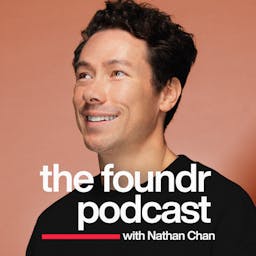
The Foundr Podcast with Nathan Chan
Foundr Media
Hear the stories, learn the proven methods, and accelerate your growth and future through entrepreneurship. Welcome to The Foundr Podcast with Nathan Chan.
About the show:
For over a decade, The Foundr Podcast with Nathan Chan has been a leading entrepreneurship podcast for open-book conversations with, by, and for founders. Whether you're starting, building, or dreaming about your business, The Foundr Podcast is where you can access experienced founders who've been in your shoes to learn their proven methods, lessons from failure, and inspirational stories.
Past guests include Emma Grede, Mark Cuban, Neil Patel, Kendra Scott, Alex Hormozi, Trinny Woodall, Tim Ferriss, Sophia Amoruso, Simon Sinek, Tony Robbins, Amy Porterfield, Ed Mylett, Michelle Zatlyn, Reid Hoffman, Scooter Braun, Dany Garcia, Marc Lore, Ariana Huffington, Pat Flynn, Lewis Howes, Jordan Harbinger, and many more.
About the host:
Nathan Chan is the CEO of Foundr and the creator of The Foundr Podcast. Chan literally started from knowing nothing. He was just an average guy working in a 9-5 job he utterly hated. He knew nothing about entrepreneurship, nothing about startups, nothing about marketing, and nothing about online or how to build a business. In the past decade, Chan's built Foundr into a global leader in entrepreneurial education, helping tens of thousands of aspiring entrepreneurs start and scale their businesses.
Need help with your business?
Visit foundr.com/foundrplustrial to join a global community of entrepreneurs, gain access to proven strategies, and fast-track your business growth confidently.
About the show:
For over a decade, The Foundr Podcast with Nathan Chan has been a leading entrepreneurship podcast for open-book conversations with, by, and for founders. Whether you're starting, building, or dreaming about your business, The Foundr Podcast is where you can access experienced founders who've been in your shoes to learn their proven methods, lessons from failure, and inspirational stories.
Past guests include Emma Grede, Mark Cuban, Neil Patel, Kendra Scott, Alex Hormozi, Trinny Woodall, Tim Ferriss, Sophia Amoruso, Simon Sinek, Tony Robbins, Amy Porterfield, Ed Mylett, Michelle Zatlyn, Reid Hoffman, Scooter Braun, Dany Garcia, Marc Lore, Ariana Huffington, Pat Flynn, Lewis Howes, Jordan Harbinger, and many more.
About the host:
Nathan Chan is the CEO of Foundr and the creator of The Foundr Podcast. Chan literally started from knowing nothing. He was just an average guy working in a 9-5 job he utterly hated. He knew nothing about entrepreneurship, nothing about startups, nothing about marketing, and nothing about online or how to build a business. In the past decade, Chan's built Foundr into a global leader in entrepreneurial education, helping tens of thousands of aspiring entrepreneurs start and scale their businesses.
Need help with your business?
Visit foundr.com/foundrplustrial to join a global community of entrepreneurs, gain access to proven strategies, and fast-track your business growth confidently.
Episodes
Mentioned books

Apr 15, 2020 • 1h 17min
298: Serial Entrepreneur Josh Snow’s Approach to Influencers, Recurring Revenue, and Paid Ads During a Pandemic
Josh Snow always finds ways to thrive in difficult situations.Growing up, his family didn’t have a lot of money, and he wanted to help them cover basic expenses. So Snow taught himself how to create websites at his local library, which is how he stumbled into entrepreneurship. He eventually took that knowledge and built a software company from the ground up, which he sold by the age of 21.Now Snow runs multiple successful businesses—with the most prominent one being his nine-figure teeth whitening business, Snow.And he’s still finding ways to overcome adversity. Just as most businesses have been impacted by COVID-19, Snow also took a huge hit in terms of sales, with its conversion rates cut in half when the pandemic first emerged. However, by making fast, strategic changes, Snow got his company through the temporary setback and is today seeing higher-than-average sales on its site.In this interview, Snow shares exactly how he made the necessary changes to his business. He also provides advice to other online businesses on how to get through this time by adjusting everything from your subscription model to your approach to influencer relations strategy.If there’s any other type of content you’d like to see that would be valuable to you during this time, please don’t hesitate to reach out at support@foundr.com to let us know.Key Takeaways
How Snow stumbled into entrepreneurship through necessity
The journey to selling his first software company at the age of 21
Why Snow believes adversity gives you the opportunity to pause and reprioritize
The inspiration behind Snow, and how it grew to be a nine-figure business
How the company has been affected by COVID-19, and the changes Snow made to help his business bounce back and make more sales than before the pandemic
Snow’s recommendations on how to adjust your subscription products, influencer relations, and paid ads strategy during this time
The importance of evolving and meeting your customer where they’re at
Why Snow believes you have to be an “everything” person if you want a successful business
Advice on using Shopify vs. funnels
The choice between hunting rabbits vs. elephants (metaphorically)

Apr 7, 2020 • 58min
297: Steve Blank’s 3-Step Process to Help Businesses Cope With COVID-19
Steve Blank is a legend in Silicon Valley. In addition to launching eight startups in 21 years, he’s also a well-known author and educator at Stanford University, Columbia University, and the UC Berkeley Haas School of Business.Having worked in the realm of entrepreneurship for so long, Blank has survived some of the worst recessions in U.S. history and has first-hand experience of what it’s like to keep your business afloat under high-pressure circumstances—knowledge that’s directly applicable to the COVID-19 global health crisis.In this interview, Blank shares his three-step process for what every business needs to do right now to survive the pandemic. He breaks down everything from calculating your burn rate to reassessing the way you work with your team. Blank also shares his own personal experiences with the 2008 recession and dot-com bubble.If there’s any other type of content you’d like to see that would be valuable to you during this time, please don’t hesitate to reach out at support@foundr.com to let us know.Key Takeaways
Why Blank believes today’s entrepreneurs should listen to the advice of seasoned founders
The three-step process Blank recommends to understand where your business is headed, from calculating finances to reassessing business models
The biggest lessons Blank learned during the 2008 recession and dot-com bubble
Why Blank believes in planning for the morning after
The importance of high-level execution during times like today
How to think about recalibrating in terms of retaining staff and hiring
The importance of setting expectations—whether in your marketing or management
Why this pandemic could be an opportunity to re-evaluate how you want to spend your life

Mar 31, 2020 • 43min
296: How Invitation Homes CEO Dallas Tanner Scaled a Multibillion-Dollar Home Rental Company at Breakneck Speed
CEO Dallas Tanner on the breakneck creation and growth of multibillion-dollar home rental company Invitation Homes.Like a lot of successful businesses, Invitation Homes was a seemingly overnight hit that had been in the making for many years.“We bought the first 30,000 homes in the first 18 months,” says CEO Dallas Tanner, of the single-family home rental company.Based on that burst of early success, it might seem as though Tanner did the impossible—come up with a brilliant idea, instantly get buy-in from an investor, and reap immediate rewards.But long before Invitation Homes launched in 2012, Tanner had already cut his teeth in the home rental business. During college, he bought a couple of houses with his dad and managed them while going to class. He later founded the Treehouse Group Companies, which focused on workforce housing in the Southwest.So, when Tanner set out to start Invitation Homes, he did so with a large body of experience, knowledge, and accomplishments in his chosen field. That could have had something to do with the quick traction he got at Blackstone, his early capital partner and provider of funds for those 30,000 homes.“High speed, low drag,” Tanner says of their initial goal. There was an intense focus on getting out there, scaling up, and achieving meaningful gain in as short a time as possible. Were they worried, though, that the swift pace might blind them to any turbulence ahead?“If you’re building an airplane while flying it, there’s always a risk that you may miss a step. We were lucky to have no major issues and that’s because we were comfortable in the area we were building. We knew it and understood it.”That early work and knowledge of the industry paid off. In 2017, Invitation Homes went public with an initial share price of $20. Two years later, it hovers between $29-30 per share, a 48% increase. Blackstone sold its remaining shares (11%) of the company in November 2019 for $1.7 billion, bringing Blackstone’s total profit from IH to $7 billion.“As we think about our business, we’ve gotten more and more efficient here in year seven,” he says. “We’re focused on the kinds of things that deliver a really good customer experience but make us as optimized as possible.”For example, the inaugural days of the business found technicians switching out locks each time a home got a new resident. New tech eventually provided the option of electronic entry, which Invitation incorporated into its homes. Now, when a resident moves out and a new one moves in, only the code needs to be changed. This made the move-in experience that much smoother for new residents and saved time for the team.Remember, though, that the quest for good systems shouldn’t overwhelm everything. “You’ve got to spend your time being as efficient as possible, but driving growth at the same time,” Tanner says. “It’s always a balancing act.”He acknowledges that it also takes some luck and good timing. “But, the only way those things go your way is if you’re head down and going hard.”Interview by Nathan Chan, feature article reprinted from Foundr Magazine, by Rebeca Seitz

Mar 25, 2020 • 59min
295: How 12RND Fitness Founder Tim West Beat His Competitors to the Punch
Believe it or not, there are many parallels between the world of boxing and the world of entrepreneurship. Tim West is familiar with both. As the founder of the fastest-growing global boxing franchise, 12RND Fitness, West has had his feet squarely planted in both realms for many years. He started his journey working in brick-and-mortar fitness centers before jumping into tech entrepreneurship, and eventually launched 12RND Fitness in 2014, which quickly exploded across Australia and is now expanding globally. In fact, West is in the process of opening up their first locations in New Zealand, Singapore, London, and Los Angeles this year. In this interview, West dives deep into his thoughts on the franchising model, his biggest lessons from working in tech, and his approach to overcoming obstacles. Check out the full conversation below! Key Takeaways How West worked his way up the rungs of the fitness ladder—from aspiring professional athlete to strength and conditioning coach Why he jumped at the opportunity to open up one of the first franchises for Jetts Fitness, the first 24-hour gym in Australia West’s first foray into tech, and the most important lessons he picked up along the way Why West decided to return to brick-and-mortar fitness, and how he came up with the MVP for 12RND Fitness How West pressure-tested his business model across Australia The reason West tested his business for two whole years before opening up to franchisees A sneak peek into West’s data-driven approach to working with franchisees Why West is grateful for his struggles

Mar 21, 2020 • 60min
294: Responding to COVID-19: What Entrepreneurs Should Be Doing Right Now
As a founder, you’re likely feeling a lot of stress and anxiety around the current situation with COVID-19. While we hope your business isn’t being too heavily impacted, we want to let you know that we’re always here for you and want to help in any way we can.We’ve been mulling over how we could be the most useful to the Foundr community and decided it would be incredibly valuable to sit down and talk to Steve McLeod. McLeod is uniquely equipped to share advice about the current circumstances for many reasons: he’s a business coach that has guided thousands of organizations through challenging situations (including Foundr); he founded his own company called Fire And Safety, which is now a $20 million business; and he’s a former firefighter who dealt with many disasters during his eight-year tenure.In this interview, we touch on many topics—from managing cash flow reserves to communicating with customers to adjusting your mindset—that we hope you’ll find helpful as we navigate this unfamiliar territory together. Whether you’re getting ready to launch a new business or are already running a seven-figure company, the contents of this interview should be applicable for entrepreneurs at every stage.If there’s any other type content you’d like to see that would be valuable to you during this time, please don’t hesitate to reach out at support@foundr.com to let us know.Key Takeaways
How McLeod’s background as a firefighter, founder, and mentor is allowing him to guide businesses today through the COVID-19 pandemic
The importance of understanding where your business is today: positioned for growth or in survival mode?
Why you need to be transparent with your teams, regardless of your current situation
McLeod’s advice: cut costs but don’t stop your sales and marketing efforts
Why you need to focus on your existing customers and how you can help them
How to keep your mindset clear during this stressful time
Why connection, discipline, and alignment are more critical than ever before
An overview of cash flow reserves, and how much you should have in the bank now
The reason why McLeod doesn’t believe it’s the right time for work-life balance
How to be a good leader in unprecedented circumstances
Why leaders need to be asking themselves the tough questions today more than ever
McLeod’s advice for businesses that are thinking about launching soon

Mar 3, 2020 • 55min
291: X Prize Founder Peter Diamandis Talks About Creating a Blueprint For The Future
When Peter Diamandis was a kid, there were two life-changing moments that shaped him into the person he is today: the launch of the Apollo space program and the release of Star Trek.These two events inspired Diamandis’ love of space and taught him to always keep his eyes on the future. It’s no surprise then that Diamandis went on launch over 20 companies in the areas of space, longevity, venture capital, and education.Diamandis has also dedicated himself to supporting others who make an impact on the world, which is why he founded the venture fund BOLD Capital Partners, the X Prize Foundation, and Singularity University—all organizations focused on promoting technologies that have the potential to improve society.In this interview, he shares his thoughts on what it takes to build a sustainable business, his predictions for industries like education and healthcare, and what he’s most excited about in terms of future innovations. This is a conversation you won’t want to miss!Key Takeaways
Why Diamandis ended up going to medical school, despite his love of space
How Diamandis carved out his own life path, which led to him starting 20+ companies in the areas of space, longevity, venture capital, and education
His predictions on which industries will transition from a scarcity to an abundance mindset
The golden rule Diamandis always follows whenever he prioritizes what to work on next
Why Diamandis believes a person’s mindset is the most valuable asset they own
The inspiration behind Diamandis’ latest book, The Future Is Faster Than You Think: How Converging Technologies Are Transforming Business, Industries, and Our Lives
What excites Diamandis most about the future, and why he feels optimistic about what’s to come

Feb 12, 2020 • 57min
288: Catena Media’s Erik Bergman Talks IPOs, Affiliate Marketing, And Finding Meaning In Life
Erik Bergman’s entrepreneurial journey started with trading hockey cards on the playground.When Bergman realized that owning coveted sports memorabilia made him feel valued and won him friends, he became obsessed. As he got older, his focus eventually shifted from trading cards to making cash.After a brief stint as a professional gambler, Bergman co-founded a website consultancy firm called Catena Media in 2012. The affiliate-based marketing company focused on the online gambling industry and eventually IPOd at €160 million.Despite achieving the wealth Bergman had relentlessly chased since his youth, he was still unhappy. So he set out to learn the true path to fulfillment and eventually found deeper meaning in his life through charity work with his latest project, Great.com.Check out this interview to learn more about Bergman’s journey to finding happiness and the most important lessons he learned along the way.Key Takeaways
How trading hockey cards instilled a sense of entrepreneurship in Bergman from a young age
Bergman’s brief stint as a professional poker player
Why Bergman and his best friend Emil Thidell launched a gambling-focused website consultancy agency
From making side-hustle money to officially launching Catena Media
How strategic website acquisitions helped Catena Media skyrocket
The long and difficult road to IPO
Why Bergman found himself in a dark place, despite his newfound wealth
How Bergman became involved in charity work and discovered his “splash of color”
The inspiration behind Great.com

Feb 4, 2020 • 56min
287: How July Founder Richard Li Grew His Luggage Company From $0 to $5 Million in 1 Year
Richard Li puts customer service above all when it comes to his luggage company, July.This unfaltering commitment is why he personally makes house calls to address complaints and why he recently hand-delivered packages after realizing that some customers wouldn’t receive the luggage they ordered in time for the holidays. But this high level of service is only a small piece of Li’s success story with July.Li, who has previous entrepreneurial experience from his furniture company Brosa, has also figured out a “magic” formula for manufacturing, marketing, and selling physical products. He used this knowledge to grow July from $0 to $5 million in revenue in just a year. And now he’s looking forward to opening up additional retail stores, introducing more products, allowing for more luggage personalization, and expanding into international markets in 2020.If you want to learn more about what it takes to launch and scale a business that revolves around a physical product, be sure to give our interview a listen!Also be sure to check out our latest online course, Ecommerce Masters, where Richard Li is one of the five instructors teaching advanced ecommerce skills.ATTENTION: We're excited to announce that Richard Li has partnered with Foundr to teach one of the modules in our course, Ecommerce Masters. Get on the Free VIP Waitlist to be notified when we open enrollment!Get a FREE Lesson from Our Course: Ecommerce Masters! Learn the FASTEST Path to a Million-Dollar StoreKey Takeaways
The opportunity Li saw in Australia’s furniture market that led him to launch Brosa
Why he stepped back from Brosa after five years to focus completely on his new direct-to-consumer luggage company, July
An overview of July’s funding journey, go-to-market strategy, and first sale
The journey from $0 to $5 million in one year
How to find a manufacturer that can grow with your company
Why Li offers July customers a 100-day trial and lifetime warranty
The rules of product development that Li follows
Why Li decided to follow the direct-to-consumer trend of opening up a physical store
July’s four growth pillars for 2020
Li’s best advice for entrepreneurs building a business around a physical product

Jan 28, 2020 • 1h 1min
286: How Annex Products Co-Founder Rob Ward Used the Power of Prediction to Build a Multimillion-Dollar Company
Rob Ward always seems to be one step ahead.Before Kickstarter took off, Ward and his co-founder Chris Peters launched two successful campaigns on the platform, funding Opena and Quad Lock—the two products that led to the founding of Annex Products. Then Ward was early to the Shopify game, which he successfully used to sell his products for several years. Ward was also quick to see the potential of Facebook Ads and has used them to scale Annex to a multimillion-dollar business.This ability to spot trends, paired with his finely-tuned approach to product development, has helped Ward find tremendous success as an entrepreneur. While Opena is no longer active, Quad Lock has become a leading device mount and accessory company, serving a wide variety of users—car commuters, motorcyclists, kayakers, even hang gliders. As a result, Quad Lock sells hundreds of thousands of units each year in over 100 countries.We’re now thrilled to have Rob Ward as one of the five instructors of our latest online course, Ecommerce Masters, teaching advanced ecommerce strategies.If you’re curious to learn more about Ward’s approach to trendspotting, product development, and more, we highly recommend you check out this episode!ATTENTION: We’re excited to announce that Rob Ward has partnered with Foundr to teach one of the modules in our course, Ecommerce Masters. Get on the Free VIP Waitlist to be notified when we open enrollment!Get a FREE Lesson from Our Course: Ecommerce Masters! Learn the FASTEST Path to a Million-Dollar StoreKey Takeaways
An overview of Ward’s prior entrepreneurial experiences with everything from laser machines to 3D printers, and how they helped him get to where he is today
How he and his co-founder, Chris Peters, founded Annex Products in 2012, building on two successful Kickstarter campaigns
Why the duo decided to eventually focus their resources on Quad Lock
How Ward stays on the cutting edge and predicts trends
Insight into Ward’s approach to the product development process—when to start thinking about the next product, the iterative process, and more
Why Ward isn’t too worried about Quad Lock copycats
Why Ward doesn’t believe in following other people’s blueprints for success
A sneak peek into the module Ward will be teaching for Ecommerce Masters

Jan 22, 2020 • 54min
285: The Art of Mind-Blowing Open Rates, Email Flows, and Authentic Email Marketing, With Boundless Labs’ Chase Dimond
At 27, Chase Dimond is already considered a marketing veteran. In addition to overseeing the marketing teams of various companies, Dimond has also founded many of his own ventures, such as Soundjuice and ZenPup.His most recent company is Boundless Labs, an agency that focuses on email marketing for ecommerce—with a special focus on CBD companies. Thanks to its modern and human-centered approach to emails, Boundless Labs acquired 30 clients with six- to eight-figure revenues in a little over a year.Dimond has also secured mind-blowing results for those clients, such as sending emails with 40% to 70% open rates (compared to the industry average of 20% to 25%) and helping companies generate 20% to 30% of their total revenue with emails.If you’re looking to master the art of email marketing, this podcast episode with Dimond is a great place to start! He gives us a sneak peek into the best practices he uses with his own clients at Boundless Labs, along with other helpful insights.Key Takeaways
How Dimond got his start in marketing, growth, and acquisitions
An overview of Dimond’s ventures, from CBD pet products to a social media platform for musicians
Why Dimond decided to launch his email marketing agency, Boundless Labs, and how he scaled from zero to 30 clients in a year
How design sets Boundless Labs apart from the rest
Dimond’s perspective on email marketing as a source of revenue for his clients
The importance of the human touch when it comes to customer retention and acquisition
How Dimond achieves a 40-70% open rate on customer thank-you emails

