

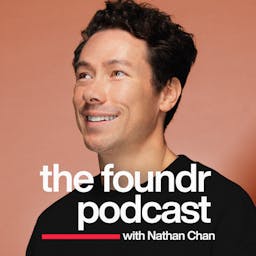
The Foundr Podcast with Nathan Chan
Foundr Media
Hear the stories, learn the proven methods, and accelerate your growth and future through entrepreneurship. Welcome to The Foundr Podcast with Nathan Chan.
About the show:
For over a decade, The Foundr Podcast with Nathan Chan has been a leading entrepreneurship podcast for open-book conversations with, by, and for founders. Whether you're starting, building, or dreaming about your business, The Foundr Podcast is where you can access experienced founders who've been in your shoes to learn their proven methods, lessons from failure, and inspirational stories.
Past guests include Emma Grede, Mark Cuban, Neil Patel, Kendra Scott, Alex Hormozi, Trinny Woodall, Tim Ferriss, Sophia Amoruso, Simon Sinek, Tony Robbins, Amy Porterfield, Ed Mylett, Michelle Zatlyn, Reid Hoffman, Scooter Braun, Dany Garcia, Marc Lore, Ariana Huffington, Pat Flynn, Lewis Howes, Jordan Harbinger, and many more.
About the host:
Nathan Chan is the CEO of Foundr and the creator of The Foundr Podcast. Chan literally started from knowing nothing. He was just an average guy working in a 9-5 job he utterly hated. He knew nothing about entrepreneurship, nothing about startups, nothing about marketing, and nothing about online or how to build a business. In the past decade, Chan's built Foundr into a global leader in entrepreneurial education, helping tens of thousands of aspiring entrepreneurs start and scale their businesses.
Need help with your business?
Visit foundr.com/foundrplustrial to join a global community of entrepreneurs, gain access to proven strategies, and fast-track your business growth confidently.
About the show:
For over a decade, The Foundr Podcast with Nathan Chan has been a leading entrepreneurship podcast for open-book conversations with, by, and for founders. Whether you're starting, building, or dreaming about your business, The Foundr Podcast is where you can access experienced founders who've been in your shoes to learn their proven methods, lessons from failure, and inspirational stories.
Past guests include Emma Grede, Mark Cuban, Neil Patel, Kendra Scott, Alex Hormozi, Trinny Woodall, Tim Ferriss, Sophia Amoruso, Simon Sinek, Tony Robbins, Amy Porterfield, Ed Mylett, Michelle Zatlyn, Reid Hoffman, Scooter Braun, Dany Garcia, Marc Lore, Ariana Huffington, Pat Flynn, Lewis Howes, Jordan Harbinger, and many more.
About the host:
Nathan Chan is the CEO of Foundr and the creator of The Foundr Podcast. Chan literally started from knowing nothing. He was just an average guy working in a 9-5 job he utterly hated. He knew nothing about entrepreneurship, nothing about startups, nothing about marketing, and nothing about online or how to build a business. In the past decade, Chan's built Foundr into a global leader in entrepreneurial education, helping tens of thousands of aspiring entrepreneurs start and scale their businesses.
Need help with your business?
Visit foundr.com/foundrplustrial to join a global community of entrepreneurs, gain access to proven strategies, and fast-track your business growth confidently.
Episodes
Mentioned books

Jun 9, 2020 • 1h 10min
308: How Henrik Werdelin Built a 9-Figure Subscription Box Business for Dogs
Henrik Werdelin has never been about chasing money, power, or fame. Instead, his focus has always been on creating cool things with people he enjoys being around. That’s exactly how BarkBox, now one of many subsidiaries under BARK, came to be.Despite Werdelin’s non-material approach to BARK, the dog subscription box company has exploded in popularity since its launch in 2012. Today, it boasts hundreds of thousands of subscribers and it is a nine-figure business.In our conversation, Werdelin shares the most important learnings he’s collected as an entrepreneur—from finding the right funding option for your business to maintaining the right headspace during challenging times. Werdelin also gives us a glimpse into BARK’s incredible company culture and how he managed to build a quirky, kind, and smart team of people to pave the path for the organization. As a bonus, we also get a sneak peek into Werdelin’s book, “The Acorn Method” to understand how companies can grow in an ever-changing environment.If there’s any other type of content you’d like to see that would be valuable to you during this time, please don’t hesitate to reach out at support@foundr.com.Key Takeaways
Why Werdelin and his co-founders decided to start creating cool stuff for dogs in 2012
The funny story of how Werdelin met one of his co-founders in a heart-shaped bed on a cruise ship
What the pet industry was like when BarkBox first entered the market
Werdelin’s advice on finding the right funding option for your business
How BARK has dealt with the pandemic, and why the pet industry is recession proof
The importance of staying in a good headspace during tough times
How Werdelin and his co-founders approach leadership and decision-making
Why BARK is an inside-out brand, and what that means
A sneak peek into Werdelin’s new book, “The Acorn Method” and the advice it shares on how companies can continue growing during uncertain times
Werdelin’s best advice for entrepreneurs who are struggling during the pandemic

Jun 2, 2020 • 59min
307: Basecamp’s David Heinemeier Hansson On What A Productive Workplace Should Look Like
As we start thinking about re-opening our businesses and offices after Covid-19, many people are wondering what the new “normal” will look like.While co-founder of Basecamp David Heinemeier Hansson doesn’t know for sure what the outcome will be, he certainly has an idea of what the new world of work should look like. As one of the biggest advocates of remote work, Hansson is hopeful that more and more companies will see the benefits of allowing employees to choose how and where they want to work.But his vision for work doesn’t stop there. Hansson is also passionate about creating an environment where employees can protect at least a few hours of their day to accomplish deep work. This means no daily stand ups, no open calendars, and no unnecessary distractions that take away from your ability to get s*** done—an approach that’s imbued in Basecamp’s own culture.If you’re fascinated by the topics of remote work and productivity, you don’t want to miss out on this conversation with Hansson.If there’s any other content you’d like to see that would be valuable to you during this time, please don’t hesitate to reach out at support@foundr.com.Key Takeaways
The email from Hansson to Jason Fried that eventually led to the birth of Basecamp
Why it’s difficult to tell what the new “normal” for work will be after Covid-19
A look at the most common misconceptions about remote work, and how the pandemic has proven them to be false
Why Hansson believes we need to focus less on the number of hours we work and more on the quality of those hours
The reason why Basecamp isn’t renewing the lease for its Chicago office
Why Hansson doesn’t believe in daily stand ups and open calendars
How to maximize deep work
Why Basecamp’s approach to work is less about productivity, and more about human health and happiness
A sneak peek into Hansson’s upcoming project, HEY
Why the phrase ASAP is overused
What Hansson’s schedule looks like on most days

May 26, 2020 • 53min
306: From Myspace To Jam City: Chris DeWolfe Breaks Down His 25 Years Of Experience As An Entrepreneur
Chris DeWolfe excels at creating massive user bases—a skill he has demonstrated with two companies you’ll likely recognize: Myspace and Jam City.After DeWolfe launched the biggest social network of its time in 2003, it was only a matter of months before Myspace completely took off and attracted millions of users around the world. Only two years after the start of his company, DeWolfe sold the platform for $580 million. But he wasn’t done yet.When DeWolfe asked himself ‘what’s next?’ he found himself drawn to the world of gaming. Not only was it easy to scale, but he also believed the current trends pointed toward an explosion in gaming. He wasn’t wrong. Today, Jam City is known for famous mobile games like Cookie Jam and Pop! and Panda, and it’s still going strong to keep up with the growing demand of casual gamers.In this interview, DeWolfe discusses the hyper growth of his companies, how to stay focused when running such a behemoth of a company, and what it takes to build massive user bases.If there’s any other content you’d like to see that would be valuable to you during this time, please don’t hesitate to reach out at support@foundr.com.Key Takeaways
How DeWolfe built the largest website in the world and the biggest social network of its time, Myspace
The trends in pop culture and technology that led to the launch of Myspace in 2003
A look into the rapid growth and eventual sale of Myspace in 2005 for $580 million
How Myspace created a roadmap for companies like Spotify and YouTube
The top three lessons DeWolfe learned from his journey with Myspace
How DeWolfe figured out his next step into the world of mobile gaming
Why Jam City targets an underserved audience for gamers
The acquisition of Mindjolt
How to be a great storyteller and create amazing games
What’s exciting for DeWolfe in the future of the mobile gaming business
What it takes to build large user bases
Why DeWolfe recommends taking measured risks in the pursuit of innovation
A sneak peek into Jam City’s latest upcoming mobile game

May 19, 2020 • 42min
305: Dropbox’s Drew Houston on Continuous Learning, Decision Making, and Fixing the Way We Work
By now, the story is legend. When Drew Houston boarded a bus from Boston to New York and discovered that he had—yet again—forgotten to bring his thumb drive, he was frustrated. So frustrated that he sat down and began writing the first lines of code of what would eventually become Dropbox.After over a decade of changing the way files are stored, synced, and shared, Houston is changing the way people work, once again. This time, to solve a problem that likely plagues every single knowledge worker today: our fragmented, overcomplicated workspaces.In this episode, you’ll learn more about Houston’s journey—from ideation to launch—with Dropbox Spaces, as well as the most important lessons he’s collected while building a multibillion-dollar company with over 500 million users.Key Takeaways
The relatable experience that inspired Houston to come up with the idea for Dropbox
Why Houston doesn’t believe there’s any “magic” involved in building a multibillion-dollar company
The importance of decision making and learning continuously on the job
How a conversation with a SpaceX engineer sparked the vision behind Dropbox Spaces
Houston’s advice on “harvesting” versus “planting” when it comes to your business
Why Houston is such a huge believer in intentionally designing your environment—at work and with your personal relationships

May 19, 2020 • 1h 2min
304: Alex Osterwalder On Why Products, Technology, And Price Aren’t Enough To Keep Your Company Competitive
Alex Osterwalder is primarily known for developing the Business Model Canvas, a template that helps startups develop and document new or existing business models.In this interview, Osterwalder shares his best insights into the world of business models—ideas that are especially applicable now as entrepreneurs try to launch businesses during Covid-19. He explains why products, technology, and price alone aren’t enough to keep your company competitive. Osterwalder also breaks down the innovative models that Apple, Netflix, and Nintendo have used to become industry leaders (and why even these behemoths aren’t safe from disruption).We also get a sneak peek into Osterwalder’s latest book called “The Invincible Company.” Not only does it contain an entire library of business models for companies of all sizes, but it also provides guidance on how startups can continuously reinvent themselves to stay ahead of the curve.If there’s any other content you’d like to see that would be valuable to you during this time, please don’t hesitate to reach out at support@foundr.com.Key Takeaways
How Osterwalder came to study business models in graduate school
Insight into Osterwalder’s latest book, “The Invincible Company”
Why companies can’t compete on products, technology, and price alone (and why your business model can provide the ultimate competitive edge)
The scalability of business models
Why companies need to transcend industry boundaries
The reason why Osterwalder urges entrepreneurs to test before they build
How Apple, Netflix, and Nintendo are prime case studies of innovative business models in action—but why even they’re not safe from disruption
Osterwalder’s stance on the “magic bullet” when it comes to business models (hint: there isn’t one)

May 12, 2020 • 53min
303: Ballsy’s Adam Hendle Talks Community Engagement, Customer Acquisition, And Leaning Into The Pandemic
Adam Hendle’s company, Ballsy, is eye-catching and humorous, which are some of the most defining characteristics of the brand.But that doesn’t mean he doesn’t take his business seriously. On the contrary, Hendle is obsessed with producing the highest quality products and finding creative ways to take his company to the next level. This is exactly how he brought in over $10 million in sales in just two years. And now, during the Covid-19 pandemic, he is still finding opportunities to grow.In this podcast episode, Hendle discusses his unique approach to everything from community engagement to customer acquisition. He also opens up about his most challenging moments in business and explains how he finds opportunities in unexpected times and places (such as during a pandemic). This is a conversation you don’t want to miss!If there’s any other type of content you’d like to see that would be valuable to you during this time, please don’t hesitate to reach out at support@foundr.com.Want some training on ecommerce? Check out our free masterclasses: FREE Masterclass: Start a Profitable Online Store (In 12 Weeks or Less) FREE Masterclass: Discover the “5 Core Drivers” Behind Today’s Fastest-Growing 7-Figure StoresKey Takeaways
What’s changed with Ballsy since the last time we talked to Hendle
An overview of Ballsy’s growth from a sales, marketing, and team perspective
How Covid-19 gave Hendle’s brand an opportunity for growth
The approach Hendle took to lean into customer demand for subscriptions and stocking up on products
How Ballsy stays engaged with its community in fun and creative ways
A deep dive into one of Ballsy’s most unique customer acquisition channels: podcast advertisements
Why it’s important to test your assumptions
Insight into some of the biggest business obstacles Hendle has had to face
Why Hendle has Ballsy’s influencers on a monthly retainer
The reason why product quality is paramount to the Ballsy brand

May 11, 2020 • 58min
302: Serial Ecommerce Entrepreneur Rory Boyle On How He Survived (And Thrived) During The Pandemic
All three of Rory Boyle’s ecommerce businesses were negatively impacted by Covid-19.But thanks to his strategic—and insanely fast—pivot, two of his companies are now making double the revenue they were before and one (which historically made most of its money through conferences) is still pulling in around 50% of what it used to make.How did Boyle recover so quickly from the pandemic? In this interview, we were lucky enough to get a detailed analysis around his thought process and strategic decisions. Boyle takes us through how he shifted his sales and marketing tactics (which still includes getting on the phone) and explains how he’s using this time as an opportunity to give back to his community and customers. He also shares tons of tips around scaling sales efforts, the art of cadence emails, and other tactics you can use to grow your revenue.If there’s any other type of content you’d like to see that would be valuable to you during this time, please don’t hesitate to reach out at support@foundr.com to let us know.If you need want some training on ecommerce, check out our Free Masterclasses:Learn How You Can Start a Profitable Online Store (In 12 Weeks or Less)Discover the “5 Core Drivers” Behind Today’s Fastest-Growing 7-Figure StoresKey Takeaways
The origin stories of Hampers With Bite, Promotions Warehouse, and Snacks With Bite
What Boyle means when he says to “control the controllables”
How COVID-19 impacted all 3 of Boyle’s businesses—and how he pivoted all of them at breakneck speed
The approach Boyle is taking to sales and marketing during the pandemic (and why his team is still hopping on the phone to talk to customers)
Why Boyle believes every ecommerce entrepreneur needs to be thinking about the next step instead of focusing on current performance
How Boyle is giving back to his community and customers
How he’s planning around stocking challenges, especially for the upcoming holidays
A super deep dive into Boyle’s best sales tactics and strategies
Why Boyle would encourage entrepreneurs to launch their business in today’s climate

May 5, 2020 • 55min
301: 8-Figure Ecommerce Founder Reveals His Best Insights For Ecommerce Entrepreneurs Struggling Through Covid-19
Today, we’re excited to share another valuable interview to help you overcome business challenges during the Covid-19 pandemic.We had the opportunity to pick the brain of Ashwin Sokke, the founder of WOW Skin Science. His global 8-figure skincare and haircare business is extremely popular in India and across the U.S., and it has been a top-selling brand on Amazon for the last four years in those countries.In this interview, Sokke shares how his company dealt with the impact of Covid-19 which shut down half of his business for several weeks. For businesses who are going through similar pains, he provides incredible insights across many topics—from how to communicate with customers (he believes we should be sending them more emails and texts during this time) to getting creative with your marketing tactics (remember giveaways?). Sokke even digs down into the nitty gritty and breaks down his thoughts on subscription models, ad investments, and SKUs.We believe this conversation will be valuable for any entrepreneur to listen to, especially those with ecommerce businesses. If there’s any other type of content you’d like to see that would be valuable to you during this time, please don’t hesitate to reach out at support@foundr.com to let us know.If you need want some training on ecommerce, check out our Free Masterclasses:Learn How You Can Start a Profitable Online Store (In 12 Weeks or Less)Discover the “5 Core Drivers” Behind Today’s Fastest-Growing 7-Figure StoresKey Takeaways
How Sokke got into the health and beauty space
The path to growing WOW Skin Science in India and the U.S. and becoming a top-selling brand on Amazon
Why Sokke develops all of his products from scratch
A glimpse into the company’s incredible numbers: 8-figure revenue and 370% growth in the U.S. last year
The impact that Covid-19 had on Sokke’s global company
Why Sokke believes companies should be sending more emails during this time (and how to be strategic about it)
Why giveaways have been a successful tactic during Covid-19
An overview on a winning stock keeping unit (SKU)
Sokke’s thoughts on how to win with subscription models
The best advice Sokke can offer to the community during Covid-19

Apr 29, 2020 • 1h 10min
300: [Special 300th Episode] Rich20Something’s Daniel DiPiazza And Foundr’s Nathan Chan Dive Deep Into the World of Instagram
The latest installment of the Foundr podcast is a landmark—our 300th episode! So to mark the occasion, we’ve got something a little different for you today.Daniel DiPiazza, the founder of Rich20Something, was on the cover of Foundr Magazine last year, and today, he returns to Foundr to “reverse interview” our own CEO, Nathan Chan, ahead of the relaunch of Foundr’s beloved Instagram Domination course.Together, Nathan and Daniel share the details of how they each found success on Instagram for their respective brands. They also explore Instagram’s algorithms, how it compares to other social media platforms, and the right way to use this powerful tool during the Covid-19 pandemic. Plus, they swap stories about their friendly competition, their time in the “Motivation Mafia,” and more!If you want to learn more about our remastered Instagram Domination course when it launches, sign up for the Free VIP waitlist here (Get a FREE Lesson!).Key Takeaways
The reason for this special “reverse interview”
How Nathan and Daniel got started on Instagram and are still finding success with the platform today
Why Instagram is the most powerful tool for both personal branding and ecommerce
A glimpse into Instagram’s algorithms and metrics
Why Instagram needs to be about more than just follower numbers
How Instagram can be a powerful tool through the current pandemic
A throwback story about the “Motivation Mafia”
Why Nathan would still pick Instagram as his platform of choice if he were to start a new company today
A comparison of Instagram vs. YouTube
How Daniel’s Instagram account helped him seal a six-figure book deal
The question that stumped Nathan (and why he prefers to focus on the present)
Why Daniel owes Nathan a trip to San Sebastián

Apr 21, 2020 • 56min
299: From $0 To $20M In 2 Years: How Happy Skin Co. Founder Dylan Mullan Went Viral
Dylan Mullan took an extremely unconventional path to entrepreneurship.While he was in school, Mullan was convinced he wanted to be a lawyer, until he started taking classes at university and realized that he hated them. After that, he spontaneously took an acting course and spent almost five years as an actor. It was eventually a desire to have more control over his life that led him and his business partner to launch Happy Skin Co together.Through a mixture of hard work, strategic decisions, and a deep investment in understanding their target customer, Mullan managed to grow his at-home hair removal business from $0 to $20 million in just two years.In this interview, Mullan maps out exactly what this path to explosive growth looked like. He breaks down his approach to everything from market research to Facebook ads and explains why mindset is ultimately an entrepreneur’s most valuable tool.If there’s any other type of content you’d like to see that would be valuable to you during this time, please don’t hesitate to reach out at support@foundr.com to let us know.Key Takeaways
The path from aspiring lawyer to aspiring actor, and how Mullan eventually wound up in the world of entrepreneurship
A look into Happy Skin Co’s early days, from long nights of planning to packaging products in Mullan’s living room with friends and family
The turning points that catapulted the company from $0 to $20 million in 2 years
How Mullan approached market research and influencer marketing in the early days
What the impact of Covid-19 has looked like for Mullan and his team, and the new opportunities it has opened up
Mullan’s best advice when it comes to creating profitable Facebook ads
An overview of the Happy Skin Co product development process and a sneak peek into what’s next
How to deal with industry copycats
Why Mullan is a huge advocate for visualization and believing in yourself

