

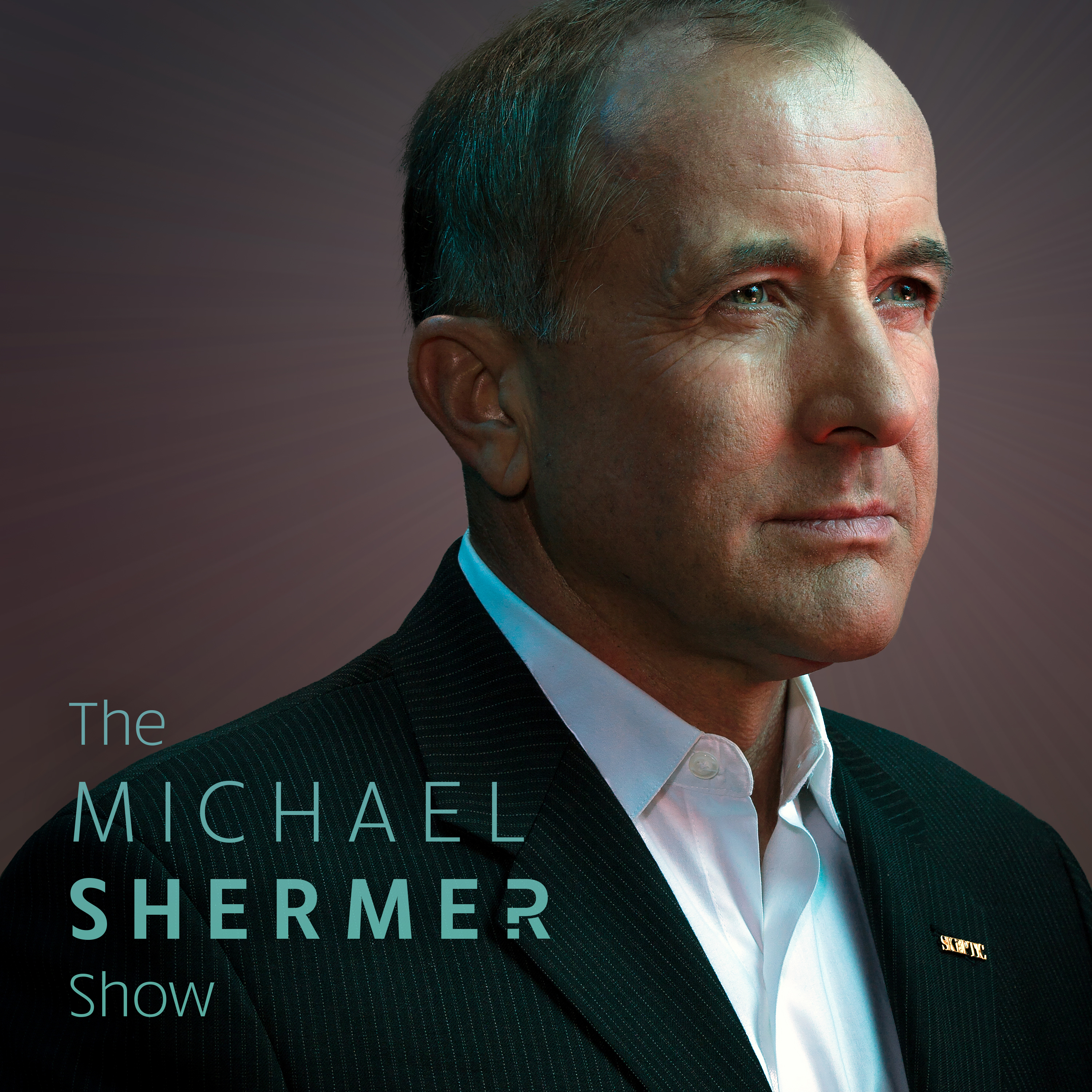
The Michael Shermer Show
Michael Shermer
The Michael Shermer Show is a series of long-form conversations between Dr. Michael Shermer and leading scientists, philosophers, historians, scholars, writers and thinkers about the most important issues of our time.
Episodes
Mentioned books

22 snips
Sep 23, 2025 • 1h 36min
The Power of Common Knowledge: Steven Pinker on Language, Norms, and Punishment
In this engaging conversation, Steven Pinker, a renowned cognitive psychologist and Harvard professor, delves into the intricate world of common knowledge. He discusses how our social interactions rely on nuanced signals like laughter and eye contact. Pinker explores the implications of common knowledge in relationships and societal norms, including the dynamics of cancel culture and the complexities of money's value. He highlights the hidden logic behind everyday life, revealing how common knowledge shapes our understanding of financial systems, political movements, and even personal connections.
Sep 20, 2025 • 1h 22min
Jim Lampley on Hosting the Super Bowl, Calling Tyson's Fights, and His Friendship with O.J.
Jim Lampley, a Hall of Fame sportscaster with a remarkable 50-year career, shares captivating insights from his life in sports journalism. He reflects on his journey from the first sideline reporter to a veteran of major events like the Super Bowl and 14 Olympics. Lampley discusses the brilliance of athletes like Muhammad Ali and Mike Tyson, emphasizes the unexpected twists of life, and addresses the ethics of performance-enhancing drugs. He also recounts personal anecdotes about O.J. Simpson and Jack Nicholson, offering a unique look into the world of sports.
12 snips
Sep 17, 2025 • 28min
The Assassination of Charlie Kirk: Shermer Reflects on Political Violence
In a thought-provoking solo commentary, the host delves into the shocking assassination of Charlie Kirk, exploring the background of the suspect and their chilling text exchanges. The conversation shifts to the psychology behind radicalization, particularly among young men seeking status, and the dangerous allure of extremist beliefs. Free speech versus incitement is scrutinized, emphasizing the importance of truth in discussions. Finally, the potential repercussions on campus discourse and the broader implications for political dialogue are examined.
46 snips
Sep 13, 2025 • 1h 38min
The Fate of Nations: Why Ignoring Human Nature Dooms Politics
Nicholas Wade, a renowned science writer and author, delves into how human nature profoundly influences political structures and societal norms. He argues that ignoring these biological underpinnings leads to political pitfalls. Topics include the interplay between genetics and political beliefs, the role of religion in social cohesion, and the evolution of morality. Wade also explores gender dynamics and the challenges posed by modern governance, emphasizing that understanding our evolutionary past is key to addressing contemporary political issues.
Sep 9, 2025 • 31min
How to Protect Children from Social Media and AI
Jean Twenge, a psychology professor at San Diego State University and author of influential books on technology's impact on youth, dives into the challenges parents face today. She discusses the emotional pitfalls of AI-driven chat apps and how they may distort children's perceptions of relationships. Twenge also addresses the alarming links between social media use and mental health decline, advocating for safer alternatives to smartphones. With practical advice, she empowers parents to navigate and protect their kids in this high-tech world.
29 snips
Sep 6, 2025 • 1h 6min
The Future of Space Exploration Amid NASA Mission Shutdowns
Alan Stern, a renowned planetary scientist and leader of NASA’s New Horizons mission, shares thrilling insights from his recent suborbital flight. He dives into the clash between government and private space ventures, emphasizing the rapid innovation in commercial space activities. Stern discusses the unfortunate budget cuts threatening NASA's future missions. He also explores the significance of ongoing extraterrestrial research and the potential for inspiring future generations in STEM through space exploration.
29 snips
Sep 2, 2025 • 1h 12min
Why Do Humans Speak?
Madeleine Beekman, professor emerita of evolutionary biology at the University of Sydney and author of The Origin of Language, discusses the unexpected origins of human language. She argues that the need to care for highly dependent infants drove early humans to communicate more effectively. This necessity for cooperation led to the development of language, fundamentally changing society. Beekman also explores the evolutionary journey of language, contrasting it with animal communication and examining how our brain's complexity plays a crucial role in social interaction.
48 snips
Aug 30, 2025 • 1h 16min
Depopulation: The Silent Global Emergency
In a captivating discussion, economist Dean Spears, an associate professor at the University of Texas at Austin and founding executive director of r.i.c.e, delves into the complexities of global population dynamics. He reveals how fears of overpopulation have shifted to concerns about declining birth rates. Spears challenges misconceptions about zero-sum economics, emphasizing the link between population and innovation. He explores cultural attitudes toward reproduction, government family planning policies, and the societal implications of a shrinking population, offering a refreshing perspective on parenting in a tech-driven future.
43 snips
Aug 26, 2025 • 1h 24min
Brainwashing, Mind Control, and Hyper-Persuasion
Rebecca Lemov, a historian of science at Harvard and visiting scholar at the Max Planck Institute, reveals the subtle ways brainwashing permeates our lives. She discusses its historical roots from POWs in North Korea to the modern dangers of social media. The conversation touches on the psychology behind cults and the moral implications of obedience in extreme situations. A focus on transformative self-awareness underscores how perceived autonomy can be manipulated. Lemov's insights challenge our understanding of control, belief, and societal norms.
Aug 19, 2025 • 1h 10min
How Foreign Governments Influence U.S. Universities
Sarah McLaughlin, a senior scholar at the Foundation for Individual Rights and Expression, dives into the alarming influence of foreign authoritarian regimes on U.S. universities. She reveals how financial ties with countries like China compromise academic integrity and freedom of expression. McLaughlin shares personal insights on censorship's rise since 2014, the implications for international students, and the debate surrounding political correctness on campuses. Her findings challenge us to consider the cost of globalization on free thought in education.

