

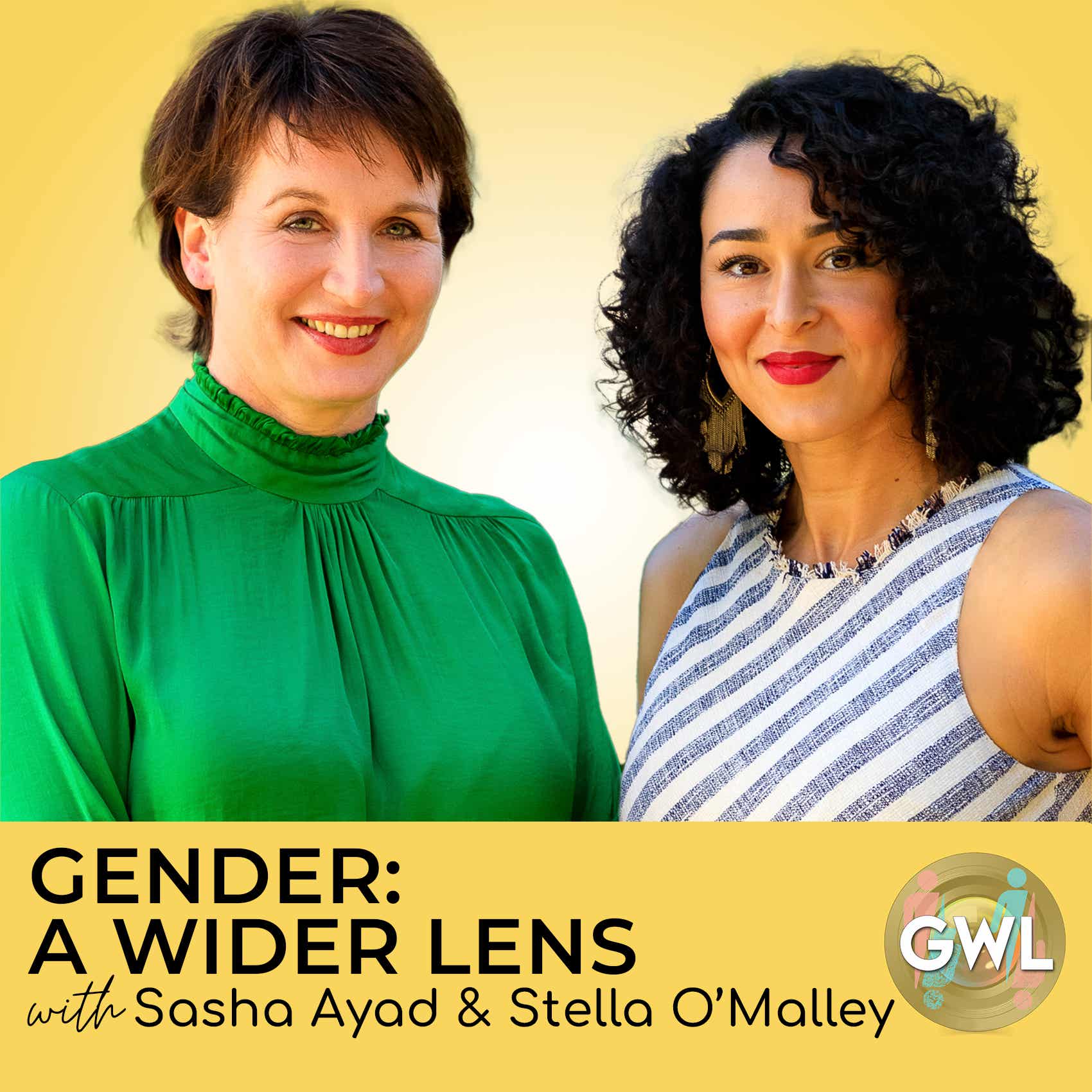
Gender: A Wider Lens
Sasha Ayad and Stella O'Malley
In this podcast, now in its fourth year, therapists Stella O'Malley and Sasha Ayad take a deep dive into the psychological and cultural forces impacting the social changes around "gender." Through interviews with researchers, doctors, therapists, parents, detransitioners, and others, Sasha and Stella's podcast is a "must listen" for anyone trying to navigate the current gender landscape. With their sharp analytical minds and deep compassionate hearts, Stella and Sasha have also become known throughout many parent networks as lighthouses in the midst of some very stormy seas. Previous guests include Helen Joyce, Jesse Singal, Leor Sapir, Kathleen Stock, Jamie Reed, Peter Boghossian and more. www.widerlenspod.com
Episodes
Mentioned books

May 7, 2021 • 1h 4min
22 — An Unexpected Gender Evolution: A Conversation with Lauren
“Lauren” is a 32-year-old lesbian who has moved with ease across the gender spectrum over the course of her lifetime. Lauren offers a positive story about how being gender non-normative and having a complicated gender experience can be a pleasant and interesting experience. Cautioning against the heavy and urgent discussions about medicalizing gender expression, Lauren wonders if we can become more playful and even joyful about gender?Links:Lauren’s Blog: Theanxiousskeptic.wordpress.com/ Extended NotesA little bit about Lauren and her experience with gender.The way our society is handling trans children is completely different from when Lauren grew up.Lauren feels a bit betrayed by the LGBTQ community.What was Lauren’s childhood like?How did Lauren’s family deal with her and her older sister’s masculine gender?Can you be gay and Mormon?Lauren was always the good child and her older sister was the problem masculine child. So it threw everyone for a loop when they found out Lauren was a lesbian, and not her sister.When Lauren dressed in drag, she felt much more comfortable in her own body.Men’s clothing was just easier to understand and when Lauren took on a more butch persona, it was a lot easier for her to date.Lauren was a butch lesbian for about 10 years before switching back to a more “feminine” look.In Lauren’s mind, being butch is almost like a third gender.At one point, Lauren identified as trans.The trans community has really affected the way lesbians see themselves. Lauren knows several people in same-sex relationships who have identified as trans at one point in time in her friend group.When it came to having children, how did Lauren and her wife decide who should have a child?A lot of Lauren’s friends who were butch were transitioning, either to a more feminine persona or trans. And she felt like she could not grieve this sense of loss. She just had to be happy for her friends.When random people were shouting slurs at Lauren and her wife, it only really started to bother her as she got older and was going to become a parent.What’s it like being a mother?Eleven-year-olds are being asked if they want to preserve their fertility. It’s crazy.Lauren has gone through many different gender identities and went on to have children. She gets fired up and passionate when young children are forced to “choose.”We have to think about the long-term well-being of children and teenagers first. Not our politics.Can we be more playful with our gender? Why do we have to always pick a side?This podcast is partially sponsored by ReIME, Rethink Identity Medicine Ethics:Rethinkime.orgLearn more about our show: Linktr.ee/WiderLensPod This is a public episode. If you would like to discuss this with other subscribers or get access to bonus episodes, visit www.widerlenspod.com

Apr 30, 2021 • 1h 15min
21 - Gender Dysphoria in Boys: Part 2 — A Conversation with Angus Fox
Continuing the discussion about the new type of boy who is seeking to transition, we speak to Angus Fox, author of a series in Quillette. Angus explains why he thought it so important to earn the trust of parents who participate in clandestine meetings about their gender dysphoric sons. We discuss the role of systematic thinking in ROGD boys and the encouragement of their female friends to transition. Angus also provides his insights as a gay man remembering his own challenging boyhood.Links:Angus Fox (2021) — “When Sons Become Daughters: Parents of Transitioning Boys Speak Out on Their Own Suffering” Quillette.com/author/angus-fox/Angus Fox — Part II Quillette.com/2021/04/06/when-sons-become-daughters-part-ii-parents-of-transitioning-boys-speak-out-on-their-own-suffering/ Angus Fox — Part III Quillette.com/author/angus-fox/ Extended NotesHow did Angus get into this field and get interested in gender dysphoria?What are some of Angus’s biases?So many parents are blindsided when their child comes out as trans.The counselors and therapists are partly to blame.Angus conducted a survey to see what parents thought was influencing their children to become trans.What did Angus uncover after conducting this extensive research?These boys are often bright, socially behind, and very online.Angus noticed that a lot of these boys were playing particular RPG games and it gave them a false illusion of what the female aesthetic really was.These very intelligent boys, who often have intelligent answers to things, are giving parents very strange and almost immature answers as to why they want to become a woman.Predatory men online could be further exacerbating the problem.How do these boys end up relating to their own sexuality?We’re seeing a rocketing number of people who are saying they’re bisexual.What benefits do these gender dysphoric boys get by joining a girl clique?Why are young women so obsessed with dressing up their new toy?So many families are just lost and don’t know what to do.Want diversity and inclusion? You should see these groups. They’re diverse and they’re all worried about their child.When you talk to de-transitioners, they all have a level of wisdom about who they are and what they want.Did Angus see a connection with autism in his surveyed group?What kinds of reactions are mom and dad having when it comes to having a trans teen?Children are taking fewer and fewer risks in our environment. As a way to rebel, they’re taking risks on their bodies and their personal identity instead.Angus is curious about the child birth order and where trans children fall under. If they have a big family, small family, and where are they in the birth order, does it impact their identity?This podcast is partially sponsored by ReIME, Rethink Identity Medicine Ethics:Rethinkime.orgLearn more about our show: Linktr.ee/WiderLensPod This is a public episode. If you would like to discuss this with other subscribers or get access to bonus episodes, visit www.widerlenspod.com

Apr 23, 2021 • 1h 3min
20 - Gender Dysphoria in Boys: Part 1
Many presume that ROGD only impacts girls, but there is a significant number of boys who appear to show the hallmark traits of Rapid-Onset Gender Dysphoria. Not quite fitting in with Ray Blanchard’s classification of homosexual transsexualism or autogynephilia, these boys tend to be softly spoken Mommy’s boys, highly intelligent and hyper-ruminative. Many prefer to remain safe at home in their bedrooms and become fixated on medical transition. In this first of two episodes, Stella and Sasha introduce some of the different ways that gender dysphoria can manifest in boys.Links:Ray Blanchard (1989). “The classification and labeling of nonhomosexual gender dysphorias.” Archives of Sexual Behavior. 18 (4): 315–334. doi:10.1007/bf01541951. PMID 2673136. S2CID 43151898.Blanchard R (August 2005). “Early history of the concept of autogynephilia.” Archives of Sexual Behavior. 34 (4):439–446. CiteSeerX 10.1.1.667.7255. doi:10.1007/s10508-005-4343-8. PMID 16010466. S2CID 15986011.Michael Bailey (2003). The Man who would be Queen. Wikipedia.org/wiki/The_Man_Who_Would_Be_QueenAnne Lawrence — (2013). Men Trapped in Men's Bodies: Narratives of Autogynephilic Transsexualism. Springer Science+Business Media. ISBN 978-1-4614-5181-5.Angus Fox (2021) — “When Sons Become Daughters: Parents of Transitioning Boys Speak Out on Their Own Suffering” Quillette.com/author/angus-fox/Donna M. (2021) — “You’re not trans, you’re just weird” Newdiscourses.com/2021/03/youre-not-trans-youre-just-weird/Kellie Jay Keen Minshull — “The locker-room has a lot to answer for” This is a public episode. If you would like to discuss this with other subscribers or get access to bonus episodes, visit www.widerlenspod.com

Apr 16, 2021 • 51min
19 - ADHD & Gender Dysphoria
Hyper-active, inattentive, immature, and impulsivity are just some of the common traits associated with ADHD. These may not have an obvious link to Gender Dysphoria and yet gender variance is found to be 6.64 times more likely among individuals with ADHD. We discuss how ADHD manifests in girls and boys, how society responds to ADHD traits, and how this interaction can lead to gender-related issues.Links: ADHD and Gender DysphoriaSciencedaily.com/releases/2014/03/140312103102.htm Girls and ADHDVerywellmind.com/adhd-in-girls-symptoms-of-adhd-in-girls-20547 Travel Programs for Adolescents/Teens/Young Adults:Adolesco.org/Habitat.org/Semesteratsea.org/Volunteerhq.org/coronavirus-update/ Elle Palmer: How my Personality Influenced my IdentityYoutube.com/watch?v=H8FrT2M44Co&feature=emb_logo Richard Branson: ADHD: The Entrepreneur’s Superpower Forbes.com/sites/dalearcher/2014/05/14/adhd-the-entrepreneurs-superpower/?sh=11f9010459e9 Michael Phelps: How swimming saved Michael Phelps: An ADHD Story Additudemag.com/michael-phelps-adhd-advice-from-the-olympians-mom/ Gabor Maté (2000) Scattered: How Attention Deficit Disorder Originates and What You Can Do About It Drgabormate.com/book/scattered-minds/Extended NotesA lot of diagnoses are flying around and it’s easy to go, “yeah, yeah.”What is ADHD? How do you define it?It’s hard to force yourself to focus when you’re really uninterested in something.ADHD is actually a good thing and it was used for our survival.When society/school tells these children they’re slow or that they’re not performing well, it can really perpetuate a lot of negative self-talk and make the problem worse.Stella can see how a lot of children with ADHD have been impacted with how poor or low self-esteem.Has ADHD always existed or is this just the byproduct of our environment?Since ADHD kids have a hard time tracking the details, they might be seen as silly or slow.Do ADHD kids seem shyer because of how many times people tell them to “stop” doing things or being who they are? Stella and Sasha wonder what kind of personality they’d truly have if they were just “free to be.”ADHD kids try their best to structure themselves and they can also end up being really obsessed with goals.Once these kids have their minds set on something, they become hyper-focused on achieving it. Even if it means it’s not 100% what they want.Social media is made for an ADHD person.How do ADHD traits show up in boys and girls, especially those with gender dysphoria?A lot of successful people have ADHD. it’s a great... This is a public episode. If you would like to discuss this with other subscribers or get access to bonus episodes, visit www.widerlenspod.com

Apr 9, 2021 • 59min
18 - COVID, Dysphoria & Listener Shout-Outs
This last year of lockdown has been a strange and unsettling time for many. We have heard reports of gender issues escalating rapidly and we have also heard accounts of people leaving all thoughts of gender identity far behind. The impact of our restricted lifestyle on our mental health is explored and some strategies that might help in these difficult times are suggested. Stella and Sasha give listeners from around the globe shout-outs and audience members are invited to request future show topics and to share their burning gender questions.Links:Msnet thread: Mumsnet.com/Talk/womens_rights/3952739-The-effect-of-lockdown-on-transitioning-teen-girlsStella O’Malley, The Journal, “Young people have suffered so much this year — they need our support”: Thejournal.ie/readme/wellness-stella-omalley-5252594-Nov2020/Stella O’Malley, Irish Independent, “We must confront painful truth: we are facing into a mental health crisis”: Independent.ie/opinion/comment/we-must-confront-painful-truth-we-are-facing-into-a-mental-health-crisis-40031671.htmlStella O’Malley, Sunday Independent, “Locked in by Covid for almost a year, the kids aren’t all right”: Independent.ie/opinion/comment/locked-in-by-covid-for-almost-a-year-the-kids-arent-all-right-40088973.htmlConnect on Twitter: @Widerlenspod & FacebookExtended NotesHow has the lockdown affected people with gender dysphoria?Some clients spend months watching transition videos on YouTube.The internet is a very influential place. Get your children off of it!Stella has noticed that young people are really scared of life.Sasha remembers being afraid to step outside after the lockdown. She’s an adult, imagine what it’s like for young people!What is Ireland like right now?What does life look like for the rest of the world? Let Sasha and Stella know!Everyone is isolated right now and Stella is seeing a lot of relapses happening. Everything from eating disorders to gender.We’ve gotten through worse! But by saying that you are denying our current experiences.We know the mental impacts war and famine have on our wellbeings that last a lifetime, but what about isolation?Children are still developing and not being able to see any of their friends; both Sasha and Stella are curious what kinds of long-term effects this will have on our society.There are intense despair and loneliness happening right now with our children.Stella shares some observations she’s had with both her introverted clients vs. extroverted clients.Sasha shares why the lockdown made her decide to move to a different location.Stella was worried that her children were spending too much time on the screens. She needed them outside.The irony is despite being on their phones all the time, young adults are under-stimulated.What have been some of the pros of the lockdown?Shoutout to the listeners! Thank you for... This is a public episode. If you would like to discuss this with other subscribers or get access to bonus episodes, visit www.widerlenspod.com

Apr 2, 2021 • 60min
17 - Autism and Gender Dysphoria
The startling links between ASD and Gender Dysphoria are raising plenty of questions as clinicians wonder why children on the spectrum tend to struggle with gender. Also, which comes first: ASD or gender nonconformity? In this episode, we explore how autistic traits may cause youth to question their gender and become attached to identity labels. And we wonder if this has implications for the trans movement.Links:Far From the Tree: Parents, Children and the Search for Identity, by Andrew SolomonAmazon.com/Far-Tree-Parents-Children-Identity/dp/0743236726 NeuroTribes: The Legacy of Autism and the Future of Neurodiversity, by Steve SilbermanAmazon.com/NeuroTribes-Legacy-Autism-Future-Neurodiversity-eboo… Scientific American Article: “Autism — It’s Different in Girls”Scientificamerican.com/article/autism-it-s-different-in-girls/ 13 YO girl with social struggles:Youtu.be/nNLznV-bZKc Papers: Thrower, E., Bretherton, I., Pang, K. C., Zajac, J. D., & Cheung, A. S. (2019). Prevalence of Autism Spectrum Disorder and Attention-Deficit Hyperactivity Disorder Amongst Individuals with Gender Dysphoria: A Systematic Review. Journal of Autism and Developmental Disorders, 50(3), 695–706. Doi.org/10.1007/s10803-019-04298-1 Hisle-Gorman, E., Landis, C. A., Susi, A., Schvey, N. A., Gorman, G. H., Nylund, C. M., & Klein, D. A. (2019). Gender Dysphoria in Children with Autism Spectrum Disorder. LGBT Health, 6(3), 95-100. doi:10.1089/lgbt.2018.0252 Butler G, De Graaf N, Wren B, et al Assessment and support of children and adolescents with gender dysphoria Archives of Disease in Childhood 2018;103:631-636. Extended NotesSasha worked with autistic children early in her career and it really shaped a lot of her training today.How do you define autism?Stella thinks girls who have autism are getting missed at a younger age compared to boys.How are gender and autism related?Some children are just getting misdiagnosed as children and it’s showing up as anxiety or depression, instead of being on the spectrum.Can’t figure out why a child might not be making progress? They’re on the wrong meds.Autistic kids in general don’t really conform to gender norms.Parents spend so much time with their autistic children just so they can live somewhat of a normal life. It’s painful and heartbreaking.It’s cute when you’re five when it comes to not picking up on the gender roles, but as you get older, it can be difficult to integrate into a normal life.Are there more autistic people now than there were before?Technology and being overly glued to it can accelerate the social deficit traits.Are you comfortable in your own body? A lot of times the answer is no.One of the signs of autism is sensory issues. Both Sasha and Stella have noticed with their gender dysphoric children that they have an overfixation on the new changes their body is giving them during puberty, and how they hate it.You don’t want to deny that children on the spectrum do have legitimate challenges, but there is a balance between blaming it on their autism... This is a public episode. If you would like to discuss this with other subscribers or get access to bonus episodes, visit www.widerlenspod.com

Mar 26, 2021 • 1h 3min
16 - Gender Dysphoria: What It's Like For Parents
Loneliness, isolation and confusion often characterises the experience of parents of the gender dysphoric child. A parallel process emerges where the children are obsessed with transition and the parents become obsessed with ROGD. Trying to set loving boundaries is often misinterpreted by others as the parent being the last standing bigot. In this episode we try to empathise with parents who feel they’ve lost control over their child’s wellbeing Links:Gender Dysphoria Support Network: https://genderdysphoriasupportnetwork.com/ Sasha’s Parent Resource Page: https://www.subscribestar.com/sashalpc Sasha’s YouTube Channel: https://www.youtube.com/channel/UCGNuXjES0uUGfvXaRwixgag Bayswater Support: https://www.bayswatersupport.org.uk/ Gender Critical Support Board: https://gendercriticalresources.com/Support/index.php Our Duty: https://ourduty.group/ Extended NotesMany parents feel lonely and isolated to be a parent of a child going through gender dysphoria.Sasha has been contacted by 1,500 families and has consulted with around 500 families on the topics of gender dysphoria.How did Stella and her parents deal with her inner struggles with her gender when she was growing up?There is a tendency to take a gender non-conforming child to a professional. Parents want to be good parents. Parents don’t want to screw their children up.For parents who are referred to a gender clinic, the things that the clinic recommends are utterly shocking. Why can’t kids just be kids?Gender clinics use fear tactics on the parents, and they listen.Early gender intervention is very damaging to the child.Suddenly, it no longer becomes about the child and their unique tastes. Their gender becomes political.Parents feel very guilty when they find out that they were being led down a path of puberty blockers that could permanently alter their children’s lives forever. They thought they were just being liberal and supporting their child’s gender identity.A good parent does “this.” And most parents blindly follow that rule.Puberty is coming fast and now parents don’t know what to do.Puberty blockers are made to seem normal in these circles, but this is a serious decision that you should not be taking lightly.What do you do when you have a very traditional gender-conforming child, and then one day they decide they’re no longer a She and want to be called a He?Parents get such a shock that they end up researching and researching to find out more.Some parents are drowning in trying to keep this a secret.By questioning whether this is right/wrong, parents get seen as transphobic,... This is a public episode. If you would like to discuss this with other subscribers or get access to bonus episodes, visit www.widerlenspod.com

Mar 19, 2021 • 1h 3min
15 - One Detrans Voice: A Conversation with Carol
Carol is a 40-year-old detransitioned butch lesbian. She transitioned at 34 and is part of an often ignored group: adult lesbians turned trans men. Carol tells us about the initial highs of transition and how things took a turn for the worse…Links:Velvet Chronicle InterviewDetrans VoicesCarol’s TwitterDetrans Voices Interviews“Where Have all the Lesbians Gone?”“Butch identity development: The formation of an authentic gender”“The He Hormone”Extended NotesWhere is the space for de-transitioners?Carol is a lesbian who is no longer taking hormones. She is beginning to detransition.What was Carol’s childhood like?When Carol was 9, she was told she was acting like a boy and needed to change.Carol’s mother lost her mind on her pastor when she found out Carol played football with his boys.Carol suspects that her mother was a closeted woman.Why did Carol choose not to go to high school?Carol thought it was really cool to see women who didn’t shave their hair. She saw what “normal” women were supposed to look like.Alcoholism is a big issue in the lesbian community.What makes someone trans? Carol checked all the boxes. But the boxes were wrong!“I don’t feel like a girl.” is just another way for someone to say that they don’t feel pretty.Carol has a younger sister who has blonde hair and blue eyes, and everybody just fell over themselves for her growing up. Carol felt like an ogre.At 17 years old, Carol had a nervous breakdown.The butch lesbian is often the butt of many jokes in the media. It was difficult for Carol who had more masculine traits.When did Carol first think about transitioning?Carol received different treatment for being a butch woman.Being a guy — is it easier?Carol tried twice to transition. In her 20s and her 30s. What was that experience like?Carol did not know the side effects she would have from taking testosterone. It was so experimental.Taking testosterone, especially in those large amounts, it’s like a drug.Carol’s mental state started to deteriorate about a year and a half into her transition as a man.By year four, Carol was paralyzed in her room and she didn’t want to leave because her anxiety was so high.Carol’s female anatomy was deteriorating as well from lack of use, so a new set of problems would have arisen if she had kept taking hormones.When did Carol decide to de-transition?Carol’s gender struggles were a form of distress and she was not given that many options to solve that distress.People often throw “transition!” into the fold as the only option when there are other pathways to explore. We need other options and education around that. Transitioning isn’t the only solution.This podcast is partially sponsored by ReIME, Rethink Identity Medicine Ethics: This is a public episode. If you would like to discuss this with other subscribers or get access to bonus episodes, visit www.widerlenspod.com

Mar 12, 2021 • 1h 6min
14 - The REAL Ways to Manage Gender Dysphoria
The misinformed presumption that gender dysphoria can only be managed through medication and/or surgery is blown out of the water in this episode. Sasha and Stella emphasize that dysphoria is a type of human distress, like any other. They discuss many different ways to understand, manage, and reduce gender dysphoria.Links:“The Detransitioners” by Laura Dodsworth, The Sunday TimesAlternatives to Deal with Gender Dysphoria, by NelemilIllusory truth effectWilliam Glasser’s Emotional NeedsThe Time in Between: A Memoir of Hunger and Hope, by Nancy Tucker“Advice for Gender Dysphoric Teens”“Storm Warnings,” by Adrienne RichExtended NotesGender dysphoria is mental distress.What are some of the best ways to manage gender dysphoria?If someone is distressed, what should we be looking at?Insomnia is a manifestation of anxiety.Are you fixated on a certain type of body and jealous you don’t have it?The more you see something, even if you don’t believe it at first, the more you accept it as reality later down the line. Be conscious of what you’re exposing yourself to.If you had mental distress, it was your problem. Therapy wasn’t exactly “the go-to” solution.Are you a parent in a rush to get your gender dysphoria child better?There is so much power in working out and owning the changes in your body.Our bodies can teach us a lot of things if we engage them correctly.What is social dysphoria?People are so afraid to say something bad or something else, but it’s your right to feel angry if it angers you!We come from apes. We were killers for survival and we all have a dark side. In our society, we can’t let that out in a healthy way.If you believe changing your body will make you happy, you’re going to spend a lot of time in that fantasy.Exercise: Measure your mood before you go online and after. Do you feel better or worse?A lot of phobias come from teens coming into their new bodies. New breasts, hair, and period pains.People are really grappling with the concept of privilege and what means.It is assumed that people who are privileged have an easy life, but this can end up suppressing a lot of core emotions or minimizing real thoughts.Many trans people have transitioned, and their feelings of gender dysphoria still remain.This podcast is partially sponsored by ReIME, Rethink Identity Medicine Ethics:Rethinkime.orgLearn more about our show: Linktr.ee/WiderLensPod This is a public episode. If you would like to discuss this with other subscribers or get access to bonus episodes, visit www.widerlenspod.com

Mar 5, 2021 • 1h 3min
13 - Are Brilliant People More Likely Trans?
Gifted and exceptional children seem more inclined to gender nonconformity and they represent a significant proportion of the ROGD teens discussed in Dr. Littman’s research. Sasha and Stella explore why there may be a link between brilliance and transgender identity.Links:“Overexcitability and the Gifted”, by Sharon Lind“Where Overexcitability and Gender Dysphoria Meet,” by Jessie Mannisto“Gender Identity and Overexcitability Profiles of Gifted College Students” Researchgate (2009)“Gender Dysphoria and Gifted Children,” by Lisa MarchianoDr. Lisa LittmanLiving with Intensity: Understanding the Sensitivity, Excitability, and the Emotional Development of Gifted Children, Adolescents, and Adults, Edited by Susan Daniels and Michael M. PiechowskiCarol Dweck & MindsetThe Social Dilemma FilmCotton Wool Kids: What's Making Irish Parents Paranoid?, by Stella O'MalleyExtended NotesHow do the Irish reward/acknowledge/talk about “exceptional learners” and gifted individuals?Educated American parents want to know how gifted their children really are.Children who are exceptionally gifted will be placed in a different learning program to help them accelerate.Kids can get set up with the expectation that they’re going to be exceptional all the time, and that leads to a lot of disappointment in life.Why are gender dysphoria and “giftedness” linked?How do you define a “gifted” person?Sasha believes a lot of gifted people really struggle with depression in their teenage years as they see all their peers having fun and they “just can’t relate.”It’s very lonely being intelligent.Intense kids crave really deep relationships and are dissatisfied by superficial relationships that are very common during the teenage years.Stella has noticed that a lot of teens aren’t “that into” music anymore. It used to be a huge part of her identity when she was growing up.If you have a growth mindset, you’re able to handle failure much easily.Everyone in life is “in a process.” Nobody starts out great.Do you have a fear of failure? It's a very common experience!Companies are savvy and they want you to get excited, emotionally, so that there’s more engagement on their platforms.It’s common for teenagers to have a big sense of imaginability, but these can really go “off the rails,” so to speak, with brilliantly gifted kids.What’s concerning is children taking on more video games instead of going outside and being physical to expend all that energy. It impacts your health and your... This is a public episode. If you would like to discuss this with other subscribers or get access to bonus episodes, visit www.widerlenspod.com

