

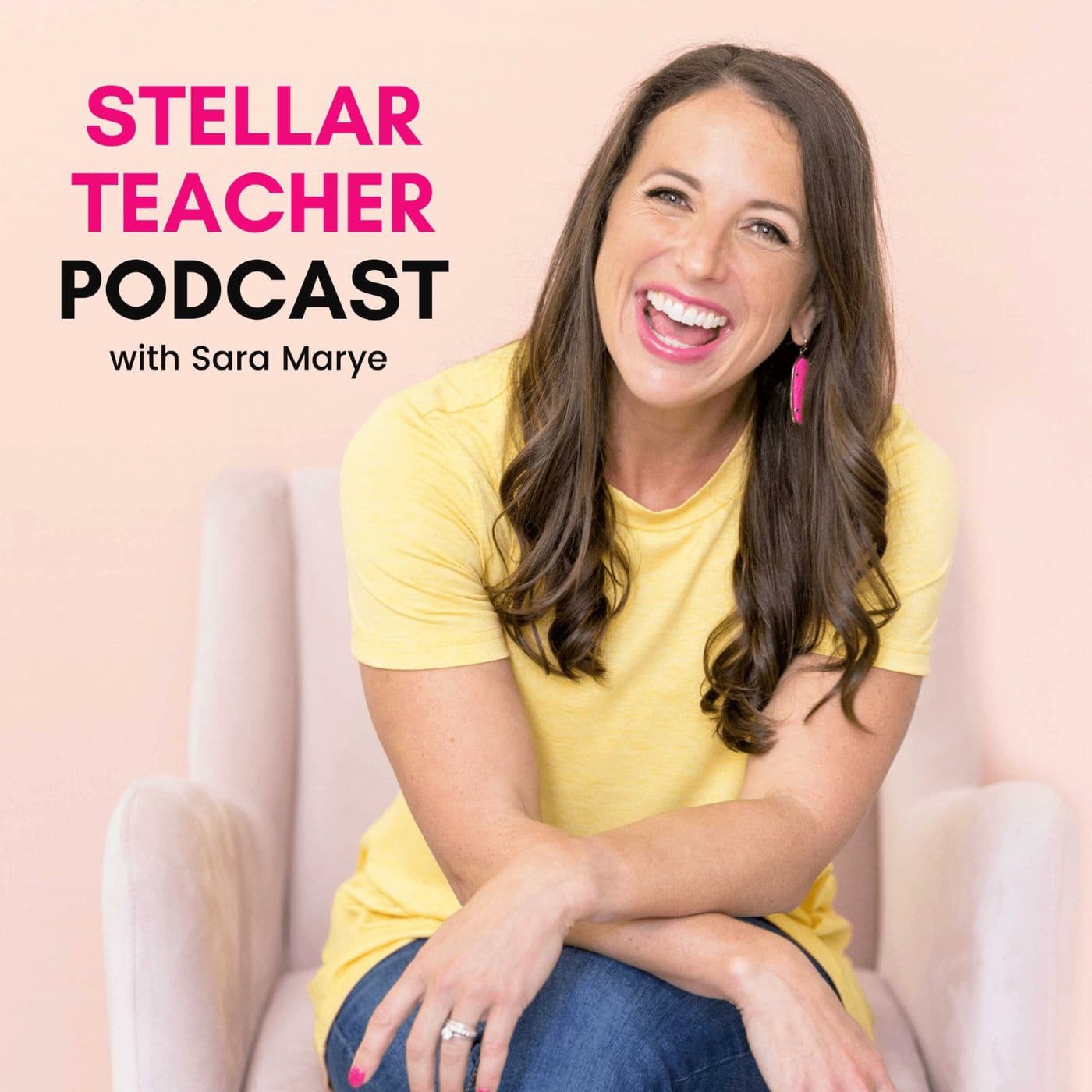
Stellar Teacher Podcast: A Podcast for Upper Elementary Teachers
Sara Marye, Literacy Teacher, Elementary Teacher
Welcome to the Stellar Teacher Podcast! We believe teaching literacy is a skill. It takes a lot of time, practice, and effort to be good at it. This podcast will show you how to level up your literacy instruction and make a massive impact with your students, all while having a little fun!
Your host, Sara Marye, is a literacy specialist passionate about helping elementary teachers around the world pass on their love of reading to their students. She has over a decade of experience working as a classroom teacher and school administrator. Sara has made it her mission to create high quality no-fluff resources and lesson ideas that are both meaningful and engaging for young readers.
Each week, Sara and her guests will share their knowledge, tips, and tricks so that you can feel confident in your ability to transform your students into life-long readers.
For printable and digital resources, head to stellarteacher.com. Connect with Sara on Instagram @thestellarteachercompany
Your host, Sara Marye, is a literacy specialist passionate about helping elementary teachers around the world pass on their love of reading to their students. She has over a decade of experience working as a classroom teacher and school administrator. Sara has made it her mission to create high quality no-fluff resources and lesson ideas that are both meaningful and engaging for young readers.
Each week, Sara and her guests will share their knowledge, tips, and tricks so that you can feel confident in your ability to transform your students into life-long readers.
For printable and digital resources, head to stellarteacher.com. Connect with Sara on Instagram @thestellarteachercompany
Episodes
Mentioned books

Jan 6, 2026 • 24min
286. Dear Stellar Teacher: Making Space for More Joy This Year
In this first Dear Stellar Teacher episode of 2026, Emily and I are kicking off the new year by talking about something that doesn’t get nearly enough attention in education: joy. A new year can bring excitement and fresh goals, but it can also feel heavy when you’re returning to the same classroom challenges, schedules, and demands. In this episode, we slow things down and reflect on what it really looks like to bring more joy into the second semester in ways that feel sustainable, meaningful, and realistic for teachers.Throughout our conversation, we share small but powerful mindset shifts and practical ideas that can help teachers rediscover joy in their classrooms and in the profession. We talk about the calming power of classroom routines, the importance of professional satisfaction, and why setting boundaries between work and life matters more than we sometimes realize. We also reflect on joyful classroom moments—like book talks, read alouds, playful routines, and recess connections—and why these experiences often stay with us long after the lesson plans are forgotten.We wrap up the episode by zooming out and talking about joy beyond the classroom. Finding joy at school is deeply connected to how we care for ourselves outside of work, whether that’s through hobbies, time outdoors, creative outlets, or meaningful connection. Our hope is that this conversation reminds you that joy doesn’t have to be big or complicated—it can come from small, intentional choices that help you reconnect with your students, your work, and yourself. As you head into the second semester, we hope you’ll find ways to make space for more joy—for you and for the kids you teach.Join us in the Stellar Literacy Collective Membership: stellarteacher.com/join!Fill out the Dear Stellar Teacher form for a chance to be featured on a future episode.Sign up for my FREE private podcast, the Confident Writer Systems Series, here!Sign up for my FREE Revision Made Easy email series here!Follow me on Instagram @thestellarteachercompany.To check out all of the resources from this episode, head to the show notes: https://www.stellarteacher.com/episode286.
Dec 29, 2025 • 10min
285. Implementing Classroom Routines for a Strong Second Semester
In this episode, I’m talking all about implementing classroom routines as we head into the second semester. This time of year can feel exciting and overwhelming all at once, especially when we realize we’re already halfway through the school year with our students. I share why routines matter so much—particularly in upper elementary—and how they create predictability, calm, and valuable “white space” that allows students to focus their energy on learning instead of figuring out what to do.I walk through a clear, five-step process for teaching routines in a way that actually sticks. We start by getting clear on the routine and its purpose, then explicitly teaching it, modeling it (both the right and wrong way), practicing with feedback, and finally reinforcing and resetting as needed. I explain why slowing down during the implementation phase is so important, even when it feels tedious, and how that upfront investment pays off later with smoother days and a more focused literacy block.I also share encouragement for those moments when routines inevitably break down. Resetting a routine doesn’t mean you failed—it means your students need a reminder, more practice, or clearer expectations. With consistency, clarity, and intentional practice, routines will eventually become second nature, helping your classroom run more smoothly and giving you more energy for the parts of teaching you love most. As you head back into your classroom, remember that strong routines aren’t built in a day—but they are worth the time it takes to build them well.Join us in the Stellar Literacy Collective Membership: stellarteacher.com/join!Sign up for my FREE private podcast, the Confident Writer Systems Series, here!Sign up for my FREE Revision Made Easy email series here!Follow me on Instagram @thestellarteachercompany.To check out all of the resources from this episode, head to the show notes: https://www.stellarteacher.com/episode285.
Dec 22, 2025 • 32min
284. 5 Steps to Teaching with Thematic Units [Listen Again]
In today’s episode, I’m sharing one of my favorite ways to bring more purpose, connection, and deeper learning into your literacy block: thematic planning. This approach—sometimes called cross-curricular instruction—was a huge shift for me when I first transitioned to an IB school. Instead of treating reading, writing, science, and social studies as separate silos, I learned how to plan around big ideas and guiding questions that tied all of our learning together. While it took time to adjust, it completely transformed the way my students engaged with content and how meaningful our classroom learning felt.Throughout the episode, I walk you through what thematic planning is, why it’s so powerful, and how you can start using it even if your school doesn’t require it. I share my personal experience with moving away from isolated, checklist-style instruction and embracing a more integrated, inquiry-driven approach. I also break down the five simple steps to designing your own thematic unit—everything from choosing a strong guiding question, to selecting connected texts, to building background knowledge, to weaving reading and writing standards into meaningful science or social studies learning. My goal is to show you that thematic planning doesn’t have to be overwhelming or reserved for specialized programs. It’s absolutely doable in any upper elementary classroom.You’ll also hear practical examples of what this looks like day to day, ideas for connecting literacy skills to real-world reading and writing, and a reminder that thematic planning is one of the best ways to build students’ content knowledge—something we simply don’t get enough time for in traditional schedules. Whether you create a week-long mini unit or a full multi-week study, thematic planning opens the door to richer discussions, more engaged readers and writers, and learning that sticks. If you decide to give thematic planning a try, I’d love to hear what topic you choose and how it impacts your students’ learning.***This episode is a replay of Episode 119, and it’s one worth revisiting as you think about planning for the months ahead.Check out my Nonfiction Science Reading Passages: Focus on Ecosystems, Focus on Biomes, Focus on Heredity.Check out my Sentence Writing Routine resource here!Join us in the Stellar Literacy Collective Membership: stellarteacher.com/join!Sign up for my FREE private podcast, the Confident Writer Systems Series, here!Sign up for my FREE Revision Made Easy email series here!Follow me on Instagram @thestellarteachercompany. To check out all of the resources from this episode, head to the show notes: https://www.stellarteacher.com/episode284.
Dec 15, 2025 • 30min
283. Your Guide to Teaching Syllabication in Upper Elementary [Listen Again]
In today’s episode, I’m unpacking a skill that often gets overlooked in upper elementary but has a huge impact on whether students can read big words with confidence. So many of our students see a long word and immediately freeze or give up, not because they don’t want to try, but because they don’t have the tools to break the word apart. That’s where syllabication comes in. When we intentionally teach students about syllable types and syllable division, we give them the confidence and know-how to tackle long words with accuracy and independence.Throughout the episode, I unpack why syllabication is such an essential part of reading instruction in grades 3–5. I talk through the six syllable types, the foundational vowel sounds students need to understand, and why prompts like “slow down” or “break apart the word” aren’t effective unless students actually know how to do those things. I also share several reasons students struggle with multisyllabic words—gaps in early instruction, difficulty applying known rules to longer words, and the increased complexity of upper elementary texts. Most importantly, I focus on how teaching syllabication directly supports fluency, comprehension, and word recognition, and how it complements the work we’re already doing with prefixes, suffixes, and roots.Finally, I break down what effective syllable instruction looks like in the classroom: explicit, systematic teaching paired with ongoing practice. I walk you through how to introduce each syllable type, why to start with simple examples, the importance of teaching exceptions, and ways to build in meaningful practice through warmups, small groups, independent reading, and vocabulary routines. My goal in this episode is to help you feel confident bringing syllabication into your classroom—because when students understand how syllables work, they gain a powerful tool for reading big words. And if you’re looking for ready-to-use lessons and visuals to support your teaching, be sure to check out the syllable types resource I mentioned at stellarteacher.com/syllables.***This episode is a replay of Episode 121, a listener favorite that continues to help teachers support students with multisyllabic words.Check out my Syllable Types: Lesson Plans & Activities Bundle here!Join us in the Stellar Literacy Collective Membership: stellarteacher.com/join!Sign up for my FREE private podcast, the Confident Writer Systems Series, here!Sign up for my FREE Revision Made Easy email series here!Follow me on Instagram @thestellarteachercompany. To check out all of the resources from this episode, head to the show notes: https://www.stellarteacher.com/episode283.
Dec 8, 2025 • 24min
282. 4 Ways to Easily Incorporate Movement into Your Instructional Day [Listen Again]
In this episode, I’m kicking off December with a little real talk about this wild stretch between Thanksgiving and winter break—and how we can make it feel a bit lighter. These weeks can be LONG, so I’m sharing encouragement to protect your energy, give yourself permission to slow down a bit, and be more present with the people you love.From there, I dive into the fun stuff: practical ways to incorporate movement into your literacy block so you can keep students engaged, focused, and still learning—even when they’re a little squirrely. I walk you through four easy movement routines you can start using right away: “Find Someone Who,” gallery walks, whip arounds, and snowball fights. I explain how each routine works, when to use it, and why taking just a few minutes to get kids up and moving can actually boost attention and comprehension rather than derail your lesson.I also share tips for explicitly teaching and practicing these routines so they feel structured rather than chaotic—think modeling expectations, practicing the movement without content first, and using visual reminders like slides or anchor charts. Whether you’re looking for simple ways to review content, build in brain breaks that are still connected to instruction, or just survive these last few weeks with a little more joy, this episode will give you low-prep, high-engagement ideas you can use between now and winter break (and then again when you’re back in January!).***This episode is a replay of Episode 111. While a few details may have shifted or changed since it first aired, the ideas and movement routines are still just as relevant and ready for you to use in your classroom.Check out our engagement routines teaching slides: stellarteacher.com/movementJoin us in the Stellar Literacy Collective Membership: stellarteacher.com/join!Sign up for my FREE private podcast, the Confident Writer Systems Series, here!Sign up for my FREE Revision Made Easy email series here!Follow me on Instagram @thestellarteachercompany. To check out all of the resources from this episode, head to the show notes: https://www.stellarteacher.com/episode282.
Dec 1, 2025 • 19min
281. 5 Reasons Why You Need to Spend More Time on Sentence Writing in Upper Elementary [Listen Again]
In today’s episode, I’m diving into a small but mighty part of literacy instruction that has a huge impact on your students’ reading and writing success—the sentence. For years in my own classroom, I didn’t give sentence-level work nearly enough attention, even though sentences are at the heart of everything students read and write. If you’ve ever wondered how to strengthen your students’ writing, boost their comprehension, or make your literacy instruction more effective, this episode will give you a fresh perspective on why focusing on sentences matters so much.I’m sharing five key reasons why sentence-level work is an essential part of upper elementary literacy instruction. Strong sentences are the foundation of all writing—whether students are crafting paragraphs, essays, summaries, or responses to reading, their success depends on their ability to write clear, complete, and detailed sentences. At the same time, understanding sentence structure is crucial for comprehension. When students understand how phrases and clauses work together, they are better equipped to make meaning from the increasingly complex texts they encounter. Plus, sentence-level work is manageable for students and teachers, it’s one of the most effective ways to teach grammar, and it benefits all learners—those who struggle and those who are already confident writers.My hope is that this episode inspires you to slow down and give sentence-level writing the time and intention it deserves. Prioritizing sentences can transform your writing instruction, strengthen your students’ reading comprehension, and make your overall literacy block more effective and more manageable. Whether you’re looking for a place to start or simply need a reminder that small shifts can lead to big growth, this episode will give you practical insight into why every upper elementary teacher should be spending more time on sentences.Join us in the Stellar Literacy Collective Membership: stellarteacher.com/join!Sign up for my FREE private podcast, the Confident Writer Systems Series, here!Sign up for my FREE Revision Made Easy email series here!Follow me on Instagram @thestellarteachercompany. To check out all of the resources from this episode, head to the show notes: https://www.stellarteacher.com/episode281.
Nov 24, 2025 • 6min
280. Slow Down to Show Up: A Thanksgiving Reminder for Teachers
As we head into Thanksgiving week, I know things can start to feel a little chaotic. Schedules are disjointed, students are distracted, and you’re probably juggling classroom responsibilities with holiday prep, travel plans, or hosting duties. It’s a lot—and it’s easy to feel the pressure to keep pushing through. But this week’s episode is your gentle reminder that it’s okay to pause, slow down, and give yourself permission to do less.In this short and heartfelt episode, I’m encouraging you to shift your focus from productivity to connection. Instead of cramming in one more lesson or assessment, think about what it might look like to create a calm and cozy classroom space. Read a picture book just for fun, play a simple vocabulary game, have your students free write about something joyful, or do a quick classroom reset together. These activities may look different from your usual plans, but they’re still deeply valuable—they help your students feel grounded, connected, and ready to return after Thanksgiving break with a clear mind.So if you needed a little permission slip this week, this is it. Doing less doesn’t mean you’re falling behind—it means you’re protecting your energy and caring for your students in a meaningful way. You’re already doing enough, and the best thing you can give yourself (and your class) this Thanksgiving week is a moment to rest and recharge. Tune in for a little encouragement and a reminder that slowing down is sometimes the most productive thing you can do.Purchase our Thanksgiving Themed Literacy Resource, or our Seasonal Literacy Bundle.Join us in the Stellar Literacy Collective Membership: stellarteacher.com/join!Sign up for my FREE private podcast, the Confident Writer Systems Series, here!Sign up for my FREE Revision Made Easy email series here!Follow me on Instagram @thestellarteachercompany. To check out all of the resources from this episode, head to the show notes: https://www.stellarteacher.com/episode280.
Nov 17, 2025 • 13min
279. Plot Twist: Student Engagement Doesn’t Happen by Accident
There are so many times as teachers when we realize we’re the ones doing all the heavy lifting during our lessons—talking, thinking, and writing—while our students sit back and watch. If that sounds familiar, you’re not alone. Student engagement isn’t something that happens automatically, even with a great lesson plan. In this episode, I’m unpacking what it really means to plan for engagement and why it’s essential to build intentional opportunities for students to think, respond, and connect throughout every lesson.I share a handful of simple engagement routines that can transform the way your students interact with your lessons. These routines—like the classic think-pair-share, agree/disagree statements, two-sentence responses, and three-two-one reflections—don’t require fancy materials or major prep. Instead, they’re flexible structures that you can use in any subject to spark thinking, encourage participation, and give every student a voice in your classroom.By the end of this episode, you’ll see how easy it can be to plan for engagement and keep your students actively involved all lesson long. My challenge for you this week is to choose one engagement routine and try it out. Start small, stay intentional, and watch how your students’ focus, confidence, and comprehension grow. Click play to discover how small, intentional changes can make a big difference in how your students show up and engage during lessons.Join us in the Stellar Literacy Collective Membership: stellarteacher.com/join!Sign up for my FREE private podcast, the Confident Writer Systems Series, here!Sign up for my FREE Revision Made Easy email series here!Follow me on Instagram @thestellarteachercompany. To check out all of the resources from this episode, head to the show notes: https://www.stellarteacher.com/episode279.
Nov 10, 2025 • 14min
278. Scaffolding That Sticks: 4 Steps to Support Student Learning
If you’ve ever wrapped up what felt like a perfectly modeled lesson only to see blank stares when your students try it on their own, you’re not alone. You know the moment: you’ve explained, demonstrated, and thought aloud, but when it’s their turn, they freeze. The problem often isn’t the modeling itself—it’s that students need more support between watching and doing. That’s where effective scaffolding comes in.In this episode, I break down the four key steps of scaffolding—modeling, approximating, fading away, and independent learning—and share why each one matters. You’ll learn how these steps help students internalize new skills rather than just imitate what they see, and how skipping a single phase can lead to confusion or frustration. When we add in those middle scaffolds, we create the structure students need to build true confidence and independence.Ultimately, scaffolding is about slowing down the learning process just enough so that all students have the chance to succeed. When we give them the right amount of support—and remove it at the right time—we set them up for meaningful growth and long-term learning. This episode will help you reflect on your own scaffolding practices and feel confident making small, intentional shifts that lead to big results.Join us in the Stellar Literacy Collective Membership: stellarteacher.com/join!Sign up for my FREE private podcast, the Confident Writer Systems Series, here!Sign up for my FREE Revision Made Easy email series here!Follow me on Instagram @thestellarteachercompany. To check out all of the resources from this episode, head to the show notes: https://www.stellarteacher.com/episode278.
Nov 3, 2025 • 14min
277. 3 Simple Summarizing Frames to Boost Comprehension
In this episode of The Stellar Teacher Podcast, I’m diving into one of the most important and challenging comprehension skills we can teach our students—summarizing. If you’ve ever had students freeze when asked to write a summary or retell every single detail of a story, you’re not alone. Summarizing requires students to synthesize, prioritize, and organize information while expressing it in their own words. It’s a higher-level skill that takes time to develop, but it’s also one of the most powerful ways to boost reading comprehension.I’ll walk you through three simple and effective summarizing frames you can introduce in your classroom this week. We’ll look at how the Somebody, Wanted, But, So, Then (SWBST) frame helps students capture the plot of a fiction text, how the TAMKO frame guides nonfiction summaries, and why the 10-Word Summary is a flexible, engaging way to help students identify what matters most. Each of these frames provides the structure students need to confidently summarize without getting overwhelmed—and over time, they’ll learn to do it independently.If your students struggle to write clear, concise summaries, this episode is for you. You’ll learn how to model and scaffold each of these frames so students can see what an effective summary looks like. Plus, I share tips for deciding which frame to use, how to help students transition beyond them, and ways to make summarizing an engaging, low-stress part of your literacy routine.Join us in the Stellar Literacy Collective Membership: stellarteacher.com/join!Sign up for my FREE private podcast, the Confident Writer Systems Series, here!Sign up for my FREE Revision Made Easy email series here!Follow me on Instagram @thestellarteachercompany. To check out all of the resources from this episode, head to the show notes: https://www.stellarteacher.com/episode277.

