

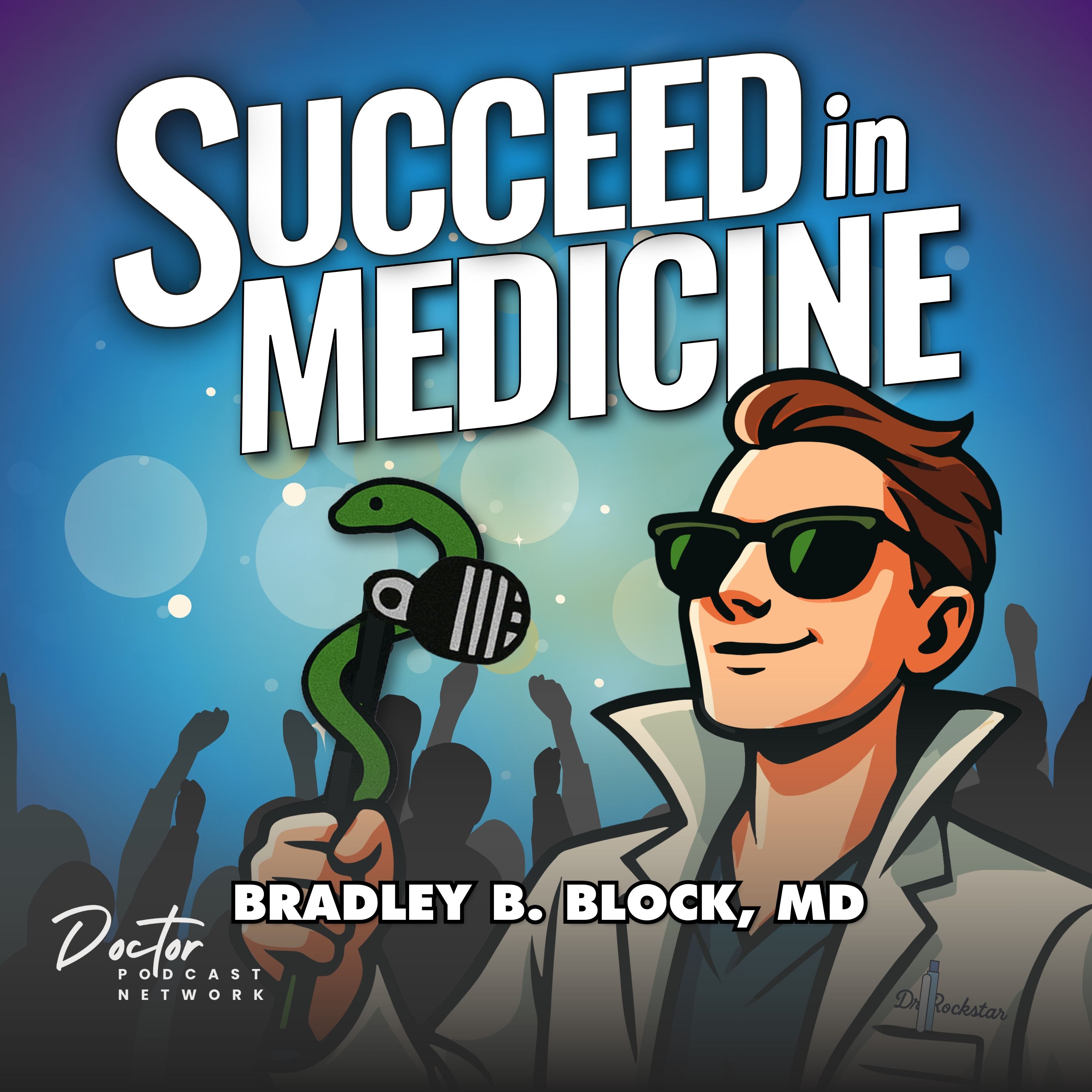
Succeed in Medicine
Bradley B. Block, MD, Doctor Podcast Network
Was your medical education enough to handle everything physician life demands? From lawsuits to leadership, career decisions to challenging conversations, balancing the personal with the professional — not enough was addressed in medical school, residency or fellowship.
This medical podcast fills those gaps so you can live up to the expectations that come with the white coat — not just in the exam room, but in all the places your MD follows you. This show is the physician mentor you didn’t realize you needed.
Your host, Dr. Bradley Block, a private practice ENT, is right there with you — navigating the same challenges and bringing in world-class guests to teach, as he puts it, “everything we should have been learning while we were memorizing Kreb’s cycle.” With nearly 500 episodes and close to half a million downloads, Brad has built a trusted space where physicians come for brass-tacks, immediately-applicable advice.
You don’t need another certification. You need a medical podcast that can be your physician mentor. It covers interpersonal skills, medical education, doctor personal finance, doctor charting, doctor careers, doctor mental health, physician soft skills, physician parenting, physician executive skills, medical decision making, medical professional development, physician side gigs, main gigs, reacting to bad reviews, misinformation, social media, negotiating and what to do when someone yells, “Is there a doctor on board?”
Guests have included Lady Glaucomflecken Kristen Flanary, Matt Abrahams, PhD, Gita Pensa, MD, Nneka Unachukwu, MD, Amy Fogelman, MD, Bapu Jena, MD, PhD.
A proud founding member of the Doctor Podcast Network!
This medical podcast fills those gaps so you can live up to the expectations that come with the white coat — not just in the exam room, but in all the places your MD follows you. This show is the physician mentor you didn’t realize you needed.
Your host, Dr. Bradley Block, a private practice ENT, is right there with you — navigating the same challenges and bringing in world-class guests to teach, as he puts it, “everything we should have been learning while we were memorizing Kreb’s cycle.” With nearly 500 episodes and close to half a million downloads, Brad has built a trusted space where physicians come for brass-tacks, immediately-applicable advice.
You don’t need another certification. You need a medical podcast that can be your physician mentor. It covers interpersonal skills, medical education, doctor personal finance, doctor charting, doctor careers, doctor mental health, physician soft skills, physician parenting, physician executive skills, medical decision making, medical professional development, physician side gigs, main gigs, reacting to bad reviews, misinformation, social media, negotiating and what to do when someone yells, “Is there a doctor on board?”
Guests have included Lady Glaucomflecken Kristen Flanary, Matt Abrahams, PhD, Gita Pensa, MD, Nneka Unachukwu, MD, Amy Fogelman, MD, Bapu Jena, MD, PhD.
A proud founding member of the Doctor Podcast Network!
Episodes
Mentioned books

Dec 21, 2019 • 38min
Why Smart Doctors Schedule Nap Time with Phil Boucher, MD
On today’s episode we speak to Dr. Phil Boucher, pediatrician, podcaster, physician coach, blogger, and physician efficiency expert. We discuss ways to make sure the private practice physician is maximizing the use of their time. That doesn’t mean no naps! He mentions scheduling nap time into one of his days! The key is to plan as much of your day as possible, schedule in some flex time for unexpected events, and be as proactive as possible about doing your work at times in which you are most efficient – when nobody else is around or awake. Make it happen! This was a great conversation with someone many of you already know from his large online footprint.Dr. Phil Boucher is a board-certified pediatrician in Lincoln, NE and business consultant. He helps private practice owners design a thriving practice and fulfilling life. Phil is an expert on marketing, branding, and organizational systems specifically for physicians, and his passion is helping tired, overworked private practice physicians climb out of the trenches to work less and earn more. He is the host of private practice matters, which can be found at privatepracticematters.comFind this and all episodes on your favorite podcast platform at SucceedinMedicine.comPlease be sure to leave a five-star review, a nice comment and SHARE!!!This medical podcast with a physician mentor explores how private practice physicians, busy doctors, and overwhelmed doctors can maximize their time and energy without burning out. We discuss physician lessons in time management, planning flex time, and scheduling work when you are most efficient—even if that means building nap time into your doctor career schedule. Listeners will learn physician soft skills for organizing their day, avoiding doctor regret, and reducing physician stress while still getting more done. This episode gives good physicians, physician parents, female physicians, and physician executives practical strategies to improve patient encounters, streamline doctor charting, and become fulfilled doctors who use their time wisely.
This medical podcast is your physician mentor to fill the gaps in your medical education. We cover physician soft skills, charting, interpersonal skills, doctor finance, doctor mental health, medical decisions, physician parenting, physician executive skills, navigating your doctor career, and medical professional development. This is critical CME for physicians, but without the credits (yet). A proud founding member of the Doctor Podcast Network!Visit www.physiciansguidetodoctoring.com to connect, dive deeper, and keep the conversation going. Let’s grow! Disclaimer:This podcast is for informational purposes only and is not a substitute for professional medical, financial, or legal advice. Always consult a qualified professional for personalized guidance. Hosted by Simplecast, an AdsWizz company. See pcm.adswizz.com for information about our collection and use of personal data for advertising.
Nov 21, 2019 • 39min
Addressing Physician Racial Biases Provide Equitable Care, with Uché Blackstock, MD
Dr. Uché Blackstock is an emergency medicine physician who is passionate about addressing the detrimental effects of structural racism on health outcomes. We discuss the origins of structural racism and how this continues to influence the health outcomes of minorities. She then gives us some tools for reflecting on our own biases and how we can work to address them. In addition to patient care, we talk about improving the diversity of faculty, and the importance of mentorship and sponsorship. We end by discussing something each of us can start doing tomorrow in order to address our own biases.Dr. Blackstock went to Harvard for both undergrad and medical school, did her emergency medicine residency at SUNY Downstate/ King’s County Hospital Center and then a fellowship in ultrasound at St. Luke’s Roosevelt. She is now associate professor at NYU as well as the faculty director of recruitment, retention and inclusion at the office of diversity affairs at the medical school. She recently started her company Advancing Health Equity, which aims to partner with healthcare organizations to address some of the critical factors that contribute to health inequity, through educational trainings and racial equity culture analytics. She can be found at advancinghealthequity.com and on Twitter @dr_uche_bee.The implicit bias test that she discussed can be found here: https://implicit.harvard.edu/implicit/takeatest.htmlFind this and all episodes on your favorite podcast platform at SucceedinMedicine.comPlease be sure to leave a five-star review, a nice comment and SHARE!!!This medical podcast with a physician mentor explores how structural racism shapes health outcomes and why busy doctors and overwhelmed physicians must reflect on their own biases to provide equitable care. We discuss physician lessons on recognizing bias, improving patient encounters, and using physician soft skills to communicate with patients respectfully. Listeners will learn practical steps for addressing physician stress tied to bias, improving medical decisions, and fostering diversity through mentorship and sponsorship. This episode gives good physicians, female physicians, physician parents, and physician executives actionable tools to avoid doctor regret, become inspiring physicians, and move toward physician financial independence by aligning their doctor career with equitable patient care.
This medical podcast is your physician mentor to fill the gaps in your medical education. We cover physician soft skills, charting, interpersonal skills, doctor finance, doctor mental health, medical decisions, physician parenting, physician executive skills, navigating your doctor career, and medical professional development. This is critical CME for physicians, but without the credits (yet). A proud founding member of the Doctor Podcast Network!Visit www.physiciansguidetodoctoring.com to connect, dive deeper, and keep the conversation going. Let’s grow! Disclaimer:This podcast is for informational purposes only and is not a substitute for professional medical, financial, or legal advice. Always consult a qualified professional for personalized guidance. Hosted by Simplecast, an AdsWizz company. See pcm.adswizz.com for information about our collection and use of personal data for advertising.
Nov 21, 2019 • 38min
What to Do With an Elevated ANA and Other Rheumatology Tips with Adam Brown, MD
Adam Brown, MD, is a rheumatologist at Cleveland Clinic and the host of the Rheuminations podcast. For the med students out there, we discuss why someone would choose rheumatology and why they are frequently the smartest doctors in the hospital. We discuss the basics of arthritis, how to interpret an ANA and why we shouldn’t be so laser-focused on our own organ systems if a patient isn’t improving as expected. We also discuss why gout is such an underappreciated phenomenon.Dr. Brown went to med school at the University of New Mexico and then did residency Georgetown in Internal Medicine. He then did fellowships in rheumatology and vasculitis, both at Cleveland Clinic, where he currently practices. He authored Rheumatology Made Ridiculously Simple, a herculean feat for such a complex specialty.Find this and all episodes on your favorite podcast platform at SucceedinMedicine.comPlease be sure to leave a five-star review, a nice comment and SHARE!!!This medical podcast with a physician mentor explores what every physician should know about rheumatology and why busy doctors and overwhelmed physicians need to look beyond their own organ systems when patients are not improving. We review physician lessons on interpreting an elevated ANA, the basics of arthritis, and why gout is such an underappreciated and often mismanaged condition. Listeners will learn how to make better medical decisions, strengthen physician soft skills in patient encounters, and avoid doctor regret by broadening their clinical thinking. This episode provides medical education for good physicians, physician parents, female physicians, and physician executives who want to improve their ability to recognize rheumatologic disease, manage physician stress, and become fulfilled doctors with greater confidence in rheumatology.
This medical podcast is your physician mentor to fill the gaps in your medical education. We cover physician soft skills, charting, interpersonal skills, doctor finance, doctor mental health, medical decisions, physician parenting, physician executive skills, navigating your doctor career, and medical professional development. This is critical CME for physicians, but without the credits (yet). A proud founding member of the Doctor Podcast Network!Visit www.physiciansguidetodoctoring.com to connect, dive deeper, and keep the conversation going. Let’s grow! Disclaimer:This podcast is for informational purposes only and is not a substitute for professional medical, financial, or legal advice. Always consult a qualified professional for personalized guidance. Hosted by Simplecast, an AdsWizz company. See pcm.adswizz.com for information about our collection and use of personal data for advertising.
Nov 21, 2019 • 33min
Moving Forward After an Adverse Outcome or Malpractice Lawsuit, Part 2, with Stacia Dearmin, MD
This is part two of the interview with Dr. Stacia Dearmin. She builds on the idea of the physician’s second victim status in bad outcome and potentially in litigation. The plaintiff’s attorney can weaponize our empathy against us after a bad outcome and she teaches us how to defend against that. She builds on ideas on how to recover that were discussed in the first episode.She is a speaker, coach, consultant and blogger on the topic. She went to medical school at Case Western Reserve and has a masters in religion and ethics from Vanderbilt. She did her residency in pediatrics at Akron Children’s Hospital and worked as a general pediatrician for a few years. She has worked as a pediatric emergency medicine physician since 2004. After working at Case Western Rainbow Babies, she is back at Akron Children’s Hospital. She is the founder of thrivephysician.com, where she focuses exclusively on the well-being of physicians facing adverse outcomes and malpractice litigation. Her experience in practice raised her awareness of the deep pain and isolation that physicians experience after an adverse outcome or in the midst of a lawsuit. She alleviates that isolation and provides insight and support around some of the toughest experiences many physicians will face in their careers. She draws on her personal story to illuminate the experience for physicians and to educate about the needs of physician defendants.She has created a course to help us at deposition. "Deposition Magic" is a new course designed to give physician-defendants exactly what they need to know to soar at their own deposition. In a series of brief, friendly videos, you'll explore the nature and purpose of deposition, the goals and tactics of the opposing attorney, and most importantly, the high-integrity mindset and strategies that will serve you as a physician-defendant. Together, we'll exchange confusion and anxiety for clarity and calm, and help you to level the playing field at deposition. Available to you online on-demand, "Deposition Magic" confers up to 3 hrs Category I CME.Find this and all episodes on your favorite podcast platform at SucceedinMedicinecomPlease be sure to leave a five-star review, a nice comment and SHARE!!!This medical podcast with a physician mentor explores physician support, physician mental health, and resilience for doctors who continue practicing after an adverse outcome or malpractice lawsuit. Dr. Stacia Dearmin draws on her personal story to illuminate the second-victim experience, shedding light on the isolation, stress, and fear many physicians face in the legal system. We discuss physician lessons on how common lawsuits are, why many doctors suffer alone, and how one starts recovering while protecting career wellbeing. Listeners will learn medical education tied to physician soft skills for coping after adverse outcomes and legal challenges, managing patient relationships, communicating with colleagues, and rebuilding confidence. This episode gives good physicians, physician parents, female physicians, and physician executives practical strategies to reduce physician stress, avoid doctor regret, and find support as they move forward in medicine.
This medical podcast is your physician mentor to fill the gaps in your medical education. We cover physician soft skills, charting, interpersonal skills, doctor finance, doctor mental health, medical decisions, physician parenting, physician executive skills, navigating your doctor career, and medical professional development. This is critical CME for physicians, but without the credits (yet). A proud founding member of the Doctor Podcast Network!Visit www.physiciansguidetodoctoring.com to connect, dive deeper, and keep the conversation going. Let’s grow! Disclaimer:This podcast is for informational purposes only and is not a substitute for professional medical, financial, or legal advice. Always consult a qualified professional for personalized guidance. Hosted by Simplecast, an AdsWizz company. See pcm.adswizz.com for information about our collection and use of personal data for advertising.
Nov 21, 2019 • 44min
Moving Forward After an Adverse Outcome or Malpractice Lawsuit, Part 1, with Stacia Dearmin, MD
Dr. Stacia Dearmin can help us get through adverse patient outcomes and malpractice litigation. She has been through it herself. She is a speaker, coach, consultant and blogger on the topic. She went to medical school at Case Western Reserve and has a masters in religion and ethics from Vanderbilt. She did her residency in pediatrics at Akron Children’s Hospital and worked as a general pediatrician for a few years. She has worked as a pediatric emergency medicine physician since 2004. After working at Case Western Rainbow Babies, she is back at Akron Children’s Hospital. She is the founder of thrivephysician.com, where she focuses exclusively on the well-being of physicians facing adverse outcomes and malpractice litigation. Her experience in practice raised her awareness of the deep pain and isolation that physicians experience after an adverse outcome or in the midst of a lawsuit. She alleviates that isolation and provides insight and support around some of the toughest experiences many physicians will face in their careers. She draws on her personal story to illuminate the experience for physicians and to educate about the needs of physician defendants.We start out discussing the statistics about how frequently physicians are sued and why we never talk to each other about it. Her own experience with an adverse outcome and lawsuit led to the creation of thrivephysician.com. We learn about the second victim and how being a second victim can take its toll on physicians especially amidst the isolation put upon us by the legal system. We learn how to start recovering.She has created a course to help us at deposition. "Deposition Magic" is a new course designed to give physician-defendants exactly what they need to know to soar at their own deposition. In a series of brief, friendly videos, you'll explore the nature and purpose of deposition, the goals and tactics of the opposing attorney, and most importantly, the high-integrity mindset and strategies that will serve you as a physician-defendant. Together, we'll exchange confusion and anxiety for clarity and calm, and help you to level the playing field at deposition. Available to you online on-demand, "Deposition Magic" confers up to 3 hrs Category I CME.Find this and all episodes on your favorite podcast platform at SucceedinMedicine.comPlease be sure to leave a five-star review, a nice comment and SHARE!!!This medical podcast with a physician mentor explores physician support, physician mental health, and resilience for doctors who continue practicing after an adverse outcome or malpractice lawsuit. Dr. Stacia Dearmin draws on her personal story to illuminate the second-victim experience, shedding light on the isolation, stress, and fear many physicians face in the legal system. We discuss physician lessons on how common lawsuits are, why many doctors suffer alone, and how one starts recovering while protecting career wellbeing. Listeners will learn medical education tied to physician soft skills for coping after adverse outcomes and legal challenges, managing patient relationships, communicating with colleagues, and rebuilding confidence. This episode gives good physicians, physician parents, female physicians, and physician executives practical strategies to reduce physician stress, avoid doctor regret, and find support as they move forward in medicine.
This medical podcast is your physician mentor to fill the gaps in your medical education. We cover physician soft skills, charting, interpersonal skills, doctor finance, doctor mental health, medical decisions, physician parenting, physician executive skills, navigating your doctor career, and medical professional development. This is critical CME for physicians, but without the credits (yet). A proud founding member of the Doctor Podcast Network!Visit www.physiciansguidetodoctoring.com to connect, dive deeper, and keep the conversation going. Let’s grow! Disclaimer:This podcast is for informational purposes only and is not a substitute for professional medical, financial, or legal advice. Always consult a qualified professional for personalized guidance. Hosted by Simplecast, an AdsWizz company. See pcm.adswizz.com for information about our collection and use of personal data for advertising.
Sep 14, 2019 • 41min
How Doctors Can Stay Professional While Engaging on Social Media with Prof. Sarah Mojarad
Professor Sarah Mojarad is a lecturer at the University of Southern California where she holds joint- faculty appointments in Viterbi School of Engineering and Keck School of Medicine. We discussed why we should act online like our first-grade teacher is reading all of our tweets and even our emails. Her areas of expertise are in social media, science communication, and online medical professionalism. Prior to joining USC, Professor Mojarad was at Caltech where she co-created the course “Social Media for Scientists” and now she teaches us Social Media for Physicians. It’s believed to be the first course of its kind to educate students on the issues and opportunities of social media-based science communication. You can find her at smojarad.com and @Sarah_Mojarad on Twitter.She gave us some tips for communicating complicated medical information – keep it simple, but include links to your bibliography. We talked about how pseudoscience and purveyors of misinformation gain traction by tugging at heartstrings and that we may be able to use those tools for good. In the end, our real audience, the ones who are really listening, may not be who it seems, it is the unseen lurkers, so get out there and don’t let the trolls get you down.Find this and all episodes on your favorite podcast platform at SucceedinMedicine.comPlease be sure to leave a five-star review, a nice comment and SHARE!!!Snapchat talking point: https://www.dovepress.com/evaluation-of-the-snapchat-mobile-social-networking-application-for-br-peer-reviewed-article-BCTTThis episodes explores how busy doctors, overwhelmed doctors, and burnt out physicians can use social media responsibly while maintaining professionalism. We share physician lessons in communicating with patients, managing patient relationships, and physician soft skills for engaging online without falling into the traps of trolls or misinformation. Doctors will learn how to simplify complicated medical education for their audience, why it matters to post like your first-grade teacher is watching, and how to balance physician stress with the demands of online communication. This episode gives good physicians, physician parents, female physicians, and physician executives practical strategies to protect their doctor career, avoid doctor regret, and still reach unseen audiences who benefit from accurate information. By learning to engage effectively on social media, physicians can reduce burnout, become inspiring physicians, and strengthen their ability to communicate with patients in a digital age.
This medical podcast is your physician mentor to fill the gaps in your medical education. We cover physician soft skills, charting, interpersonal skills, doctor finance, doctor mental health, medical decisions, physician parenting, physician executive skills, navigating your doctor career, and medical professional development. This is critical CME for physicians, but without the credits (yet). A proud founding member of the Doctor Podcast Network!Visit www.physiciansguidetodoctoring.com to connect, dive deeper, and keep the conversation going. Let’s grow! Disclaimer:This podcast is for informational purposes only and is not a substitute for professional medical, financial, or legal advice. Always consult a qualified professional for personalized guidance. Hosted by Simplecast, an AdsWizz company. See pcm.adswizz.com for information about our collection and use of personal data for advertising.
Sep 12, 2019 • 29min
Pencillin Allergy is WAY Overdiagnosed with Payel Gupta, MD
On today’s show we speak to allergist, Dr. Payel Gupta about penicillin allergy. Dr. Gupta is triple board certified in Allergy & Immunology, Pediatrics and Internal Medicine and currently has a practice on the Upper West Side of Manhattan with ENT and Allergy Associates. We discuss how common penicillin allergy is and how commonly the diagnosis is incorrect. She goes through the four types of hypersensitivity reaction, and then focus in on type I, the IgE-mediated reaction. We go through presentation, treatment, and some commonly confused conditions. She teaches us how penicillin testing is done, why we can trust it and dispels some misconceptions about penicillin allergy.Dr. Gupta earned her medical degree from Michigan State University; and then pursued a residency in both Internal Medicine and Pediatrics at Rush University Medical Center in Chicago. She then moved to New York City where she completed a fellowship in Allergy and Immunology at the State University of New York, Downstate Medical Center. She is currently on the board of the New York Allergy and Asthma Society and serves as the treasurer/ secretary. She is also a National Spokesperson for the American Lung Association.Find her podcast at itchpodcast.com and follow her on Instagram @nycdoctor.Find this and all episodes on your favorite podcast platform at SucceedinMedicine.comPlease be sure to leave a five-star review, a nice comment and SHARE!!!This medical podcast with a physician mentor explores why penicillin allergy is so commonly overdiagnosed and what busy doctors and overwhelmed physicians need to know to get it right. We review physician lessons on the four types of hypersensitivity reaction, with a focus on type I IgE-mediated reactions, and how to distinguish true allergy from commonly confused conditions. Physicians will learn how penicillin allergy testing is performed, why it is reliable, and how to dispel common misconceptions that lead to physician stress, doctor regret, and unnecessary changes in medical decisions. This episode gives good physicians, female physicians, physician parents, and physician executives practical medical education for managing patient relationships, communicating with patients, and improving patient encounters by accurately diagnosing penicillin allergy. With clear guidance on respectful care and physician soft skills, this episode helps turn overwhelmed doctors into fulfilled doctors who can confidently make the right call.
This medical podcast is your physician mentor to fill the gaps in your medical education. We cover physician soft skills, charting, interpersonal skills, doctor finance, doctor mental health, medical decisions, physician parenting, physician executive skills, navigating your doctor career, and medical professional development. This is critical CME for physicians, but without the credits (yet). A proud founding member of the Doctor Podcast Network!Visit www.physiciansguidetodoctoring.com to connect, dive deeper, and keep the conversation going. Let’s grow! Disclaimer:This podcast is for informational purposes only and is not a substitute for professional medical, financial, or legal advice. Always consult a qualified professional for personalized guidance. Hosted by Simplecast, an AdsWizz company. See pcm.adswizz.com for information about our collection and use of personal data for advertising.
Sep 6, 2019 • 44min
Make Your Patients Laugh While Staying Professional with Scott Dikkers of The Onion
Scott Dikkers founded the world’s first humor website, TheOnion.com, in 1996. A few years earlier he helped found the original Onion newspaper. He’s served as The Onion’s owner and editor-in-chief, on and off, for much of the last quarter century. He led The Onion’s rise from small, unknown college humor publication to internationally respected comedy brand. He is also a New York Times best seller, and Peabody Award winner. He documented his process for creating humor in his book, How to Write Funny, and the second in the series, How to Write Funnier, and next on the way, How to Write Funniest, which are the basis of the Writing with The Onion program he created and teaches at The Second City Training Center in Chicago. Scott offers other courses and free resources for comedy writers on the How to Write Funny website.He first dispels the myth that funny is innate an then we dive into how to be funny, starting with how to just dip our toes in the water. He teaches us how to recover from a failed joke, how to joke about subjects that might seem taboo, how to work humor into our office visits and lectures. Apparently, stand-up comics are jealous of our mundane topics. He has a system of 11 funny filters, or types of humor of which all jokes are made, and which are the most and least appropriate for physicians. If you take nothing else away from this, the one rule to follow for comedy is to afflict the comfortable while comforting the afflicted. Afflicting the comfortable might be out of our comfort zones, but comforting the afflicted is what we do!Find this and all episodes on your favorite podcast platform at SucceedinMedicine.comIn this episode, we teach busy doctors, overwhelmed doctors, and burnt out physicians how to use humor as part of their physician soft skills while communicating with patients. We explore doctor lessons on when and how to make your patients laugh while staying professional, how to recover from failed jokes, and which types of humor are most effective in patient encounters. Physicians will learn how humor can reduce physician stress, improve managing patient relationships, and strengthen medical decisions through better communication. This episode gives good physicians, physician parents, female physicians, and physician executives practical strategies for adding appropriate humor into doctor charting, lectures, and daily medical education, turning overwhelmed doctors into fulfilled doctors who know how to comfort the afflicted while still being inspiring physicians. Please be sure to leave a five-star review, a nice comment and SHARE!!!#SOMEDOCs #funnydoc #docfunny #phunnyphysician #docmcfunny
This medical podcast is your physician mentor to fill the gaps in your medical education. We cover physician soft skills, charting, interpersonal skills, doctor finance, doctor mental health, medical decisions, physician parenting, physician executive skills, navigating your doctor career, and medical professional development. This is critical CME for physicians, but without the credits (yet). A proud founding member of the Doctor Podcast Network!Visit www.physiciansguidetodoctoring.com to connect, dive deeper, and keep the conversation going. Let’s grow! Disclaimer:This podcast is for informational purposes only and is not a substitute for professional medical, financial, or legal advice. Always consult a qualified professional for personalized guidance. Hosted by Simplecast, an AdsWizz company. See pcm.adswizz.com for information about our collection and use of personal data for advertising.
Aug 29, 2019 • 49min
Physician Financial Independence Starts With Six Simple Habits with Sarah Stanley Fallaw, PhD
On today’s episode, we discuss the characteristics that predict an individual’s propensity to build wealth, why physicians have a bed reputation in this department and what we can do to improve, with industrial psychologist, Dr. Sarah Stanley Fallaw. Dr. Fallaw is the author of The Next Millionaire Next Door and the founder of DataPoints LLC, a research and technology company that provides advisors and individuals with behavioral science tools to achieve financial success. DataPoints created the industry's first assessment of individual propensity to build wealth based on The Millionaire Next Door. Her research on psychometrics and financial psychology has been featured in conferences and publications including Industrial and Organizational Psychology and the Journal of Financial Services Professionals. Sarah received her Ph.D. in Applied Psychology from the University of Georgia in 2003.We dive into the six behavioral components that contribute to an individual’s propensity to build wealth: social indifference, frugality, an internal locus of control, confidence in financial literacy, contentiousness, and planning and monitoring. We discuss how a few big decisions can have far reaching consequences on our ability to accumulate wealth, like choosing a neighborhood and choosing a spouse and creating a long-term financial plan. She gives us some smaller habits to help us develop our wealth building potential, like suggestions for apps that allow us to check in on our finances easily, reading blogs or books to allow us to realize how much control we do have, and we end with how she is passing that wealth building mindset on to her children.This episode explores doctor finance, physician financial independence, and the six behavioral habits that help busy doctors and overwhelmed physicians build long-term wealth. We discuss physician lessons in frugality, social indifference, planning and monitoring, financial literacy, an internal locus of control, and confidence with money. Doctors will learn how big financial decisions—like choosing a neighborhood, a spouse, or a financial plan—can shape their future, and how small doctor finance habits can create momentum toward financial freedom. From using apps to track spending, to reading medical education and finance blogs, to passing on a wealth-building mindset as a physician parent, this episode gives good physicians practical strategies to avoid doctor regret, reduce physician stress, and move closer to becoming fulfilled doctors with true financial independence.
This medical podcast is your physician mentor to fill the gaps in your medical education. We cover physician soft skills, charting, interpersonal skills, doctor finance, doctor mental health, medical decisions, physician parenting, physician executive skills, navigating your doctor career, and medical professional development. This is critical CME for physicians, but without the credits (yet). A proud founding member of the Doctor Podcast Network!Visit www.physiciansguidetodoctoring.com to connect, dive deeper, and keep the conversation going. Let’s grow! Disclaimer:This podcast is for informational purposes only and is not a substitute for professional medical, financial, or legal advice. Always consult a qualified professional for personalized guidance. Hosted by Simplecast, an AdsWizz company. See pcm.adswizz.com for information about our collection and use of personal data for advertising.
Aug 23, 2019 • 50min
How Doctors Can Optimize Student Loan Repayment with Travis Hornsby
Travis Hornsby founded Student Loan Planner after helping his physician wife navigate ridiculously complex student loan repayment decisions. He helps us parse through the complexity of optimizing your student loan repayment strategy. He gives us an overview of the different repayment systems, who qualifies and who doesn’t and why it seems like nobody qualifies right now. We get a little political as he predicts what’s going to happen to the current system as well as the student loan forgiveness the democrats are discussing.To date, Student Loan Planner has consulted on over half a billion in student debt. Travis is a Chartered Financial Analyst and brings his background as a former bond trader, trading billions of dollars. He brings that same intensity to analyzing the best repayment paths for graduate degree professionals with six figures of student debt. Student Loan Planner has helped over 2,000 clients save over $100 million dollars on their student loans.This medical podcast dives deep into doctor finance and physician financial independence by focusing on student loan repayment strategies for busy doctors, overwhelmed doctors, and burnt out physicians. Travis Hornsby of Student Loan Planner explains how physicians can optimize repayment plans, avoid doctor regret, and make smart medical decisions about their financial future. We cover physician lessons on income-driven repayment, student loan forgiveness, and why so many doctors currently do not qualify. Listeners will learn physician soft skills for navigating financial stress, gain doctor help in understanding the politics of student loan forgiveness, and discover how good physicians and fulfilled doctors can take control of student debt while improving physician mental health. This episode is packed with practical advice for physician parents, female physicians, physician executives, and any doctor career path seeking clear answers on repayment systems, forgiveness options, and long-term strategies for achieving physician financial independence.
This medical podcast is your physician mentor to fill the gaps in your medical education. We cover physician soft skills, charting, interpersonal skills, doctor finance, doctor mental health, medical decisions, physician parenting, physician executive skills, navigating your doctor career, and medical professional development. This is critical CME for physicians, but without the credits (yet). A proud founding member of the Doctor Podcast Network!Visit www.physiciansguidetodoctoring.com to connect, dive deeper, and keep the conversation going. Let’s grow! Disclaimer:This podcast is for informational purposes only and is not a substitute for professional medical, financial, or legal advice. Always consult a qualified professional for personalized guidance. Hosted by Simplecast, an AdsWizz company. See pcm.adswizz.com for information about our collection and use of personal data for advertising.

