

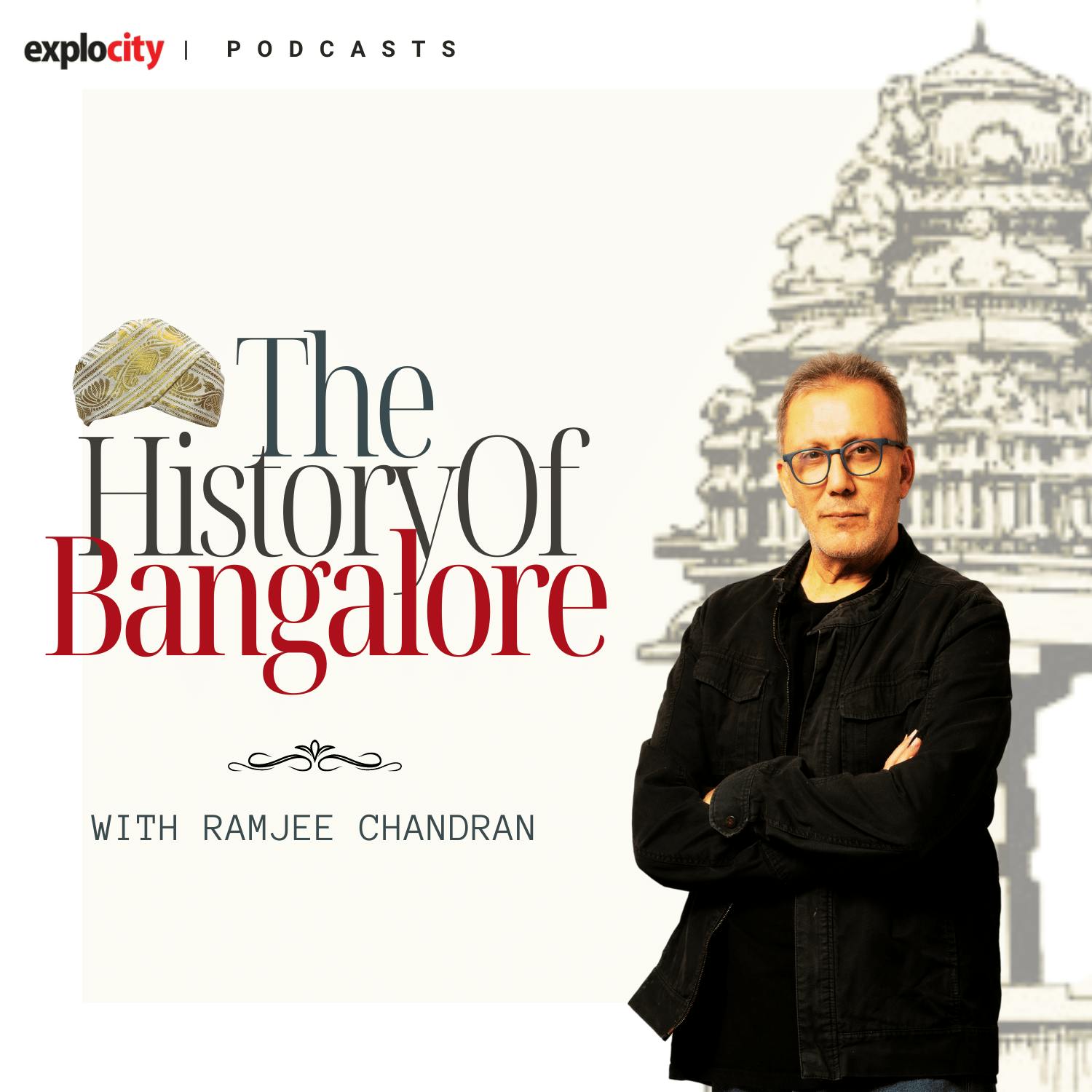
The History Of Bangalore
Ramjee Chandran
"The History of Bangalore" explores Bangalore's evolution from its early beginnings in the 4th century AD, from the dynasties of the Kadambas and the Gangas, through the eras of princely rule, the rise of the British Raj, and ultimately, the dawn of Indian independence in 1947.Join us as we uncover the power struggles, alliances, and battles that shaped this dynamic city.Expect a captivating blend of scholarly research and engaging storytelling. We'll delve into the reigns of powerful kings, the rise and fall of empires, and the events that forged Bangalore into the prominent city it is today.Whether you're a history buff or simply curious about Bangalore's roots, this podcast is for you.We gratefully acknowledge the support of the Prestige Group, that makes this podcast possible.Follow The History Of Bangalore on social, here:Instagram: https://www.instagram.com/historyofbangalore/Facebook: https://www.facebook.com/HistoryOfBangaloreTwitter: https://twitter.com/HistoryOfBLRYouTube: https://youtube.com/@HistoryOfBangalore?si=mnH3BsYfI4BUU234You can follow Ramjee Chandran on Instagram and Twitter: @ramjeechandranThe theme music for the show was composed by German-Indian Koln based percussionist, Ramesh Shotham.Ramjee Chandran's photographs: Asha Thadani
Episodes
Mentioned books

Jan 22, 2026 • 19min
After Talikota: The Sack of Vijayanagara
The defeat at the Battle of Talikota was only the beginning of the end. Ramjee Chandran chronicles the "ooru alivu"—the systematic erasure—of one of the world’s greatest metropolises. As the battlefield lay thick with the carnage of fallen empires, the Vijayanagara royals, led by Tirumala, executed a desperate exodus, loading 1,550 elephants with a treasury of gold and jewels to flee toward Penukonda.
We explore the two-stage destruction of the capital: first, the chaotic plunder by local robber tribes and "jungle people" who descended on the forsaken city, followed by the six-month organised dismantling by Sultanate forces using fire and crowbars to level the city's symbolic heart. Amidst this comprehensive ruin, we examine the strange anomaly of the Virupaksha temple, which remained largely untouched while the surrounding city was reclaimed by the jungle and wild animals. This episode captures the visceral moment a seat of imperial power became an empty shell, forever shifting the political gravity of the Deccan.
We gratefully acknowledge the support of the Prestige Group, that makes this podcast possible.
Follow The History Of Bangalore on social, here:
Instagram: https://www.instagram.com/historyofbangalore/
Facebook: https://www.facebook.com/HistoryOfBangalore
Twitter: https://twitter.com/HistoryOfBLR
YouTube: https://youtube.com/@HistoryOfBangalore?si=mnH3BsYfI4BUU234
iHeartRadio: https://www.iheart.com/podcast/1323-the-history-of-bangalore-163453722/
Follow Ramjee Chandran on Instagram and Twitter: @ramjeechandran
The theme music for the show was composed by German-Indian Koln based percussionist, Ramesh Shotham. Ramjee Chandran's photos by Asha Thadani.
RESEARCH AND SOURCES: All our episodes are based on published research and archive records. To request information about our sources, write to hob@explocity.com. Let us know if you are a researcher (either institutional or independent) and also provide some information about why you need this information. Researchers will get priority. We only have time to engage serious, academic queries so please understand if we do not respond to casual requests.

Jan 13, 2026 • 21min
The Tale from Talikota: The Battle of Rakkasagi-Tangadgi: 1565
We stand on the north bank of the Krishna River to witness one of the most consequential and bloody battles in history: the Battle of Rakkasagi-Tangadgi, popularly known as Talikota.
Ramjee Chandran details how the vast coalition of the Deccan Sultanates—Bijapur, Ahmadnagar, Golconda, and Bidar—marched south in early 1565 to challenge the dominance of the Vijayanagara Empire. As the two massive forces collided, a day that began with Vijayanagara's tactical confidence quickly descended into catastrophe due to a shocking battlefield betrayal by the Gilani brothers.
This episode chronicles the final, frantic hours of the empire, the capture of the defiant Aliya Rama Raya, and his immediate execution at the hands of Husain Nizam Shah. In a single afternoon, two centuries of imperial rule were shattered, leaving the capital in chaos and forever altering the political landscape of the Bangalore plateau.
We gratefully acknowledge the support of the Prestige Group, that makes this podcast possible.
Follow The History Of Bangalore on social, here:
Instagram: https://www.instagram.com/historyofbangalore/
Facebook: https://www.facebook.com/HistoryOfBangalore
Twitter: https://twitter.com/HistoryOfBLR
YouTube: https://youtube.com/@HistoryOfBangalore?si=mnH3BsYfI4BUU234
iHeartRadio: https://www.iheart.com/podcast/1323-the-history-of-bangalore-163453722/
Follow Ramjee Chandran on Instagram and Twitter: @ramjeechandran
The theme music for the show was composed by German-Indian Koln based percussionist, Ramesh Shotham. Ramjee Chandran's photos by Asha Thadani.
RESEARCH AND SOURCES: All our episodes are based on published research and archive records. To request information about our sources, write to hob@explocity.com. Let us know if you are a researcher (either institutional or independent) and also provide some information about why you need this information. Researchers will get priority. We only have time to engage serious, academic queries so please understand if we do not respond to casual requests.

Jan 6, 2026 • 21min
Tall Poppies, And A Small Minded Man
Vijayanagara stood at the absolute height of its prosperity in the late 1550s, yet the character of its leadership had begun a dangerous shift toward petty arrogance. Ramjee Chandran explores the "Tall Poppy Syndrome" that defined Aliya Rama Raya’s rule—a philosophy of cutting down anyone who rose too high, from capable local administrators like Kempe Gowda to neighboring sovereigns. This episode details how Rama Raya’s hubris transformed manageable political interference into a permanent existential threat for the Deccan Sultanates. Through a series of calculated humiliations and military campaigns marked by religious desecration, he unwittingly did the impossible: he forced his bitterest enemies to unite. We follow the diplomatic masterstroke of the mediator Mustafa Khan Ardistani and the marriage alliances that bound the houses of Bijapur, Ahmadnagar, and Golconda together, setting the stage for the cataclysmic Battle of Rakkasagi-Tangadgi.
We gratefully acknowledge the support of the Prestige Group, that makes this podcast possible.
Follow The History Of Bangalore on social, here:
Instagram: https://www.instagram.com/historyofbangalore/
Facebook: https://www.facebook.com/HistoryOfBangalore
Twitter: https://twitter.com/HistoryOfBLR
YouTube: https://youtube.com/@HistoryOfBangalore?si=mnH3BsYfI4BUU234
iHeartRadio: https://www.iheart.com/podcast/1323-the-history-of-bangalore-163453722/
Follow Ramjee Chandran on Instagram and Twitter: @ramjeechandran
The theme music for the show was composed by German-Indian Koln based percussionist, Ramesh Shotham. Ramjee Chandran's photos by Asha Thadani.
RESEARCH AND SOURCES: All our episodes are based on published research and archive records. To request information about our sources, write to hob@explocity.com. Let us know if you are a researcher (either institutional or independent) and also provide some information about why you need this information. Researchers will get priority. We only have time to engage serious, academic queries so please understand if we do not respond to casual requests.

Dec 15, 2025 • 24min
The Tuluva Dynasty Falls. And Rama Raya’s Toxic Politics: 1540-1545
The Bengaluru Pete's prosperity was put on hold by the severe political crisis at the imperial capital of Vijayanagara. Ramjee Chandran details the unraveling of the Tuluva dynasty following the death of Emperor Achyuta Raya in 1542. The episode chronicles a decade of palace coups and assassinations—including the murder of Achyuta's son, Venkata I—as powerful factions, particularly the one led by Aliya Rama Raya, fought for control.
Rama Raya ultimately triumphs, installing the legitimate claimant Sadashiva Raya as a 'confined monarch' while exercising all real power as regent. This new political order relied on surveillance and containment, creating an atmosphere where the autonomous strength of provincial chiefs like Kempe Gowda was viewed with deep distrust. This is the highly unstable empire that Kempe Gowda is forced to return to after his five-year imprisonment in Anegundi.
We gratefully acknowledge the support of the Prestige Group, that makes this podcast possible.
Follow The History Of Bangalore on social, here:
Instagram: https://www.instagram.com/historyofbangalore/
Facebook: https://www.facebook.com/HistoryOfBangalore
Twitter: https://twitter.com/HistoryOfBLR
YouTube: https://youtube.com/@HistoryOfBangalore?si=mnH3BsYfI4BUU234
iHeartRadio: https://www.iheart.com/podcast/1323-the-history-of-bangalore-163453722/
Follow Ramjee Chandran on Instagram and Twitter: @ramjeechandran
The theme music for the show was composed by German-Indian Koln based percussionist, Ramesh Shotham. Ramjee Chandran's photos by Asha Thadani.
RESEARCH AND SOURCES: All our episodes are based on published research and archive records. To request information about our sources, write to hob@explocity.com. Let us know if you are a researcher (either institutional or independent) and also provide some information about why you need this information. Researchers will get priority. We only have time to engage serious, academic queries so please understand if we do not respond to casual requests.

Dec 8, 2025 • 21min
The Rise And Imprisonment of Kempe Gowda: 1537-1542
The Bengaluru Pete was a runaway success; by the early 1540s, it was regulating itself and thriving with a robust internal economy. Ramjee Chandran details how this local prosperity coincided with a profound political crisis at the imperial capital of Vijayanagara. With the empire strained by internal power struggles and the growing dominance of Aliya Rama Raya, Kempe Gowda's regional success was soon viewed as a potential threat. A critical boundary was crossed when a rumour about the chieftain's rising power reached the court. The consequence was immediate and severe: Kempe Gowda was seized, his territories were confiscated, and he was held captive in Anegundi for five years. This episode explores the political intrigue that led to his downfall and the critical question left unanswered: would the new city of Bengaluru survive its founder's long absence?
We gratefully acknowledge the support of the Prestige Group, that makes this podcast possible.
Follow The History Of Bangalore on social, here:
Instagram: https://www.instagram.com/historyofbangalore/
Facebook: https://www.facebook.com/HistoryOfBangalore
Twitter: https://twitter.com/HistoryOfBLR
YouTube: https://youtube.com/@HistoryOfBangalore?si=mnH3BsYfI4BUU234
iHeartRadio: https://www.iheart.com/podcast/1323-the-history-of-bangalore-163453722/
Follow Ramjee Chandran on Instagram and Twitter: @ramjeechandran
The theme music for the show was composed by German-Indian Koln based percussionist, Ramesh Shotham. Ramjee Chandran's photos by Asha Thadani.
RESEARCH AND SOURCES: All our episodes are based on published research and archive records. To request information about our sources, write to hob@explocity.com. Let us know if you are a researcher (either institutional or independent) and also provide some information about why you need this information. Researchers will get priority. We only have time to engage serious, academic queries so please understand if we do not respond to casual requests.

Dec 1, 2025 • 23min
The Fort and the Defence of Bengaluru: 1537
The establishment of the Bengaluru Pete was an act of both commerce and defence, necessary for survival in the volatile 16th-century Deccan. Ramjee Chandran details how Kempe Gowda’s security plan was dual-layered: relying regionally on the shield of the nine surrounding hill forts, the Navadurgas, and locally on the fortified enclosure. The central feature was the Bengaluru Fort, but imperial policy constrained its design. We explore why the Vijayanagara Emperor strictly mandated that the fort be constructed primarily of mud —never stone walls— which could have been interpreted as a step toward defiance. This episode details the simple but effective defensive engineering, from the narrow, dismounting-only gateways to the elevated platforms that allowed every citizen to participate in the town’s protection.
We gratefully acknowledge the support of the Prestige Group, that makes this podcast possible.
Follow The History Of Bangalore on social, here:
Instagram: https://www.instagram.com/historyofbangalore/
Facebook: https://www.facebook.com/HistoryOfBangalore
Twitter: https://twitter.com/HistoryOfBLR
YouTube: https://youtube.com/@HistoryOfBangalore?si=mnH3BsYfI4BUU234
iHeartRadio: https://www.iheart.com/podcast/1323-the-history-of-bangalore-163453722/
Follow Ramjee Chandran on Instagram and Twitter: @ramjeechandran
The theme music for the show was composed by German-Indian Koln based percussionist, Ramesh Shotham. Ramjee Chandran's photos by Asha Thadani.
RESEARCH AND SOURCES: All our episodes are based on published research and archive records. To request information about our sources, write to hob@explocity.com. Let us know if you are a researcher (either institutional or independent) and also provide some information about why you need this information. Researchers will get priority. We only have time to engage serious, academic queries so please understand if we do not respond to casual requests.

Nov 24, 2025 • 21min
The Building of Bengaluru Pete: 1537
We step into the year 1537 to witness the spectacular groundbreaking of the Bengaluru Pete. Ramjee Chandran joins Kempe Gowda as he lays the foundations of the new city, beginning with an auspicious ceremony where four pairs of milk-white bulls ploughed the first furrows. These lines became the city’s two main arteries: the wide north-south wholesale axis of Doddapete, and the narrower east-west retail axis of Chikkapete. This foundational grid spread outward into rectangular blocks organized by trade and protected by a ring of eight gates aligned to major routes. Kempe Gowda's meticulous design placed specific occupations — from smiths near the gates to gold merchants at the secure centre — ensuring the town functioned with maximum efficiency. By the early 1540s, this meticulously planned urban framework was complete, attracting merchants instantly.
We gratefully acknowledge the support of the Prestige Group, that makes this podcast possible.
Follow The History Of Bangalore on social, here:
Instagram: https://www.instagram.com/historyofbangalore/
Facebook: https://www.facebook.com/HistoryOfBangalore
Twitter: https://twitter.com/HistoryOfBLR
YouTube: https://youtube.com/@HistoryOfBangalore?si=mnH3BsYfI4BUU234
iHeartRadio: https://www.iheart.com/podcast/1323-the-history-of-bangalore-163453722/
Follow Ramjee Chandran on Instagram and Twitter: @ramjeechandran
The theme music for the show was composed by German-Indian Koln based percussionist, Ramesh Shotham. Ramjee Chandran's photos by Asha Thadani.
RESEARCH AND SOURCES: All our episodes are based on published research and archive records. To request information about our sources, write to hob@explocity.com. Let us know if you are a researcher (either institutional or independent) and also provide some information about why you need this information. Researchers will get priority. We only have time to engage serious, academic queries so please understand if we do not respond to casual requests.

Nov 17, 2025 • 28min
A Blueprint for the Bengaluru Pete: 1537
The founding of Bengaluru is a period of history "deceptively difficult to reconstruct," relying on fragmentary evidence from local documents. Ramjee Chandran details Kempe Gowda's comprehensive strategy to found the Bengaluru Pete, overcoming a period "almost entirely without reliable records." The blueprint leveraged geography for success, starting with the defensive shield of the Navadurgas and the natural convergence of trade routes. He secured vital resources by integrating territories like Domlur and Ulsoor to ensure predictable food and water supply. Despite receiving imperial permission from Achyuta Raya, Vijayanagara policy dictated a critical constraint: he was only allowed to build a functional mud fort, revealing the empire's lingering fear of revolt.
We gratefully acknowledge the support of the Prestige Group, that makes this podcast possible.
Follow The History Of Bangalore on social, here:
Instagram: https://www.instagram.com/historyofbangalore/
Facebook: https://www.facebook.com/HistoryOfBangalore
Twitter: https://twitter.com/HistoryOfBLR
YouTube: https://youtube.com/@HistoryOfBangalore?si=mnH3BsYfI4BUU234
iHeartRadio: https://www.iheart.com/podcast/1323-the-history-of-bangalore-163453722/
Follow Ramjee Chandran on Instagram and Twitter: @ramjeechandran
The theme music for the show was composed by German-Indian Koln based percussionist, Ramesh Shotham. Ramjee Chandran's photos by Asha Thadani.
RESEARCH AND SOURCES: All our episodes are based on published research and archive records. To request information about our sources, write to hob@explocity.com. Let us know if you are a researcher (either institutional or independent) and also provide some information about why you need this information. Researchers will get priority. We only have time to engage serious, academic queries so please understand if we do not respond to casual requests.

Nov 4, 2025 • 20min
The Birth of Bengaluru: 1531-1537
While the Vijayanagara Empire under Achyuta Raya was wrestling with northern turmoil, constant friction with Bijapur, and Portuguese unease in the 1530s, the Mysore plateau remained a quiet, profitable hub for trade. Here, the local chieftain, Kempe Gowda, saw the empire's crisis as a rare opportunity and an indicator that the center would soon fail to hold. Ramjee Chandran details how Kempe Gowda shrewdly turned the empire's weakness into his own strength, resolving to build a new and independent trade city. Having earned the empire's trust, his petition to Achyuta Raya for permission to build a fort was swiftly granted. Between 1532 and 1537, this act of political foresight led to the founding and construction of the fort and township that he named Bengaluru.
We gratefully acknowledge the support of the Prestige Group, that makes this podcast possible.
Follow The History Of Bangalore on social, here:
Instagram: https://www.instagram.com/historyofbangalore/
Facebook: https://www.facebook.com/HistoryOfBangalore
Twitter: https://twitter.com/HistoryOfBLR
YouTube: https://youtube.com/@HistoryOfBangalore?si=mnH3BsYfI4BUU234
iHeartRadio: https://www.iheart.com/podcast/1323-the-history-of-bangalore-163453722/
Follow Ramjee Chandran on Instagram and Twitter: @ramjeechandran
The theme music for the show was composed by German-Indian Koln based percussionist, Ramesh Shotham. Ramjee Chandran's photos by Asha Thadani.
RESEARCH AND SOURCES: All our episodes are based on published research and archive records. To request information about our sources, write to hob@explocity.com. Let us know if you are a researcher (either institutional or independent) and also provide some information about why you need this information. Researchers will get priority. We only have time to engage serious, academic queries so please understand if we do not respond to casual requests.

Oct 20, 2025 • 24min
The Estimation of Achyuta Raya: 1529-1531
Following the death of Krishnadeva Raya in 1529, his brother, Achyuta Raya, inherited an empire fraught with danger. Ramjee Chandran explores the immense challenge of succeeding the legendary emperor, facing enemies at the gates, a cooling relationship with the Portuguese, and the looming political threat of Aliya Rama Raya. The episode examines why history, particularly through the lens of Portuguese chroniclers like Fernão Nuniz, has largely judged Achyuta Raya as "feeble". It argues that his quiet, pragmatic diplomacy — a strategy of "peace through equilibrium" — was an essential and underappreciated necessity for keeping the great empire intact.
We gratefully acknowledge the support of the Prestige Group, that makes this podcast possible.
Follow The History Of Bangalore on social, here:
Instagram: https://www.instagram.com/historyofbangalore/
Facebook: https://www.facebook.com/HistoryOfBangalore
Twitter: https://twitter.com/HistoryOfBLR
YouTube: https://youtube.com/@HistoryOfBangalore?si=mnH3BsYfI4BUU234
iHeartRadio: https://www.iheart.com/podcast/1323-the-history-of-bangalore-163453722/
Follow Ramjee Chandran on Instagram and Twitter: @ramjeechandran
The theme music for the show was composed by German-Indian Koln based percussionist, Ramesh Shotham. Ramjee Chandran's photos by Asha Thadani.
RESEARCH AND SOURCES: All our episodes are based on published research and archive records. To request information about our sources, write to hob@explocity.com. Let us know if you are a researcher (either institutional or independent) and also provide some information about why you need this information. Researchers will get priority. We only have time to engage serious, academic queries so please understand if we do not respond to casual requests.

