
In Good Companies
Cadence Bank
Starting and running a business or managing one isn’t for the faint of heart. You’re balancing internal and external forces in a continually changing landscape. You’re building strategies, and banking on the future – no matter what it holds. This is where Cadence Bank’s In Good Companies comes in. We share our wealth of knowledge, and insights from noted industry experts, to guide you through the forces shaping business today.
We’re back for Season 6, and this time, we’re setting our sights on the future of work. We’re asking the big questions, like:
What will your career look like in 2030? Or 2050, even?
How is ESG shaping the future of companies?
And how can we leverage AI to our advantage?
We bring together experts from across the board, from Silicon Valley to multinationals like EY, to help you stay on the cutting edge of business. And we get to know those who are building the future of our companies; because at Cadence Bank, we want to hear the human side of every success story.
Hosting our stellar range of guests this season is our new host, Ari Marin. He is a Cadence Bank Senior Vice President and family enterprise advisor, whose specialty is consulting with family-owned and small businesses. Ari’s idea of “good company” is being around creative, insightful people with unique and inspirational stories. For Season 6, he brings in his curiosity and ambition to In Good Companies, to lead discussions with our guests, and bring listeners across the U.S. all the information they need, in one place, in under 30 minutes.
Ready to launch into the future? Then join us!
We’re back for Season 6, and this time, we’re setting our sights on the future of work. We’re asking the big questions, like:
What will your career look like in 2030? Or 2050, even?
How is ESG shaping the future of companies?
And how can we leverage AI to our advantage?
We bring together experts from across the board, from Silicon Valley to multinationals like EY, to help you stay on the cutting edge of business. And we get to know those who are building the future of our companies; because at Cadence Bank, we want to hear the human side of every success story.
Hosting our stellar range of guests this season is our new host, Ari Marin. He is a Cadence Bank Senior Vice President and family enterprise advisor, whose specialty is consulting with family-owned and small businesses. Ari’s idea of “good company” is being around creative, insightful people with unique and inspirational stories. For Season 6, he brings in his curiosity and ambition to In Good Companies, to lead discussions with our guests, and bring listeners across the U.S. all the information they need, in one place, in under 30 minutes.
Ready to launch into the future? Then join us!
Episodes
Mentioned books

Oct 31, 2023 • 30min
Nurture your Culture: Dr Marcus Collins on the Power of Culture in Business
A recent Deloitte survey shows that our professional expectations have shifted in the past decade. In 2023, our youngest workers want jobs aligned with their values, where they have a purpose and find a sense of belonging. Increasingly, our workforce looks for good company culture, first and foremost. So how does culture drive strategy? And how can it help your business thrive? We ask Dr. Marcus Collins, an award-winning marketer, professor and author of the best-selling book “For the Culture”.Culture is the cornerstone of Marcus’s career. Back in 2009, he worked in the music industry, running digital strategy for Beyoncé. He then made a name in advertising; working with agencies like Doner, or Wieden+Kennedy. In the field, he saw firsthand how culture lifts business; so he continued to study it with a doctorate at Temple University. In this episode, he gives us a crash course. Marcus will define what culture means, and share his best advice to turn identity into power. We’ll see how culture can help companies reach their community, and find new talents too. Finally, Marcus will explain how to handle cultural questions responsibly, by staying mindful of other perceptions.Join Marcus and Patrick for a fascinating and energetic conversation. And find out today how culture shapes the company you keep. Highlights:A deceptively simple concept (2:01)Finding a working definition for “culture” (4:07)Culture as a measurement of normality (6:43)When culture and marketing go hand in hand (7:50)Influencing people who see the world our way (9:24)How culture transforms a job into a calling (10:39)Culture for recruitment: a successful example (13:55)Tuning into other people’s perspectives (17:27)How emotion interacts with judgment (19:21)Benefits of activating your base (22:12)The problem with being normal (24:56)Using culture for good (26:21)Intentions, perspectives, and outcomes (28:04)Links:Cadence Bank WebsiteCadence Bank TwitterCadence Bank LinkedInMarcus Collins WebsiteMarcus Collins TwitterMarcus Collins LinkedInMarcus Collins InstagramMarcus Collins’s book - “For the Culture”Deloitte - "The Deloitte Global 2023 Gen Z and Millennial Survey"If you have questions about the show or topics you'd like discussed in future episodes, email our producers, Natalie.Barron@cadencebank.com, Eydie.Pengelly@cadencebank.com, or danielle.kernell@cadencebank.com.
Oct 24, 2023 • 32min
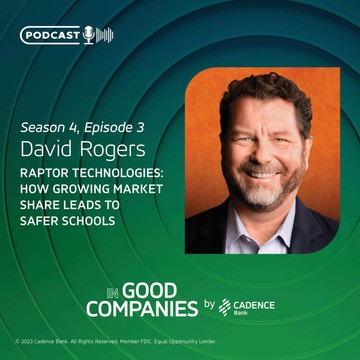
Raptor Technologies: How Growing Market Share Leads to Safer Schools
Listener warning: This podcast includes discussions of school shootings and trauma, which may be distressing for some listeners.A recent survey from the National Center for Education Statistics reports that two-thirds of American public schools now control visitor access to their school grounds. This includes getting equipment, hiring staff and implementing crisis plans. So, who designs these systems? We will find out today, with David Rogers from Raptor Technologies.Raptor Technologies is the U.S. leader in school security software. Once a family-owned business, Raptor now works with 37, 000 schools across the country. That’s thanks in part to David Rogers, their chief marketing officer. After 20 years in high-tech marketing, David has touched on everything from software development to fintech. In this episode, he shares how technology can make schools safer, and why this work needs to happen now. With a passion that is nothing short of inspiring, David draws lessons from Raptor’s success: from its humble beginnings in Houston, Texas, to its recent venture in global markets. He also tells us how safety management technology can help during an emergency; points out the importance of risk prevention; and reveals how school districts and families can get involved too. Because, at the end of the day, school safety is about creating a supportive network around our communities. So join Patrick and David today, and follow in Raptor’s steps to protect every school, every child, every day. Highlights:Raptor Technologies’ mission (2:27)The origins of Raptor Tech (4:25)Becoming market leaders (6:03)Why Raptor products stand out (8:13)How technology can help in an emergency (10:42)Prevent, prepare, respond, recover (12:30)Staff training at Raptor (14:29)Supporting employees’ mental health (15:54)What are common school safety risks? (17:29)Covid-19’s impact on young people’s mental health (19:14)From a reactive to a preventive society (21:03)Challenges within the public sector (23:11) How parents can support school safety management (25:29)Technology can make a difference (28:35)Links:Cadence Bank WebsiteCadence Bank TwitterCadence Bank LinkedInDavid Rogers LinkedInRaptor Technologies LinkedInRaptor Technologies WebsiteRaptor Technologies Twitter Raptor Technologies YouTubeNew York Times - “Panic Buttons, Classroom Locks: How Schools Have Boosted Security”If you have questions about the show or topics you'd like discussed in future episodes, email our producers, Natalie.Barron@cadencebank.com, Eydie.Pengelly@cadencebank.com, or danielle.kernell@cadencebank.com.
Oct 17, 2023 • 30min
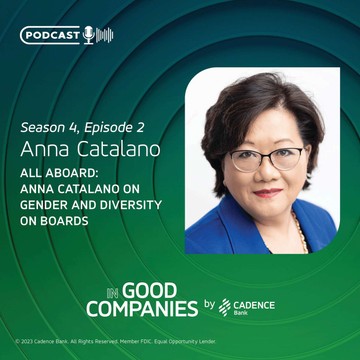
All Aboard: Anna Catalano on Gender and Diversity on Boards
When picturing a board of directors, what comes to mind? Men in suits sitting around a table? Well, you are not to blame. In 2023, women hold only 28% of board seats in the Russell 3000. So how are companies making efforts to diversify their leadership? How can established directors lift up people who haven’t always had their seat at the table? What is the benefit of seeing more diversity in the boardroom? Anna Catalano is well-placed to know. Over the last 20 years, Anna has perfected the art of board governance and sat on a dozen public boards. Fortune magazine named her one of the most powerful women in international business, which is no understatement. In recent years, she has become a prominent voice advocating for diversity and board refreshment in corporate leadership. Together, we will talk about leadership and representation; the key functions of a board of directors today. We will also weigh up the challenges awaiting women in business, and think about how boards can make space for new talents. Looking back on her career, Anna will revisit her most formative experiences; from unconscious bias, to bold career turns, her story is as inspiring as it is insightful.Push the doors of the boardroom open with Patrick and Anna… And you will find that change is underway.Highlights:What a board of directors does (2:38)Improving diversity around the table (4:13)How directors are recruited (5:49)Reconciling diversity and meritocracy (8:09)Handling unconscious bias (10:08)The importance of interrogating assumptions (12:29)How board directors lift up new talents (14:23)Thoughts on board refreshments (16:02)How to get board-ready (18:39)Seizing new learning opportunities (22:23)Getting out of your comfort zone (24:08)Diversity to revisit the way things are done (26:21)What good leadership means to Anna (27:27)Links:Cadence Bank WebsiteCadence Bank TwitterCadence Bank LinkedInAnna’s WebsiteAnna’s Blog Anna’s LinkedInAnna’s TwitterAnna Catalano - “The Importance of Board Refreshment”Wall Street Journal - “Anna Catalano Is in The Room Where It Happens” Fortune - “Women hold a record number of corporate board seats. The bad news: It’s barely over 25%, and it’s slowing down.”If you have questions about the show or topics you'd like discussed in future episodes, email our producers, Natalie.Barron@cadencebank.com, Eydie.Pengelly@cadencebank.com, or danielle.kernell@cadencebank.com.

Oct 10, 2023 • 28min
Trust The Process: How Human Connection Drives Business Performance
There is no P&L statement for well-being, but we all know a great team when we're on one. So, what’s the secret? How do leaders build a business culture where people feel good and work well together? How can companies make sure that their people show up every day as the best version of themselves? “With trust and connection,” says David Mead. David is an international business speaker, leadership builder and co-author of the bestselling book Find Your Why. For a decade he has toured the world, advising over 300 companies across 21 countries on how to bring purpose to their business. In this episode, he tells us how humanity can drive a high-impact team. Together, we reflect on what makes a good experience in the workplace; we find out what great leaders have in common; and we consider the best ways to communicate and collaborate as a team. Plus, David shares his recipe for success, which boils down to three key ingredients: honesty, humility, and humanity. So put your trust in David and Patrick, press play, and embark on a journey to make business better for everyone. Highlights:· The best job David ever had (2:26)· What a healthy work culture looks like (4:28) · Towards a more human business (5:21) · Preventing isolation, driving innovation (7:25) · The attributes of a good leader (9:36) · Practicing Honesty, Humility, Humanity (11:32) · Honesty: delivering constructive feedback (14:15) · Humility: listening and taking responsibility (15:11) · Humanity: valuing people (18:56) · Reflecting on previous Leadership experience (21:21) · The impact of the Covid-19 pandemic (23:25) · In praise of simplicity (25:11) Links:· Cadence Bank Website· Cadence Bank Twitter· Cadence Bank LinkedIn· David Mead’s Website· David Mead’s LinkedIn· Book- ‘Find Your Why’ by David Mead and Simon Sinek· Gallup – Percent Who Feel Employer Cares About Their Wellbeing Plummets Feedback:If you have questions about the show or topics you'd like discussed in future episodes, email our producers, Natalie.Barron@cadencebank.com, Eydie.Pengelly@cadencebank.com, or danielle.kernell@cadencebank.com.
May 23, 2023 • 26min
Opportunity for All: John Hope Bryant on Building Up Entrepreneurs
Often, the story of an entrepreneur is focused on exceptional individuals. But every entrepreneur knows that they can’t do it alone. We all need a helping hand to reach our true potential. That’s especially true for those from underserved communities. So how do we empower entrepreneurs? What can we give them, and what do they have to do for themselves?To find out, we spoke with John Hope Bryant, an exceptional individual himself. John’s been called “The Conscience of Capitalism,” advising three sitting U.S. presidents, and was named one of Time Magazine’s “50 Leaders for the Future.” His nonprofit, Operation HOPE, is the largest nonprofit provider of financial literacy, inclusion, and economic empowerment tools in the United States.An entrepreneur himself, John knows the barriers that minority business owners face. So on this episode, we hear what John has learned from his journey, the challenges and opportunities of minority entrepreneurship and Operation HOPE’s “One Million Black Businesses” initiative. We’ll cover how to build networks, capital, and belief in budding entrepreneurs.Listen in to hear how our powerhouse guest empowers entrepreneurs with hope.Highlights:Introduction to Operation HOPE (1:47)How entrepreneurship changed John’s life (3:59)Enterprise can create generational wealth (5:48)John’s first business at 10 years old (7:21)How the Rodney King riots changed John’s perspective (10:06)The origins of Operation HOPE (11:15)Barriers to entrepreneurship (12:28)Never give up (12:51)Empowering entrepreneurs with belief (14:28)Helping an entrepreneur build their network (16:20)One Million Black Businesses (19:30)How entrepreneurs can empower themselves (21:47)“Just do something” (23:20)The 3rd Reconstruction (24:45)Links:Cadence Bank WebsiteCadence Bank TwitterCadence Bank LinkedInOperation HOPEJohn Hope Bryant HoldingsJohn Hope Bryant LinkedInJohn Hope Bryant - BooksOperation HOPE - 1 Million Black BusinessesOperation HOPE - Small Business DevelopmentCadence Bank - SBA LoansInc. Magazine - How to Empower Underrepresented EntrepreneursForbes - Eight Ways to Support Your Fellow EntrepreneursFeedback:If you have questions about the show or topics you'd like discussed in future episodes, email our producers, sheena.cochran@cadencebank.com or danielle.kernell@cadencebank.com.
May 16, 2023 • 32min
How to Deal with the Deal: The Human Side of M&A
Whether you’re selling a business or buying into one, it’s a big deal. And when the stakes get high, so do emotions. On this episode, we dive into the human element of mergers & acquisitions. What’s it like to sell your business? How do you navigate change? What can you do to build trust?Fortunately, we spoke with two people who have experienced the whole spectrum of M&A transactions. Father and son team George & Joshua Robertson run GrowCo Capital, an investment firm based out of Fort Worth, Texas. But before they were in venture capital, they ran their own businesses, including National HME. Hear the story of how George and Josh navigated the strategic partnership and eventual sale of their family business, and the lessons they now bring to the buy-side. We’ll explore how to manage your emotions, communicate with employees, and set a clear vision, so that everyone can win. So listen in and find out: how do you deal with the deal?Highlights:The Robertsons’ family background (2:05)Planting the seeds for National HME (4:40)National HME: the early years (7:43)Why the Robertsons went looking for strategic partners (8:54)How they chose partners (10:02)Managing emotions (12:06)How George and Josh adapted to new partners (14:22)The golden nugget (16:41)Communicating with employees (18:03)Saying goodbye to the company you’ve built (19:23)Having values at your core (21:47)George and Josh on the buy-side (22:53)Using what they’ve learned (23:57)Channeling emotion towards a goal (26:13)MasVida Health and the future for the Robertsons (28:17)Links:Cadence Bank WebsiteCadence Bank TwitterCadence Bank LinkedInGrowCo CapitalGeorge Robertson LinkedInJoshua Robertson LinkedInMasVida HealthForbes - Emotions Matter When Selling Your CompanyHarvard Business Review - Dealing with the Emotional Fallout of Selling Your BusinessLinkedIn - What CEOs must do to lead successful mergers and acquisitionsFeedback:If you have questions about the show or topics you'd like discussed in future episodes, email our producers, sheena.cochran@cadencebank.com or danielle.kernell@cadencebank.com.
May 9, 2023 • 26min
A Whole New Ballgame: Jim Crane on Business Transformation
Whether it’s because of new leadership, exogenous shock, or a plain old rut, all companies eventually need to change. While there’s no single template for how to transform your business, you can learn a lot from those who have done it successfully; and there’s probably no better example than Jim Crane and the Houston Astros baseball franchise. When Jim bought the team in 2011, they were one of the worst teams in baseball. Over the course of the next decade, they became one of the most successful. Under Jim, the Astros have won two championships and become perennial contenders. They’ve also tripled their revenue. So how did he do it?On this episode, we’ll explore Jim’s approach to transformation: how he identifies problems, manages his teams, and creates partnerships with multiple stakeholders, all with an eye toward a winning culture. Find out the reason Jim took a hands-off approach to baseball operations and why he invested heavily in the Astros’ charitable foundation. Plus, how Jim applied the same formula to the PGA Tour’s Houston Open.When you transform your business, you have to cover your bases. So join us and get strategies that will help you right off the bat. Highlights:How Jim turned a $10,000 loan into $4B in revenue (1:56)Jim’s passion for sports (4:34)What Jim saw in the struggling Astros (6:02)Diagnosing the team’s biggest problem (7:04)The benefits of a hands-off approach (8:25)Creating a winning culture (11:23)The Community Leaders program and creating external partnerships (12:59)The Astros become world champions (16:32)The Houston Open: A microcosm of Jim’s approach (17:49)To maintain your edge, you’ve got to keep working (21:02)How to apply these lessons to your business (22:21)Links:Cadence Bank WebsiteCadence Bank TwitterCadence Bank LinkedInJim Crane - Crane WorldwideCrane Worldwide Logistics WebsiteHouston Astros WebsiteAstros Foundation WebsiteHouston Open WebsiteMcKinsey - What is business transformation?Harvard Business Review - Four types of business transformationDeloitte - Six keys to business transformationFeedback:If you have questions about the show or topics you'd like discussed in future episodes, email our producers, sheena.cochran@cadencebank.com or danielle.kernell@cadencebank.com.
May 2, 2023 • 32min
Everlasting Love: Sustaining a culture of love
Last week, Mohammad Anwar and Chris Pitre introduced us to the concept of “Love as a Business Strategy” and showed how beneficial it is to leaders. But leaders aren’t the only ones in a business. So, what does a culture of love bring to employees? The answer: a lot! They have just as much to gain from a culture of love as leaders do. Love as a business strategy empowers teams and makes them more efficient.While leaders are essential in implementing a culture of love, employees are key in sustaining one. So how do you make that happen? Well, it starts with hiring the right people–and they may not be who you expect. Once they’re in the door, you establish connections and make them feel secure–because when people feel safe they can be honest. “Honesty over Harmony” is one of the foundational tenets of Love as a Business Strategy. Honest communication cuts down on time; honest criticism leads to better products; and honest feedback opens the door to accountability.On this episode, you’ll hear all about how Mohammad and Chris encourage these behaviors and build them into their business; small changes that can make a culture of love much easier to maintain. So join us, as we explore the labor of love.Highlights:Defining Love as a Business Strategy (3:29)What leaders don’t understand about employees (5:02)Empowered employees (6:19)How a culture of love makes employees more efficient (7:08)Hiring: Culture add vs. culture fit (9:13)Hiring: Capability over competence (11:32)How Softway builds connections between employees (13:47)Creating a feeling of security in employees (15:30)Honesty over harmony (16:43)Silence is the biggest cost that’s not on your balance sheet (19:15)Culture vultures (21:00)Holding each other accountable (23:09)How a culture of love sets you up for the future (26:18)Seneca Leaders (28:57)Links:Cadence Bank WebsiteCadence Bank TwitterCadence Bank LinkedInMohammad Anwar LinkedInChris Pitre LinkedInSeneca LeadersLove as a Business Strategy - BookLove as a Business Strategy - Podcast Softway WebsiteCulture+ WebsiteFeedback:If you have questions about the show or topics you'd like discussed in future episodes, email our producers, sheena.cochran@cadencebank.com or danielle.kernell@cadencebank.com.
Apr 26, 2023 • 39min
All You Need Is Love: The origins of “Love as a Business Strategy”
How much better would the world be if everyone loved going to work? How much more engaged would we be? How much more efficient? That’s the vision of Mohammad Anwar and Chris Pitre (Softway & Culture+), two co-authors of the WSJ-bestseller Love as a Business Strategy. They want to revolutionize the way companies do business, by putting people at the center of every decision. But this idea didn’t come out of nowhere. It was born from the real-life transformation of their company, Softway. So on this episode, we’re telling that story: how a leader learned to love his team and, in doing so, transformed his company and himself.Mohammad founded Softway when he was 20 years old, and he’d grown the business to over 300 employees since its inception. But by 2015, the company had developed a toxic culture, and Mohammad was known for his unprofessional outbursts. With the business struggling, morale was low. Two weeks after Chris was hired, Softway laid off a third of its workforce by gathering them in a conference room and telling them all at once. Mohammad didn’t know if the business would last another month.But then he had a realization, and together he and Chris went on a journey to institute a “culture of love.” Through slow, quiet work, Mohammad changed his behaviors and made Softway a place that employees loved. Success soon followed. Now, they help other businesses change their own cultures. On this episode, we’ll explore the leader’s role in a culture of love: their responsibilities, behaviors and how they stand to benefit. So, join us, as we answer the question: “What’s love got to do with it?” Highlights:Meet Mohammad Anwar & Chris Pitre (1:12)What is “love as a business strategy”? (2:22)The origins of Softway (3:23)The infamous “Dirty fridge” email (5:44)Softway’s darkest day (9:39)Why it’s hard to be a leader (12:02)Mohammad’s epiphany (15:07)Misconceptions about the culture of love (17:21)Perks are not culture (20:21)Culture eats strategy for breakfast, but behaviors eat culture for lunch (21:29)Redefining leadership (23:11)Changing behavior (26:30)Trickle-down culture (28:21)The role of forgiveness (30:15)Softway’s turnaround (31:35)No excuses (35:54)Seneca Leaders (38:28)Links:Cadence Bank WebsiteCadence Bank TwitterCadence Bank LinkedInMohammad Anwar LinkedInChris Pitre LinkedInSeneca LeadersLove as a Business Strategy - BookLove as a Business Strategy - Podcast Softway WebsiteCulture+ WebsiteFeedback:If you have questions about the show or topics you'd like discussed in future episodes, email our producers, sheena.cochran@cadencebank.com or danielle.kernell@cadencebank.com.
Apr 18, 2023 • 26min
The CX Factor: Creating Standout Customer Experience
Customers judge your company on more than just the product you sell. They’re evaluating every interaction, from start to finish: Was the website easy to navigate? Were the employees friendly and helpful? Did their order come quickly (and in one piece)? They want convenience, consistency and connection. All that adds up to a customer experience, or CX, as it’s known; and those two little letters have the power to make or break your company. The benefits of good customer experience are huge. Satisfied customers are more loyal and will pay a premium. But the drawbacks of bad CX are even greater: almost three-quarters of customers would switch to a competitor after just two bad experiences. So how do you create a genuinely great customer experience?That question is at the center of everything that Daniel Herrmann works on. Daniel is the vice president of product strategy and customer insights at NCR. It’s his job to make NCR work better for its customers. And to him, CX is more than a strategy; it’s a mindset that infuses every aspect of your business. Together we’ll explore the building blocks of exceptional CX: how you measure, design, and implement CX. Plus, why he thinks CX creates more efficient, innovative, and aligned companies. So, join us, as we pay our respects to CX and walk a mile in Daniel's shoes. Because the customer journey of a thousand miles begins with a single step.Highlights:Meet Daniel Herrmann (1:43)Customer experience is anything and everything (3:12)The benefits of good CX (4:49)Without CX, customers won’t stick around (5:47)Why overall customer satisfaction has been declining for years (6:16)Putting the C in CX (8:45)The role of leadership: articulate and communicate (9:08)A customer-oriented culture (10:10)The most common mistake that companies make when it comes to CX (12:14)Measuring CX: Net Promoter Score (12:58)Creating a narrative with your data (14:04)Why you need quantitative and qualitative data (16:17)How good CX leads to innovation (17:11)Customer journey maps (18:24)The four building blocks to make CX a systematic competence (20:16)Top priority: a process for collecting feedback (21:48)Daniel’s top takeaways (24:04)Links:Cadence Bank WebsiteCadence Bank TwitterCadence Bank LinkedInDaniel Herrmann LinkedInNCR WebsiteHarvard Business Review - Understanding Customer ExperienceHarvard Business Review - 10 Ways to Boost Customer SatisfactionPwC - The Future of Customer ExperienceAmerican Customer Satisfaction Index - US Overall Customer SatisfactionFeedback:If you have questions about the show or topics you'd like discussed in future episodes, email our producers, sheena.cochran@cadencebank.com or danielle.kernell@cadencebank.com.

