

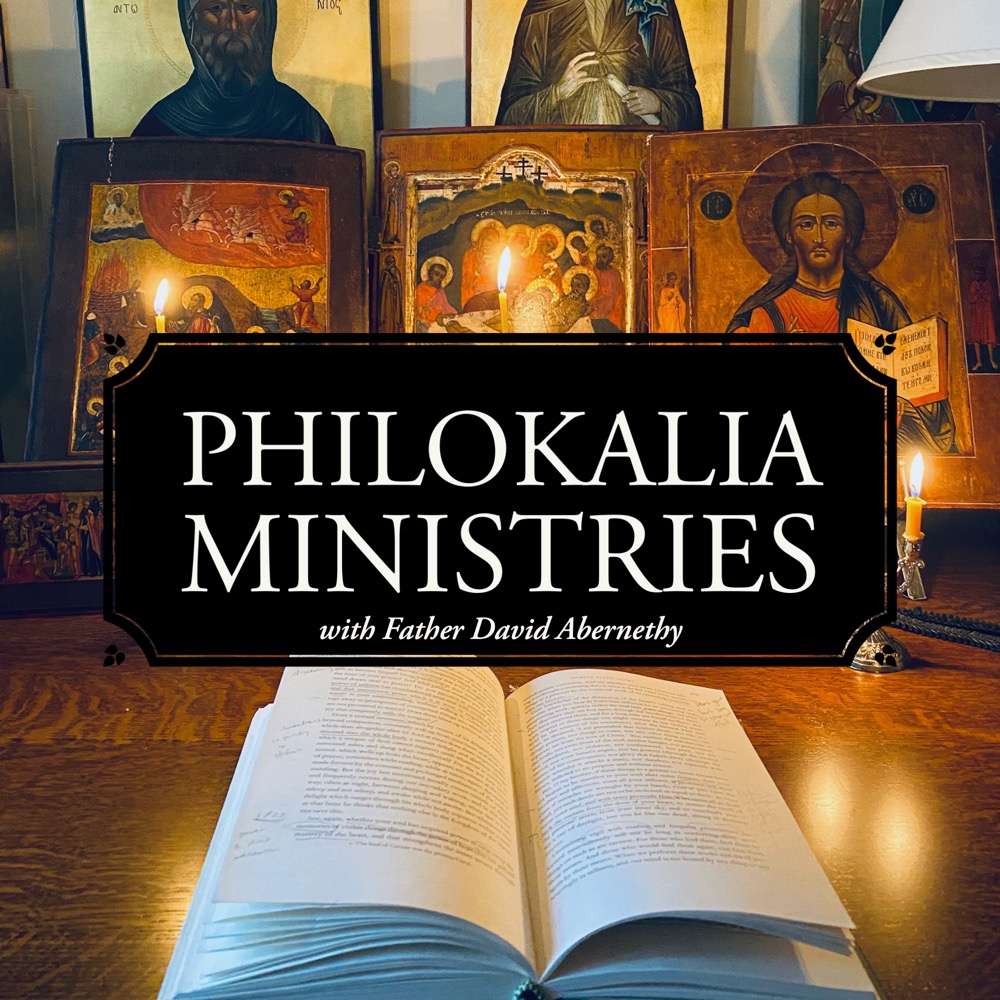
Philokalia Ministries
Father David Abernethy
Philokalia Ministries is the fruit of 30 years spent at the feet of the Fathers of the Church. Led by Father David Abernethy, Philokalia (Philo: Love of the Kalia: Beautiful) Ministries exists to re-form hearts and minds according to the mold of the Desert Fathers through the ascetic life, the example of the early Saints, the way of stillness, prayer, and purity of heart, the practice of the Jesus Prayer, and spiritual reading. Those who are involved in Philokalia Ministries - the podcasts, videos, social media posts, spiritual direction and online groups - are exposed to writings that make up the ancient, shared spiritual heritage of East and West: The Ladder of Divine Ascent, Saint Augustine, the Philokalia, the Conferences of Saint John Cassian, the Ascetical Homilies of Saint Isaac the Syrian, and the Evergetinos. In addition to these, more recent authors and writings, which draw deeply from the well of the desert, are read and discussed: Lorenzo Scupoli, Saint Theophan the Recluse, anonymous writings from Mount Athos, the Cloud of Unknowing, Saint John of the Cross, Thomas a Kempis, and many more.
Philokalia Ministries is offered to all, free of charge. However, there are real and immediate needs associated with it. You can support Philokalia Ministries with one-time, or recurring monthly donations, which are most appreciated. Your support truly makes this ministry possible. May Almighty God, who created you and fashioned you in His own Divine Image, restore you through His grace and make of you a true icon of our Lord and Savior Jesus Christ.
Philokalia Ministries is offered to all, free of charge. However, there are real and immediate needs associated with it. You can support Philokalia Ministries with one-time, or recurring monthly donations, which are most appreciated. Your support truly makes this ministry possible. May Almighty God, who created you and fashioned you in His own Divine Image, restore you through His grace and make of you a true icon of our Lord and Savior Jesus Christ.
Episodes
Mentioned books

Dec 17, 2015 • 1h 16min
Conferences of St. John Cassian - Conference Eighteen On the Kinds of Monks Part II
We continue to listen with Cassian and Germanus to Abba Piamun discuss the kind of monks - Cenobites, Anchorites, Sarbaites and a fourth category of monk who briefly enters the cenobitic life only to rapidly leaves the confines of communal discipline and obedience to an elder for a premature embrace of the life of seclusion. The distinctions made by Abba Piamun, however, merely serve as a backdrop to a greater discussion the necessary progress and formation that one must embrace before seeking a life a greater hiddenness and contemplation. The conference is fraught with examples of the dangers of seeking to leap over the fundamental formation of the common life. To do so, reveals a kind of pride or self-delusion; that one can enter into a higher state without having properly formed the mind and heart in humility and obedience.
A rather lengthy discussion ensued among the group about the challenges of living in the world according to the wisdom put forward in the conference. How does one gain or find the benefits of the cenobium while living in the world? Where is the necessary formative influence of obedience to an elder to be sought? How does one create a culture where the pursuit of holiness and purity of heart are the fundamental goals while living in the secular world?
Dec 10, 2015 • 1h 23min
Conferences of St. John Cassian - Conference Eighteen Part I on the Kinds of Monks
Cassian and Germanus move deeper into the Egyptian desert in search of a larger and more perfect group of holy men. The meet Abba Piamun, the elder and priest of all the anchorites living a more solitary life there under his guidance. Before speaking to them about the various kinds of monastic life, Piamun discusses the necessary dispositions that would make a journey such as their's fruitful. There had been many before Cassian and Germanus who simply came to Egypt to satisfy their curiosity but lacking the necessary desire to embrace the teachings of the elders and to imitate their lives. They must approach the spiritual life as anyone seeks to acquire a skill in some art; they must give themselves over to the pursuit fully. They must seek to imitate fully and faithfully the elders rather than simply to discuss or analyze everything that they see or hear. In other words, they must not cling to or trust their own judgment for they will only come to the point where even things which are very beneficial or salutary will seem useless or harmful to them. Letting go of all obstinacy they must seek to become docile and allow the truth to emerge through their experience over time.
How different this is from the modern Christian. Often we want to be convinced of the truth or experience the fruits of faith and religious discipline while eluding the necessary obedience and docility. We want to be sold on why we should want to embrace the ascetic life rather than humbly seeking the counsel and guidance of others.
Dec 3, 2015 • 1h 11min
Conferences of St. John Cassian - Conference Seventeen on Promises and Lying III
We come to the conclusion of Germanus' and Cassian's discussion with Abba Joseph on Making Promises and the rare dispensation that would allow one to break them. The considerations laid out in this conference must be seen in light of a life lived in pursuit of holiness and specifically in seeking purity of heart. Cassian and Germanus are well aware of the implications of going back on their promise to return from Egypt to their home monastery. In fact, they are in anguish about the prospect.
Yet, Abba Joseph understands that they made their oath rashly and in such a way that they could see that leaving Egypt without having gained knowledge of their life through long experience was foolhardy. To leave prematurely would be to jeopardize their own salvation in the sense that it may lead them to return to a life of mediocrity. Cassian and Germanus must apply what Joseph describes as a "hellebore": a poisonous herb that when applied in the state of deadly illness can be curative. It must be used then and only then. For if applied when one is healthy it will bring about death. Such is the breaking of their oath now. They are exchanging one tool for another - remaining in Egypt as a higher state of life and one that will lead them more assuredly along the path to their immediate goal of purity of heart. They will have to bear the burden of this breaking this rashly made oath and make reparation for it, but nonetheless it is the appropriate decision. Lying or breaking an oath under any other circumstance however would be spiritually deadly.
Our tendency in the West is to seek comfort in the legal and moral absolutes. Yet on those rare occasions it can be means of excusing ourselves from the greater charge of holiness of life. We can cling with fidelity to some truth only to excuse ourselves from heeding the call of Truth Himself.
Oct 8, 2015 • 1h 8min
Conferences of St. John Cassian - Conference Seventeen on Promises and Lying II
Cassian and Germanus find themselves struggling, as it were, with a seemingly no win situation. No matter what decision they make they will experience loss on a spiritual level. They had made a rash promise when coming to Egypt. They had promised their superiors that they would return quickly. However, they have found that simply hearing the teachings of the elders was insufficient; they must live the discipline of the desert for a much longer period of time in order to have their hearts formed and purged of the slackness that lies within. To return now would not only make it impossible for them to communicate the wisdom of the desert fully but also place them both in jeopardy on a spiritual level. Once have let the inspiration to pursue the perfection of the desert monasticism pass they would experience enormous spiritual loss. However, to remain now would be to set aside a promise they had made to their superiors. Abba Joseph seeks to guide them through this situation realizing that they had acted rashly and without discernment. One must never promise anything quickly. The question now, however, is where can the inevitable damage they will experience be made more tolerable and compensated for by the remedy of reparation. They must humbly assume the damage caused by their sin but remain along the path where their lack of discernment and purity of heart will be addressed in order that they same mistake not be made again. What hospital do you go to depending on your infirmity? Where will the deepest and most lasting healing take place?
Sep 10, 2015 • 1h 4min
Conferences of St. John Cassian - Conference Seventeen on Promises and Lying
This is probably the most challenging Conference to read, to read patiently, and with a sense of generosity when interpreting its teachings. Cassian and Germanus made a promise to their superiors in Palestine that when visiting Egypt they would return as quickly as possible. Once there, however, they discover that it was a promise rashly made and without discernment. The way of desert wisdom is not learned quickly or communicated to others after only a brief stay. Cassian and Germanus are then faced with the question of breaking their promise in order to stay and so know the blessings of the Egyptian lifestyle or to return prematurely and fall perhaps back into a a kind of mediocrity. They turn to Abba Joseph once again for guidance and counsel.
It is important to read this Conference understanding that Cassian is focused more on the spiritual life and living in the tension of real experience than with theological exactness. We must place this discussion in the context of the pursuit of God, which within the broken character of the world and the sinfulness of one's own life will often, if not always, require special repentance in recognition of how far one falls short of perfection.
There are genuinely cases in which one must act in a way that is imperfect, guilty or sinful. One must! However, there can be no rationalization in this regard. It is lying; permitted for good not evil, of necessity, and medicinal in nature. It is employed as if its nature were that of a hellebore - useful if taken when some deadly disease is threatening but if taken without being required by some great danger is the cause of immediate death.
The difference between Palestine and Egypt is among other things, the difference between rigidity and flexibility, which in this case is another way of describing discretion. It is better to go back on our word than to suffer the loss of something that is salutary and good. We do not recall that the reasonable and proven fathers were ever hard and inflexible in decisions of this sort but that, like wax before fire, they were so softened by reason and by the intervention of more salutary counsel that they unhesitatingly yielded to what was better. But those whom we have seen cling obstinately to their own decisions we have always experienced as unreasonable and bereft of discretion.
Sep 3, 2015 • 1h 25min
Conferences of St. John Cassian - Conference Sixteen on Friendship Part III Conclusion
Cassian and Germanus conclude there discussion with Abba Joseph by discussing the various kinds of feigned patience that mask the anger and bitterness that we can hold in our hearts towards others. Our words may be smoother than oil but become darts meant to wound. One can relish gaining the position of emotional advantage over the other while maintaining the perception of virtue; fasting or embracing greater silence in a diabolical fashion that only increases pride rather than fostering humility.
Again, Abba Joseph reminds us that our desire should be not only to avoid anger ourselves but to sooth and calm the annoyance that arises in another's heart. We cannot be satisfied with our own sanctity; as if that could exist at the expense of others. We must enlarge our hearts so as to be able to receive the wrath of others and transform it through love and humility. By humble acts of reparation we should seek to diminish anger at every turn rather than inflame it.
Aug 27, 2015 • 1h 13min
Conferences of St. John Cassian - Conference Sixteen on Friendship Part II
Cassian continues to "take us where we do not want to go" in this Conference on Friendship. Divine Love and purity of heart must become the lens through which we see every interaction with another person. A willingness to set aside our will and judgment for the sake of charity is paramount. We must not make our perception of the truth or need to speak the truth our god, but rather we must be willing to set aside all in humility so as not to be the source of discord and contention. These are truly hard sayings and difficult to bear and we will keep coming back in our pride to make the will and wisdom of God inappropriate and impossible to live. Cruciform love is what we must bear witness to in our actions and allow to form our every thought and perception. We must overcome every wave of anger and annoyance that wells up within our hearts and develop such a sensitivity to and desire to preserve this charity that we do everything in our power to soothe the hearts of those who are angry with us justly or unjustly.
Aug 20, 2015 • 1h 7min
Conferences of St. John Cassian - Conference Sixteen on Friendship
You could feel the tension rise in the room as we began to make our way through Cassian's Conference on Friendship. It was startling, jarring and challenging while being absolutely beautiful and psychologically insightful at the same time. He gradually reveals to us what we value the most and what are hearts are truly set upon both for ourselves and others. He is, one might say, mercilessly realistic. I doubt any of us will view friendship or any other relationship in the same way!
Some preliminary conversation about the relationship between Cassian and Germanus provides the occasion for Abba Joseph to raise the topic of the different kinds of friendship. After speaking of friendships founded on utility, kinship, and the like, he observes that they are subject to disintegration for one reason or other. Only a friendship based on a mutual desire for perfection is capable of surviving, and this desire must be strong in each friend; each must, in a word, share a common yearning for the good. When Germanus asks whether one friend should pursue what he perceives as good even against the wishes of the other friend, Joseph replies by saying that friends should never or rarely think differently about spiritual matters. Certainly they should never get into arguments with one another, which would indicate that in fact they were not of one mind in the first place. With this Joseph sets out six rules for maintaining friendship. It is interesting to see that these rules treat the subject more from the negative than from the positive side; that is, they aim more at preserving a friendship from collapse than at promoting it, although of course the former implies the latter. The final three rules, thus, touch upon controlling anger. Indeed, much of the rest of the conference has precisely this for its theme. The practice of humility and discretion-even to the point of seeking counsel from those who appear slow-witted, although actually they are more perceptive-is a major antidote to that divisiveness of will among friends from which anger springs. For the space of three chapters, the tenth to the twelfth, the discussion is so focused on discretion as to be particularly reminiscent of the second conference. Following these chapters Cassian distinguishes between love and affection: The former is a disposition that must be shown to all, whereas the latter is reserved to only a few. Affection itself exists in almost limitless variety: "For parents are loved in one way, spouses in another, brothers in another, and children in still another, and within the very web of these feelings there is a considerable distinction, since the love of parents for their children is not uniform" (16.14.2). The remaining half of the conference returns to the topic of dealing with anger, and in it Cassian demonstrates, as he did in previous conferences, his fine grasp of the workings of the human mind. He had already alluded in the ninth chapter to unacceptable conduct being concealed under the guise of "spiritual" behavior, and with the fifteenth chapter he takes this up again. There are brothers, for example, who cultivate the exasperating habit of singing psalms when someone is angry with them or they are angry with someone; they do this instead of seeking reconciliation and, undoubtedly, in order to manifest to any who might be looking on that they are superior to their own and others' emotions. Other brothers find it easier to treat pagans mildly and with restraint than to act in such wise toward their fellows; Cassian can only shake his head at this attitude. Still others give those who have irritated them the "silent treatment" or make provoking gestures that are more injurious than words; these persons deceive themselves by claiming that they have spoken nothing to disturb their confreres. (At this point Cassian distinguishes between deed and intention, which is a nuance that will assume a certain prominence in the next conference.) There are others, again, few though they may be, who stop eating when they are angry, although ordinarily they are able to endure fasting only with difficulty; persons of this sort must be qualified as sacrilegious for doing out of pride what they cannot do out of piety. Finally, there are some who knowingly set themselves up for a blow because of their all too artificially patient demeanor, to which they add insulting language; this patent abuse of the gospel injunction to turn the other cheek in fact indicates a wrathful spirit. Only the person who is strong, Cassian informs the reader, can sustain one who is weak without losing his temper. The weak, on the other hand, are easily moved to anger and to harsh words. To sum up, anger must never be surrendered to, and when discord has arisen reconciliation must be speedy. The concentration on anger in these pages that treat of friendship must at first appear startling, and Cassian may be criticized for not presenting a more optimistic vision of his subject. Where are the beautiful sentiments that lie scattered throughout much of Augustine's Confessions, say, or that can be found in Gregory Nazianzen, Paulinus of Nola, and others? Does friendship consist in nothing more than swallowing one's gorge? Yet Cassian is being painfully realistic: Anger is in fact one of the greatest threats, if not the greatest, to the very intimate relationship that he suggests in the opening pages of the conference. For a more idealized picture of friendship we must go to the first lines of the present conference or to those of the very first conference, in which Cassian describes his bond with Germanus. This is certainly the ideal, and we may only wish that its portrayal had been a little longer drawn out. A perhaps more important criticism is that most of what Cassian says is not really specific to friendship but can apply to almost any relationship. If the reader senses a slight unfocusing of the conference, it is probably for this reason.
Aug 13, 2015 • 1h 10min
Conferences of St. John Cassian - Conference Fifteen on Divine Gifts
Abba Nesteros's second conference, which deals with the charism of healing, is the shortest of all twenty-four conferences. Nesteros begins by distinguishing among three kinds of healing that differ by reason not of their object or their effect but by reason of the character and disposition of the healer. Thus there are healings performed by holy persons; by sinners and by other unworthy persons to whom, nonetheless, power has been given by God; and by demons who work through public sinners and who are thereby seeking to undermine the respect in which religion is held. Therefore it is not miracles themselves that are admirable, since the wicked can sometimes perform them, but rather a virtuous life. Above all, it is love that counts, and this is equivalent to that practical knowledge that had been discussed in 14.1.3ff. The great men of the desert were in fact hesitant to work miracles, and they only did so when it seemed that they were compelled to it. As an illustration of this reluctance, Nesteros recounts the stories of three abbas who enacted miracles either to defend the faith in some way or as a merciful response to an urgent request. These men gave no credit to themselves for their gift but humbly acknowledged God as its source. It is humility that particularly marks the Christian and that is capable of being learned by all, whereas miracle-working is for the few and is, in any event, conducive to vainglory. Indeed, it is a greater miracle to control one's own passions than to work miracles for others. As a proof of this, and in conclusion, Nesteros relates an incident in the life of Abba Paphnutius. Paphnutius prided himself on his perfect chastity, but once, when he was cooking his meal, he burned his hand, which upset him. This in turn led him to reflect, despite his conviction of being pure, on the fires of hell. As he was musing on these thoughts and slowly drowsing off, an angel appeared to him and gently rebuked him for believing that he was pure, when in fact he was not completely in control of himself. If he wanted to demonstrate this to himself, he should take a naked maiden and embrace her and see if he remained unmoved. Paphnutius wisely realized that he could not survive such a test, and Nesteros ends the conference by observing that perfect purity is a higher gift than expelling demons. Cassian's express relegation of miracles and extraordinary charisms to a very secondary level in comparison with a virtuous life is consonant with his words in Inst. praef. 8: "My plan is to say a few things not about the marvelous works of God but about the improvement of our behavior and the attainment of the perfect life, in keeping with what we have learned from our elders." The same sentiment appears later in Conlat. 18.1.3, when Cassian declares himself unwilling to expatiate on the miracles of Abba Piamun; his purpose is to "offer to our readers only what is necessary for instruction in the perfect life and not a useless and vain object of wonderment without any correction for faults." Nonetheless there is enough of the miraculous in the present conference, and throughout The Conferences in general, for the reader to grasp quickly that wonders were not necessarily infrequent in the desert. This is in turn intended to accomplish the further end of implanting in the reader an awe of the abbas whose teaching is being transmitted. Their miracles thus give authority to their words.
Jul 30, 2015 • 1h 25min
Conferences of St. John Cassian - Conference Fourteen On Spiritual Knowledge Part III
Once worldly cares have been stilled and virtue acquired, Abba Nesteros tells Cassian and Germanus that an assiduous program of reading the Bible must be undertaken. Reading though brings with it the danger of pride and consequently Abba Nesteros tells them that humble discretion must be exercised. He suggest the memorization of Scripture - in fact, perhaps, surprising to modern ears, the memorization of the entire Bible. Scripture is put forward here as the subject of continual mediation.
Spiritual matters are not to be spoken of lightly; nor without experience behind them. Our one desire should be to seek to be the spouse of Christ and to allow our hearts to be shaped fully by His Word. Holiness leads to the deepest knowledge and we must avoid relying simply on human wisdom and rhetorical skill. Likewise we must set aside all daydreaming about worldly literature and the exercise of the intellect, reason and imagination and make Christ our lasting treasure; understanding that in Him we lack absolutely nothing.
Finally, when speaking of the mysteries of God, our words should be directed especially to those who know the bitterness of life, whose hearts have been crushed by the weight of their own sin - those who know their poverty and so can truly be nourished and healed by the Word.

