

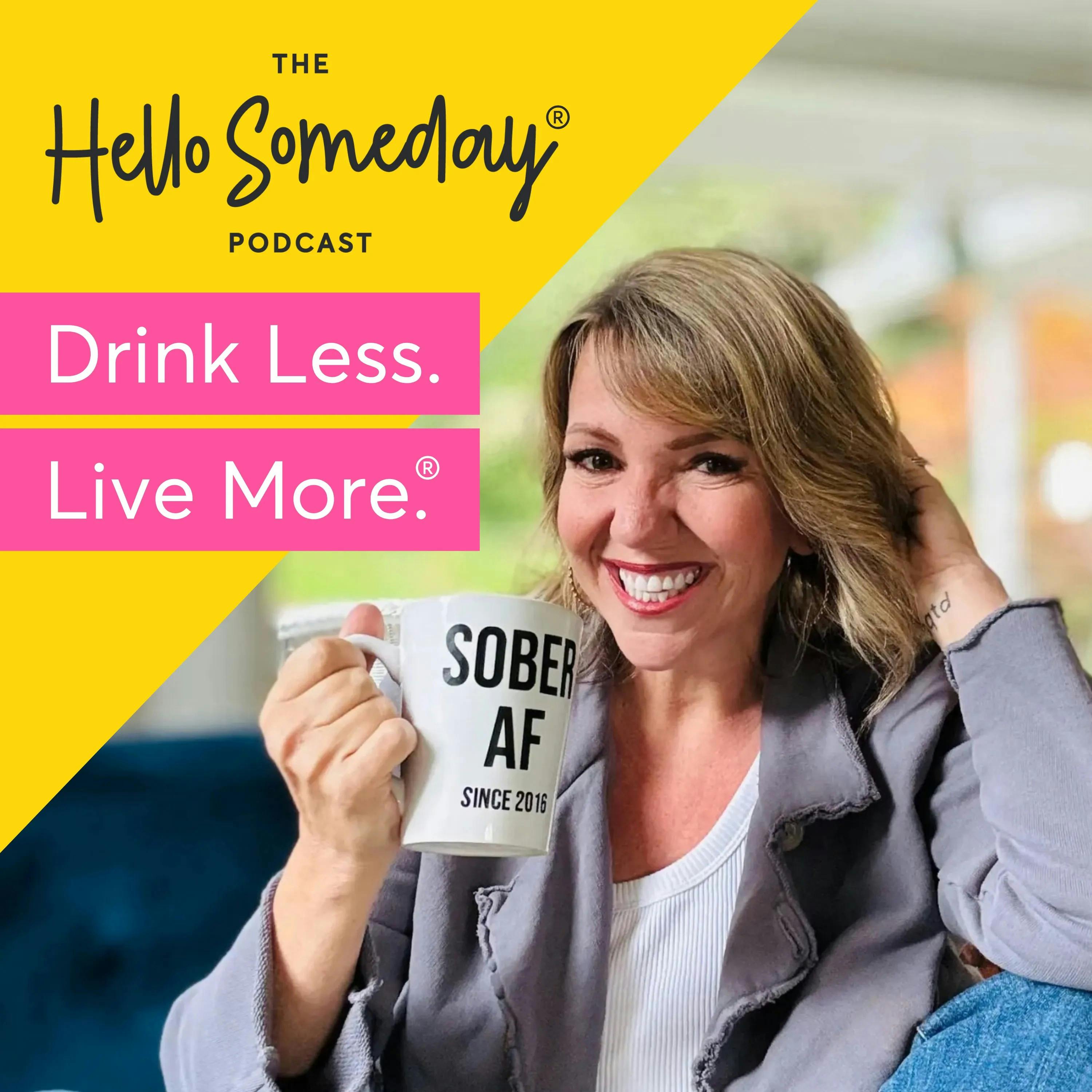
The Hello Someday Podcast For Sober Curious Women
Casey McGuire Davidson
Are you worried you might be drinking too much but can't seem to cut back or drink less for very long? I'm Casey McGuire Davidson, a Sober Coach for high-achieving women, and I'm here to help.I created the Top 100 Mental Health Podcast The Hello Someday Podcast For Sober Curious Women, to help you take a break from drinking and create a life you love without alcohol.Each week I’ll bring you tools and conversations you need to get out of the drinking cycle.You'll find advice on how to get through your first week alcohol-free and what to expect in your first 30 days sober, interviews with the authors of the best quit lit books for women and conversations about how to talk to your friends and family about taking a break from drinking.With over 275 episodes, 2 Million downloads + a show ranked in the top 0.5% globally, The Hello Someday Podcast has the inspiration and information you need to drink less, live more and start your sober journey. If you want amazing support in early sobriety or a girlfriend to talk about how to manage motherhood, work and life without alcohol, The Hello Someday Sobriety Podcast is for you. 🧰 Get Your FREE GUIDE: Expert Tips For Your First 30-Days Alcohol-Free!https://hellosomedaycoaching.com/30-day-sober-guide/❤️ Join my sober coaching program + community: The Sobriety Starter Kit!http://sobrietystarterkit.com/💥 Follow me on IG for all things sober curious life!https://www.instagram.com/caseymdavidson/🎙 Listen to the Podcast + get the show notes!https://hellosomedaycoaching.com/podcast/ ☕ Love the show? Buy me a coffee!https://www.buymeacoffee.com/hellosomeday Or leave me a rating or review!⭐⭐⭐⭐⭐"I’ve listened to so many sober podcasts and The Hello Someday Podcast is by far THE BEST Sobriety Podcast out there for women. This podcast was key to me quitting alcohol. Casey's practical tips and tricks are invaluable, with advice I haven’t heard anywhere else. If I could give this podcast 27 stars I would!!" - Laura
Episodes
Mentioned books

Jan 1, 2021 • 32min
Ep. 38: The Sober Girl’s Guide to Dry January
Today is The Day! It’s January 1st, 2021. It is DRY JANUARY and you are ready to stop drinking. It’s the perfect time for a fresh start. You’re ready to
Take a break from drinking to be healthier and happier, more fulfilled and confident.
Sleep through the night and wake up feeling good.
Get out of the drinking cycle of feeling, tired, stuck and defeated.
And I’ve got all the tools you need to start strong and keep on going!In this podcast I’m going to share all my best tips and tricks to set you up for success so that you get the most out of Dry January.You’ll learn
How to use Dry January as a springboard to building a life you love without alcohol, not as a short break from the drinking cycle.
Why Dry January gives you the perfect reason to tell others you’re not drinking, without labels or explanations.
How to build up sober momentum in Dry January without worrying about questions of ‘forever’ or ‘never again’.
Where to hook up with other women doing Dry January so that you can cheer each other on.
How to step up self care this month and use treats and rewards so that your time not drinking is really pleasurable.
How to take advantage of this month to change your go-to habits so that after the 31 days you won't want to go back to drinking.
And if one of your goals in 2021 is to drink less + live more I can help. I created an on-demand course, The Sobriety Starter Kit, which can help you make 2021 the year you stop drinking. The Sobriety Starter Kit is the online, self-study sober coaching course that will help you quit drinking and build a life you love without alcohol.The course is based on the sober coaching work I do with my private clients and is available at a cost that’s significantly more affordable than one-on-one coaching. Plus the online Sobriety Starter Kit course is ready, waiting and available to support you anytime you need it. When you purchase the course you’ll have lifetime access to it. You can start today or at any other time. The course is self-paced, so you’re never ‘behind’. You can move through the lessons as quickly or slowly as you need to and revisit earlier lessons at any time. In the Sobriety Starter Kit you’ll learn the framework, plus all the skills + strategies you need to stop drinking and build a life you love without alcohol – without white-knuckling it or hating the process.And I’ll hold your hand each step of the way. Click here to get all the details. Resources mentioned in this episode Episode 34 - The first episode on using Atomic Habits to Quit Drinking with Identity Based HabitsEpisode 35 - The second episode on using Atomic Habits to Quit Drinking on how to break your habit of drinking in four simple steps - without relying on willpower or hating the process Episode 36 - The third episode on using “The Habits Tipping Point”, that magical moment when choosing not to drink simply becomes a part of who you are. The Sobriety Starter Kit Online Course Connect with Casey McGuire DavidsonCheck out The Sobriety Starter Kit. The private, on-demand coaching course you need to break out of the drinking cycle - without white-knuckling it or hating the process.Grab your Free Sober Girls Guide To Quitting DrinkingGet support during the holiday season from women who are on the alcohol-free path with the guide on How to find and join my Favorite Private Sober Facebook groupsWebsite: www.hellosomedaycoaching.comInstagram: Casey @ Hello Someday Coaching (@caseymdavidson)

Dec 26, 2020 • 1h 2min
Ep. 37: How To Manifest The Shit Out Of Life
As the end of 2020 approaches many of us are ready to turn the page on this year and start anew. And it’s time to start fresh and look ahead to what you want and how to make that happen.And in this episode I want to tell you just how to do that. How to not only turn the page on last year and set new intentions for 2021, but also to keep your intentions strong as motivation fades after a few weeks or months. Too often in life, we’ve stopped dreaming. Or if we have dreams we dismiss them as impractical or impossible. We feel weighed down by responsibilities or what other people might think. Or our own habits, fears, limiting beliefs and assumptions of what is achievable, appropriate or allowed stops us in our tracks. My goal is to get you centered on what lights you up, fires up your imagination and brings you joy. To change what’s weighing you down because you deserve to feel happy and fulfilled. We think it’s our busy schedules or responsibilities that get in our way, but it’s not that. The biggest thing that stops us from achieving our dreams is ourselves.Our fears, our limiting beliefs and our negative self-talk. My challenge to you is to focus on what you want to feel and do in your life (regardless of what others think) and take small and large steps towards your dreams. And if one of your goals in 2021 is to drink less + live more I can help. I created an on-demand course, The Sobriety Starter Kit, which can help you make 2021 the year you stop drinking. The Sobriety Starter Kit is the online, self-study sober coaching course that will help you quit drinking and build a life you love without alcohol.The course is based on the sober coaching work I do with my private clients and is available at a cost that’s significantly more affordable than one-on-one coaching. Plus the online Sobriety Starter Kit course is ready, waiting and available to support you anytime you need it. In the Sobriety Starter Kit you’ll learn the framework, plus all the skills + strategies you need to stop drinking and build a life you love without alcohol – without white-knuckling it or hating the process. And I’ll hold your hand each step of the way. Click here to get all the details. Resources mentioned in this episode Download The Ultimate Vision Board Starter Kit Blog: How Vision Boards Work & Why You Need One The Sobriety Starter Kit Online Course Brené Brown: The Midlife Unraveling Jen Sincero’s Book: You Are A Badass Connect with Casey McGuire Davidson Check out The Sobriety Starter Kit. The private, on-demand coaching course you need to break out of the drinking cycle - without white-knuckling it or hating the process. Grab your Free Sober Girls Guide To Quitting Drinking Get support during the holiday season from women who are on the alcohol-free path with the guide on How to find and join my Favorite Private Sober Facebook groups Website: www.hellosomedaycoaching.comInstagram: Casey @ Hello Someday Coaching (@caseymdavidson)

Dec 22, 2020 • 43min
Ep. 36: The Habits Tipping Point - When Choosing Not To Drink Becomes Easy and Simply Part Of Who You Are
The Habits Tipping Point: When Choosing Not to Drink Becomes Easy and Simply Part Of Who You AreWelcome to Episode #3 in the Atomic Habits series on how to break your habit of drinking based on the research into what works in changing behavior for long term success.In part one of Atomic Habits, Episode 34, we discussed how to quit drinking using identity based habits. We talked about how every action you take supporting your goal to be alcohol-free [like listening to this podcast] is casting a vote for your identity as a happy, healthy woman who doesn’t need to drink to have fun or cope with life. In part two of Atomic Habits, Episode 35, we talked about how to break your habit of drinking in four steps by changing your cues, cravings, responses, and rewards habit loop.And in today’s Episode, part three, we're going to talk about the tipping point. The point when your behavior changes and shifts into your identity. There is a tipping point where by choosing not to drink you are simply acting IN ALIGNMENT with who you are.
The struggle not to drink is gone.
Your mind is not constantly thinking about drinking or not drinking.
You're someone who used to drink but don’t anymore, because you feel better without it.
In this episode we’ll dig into:
How to avoid the stumbling blocks that have tripped you up in the past and led you back to drinking.
What to do when you’re in the ‘plateau of latent potential,’ the time period when the work you’re doing builds until you hit the tipping point.
Good habits make time your ally and bad habits make time your enemy.
Habits are the compound interest of self-improvement. In the same way that money multiplies through compound interest, the effects of your habits multiply as you repeat them across time. At first you feel better and your progress is small and incremental. But as more time goes by those small improvements compound exponentially. The positive or negative trajectory of your life is immense depending on which habits you keep or change.When you change your habit of drinking, you’ll have a bunch of immediate benefits. You’ll have more energy and sleep well. You’ll look better and have more patience. And you will also change the trajectory of your life. From one that’s declining slowly and then more steeply, to one that’s improving slowly and then improving exponentially over time. Impressive results are the natural outcome of many small improvements accumulating over time. Atomic Habits links and resources mentioned Grab a copy of Atomic Habits by James Clear Episode 34 - The first episode on using Atomic Habits to Quit Drinking with Identity Based Habits Episode 35 - The second episode on using Atomic Habits to Quit Drinking on how to break your habit of drinking in four simple steps - without relying on willpower or hating the process. Podcast episodes on how to prime your mindset, physical and social environment for success in quitting drinkingEpisode 2 - 5 Mistakes Women Make When Quitting DrinkingEpisode 3 - 7 Strategies To Get You Through Your First Week Without AlcoholEpisode 10 - 10 Things You Need In Your Sober ToolkitEpisode 23 - Feeling Bored In Sobriety? Things To Know + What To Do Connect with Casey McGuire DavidsonGrab your Free Sober Girls Guide To Quitting DrinkingGet support during the holiday season from women who are on the alcohol-free path with the guide on How to find and join my Favorite Private Sober Facebook groups Website: www.hellosomedaycoaching.comInstagram: Casey @ Hello Someday Coaching (@caseymdavidson)

Dec 17, 2020 • 58min
Ep. 35: Break Your Habit of Drinking in Four Steps - Change Your Cue, Craving, Response + Reward Cycle
Have you been trying to break your habit of drinking using willpower, positive inspiration or negative, fear-based motivation by trying to avoid negative consequences? If you haven’t been successful in your attempts to stop drinking using this approach it’s actually not your fault. Instead you've likely just been trying to make a long term behavior change in all the wrong ways. There are easy ways and hard ways to break a habit, and research into the science of behavior change shows that willpower just doesn’t work in the long term. In this episode I’m going to talk about how to break your habit of drinking in four simple steps - without relying on willpower or hating the process. We’ll dive into:
The four laws of how to break a bad habit and how to build a new one, as outlined in Atomic Habits by James Clear.
Why understanding your personal habit loop of cues, cravings, responses and rewards is critical to helping you stop drinking without relying on willpower or hating the process.
How creating and sharing an implementation intention is fundamental to succeeding in change where you have stumbled in the past.
Why environmental design is key to achieving your goals. Making small changes to your physical and social environment will make it easier to break the drinking cycle.
What has likely tripped you up in the past and practical and specific ways to set yourself up for success, not self-sabotage.
What you should learn from times you’ve tried to stop before, without shaming yourself for going back to drinking.
There are four laws of how to break a bad habit and how to build a new oneFirst, start with your implementation intention. It’s a stated plan to solidify your plan to be alcohol-free for a specific amount of time.
The first law of how to make a new habit stick is to make it obvious. The more visible and available a habit is, the more likely you are to stick to it.
The second law is to make it attractive. The more appealing a habit is, the more likely you are to feel motivated to do it.
The third law is to make it easy. The easier, simpler, more convenient and frictionless a habit is, the more likely it is to be performed.
And the fourth law is to make it satisfying. The more satisfying, enjoyable, and pleasurable a habit is, the more likely it is to stick.
Atomic Habits links and resources mentioned Grab a copy of Atomic Habits by James Clear Episode 34 - The first episode on using Atomic Habits to Quit Drinking with Identity Based Habits Podcast episodes on how to prime your mindset, physical and social environment for success in quitting drinking Episode 2 - 5 Mistakes Women Make When Quitting DrinkingEpisode 3 - 7 Strategies To Get You Through Your First Week Without AlcoholEpisode 10 - 10 Things You Need In Your Sober ToolkitEpisode 23 - Feeling Bored In Sobriety? Things To Know + What To Do Connect with Casey McGuire Davidson Grab your Free Sober Girls Guide To Quitting Drinking Get support during the holiday season from women who are on the alcohol-free path with the guide on How to find and join my Favorite Private Sober Facebook groups Website: www.hellosomedaycoaching.comInstagram: Casey @ Hello Someday Coaching (@caseymdavidson)

Dec 10, 2020 • 1h 11min
Ep. 34: Quit Drinking With Identity Based Habits, Because Willpower Doesn’t Work.
Now back to How to Quit Drinking With Identity Based Habits, Because Willpower Doesn’t Work. There are easy ways and hard ways to break the habit of drinking. And if you’ve tried a bunch of times to get sober momentum and given up after 2 weeks or 2 months, I’m betting that you’ve tried ALL the hard ways to stop drinking and it’s brought you back to the same place. In this episode I’m going to share with you the research and framework behind how to break your habit of drinking once and for all, without relying on willpower, white-knuckling it or hating the process. What I’ve found in the coaching work I do with women is that approaching not drinking based on the research into what works in terms of long term behavior change is the most powerful, logical and sustainable way to become a happy and healthy non-drinker. And the best book I’ve found on how to change your habits and behavior is Atomic Habits by James Clear. Here’s what doesn’t work when you’re trying to stop drinking:
Shaming or blaming yourself for drinking again when the physical, social and emotional environment you live in has set you up for failure
Relying on hitting a low enough ‘bottom’ so that you’ll finally have the motivation to not drink and the willpower to resist alcohol
Keeping your wine (or your alcohol of choice) in your home (so that you don’t have to ask your partner to change their behavior)
Relying on your partner, family and drinking friends as your main source of support for changing your relationship with alcohol
If you’ve tried to stop drinking before and don’t seem to get very far there are a lot of reasons why what you’ve been doing up until now hasn’t been working. Here’s what you’ll learn in today’s episode about the ways to change your behavior and stop drinking in a way that’s easier and set up in a way for long term success.
How to prime your physical environment and social support to overcome the moments when willpower isn’t enough and motivation fades
Why true behavior change is based on identity change - who you believe you are. Because when you change your identity from a “red wine or chardonnay girl” to a “healthy, happy, confident and inspiring woman who doesn't drink anymore because she feels better and does more without it” - then, when you don’t drink, you are simply acting IN ALIGNMENT with who you are
How to get rid of the limiting beliefs and fears you have about what your life will look like without drinking
Why it's important to focus on your trajectory (the path that you are on and where it is leading you) rather than your end goal
How altering the media and messages you surround yourself with (including the messages you tell yourself) can be the difference between success and failure
Links and resources mentioned Grab a copy of Atomic Habits by James Clear Podcast episodes on how to prime your mindset, physical and social environment for success in quitting drinkingEpisode 2 - 5 Mistakes Women Make When Quitting DrinkingEpisode 3 - 7 Strategies To Get You Through Your First Week Without AlcoholEpisode 10 - 10 Things You Need In Your Sober ToolkitEpisode 23 - Feeling Bored In Sobriety? Things To Know + What To Do Connect with Casey McGuire DavidsonGrab your Free Sober Girls Guide To Quitting DrinkingGet support during the holiday season from women who are on the alcohol-free path with the guide on How to find and join my Favorite Private Sober Facebook groupsWebsite: www.hellosomedaycoaching.comInstagram: Casey @ Hello Someday Coaching (@caseymdavidson)

Dec 3, 2020 • 1h 24min
Ep. 33: Quitter: Drinking, Relapse + Recovery with Erica C. Barnett
There is no cookie cutter way to quit drinking. Often it takes many tries to find out what level of support you need to navigate life without drinking as a way to cope with life and what framework of recovery works for you. My guest today is Erica C. Barnett, the Seattle author of the book Quitter: A Memoir of Drinking, Relapse and Recovery. Erica’s experience with drinking and quitting drinking illustrates that it often takes a lot of trying to know what works for you. And that being able to move from relying on drinking pretty heavily as your main coping mechanism to not drinking and being able to sustain that often takes a number of tries. I loved my conversation with Erica and we covered a lot of ground. We talked about the good and the bad in drinking, quitting drinking and life in recovery. Plus Erica shared a ton about the ins and outs of the world of outpatient + inpatient treatment and detox facilities, which I knew very little about before our conversation. In this episode, Erica and I chat about
How awesome it is that we’re now able (with a few years distance from quitting drinking) to laugh at ‘all of it’ (our drinking, the situations we got into, the things we screwed up, the times we tried to stop drinking and failed, our paths to sobriety and everything in between)
The rapid increase in women binge drinking and drinking daily during the 2020 quarantine and COVID pandemic and the relentless messaging in our society encouraging (and pressuring) women to drink everyday
How fucked up it is that our society first encourages and trivializes women’s reliance on wine as “cute” or “funny” and then blames women for becoming addicted to an addictive substance
Why despite the fact that alcohol use disorders are more common than opioid addiction and kill more people, alcohol is positioned as an almost entirely fun and harmless substance
Why relapse is more often than not a part of recovery yet relapse is treated as a personal failure rather than a near-inevitability
The differences between the many paths to recovery including cognitive behavioral therapy, 12 step programs, online alcohol-free groups, inpatient and outpatient treatment facilities, medically supervised detox services, sober coaching and everything in between
The judgement surrounding addiction and how it can be harmful to recovering addicts.
The treatment industry and how it relies on repeat customers to keep it profitable and thriving - as well as Erica’s personal experiences (what worked and what didn’t) at various treatment centers
About Erica C. BarnettErica is a longtime political journalist and the author of a great book, Quitter: A Memoir of Drinking, Relapse and Recovery. She founded and edits the website PublicCola.com, which covers local news and politics in Seattle. Links and resources mentionedGrab a copy of Quitter: A Memoir of Drinking, Relapse, and RecoveryCheck out Erica’s blog, Thecisforcrank.comCheck out http://PubliCola.com and I Was a “Fun” Drunk. Until I Wasn’t. Connect with Erica C. Barnett Follow Erica on Twitter @ericacbarnettConnect with Erica on Instagram @ericabarnett Connect with Casey McGuire Davidson Grab your Free Sober Girls Guide To Quitting Drinking Get support during the holiday season from women who are on the alcohol-free path with the guide on How to find and join my Favorite Private Sober Facebook groups Website: www.hellosomedaycoaching.comInstagram: Casey @ Hello Someday Coaching (@caseymdavidson)

Nov 26, 2020 • 59min
Ep. 32: 10 Ways Running Can Jumpstart Your Recovery
Developing a running practice can jumpstart your recovery. Running is a layer of support that helps you set goals, boost confidence, and fill your time with a healthy alternative when all you want to do is pour yourself a drink. My guest today is Margaret Ward. Margaret is a mother of 4, a multiple marathon finisher, a retired chardonnay drinker, a life and sobriety coach and a former lawyer. She’s been featured in Trail Runner Magazine and her main passions, beside her kids, is finding adventure through traveling and running around the world. Margaret’s Recovery Run Adventures offers alcohol-free adventures to destination races in Iceland, Norway and Italy and more. In this episode we discuss,
The struggles of motherhood that can drive women to drink as a way to cope with stress and anxiety
The mental and physical benefits of running that will help you heal
How developing a small, consistent running practice can ease early sobriety
How running can help you build up small wins and boost your confidence
The way in which running helps you become more in tune with your body
Fun and exciting running adventures around the world in Iceland, Norway and Italy
10 Ways Running Can Jumpstart Your Recovery
Running requires little financial commitment and you can jump in at any time. Just grab your running shoes and head out the door.
Helps control your cravings, especially in early sobriety. When you run, your brain releases endorphins. Endorphins is a chemical released by your brain that triggers positive emotions. This is also known as the runners high.
Running decreases stress and anxiety. In early sobriety, your stress and anxiety levels can increase. Running increases your heart rate which in turn changes your brain chemistry. Your brain releases an anti-anxiety neurotransmitter such as GABA.
Moving your body allows you to practice mindfulness. When you run, you connect with your breathing and get into a state of flow. Running is a form of moving meditation.
Allows you to set goals and see immediate results. Setting running goals builds confidence and it gives you something to celebrate once that goal is accomplished. Start small and commit.
Provides structure to your day which is an important tool to have during early sobriety.
Counteracts Boredom.
Running is a natural way to release energy. Releasing build up energy helps regulate your nervous system, control anger, and will physically tire you out which will help you sleep at night.
When you start running, you open yourself up to a whole new world. A community of women who will cheer you on and hold you accountable. Joining a local running group helps you establish connections with other women.
Running provides you a great reason to stop drinking. You’re getting your body healthy. You are giving yourself a great tool to jumpstart your sobriety.
Shownotes: www.hellosomedaycoaching.com/32 Links and resources mentioned Spark: The Revolutionary New Science of Exercise and the Brain by John Ratey Born to Run by Christopher McDougall Connect with Margaret Ward Find out more about Margaret’s life and sobriety coaching and her travel + running trips at https://recoveryrunadventures.com/coaching/ You can also get Margaret’s free guide, 5 Steps to Jumpstart Your Running and Recovery, at https://recoveryrunadventures.com/coaching. Read Margaret Ward’s feature in Trail Runner Magazine. Follow Margaret on Facebook at Recovery Run Adventures Connect with Margaret on Instagram @recoveryrunadventures Connect with Casey McGuire Davidson Grab your Free Sober Girls Guide To Quitting Drinking Get support during the holiday season from women who are on the alcohol-free path with the guide on How to find and join my Favorite Private Sober Facebook groups Website: www.hellosomedaycoaching.comInstagram: Casey @ Hello Someday Coaching (@caseymdavidson)

Nov 19, 2020 • 1h 19min
Ep. 31: How To Get Through The Holidays Without Drinking with Jean McCarthy
The holidays are both a wonderful time of year as well as a time that can trip up women who have stopped drinking, from those in early sobriety to those that might have quit months (or years) earlier. A lot of us might get to November and December and think, I've been doing this not drinking thing for a while now. I've got this. But the holidays are a unique combination of back-to-back drinking events + occasions, family dynamics, memories of previous years drinking, physically being surrounded by alcohol with powerful emotional and social triggers. The holiday season can undermine your recovery if you're not prepared to navigate it in a way that supports your sobriety. In this episode, Jean and I share all the tips and tricks to having a wonderful holiday season without drinking. We talk about:
How to socialize sober + reduce stress and anxiety around attending holiday gatherings
Specific strategies for navigating Thanksgiving, Hanukkah, Christmas + New Year’s Eve
Practical advice on attending + hosting holiday parties, traveling + staying with family or having family members stay with you
What you can share with family + friends so they can make not drinking easier for you during the holidays
Why annual traditions and the specific expectations around what events happen during the holiday season, who hosts, what is served, how long people are together, who travels + for how long, can lead to resentments + challenges for your sobriety
Why it’s important to identify your expectations around the holidays + evaluate how they might impact you physically, mentally and emotionally
How to say no, modify traditions + set boundaries without feeling like you’re high maintenance
The fun stuff: why to set up a seasonal or holiday ‘bucket list’ with ideas of how to make the most of this special time that’s not centered around alcohol
Ideas for new traditions that can make the season more joyful, memorable + fulfilling
About Jean McCarthyJean McCarthy is the host of the Bubble Hour Podcast, an award winning blogger + recovery advocate. Jean is an author of two books. Her book, The Unpickled Holiday Survival Guide - staying alcohol free during the festive season is a wonderful resource about sobriety for people in recovery and for their families. Her collection of poetry, The Ember Ever There - Poems on change, grief, growth, recovery and rediscovery was published in early 2020.I interviewed Jean for this podcast in episode nine about her poetry and her story. Jean started her blog, Unpickled in 2011, and has continued to chronicle her alcohol free lifestyle. Since her first day of sobriety, thousands of readers have credited Unpickled as a motivating factor in their decision to quit drinking.SHOWNOTES: www.hellosomedaycoaching.com Links and resources mentioned Connect with Jean MccarthyLink to buy Jean’s Holiday Survival Guide and The Ember Ever There books: www.jeanmccarthy.ca/booksInstagram @jeanmccarthy_writesFacebook pages for Unpickled (www.facebook.com/unpickled) and The Bubble Hour (www.facebook.com/thebubblehour) Also websites: https://jeanmccarthy.ca/, https://unpickledblog.com/, https://jeanmccarthy.ca/the-bubble-hour/, https://www.amazon.com/dp/1999299906Connect with Casey McGuire Davidson Grab your Free Sober Girls Guide To Quitting Drinking Get support during the holiday season from women who are on the alcohol-free path with the guide on How to find and join my Favorite Private Sober Facebook groups Website: www.hellosomedaycoaching.comInstagram: Casey @ Hello Someday Coaching (@caseymdavidson)

Nov 12, 2020 • 1h 12min
Ep. 30: The Enneagram and Transformational Habits
The Enneagram is a tool of self discovery. It can help you understand yourself and why you respond and act the way you do. Today my guest is Jim Zartman. Jim is a certified Enneagram coach who walks us through the Enneagram types as well as transformational habits that can change our lives. Since Jim has done Enneagram work and typing interviews with over 50 women who are on the alcohol-free path, I asked him to talk about how the Enneagram work can be viewed through the lens of women who have relied on alcohol as a coping mechanism and are now leaving it behind. If you’re stepping away from alcohol the Enneagram can help you understand your unique core drivers, core needs, beliefs and patterns that have been influencing your choices and decisions. Jim shares that your core drivers can show up as superpowers or as a shadow that can sabotage the best parts of you. Jim shares, “The best of you is permanent. The worst of you is temporary. You never want to be less of yourself. You want to be the best of yourself with fewer sabotaging patterns. The Enneagram can help you uncover the best parts of you.” In Jim’s Enneagram work with clients he sees that:
Understanding your Enneagram type can help you gain a better understanding of your core motivations, driven by your desires and fears
Your Enneagram type is not a landing place, but a launch pad - it’s a tool in your growth, not the list of behaviors you are now held to
Your Enneagram type doesn’t put you in a box. Rather it gives you a framework for your tendencies and the lens through which you interact with your surroundings
In this episode, Jim and I chat about:
What the Enneagram is and how you can use the Enneagram as a tool to help you stop relying on alcohol as a coping mechanism
Transformation habits that can make a big difference in your sobriety
How you show up + being consistent
Acceptance
Curiosity
The three types of the main intelligence centers: the body center, heart center, & head center
Shownotes: www.hellosomedaycoaching.com/30Grab your Free Sober Girls Guide To Quitting DrinkingTo get the full guide of the best quit lit for women go to www.hellosomedaycoaching.com/quit-lit About Jim ZartmanJim is a certified enneagram coach and the co-founder of The Art of Growth, which is a team of coaches and consultants who work with individuals and organizations to help them achieve the transformation they want in themselves, their work and their relationship. Connect with Jim ZartmanWebsite: www.theartofgrowth.orgListen to The Art of Growth Podcast Connect with Casey McGuire DavidsonWebsite: www.hellosomedaycoaching.comInstagram: Casey @ Hello Someday Coaching (@caseymdavidson)Facebook: https://www.facebook.com/HelloSomeday Listen to more podcast episodes to drink less + live more.

Nov 5, 2020 • 59min
Ep.29: How is Coaching different than AA with Dennis Berry
What is the difference between Life, Recovery and Sober Coaching and a 12 step program like Alcoholics Anonymous?Most people who are trying to stop drinking have preconceived notions about what goes on in 12 step recovery programs such as AA based on what they’ve seen on TV and in movies and are also confused about what exactly “life coaching” or “sober coaching” involves. Some people wonder if a life and recovery coach is just a private paid AA Sponsor (spoiler alert - it’s not!) Going through a 12 step program, like Alcoholics Anonymous, typically involves attending meetings where members follow the 12 steps laid in the Big Book of Alcoholic Anonymous as a process that recovering alcoholics work through to successfully achieve and maintain sobriety. Many of these steps are ideally taken with the help of a sponsor, an individual who has gone through the AA program and helps others who are new to AA as they navigate early sobriety.Unlike AA, most life and sobriety coaches use a flexible approach to identify your personal goals around not drinking and succeeding in other areas of your life and create a plan to achieve them based on individual needs, motivations and preferences. I think that hiring a coach to stop drinking is similar to the decision you might make to hire a personal trainer or a nutritionist to increase your fitness levels or refine your eating habits. I’ve invited my guest, Dennis Berry, to have this conversation with me because he’s not only a skilled life coach who is passionate about the benefits of coaching, but he is also in recovery and found recovery in AA and for many years was an active participant in the program. He both sees all the benefits of 12 Step programs and the difference between AA and coaching. In this episode, we discuss:
How life, sobriety and recovery coaching differs from the approach used in 12 Step Recovery Programs such as Alcoholic Anonymous.
Why most people need layers of support to stop drinking which may include a combination of coaching, therapy, exercise, 12 step programs, podcasts, books, online support groups and other hobbies, habits and healthy pursuits.
How coaching differs from the work done by sponsors in AA or therapy in being goal and future-focused.
The benefits of the Alcoholics Anonymous as a program which is widely available (with an estimated membership of 2 million people around the world), free of cost and offers fellowship, support and a structured program of steps to take to stop drinking.
The limitations of AA as a program created 85 years ago, in 1935, by two white men. In 1939, the Fellowship published its basic textbook, Alcoholics Anonymous and in 1953 AA’s 12 steps (the guidelines by which to get sober and recover) and 12 traditions (the principles behind the steps meant to keep members focused on the primary purpose) were written. Criticisms of AA have been that it can be seen as a one-size-fits-all approach that is rigid and antiquated.
The importance of developing independence in sobriety and why Dennis believes AA’s philosophy and approach can foster dependence on the program.
About Dennis BerryDennis is a Life Coach based in Colorado, who has been working with people recovering from addiction worldwide for over 15 years. Dennis has been in recovery from drug abuse for 17 years. His recovery has helped him find his mission in life, which is to help others on their journey through sobriety and achieve inner peace and success in every area of their lives. Dennis is also the host of The Funky Brain Podcast. Shownotes: www.hellosomedaycoaching.com/29Grab your Free Sober Girls Guide To Quitting DrinkingGet the guide on How to find and join my Favorite Private Sober Facebook groups Connect with Dennis BerryWebsite www.dennisberry.comListen to The Funky Brain Podcast Connect with Casey McGuire DavidsonWebsite: www.hellosomedaycoaching.comInstagram: Casey @ Hello Someday Coaching (@caseymdavidson)

