

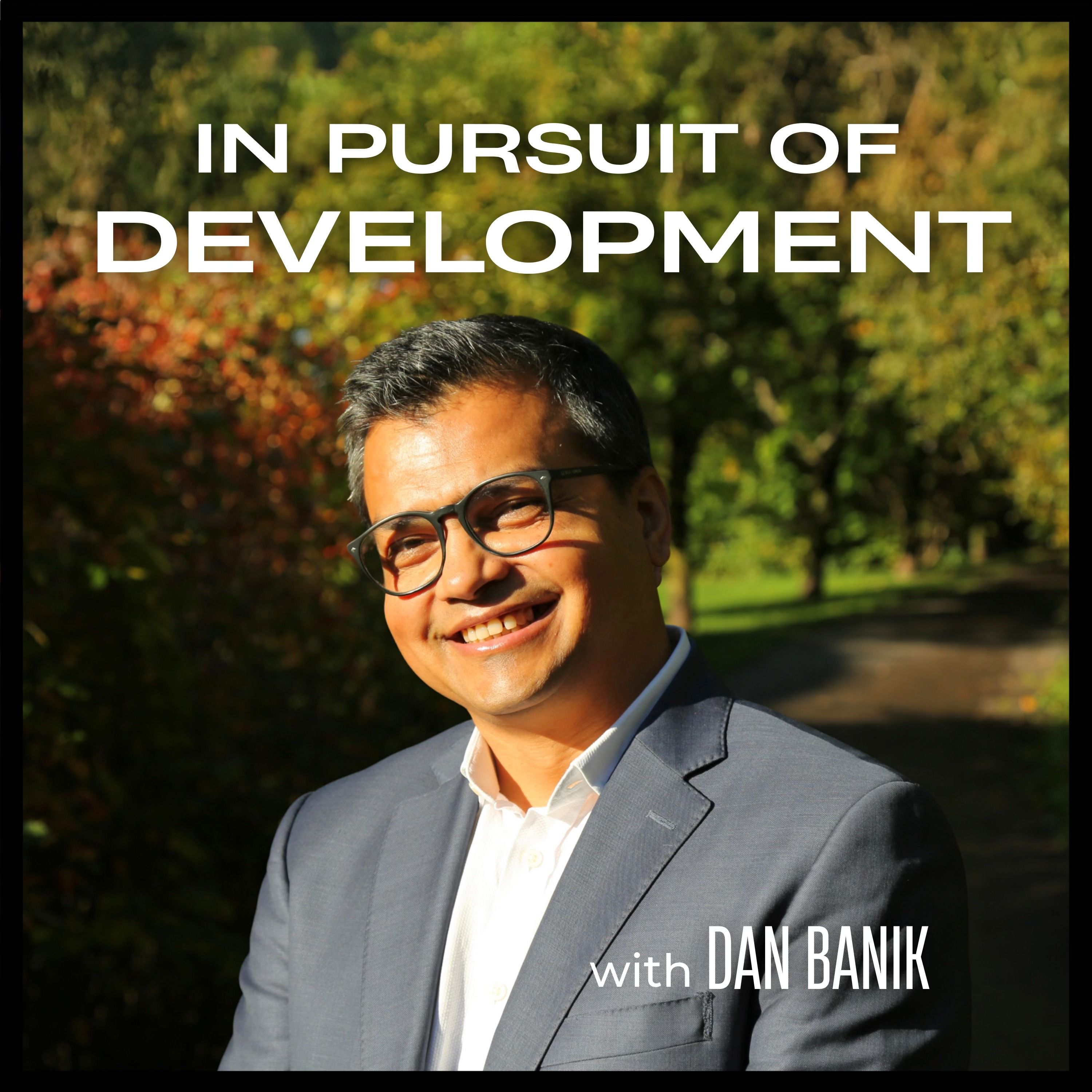
In Pursuit of Development
Dan Banik
Step into conversations that travel across continents and challenge the way you think about progress. From democracy and inequality to climate resilience and healthcare, Dan Banik explores how societies navigate the complex terrain of democracy, poverty, inequality, and sustainability. Through dialogues with scholars, leaders, and innovators, In Pursuit of Development uncovers how ideas travel, why policies succeed or fail, and what it takes to build a more just and resilient world. Expect sharp insights, candid reflections, and a global perspective that connects local struggles to universal aspirations.
Listen, reflect, and be inspired to see global development in a new light. 🎧
Listen, reflect, and be inspired to see global development in a new light. 🎧
Episodes
Mentioned books

Dec 7, 2022 • 55min
The power of the Chinese state: Examination, Autocracy, Stability, and Technology — Yasheng Huang
Ever wondered why the state in China is so powerful? Yasheng argues that Keju — the Imperial civil service examination — has historically maximized a specific type of knowledge in the minds of the population such as memorization. It also reduced the scope of, or eliminated, alternative ideas. Keju made the state all powerful. The state was able to monopolize the very best of human capital. And in doing so, the state deprived society access to talent and pre-empted organized religion, commerce, and intelligentsia. While it is China’s blessing, Keju is also a curse as it decimated society.Yasheng Huang is a Professor of International Management and Faculty Director of Action Learning at the MIT Sloan School of Management. His forthcoming book, which will be published by Yale University Press, is The Rise and the Fall of the EAST: Examination, Autocracy, Stability and Technology in Chinese History and Today. Twitter: @YashengHuangKey highlights Introduction – 00:52Recent protests in China – 03:15Protest strategies and logistical capacity – 13:25Why is the Chinese state so powerful? – 19:35The role of the civil service exam in China – 35:00Meritocracy and the Chinese bureaucracy – 47:15 Host:Professor Dan Banik, University of Oslo, Twitter: @danbanik @GlobalDevPodApple Google Spotify YouTubehttps://in-pursuit-of-development.simplecast.com/
Host:Dan Banik LinkedInX: @danbanik @GlobalDevPod Subscribe:Apple Spotify YouTubehttps://in-pursuit-of-development.simplecast.com

Nov 30, 2022 • 50min
Show me the money: Why cash transfers matter for development — Ugo Gentilini
Cash transfer schemes have grown in popularity in many parts of the world in the past few decades. Numerous studies find that cash transfer programs can be one of the most effective social protection tools at our disposal in the fight against poverty. There is now also growing empirical evidence of how cash transfers can provide quick relief during major economic crises. In addition to economic effects, they may change gender hierarchies and improve the position of women in local society, increase school attendance, and improve nutrition. It is therefore no surprise that cash transfer programs have been warmly embraced by many civil society organizations and international agencies. But is it all win-win? What works and what does not, and how can cash transfers be made even more effective as a tool for global development? Ugo Gentilini is an economist and the global lead for social assistance at the World Bank. He has worked extensively on the analytics and practice of social protection, including in relation to economic crises, fragility and displacement, and resilience and disaster risk management. He also writes a popular weekly newsletter and is my go-to-person on everything to do with social protection. In a new paper — Cash Transfers in Pandemic Times — Ugo combines analysis of large datasets with a review of about 300 pandemic papers, evaluations, and practical experiences and concludes with 10 lessons from the largest scale up of cash transfers in history. Twitter: @UgentiliniKey highlights Introduction – 0.48 Definition and understanding of cash transfers – 3.46 Increased interest in cash transfers – 6.15 Evolution of conditional and unconditional cash transfers – 14.38 Challenges and benefits of cash transfers – 19.33 What works, cash transfers and in-kind transfers - 25.36 Logistical and structural challenges of cash transfers - 31.00 How the pandemic has changed cash transfers – 40.10 Cash transfers going forward and advice for the future – 43.42 Host:Professor Dan Banik, University of Oslo, Twitter: @danbanik @GlobalDevPodApple Google Spotify YouTubehttps://in-pursuit-of-development.simplecast.com/
Host:Dan Banik LinkedInX: @danbanik @GlobalDevPod Subscribe:Apple Spotify YouTubehttps://in-pursuit-of-development.simplecast.com

Nov 23, 2022 • 52min
Crises of democracy — Adam Przeworski
Democracy is valued by many people because it enables us to achieve freedom and political equality in addition to numerous economic and social goals. But democracy also allows us to decide from time to time by whom we wish to be governed. Through elections, we can place in office those who we expect to like and also remove from office those we do not like.Adam Przeworski argues that the essence of democracy is that it processes in relative liberty and peace whatever conflicts that arise in society. And elections are the main mechanism by which conflicts are managed. This is because elections generate temporary winners and losers designated by specific rules. Elections peacefully process conflicts when the losers do not find their defeat too painful and if they expect to have a reasonable chance of winning in the future. This also means that the winners do not inflict too much pain on the losers and do not foreclose the possibility of being removed from office.Adam Przeworski is Emeritus Professor of Politics at New York University and one of the world’s foremost scholars on democracy. He has studied political regimes, democracy, autocracy, and their intermediate forms, the conditions under which regimes survive and change, as well as their consequences for economic development and income equality. His latest book is Crises of Democracy, where he discusses the political situation in established democracies, places this in the context of past misadventures of democratic regimes, and speculates on the future of democracy. Twitter: @AdamPrzeworskiKey highlights:Introduction - 0:44Definitions and understandings of democracy – 2:42The distinction between democracy and freedom – 11:15Democracy and minority rights – 17:54Income and democracy – 30:08Processing conflicts – 37:27The future of democracy in Poland – 45:36 Host:Professor Dan Banik, University of Oslo, Twitter: @danbanik @GlobalDevPodApple Google Spotify YouTubehttps://in-pursuit-of-development.simplecast.com/
Host:Dan Banik LinkedInX: @danbanik @GlobalDevPod Subscribe:Apple Spotify YouTubehttps://in-pursuit-of-development.simplecast.com

Nov 16, 2022 • 1h 6min
Silenced voices in global health — Address Malata
Global health organizations are mainly located in the global North and experts from low- and middle-income countries are underrepresented in global health leadership positions. Thus, it is unsurprising that there has been considerable criticism and heated debate on who should represent the underrepresented. According to our guest this week, it is crucial to ask: Who Speaks for Whom and About What?Professor Address Malata is the Vice Chancellor of the Malawi University of Science and Technology (MUST). She trained to be a nurse and is former President of Africa Honor Society of Nursing and former Vice President of International Confederation of Midwives. She has previously served as principal of the University of Malawi’s Kamuzu College of Nursing and is the recipient of numerous honors both at home and abroad. Host:Professor Dan Banik, University of Oslo, Twitter: @danbanik @GlobalDevPodApple Google Spotify YouTubehttps://in-pursuit-of-development.simplecast.com/
Host:Dan Banik LinkedInX: @danbanik @GlobalDevPod Subscribe:Apple Spotify YouTubehttps://in-pursuit-of-development.simplecast.com

Nov 9, 2022 • 1h 1min
The development bargain — Stefan Dercon
Development is a gamble because success is not guaranteed when benefits materialize in the long-term and a host of factors may undermine elite positions. Some countries are able to settle on elite bargains that favour growth and development, and others are unable to reach such settlements.While elite bargains in China, Indonesia, Bangladesh, Ethiopia, Rwanda and Ghana ended up being development bargains, the opposite was the case in Nigeria, DRC, Malawi and South Sudan. Stefan Dercon is Professor at the Blavatnik School of Government and the Economics Department at theUniversity of Oxford, where he also directs the Centre for the Study of African Economies.His latest book – Gambling on Development: Why some countries win and others lose– draws on his academic research and his policy experience across three decades. Twitter: @gamblingondevKey highlights:Introduction - 0:55Bridging the gap between research and policy – 3:09Why a general recipe for development is not very helpful – 11:22Gambling for development: Key arguments – 28:38The future of foreign aid – 45:13 Host:Professor Dan Banik, University of Oslo, Twitter: @danbanik @GlobalDevPodInstagram: @GlobalDevPodApple Google Spotify YouTubehttps://in-pursuit-of-development.simplecast.com/E-mail: InPursuitOfDevelopment@gmail.com
Host:Dan Banik LinkedInX: @danbanik @GlobalDevPod Subscribe:Apple Spotify YouTubehttps://in-pursuit-of-development.simplecast.com

16 snips
Nov 2, 2022 • 58min
Transforming our global food system — Gunhild Stordalen
Issues with the global food system and the need for radical transformation. Global food security, inequitable distribution, and combatting food waste. The EAT-Lancet report on sustainable diets and upcoming commission. Pushback and misunderstandings surrounding the report. Shift towards vegetarian options and influencing policy. Importance of collaboration to tackle global food system challenges.

Oct 26, 2022 • 58min
Why we fight — Chris Blattman
While there are millions of hostile rivalries around the world, only a fraction of these erupt into violence. It is easy to overlook the underlying strategic forces of war and to see war mainly as a series of errors and accidents. It is also easy to forget that war shouldn’t happen—and most of the time it doesn’t. Chris Blattman is a Professor at the University of Chicago in the Harris School of Public Policy. He is an economist and political scientist who studies violence, crime, and underdevelopment. His most recent book is Why We Fight: The Roots of War and the Paths to Peace, which shows that violence is actually not the norm; and that there are only five reasons why conflict wins over compromise. Twitter: @cblatts Host:Professor Dan Banik, University of Oslo, Twitter: @danbanik @GlobalDevPodApple Google Spotify YouTubehttps://in-pursuit-of-development.simplecast.com/
Host:Dan Banik LinkedInX: @danbanik @GlobalDevPod Subscribe:Apple Spotify YouTubehttps://in-pursuit-of-development.simplecast.com

Oct 19, 2022 • 54min
Africa's right to development — Mo Ibrahim
Mo Ibrahim, a Sudanese-British entrepreneur, founded one of the largest mobile phone companies that operated on the African continent. In 2006, he established the Mo Ibrahim Foundation with the goal of fostering improved governance. The foundation publishes The Ibrahim Index of African Governance, which assesses governance performance in 54 African countries. It also awards the Ibrahim Prize for Achievement in African Leadership (worth $5 million) to African leaders who have successfully delivered security, health, education, and economic development to their constituents and have democratically transferred power to their successors.Resources:The Road to COP27 Making Africa’s Case in the Global Climate Debate(July 2022)"Billionaire Mo Ibrahim attacks ‘hypocrisy’ over Africa’s gas", The Guardian, 17 October 2022Host:Professor Dan Banik, University of Oslo, Twitter: @danbanik @GlobalDevPodApple Google Spotify YouTubehttps://in-pursuit-of-development.simplecast.com/
Host:Dan Banik LinkedInX: @danbanik @GlobalDevPod Subscribe:Apple Spotify YouTubehttps://in-pursuit-of-development.simplecast.com

Mar 30, 2022 • 52min
The pursuit of liberty and prosperity along a narrow corridor — Daron Acemoglu
In the bestselling book – Why Nations Fail: The Origins of Power, Prosperity, and Poverty (2012), Daron Acemoglu and James Robinson ask why some nations are rich and others poor, divided by wealth and poverty, health and sickness, food and famine. They claim that it is neither culture, weather, nor geography. Rather, they argue that economic success depends on man-made political and economic institutions. In their latest book, The Narrow Corridor: States, Societies, and the Fate of Liberty (2019), Daron and Jim show that liberal-democratic states exist in between the alternatives of lawlessness and authoritarianism. And while the state is needed to protect people from domination at the hands of others in society, the state can also become an instrument of violence and repression. Society’s default condition is anarchy (or the "Absent Leviathan"). The alternatives to chaos are despotism (the "Despotic Leviathan"), the powerless state (the "Paper Leviathan"), and the "Shackled Leviathan" (or state which equals the corridor between the Absent, Paper, and Despotic Leviathans). Thus, liberty originates from a delicate balance of power between state and society.Daron Acemoglu is Institute Professor in the Department of Economics at the Massachusetts Institute of Technology (MIT). Host:Professor Dan Banik, University of Oslo, Twitter: @danbanik @GlobalDevPodApple Google Spotify YouTubehttps://in-pursuit-of-development.simplecast.com/
Host:Dan Banik LinkedInX: @danbanik @GlobalDevPod Subscribe:Apple Spotify YouTubehttps://in-pursuit-of-development.simplecast.com

Mar 23, 2022 • 53min
Can fixing dinner fix the planet? — Jessica Fanzo
A complex web of factors affects our ability not only to meet nutritional needs, but also our efforts to sustain biodiversity and protect the environment. As the world's agricultural, environmental, and nutritional needs intersect—and often collide—how can nations, international organizations and consumers work together to reverse the damage by changing how we make, distribute, and buy food? And do we have the right to eat wrongly?Jessica Fanzo is the Bloomberg Distinguished Professor of Global Food & Agricultural Policy and Ethics at Johns Hopkins University. She has previously worked as an advisor for various organizations and governments including the Global Alliance for Improved Nutrition (GAIN), the International Food Policy Research Institute (IFPRI), the Scaling Up Nutrition movement (SUN), the UN Standing Committee on Nutrition (UNSCN), and the World Health Organization (WHO). Her latest book is Can Fixing Dinner Fix the Planet? Inextricably bound together by food (OECD forum)It's Her Time: Jess Fanzo (Worldwildlife.org)The Future of Food (video interview, CGTN)Twitter: @jessfanzoHost:Professor Dan Banik, University of Oslo, Twitter: @danbanik @GlobalDevPodApple Google Spotify YouTubehttps://in-pursuit-of-development.simplecast.com/
Host:Dan Banik LinkedInX: @danbanik @GlobalDevPod Subscribe:Apple Spotify YouTubehttps://in-pursuit-of-development.simplecast.com

