

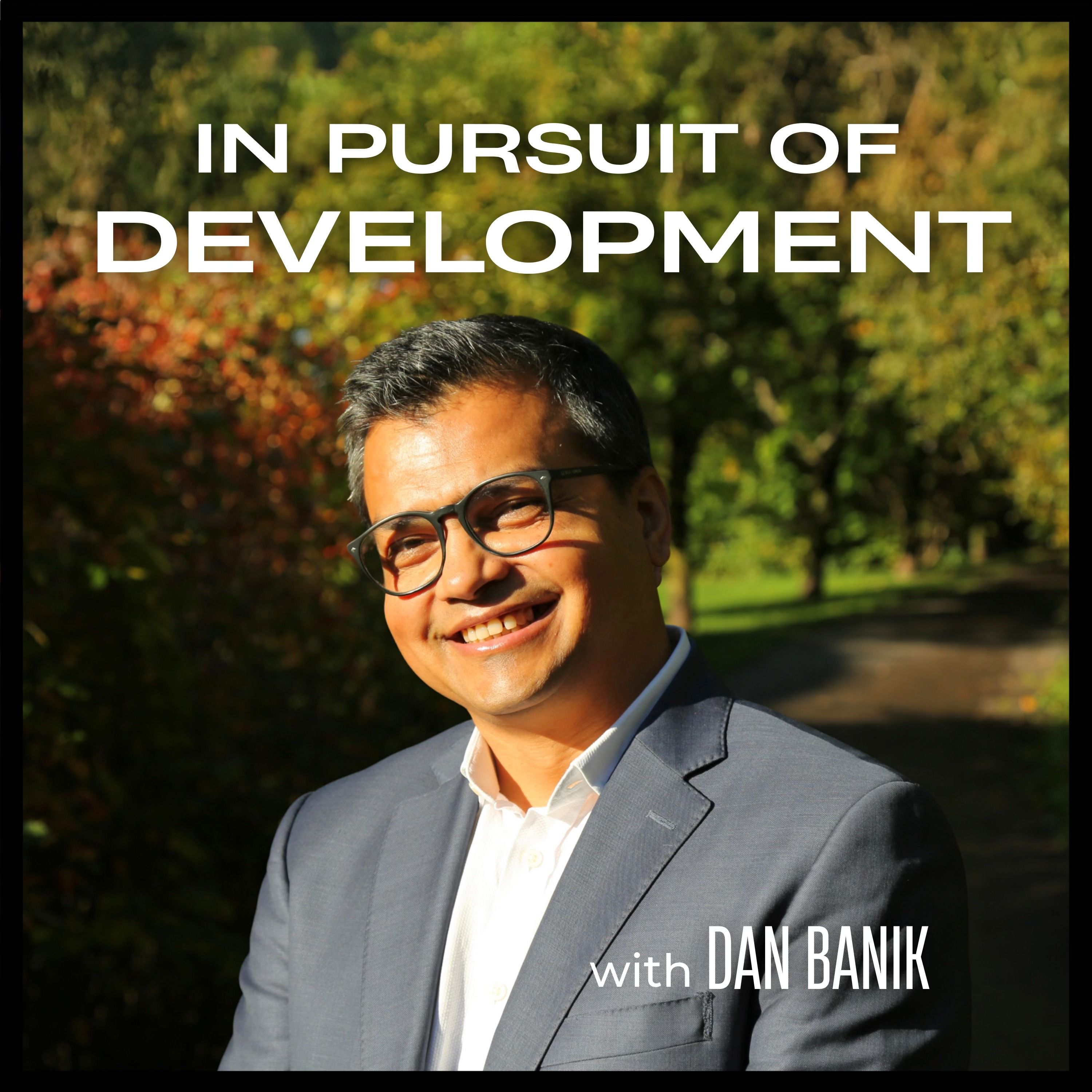
In Pursuit of Development
Dan Banik
Step into conversations that travel across continents and challenge the way you think about progress. From democracy and inequality to climate resilience and healthcare, Dan Banik explores how societies navigate the complex terrain of democracy, poverty, inequality, and sustainability. Through dialogues with scholars, leaders, and innovators, In Pursuit of Development uncovers how ideas travel, why policies succeed or fail, and what it takes to build a more just and resilient world. Expect sharp insights, candid reflections, and a global perspective that connects local struggles to universal aspirations.
Listen, reflect, and be inspired to see global development in a new light. 🎧
Listen, reflect, and be inspired to see global development in a new light. 🎧
Episodes
Mentioned books

Jul 8, 2020 • 1h 1min
Chinese aid and South-South Cooperation — Marina Rudyak
China is on everyone’s mind these days. It is not just related to the origins of Covid. There is considerable global attention on Beijing’s tense relations with Washington, Ottawa, New Delhi, Tokyo, and even many European capitals. But China wields great influence in large parts of the world, including in low and medium incomes countries, through its investments and aid. And in recent years, Beijing has steadily expanded its global influence through its signature foreign policy project – The Belt and Road Initiative – which is a long-term plan to undertake a series of large investments in roads, bridges, gas pipelines, railways, ports and power plants in over 70 countries. Joining me today to discuss the role and impact of China’s aid and investments around the world is Marina Rudyak.Marina is an assistant lecturer at the Institute of Chinese Studies at Heidelberg University in Germany. She studied Modern and Classical Chinese Studies and Public Law at Heidelberg University and Shanghai International Studies University. In her recently completed Ph.D. dissertation, Marina focuses on Chinese foreign aid policies and Beijing’s evolving role in international development.Before re-joining Heidelberg University in 2014, Marina was a policy advisor with the German Agency for International Cooperation (GIZ) in Beijing where she managed a multi-country project on regional economic cooperation. Resources:The Ins and Outs of China’s International Development AgencyMarina Rudyak's China Aid blogFollow Marina on Twitter
Host:Dan Banik LinkedInX: @danbanik @GlobalDevPod Subscribe:Apple Spotify YouTubehttps://in-pursuit-of-development.simplecast.com

Jul 1, 2020 • 1h 5min
State capacity in Latin America — Benedicte Bull
There have been numerous news reports in recent weeks pointing to how Covid will damage Latin America more severely than many other world regions. Several commentators and scholars have argued that the pandemic will wipe out several decades of social progress, pushing millions back into poverty. To discuss economic growth and poverty and inequality reduction in Latin America both before and after Covid, in addition to key political trends in the region, I am joined by my colleague Benedicte Bull. Benedicte Bull is a professor of political science and head of the Norwegian Latin America Research Network (NorLARNet) at the Centre for Development and the Environment at the University of Oslo. Her research has focused on the relationship between politics, state building and development, and how international relations influence the possibilities for establishing good institutions that can produce positive societal change.Resources:"Latin America ‘to lose 20 years of progress’ in poverty reduction" (Financial Times, 29 June 2020)Inequality in Latin America?The crisis in Venezuela: Drivers, transitions, and pathwaysPeace-building and business elites in Guatemala and El Salvador: explaining the discursive ‘institutional turn’Chinese engagement in Africa and Latin America: does it matter for state capacity?Covid in developing economies (E-book, edited by Simeon Djankov and Ugo Panizza)Benedicte Bull on TwitterFollow the In Pursuit of Development podcast on Twitter
Host:Dan Banik LinkedInX: @danbanik @GlobalDevPod Subscribe:Apple Spotify YouTubehttps://in-pursuit-of-development.simplecast.com

Jun 24, 2020 • 1h 20min
Erik Solheim on sustainable development
Our world is facing considerable challenges, not just in relation to the Covid crisis, but also in terms of our desire to eradicate extreme poverty and hunger and address the adverse impacts caused by climate disruption.Despite such challenges, we cannot underestimate the numerous developmental successes that the world has witnessed in recent decades. In relation to health, prosperity, safety, peace, and happiness, humanity is much better off today than ever before in history. And although such achievements have not been equally replicated in all arenas (e.g. the environment), this should deter us from asking what “success” means in practice, and how such ideas can be mobilized by national governments and the international community in pursuit of sustainable development.To discuss the relationship between development and the environment, the need to change consumer behavior and the future role of China, India, aid and the United Nations in a post-Covid world is my guest this week – Erik Solheim – a veteran Norwegian diplomat, who has previously served as the leader of Norway’s Socialist Left Party (1987-1997) and was Norway’s Minister for International Development and Minister of Environment (2005-2012). He also served as Chair of the OECD's Development Assistance Committee (DAC) (2013-2016) and Under-Secretary-General of the United Nations and Executive Director of the United Nations Environment Programme (2016-2018). Resources:Erik Solheim, UNEP websiteHow Can We Better Understand “Success” in International Development?Follow Erik Solheim on TwitterFollow Dan Banik on Twitter
Host:Dan Banik LinkedInX: @danbanik @GlobalDevPod Subscribe:Apple Spotify YouTubehttps://in-pursuit-of-development.simplecast.com

Jun 17, 2020 • 1h 19min
Democracy, development and Covid response in Africa — Boniface Dulani
Malawi is my second home. Every year, for the past fifteen years, I have made numerous trips from Norway to this beautiful country in Southern Africa to conduct research and to teach at the University of Malawi’s Chancellor College. During this time, I have been privileged to strike up many friendships with Malawians from all walks of life. I miss my friends. With borders closed all over the world, I worry that I may not be able to return to this beautiful country for a very long time. My initial interest in Malawi was spurred by two Masters students of political science at the University of Oslo who were studying health policy and local perceptions of the impact of democracy in Malawi in 2004-2005. While supervising these students, I began to learn about a country that did not normally elicit much international attention. The more I read, the more intrigued I became. The narrative then, as is also often the case now, was of Malawi struggling to achieve economic growth and address poverty reduction while undergoing democratic consolidation. The social science literature on Malawi then was limited. And the few good books that offered nuanced analyses explaining Malawi’s underdevelopment highlighted a dysfunctional political system, pervasive corruption, and the general lack of trust in democratic institutions. Hence, many questioned the added value of democracy and whether hard fought democratic freedoms have provided citizens with improved livelihoods. Many of these issues remain as relevant today as they were fifteen years ago. I have tried to decode the “Malawi paradox” – i.e. despite peace, political stability and consistent support for democracy, most Malawians have not witnessed radical improvement in their living standards and the country continues to perform poorly on most development indicators. And high levels of corruption, administrative inefficiency and political inaction and the lack of foresightedness continue to dominate the development landscape. Malawi lags behind its neighbours, and hence the international development discourse is frequently characterised by the perception that “there are developing countries, and then there is Malawi”. Such statements imply a sense of hopelessness about the country’s development trajectory. We address many of these issues in a book that I edited with Professor Blessings Chinsinga in 2016 entitled Political Transition and Inclusive Development in Malawi: The Democratic Dividend (open access). In this book, we concluded that democracy does not necessarily always foster or guarantee development when the desire to win the support of the electorate results in the adoption of populist policies. Indeed, although the overarching policy goals of the various governments in Malawi since 1994 have been poverty alleviation, the empirical evidence suggests that the impact of democracy on poverty reduction and socio-economic development has been negligible. Will the upcoming elections usher in a new age for Malawi? Only time will tell. My guest in this episode is Dr. Boniface Dulani, who studied at York and Sussex universities in the UK and has a doctorate in political science from Michigan State University in the United States. He is the Director of Survey at Afrobarometer – a non-partisan, pan-African research institution conducting public attitude surveys on democracy, governance, the economy and society in over 30 countries on the African continent. Dr. Dulani is senior lecturer at the Department of Political and Administrative Studies at Chancellor College, University of Malawi.
Host:Dan Banik LinkedInX: @danbanik @GlobalDevPod Subscribe:Apple Spotify YouTubehttps://in-pursuit-of-development.simplecast.com

Jun 8, 2020 • 30min
The population question
Much of Africa is experiencing high birth rates and certain countries such as the Democratic Republic of Congo and Nigeria are projected to witness massive increases in their populations in the next few decades. An explosive growth in population will in turn pose major challenges for government policies aimed at promoting development and well-being of citizens. Are governments reluctant to talk about birth control. If so, why? And what can policymakers learn from the Indian and Chinese experiences? The current discourse on birth control is polarized. Some scholars argue that despite its adverse impacts on the climate, the population question is largely neglected by the climate community. Others highlight the importance of better protecting reproductive rights, improved access to contraceptives, strengthening gender equality, improved educational opportunities and increasing the living standards of the world’s poorest people. Still others believe that people in rich countries should reduce their consumption levels in order to protect the environment.Blog:"The population question""A room full of elephants? Population, consumption and sustainability"Follow me on: Twitter: https://twitter.com/danbanikFacebook: https://www.facebook.com/dan.banik.officialPlease send me your questions, comments and suggestions by e-mail: InPursuitOfDevelopment@gmail.com
Host:Dan Banik LinkedInX: @danbanik @GlobalDevPod Subscribe:Apple Spotify YouTubehttps://in-pursuit-of-development.simplecast.com
Jun 8, 2020 • 27min
Dreaming of electricity
In this episode, I begin by discussing India's achievements in improving access to electricity before providing a brief overview of electricity access at the global level. I then go on to identify some of the major challenges that hundreds of millions of people on the African continent face in trying to access electricity. Most countries on the continent are struggling to promote clean and renewal forms of energy, but there are certain exceptions, such as Rwanda and Ethiopia. And then there are countries like Kenya and Malawi who have pinned their hopes on highly polluting coal-fired power plants. What type of strategy should policymakers in these countries pursue to generate clean energy and increase access to electricity, especially in rural areas? Blog:"Dreaming of electricity"Follow me on: Twitter: https://twitter.com/danbanikFacebook: https://www.facebook.com/dan.banik.officialPlease send me your questions, comments and suggestions by e-mail: InPursuitOfDevelopment@gmail.com
Host:Dan Banik LinkedInX: @danbanik @GlobalDevPod Subscribe:Apple Spotify YouTubehttps://in-pursuit-of-development.simplecast.com
Jun 8, 2020 • 27min
Crises and leadership
Covid-19 has confronted leaders with a crisis that they probably never expected in their lifetime. With the growing demand for, and resistance against, strict quarantines and national lockdowns, which entail severe restrictions on the freedom of movement and assembly of citizens, democracies as well as non-democracies around the world are being tested. There is also growing frustration, especially among the youth in Africa on the inability of the current political system to provide them with better representation and a stronger say in how their countries are governed. Many of Africa’s leaders are also accused of not adequately adapting to the demands of the global economy and largely ignoring the adverse impacts of climate change within their borders. A crisis tends to get citizens to rally around their leaders and their governments. But good leaders are not just effective during crises, they are also effective in non-crisis times. Blog:"Leadership for sustainable development"Follow me on: Twitter: https://twitter.com/danbanikFacebook: https://www.facebook.com/dan.banik.officialPlease send me your questions, comments and suggestions by e-mail: InPursuitOfDevelopment@gmail.com
Host:Dan Banik LinkedInX: @danbanik @GlobalDevPod Subscribe:Apple Spotify YouTubehttps://in-pursuit-of-development.simplecast.com
Jun 8, 2020 • 37min
China in a post-Covid world
In this episode, I discuss why China’s role and influence will continue to expand in a post Covid-19 world. In the initial months of the crisis in early 2020, the main narrative coming from China was very much inward-looking in that Beijing was projecting for its citizens as well as to the world that it could control the outbreak and that no other country would be able to perform better on this matter that it was already doing. Gradually, however, the narrative began to shift to one where Beijing has pursued a more aggressive public relations campaign. A key question is: Who will risk discontinuing their already deep ties with, and dependency on, China? While the United States is gradually withdrawing from the international arena, China appears well-placed to reap the benefits of its development diplomacy, the ambitious Belt and Road Initiative and the growing global interest in sustainable development which appeals to a growing number of countries around the world. Related articles/blogs:"Coordinating Chinese aid in a globalized world" (Carnegie-Tsinghua Centre for Global Policy, 2019)"The coronavirus: State capacity and crisis response in China", Global Policy journal (2019)"Global goals and the national interest: China's embrace of the SDGs" (Oslo SDG blog, 2019)Follow me on: Twitter: https://twitter.com/danbanikFacebook: https://www.facebook.com/dan.banik.officialPlease send me your questions, comments and suggestions by e-mail: InPursuitOfDevelopment@gmail.com
Host:Dan Banik LinkedInX: @danbanik @GlobalDevPod Subscribe:Apple Spotify YouTubehttps://in-pursuit-of-development.simplecast.com
Jun 8, 2020 • 3min
Introducing: In Pursuit of Development
Hi everyone, I’m Dan Banik. And welcome to the In Pursuit of Development podcast. I am a professor of political science at the University of Oslo, where I also direct the Oslo SDG Initiative on Sustainable Development. For the past couple of decades, I have been conducting research on the politics of poverty. Some of the countries I have been studying include China, India, Malawi, Kenya and Rwanda. So, if you are interested in democracy, poverty eradication, and climate change, this is your go-to podcast for a deeper understanding of the politics of global development.Many recent global discussions have highlighted the double challenge facing our world: to eradicate hunger and poverty and to stabilize the global climate before it is too late. We are also being constantly warned that as the negative impacts of climate change will only worsen soon, we must redouble our focus and energy in promoting a sustainable development agenda. Many thus urge us to transform our policies and practices related to economic growth, food and agriculture, and our everyday consumption patterns. But how can we achieve such ambitious transformations, and what are the main challenges ahead? In each episode, I will discuss the experiences of developing and “emerging economies” in Africa, Asia and Latin America. While some episodes or seasons will feature monologues, in others I will interview politicians, civil servants, activists, media personalities and fellow academics on a range of issues such as governance, corruption, foreign aid, gender equality, policies on healthcare, education, agriculture, food, and energy, in addition to economic growth and inequality, and climate change.While I will examine major global challenges and highlight various “problems”, I will also highlight “solutions” and “what works” on the ground. This podcast will thus enable you to examine development interventions critically. It will also help you better understand how “promising” policies, programs, and practices can be deployed in a range of international contexts.Follow me on: Twitter: https://twitter.com/danbanikFacebook: https://www.facebook.com/dan.banik.officialPlease send me your questions, comments and suggestions by e-mail: InPursuitOfDevelopment@gmail.com
Host:Dan Banik LinkedInX: @danbanik @GlobalDevPod Subscribe:Apple Spotify YouTubehttps://in-pursuit-of-development.simplecast.com

