

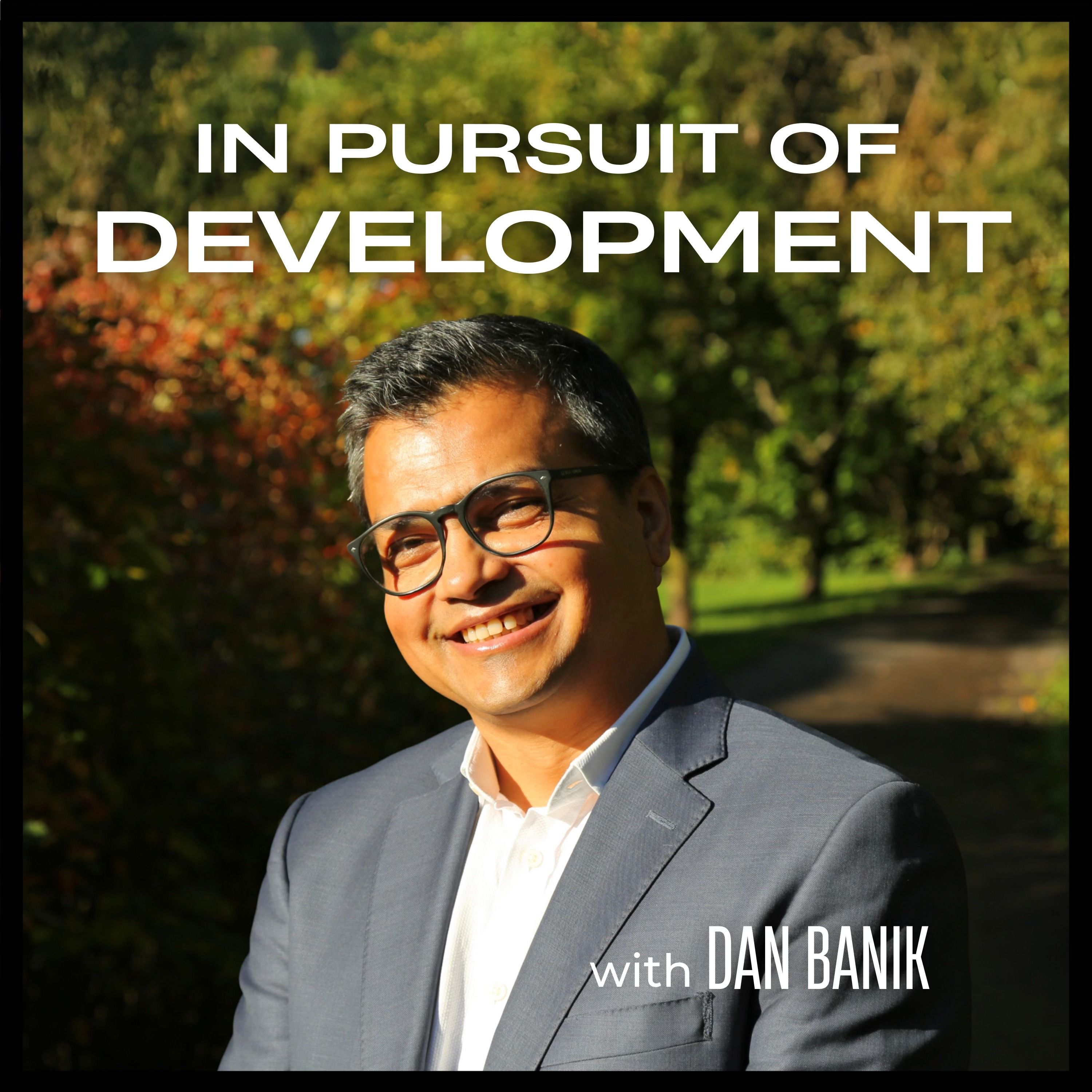
In Pursuit of Development
Dan Banik
Step into conversations that travel across continents and challenge the way you think about progress. From democracy and inequality to climate resilience and healthcare, Dan Banik explores how societies navigate the complex terrain of democracy, poverty, inequality, and sustainability. Through dialogues with scholars, leaders, and innovators, In Pursuit of Development uncovers how ideas travel, why policies succeed or fail, and what it takes to build a more just and resilient world. Expect sharp insights, candid reflections, and a global perspective that connects local struggles to universal aspirations.
Listen, reflect, and be inspired to see global development in a new light. 🎧
Listen, reflect, and be inspired to see global development in a new light. 🎧
Episodes
Mentioned books

Sep 23, 2020 • 1h 4min
Legislative development in Africa — Ken Ochieng' Opalo
Studying the role of institutions and their evolution often helps us better understand political and economic development in countries all over the world. And one such key institution is the legislature, which plays a critical role in democratic consolidation by providing a stable system of horizontal accountability. Legislatures craft legislation, pass laws, exercise oversight of the executive branch and thereby provide the institutional mechanism which allows societies to perform representative governance on a daily basis. Individual legislators articulate competing interests and try to influence the policymaking process. They also perform an important function – that of constituency service, i.e. they may regularly visit their constituencies and meet their constituents and address local needs and may even be involved in providing various types of public goods to their constituents through development projects. The extent of legislative capacity and power, of course, varies greatly from country to country. In some countries, the legislature remains relatively weak despite multiparty politics, regular elections and even when ruling parties lose elections. But in other countries, the legislature has functioned effectively as a check on the executive branch of government as well as provided important contributions to the policymaking and policy implementation processes. But legislatures and legislative capacity in developing countries have not received the kind of scholarly attention that they deserve. This is indeed surprising. In his brilliant book, Legislative Development in Africa: Politics and Postcolonial Legacies, published in 2019 by Cambridge University Press, Ken explores how the adaptation of inherited colonial legislative institutional forms and practices continue to structure and influence contemporary politics and policy outcomes in Africa. He contrasts the records of legislative performance and discusses why the legislatures in some emerging democracies have enhanced their capacity and power while those in others have not. Ken finds that the introduction of competitive multiparty electoral institutions strengthened the Kenyan legislature but not the Zambian one. He also examines how and under what conditions democratic legislatures emerge in countries that have had strong autocratic foundations. Ken’s book thus makes a strong case for strengthening legislatures in emerging democracies. He argues that attempts to strengthen legislatures in emerging democracies should not just be limited to technical assistance and organizational capacity building but also include the political empowerment of legislators. Ken Ochieng’ Opalo is an Assistant Professor in the School of Foreign Service at Georgetown University. His research interests include legislative politics, subnational administration and local government, electoral politics, and the political economy of development in Africa. Ken’s current research projects include studies of the politics of service provision and accountability under devolved government in Kenya, education sector reforms in Tanzania, inter-state relations in Africa, and executive-legislative relations in Kenya. His works have been published in the British Journal of Political Science, the Journal of Democracy, the Journal of Eastern African Studies, and Governance. He is a member of EGAP (Evidence in Governance and Politics), gui2de (Georgetown University Initiative on Innovation, Development, and Evaluation) and a non-resident fellow at Brookings Institution and the Center for Global Development. His research has been funded by the Luminate Group, the Susan Ford Dorsey Fellowship, and the United Kingdom’s Department for International Development (DFID). Ken earned his BA from Yale University and PhD from Stanford University. Resources:Follow Ken Opalo on TwitterFollow In Pursuit of Development on Twitter
Host:Dan Banik LinkedInX: @danbanik @GlobalDevPod Subscribe:Apple Spotify YouTubehttps://in-pursuit-of-development.simplecast.com

Sep 16, 2020 • 1h 5min
Why AIDS interventions in Africa often fail — Kim Yi Dionne
As the international community addresses numerous development challenges, we must often pause, reflect, and ask: Do good intentions lead to good results? If so, when? And how? There are innumerable development agendas and a multitude of stakeholders involved in saving lives as well as promoting long-term development in many developing countries. What really is the impact of their activities? Are such activities well-coordinated? How effectively can external actors make a meaningful contribution to alleviating local problems? And most importantly, whose priorities do such interventions address, and to what extent are the so-called “beneficiaries” consulted? Guest: Kim Yi Dionne, associate professor of political science, University of California, Riverside. Dr. Dionne also edits The Monkey Cage, a blog on politics and political science at The Washington Post. Resources:Doomed Interventions: The Failure of Global Responses to AIDS in Africa, Cambridge University Press (2018)Profile: Kim Yi Dionne, University of California, RiversideKim Yi Dionne on TwitterUfahamu Africa podcastDan Banik on TwitterIn Pursuit of Development on Twitter
Host:Dan Banik LinkedInX: @danbanik @GlobalDevPod Subscribe:Apple Spotify YouTubehttps://in-pursuit-of-development.simplecast.com

Sep 9, 2020 • 1h 2min
India’s development and the political economy of growth — Kunal Sen
With the phenomenal growth of its economy in recent years and its longstanding democratic record, India — the world's largest democracy — has emerged as a major global power. Not only has democracy survived in India, but in recent decades the country has also established itself as a beacon of hope for other developing countries striving to achieve a similar combination of democracy, development, and the rule of law. India’s management of the COVID pandemic, however, has made news headlines in recent weeks not just because of the massive spike in COVID cases but also because the country’s GDP plunged by 23.9 per cent in the period April – June 2020 – the biggest contraction of any major Asian country. And then there are rising tensions with China. As India’s Prime Minister Narendra Modi put it recently, India is fighting on many fronts.But some of India’s problems began in a pre-COVID era. There were signs that economic growth was slowing and unemployment was on the rise. Guest: Professor Kunal Sen, Director of UNU-WIDER and professor of development economics at the Global Development Institute at the University of Manchester.Topics discussed:The state of development economics research todayHow is COVID is deepening global inequality?India's economic growth trajectory since 1991Role of India's informal sectorTaxation policy in, and fiscal capacity of, developing countriesResources:Narendra Modi’s performance on the Indian economy – five key policies assessedFive ways coronavirus is deepening global inequalityTransitions between informal and formal jobs in IndiaKunal Sen on TwitterDan Banik on TwitterIn Pursuit of Development on Twitter
Host:Dan Banik LinkedInX: @danbanik @GlobalDevPod Subscribe:Apple Spotify YouTubehttps://in-pursuit-of-development.simplecast.com

Sep 2, 2020 • 58min
Globalization, the Nordic model and the economics of belonging — Martin Sandbu
Martin Sandbu has an exciting new book, The Economics of Belonging: A Radical Plan to Win Back the Left Behind and Achieve Prosperity for All (Princeton University Press).Martin argues that the western social order has rested on three crucial pillars. First, political principles centered on individual rights, equality before the law, robust and independent institutions and regular, free and meaningful elections. The second pillar consists of a social market economy, that is a capitalist system in which prosperity is broadly shared. And the third pillar is economic and political openness to the outside world for the joint realization of this social order.Much of the political debate in recent years, especially in the United States and in parts of Europe, has questioned the purpose and value of this western economic and political order that has been in place since 1945. This has been in part been fueled by widening income inequality, growing political polarization, and the rise of populist leaders. Some have also blamed globalization for such discontentment. But Martin argues that it is not globalization that is to blame for many of our current problems, but rather technological change and flawed domestic policies that have made it difficult for some groups in society to particulate fully and justly in the economy. The real problem, he writes, is that “The western social order no longer fulfills its promise of an economy that provides a good place for everyone."Martin Sandbu is the European Economics Commentator for the Financial Times. He also writes Free Lunch, the FT's weekly newsletter on the global economic policy debate.Martin Sandbu on TwitterDan Banik on TwitterIn Pursuit of Development on Twitter
Host:Dan Banik LinkedInX: @danbanik @GlobalDevPod Subscribe:Apple Spotify YouTubehttps://in-pursuit-of-development.simplecast.com

Aug 26, 2020 • 53min
The historic court ruling in Malawi annulling the 2019 presidential elections — Edge Kanyongolo
In a landmark ruling in February of this year, Malawi’s High Court concluded that the country’s president Peter Mutharika was “not duly elected”. The Court thus annulled the May 2019 elections in Malawi citing massive irregularities. It ordered new elections within five months and concluded that the Malawi Electoral Commission had failed to carry out its responsibilities according to the constitution and electoral law. The lengthy, meticulously detailed, and unanimous ruling by the five judges has attracted widespread international acclaim. The court ruling followed numerous protests organized throughout the country after the May 2019 elections. Edge Kanyongolo is an Associate professor at the Department of Law at Chancellor College, University of Malawi. Resources:A great judgment, but court victories won’t deliver democracy in Malawi (Dan Banik & Happy Kayuni, The Conversation, February 2020)Political Transition and Inclusive Development in Malawi: The democratic dividend (open access book with a chapter by Edge Kanyongolo, edited by Dan Banik and Blessings Chinsinga, Routledge).Courts and the Poor in Malawi: Economic Marginalization (Siri Gloppen and Edge Kanyongolo, International Journal of Constitutional Law, 2007)Edge Kanyongolo on TwitterDan Banik on TwitterIn Pursuit of Development on Twitter
Host:Dan Banik LinkedInX: @danbanik @GlobalDevPod Subscribe:Apple Spotify YouTubehttps://in-pursuit-of-development.simplecast.com

Aug 19, 2020 • 57min
The need to politicize development economics — Ingrid Harvold Kvangraven
Ingrid Harvold Kvangraven's research focuses on the role of finance in development, structural features of underdevelopment, the political economy of development (including the role of international institutions), and critically assessing the economics field.Dr. Kvangraven is currently an Assistant Professor in International Development at the University of York’s Department of Politics. She is the founder and editor of Developing Economics and founder and steering group member of Diversifying and Decolonising Economics (D-Econ).ResourcesIngrid's websiteBeyond The Stereotype: How Dependency Theory Remains RelevantIf we want to tackle global inequality, we need better economic theories‘Impoverished economics? A critical assessment of the new gold standardThe Wall Street Consensus (Daniela Gabor)Follow Ingrid Hvangraven on TwitterIn Pursuit of Development on Twitter
Host:Dan Banik LinkedInX: @danbanik @GlobalDevPod Subscribe:Apple Spotify YouTubehttps://in-pursuit-of-development.simplecast.com

Aug 12, 2020 • 59min
Pakistan's healthcare system and its recent success in fighting Covid — Usman Mushtaq
As the Covid pandemic continues to dominate world headlines, there is growing interest in better understanding how some low and middle-income countries have achieved considerable success in responding to this global crisis. Vietnam is one such country that has been successful in combating Covid. Another is Cuba. And the state of Kerala in India has also received much praise for its handling of the pandemic. But for the past few weeks a rather unlikely, success story has emerged. It is that of Pakistan, which has been branded as a bright spot, having achieved remarkable progress despite numerous predictions, including one study from June, which had warned of millions of infections and at least a hundred thousand deaths. But Pakistan appears to have, at least for the time being, defied these odds and the Covid curve appears to be flattening. And although experts say it is too early to claim victory over the virus, Pakistan’s somewhat unheralded achievement merits closer attention, especially given the long history of its dysfunctional and fragmented healthcare system.Dr Usman Mushtaq is a Norwegian-Pakistani medical doctor who for the past year or so has been working as an advisor for Pakistan’s Ministry of National Health Services, Regulations and Coordination. It was Dr Zafar Mirza, until recently Pakistan’s Minister of Health, who asked Dr Mushtaq to join his team in Pakistan. Dr Mushtaq is a member of the Board of Trustees of EAT Foundation and has previously been a member of the EAT Advisory Board and Director of Policy and Global Strategy for EAT. He is also a member of the Norwegian Labour Party. Usman Mushtaq on TwitterDan Banik on TwitterIn Pursuit of Development podcast on TwitterQuestions, comments and suggestions: InPursuitOfDevelopment@gmail.com
Host:Dan Banik LinkedInX: @danbanik @GlobalDevPod Subscribe:Apple Spotify YouTubehttps://in-pursuit-of-development.simplecast.com

Aug 5, 2020 • 1h 6min
How Black Lives Matter is also a reckoning for foreign aid and international NGOs — Degan Ali
Many have highlighted the need for equity and justice in the field of foreign aid and humanitarian assistance. Local civil society organizations (CSOs) or non-governmental organizations (NGOs) are the frontline workers, risking their lives to access areas that well-funded international NGOs or even UN agencies cannot access. However, critics of the current system claim that the local NGO is often the sub-contractor and not a real partner that is allowed to contribute to the design of the project. If something goes wrong in the process, that local NGO is blacklisted, not the UN agency or the international NGO that received the funding. There are also other concerns. For example, the local NGO rarely receives a decent overhead rate or adequate funds to cover operational expenses. Local NGO staff are also often poached by multilateral institutions and international NGOs. All of this, some claim, results in a serious and systematic erosion of capacity in the Global South. And local knowledge and organizational capacity are often undervalued.Degan Ali has for long spoken out against systematic racism – the systemic structure of power, money, and decision-making that goes into the design of the international humanitarian and aid architectures. She has campaigned for a more just and dignified aid system that allows recipient countries to take back power. In a recent op-ed, she argued that “Talking about racism is not enough” and that “We can’t afford another 50 years of apathy in the international system.”Degan Ali is the Executive Director of Adeso, an organization that has been a leader globally and in Somalia for its work on cash transfers and environmental justice. She has been a passionate advocate at the global level on the mainstreaming of cash as the primary response mechanism to humanitarian crisesResources"'We are demanding change': the Somali woman taking on international NGOs", The Guardian, March 2016"Is it finally time for the localization agenda to take off?", Devex, June 2020"Opinion: 'Accelerate your commitments' during COVID-19— an open letter to donors", Devex, April 2020YOUTUBE VIDEO: Imagining and creating a decolonized world with racial and economic justice at its core, webinar hosted by Intersectional Feminist Foreign Policy(IFFP) and AdesoNetwork for Empowered Aid Response (NEAR)Degan Ali on TwitterDan Banik on TwitterIn Pursuit of Development podcast on TwitterQuestions, comments and suggestions: InPursuitOfDevelopment@gmail.com
Host:Dan Banik LinkedInX: @danbanik @GlobalDevPod Subscribe:Apple Spotify YouTubehttps://in-pursuit-of-development.simplecast.com

Jul 29, 2020 • 1h 33min
How is India handling the pandemic? A conversation with Tathagata Satpathy
Although India faces numerous challenges – a huge population, rising unemployment, growing environmental vulnerabilities – there is general agreement that, despite many odds, democracy has not only survived but is now firmly entrenched in the social and political fabric of the country. In recent months, however, the country has been rocked by nationwide protests following the enactment of the Citizen Amendment Act in December 2019. And then Covid struck. On the 24th of March, Prime Minister Modi announced that the country was going into a three-week lockdown. The sheer scale of this nationwide lockdown affecting 1.3 billion people, was unprecedented. In subsequently extending the lockdown beyond the initial 3 weeks, the Prime Minister noted: “India didn’t wait for the problem to escalate. Instead, as soon as the problem appeared, we tried to stop it by making swift decisions. I can’t imagine what the situation would have been had such quick decisions not been taken”.In the initial weeks and months, the lockdown appeared to be working well but once it was gradually lifted, there was a surge in Covid cases. And many within India remain worried that the country’s healthcare system may not be able to tackle a crisis of such magnitude. But there is also growing evidence of how India has radically stepped up its Covid-testing capacity. And last year, an ambitious new health insurance plan was launched – the Ayushman Bharat Yojana, which aims to provide free health coverage to large groups in the country, Joining me to discuss India’s Covid response, health insurance policies, center-state relations in the country’s federal set-up, the role of political parties in promoting development and reducing poverty, and much much more is Mr. Tathagata Sathpathy. Tathagata Satpathy served four terms as Member of Parliament, representing the Dhenkanal constituency of the state of Orissa (also known as Odisha). Until recently, he was a member of the Biju Janata Dal (BJD) political party and was the party’s chief whip in the Lok Sabha – the lower house of the Indian parliament. In addition to being a politician, Mr. Satpathy is the owner and editor of the daily Odia newspaper, Dharitri, and the English daily, Orissa Post. Follow Tathagata Satpathy on TwitterFollow Dan Banik on TwitterIn Pursuit of Development on Twitter
Host:Dan Banik LinkedInX: @danbanik @GlobalDevPod Subscribe:Apple Spotify YouTubehttps://in-pursuit-of-development.simplecast.com

Jul 22, 2020 • 1h 26min
The relevance of foreign aid — Bård Vegar Solhjell
For decades, the mantra of globalization supported increased foreign aid to, and trade with, low-income countries. The proclaimed goal was to reduce poverty and promote economic growth and development. But aid policies have increasingly become both complex and fragmented. Some argue that there is an unprecedented international policy overload when it comes to aid and development. Indeed, some even claim that we are witnessing aid fatigue. Many traditional donors are also revisiting the role and impact of aid. In a world which was already struggling to cope with numerous crises even before the Covid pandemic struck – inadequate finance, food insecurity, climate change – the pattern and flow of aid to low-income countries in the near future is potentially going to change in fundamental ways. Bård Vegar Solhjell is Director General of the Norwegian Agency for Development Cooperation (Norad). He has substantial political experience having served as a member of Parliament and Party Secretary for the Socialist left Party in Norway and subsequently also as Norway’s Minister of Education and Minister of Environment. He was also CEO of WWF Norway.ResourcesThis is how Norwegian development aid funds were spent in 2019 (Norad)Norwegian Aid Statistics (Norad)From Knowledge to Implementation, Norad's Evaluation Department, Annual Report 2019/2020Follow Bård Vegar Solhjell on TwitterFollow Dan Banik on TwitterFollow In Pursuit of Development on Twitter
Host:Dan Banik LinkedInX: @danbanik @GlobalDevPod Subscribe:Apple Spotify YouTubehttps://in-pursuit-of-development.simplecast.com

