

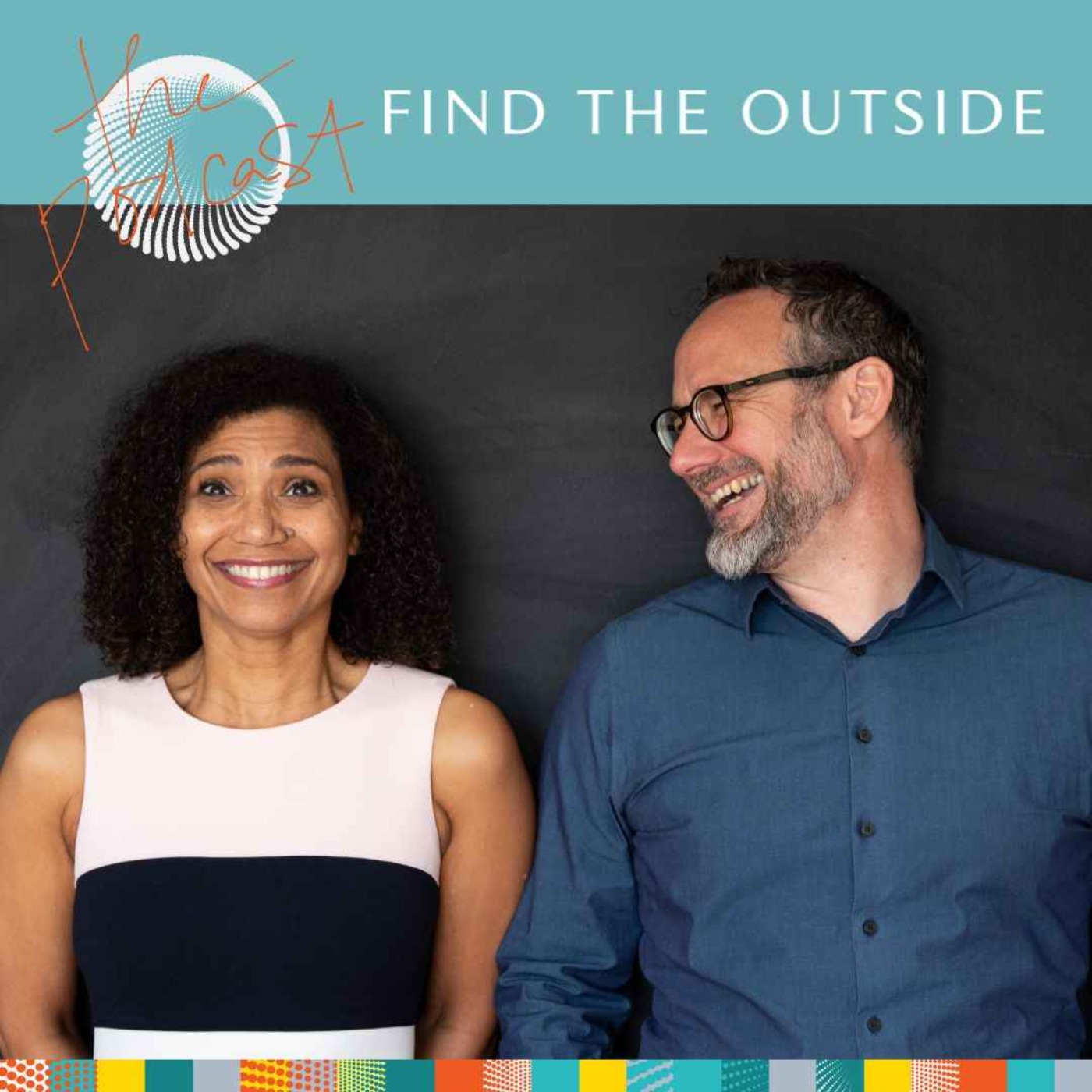
Find The Outside
Tim Merry & Tuesday Rivera
A lively, off-the-cuff conversation hosted by Tuesday Rivera and Tim Merry on large-scale systems change and equity. Together, Tim and Tuesday are THE OUTSIDE - systems change and equity facilitators who bring the fresh air necessary to organize movements, organizations, and collaborators forward for progress, surfacing new mindsets for greater participation and shared impact.In this podcast, we’ll share our greatest light-bulb moments as we advance our own understanding of this work. We’re doing it live, and inviting you in. Welcome! As Tim says in the first episode: reflection is too important to leave to chance. These conversations give us (and you!) a chance to slow down, catch our breath, and see our space and our work more clearly. Hosted on Acast. See acast.com/privacy for more information.
Episodes
Mentioned books

Feb 2, 2021 • 51min
3.09: Jeremy Lu: On values, online tools + living many lives (Full Episode)
Tim and Tuesday welcome Jeremy Lu, co-founder of the online collaboration tool GroupMap. Get ready for a conversation that reveals his incredible life experiences, and digs into why it matters which online tools we use to build the world we want.For detailed show notes, links and resources, please visit: https://www.findtheoutside.com/podcast Hosted on Acast. See acast.com/privacy for more information.

Jan 19, 2021 • 40min
3.08: Inexorable: On Unstoppable Momentum (Full Episode)
Tim & Tuesday talk through what is inexorable in ourselves and the world right now and what is open to our influence. To meet the unstoppable momentum of these times, they explore what mythical weapons they will be taking into 2021. Intrigued, right?!! Listen in.For detailed show notes, links and resources, please visit: https://www.findtheoutside.com/podcast Hosted on Acast. See acast.com/privacy for more information.

Jan 5, 2021 • 45min
3.07: Monuments: On taking the circuitous route to discovery (Full Episode)
Tim & Tuesday kick off the new year reflecting on the turning points of 2020 while reaching into history and ancestry to lend some meaning and insight on this moment we’re in and where we go from here.For detailed show notes, links and resources, please visit: https://www.findtheoutside.com/podcast Hosted on Acast. See acast.com/privacy for more information.

Dec 15, 2020 • 46min
3.06: Ambition: On willpower, trust and a future that claims us (Full Episode)
Tim & Tuesday host a far ranging conversation on how they relate to ambition and willpower in thier work. How is our drive helping, and hindering, our ability to do the work we love?For detailed show notes, links and resources, please visit: https://www.findtheoutside.com/podcast Hosted on Acast. See acast.com/privacy for more information.

Dec 1, 2020 • 52min
3.05: Classy - On navigating class, wealth and leadership distribution (Full Episode)
Tim & Tuesday dive into a conversation on class, spurred on by a recent conversation with an Outsider about delegation and leadership. Join in as we explore money, class structures, hierarchy, unconscious bias, leadership responsibilities and more - all within the the very practical context of the structure of The Outside.For detailed show notes, links and resources, please visit: https://www.findtheoutside.com/podcast Hosted on Acast. See acast.com/privacy for more information.

Nov 17, 2020 • 50min
3.04: Winged Words: On finding the soul of the work (Full Episode)
Inspired by Dr. Martin Shaw and author Cyndi Suarez, Tim and Tuesday explore the power of words, story and myth in systems change. How can "Articulation Leadership" add depth and momentum to groups seeking to make progress on big change?For detailed show notes, links and resources, please visit: https://www.findtheoutside.com/podcast Hosted on Acast. See acast.com/privacy for more information.

Nov 3, 2020 • 43min
3.03: Change in St. Croix: Small Reflects All (Full Episode)
Tim and Tuesday talk with fellow Outsiders, Sommer Sibilly-Brown and Kristina Torres, where they introduce us to the Island of St. Croix, Crucians and how this small island can show us that big change can be done differently.For detailed show notes, links and resources, please visit: http://findtheoutside.com/podcast Hosted on Acast. See acast.com/privacy for more information.

Oct 20, 2020 • 51min
3.02: Spirit of Change (Full Episode)
What does the spiritual journey look like for people involved in large scale systems change work? How is the spiritual path different from the mental health and leadership journeys also at play for those engaged in change initiatives? Listen in as Tim and Tuesday share some of their own personal journeys and what they're discovering along the way.New episodes will be available every second Tuesday. If you’d like to get in touch with us about something you heard on the show, reach us at podcast@findtheoutside.com Find the songs we’ve played on the podcast—on our playlist. Or search ‘Find the Outside’ on Spotify.Resources + Links mentioned in today's episode:Awakin CallsDuration: 50:37Produced by: Mark Coffin Theme music: Gary BlakemoreEpisode cover image: source Hosted on Acast. See acast.com/privacy for more information.

Oct 6, 2020 • 44min
3.01: TRANSLATING POWER: FINDING THE LANGUAGE THAT CAN BRIDGE WORLDS
In the first episode of season three, Tim and Tuesday talk with Cyndi Suarez, author of The Power Manual, where they explore the complexities of power and language. Join us for an invigorating, heartfelt and insightful conversation. Together, Tim Merry and Tuesday Ryan-Hart are THE OUTSIDE—systems change and equity facilitators who bring the fresh air necessary to organize movements, organizations, and collaborators forward for progress, surfacing new mindsets for greater participation and shared impact.3.01 — SHOW NOTESTuesday: Today on the podcast, our first of Season III, we are talking with Cyndi Suarez. Cyndi is the Senior Editor at Nonprofit Quarterly, she’s the author of The Power Manual: How To Master Complex Power Dynamics, she’s worked as a strategy and innovation consultant with a focus on networks and platforms for social movements, and she studied feminist theory and organizational development for social change. Cyndi: In the last few years, I’ve realized a different form of leadership that I’ve been exploring and I’ve been calling it “Articulation Leadership.” Seeing the power in putting things that we want into words; how that just opens up different worlds and possibilities. Tim: A lot of what we [The Outside] do happens in the experience that people have with each other but it becomes vastly insufficient when you are talking to someone about some major transformation work, that they will feel has very high stakes to it, and then you’re like, you have to really experience it to know what we are talking about. And so, we’re really in a question of how do you use words to evoke something that in some ways is felt? And then there is something for me about whether we are developing a new language or is it about finding the right words for the moment? Those are the two big questions we are in. Cyndi: The work of translation - of being able to both dive deep for the depth that you need and to find common ground - is one of the biggest challenges of organizing for power. It often does require redefining these identities that have been put on us and at the same time you need to reconnect with a larger table. Tuesday: When you talked about translation or connection; there’s a piece that is strategy. Part of it is grounding and deepening so we know what we’re doing and who we are to do it, but then there is also this piece around strategy that you just have to pay attention to. The reason we formed The Outside is because we felt like as we did systems change work there was very little power analysis and then in some of the movement-based spaces, there wasn’t much strategy to the level that you are talking about - not connecting out to make change. You have to do both to get you where you want to go. Cyndi: In my work, I am constantly challenging people to question the idea of shared strategy. Why? Why don’t we have a portfolio? Why do we have to agree? What do we have to agree on? This idea that we have to agree on everything is really extreme and tiring. It does not allow for the diversity that we have in our spaces. It doesn’t encourage it. I think there is a way that we need to be both humble and sophisticated in these conversations. We have to care enough and be curious enough about people. Being drawn towards difference is less explored especially in leadership and translation work. Tim: That bridging role is about power but also what we are often doing is pitching to people who hold wealth, influence, positional or hierarchical authority something that in many ways will undermine the established power that they have or the way they have got to that position of power. What’s the language that translates into positions of power - why power needs to be let go of and how does that begin to start shifting people’s fundamental beliefs about themselves and what it means to lead in today’s world? What’s the language that’s hard enough to bridge into the leadership worlds that we are currently engaging but soft enough to point to something new?Tuesday: Cyndi, you’ve just said so many interesting little nuggets… I am curious how you got to where you are?Cyndi: Since I was a kid, I always knew that I was going to write about power. I loved reading. Reading has always been a big part of my life. I am attracted to things that are different and that I don’t know. Tim: How do you stay tuned to this? Cyndi: I’m reading this book called Sacred Contract and one of the things that she says about people who tend to create something new or something big is that there is a point at which they have to go against the tribe. They always have to break from what is known to them in order to make their contribution. I think part of it is that. I came knowing and trusting myself and I have a spiritual practice - I am very inward focused. I spend a lot of time imagining what I want. My trajectory has been that I always end up doing exactly what I wanted to do. Tuesday: You feel so clear in your internal compass and there is an outward thing that is happening - you don’t feel afraid of ideas. It’s so unique. Also, please tell us about The Edge Institute. Cyndi: The Edge Institute grew out of the work that I do with Nonprofit Quarterly and The Power Manual. When we engage people of colour, in the sector, no matter what level of leadership they were in, people really wanted a different space, outside of their organization, to come and to think and to be with other leaders and to explore and create the new forms they want or suspect other people want. “Forms” is everything from subjectivity, to organizational form, to interactional frameworks… anything that is a form; that’s what this is a space for. It’s a larger thing than a project in a nonprofit world. Launching our interactive website in October 2020 - edgeleadership.orgFor more of Cyndi’s articles, or to reach out, visit her on Twitter @cyndisuarez or by visiting cyndisuarez.com Song: “Mountains,” by The Vision, feat. Andreya Triana (Danny Krivit Remix)Poem: PEACE, by AkalaPEACE Peace is on the way By the sword they say After this, this last blow Last chop, last drop After this, this last scream Last shout, last trample of boot Just one more, one last Rubble wreck where once were dreams housed Last plane, last flame, last sky Just one, one more naked Vietnamese girl Be she Russian, Israeli, Palestinian, Sudanese Or great, great, great, really great British Just one more placard wielding warrior And this last sword-slinging gunman One more song of machine metal Hurtling death to outrun life Just one more war Then we can have peaceSubscribe to the podcast now—in Apple Podcasts, Spotify, Stitcher or anywhere else you find podcasts. New episodes will be available every second Tuesday. If you’d like to get in touch with us about something you heard on the show, reach us at podcast@findtheoutside.com Find the song we played in today’s show—and every song we’ve played in previous shows—on the playlist. Just search ‘Find the Outside’ on Spotify.Duration: 44:12Produced by: Mark Coffin @ Sound Good StudiosTheme music: Gary BlakemoreEpisode cover image: source Hosted on Acast. See acast.com/privacy for more information.

Jun 30, 2020 • 32min
2.20: Woven: Staying Interconnected
In season two’s final episode, Tim and Tuesday wrap up by offering a piece of advice: stay woven! Stay woven with the people you care about, stay woven with the people you work with and pay attention to how woven and connected you are in your communities. And if you notice someone falling away, weave them back in! Keep weaving the world events into our everyday living. These times demand all of us together meeting these times.Together, Tim Merry and Tuesday Ryan-Hart are THE OUTSIDE—systems change and equity facilitators who bring the fresh air necessary to organize movements, organizations, and collaborators forward for progress, surfacing new mindsets for greater participation and shared impact.2.20 — SHOW NOTESTues: This week on the podcast we are talking about being woven… being woven together as Outsiders, and as a team, being woven together with our clients a little bit in this changing context and then making sure our work is woven and meeting what is happening in the external world.Tues: I am feeling that Tim and I are quite well woven together. I am feeling good about where we are in partnership with this business and my experience of that is simply a re-weaving or re-knitting together, in the past couple weeks, that make us quite strong and smooth. Tim: This is our final podcast of this season… and I like the idea of woven as well as it brings together many of the topics we’ve been talking about over the last two seasons and that feels right - what’s happening between us, what’s happening in the world, what’s happening in our team and in relationship to the people we work with. It feels like a good way to end talking about things being woven, and how they are woven and how well they are woven and how we weave each other together and how important that is when you are working remotely. The quality of attention and alertness we need to have to our relationships so that we can deliver on the work that is at hand is heightened. We’ve always said that relationships equal results. I think that is even more true in terms of being able to deliver results when you are not able to take a walk that morning together or whatever else it might be that you need to do to sustain your relationships. It’s that intention and aspiration to pay attention to each other. Tues: I did this work to be in partnership with you and the work is better when we’re in it together. This idea of distance - we can’t in the same way know what is up for each other. I wonder if there is some inevitable moving apart in this remote way of working that then says what are your practices for coming back together?Tim: When we are working remotely, and in technical web-based spaces, we also need to pay attention to the conditions we put in place for people to connect and contribute. There is a personal reaching out and paying attention to relationship but a lot of what we are doing is tech upgrade. How do you create the ease between people of reaching out to each other to keep everyone connected in? Tues: We were able to get by on good equipment until that was “the way” of being together. We are making it possible for our physical bodies to connect more. Tim: Yeah, can you have a set-up that allows you to relax and be online? Find your techie mate and have them help you to set up an environment to be conducive to being relaxed into online spaces. It’s a big deal when running online meetings and to organize effectively. The other thing I am realizing is one-on-one conversations still need to happen to build the relationship. This also requires effort and planning and it is part of the work. Tim: It’s wild out there, mate and that’s another reason to stay woven. It feels stressful. Meg [Wheatley] also says when the shit hits the fan, “people turn to each other.” That is why this species has managed to evolve. When things get hard, we turn to each other. Tim: If there is one piece of advice in our final podcast episode, as all of us head through the summer and into the Fall and Autumn, it’s stay woven. Stay woven with the people you’re caring about, stay woven with the people you’re working with to deliver the things that matter to you in the world, pay attention not just to the inevitable pivot and thrust of energy we all need to create to get through re-entering our work spaces in new ways but also pay attention to how woven we are and how connected we are as teams and caring members of communities. Tues: This particular moment is calling for a re-weaving or different kinds of weaving that we haven’t had to access before. Most of us haven’t had to do this kind of online life before. There is also the larger movement of breaking down of systems and seeing the brokenness of systems that I think also will require a re-weaving. As you think about staying woven, find new ways to weave and then also look for opportunities to re-weave. Tues: My uncle Chucky was very active in SNCC (Student Nonviolent Coordinating Committee), so I can go to historical news reels and find mention of him and what he did and read his story. This makes me think of what my grandkids will ask of this time and what we did and how we were and will I be proud of how we/I responded? Tim: There is something about looking back and understanding the complexity of our heritage and our lineage that contributes to our ability to be here now. Tues: I feel like we all have to do that. We all have to know where we’re coming from to point where we’re going. Tim: For those of you who dane to tune in to us, we are grateful. Thank you for joining us. We will continue thorough the summer through a vlog series. You will find us on Facebook and Instagram for that. You will get to meet the members of The Outside team. The podcast will start up again this Autumn - let us know if there are things you want to hear in Season 3 or things you want us to go deeper into. Song: “Abebrese” by Ebo Taylor.Poem: “Turning to One Another” by Margaret Wheatley, “Turning to One Another,” 2002There is no power greater than a community discovering what it cares about. Ask “What’s possible?” not “What’s wrong?” Keep asking.Notice what you care about.Assume that many others share your dreams.Be brave enough to start a conversation that matters. Talk to people you know.Talk to people you don’t know.Talk to people you never talk to.Be intrigued by the differences you hear.Expect to be surprised.Treasure curiosity more than certainty.Invite in everybody who cares to work on what’s possible. Acknowledge that everyone is an expert about something. Know that creative solutions come from new connections.Remember, you don’t fear people whose story you know. Real listening always brings people closer together.Trust that meaningful conversations can change your world. Rely on human goodness. Stay together.Subscribe to the podcast now—in Apple Podcasts, Spotify, Stitcher or anywhere else you find podcasts. New episodes will be available every second Tuesday. If you’d like to get in touch with us about something you heard on the show, reach us at podcast@findtheoutside.com. Find the song we played in today’s show—and every song we’ve played in previous shows—on the playlist. Just search ‘Find the Outside’ on Spotify.Duration: 31:31Produced by: Mark Coffin @ Sound Good StudiosTheme music: Gary BlakemoreEpisode cover image: source Hosted on Acast. See acast.com/privacy for more information.

