

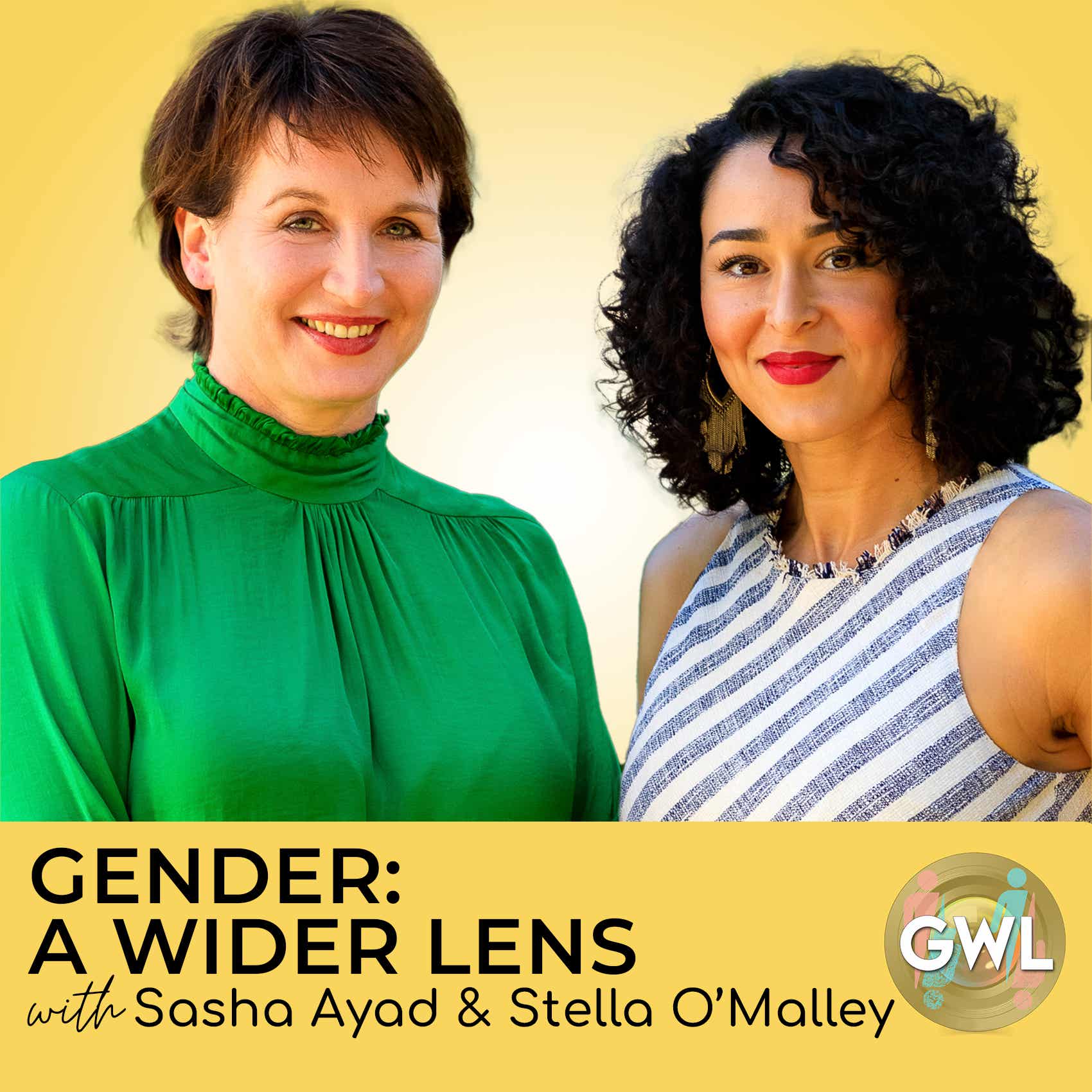
Gender: A Wider Lens
Sasha Ayad and Stella O'Malley
In this podcast, now in its fourth year, therapists Stella O'Malley and Sasha Ayad take a deep dive into the psychological and cultural forces impacting the social changes around "gender." Through interviews with researchers, doctors, therapists, parents, detransitioners, and others, Sasha and Stella's podcast is a "must listen" for anyone trying to navigate the current gender landscape. With their sharp analytical minds and deep compassionate hearts, Stella and Sasha have also become known throughout many parent networks as lighthouses in the midst of some very stormy seas. Previous guests include Helen Joyce, Jesse Singal, Leor Sapir, Kathleen Stock, Jamie Reed, Peter Boghossian and more. www.widerlenspod.com
Episodes
Mentioned books

Sep 24, 2021 • 1h 3min
42 - ROGD and the Struggle to Grow Up
Many children with ROGD seem reluctant to grow up. Sometimes this is related to the difficulties of an early puberty or the hyper-sexualization of children. Other times the gap between the Disneyfied wonder of childhood and the grim hard reality of adulthood feels unsurmountable. Sasha and Stella delve into the psychology of the fear of growing up and how elements of both transition and transgender activist dogma may further infantilize and stunt development.Links:Four Thousand Weeks: Time Management for Mortals, by Oliver Burkeman: Amazon.com/Four-Thousand-Weeks-Management-Mortals/dp/0374159122“Trans Kids May Reject Family, Not the Other Way Around” Transgendertrend.com/trans-kids-reject-family-not-other-way-around/ Transparency podcast (episode with Mars Fernandez):Youtube.com/watch?time_continue=1&v=H-7PkjWgwa8&feature=emb_logo Rees M. “The age of menarche” ORGYN. 1995;(4):2-4. PMID: 12319855. Pubmed.ncbi.nlm.nih.gov/12319855/ Extended Notes:People with rapid gender dysphoria are having a hard time with the process of growing up.Children see the stress of growing up and they want so desperately to opt out of it.If you want to get into a good college, you need all these “extra” activities, which means no one really has true hobbies anymore.People love to stay in the fantasy world of YouTube, where many subgenres are acting younger than they are.So much of this “drama” is fueled on the internet. Why do you get some of the biggest criticisms from people with a cartoon avatar on their profile?Children are stuck between innocent Disney and hypersexualization. Where do you really go from here?Stella has noticed that a lot of people who have gender issues also tend to have gone through puberty earlier than their peers.Getting a period at seven years old is very traumatizing.What fears do boys have about growing up?When children have unlimited access to content, their imagination tends to dwindle, as well.Do kids play seven minutes in heaven anymore? These innocent fun games were a vital part of being comfortable with your body.Everything is so screen-based now. Human interaction is very low.Adulthood seems really intimidating to a kid who has never had to interact with people. Going into a crowded room gives them anxiety.Young, young girls are seeing a lot more porn than you might think.When teenagers want to transition and get top surgery, it's a very difficult and vulnerable state to be in. They have to rely on mom and dad to take care of them once again.A child has not thought things fully the way an adult parent has. The adult has gone through all the painful scenarios their child can go through.You don’t have to dwell on certain things, but it’s important to face it, at the very least.If you have an estranged relationship with your child, what do you do?Doctors don’t always want you to know the truth about your body and the types of medical consequences there are when transitioning. There’s a whole movement that prevents the sharing of this knowledge.When you ask transitioning girls who they’d like to look like, they never describe their father. They describe a “magazine model” or a K-pop star.Kids want to rush into the... This is a public episode. If you would like to discuss this with other subscribers or get access to bonus episodes, visit www.widerlenspod.com

Sep 17, 2021 • 1h 12min
41 — Trans: A Conversation with Helen Joyce
The New York Times describes Helen Joyce’s book, Trans: When Ideology Meets Reality, as “an intelligent, thorough rejoinder to an idea that has swept across much of the liberal world seemingly overnight.” Joyce reminds us that her book is not about trans people, but rather, it is about the idea “that people should count as men or women according to how they feel and what they declare, instead of their biology.” Helen explains the ways it’s more acceptable for men to “give up some privilege” and strategies women in other cultures have used to opt out of unfavorable circumstances. Perhaps denying sex leads to a perfectly clear demonstration of just how different men and women can be. We also reflect on the differences between American’s tendency to double-down on bad policy and the hopefulness Helen feels with the unfolding UK reckoning with gender self-ID. In this episode, we discuss the many ramifications of “you are exactly who you say you are.”Links:Helen Joyce’s Website: Thehelenjoyce.comHelen on Twitter: Twitter.com/HJoyceGender Book Review by Jesse Singal Nytimes.com/2021/09/07/books/review/trans-helen-joyce.html Helen’s interview with Andrew Doyle:Youtube.com/watch?v=KAYR8GUJsqo Stella’s Book Review in The Evening Standard: Standard.co.uk/culture/books/trans-when-ideology-meets-reality-helen-joyce-review-b944183.html Becoming Julia (Gender Transition Documentary): YouTube.com/watch?v=kNjV37vp5qk The End of the World is Flat by Simon Edge: Eye-books.com/books/the-end-of-the-world-is-flat Survivorship Bias: En.wikipedia.org/wiki/Survivorship_bias Small Gods by Terry Pratchett: Terrypratchettbooks.com/books/small-gods Extended Notes:NY Times reviewed Helen’s new book, Trans, and Sasha is even in the book!Helen didn’t even think her book would get published because of its taboo topic.Are people fascinated with gender or with sex?Non-binary people are trying to redefine everybody and trying to change a “fundamental truth.” Of course, it gets people upset.What is the difference between transsexualism and gender self-ID?This book is not about trans people, it’s a book about ideology.If being trans was an ideology, a belief system, that’d be okay. However, this movement is trying to change gender facts, and that’s a harder thing to get behind.Right now it’s very difficult to determine what stance is going to be on “the right side of history.”The trans movement is structured as “the next thing” that needs to be liberated from oppression. However, will it be?Why do men commit more transphobic acts than women?People say that when you call people trans,... This is a public episode. If you would like to discuss this with other subscribers or get access to bonus episodes, visit www.widerlenspod.com

Sep 10, 2021 • 1h 7min
40 — Social Transition: A Powerful Psychosocial Intervention
Social transition is often the first recommended intervention when a young person begins questioning his or her gender identity. It entails changing one’s name, pronouns, appearance, and other identity markers to match the desired gender. In very recent years, schools, led by the current gender identity affirmative approach, have taken it upon themselves to support and sometimes encourage students with social transition. Families often feel pressured by professionals to make these powerful changes despite little evidence supporting these interventions. At times, living in another identity can create more problems than it resolves. In this episode Sasha and Stella do a deep dive into the many challenges that arise with social transition.Links:Michael Biggs on Puberty Blockers:Youtube.com/watch?v=9VHlkE40cFk&feature=youtu.beHow Trans Kids and Parents Decide When to Start Medical Transition (VICE News): Youtu.be/QD720mHFqW0Detrans Needs Survey: Tandfonline.com/doi/full/10.1080/00918369.2021.1919479Kai and Kimberly: Vice.com/en/article/9k9bkv/she-was-asking-the-lord-to-let-her-die-raising-a-trans-child-in-texasCatherine Tuerk: Catherinetuerk.com/about/1funny.com/my-3-year-old-son-is-a-girl-now/Extended Notes:What’s the difference between pre-gay children vs. transgender children? Sasha shares a story of how a mother reacted poorly to her son’s femininity. So many families just have no idea what to do in a situation like this. What does transitioning look like for those under 8 or 9? For parents, it’s almost like a scary nightmare when their child says they’re an opposite sex. What do you do? How does one prepare for this? Adults have the responsibility to teach their children about the realities of the world. Should children really be leading the way on how they’re feeling? Should therapists really be listening to these young children? What is sex constancy? It’s so dangerous to have a 4 year old transition. Should you let children explore their gender identity? Sasha thinks it’s a blurry line. Context and environment matters. Watchfully waiting doesn’t always make sense in today’s world when our children have strong influences to ‘be a certain way’. During Stella’s generation, they’d just ask her if she was a boy or a girl. Now, children are being asked by their community if they’re trans. It’s a very different shift. People are put into a very ‘gendered’ box these days. The moment you’re slightly different than that, society asks if you’re transitioning. What are the psychological impacts of a 13 year old socially transitioning? Children who socially transition end up in an interesting situation. They either have to commit 100% or be seen as a fraud. Parents are terrified. They go down this path because they’re afraid their child will commit suicide. Your 5 year old is not going to be committing suicide! There’s so much talk about transphobia and parents kicking these children out of the house. The opposite is true.... This is a public episode. If you would like to discuss this with other subscribers or get access to bonus episodes, visit www.widerlenspod.com

Sep 3, 2021 • 1h 5min
39 - Nonbinary Identities
With the invention of the term “nonbinary,” we’ve seen an unprecedented number of young people claiming to feel like neither a man nor a woman. Today, we explore Ian Hacking’s concept of “making people up” and the creation of new classifications and “types” of people. Several questions also arise: does a non-binary identification require medicalization? What personality traits may correlate with this identity and is it different in males and females? For parents, how might one respond when a timid child quietly says “No” to the “gender binary?” And what role does non-binary label play as individuals step in and step out of trans identification?Links:Gender Census: Gendercensus.com/results/2021-worldwide/#pronounsKori and Searyl Doty: Theguardian.com/lifeandstyle/2020/jul/08/parent-raising-gender-free-childJamie Shupe: Theguardian.com/world/2016/jun/16/jamie-shupe-first-non-binary-person-oregonJamie Shupe: Twitter.com/notabledesisterLisa Shupe interviewed on Transparency Podcast: Youtube.com/watch?v=edzyk-TQhEYSam Smith: Theguardian.com/music/2019/sep/13/sam-smith-on-being-non-binary-im-changing-my-pronouns-to-theythemSam Smith and Alok: Mirror.co.uk/3am/celebrity-news/sam-smith-alok-vaid-menon-20126943 Alice Hope’s YouTube video: Youtube.com/watch?v=9WJBp3eEhqYExtended Notes:Parents feel so old when the term “nonbinary” gets thrown around. What does it mean?Sasha gives a bit of context and the definition of the word.Nonbinary people have an element of protest. They’re completely opting out of the “normal.”The term “nonbinary” really started picking up speed in 2014 and having it skyrocket in 2019.Are nonbinary identities just a stepping stone into trans identity?A lot of nonbinary females think they should have top surgery, which helps them with their image that they’re in this “neither/or” gender space.Can you inflict your ideologies on a little child? Stella feels like the answer should be no.There is controversy on listing two mothers or two fathers on the birth certificate. It’s a bit like stretching the truth/reality.The average 14-year-old female calls herself nonbinary. What’s going on here?Are our sexual differences causing distress among teenagers? Do they wish for a simpler time where none of this gender stuff matters?It’s a bit of a confusing thing, you shouldn’t go by looks but a lot of these gender identities use looks as a baseline.Can you be nonbinary while also looking very female or very male?How do you know if something is a singular and not a plural when you’re using the “they” pronoun.How do parents manage other children who are calling themselves they/them?Sasha wonders if saying you’re nonbinary is due to some uneasiness that’s happening in their lives, some form of trauma or unhappiness... This is a public episode. If you would like to discuss this with other subscribers or get access to bonus episodes, visit www.widerlenspod.com

Aug 27, 2021 • 1h 5min
38 - DSDs and the “Sex Spectrum”: A conversation w/ Claire Graham
“Differences in Sexual Development” (DSDs) is an umbrella term encompassing a range of over 40 medical conditions that impact sexual development in humans. We speak with Claire Graham, an advocate for the organization, DSD Families and explore the intricacies of these complex conditions, which are often simplified and misunderstood. Claire also tells us how she became embroiled in heated debates about transgender advocacy and dispels common myths that are used to conflate “intersex” conditions with transgender issues. Links Claire’s Blog: https://mrkhvoice.com/index.php/2019/12/18/what-is-dignity/ DSD Families: https://dsdfamilies.org/charity John Money and David Reimer: https://embryo.asu.edu/pages/david-reimer-and-john-money-gender-reassignment-controversy-johnjoan-case This is a public episode. If you would like to discuss this with other subscribers or get access to bonus episodes, visit www.widerlenspod.com

Aug 20, 2021 • 1h 15min
37 - Womanhood: A Conversation with Milli Hill
The founder of the Positive Birth Movement speaks to us about the birthing process and women’s health. A common theme of self-assertion and empowering women to speak up has characterised Milli’s work over the last decade. There were attempts to silence Milli last year when she said that the word “woman” has significance in relation to childbirth. Milli, however, decided to assert her boundaries and speak her truth; in this episode she explains why. Links: Milli Hill: https://www.millihill.co.uk/ I will not be silenced: https://www.millihill.co.uk/2021/07/10/i-will-not-be-silenced/ The Positive Birth Book by Milli Hill https://www.amazon.co.uk/Positive-Birth-Book-Approach-Pregnancy/ Give Birth like a Feminist by Milli Hill https://www.amazon.co.uk/Give-Birth-Like-Feminist-Milli/ Mumsnet: https://www.mumsnet.com/ Birth: A History by Tina Cassidy https://www.amazon.co.uk/Birth-History-Tina-Cassidy/ #BirthJustHappened: https://www.instagram.com/explore/tags/birthjusthappened/?hl=en [Text Wrapping Break] The Business of Being Born: https://www.amazon.com/Business-Being-Born-Helen-Ayres/dp/B001IIHAGK[Text Wrapping Break] Jane Hardwick Collings & Female Rights of Passage: https://janehardwickecollings.com/[Text Wrapping Break] Birth & Sex (Book): https://www.amazon.com/Birth-Sex-Sheila-Kitzinger/dp/1780660502 Project Netti: https://projectnettie.wordpress.com/ Panics and Persecutions – Quillette book https://www.amazon.co.uk/s?k=panics+and+persecutions Extended NotesA little bit about Milli and why she decided to start the Positive Birth Movement.What were some common themes coming up for women who were about to give birth?The birth room was built with the needs of the midwife and doctor in mind, not for the women in mind.Sasha shares her experiences with an American hospital vs. an overseas one.So many mothers are not listened to when they’re at the hospital. Their wishes are ignored.Milli is passionate about everyone having a positive birth experience, no matter the context or environment they choose to be in.You don’t have to just “go with the flow” when it comes to giving birth. You have the right to choose.Meghan Markle got attacked... This is a public episode. If you would like to discuss this with other subscribers or get access to bonus episodes, visit www.widerlenspod.com

Aug 13, 2021 • 1h 5min
36 - Talking Testosterone with Carole Hooven
Carole Hooven, Ph.D., is lecturer and co-director of undergraduate studies in the Department of Human Evolutionary Biology at Harvard University. She earned her Ph.D. at Harvard, studying sex differences and testosterone, and has taught there ever since. Hooven has received numerous teaching awards, and her popular Hormones and Behavior class was named one of the Harvard Crimson’s “top ten tried-and-true.”In this episode, Stella and Sasha talk to Carole about her new book, Testosterone, which explores the powerful impact this sex hormone has on the human body. This discussion revolves around a central theme: to make the world a better place, we must be willing to understand the harsh realities of our mammalian nature and take into account the biological drives behind our behavior.Links:Carole Hooven:Twitter: twitter.com/hoovlet?ref_src=twsrc%5Egoogle%7Ctwcamp%5Eserp%7Ctwgr%5Eauthor www.carolehooven.com/Carole’s Book: us.macmillan.com/books/9781250236067Carole’s Link Tree: linktr.ee/CaroleHooven Stella’s Review: www.standard.co.uk/culture/books/testosteronedr-carole-hooven-review-b941337.html Katie Herzog’s piece in Barri Weiss’s substack: bariweiss.substack.com/p/what-happens-when-doctors-cant-speak bariweiss.substack.com/p/med-schools-are-now-denying-biological Extended NotesA little bit about Carole and her experience.Carole talks about her book, T: The Story of Testosterone, The Hormone That Dominates and Divides Us.When Carole was in Uganda studying chimps, she always knew that if she was working with only females, her day would be pretty relaxed. It’s when the males came to play, however, that she had a full day on her hands.Carole witnessed a male chimp viciously and brutally beat a female chimp who wanted nothing more than to protect her child. It was shocking to watch.Carole breaks down the importance of testosterone and estrogen in our bodies.Males resolve conflict much more quickly than females. There is a reason why there is a hierarchy and it benefits the entire pack to know who’s who.What did Carole discover when she interviewed a wide variety of people going through testosterone procedures?Carole found some fascinating things. People who were living as biological women and hated being objectified, now transitioned into men, found themselves having urges to objectify women.Our nurture can be significantly modeled. The power of our environment can shape our nature.What is CAH and why do women who have this tend to have more male-oriented positions?Just witness how boys vs. girls play with one another. There is a reason for this act in play between the sexes. This crosses all cultures and is even witnessed in animals.Carole shares her insights about gay men and their sexual patterns.Knowledge is power. Carole is passionate about this because it’s important to know how we work on a biological level. We think if we... This is a public episode. If you would like to discuss this with other subscribers or get access to bonus episodes, visit www.widerlenspod.com

Aug 6, 2021 • 1h 1min
35 - Communicating About Gender: Translating Between Parent & Child
We invite parents and children to listen to this episode together. Stella and Sasha alternate between the perspectives of the parent and their dysphoric child and attempt to translate what each may be thinking and feeling when communicating about gender identity becomes difficult. Discussing the emotions, the inner motivations, and the thoughts parents and children might experience when gender related distress hits the family, we hope that this episode might begin to build bridges between parents and young people and foster more empathy in the parent-child dyad. Links Cat Stephens: Father and Son https://youtu.be/P6zaCV4niKk WB Yeats: The Mask http://www.online-literature.com/yeats/800/ This is a public episode. If you would like to discuss this with other subscribers or get access to bonus episodes, visit www.widerlenspod.com

Jul 30, 2021 • 58min
34 - Gender Dysphoria & Suicide
Sasha and Stella tackle the complex subject of suicide. They reflect on the many emotional and relational difficulties involved and parse out the differences between suicide risk and suicidal ideation. While terrifying, it sometimes offers an escape fantasy and desire for control, making suicide an existential issue. Furthermore, they point to the stark lack of data available relating to gender dysphoria and suicidality and discuss how the fear of suicide is used against families wishing to safeguard their children. If you wish to speak to someone about any issues that arose during this please contact the Samaritans https://www.samaritans.org/ireland/how-we-can-help/contact-samaritan/ Links:Assist Applied Suicide Intervention Skills Training: https://www.youth.ie/training/asist-applied-suicide-intervention-skills-training/ Media guidelines: https://www.samaritans.org/ireland/about-samaritans/media-guidelines/ Kurt Cobain https://www.newsweek.com/did-kurt-cobains-death-lower-suicide-rate-1994-244332 Robin Williams https://www.psychologytoday.com/ie/blog/talking-about-men/201908/robin-williams-death-and-subsequent-suicide-contagion Dhejne C, Lichtenstein P, Boman M, Johansson ALV, Långström N, et al. (2011) Long-Term Follow-Up of Transsexual Persons Undergoing Sex Reassignment Surgery: Cohort Study in Sweden. PLOS ONE 6(2):e16885. https://doi.org/10.1371/journal.pone.0016885 https://journals.plos.org/plosone/article?id=10.1371/journal.pone.0016885 The Trans Trains 2 (Swedish documentary with subtitles): ttps://www.youtube.com/watch?v=73-mLwWIgwU Michael Biggs on suicie: Attempted suicide by American LGBT adolescents https://4thwavenow.com/tag/michael-biggs/ Mum's fury after transgender suicide teen sold hormones from illegal online clinic https://www.cambridge-news.co.uk/news/cambridge-news/transgender-treatment-nhs-webberley-jayden-16504026 Transgender Trend: Suicide Facts and Myths: https://www.transgendertrend.com/the-suicide-myth/ Philip Larkin: This be the verse https://www.poetryfoundation.org/poems/48419/this-be-the-verse Extended NotesThis episode... This is a public episode. If you would like to discuss this with other subscribers or get access to bonus episodes, visit www.widerlenspod.com

Jul 23, 2021 • 1h 13min
33 - Beyond the ‘Gifted’ Label: A Conversation w/ Jessie Mannisto
Stella and Sasha sit down with Jessie Mannisto, the Editor in Chief of Third Factor Magazine, a publication for and about uncommon people and their uncommon paths through life. Jessie expands on the many overlapping experiences of gifted, creative, intense, and gender dysphoric individuals. They explore some critiques and uses of terms like ‘queer’ and ‘asexual.’ Stella and Sasha ask Jessie about androgyny, loneliness, ordinariness, and exceptionalism in dysphoria people. And what’s up with anime and fan fiction amongst gender-questioning youth? Links:Jessie Mannisto on Sasha’s YouTube Channel Disintegration as an Opportunity for Growth: Part 1: https://www.youtube.com/watch?v=rGBcqT6h0Pw&t=1081s Part 2: https://www.youtube.com/watch?v=mFKpuoR9-zg&t=2s Where Intensity and Gender Dysphoria Meet: https://www.thirdfactor.org/intensity-gender-dysphoria Existential Depression in Gifted Individuals:https://www.sengifted.org/post/existential-depression-in-gifted-individuals Rainforest mind - Paula Prober: https://www.amazon.com/Your-Rainforest-Mind-Well-Being-Gifted/dp/0692713107 Hilary Jacobs Hendel - https://www.amazon.com/Its-Not-Always-Depression-Authentic/dp/0399588140 Creativity https://www.amazon.com/Creativity-Psychology-Discovery-Invention-Perennial-ebook/dp/B000TG1X9C Third Factor Magazine: https://www.thirdfactor.org/ Twitter: https://twitter.com/thirdfactormag?lang=en Facebook: https://www.facebook.com/ThirdFactorMag/ Extended NotesA little bit about Jessie and how she got involved in the field of giftedness and overexcitability.Jessie noticed a connection between gender dysphoric people and giftedness.What is the definition of “giftedness”?There are five domains or key areas where you can be gifted: Intellect, imagination, psychomotor, sensory, and emotions.How do these domains manifest into those who are extremely gifted?Although not a reliable measure, overexcitability is often linked to giftedness. One of the ways people tried to test for giftedness was through overexcitability, but it was not conclusive.What is the “hedgehog dilemma”?The more that you’re an outlier, the more you try to seek out people who are like you to confirm that you’re “okay” and not abnormal.Belonging is the biggest issue for these types of people.What is a “magnet” school?Most gifted people know they’re difficult and can be hard to manage. Jessie believes some of these... This is a public episode. If you would like to discuss this with other subscribers or get access to bonus episodes, visit www.widerlenspod.com

