

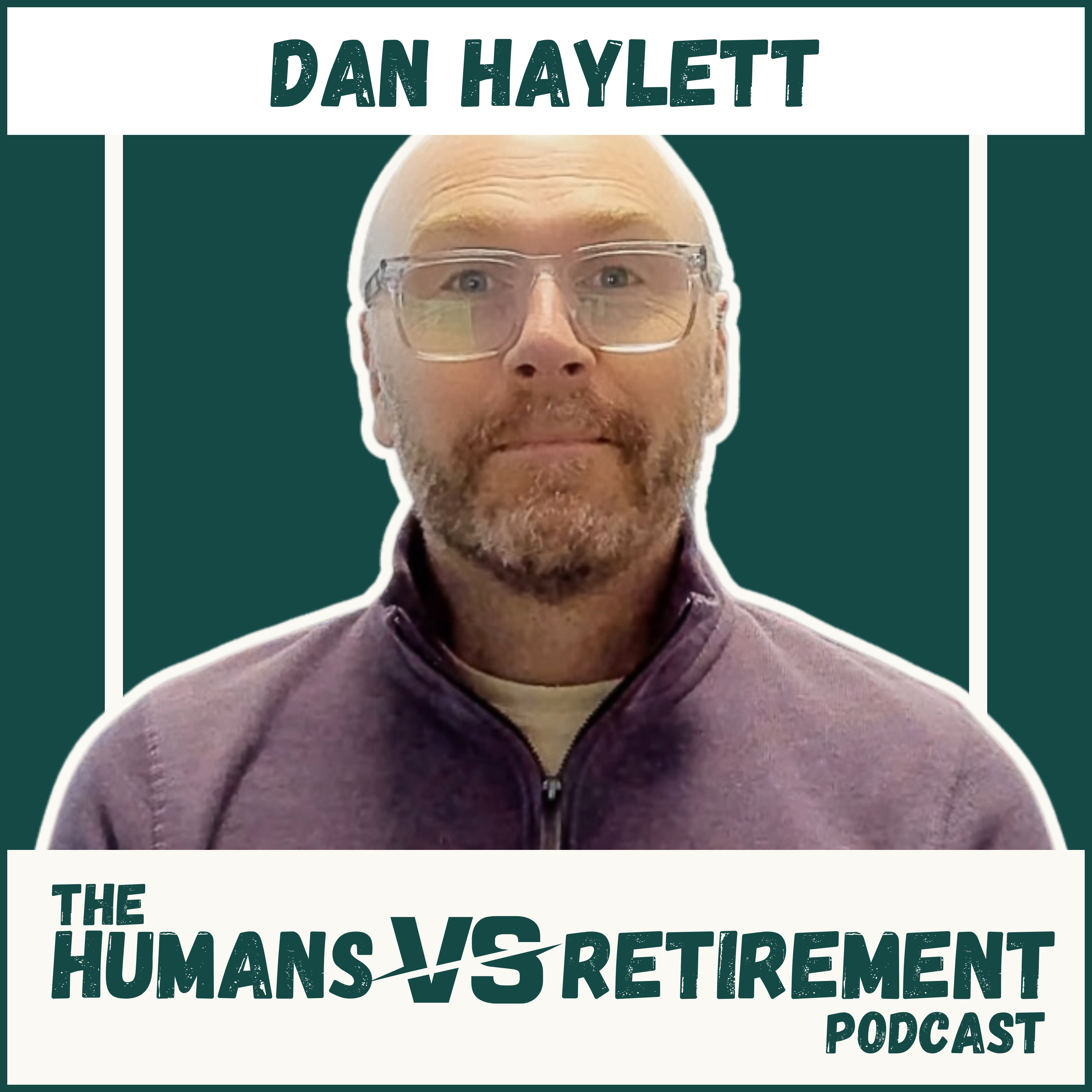
The Humans vs Retirement Podcast
Dan Haylett
Humans vs Retirement is the podcast that proves retirement isn't just about money, it's about life. Hosted by me Dan Haylett, I dive into the real, human side of retirement: the emotions, the mindset shifts, and the messy, wonderful journey of reinventing yourself for the next chapter. Through honest conversations with experts and inspiring stories from retirees themselves, you'll get the tools, ideas, and encouragement you need to retire to something, not just from something.
If you want to make your second half even better than your first, hit subscribe and join the Humans vs Retirement community.
If you want to make your second half even better than your first, hit subscribe and join the Humans vs Retirement community.
Episodes
Mentioned books

Apr 12, 2024 • 4min
Humans Vs Retirement is 1 Year Old - Thank You!

Apr 5, 2024 • 1h
Don't Retire... Graduate! with Eric Brotman
Summary Eric is the founder and CEO of BFG Financial Advisors a large financial planning business in Baltimore, USA that specialises in retirement planning. As well a writing his book Eric hosts a podcast by the same name and id a regular contributor to forbes.com and Sunday morning TV in Baltimore In this conversation Eric and I discuss the concept of retirement as a graduation and the need to redefine retirement as an opportunity for growth and exploration. Eric highlights the significance of having an abundance mindset and being open to reinventing oneself in retirement. Eric shares the three secrets to the happiest retirees: being debt-free, taking care of your health, and having a sense of purpose. Takeaways Retirement should be seen as a graduation and an opportunity for growth and exploration. Financial independence is key to a fulfilling retirement, and it is important to plan for it early in life. Having an abundance mindset and being open to reinvention can lead to a more fulfilling retirement. Financial literacy is crucial in achieving financial independence and making informed decisions. The fear of running out of money in retirement can be alleviated by working with a financial advisor and having a well-thought-out plan. The three secrets of the happiest retirees include embracing a second childhood, cultivating wisdom and mindset, and finding purpose and identity in retirement. Being debt-free or adverse debt-free is important in retirement to reduce anxiety and ensure a peaceful retirement. Taking care of your health is crucial, as it is easier to stay healthy than to get healthy. Having a sense of purpose gives retirees a reason to get out of bed every morning and brings fulfilment to their lives. Retirees should plan and have intention in their retirement to ensure a smooth transition and make the most of their time. Chapters 00:00 Introduction and Background 06:03 Redefining Retirement as a Graduation 09:25 Embracing a Second Childhood 14:10 Compounding Mindset and Wisdom 19:25 Finding Purpose and Identity in Retirement 23:21 The Emotional and Psychological Challenges of Retirement 28:20 The Importance of Financial Literacy 35:25 The Fear of Running Out of Money in Retirement 37:47 Achieving Financial Independence without Being Good with Money 42:56 The Three Secrets of the Happiest Retirees 43:05 The Three Secrets to the Happiest Retirees 44:05 Taking Care of Your Health 45:01 Having a Sense of Purpose 46:44 Debt and Financial Freedom 48:29 The Importance of Good Health 49:26 The Value of Purpose in Retirement 50:23 The Inflation Rate for Retirees 52:13 Planning and Intention in Retirement 53:10 Finding a Sense of Purpose in Retirement 54:08 What Financial Freedom Looks Like Episode Links & Resource Buy Eric's book Don't Retire… Graduate! Listen to Eric's Podcast Connect with Eric on LinkedIn WealthGPS – Lifestyle Financial Planning by TFP Download My FREE Retirement Toolkit Subscribe to my Super Sunday Retirement Roundup Newsletter

Mar 29, 2024 • 57min
Navigating Money and Relationships in Retirement with Ed Coambs
Summary In this episode, Ed Coambs, a financial planner, and therapist, discusses the challenges couples face in managing money and planning for retirement. He shares his personal journey from being a firefighter to becoming a financial planner and therapist. Ed emphasizes the importance of understanding one's own relationship with money and how it impacts relationships. He introduces the concept of financial intimacy and explains how it can help couples navigate the complexities of retirement planning. Ed also highlights the role of attachment theory in understanding couples' dynamics around money. In this conversation, Ed and I discuss the challenges couples face when transitioning from work to retirement and how financial therapy can help. He emphasises the importance of creating a safe space for vulnerability and open communication. He also explores the influence of childhood experiences on money management and the challenge of spending money in retirement. Our conversation highlights the need for balance in money management and the role of financial therapy in helping couples live a happy and fulfilling retirement. Takeaways Understanding one's own relationship with money is crucial for successful financial planning and healthy relationships. Couples often have different expectations and visions for retirement, which can lead to conflicts and challenges. Financial intimacy, where both partners are actively involved in financial decision-making and have open and honest conversations about money, is essential for a harmonious retirement. Attachment theory can provide insights into individuals' behaviours and attitudes towards money and relationships. Couples often struggle to transition from work to retirement and may find it difficult to let go and enjoy the fruits of their labour. Creating a safe space for vulnerability and open communication is crucial for couples to navigate retirement successfully. Childhood experiences play a significant role in shaping individuals' attitudes and behaviours towards money. Spending money in retirement can be a psychological challenge, and finding a balance between spending and saving is essential. Financial therapy can help couples address their money-related issues and create a healthy and fulfilling retirement. Chapters 00:00 Introduction and Background 06:15 The Journey to Financial Therapy 10:35 The Healthy Love and Money Way 23:34 The Importance of Financial Intimacy 28:00 The Struggle to Transition from Work to Retirement 32:38 Creating a Safe Space for Vulnerability 35:12 The Influence of Childhood Experiences on Money 38:18 The Challenge of Spending Money in Retirement 44:07 The Importance of Balance in Money Management 51:08 The Role of Financial Therapy in Retirement Episode Links & Resources Go see Ed's Website Buy Ed's book The Healthy Love and Money Way Listen to Ed's Healthy Love and Money Podcast Check out Ed's Online Courses for Couples Connect with Ed on LinkedIn Connect with Ed on X WealthGPS – Lifestyle Financial Planning by TFP Download My FREE Retirement Toolkit Subscribe to my Super Sunday Retirement Roundup Newsletter

Mar 22, 2024 • 1h 1min
The Money Sandwich: Balancing Adult Children, Aging Parents, and Retirement with Marc Bineham
Summary Have you ever herd of 'the sandwich generation'? Are you part of it? And if so, what challenges does it bring to your retirement? Well. In this episode I get to have a conversation with a guy that has literally wrote the book on the subject! Mark Bineham is one of Australia's top keynote speakers on retirement and the award-winning author of 'The Money Sandwich". Mark's goal has always been to help people live their very best life through positive mindset, promoting well-being and simply achieving financial freedom that much sooner, because in his words "we all deserve that, don't we?. In 2019, a turning point occurred in his life when he underwent open-heart surgery. Prompting a re-evaluation of his 30-year career as a financial advisor, including four years as the national president of the Association of Financial Advisers. While he always loved helping his own clients reach their goals and aspirations, he realised most people just couldn't afford help or advice, and that had to change. That's when he decided to pour all the knowledge he gained over his career into a book, which he proudly titled The Money Sandwich and subsequently setting up a family business with his Daughter Katherine by the same name which enables him to take this message out to the wider world through presentations, workshops and courses. In this thought-provoking conversation Mark and I discuss the challenges faced by the sandwich generation, who are responsible for supporting both their adult children and aging parents. Mark emphasizes the importance of having conversations about retirement and estate planning with your elderly parents and adult children. He also introduces the concept of the 'third act' as a more positive and fulfilling way to approach retirement and highlights the need for mindset shifts and an understanding of the emotional aspects of money in order to achieve happiness in retirement. Our conversation explores changing attitudes towards work and retirement, the negative connotations of money, the impact of financial stress on productivity and health, the importance of talking about money, the value that financial planning professionals add at this stage of life, and what financial freedom looks and feels like. Takeaways The sandwich generation faces the challenge of supporting both adult children and aging parents. Having conversations about retirement and estate planning with elderly parents is crucial to avoid future conflicts. The 'third act' is a more positive and fulfilling way to approach retirement. Understanding the emotional aspects of money is essential for achieving happiness in retirement. Younger generations are redefining work-life balance and are more focused on enjoying life. Financial stress is a major cause of anxiety, arguments, and relationship breakdowns. Financial stress negatively affects productivity in the workplace. Talking about money and seeking professional help can alleviate financial stress. Financial planning professionals can provide guidance and support in managing money and achieving financial freedom. Chapters 00:00 Introduction and Background 05:25 Unleashing Your Third Act 08:34 The Money Sandwich and the Sandwich Generation 14:30 Challenges of Supporting Adult Children 22:35 Challenges of Supporting Aging Parents 29:24 Reframing Retirement as the Third Act 38:44 Money Shifts for Happiness 45:31 Changing Attitudes Towards Work and Retirement 47:00 The Negative Connotations of Money 48:31 Financial Stress and its Impact on Productivity and Health 49:30 The Importance of Talking About Money 50:52 The Need for Financial Planning Professionals 53:51 What Financial Freedom Looks Like Episode Links & Resources Get Marc's brilliant book The Money Sandwich Listen to The Money Sandwich Podcast Visit The Money Sandwich website Connect with Marc on LinkedIn Connect with Marc on X WealthGPS – Lifestyle Financial Planning by TFP Download My FREE Retirement Toolkit Subscribe to my Super Sunday Retirement Roundup Newsletter

Mar 15, 2024 • 57min
How to Live a Regret Free Retirement with Christine Benz
Summary Christine is director of personal finance and retirement planning for Morningstar, Inc. In that role, she focuses on retirement and portfolio planning for individual investors. She also co-hosts a podcast for Morningstar, The Long View, which features in-depth interviews with thought leaders in investing and personal finance. and I was honoured to be asked to be a guest on last year (link in the show notes). She is a prolific writer and her published Morningstar articles are must reads for anyone interested in retirement planning. In this episode, Christine and I cover a lot of ground! We discuss various aspects of retirement planning, including blind spots, sequence risk, inflation, the bucketing approach to income management, the importance of continuing to work, and lessons for a happy and successful retirement. Christine emphasizes the need to consider both financial and non-financial aspects of retirement and to make choices that align with personal happiness and purpose and also highlights the value of working with a financial planner to navigate the complexities of retirement planning. Takeaways Retirement planning should consider both financial and non-financial aspects, such as happiness, purpose, and social connections. Blind spots in retirement planning include sequence risk, inflation, and unexpected spending shocks. A bucketing approach to retirement income can help manage sequence risk and ensure liquidity for short-term needs. Continuing to work in retirement can provide financial security, social connections, and a sense of purpose. Spending in line with personal happiness and avoiding regrets are key considerations in retirement planning. Working with a financial planner can help navigate the complexities of retirement planning and ensure a successful retirement. Retirement planning is crucial for financial security in later years. Common mistakes in retirement planning include underestimating expenses and not starting early enough. Financial advisors can provide valuable guidance and expertise in retirement planning. Behavioural biases can negatively impact retirement planning decisions. Seeking outside help, such as financial advisors or experts, can help identify blind spots and provide a fresh perspective. Chapters 00:00 Introduction and Background 07:15 The Blind Spots of Retirement 13:38 Mitigating Sequence Risk and Inflation 17:47 Bucketing Approach to Retirement Income 25:26 The Importance of Continuing to Work in Retirement 35:37 Lessons for a Happy, Successful, and Wealthy Retirement 38:20 Spending to Optimize Happiness 40:26 Living Life with No Regrets 48:15 The Value of Working with a Financial Planner 10:32 Common Retirement Planning Mistakes 23:45 The Role of Financial Advisors in Retirement Planning 34:56 The Impact of Behavioral Biases on Retirement Planning 43:21 The Value of Seeking Outside Help 51:09 Blind Spots and the Importance of Outside Perspective Episode Links & Resources Pre-order Christine's book How to Retire: 20 Lessons For A Happy, Successful & Wealthy Retirement Read all of Christine's brilliant stuff on retirement and investing Subscribe to her podcast The Long View Listen to my appearance on The Long View Podcast Connect with Christine on LinkedIn Connect with Christine on X WealthGPS – Lifestyle Financial Planning by TFP Download My FREE Retirement Toolkit Subscribe to my Super Sunday Retirement Roundup Newsletter

29 snips
Mar 8, 2024 • 1h
How Much Money Do You Need For The Rest Of Your Life with Paul Armson
Paul Armson, founder of Inspiring Advisers and author of 'Enough?', shares his transformative journey in lifestyle financial planning after a personal wake-up call. He emphasizes prioritizing life experiences over mere financial gains, urging listeners to redefine what it means to be financially secure. Paul categorizes retirement motivations into three groups and advocates for a simpler, more fulfilling approach to financial independence. His insights inspire individuals to embrace their passions now, rather than deferring dreams for an uncertain future.

Mar 1, 2024 • 57min
Embracing a "Second Childhood" in Retirement with Jonathan Clements
Summary Jonathan Clements is the founder and editor of Humble Dollar and brilliant free blog site that is dedicated to providing articles, guides and resources from some of the greatest thinkers in the world of finance. The goal of Humble Dollar is to tell you everything you need to know about money – all in one place without the hype and hollow promises that characterises so much financial writing. Jonathan was born and educated in England before moving to the states and prior to semi-retiring and launching humble dollar in 2014, Jonathan spent almost 20 years as The Wall Street Journal's personal finance columnist and six years at Citi group where he was director of financial education for the banks US wealth management arm. He is also the author of 9 personal finance books. In this episode, Jonathan and I discusses the challenges and risks in retirement, both from a financial and human standpoint. He focuses on the need to have sense of purpose and identity in retirement, which he believes can be overcome by continuing to work in some fashion. Jonathan also explores the concept of embracing a second childhood, allowing for childlike curiosity and exploration. He emphasises the importance of experimenting in early retirement to discover what truly makes one happy. Jonathan also discusses his work with Humble Dollar and the ventures that provide him with a sense of purpose. Takeaways Longevity risk is a significant financial challenge in retirement, and individuals should consider guaranteed income options such as annuities. Investing in the stock market can help retirees combat inflation and grow their wealth over time. Working in retirement provides not only financial benefits but also a sense of purpose, identity, and social interaction. Retirees should focus on their own financial goals and avoid comparing themselves to others. Retirement can be a time of exploration and curiosity, allowing individuals to embrace a second childhood and pursue new interests and passions. Transitioning to retirement can be a unique experience depending on one's life circumstances. Early retirement is a period of experimentation to find activities that bring fulfilment. Financial stability and a sense of purpose are key factors in enjoying retirement. Chapters 00:00 Introduction and Background 04:05 Financial Challenges and Risks in Retirement 11:02 Investing in Retirement 21:28 The Importance of Working in Retirement 28:36 Generating Income in Retirement 38:02 The Importance of Identity and Purpose in Retirement 45:45 Avoiding Comparisons in Retirement 48:12 Embracing a Second Childhood in Retirement 48:30 Transitioning to Retirement 49:23 Experimenting in Early Retirement 50:35 Finding Fulfilment in Retirement 52:03 Humble Dollar and Jonathan's Work 53:16 Closing Remarks Episode Links & Resources Humble Dollar Jonathan's book My Money Journey: How 30 people found financial freedom – and you can too Jonathan's book From Here to Financial Happiness: Enrich Your Life In Just 77 Days Connect with Jonathan on LinkedIn Connect with Jonathan on X WealthGPS – Lifestyle Financial Planning by TFP Download My FREE Retirement Toolkit Subscribe to my Super Sunday Retirement Roundup Newsletter

Feb 23, 2024 • 55min
The Power of Giving: How Retirees Can Help Combat Climate Change with Jack Chellman
Summary In this episode of The Humans vs Retirement Podcast, I sit down with Jack Chellman, Chief Project Officer of the Global Returns Project a UK charity that is on a mission to create systemic change to fund the highest impact climate charities and make giving toward climate change as easy and accessible as possible. Jack and I discuss how charitable giving could and maybe should form part of every retirement plan. Jack also dispels many myths about giving and explains how the Global Returns Project makes charitable giving easy and transparent by selecting high-impact climate charities and providing rigorous monitoring and reporting. The portfolio of charities includes organizations that protect rainforests, enforce environmental law, conserve marine life, and restore forests. Jack emphasizes the need for increased philanthropy towards climate mitigation efforts and highlights the role of the Global Returns Project in making sustainable giving mainstream. He also discusses the integration of the project into financial planning and the options for donating. We explore the impact of climate change, individual actions to combat it, and the role of governments and corporations in addressing the issue. Our conversation highlights the importance of taking meaningful action to combat climate change and emphasizes the potential for positive change if everyone contributes. Takeaways Charitable giving can be an important part of a retirement plan, allowing individuals to make a positive impact on causes that matter to them. The Global Returns Project makes charitable giving easy and transparent by selecting high-impact climate charities and providing rigorous monitoring and reporting. The portfolio of charities recommended by the Global Returns Project includes organizations that protect rainforests, enforce environmental law, conserve marine life, and restore forests. Donating to climate charities is a way to address the urgent issue of climate change and its impact on other important causes. The Global Returns Project can be integrated into financial planning, allowing individuals to allocate a portion of their assets to charitable giving. Climate change is a pressing issue that requires immediate action. Individual actions, such as reducing carbon emissions and adopting sustainable practices, can make a significant impact. Investing in sustainable solutions is crucial for addressing climate change. Governments and corporations play a vital role in implementing policies and initiatives to combat climate change. Taking meaningful action collectively can lead to positive change and make a difference. Chapters 00:00 Introduction to the Global Returns Project 03:21 Charitable Giving as Part of a Retirement Plan 09:36 Dispelling Myths about Charitable Giving 12:59 Making Charitable Giving Part of Asset Allocation 18:49 The Importance of Transparency and Impact Reporting 23:20 The Limitations of Sustainable Investing 26:45 The Portfolio of Charities and Their Impact 32:34 The Mechanics and Methodology of the Global Returns Project 40:02 Integrating the Global Returns Project into Financial Planning 49:05 How to Donate and Get Involved 05:00 Understanding Climate Change 15:00 The Impact of Climate Change 25:00 Individual Actions to Combat Climate Change 35:00 Investing in Sustainable Solutions 45:00 The Role of Governments and Corporations 51:12 Taking Meaningful Action Episode Links & Resources The Global Returns Project WealthGPS – Lifestyle Financial Planning by TFP Download My FREE Retirement Toolkit Subscribe to my Super Sunday Retirement Roundup Newsletter

Feb 16, 2024 • 1h 10min
How To Have An Epic Retirement with Bec Wilson
Summary In this episode, I get to have a great conversation with Bec Wilson, author of 'How to Have an Epic Retirement,' to discuss the key themes and pillars of retirement planning. Bec shares her journey into the retirement space and the inspiration behind her book. We discuss the importance of understanding lifespan and healthspan, as well as the financial confidence needed for retirement. Bec emphasizes the need for proactive health management and the role of exercise and diet in healthy aging. The conversation highlights the interconnectedness of time, money, and health in creating an epic retirement. We have a great discussion about the 5 pillars of retirement: time, money, health, happiness, and your home as you age. We delve into the importance of happiness and fulfilment in retirement, emphasising the need for social interaction and meaningful activities. Finally, Bec introduces the five big stages of retirement: pre-euphoria, adjustment, euphoria, post-euphoria, and frailty. Takeaways Social interaction and building relationships are crucial for happiness and fulfillment in retirement. Making informed decisions about housing can help minimize financial risks and maximize retirement enjoyment. The five big stages of retirement are pre-euphoria, adjustment, euphoria, post-euphoria, and frailty. Planning for retirement should include considerations for physical and mental health to maintain independence and minimize time spent in frailty. Chapters 00:00 Introduction and Background 03:00 The Six Pillars of Retirement 24:36 Time: Understanding Lifespan and Healthspan 32:48 Money: Financial Confidence and Planning 39:04 Health: Taking Care of Your Body and Mind 43:32 Pillar 4: Happiness and Fulfillment 47:41 Pillar 5: Your Home as You Age 57:15 The Five Big Stages of Retirement Episode Links & Resources Bec's book How to have an Epic Retirement Bec's Website https://epicretirement.com.au/ Bec's Newsletter https://www.epicretirement.net/ Bec's Podcast https://www.primetimers.net/ WealthGPS – Lifestyle Financial Planning by TFP Download My FREE Retirement Toolkit Subscribe to my Super Sunday Retirement Roundup Newsletter

Feb 9, 2024 • 1h 17min
An Evidence-Based and Academic Approach to Retirement Planning with David Jones
Summary In this episode, I get to sit down with David Jones from Dimensional about evidence-based investing and retirement planning. We discuss the challenges of the retirement transition, the importance of social connections, and the role of financial planning in retirement. We also explore the fear of spending money in retirement and the benefits of intergenerational wealth. Our conversation concludes with a discussion on the Japanese concepts of Kanreki and Ikigai in retirement and the secret of evidence-based investing. Takeaways Retirement transition can be challenging, and it is important to have a clear financial plan and structure in place. Social connections are crucial in retirement for mental and physical health. Investing in retirement should be based on evidence and academic research to mitigate risks and achieve long-term goals. Overcoming the fear of spending money in retirement requires open communication, financial planning, and understanding the purpose of wealth. Intergenerational wealth and gifting can be beneficial for both the giver and the receiver, and open conversations about money within families are important. Chapters 00:00 Introduction and Background 04:35 Dimensional's Evidence-Based Approach 07:43 The Lack of Academic Research in Investing 10:03 The Challenges of Retirement Transition 13:18 The Challenges of Retirement 16:21 The Importance of Social Connections in Retirement 18:01 The Role of Financial Planning in Retirement 19:37 Investing in Retirement with Evidence and Academic Research 28:55 Understanding Risk in Retirement 36:44 Overcoming the Fear of Spending in Retirement 43:28 The Importance of Financial Planning in Retirement 46:17 The Challenges of Spending Money in Retirement 48:30 Using Monopoly to Understand Intergenerational Wealth 55:16 Japanese Concepts of Kanreki and Ikigai in Retirement 01:06:37 The Secret of Evidence-Based Investing Episode Links & Resources My blog about the Japanese concept of Kanreki David's Monopoly Money article WealthGPS – Lifestyle Financial Planning by TFP Download My FREE Retirement Toolkit Subscribe to my Super Sunday Retirement Roundup Newsletter

