

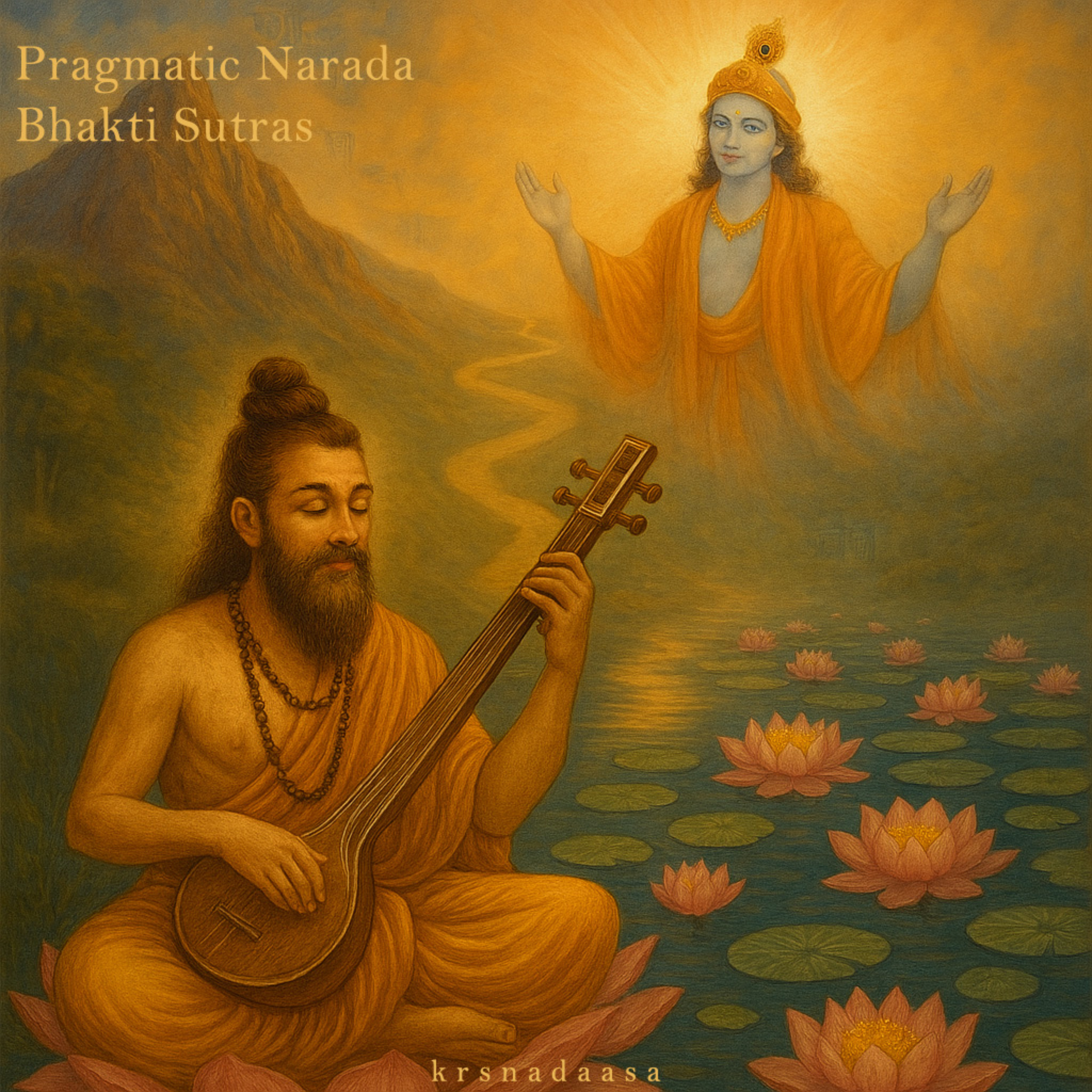
Pragmatic Bhakti Sutras
krsnadaasa
Go beyond spiritual theory with Pragmatic Bhakti Sutras. This podcast translates the ancient Narada Bhakti Sutras into clear, actionable wisdom for modern life. Discover how Bhakti Yoga unites Vedantic knowledge (Jnana) with divine love (Bhakti), offering practical steps to deepen devotion and cultivate a living connection with the Divine. From philosophy to daily practice, each episode guides you on the timeless path of Bhakti Yoga. Follow now to transform your spiritual journey.
krsnadaasa
(Serbvant of Krishna)
pragmaticgita.com
Episodes
Mentioned books

Oct 6, 2025 • 1h 3min
Pragmatic Bhakti Sutras: The Divine Intoxication: Trading Endless Desire for Eternal Joy [Sutras 6 to 8]]
Have you ever wondered if there is a happiness that doesn't fade, a peace that worldly troubles cannot touch? What if the greatest fulfillment comes not from getting what you want, but from wanting nothing at all?In this profound exploration of Sutras 6, 7, and 8 of the Narada Bhakti Sutras, we journey into the heart of divine love. Discover the three signs of a true spiritual awakening. You will learn about the ecstatic state of divine intoxication, a sacred stillness that transcends the noise of the mind, and an unshakeable joy that arises from within your own Self.We unravel the beautiful paradox that pure love is completely free of desire because it is, in itself, complete fulfillment. Through the powerful and moving story of a young Swami Vivekananda at the temple, you will see how worldly concerns simply dissolve in the presence of the Divine. This episode redefines renunciation, not as a harsh sacrifice, but as the intelligent and natural choice of letting go of lesser things to embrace an infinite love, much like leaving a taxi to board an airplane to your ultimate destination.Join us to learn how to transform the endless fire of desire into the selfless warmth of service and find a love that asks for nothing but gives everything.What you will learn in this episode:The three experiential stages of realizing divine love; divine intoxication, sacred stillness, and self-delight.The critical difference between temporary worldly pleasures and eternal, blissful joy.Why true devotion is selfless and how focusing on service naturally quiets the mind.The wisdom of "natural renunciation," allowing attachments to fall away effortlessly as your love for the Divine grows.How to apply these ancient teachings in your modern life with simple, practical daily exercises.Keywords: Narada Bhakti Sutras, Bhakti Yoga, Vedanta, Hinduism, Spirituality, Divine Love, Renunciation, Swami Vivekananda, Sri Ramakrishna, Meditation, Self-Realization, End of Desire, Spiritual Joy, Service, Devotion.krsnadaasa (Servant of Krishna)

Sep 29, 2025 • 51min
Pragmatic Bhakti Sutras: The Art of Fulfillment [Sutra 5]
Have you ever wondered what it would feel like to be so completely fulfilled that no desire could touch you, no loss could break you, and no success could intoxicate you? What if there was a state of being so full of joy that all your anxieties about the past and future simply dissolved?This episode explores that extraordinary state through the timeless wisdom of the Narada Bhakti Sutras, an ancient guide to the path of divine love, or bhakti yoga. We journey through four transformative verses that provide a practical roadmap to moving beyond the endless cycle of wanting and seeking that defines so much of modern life.Join us to discover the secret of pūrņakāma, a heart so full of divine love that it needs nothing else.In this episode, you will learn aboutThe Five Freedoms that arise from divine love, liberating you from desire, grief, hatred, worldly excitement, and selfish ambition.The three signs of a spiritual awakening, including divine intoxication, sacred stillness, and a profound delight in your own true Self.Inspiring stories from the Bhagavad Gita and the lives of spiritual masters like Swami Vivekananda and Sri Ramakrishna that illustrate these profound truths.The practice of true renunciation as an intelligent and natural letting go, like leaving a taxi to board a plane for an ultimate destination.A guided meditation designed to help you release past regrets and future worries, allowing you to find deep peace and contentment in the present moment.If you are on a path of spiritual growth and seeking a happiness that is stable, eternal, and truly satisfying, this episode offers ancient wisdom and practical tools to help you find your way home to a heart full of peace.krsnadaada(Servant of Krishna)

Sep 13, 2025 • 11min
Narada Bhakti Sutras: A Guided Meditation to Release Regret and Calm Anxiety
Are you caught in a loop of replaying past mistakes or rehearsing future worries? Does the weight of regret and the buzz of anxiety keep you from finding peace? This powerful guided meditation is your sanctuary.In just a few minutes, you will be gently guided to release what's holding you back. Through calming visualization, you'll learn to let go of past regrets by imagining them as a heavy stone released from your hand, and watch future anxieties dissolve like a passing cloud in a clear blue sky. This practice is designed to quiet the noise and bring you home to the profound stillness and freedom of the present moment.Stop the cycle of overthinking and stress. Discover the spaciousness and inner peace that is always available to you, right here, right now.This meditation is perfect for:Anxiety & Stress ReliefLetting Go of the Past & Releasing RegretCalming Overthinking & Racing ThoughtsDeep Relaxation and Finding StillnessPracticing Mindfulness & Being PresentA peaceful start to your morning or a way to unwind before sleepPress play, take a deep breath, and give yourself the gift of now. You deserve this peace.krsnadaasa(Servant of Krishna)

Sep 10, 2025 • 1h 7min
Narada Bhakti Sutras: Beginning the Journey of Divine Love [1 to 4]
Have you ever noticed that quiet ache in your heart? It's a gentle but persistent longing for a love that's truly unconditional, a love that accepts you just as you are and never fades away. The great sage Narada tells us this longing isn't a mistake; it's actually a compass. It's pointing you toward the most profound relationship you can ever have, which is your personal connection with the Divine. Our podcast, "The Path of Divine Love," is a friendly guide for this journey inward, using Narada's beautiful masterpiece, the Narada Bhakti Sutras, as our map.This series gets to the heart of what bhakti, or pure divine love, truly is. We'll be exploring a path that values feeling and experience over dry intellectual study. While many texts analyze devotion, Narada Muni speaks right to our emotional core. He helps us feel and realize divine love in a personal way. In his very first statement, Narada makes it clear that he’s here to explain pure devotion, setting this path apart from all others. We'll unpack his short, powerful sayings, called sutras, making their ancient wisdom feel fresh and relevant to your life today.Come join us as we discover what it means to follow the heart's path. We'll talk about the simple preparations for this journey, qualities like clear-mindedness, daily practice, and a pure heart. Think of these not as strict rules, but as gently tuning an instrument so it can play beautiful, divine music. This spiritual path is open to everyone, no matter your background. History is filled with stories of great saints from all walks of life who found spiritual perfection through pure and simple devotion.The promise of this journey is a deep and lasting transformation. By practicing bhakti, you gain something truly extraordinary. Narada explains that a devotee receives three incredible gifts. The first is a taste of immortality (amrita), which means finding an everlasting peace that lifts you above the usual worries of the world. The second is complete satisfaction (tripti). This is the feeling of finally filling that deep emptiness inside with a love so pure that it quenches your soul's thirst forever. And the third is true perfection (siddhi), which has nothing to do with getting special powers. Instead, it’s about your heart becoming soft, tender, and full of compassion for every living being.Throughout our episodes, we’ll share powerful stories to bring these ideas to life, like the amazing story of Prahlada. His unshakable faith in the face of incredible danger shows the real power of perfected devotion. If you're looking to connect with a love that never fades and find a deep sense of purpose, this podcast is for you.krsnadaasa(Servant of Krishna)https://pragmaticgita.com

Sep 6, 2025 • 1h 8min
Narada Bhakti Sutras: An Enlightening Path to Divine Love: Introduction
Have you journeyed through the philosophical depths of Vedanta, intellectually grasping the truth of "Tat Tvam Asi," That Thou Art? Have you studied the Bhagavad Gita, analyzing Karma, Jnana, and Dhyana Yoga, only to arrive at Krishna's profound conclusion that Bhakti is the most direct path? If your intellect has brought you to the threshold of divine love, this exploration is your next step.Welcome to a journey into the heart of devotion with the Narada Bhakti Sutras. This series is for the seeker who stands ready to transform profound knowledge into a living, breathing experience. We move beyond the intellectual analysis of Brahman and into a loving contemplation of Bhagavan. Our guide on this path of divine love is the celestial sage, Narada Muni, the king of all rishis, who distilled the essence of pure devotion into 84 concise and powerful aphorisms.In this introductory episode, we lay the foundation for this sacred study. We explore the critical transition from Jnana to Bhakti, understanding how the intellect, once used for negation and inquiry, is beautifully reoriented to appreciate the infinite qualities of the Divine. You'll learn what is bhakti yoga at its core, discovering that it is unmotivated service, or sevā, that sweetens the spiritual journey. We will delve into the two fundamental stages of devotion. The first is Sadhana Bhakti practices, the disciplines like hearing, chanting, and remembering that purify the heart. The second is Para Bhakti, the state of perfected, spontaneous divine love that is bestowed by grace.We also address the subtle spiritual obstacle of transcending the desire for mukti, or liberation. The Narada Bhakti Sutras teach that for a true devotee, the bliss of loving service is a goal far greater than freedom from samsara. A central theme we will embrace is the absolute necessity of devotion to the Guru, the living link to divine wisdom, who makes this entire transformation possible. Join us as we prepare our hearts to receive Sage Narada's teachings, moving from the head to the heart, where the knowledge of "I am Brahman" blossoms into the sweet experience of "I am Yours." This is the promise of the Narada Bhakti Sutras.krsnadaasa (Servant of Krishna)pragmaticgita.com

Jun 4, 2023 • 31min
Pragmatic Bhakti Sutra, Shlokas 81 - 84 (FINAL)
Shloka 81:त्रिसत्यस्य भक्तिरेव गरीयसी , भक्तिरेव गरीयसी ||८१||
Tri-satyasya bhaktireva gariyasi, bhaktireva gariyasi.
त्रिसत्यस्य (trisatyasya) - of the three truths; भक्तिरेव (bhaktireva) - devotion indeed; गरीयसी (gariyasi) - is superior; भक्तिरेव (bhaktireva) - devotion indeed; गरीयसी (gariyasi) - is superior.
Devotion indeed is superior to the three truths. Devotion indeed is superior
Narad Ji now wants to drive home the point. Bhakti is the highest, love for Bhagavan is the highest. Bhakti will give us the highest realization and perception of Bhagavan.
The term "trisatyasya" emphasizes the timeless and absolute truth of this concept - it's a truth that transcends the past, present, and future, standing resolute in all aspects of existence.
Narad Ji remnids us that the Supreme Lord is the ultimate and unchanging truth across all periods of time. He also reinforces the importance and superiority of Bhakti as the most beneficial spiritual practice.
In the Ram Charit Manas, we come across an illuminating discussion in the Uttar Kand. Here, the wise crow Kaagbhusundi describes Bhakti as a priceless gem - the 'Chintamani'.
According to Ramcharitmanas, Kaagbhusundi is a crow who possesses great wisdom and divine knowledge. He has the unique ability to recount the story of Lord Rama, a form of the Supreme Being. Kaagbhusundi is considered one of the few characters who is eternally free from the cycle of birth and death.
He was born as a Brahmin in one of his previous births and was named Kaagbhusundi due to his intellect and knowledge. Kaagbhusundi is a Sanskrit name that can be broken down into two parts: 'Kaag' and 'Bhusundi.'
'Kaag' in Sanskrit refers to a 'crow,' and 'Bhusundi' is derived from the root word 'Bhus,' which means 'to exist' or 'to be.'
So, 'Kaagbhusundi' could be translated roughly as 'the crow who continues to exist' or 'the one who exists in the form of a crow.'
However, due to his arrogance, he disrespected his guru and was cursed to be reborn as a crow. Despite his curse, he was given a boon by Lord Shiva to retain his knowledge and wisdom across all his future lives.
In the form of a crow, Kaagbhusundi continued his spiritual practices and devotion towards Lord Rama. His persistent Bhakti (devotion) led him to receive divine vision and wisdom. His most significant contribution is his discourse to Garuda, the eagle mount of Lord Vishnu, where he explains the power and significance of Bhakti.
Kaagbhusundi plays a key role in the Ramayana, signifying the power of devotion, and his story also emphasizes the importance of humility in spiritual growth.
Kaagbhusundi beautifully portrays how this gem of Bhakti can light up the darkest corners of ignorance and remain unscathed by worldly distractions. (Uttar Kand, Doha 120)
"जो सो रत्न जन जीवहिं धारा। न सपनेहुं दुख ताहु उचारा।।"
He, in whose heart dwells this gem (of devotion), does not utter a word about pain even in his dreams.
However, this precious gem of Bhakti cannot simply be acquired by human effort alone. It is a divine gift, granted only through the grace and kindness of the Supreme Lord. This echoes the teachings of Bhagavad Gita, where Lord Krishna stresses the importance of Bhakti and how it paves the way for spiritual enlightenment.
May 27, 2023 • 58min
Pragmatic Bhakti Sutra, Shlokas 76 - 80
Shloka 76: भक्तिशास्त्राणि मननीयानि तदुद्बोधककर्माणि करणीयानि॥ ७६॥
bhakti-śāstrāṇi mananīyāni tad-udbodhaka-karmāṇi karaṇīyāni.
भक्तिशास्त्राणि (bhakti-śāstrāṇi) - scriptures of devotion; मननीयानि (mananīyāni) - to be contemplated upon; तदुद्बोधककर्माणि (tad-udbodhaka-karmāṇi) - actions that lead to understanding; करणीयानि (karaṇīyāni) - to be performed.
The scriptures on devotion should be contemplated upon, and the teachings should be practiced diligently.
Narad Ji instructs us to read the scriptures on bhakti very carefully and reflect upon the teachings and practice the teachings consistently and with conviction.
Shravana, Manana, and Nididhyasana are three important stages in the process of spiritual practice and self-realization in Hindu philosophy.
Shravana: Shravana refers to the stage of listening or hearing. It involves the study and listening to the teachings of spiritual texts, scriptures, and the wisdom of enlightened beings. During this stage, one actively seeks knowledge and understanding of spiritual truths. It is through shravana that one becomes familiar with the principles, concepts, and guidance presented in the scriptures.
Manana: Manana means contemplation or reflection. After gaining knowledge through shravana, one engages in deep reflection, contemplation, and analysis of the teachings. It involves internalizing and assimilating the knowledge intellectually. By constantly contemplating on the teachings, one clarifies doubts, resolves contradictions, and develops a deeper understanding of the spiritual truths. Manana helps in internalizing the knowledge and making it a part of one's worldview.
Nididhyasana: Nididhyasana is the stage of deep meditation or profound contemplation. It goes beyond intellectual understanding and involves sustained and focused meditation on the truth realized through shravana and manana. During nididhyasana, one dwells on the knowledge gained and tries to directly experience and realize it at a deeper level. This stage is marked by intense concentration, absorption, and contemplative practice. Nididhyasana leads to a direct experiential realization of the teachings, resulting in spiritual transformation and liberation.
When it comes to devotion, we're not just talking about the theories and techniques. It's about experiencing that deep connection with the divine, where devotion and Vedanta come together as one.
May 20, 2023 • 42min
Pragmatic Bhakti Sutra, Shlokas 71 - 75
Shloka 71: मोदन्ते पितरो नृत्यन्ति देवताः सनाथा चेयं भूर्भवति॥ ७१॥
modante pitaro nṛtyanti devatāḥ sa-nāthā ceyaṁ bhūr-bhavati.
मोदन्ते (Modante) - Rejoice; पितरो (Pitaro) - Ancestors; नृत्यन्ति (Nrityanti) - Dance; देवताः (Devatah) - Deities; सनाथा (Sanaatha) - Protected; चेयं (Cheyam) - This; भूर्भवति (Bhoorbhavati) - Earth Becomes.
When such a pure devotee is born, their ancestors rejoice, the divine beings in heaven dance in joy and this earth itself becomes sanctified.
Such a pure devotee has such a powerful impact on everybody around them and the whole Earth. Prahalada, Mirabai, Hanuman are some of the examples of such great devotees who are cherished and revered by everybody.
It's important to note that by "ancestors," we're not just talking about a devotee's biological parents. We're talking about all the people who've tried to live a spiritual life in the past. These ancestors feel a sense of fulfillment when they see a devotee experiencing the ultimate love for Bhagavan. It's as if all their hard work and sacrifices have paid off in this one person who has found the truth.
Such a person, filled with love and truth, becomes the perfect example of what we should all aspire to be. They are the outcome of a long journey of spiritual evolution.
The Earth, in this context, is considered as the wife of Bhagavan. So, when a devotee, who is like a hero, comes to her rescue, it's like she's reunited with her Lord. This devotee stands against all the negative forces that harm the Earth and promotes a more moral, ethical, and humane way of life.
Just like waking up from a dream liberates us from its illusions, when a true devotee discovers the ultimate truth, it brings a sense of freedom to everyone around them. They constantly share their joy and understanding with others, hoping to bring light into their lives.
And that's their sole purpose - to help others see the truth and live a better life. This is what prophets, saints, and wise people have always done. They form a sort of spiritual fraternity, working together to make the world a better place.
In the Ramcharitmanas, Uttara Khanda, Lord Shiva tells Parvati:"सुनु उमा सुख भए सजजना। ते जनम कुटुम्ब जहाँ जना।।"
"Listen, Uma, blessed is the family, and happy are the good people, where a devotee of Lord Ram is born."
In this verse, Lord Shiva is emphasizing the power and glory of being a devotee of Lord Ram. According to him, the birth of such a devotee not only blesses their family but also brings happiness and honor to the world.
Shloka 72: नास्ति तेषु जातिविद्यारूपकुलधनक्रियादिभेदः॥ ७२॥
nāsti teṣu jāti-vidyā-rūpa-kula-dhana-kriyādi-bhedaḥ.
नास्ति (Nasti) - There is no; तेषु (Teshu) - Among them; जाति (Jati) - Caste; विद्या (Vidya) - Knowledge; रूप (Roop) - Beauty; कुल (Kul) - Family; धन (Dhan) - Wealth; क्रिया (Kriya) - Deeds; अदिभेदः (Adibhedah) - Etcetera differences.
Among such saints, there is no distinction based on caste, knowledge, beauty, family, wealth, deeds, and so on.
This verse emphasizes the spiritual principle that in the realm of devotion to Bhagavan, material distinctions hold no value.
Let us remind ourselves of what Shri Krishna said in the Bhagavad Gita (9.22):
अनन्याश्चिन्तयन्तो मां ये जनाः पर्युपासते |
तेषां नित्याभियुक्तानां योगक्षेमं वहाम्यहम् || 9.22 ||
ananyāś cintayanto māṁ ye janāḥ paryupāsate
teṣāṁ nityābhiyuktānāṁ yoga-kṣemaṁ vahāmy aham
To those who are constantly devoted and who worship Me with love, I give the understanding by which they can come to Me. In their hearts, I live, and from within them, I guide them.
May 13, 2023 • 42min
Pragmatic Bhakti Sutra, Shlokas 67 - 70
Shloka 67: भक्ता एकान्तिनो मुख्याः॥ ६७॥
bhaktā ekāntino mukhyāḥ.
भक्ता - devotees; एकान्तिनः - whose one and only goal is the Lord Himself; whose single pointed devotion towards the Lord is for its own sake; मुख्याः - primary
Devotees whose sole, single goal is the Lord Himself and whose single pointed devotion towards the Lord is just for the sake of devotion, are the best devotees.
Narad Ji has already described Ananya Bhakti and Shri Krishna has also emphasized the importance of such single minded and unalloyed devotion. Here Narad Ji is reiterating the fact that devotees with such ananya bhakti and are devoted to God only for the sake of Love are the best type of devotees who are very dear to God.
Ananya bhakti is the primary requirement for achieving God’s divine grace and to reach this, we have to prepare ourselves and purify ourselves. This process has been described by Narad Ji so far in the Bhakti Sutra. And Shri Krishna has also taught us the whole process in the Bhagavad Gita.
A point to note is that, as explained by Shri Krishna, we can progress in the path of bhakti yoga by focusing on the form of Krishna. There are many artistic renditions of His form and it is advised to pick any one form and then focus our minds on that form. It is better than having a thousand forms and getting distracted by the various differences, etc.
There is a very profound statement made by Krishna in the Srimad Bhagavatam(11.14.21):भक्त्याहमेकया ग्राह्य: श्रद्धयात्मा प्रिय: सताम् ।
भक्ति: पुनाति मन्निष्ठा श्वपाकानपि सम्भवात् ॥ २१ ॥
bhaktyāham ekayā grāhyaḥ
śraddhayātmā priyaḥ satām
bhaktiḥ punāti man-niṣṭhā
śva-pākān api sambhavāt
bhaktyā — by devotional service; aham — I; ekayā — unalloyed; grāhyaḥ — am to be obtained; śraddhayā — by faith; ātmā — the source of our soul; priyaḥ — the object of love; satām — of the devotees; bhaktiḥ — pure devotional service; punāti — purifies; mat-niṣṭhā — fixing Me as the only goal; śva-pākān — dog-eaters; api — even; sambhavāt — from the contamination of low birth.
Only by practicing unalloyed devotional service with full faith in Me can one obtain Me. I am naturally dear to My devotees, who take Me as the only goal of their loving service. By engaging in such pure devotional service, even the dog-eaters can purify themselves from the contamination of their low birth.
Even unfortunate people who are born in families with tamasic gunas and who inherit the practice of sinful activities can at once be purified by the potency of pure devotional service. Such service must have Shri Krishna as the only goal (man-niṣṭhā), must be rendered with full faith (śraddhayā), and must be one pointed and without any selfish motivation (ekayā).
May 6, 2023 • 57min
Pragmatic Bhakti Sutra, Shlokas 63 - 66
Shloka 63: स्त्रीधननास्तिकवैरिचरित्रं न श्रवणीयम्॥ ६३॥
strī-dhana-nāstikavairicaritraṁ na śravaṇīyam.
स्त्री-धन-नास्तिक-वैरि-चरित्रम् - the descriptions of women, wealth, atheists and enemies; न - not; श्रवणीयम् - should be listened to
The seekers of divine love should not hear stories or engage in discussions of sex, riches, atheism and enmity towards anyone.
There are two worlds, one is the outer world, made by God using the five elements and one is the inner mind of our mind and its illusions and delusions. The inner world determines our experience of the outer world. That is one of the main reasons we need to practice vairagya or detachment so that we can stabilize and purify our inner world.
As long as our inner world is not stabilized and purified, it will get aggravated when put in contact with sensory objects from the outer world. For example, let us say a person is trying to quit drinking alcohol and trying to control their mind. Then one day the neighbor comes home and brings a bottle of alcohol with them and starts consuming in front of this person. At this point, the person who was trying to control their mind so far, now finds it extremely hard to do so and will most likely give in to the temptation. That is one of the main reasons that we are instructed to avoid kusanga and maintain satsanga.
Let us remember Shri Krishna’s warning:यततो ह्यपि कौन्तेय पुरुषस्य विपश्चित: |
इन्द्रियाणि प्रमाथीनि हरन्ति प्रसभं मन: || 60||
yatato hyapi kaunteya puruṣhasya vipaśhchitaḥ
indriyāṇi pramāthīni haranti prasabhaṁ manaḥ
The senses are so strong and turbulent, O son of Kunti, that they can forcibly carry away the mind even of a person endowed with discrimination who practices self-control.
Thus, Narad Ji tells us that we should not only avoid bad company, but also avoid listening to or discussing topics that will prevent the mind from stabilizing and establishing itself in God to progress on the spiritual path.
Just like we apply wax coating to automobile and machinery to prevent it from getting rusted, in one of his lectures, Swami Chinmayananda says that we should apply ‘Narayana Oil’ to our mind so that it also doesn’t get rusted or impacted by the various negativities of the material world.
abhimāna-dambhādikaṁ tyājyam.
अभिमान-दम्भ-आदिकम् - pride, vanity, and such other vices; त्याज्यम् - should be given up
Pride, hypocrisy, vanity and similar negative qualities should be abandoned.
Shloka 64: अभिमानदम्भादिकं त्याज्यम्॥ ६४॥

