

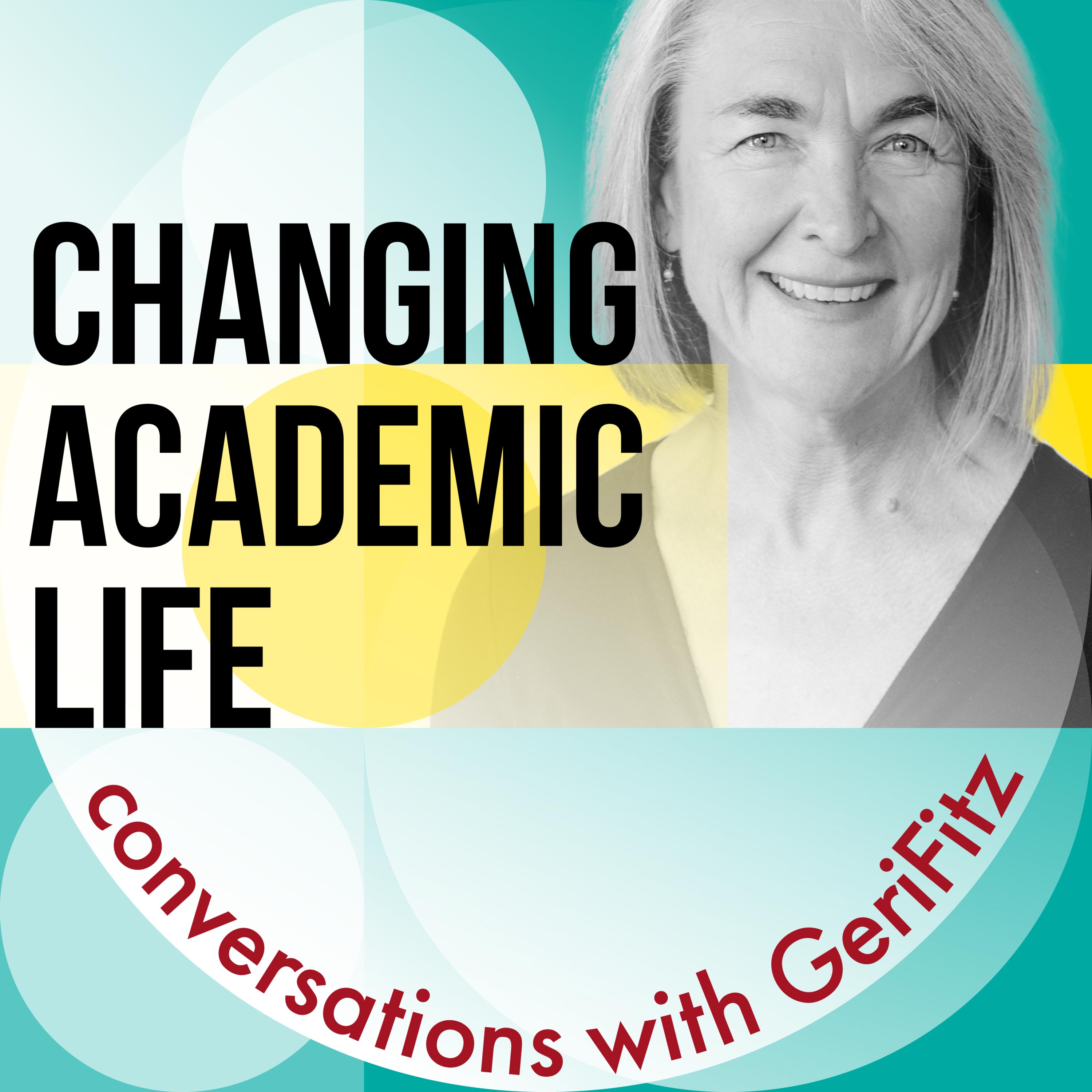
Changing Academic Life
Geraldine Fitzpatrick
What can we do, individually and collectively, to change academic life to be more sustainable, collaborative and effective? This podcast series offers long-form conversations with academics and thought leaders who share stories and insights, as well as bite-size musings on specific topics drawing on literature and personal experience.
For more information go to https://changingacademiclife.com
Also see https://geraldinefitzpatrick.com to leave a comment.
NOTE: this is an interim site and missing transcripts for the older podcasts. Please contact me to request specific transcripts in the meanwhile.
For more information go to https://changingacademiclife.com
Also see https://geraldinefitzpatrick.com to leave a comment.
NOTE: this is an interim site and missing transcripts for the older podcasts. Please contact me to request specific transcripts in the meanwhile.
Episodes
Mentioned books

Nov 29, 2023 • 5min
Revisiting Irina part 2
There were some technical hiccups in Part 2 of my conversation with Irina Shklovski, making the original audio I released very choppy (a lesson in not relying on smart tools!). I’ve uploaded new audio version that is much easier to listen to and doesn't chop off words. So this is an encouragement to you to listen to this now as it is such an important raw honest conversation and Irina shares so many useful ideas about coming back from burnout and learning to be enough, do enough. I include a clip from that conversation as a teaser. Overview:00:00 Intro00:29 Addressing Technical Issues on Irina Part 201:52 Revisiting Irina's Conversation02:35 Snippet from Irina's Conversation04:13 Encouragement to Listen to Part Two04:30 Outro05:25 EndEpisode: Irina Shklovski Part 2

Nov 22, 2023 • 20min
On Self Compassion
In this short episode I pick on the notion of self-compassion from the discussion with Mark Reed last week, and go back to Kristin Neff’s work and other related self-compassion researcher to unpack the three components of self-compassion and some practices for cultivating self-compassion and also point to some of the research evidence base for the benefits of self-compassion. I also share my own experience in needing to apply self-compassion this week. Overview:00:29 Introduction01:27 Replaying Mark Reed on self-compassion02:26 An overview of self-compassion06:37 Examples of self-compassion practices08:24 My self-compassion experience11:25 Example research evidence base17:45 Back to Mark20:24 EndFor atranscript to follow automatically with the audio: https://share.descript.com/view/JxbMM1C5ZIZ Related Links:The podcast conversation with Mark Reed Kristin Neff’s Self-Compassion web page Neff, K., Hsieh, Y. & Dejitterat, K. Self-compassion, Achievement Goals, and Coping with Academic Failure. Self and Identity, 4, 263-287, 2005. DOI: 10.1080/13576500444000317 Zessin, U., Dickhäuser, O. & Garbade, S. The Relationship Between Self-Compassion and Well-Being: A Meta-Analysis. Health and Well-Being, 7(3), 340-364 2015Ewert, C., Vater, A. & Schröder-Abé, M. Self-Compassion and Coping: a Meta-Analysis. Mindfulness 12, 1063–1077 (2021). https://doi.org/10.1007/s12671-020-01563-8Lee, K.J., Lee, S.M. The role of self-compassion in the academic stress model. Curr Psychol41, 3195–3204 (2022).https://doi.org/10.1007/s12144-020-00843-9Dreisoerner, A., Klaic, A., van Dick, R. et al. Self-Compassion as a Means to Improve Job-Related Well-Being in Academia. J Happiness Stud 24, 409–428 (2023). https://doi.org/10.1007/s10902-022-00602-6Phillips WJ, Hine DW. Self-compassion, physical health, and health behaviour: a meta-analysis. Health Psychol Rev. 2021 Mar;15(1):113-139. Doi:10.1080/17437199.2019.1705872. Epub 2019 Dec 22. PMID: 31842689.Neff, K. Self-Compassion: Theory, Method, Research, and Intervention. Annu. Rev. Psychol. 2023. 74:193–218. Acknowledgement: Episode artwork image of person hugging themselves: Photo by Hala Al-Asadi on Unsplash

Nov 15, 2023 • 53min
Mark Reed on mental health, love and impact
Professor Mark Reed is an academic, author, podcaster, consultant, trainer, policy advisor among his many roles. His research area is on ecosystem markets and environmental governance, and he studies how researchers can generate and share their knowledge so they can change the world. Reflecting both of these strands, he is both an academic, co-directing a research Centre at Scotland’s Rural College, and he is the founder of Fast Track Impact, a training and coaching company, and he hosts The Fast Track Impact podcast. He also has a host of other roles you can read about on his web page. We discuss the concept of 'impact' in academia, the challenges of mental health and burnout amongst academics, and the importance of self-compassion, self-reflection and self-care. Driven by a desire to make a difference, Mark intertwines his academic inquiries with a commitment to environmental stewardship and decolonizing research. He also talks about his commitment to empowering colleagues, managing postdocs efficiently, and his take on the biases and limitations within the academic system.Overview00:05 Introduction00:30 Meet Professor Mark Reed: A Multi-faceted Academic01:18 The Importance of Self-Reflection in Academia01:56 Mark's Personal Struggles and the Importance of Self-Compassion02:07 The Role of Purpose and Values in Mark's Work02:56 Mark's Journey as an Academic and Policy Advisor07:23 The Challenges and Biases in the Academic System08:32 Building a Compassionate Culture in Academia11:33 Decolonizing Research and Influencing Policy27:11 The Role of Empathy and Love in Research32:13 The Importance of Self-Care and Work-Life Balance in Academia48:05 Creating a Purposeful Workplace and Leading from the Bottom Up51:24 Conclusion: The Impact of Love and Empathy in Academia52:56 EndListen here for a version to follow the transcript linked directly to the audioRelated LinksMark's research web page & Fast Track Impact pageMark’s books: https://www.fasttrackimpact.com/books#impact-cultureThe Research Impact Handbook 2nd Ed 2018The Productive Researcher 2017Impact Culture 2022 Mark’s ‘The Fast Track Impact’ podcast seriesMark Reed & Hanna Rudman, Re-thinking research impact: voice, context and power at the interface of science, policy and practice, 18, Sustainability Science, 967-981, 2023.Richard Watermeyer's 2019 book: Competitive Accountability in Academic Life: The Struggle for Social Impact and Public LegitimacyDr Kristin Neff, Uni of Austen Texas on self compassion Prof Michelle Pinard, Uni of Aberdeen

Nov 8, 2023 • 7min
On choosing the park
In this very short 7mins episode, I talk about choosing to go to the park instead of doing a longer episode as I had planned - making good enough choices and honouring other areas of my life.I also point to related older podcasts that talked about issues around burnout, obsessive vs harmonious passion, self care, planning:Jolanta Burke on burnout, harmonious passion, positive workplaces & helping others (from 2017)Anna Cox on family, work & strategies for making the changes we want (from 2017)Amy Ko on being reflectively self-aware, deliberately structured, & amazingly productive (also from 2017)

Nov 1, 2023 • 59min
Irina Shklovski (Part 2) on coming back from burnout, being enough, doing enough
Professor Irina Shklovski, University of Copenhagen, continues her powerful story about her academic burn-out experiences, returning to work and learning the dance of how to be enough and do enough. She discusses the push-and-pull between professional expectations and personal health, the value of reflection and self-awareness, how to establish work boundaries, and the crucial role of support from colleagues. We also touch on university funding, neoliberal culture in academia, and the importance of nurturing a balanced lifestyle which includes non-work related activities. The conversation ends with a call for change in academia, highlighting the need to redefine standards for success and manage the increasing pressures in academic cultures. Overview:[00:29] Episode introduction & recap Part 1[04:53] Trying to plan[06:29] Saying no and yes[14:44] Value of professional help[22:57] Tracking work[32:10] Making time for rest[40:24] Culture/structure influences[49:39] Supporting students in what is enough[54:46] Wrapping up[59:04] EndListen here for a version to follow the transcript linked directly to the audioRelated Links:Pernille Bjørn Kasper HornbækRidiculous SoftwareToggle Track Haruki Murakami, What I talk about when I talk about running

Oct 25, 2023 • 45min
Irina Shklovski (Part 1) on Burning Out
Professor Irina Shklovski, University of Copenhagen, has a powerful story to tell about her burn-out experiences. In Part 1 she talks about how she got there, having an amazingly supportive department and colleagues, and how her body tells her when to stop. Implicated in this are issues such as being across two departments, defining her scholarship, starting a new uni during COVID, the downside of getting grants and what it’s like getting to the point of not being able to function and having to ask for help. Apologies for missing music - trying to get that sorted!Overview:[00:29] Episode introduction[01:58] Navigating two departments…during COVID[10:32] Deciding for CS, being uncomfortable, having impact [24:25] Journey to burnout[29:35] Making the call for help[38:45] How her body tells her when to stop[42:32] Wrapping up[45:17] End Click here for a walk-through transcriptRelated LinksGender studies (TEMAG) - Linköping UniversityIrina Shklovski, Uni of Copenhagen web pageKasper HornbæckPernille BjørnBob Kraut, Carnegie Mellon Uni, HCI Institute

Oct 20, 2023 • 19min
Mobility, pensions and you, yes you! (solo)
In this short solo episode, I reflect back on recent conversations around academic mobility, discuss some benefits, and also point to an EU initiative to improve support for mobility across sectors, countries and disciplines. I also discuss some of the costs and issues around mobility, and in particular pensions, something we don’t often think about. In sharing my experiences with a complicated pension situation because of my international and sector mobility, I encourage everyone to think about this now.Overview:[00:29] Episode introduction, revisiting mobility form past episodes[02:16] EU initiative towards better mobility support, mobility benefits[04:47] Shadow sides of mobility[06:12] Pension challenges with mobility[08:12] My mobility and pension story[15:08] Encouraging people to think more about pensions[16:50] RESAVER pension fund[19:24] End

Oct 11, 2023 • 1h 7min
Susanne Bødker on career, culture and choices
Susanne Bødker, Professor of Human Computer Interaction at Aarhus University, reflects on her 40-year career, discussing topics such as mobility, changes over time, hiring practices, creating collegial culture, being active in university politics, transitioning to retirement, and being a single parent. She emphasizes the value of participation and human connections in academia.

Sep 27, 2023 • 42min
Reforming research assessment top-down bottom-up middle-out (solo)
Following the conversation with Dr Karen Stroobants on the EU CoARA agreement, I discuss some other top-down initiatives at international and national levels for reforming research assessment. I also share some of my own bottom-up experiences trying to put these principles to work eg in writing references and being part of evaluation panels. It is also my hope that these actions can also have some middle-out influence.Overview [41:33 mins] - full transcript available:[00:00:29] Episode introduction[00:02:10] The 10 Commitments of CoARA[00:05:02] Other international initiatives[00:10:34] Netherlands as example of national initiatives[00:17:20] Some of my 'bottom up' examples[00:34:18] Middle out strategies[00:38:35] Wrapping upRelated links:CoARA: Coalition for Advancing Research Assessment and CoARA CommitmentsLERU: League of European Research Universities LERU Publication: A Pathway towards Multidimensional Academic Careers 2022DORA: San Francisco Declaration on Research Assessment 2013Leiden Manifesto for Research Metrics 2015 The Metric Tide: Review of metrics in research assessment Strategy Evaluation Protocol 2021-2027 Room for Everyone’s Talent Related podcasts:Karen Stroobants on changing research culture and reforming research assessmentSarah Davies: Part 1 on mobility, precarity and notions of excellence and part 2 on luck, disrupting excellence, and cultures of careTanita Casci and Elizabeth Adams on supporting, rewarding and celebrating a positive collegial research culture James Wilsden on metrics and responsible research evaluation Keywords:Academia, CoARA, Diversity, Governance and policy, Research culture, Research Evaluation

Sep 21, 2023 • 8min
Being a Work in Progress (solo)
In this short episode I reflect on my recurring life lesson about putting unrealistic pressures on myself, in this case to put out a full podcast this week. Especially when the platforms I am using are a work in progress. And accepting that I am also a work in progress. What are your recurring life lessons?Transcript [08:03 mins][00:00:29] Geri: Do you ever have any of those life lessons where it seems like the universe needs to serve them up to you again and again and again? Because you're so slow to learn them. And so you need to be reminded about them over and over and over again. Well, this week I've been returned to one of my recurring life lessons that it seems like I still don't learn. Which is about setting up unreal expectations for myself. [00:01:02] I made the bold claim in the short intro session to season four. That my aim was to try to release a podcast every week on a Wednesday morning. And so I've already put myself under enormous pressure to do that. Uh, we put out the great conversation with Karen last week Karen Stroobants about reforming research evaluation. And I wanted to follow up that podcast, just responding to some of the issues she raised in terms of my personal experiences. And so I did record something and then I spent ages processing the audio and so on. And doing it quite uncritically because I was just driven by, I had to get it out. I had to get it out. Uh, and then Wednesday came and I miss my 8:00 AM release time and it still wasn't done. And I'm still feeling the pressure last night and it just occurred to me. It has stepping back a little bit. It's actually not very good at all. Despite the huge amount of time and effort that I've put into it, it's really not ready to go out. And it's something that I should take just as a, as a rehearsal . So then I was feeling doubly bad about it. [00:02:15] But do you know what? That all just comes from me? I created that. No one else. I know that no one is sitting around at 8:00 AM or 9:00 AM on a Wednesday. Waiting for the podcast to drop. But still I felt the pressure. I felt bad. And I ended up putting a whole lot of misdirected time and inefficient effort. Having bought into that pressure. And that whole unrealistic expectation. [00:02:43] So I'm not going to release that podcast. I am still going to get something out this week. So what's my minimal commitment that I can do. And I'm just going to do this short one with yet another confession. About this time, setting up unrealistic expectations. [00:03:01] And when you think about it, logically of course they were unrealistic expectations. What on earth was I thinking. Of course, it's going to be hard to do weekly at the moment. Because this whole new podcast set up is a work in progress, literally. We're still getting the new technology platforms in place for the podcast and that that's everything from the recording platform. The platform where I process the audio, do the transcriptions. Um, we're setting up a whole new podcast server. They're all new. At once. And so every aspect of the workflow now is brand new as well. And on top of that, they're really great platforms, but in being great, they're also quite complex. And so there's a huge learning curve, both just in getting to know the software and what each of the platforms can do. As well as how I want to use them and how to make that workflow work. [00:04:02] And the other aspect, that's a big work in progress and taking time and effort is the website. And. And also there's a lot of interplay between the new podcast server and the new website that we're trying to work out as well. So that the whole environment I'm trying to work in. Is a work in progress. [00:04:21] And I'm clearly a work in progress as well. Because I forgot to allow myself grace for being on a learning curve. And learning curves are always uncomfortable. Aren't they it's. It's uncomfortable feeling like you don't know, not being an expert. Um, and also dealing with the uncertainty of that, and also the inevitable challenges that come up and problems. [00:04:46] And it's not just that on top of that, this my whole life situation. These are my last days in my current role before transitioning on. And there's a whole lot to be done practically. And not to mention a whole lot to deal with emotionally and the whole emotional overlay of, um, you know, those interesting aspects to endings and beginnings, you know, the sadness of endings the excitement of new beginnings and. so on., And on top of all of that, we've also had a lot of visitors, both personal visitors and work visitors. So, duh, of course, it's going to be hard to get something out on Wednesday. And that's okay. That it didn't happen. [00:05:31] And so this week has been returning to the lesson. My recurring life lesson. That it's okay. That I'm okay. Uh, not to put such high expectations on myself and create my own pressures. To hold the expectation's lightly. To be comfortable with adjusting deadlines and to be comfortable with good enough and recognizing when good enough is good enough. And it's okay to also say that. Say the one that I had tried to prepare for this week. Wasn't good enough. [00:06:05] So. This is just a short podcast today. I'll do my best to get something out next week, but I won't put pressure on myself and I'll just accept that. Work on being kind to myself, recognize that we will eventually get all of this new stuff, worked out, that the learning curve will become a little bit easier. The website will be up and running my new life, whatever that's going to have it, that's going to be unfolding. Will happen and we'll get into the rhythm as well, and just try to maintain, more of a detached curiosity to see how it all works out. [00:06:45] So thanks for listening to my confession. Uh, maybe this invites you to also reflect on what are your recurring life lessons that the universe needs to present you with again, and again, and again. And hopefully. Maybe you are not as slow as me as at learning those lessons. Have a good week

