

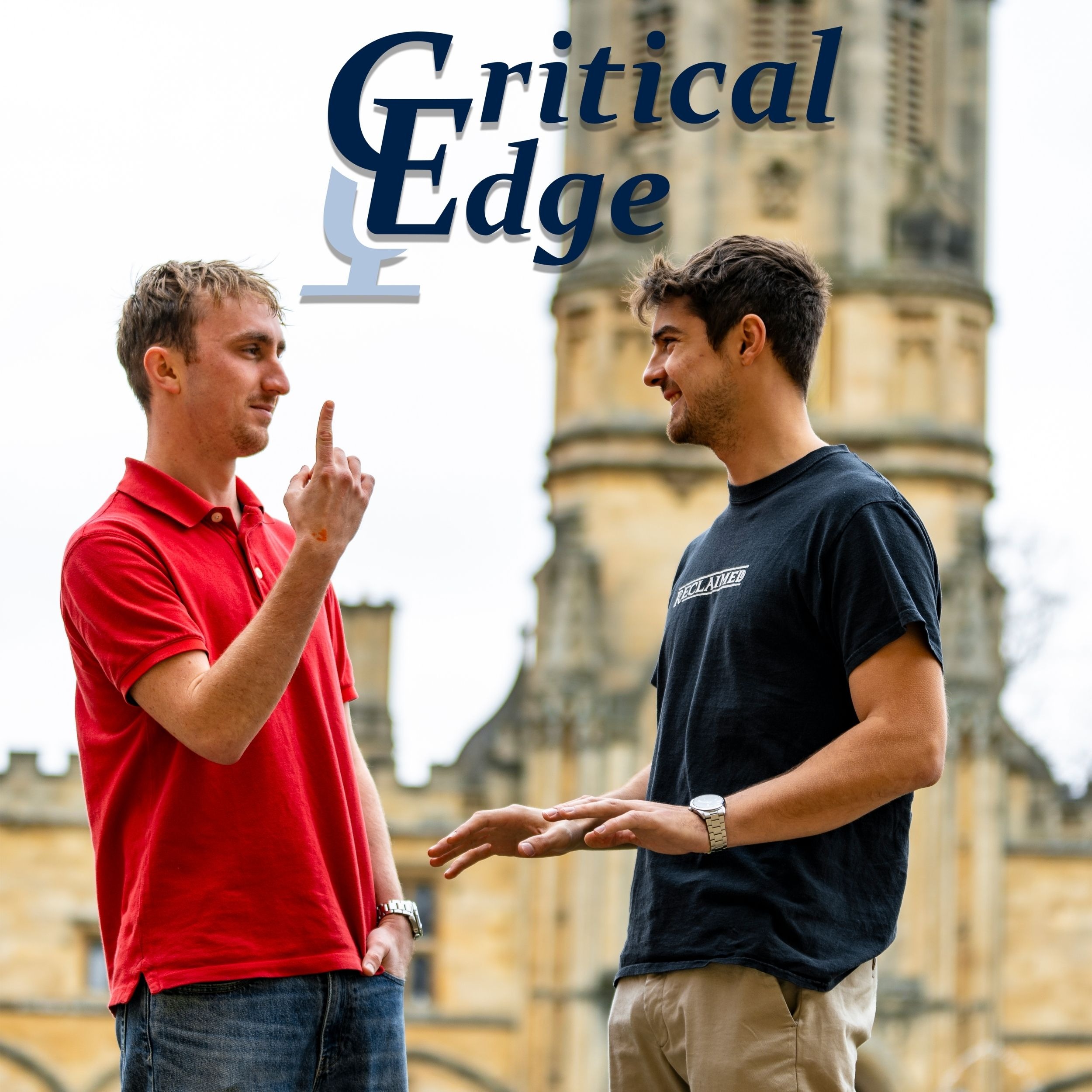
Critical Edge
Lukas Seifert and Oliver Walsh
Critical Edge stands for pushing ideas to the limit, and pushing our guests to those limits too. We feel that too many platforms host brilliant individuals, but don’t end up asking the questions that really matter. This is a platform for debate, a disruptive media channel, which discusses perspectives too often unexplored.Get ready for a new communal project. Ideas are sharper at the edge.
Episodes
Mentioned books

Oct 1, 2026 • 38min
Peter Tatchell: Why Social Media Spreads Discrimination | #73
Best mates Ollie and Lukas sit down with LGBT+ and Human Rights campaigner Peter Tatchell. We cover everything from queer politics to social media to pornography, sex education and changing sexual behaviour.Critical Edge is a multi-media community started by two friends seeking to learn how to think, not what to think. Subscribe or check out our other platforms to join the team :)
Sep 24, 2026 • 1h 4min
Jonathan Anomaly: Genetic Enhancement is the Future | #72
Best mates Ollie and Lukas sit down with Jonathan Anomaly, an advocate for genetic modification of embryos to make the human race smarter, taller, stronger, healthier, better-looking even. Lukas and Ollie get into the nitty-gritty of this bio-ethical question with him, arguing that it can lead to some big political and ethical problems down the line, that it might even look something like eugenics. Ultimately, it’s up to you to decide your view.What do you think? Is technology going too far? Let us know your thoughts: if your ideas are well-reasoned, respectful, and thought-provoking, we’d love to go back and forth with you on this!!Critical Edge is a multi-media community started by two friends seeking to learn how to think, not what to think. Subscribe or check out our other platforms to join the team :)
Sep 4, 2026 • 58min
Hamid Ismailov: How Literature Can Overthrow a Regime | #71
Best mates Ollie and Lukas sit down with renowned Uzbek novelist, poet and journalist Hamid Ismailov to explore language, censorship, exile and the future of literature.From BookTok to Beckett, political propaganda to AI-generated fiction, we ask how stories shape our thinking—and what happens when writers break the rules. Hamid shares why he was forced to leave Uzbekistan, how literature challenges authoritarianism, and why he remains hopeful about the future of books.His parting advice? “You are much more interesting than you think.”Critical Edge is a community founded by two friends learning how to think, not what to think. Follow the podcast and join us on our other platforms :)
Jul 23, 2026 • 35min
Carl Jung's Shadow: How to Become Who You Are | #70
In this episode, best mates Ollie and Lukas sit down to discuss all things Carl Jung and psychoanalysis.We begin by talking about the Jungian shadow, the repository of our subconscious where we dump all those things we don’t like about ourselves, or don’t identify with: our anger, our shame, whatever it might be. The shadow is hard to recognise, precisely because we repress it into our subconscious. Not being aware of this, though, can lead to shadow projection: to imagining that the traits we fear in ourselves are only located in others. Through a psychoanalytic process of identification, we can bring it to the forefront. The key, then, is to integrate the shadow: to make the unconscious and conscious come together. This is what allows us to ‘individuate’, to ‘become who we are’.We move on to discuss dreams, and dream interpretation. Jung’s theory of dreams takes a lot from Sigmund Freud: the basic belief is that dreams are constructions of the unconscious which we can interpret to understand our own subconscious better. Jung is much more open than Freud though, and doesn’t think that psychoanalysis boils down to sex and aggression. Instead, dreams are repositories of symbols which can be read much like one reads metaphors in a book. They also have a homeostatic function: they act like a pressure valve, bringing repressed thoughts back up to the conscious level. If we can learn to read our dreams, perhaps we can learn to understand ourselves better.Finally, we discuss Carl Jung’s theory of archetypes. For Jung, an archetype is an image, concept, or symbol which resides in the collective unconscious. That is, basic structures of thought which we all share in our unconscious: the self, the hero, the mother, the child, and so on. These archetypes shape the way we interpret everything around us. Individual mothers live up, or don’t, to the archetype we share of them. Recognising this can help us understand the structures of our own thought, and how biases might be built into our way of seeing. For example, by analysing how our archetypes might be shaped by patriarchal ways of seeing and thinking.Lukas and Ollie, most of all, talk about how all of this can help us think in our own lives. Stick around for more of that. We’re here to learn how to think, not what to think.00:00 - Jung's Concept of the Shadow06:26 - Dreams and the Unconscious10:45 - Dream Analysis and their Significance20:00 - Archetypes and the Collective Unconscious26:14 - The Personal and Cultural Role of Archetypes
Jul 17, 2026 • 56min
Ilan Pappé: This is Why I Gave Up On My Country | #69
Best mates Ollie and Lukas sit down with renowned Israeli Historian of the 'New School', Ilan Pappé. In this episode, we pull out the nuances in discussions about the two-state solution, the use of language, the genocide, colonisation, and the future. We begin with an in-depth discussion about how discourse shapes the way we view an issue: should the situation be described as a conflict, a genocide, a war, or something else? The discussion turns around how we can balance the priorities of international policy-makers and NGOs which are actively seeking practical solutions, with the principled approach to language which says we should describe things as we believe them to be.Ilan Pappé, a resident of Israel living in Haifa, explains what it's like on the ground: the problematic attitudes of many everyday Israelis, and how he deals with conflict arising from his pro-Palestinian principles. He even goes so far as to draw parallels with the Nazi regime's discourse surrounding the Jews: the totalising and dehumanising rhetoric that allows one to carry out acts of brutality. This is also top-down, indeed Pappé opens up about how Israeli schools utilitse Middle Eastern history as a way to give their nation a certain view of the world and their place in it. Fear is manipulated in order to keep conflict with Iran, Lebanon, Palestine, and so on, evergoing.Without context, we cannot know where or who we are. Ilan Pappé recognises the tragedy of October 7th, and meanwhile argues that we cannot understand it without the context which brought it into being. He talks about the 'colonisation of Palestine' as being a process of settler colonialism which displaced Palestinians and used violence to erase them from 'the land with no people'.Ollie and Lukas get into it with Ilan about the future. Ollie expresses his internal debate about the two- and one-state solution. One is perhaps more 'pragmatic', and the other more 'ideal'. Ilan tells us that it is not us who should decide, but the Palestinians.Critical Edge is a multi-media community started by two friends seeking to learn how to think, not what to think. Subscribe or check out our other platforms to join the team :)The book Ollie got Lukas for his birthday: https://amzn.to/3T5BlhOOn Palestine: https://amzn.to/4wjqjUP10 Myths about Israel: https://amzn.to/4wjqjUP00:00 - The significance of language for Israel-Palestine08:32 - Language and attitudes within Israel12:31 - Nazism, Fear, and Conversation in Israel19:17 - The Cycle of Violence: Its Roots and Future25:42 - October 7th and Historical Context34:23 - The Two-State Solution, Aparthed, and the Future45:23 - Normalcy after the Genocide for Palestinians54:42 - Imagining a Shared Future in Palestine
Jul 13, 2026 • 55min
We Interviewed a Childcare Worker | In Plain Sight #1
Ollie and Lukas sit down with social care worker Catherine. They discuss the importance of childcare, how the NHS and national systems are failing children, and where parents go wrong. Catherine shares her personal story of IVF and finding her way to social care.This episode is the first in our new series, In Plain Sight. In this series, Ollie and Lukas get the perspectives of people who do really important work, but whose contributions and points of view aren't heard enough. These essential workers tell us their story, their perspective on what Westminster needs to do differently, and how their sector is changing.Critical Edge is a multi-media community started by two friends seeking to learn how to think, not what to think. Subscribe or check out our other platforms to join the team :)
Jun 23, 2026 • 35min
Cenk Uygur: The Real Reason I Was Banned From the UK | #68
Ollie and Lukas sat down again with Cenk Uygur to discuss being banned from the UK for anti-semitism, Israel’s influence in the UK, and Palestine.Critical Edge is a multi-media community started by two friends seeking to learn how to think, not what to think. Subscribe or check out our other platforms to join the team :)
Jun 5, 2026 • 1h 2min
Philip Pullman: Life Imitates Art | #67
Critical Edge hosts and best mates Ollie and Lukas sit down with Philip Pullman, renowned author of His Dark Materials.We drew on everything from Milton's Paradise Lost to Superman to William Blake. This episode was about the power of literature to change the way we see ourselves and the way we live our lives, as well as the way storytelling can light up our imaginations. Lukas told Philip about how the concept of the daemon changed the way he saw his own personality, and the souls of those people around him. Philip also shared how Philip Goff's book Galileo's Error, which argued for pansychism, was the non-fiction book that most profoundly shaped his view of the world. Consciousness now seeps everywhere through his literary work. Philip said he doesn't like fantasy, at least not if it doesn't deal with fundamental questions of human psychology. This is why he loved Paradise Lost: the three of us bonded over Gustave Doré's famous illustrations for Paradise Lost, and William Blake's Illuminations.We finished with a discussion about how basic structures of thought can seep into the way we think, even at a young age. Ollie argued that Sleeping Beauty can make us see the man as the active desirer and the woman as the passive desired, although of course Philip thought better stories could plug this gap.Is it impossible to live without narrative structures? Ollie argued that the heads of people who don't read are simply filled with worse narratives, like the American Dream, which prizes money above all. Philip finished by recommending one of his favourite works of political thought for our next guest. Critical Edge is a multi-media community started by two friends seeking to learn how to think, not what to think. Subscribe or check out our other platforms to join the team :)0:00 - Introduction0:33 - Fiction as a Guide to Life1:44 - The Art of Storytelling3:21 - Growing Up in Australia9:42 - What Daemon Would You Have?16:02 - Books That Shaped Pullman24:01 - Panpsychism and Consciousness30:28 - Fantasy, Paradise Lost, and His Dark Materials42:49 - How Does Fiction Shape our Psychology?51:33 - Stories, Gender Roles, and Fairytales1:01:03 - Outro and Recommendation
May 26, 2026 • 1h 16min
What Happens When a Philosopher Takes DMT? | #66
Critical Edge hosts and best mates Ollie and Lukas sit down with rockstar panpyschist Philip Goff.Ollie, Lukas and Philip talked about it all. We started with a discussion about the fundamental nature of consciousness, and why it can't be understood using the language of science: David Chalmer's 'hard problem of consciousness'. This led us to panpsychism and its connection to mystical beliefs. Philip opened up about his experience doing toad venom (5-MEO-DMT) and the perspective that opened up for him regarding our connection to something bigger.
May 13, 2026 • 46min
Is War Built Into Our Psychology? | #65
Critical Edge hosts and best mates Ollie and Lukas sit down with veteran of the philosophy game Jeff McMahan, an ethicist who lives and breathes his work. We really got into it this episode. We discussed whether war can ever be justified, the ethics of autonomous weapons, and the difficult questions concerning Gaza and Iran. Jeff isn’t one to weasel his words: you’ll want to hear what he has to say.Critical Edge is a multi-media community started by two friends seeking to learn how to think, not what to think. Subscribe to our Spotify to hear more!

