

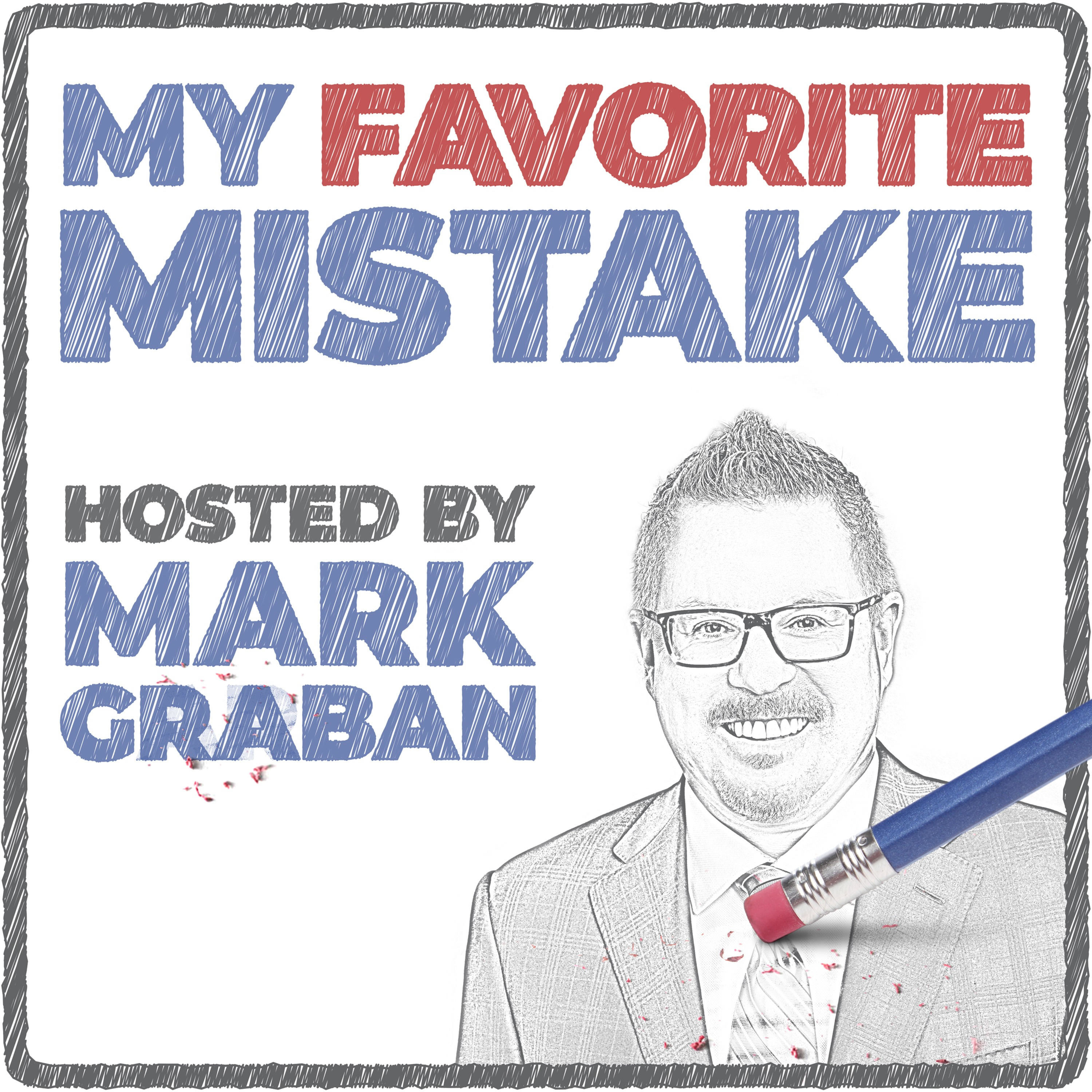
My Favorite Mistake: Learning Without Blame in Business and Leadership
Mark Graban
My Favorite Mistake is a podcast about learning without blame in business and leadership.
Despite the name, it’s not just my favorite mistake—it’s yours, it’s ours, and it’s what we can all learn from when things don’t go as planned.
Hosted by author and consultant Mark Graban, each episode features honest conversations with leaders, executives, entrepreneurs, and changemakers about a meaningful mistake they made—and what they learned after things went wrong. How they responded. How they improved. How they grew as leaders.
This isn’t a show about failure theater, gotcha moments, or simplistic “lessons learned.” It’s about how real people reflect, improve, and lead better in complex organizations—without scapegoating, shame, or hindsight bias.
What You’ll Hear
• Leadership and management mistakes that reshaped careers, teams, and organizations• How teams and leaders learn without blaming individuals• Insights about culture, systems, decision-making, and psychological safety• Practical lessons drawn from real experience, not abstract theory
Guests come from business, healthcare, technology, sports, entertainment, government, and academia, sharing stories that reveal how learning actually happens.
The Perspective
Mark brings a systems-thinking lens grounded in Lean management, continuous improvement, and psychological safety. The focus is less on who messed up and more on what the system taught us.
Who This Podcast Is For
• Leaders and managers who want to learn from mistakes without blame• Executives working to build healthier, more resilient cultures• Professionals who believe improvement starts with reflection, not punishment
My Favorite Mistake: Learning Without Blame in Business and Leadership
Despite the name, it’s not just my favorite mistake—it’s yours, it’s ours, and it’s what we can all learn from when things don’t go as planned.
Hosted by author and consultant Mark Graban, each episode features honest conversations with leaders, executives, entrepreneurs, and changemakers about a meaningful mistake they made—and what they learned after things went wrong. How they responded. How they improved. How they grew as leaders.
This isn’t a show about failure theater, gotcha moments, or simplistic “lessons learned.” It’s about how real people reflect, improve, and lead better in complex organizations—without scapegoating, shame, or hindsight bias.
What You’ll Hear
• Leadership and management mistakes that reshaped careers, teams, and organizations• How teams and leaders learn without blaming individuals• Insights about culture, systems, decision-making, and psychological safety• Practical lessons drawn from real experience, not abstract theory
Guests come from business, healthcare, technology, sports, entertainment, government, and academia, sharing stories that reveal how learning actually happens.
The Perspective
Mark brings a systems-thinking lens grounded in Lean management, continuous improvement, and psychological safety. The focus is less on who messed up and more on what the system taught us.
Who This Podcast Is For
• Leaders and managers who want to learn from mistakes without blame• Executives working to build healthier, more resilient cultures• Professionals who believe improvement starts with reflection, not punishment
My Favorite Mistake: Learning Without Blame in Business and Leadership
Episodes
Mentioned books

Jan 25, 2026 • 39min
Undercharging for Consulting: Amy Rasdal on Fear, Pricing, and Knowing Your Worth
What happens when you know your value—but say a lower number anyway?
In this episode of My Favorite Mistake, Mark Graban is joined by Amy Rasdal, founder of Billable at the Beach and author of Land a Consulting Project Now. Amy shares her favorite mistake from the early days of consulting: undercharging for her work because of fear, even when she knew she was worth more.
Amy explains how that moment became a “gateway mistake,” leading her to better understand pricing, confidence, and the hidden beliefs that hold many accomplished professionals back. The conversation explores why undercharging is so common, how fear shows up in pricing conversations, and why selling out your time at a discount can quietly limit long-term success.
This episode is especially relevant for consultants, freelancers, and professionals considering a move from corporate life into independent work.
🔗 Full show notes: https://www.markgraban.com/mistake336

Jan 22, 2026 • 6min
Releasing the Wrong Body Is Not Just “Human Error” - Mistake of the Week
A devastating hospital mistake in Glasgow was described by leaders as “human error,” even as they acknowledged that “very rigorous processes” were not followed.
In this episode of The Mistake of the Week, Mark Graban examines why suspensions and discipline don’t guarantee improvement — and how gaps between written procedures and real work create hidden risk.
Punishment may feel like accountability, but without fixing the system, the same harm remains possible.

Jan 19, 2026 • 45min
How Buying an Oil Tanker Became My Favorite Mistake — Kevin Hipes
What happens when a business deal looks solid on paper—but falls apart in real life?
Episode page with video, links, and more
My guest for Episode #335 of the My Favorite Mistake podcast is Kevin Hipes, an entrepreneur, author, and former city commissioner who’s been called the “New York Forrest Gump” because of the many lives he’s lived.
Kevin shares the story of one of his biggest—and most unforgettable—business mistakes: buying an oil tanker in the Caribbean. What began as a seemingly foolproof investment with a strong pro forma turned into a cascade of unexpected challenges, including regulatory changes, ethical dilemmas, geopolitical risk, and international drama.
In this episode, we talk about:
Why smart people still make big business mistakes
How external forces can derail even the best plans
Learning from failure instead of hiding from it
Resilience after financial and emotional setbacks
The importance of mental health awareness for leaders and entrepreneurs
Kevin’s story is funny, sobering, and deeply human—and a powerful reminder that mistakes don’t define us unless we refuse to learn from them.

Jan 15, 2026 • 6min
“But I Wore the Juice”: The True Story That Inspired the Dunning–Kruger Effect | Mistake of the Week
What does a failed bank robbery have to do with one of the most cited ideas in psychology?
More than you might expect.
In this episode of My Favorite Mistake, Mark Graban tells the true story of McArthur Wheeler, a man who believed that rubbing lemon juice on his face would make him invisible to security cameras. Confident in his reasoning—and even more confident in his ability to test it—Wheeler walked into two Pittsburgh banks in broad daylight, fully exposed, certain that his citrus-based logic would protect him.
It didn’t.
When police later showed him clear surveillance photos, Wheeler’s stunned response became legendary: “But I wore the juice.”
That moment caught the attention of psychologist David Dunning, who saw in Wheeler’s mistake something deeper than criminal incompetence. Along with Justin Kruger, Dunning went on to study how people with low skill often lack the awareness to recognize their own limitations—research that became known as the Dunning–Kruger Effect.
This episode explores the layered nature of mistakes: flawed assumptions, poorly designed tests, and the dangerous certainty that both are correct. It’s not a story about stupidity. It’s a story about human blind spots—and how easily confidence can outrun competence.
Whether in leadership, work, or everyday life, the lesson is universal: it’s not enough to test our ideas. We also have to test how we test them.
Because some of the most convincing mistakes are the ones that feel like proof.

Jan 12, 2026 • 40min
Choosing Engineering When I Was Wired for People (Angie Callen)
Episode Page
Angie Callen — founder of Career Bend, host of No More Mondays, and author of Scary Good: Discovering Life Beyond the Sunday Scaries — shares why choosing engineering school became her favorite mistake.
In this episode, Angie reflects on becoming an engineer despite being deeply people-oriented, how that decision shaped her thinking, and why mistakes that “don’t fit” often unlock clarity, confidence, and unexpected opportunity.
Mark and Angie discuss career transitions, Sunday Scaries, confidence built through action (not perfection), the difference between empathy and compassion, and why so many high performers stay stuck in roles that no longer align with who they are.
This conversation explores how mistakes can become catalysts — not failures — and why meaningful work starts with understanding yourself, not following default paths.

Jan 8, 2026 • 4min
The HR Tool That Accidentally Fired Everyone - Mistake of the Week
In this week’s Mistake of the Week, a company’s HR team accidentally sent a mass termination email to the entire workforce — including the CEO. The culprit was an offboarding automation tool left in the wrong mode, turning a routine test into a company-wide panic.
Mark Graban explores what this moment teaches about automation, human fallibility, and the danger of relying on memory in systems that affect people’s livelihoods. Instead of asking, “Who pressed the wrong button?”, the real question is, “Why was this mistake even possible?”
A funny story now, but a real lesson in error-proofing or the lack thereof.
Because even when no one’s actually fired, the fear can linger long after the email is retracted.

Jan 5, 2026 • 47min
Startup Mistakes That Linger: Jason Sherman on Co-Founders, Smart Money, and MVP Learning
In this episode of My Favorite Mistake, Mark Graban talks with Jason Sherman, an entrepreneur, startup advisor, and educator, about the early startup mistakes that quietly shape everything that follows.
Episode page with transcript, video, and more
Jason shares hard-earned lessons about choosing co-founders, distinguishing “smart money” from money alone, and why MVPs should accelerate learning rather than encourage overbuilding. The conversation explores judgment, incentives, and alignment through a Lean lens — showing how optimism, unchecked assumptions, and unclear decision rights can undermine even strong ideas.
This episode is especially relevant for founders, leaders, and anyone working under uncertainty who wants to turn mistakes into insight instead of regret.

Jan 1, 2026 • 5min
Why New Year’s Resolutions Fail: Willpower vs. System Design
Why do New Year’s resolutions fail so predictably—and what does that teach us about change at work? In this Mistake of the Week, Mark Graban explores why treating change as a test of willpower is a reliable setup for frustration, both personally and in organizations.
Drawing on behavioral psychology and leadership examples, the episode connects failed personal resolutions to common organizational mistakes: big announcements, ambitious targets, and too little attention to system design and psychological safety.
The takeaway is practical and actionable: instead of trying to boost motivation or eliminate human error, leaders should focus on making the right choices easier and the wrong ones harder—starting small, iterating, and learning forward instead of blaming backward.

Dec 27, 2025 • 4min
Nick Saban’s “Dumbest” Call—and Why His Players Loved It
Nick Saban calls it “the dumbest decision I ever made” — a fourth-and-one call from the 2001 SEC Championship Game that still sticks with him.
In this episode, Mark Graban breaks down why even the greatest coaches make mistakes, what Saban learned from the moment, and how leaders can turn high-pressure missteps into opportunities for trust and growth.
Perfect for listeners interested in leadership, football, coaching, and the psychology of mistakes.

Dec 18, 2025 • 4min
How a Mistake Turned Jingle Bells into a Christmas Song
Jingle Bells is one of the most recognizable Christmas songs ever written… except it wasn’t written for Christmas at all. In this week’s Mistake of the Week, we unpack one of America’s most enduring cultural misconceptions: the belief that Jingle Bells has anything to do with Christmas.
Originally titled One Horse Open Sleigh, the song debuted at a Thanksgiving church service in the 1850s and was inspired not by Santa or reindeer, but by noisy, fast sleigh races in Medford, Massachusetts. No Christmas trees. No North Pole. Just winter racing, youthful chaos, and a catchy melody.
Over the decades, repetition turned assumption into “truth,” and a Thanksgiving song quietly shifted into a holiday anthem. It’s a perfect example of how knowledge mistakes spread — harmless, familiar, and rarely examined.
In this 3–4 minute episode, Mark explains:
Why Jingle Bells was never meant to be a Christmas song
How repetition and cultural habit transformed it anyway
What this teaches us about assumptions, organizational habits, and the stories we never question
Why small knowledge mistakes can persist for generations
If you care about learning, improvement, and understanding how mistaken beliefs take root, this episode offers a fun seasonal reminder: even our most cherished “facts” deserve a second look.

