

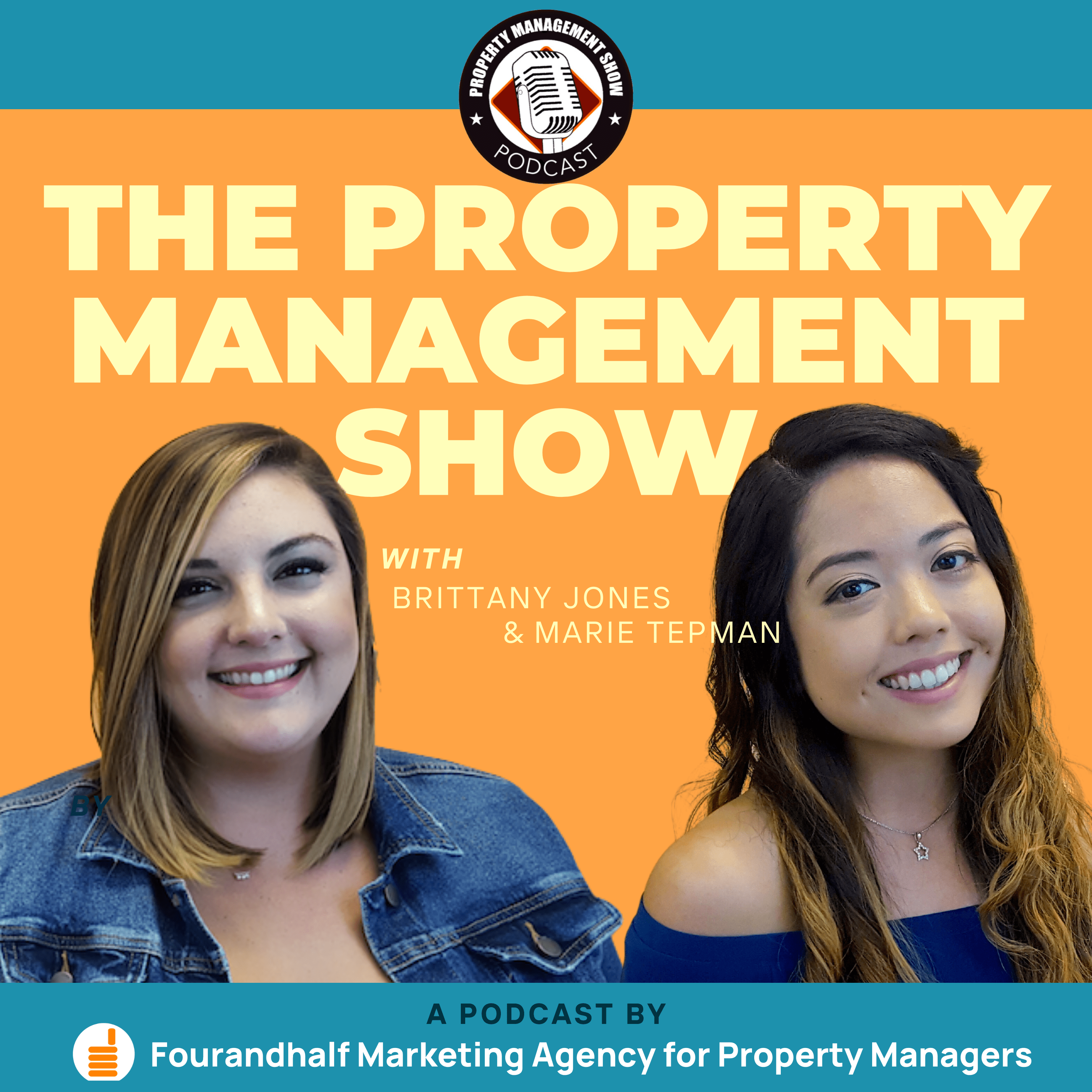
The Property Management Show
The Property Management Show
The goal of the Property Management Show podcast is to deconstruct business success into its key components and invite subject matter experts to help you improve every facet of your property management business. The topics covered here range from property management marketing, industry innovations, success stories, all the way to general best practices on how to run a successful business enterprise. The podcast creators are Brittany Jones and Marie Liamzon-Tepman from Fourandhalf, Inc – a marketing company that works exclusively with fee-based Property Management companies. Fourandhalf Marketing Agency was established in 2012 and has the best and longest track record for helping property management companies grow. They help with both marketing strategy as well as implementation. Their services include property management website design and SEO, content creation to attract and nurture leads, reputation management, online ads, you name it. Visit fourandhalf.com to learn more.
Episodes
Mentioned books

Apr 13, 2023 • 45min
How to Market a Property Management Company with Marie Tepman
Kathleen Richards recently interviewed Marie for her PM Tribe coaching group. They talked about the importance of marketing for property management companies, when it makes sense to seek professional help, and the current trends in the property management industry.
There was lots of good information during that interview, and we want to share it with property managers today on The Property Management Show.
Kathleen Richards and Fourandhalf
Kathleen began working with Fourandhalf in the early days, when the company was the first and only marketing agency that focused specifically on property managers. She began with creating video blogs, which was a new idea. Even the idea of property management marketing was new.
According to Kathleen, the content marketing help she received from Fourandhalf over six years helped her grow her business. Not only did she grow her business, she established herself as an expert in the property management industry. Kathleen had been teaching at the local college and doing workshops on property management, so the video marketing added to her credibility.
In her coaching group, Kathleen introduced Marie and Fourandhalf as a great team to work with. They took her local business, a “little company in Santa Cruz” to the next level and helped her attract new clients.
The Purpose of a Marketing Strategy
The first question to tackle is a pretty simple one: What is the purpose of marketing?
And, why should property managers invest in marketing strategies for their local businesses?
General Purpose of Marketing
The general purpose of marketing is to inform, educate, and convince people about a product, service, or idea. Even nonprofit organizations can use marketing to convince people to join their causes. Politicians use marketing to get people behind them. Local businesses want to share who they are and what they do.
Marketing Property Management Services
For a property management company, the purpose of a marketing strategy is to attract prospective renters who may want to rent your properties. Or, to attract self-managing owners who may need a professional property manager. You invest in marketing strategies to attract investors, to retain current resident and owner clients, and to educate potential clients on the value of professional property management.
Education is marketing at its core. You’re explaining why a professional property manager is better for property owners than managing a property on their own. You want to share benefits and highlight the problems you help property owners solve.
How Can a Property Management Company Benefit from a Marketing Plan?
Let’s say you need to go somewhere you’ve never been, and instead of using a GPS or glancing at a map, you get in your car and start driving.
You might get there eventually, if you stop and ask for directions or try several different routes. But, you will get lost, and you will waste a lot of time and money.
In this metaphor, a formal marketing plan serves as your GPS or your map. It shows you the most efficient way to get to your destination. It doesn’t mean you’ll never get there without it. It’s just a smarter way to do things.
Competing with Other Property Managers and Local Businesses
The theme for Kathleen’s PM Tribe this month is competition. Competition can be a good thing, keeping you sharp and focused and relevant.
How does a sound marketing strategy help you not only find new clients, but also compete in the marketplace?
Sometimes, it feels like you’re doing the same things as other property managers. Marketing is the best way to differentiate yourself. It starts with identifying your ideal client and understanding how to talk to those ideal new clients. You have the opportunity to position yourself as a no-brainer choice.
Too many property management companies don’t spend time thinking about their ideal client. Or, they’re not working to decide which market segment they’re best designed to serve. The market thinks property management is a commodity, but it’s not. Every company is a bit different.
The ideal client is important as you put together marketing strategies to attract prospective customers.
Then, you have to think about what makes you unique in attracting those new ideal clients. A marketing strategy will help you communicate your message. It’s a trap to accept all the new clients who come your way. Not everyone will be a good fit. There’s more churn and turnover and conflict when you open your doors to everyone. Be clear about your ideal clients. Where do they want and need specific services? What kind of properties do they rent out? You’re more successful when you’re more focused.
Property Management Marketing Sets You Apart
It can seem like a challenge to set yourself apart from your competition in a local area. How can a company set itself apart from all the others in Santa Cruz?
Marie says with authenticity.
As a professional property manager, you find yourself roped into the lives of your owners and renters. Whether you like it or not, this is the nature of the industry. If you’re authentic and human, you’re establishing yourself and your property management business as something that’s different from others.
Technology is fantastic, but property management is still a relationship business. Use technology to increase efficiency. Don’t utilize it to the point that you’ve removed authenticity from your brand. It doesn’t work. Relationships are between people, not interfaces.
Kathleen likes to say technology is there to support you, not replace you.
Digital Marketing Industry Trends
Artificial Intelligence (A.I.) is perhaps the biggest trend in digital marketing right now. Everyone is talking about the influence of A.I. There’s been a panic about A.I. taking all the creative jobs. Schools are worried ChatGPT is facilitating plagiarism. Tools are coming out that promise to do everything a marketer can do. A.I. is an effective method for generating immediate content, but there’s actually nothing to worry about.
This is not the value that digital marketing agencies and creative content creators provide.
The trend is to use A.I., and that’s a good idea. But, if you believe that marketing is just about putting text in a document and publishing it online, you don’t understand the true value of a marketing strategy.
A.I. makes things more efficient, but there is so much money coming into the creation of content online, it’s clear that content marketing plans still work. Why would they invest so much money if content was not still king?
When Kathleen first started working with Fourandhalf, very few property management companies were making videos. Now, everyone is doing it. Anyone can put words on the internet. If you’re not already creating content, you’re behind. If you’re still running print ads only, you’re behind.
The trend for using relevant content to generate leads is taking off. But – you need well written copy. You need content marketing within a full property management marketing strategy.
Like competition, A.I. does not make marketing property management services irrelevant. It does make your marketing team focus on sharing the value that you bring.
Kathleen could have made her own videos 10 years ago. It might have even helped her save money. But, she wanted them to look good. She wanted them the right size and length, and she wanted them ready to share on social media channels and social media pages and other websites.
A.I. provides the same benefit in that it frees up your time. Instead of writing a listing, you can focus on a higher level of customer service.
Online Reputation in the Property Management Industry
If you don’t have the budget for a formal marketing strategy, where should you start?
Keeping a close eye on your online reputation can be done without a budget. Stay on top of this, because you don’t want to ignore it long enough to suddenly discover you’re in a hole that you need to dig yourself out of.
If you want to attract new clients but you can’t afford paid marketing, focus on attracting prospective owners with a stellar reputation. People use online reviews and star ratings to make purchasing decisions. They do this even for a simple purchase on Amazon, so when it comes to a major investment like choosing a property management partner, of course they’ll pay attention to online reputation.
Not focusing on reputation does a disservice to your property management company.
People have a love/hate relationship with Yelp.
But, if you try to step back a bit, you’ll see how it can benefit you and your marketing strategies. In the corporate world, marketing departments spend thousands of dollars a year on focus groups. With online reviews, you have ready-made focus groups. Read company information, absorb positive reviews, and don’t be afraid to look at negative reviews. They can be a goldmine.
Kathleen remembered an incident where tenants left a bad review about her company because they didn’t get their security deposit back. After some research, she realized the tenant who posted was never a tenant of hers. So, she responded with this information and then shared information on how her company handles deposit returns. It was an opportunity for her to showcase how she did business differently.
No paid marketing required. You don’t even need a content marketing plan when you’re focused on reputation.
Be open to those negative reviews, especially if they’re true and indicate a change you need to make to your business. Always ask your clients for reviews. You can share those reviews on social media accounts and on your own web pages.
Kathleen would sometimes ask her friends to test her company. Like mystery shoppers, they would call and be pleasant and then they would call and be awful. This told her how her staff would react to different types of potential new clients.
Marie spearheaded a property management marketing industry survey a few years ago, and one interesting thing out of that is this statistic:
Property management business owners who prioritized reputation as one of their top three business priorities were 16 percent more likely to have their property owner clients stay longer.
When you care about reputation and invest in it, there’s a better chance you’ll retain your owner clients and your tenants.
Higher retention rates depend on:
How you’re treating people.
Whether metrics are in place to evaluate your staff.
Policies and procedures that are consistently followed
When you’re intentional and you prioritize your online reputation and your service to owners and tenants, of course you’ll retain them.
This is a cost effective way to ensure you’re providing the best services to your clients.
Investing in Marketing Efforts
Marie has seen property management companies attract new clients and knock their business growth out of the park and others who fizzled out very fast. What’s the difference, Kathleen asked.
The most successful management companies view marketing not just as an expense, but as an investment. They look at marketing as something that you sow and then later reap.
A marketing strategy takes time. You may wait six months or even over a year to see real results. The companies that grow frustrated when they don’t have 100 new doors in a month are the ones who move on and don’t find themselves able to grow with any success. They tend to want unrealistic things given their budget.
Successful companies also understand the importance of identifying an ideal client within larger customer markets.
Long term thinking drives success more than simply thinking about this month versus last month. There is no instant gratification when it comes to content marketing plans or generating leads. No business will shift overnight. It’s a process, and you need to work through that process.
It’s easy to misunderstand the purpose of marketing efforts.
Marketing is educating your clients. You might spend a year talking to prospective clients before you finally close the deal and take on their rental property.
When is it Time for Professional Property Management Marketing?
Every company moves and grows differently, but by the time you’re at 100 or 150 doors, you know you’re suddenly running a different business than you once were.
You might feel like you’re outgrowing things operationally, or maybe your property management website isn’t as impressive as other websites and you want to use it to attract new leads in a more aggressive way. Maybe you’re not getting the reviews you want or you have your eye on certain goals and you’re not quite getting there.
This is a good time to work with a marketing agency. You can expect a property management marketing strategy to get you where you want to go, especially when it comes to attracting new clients.
Once you’re making a profit, you can begin to think bigger. Invest in your property management website. Start hiring staff. Make investments in your business. You’re ready to position yourself as an expert in the property management industry. You’re thinking about paid ads and digital marketing and reaching a target audience.
It’s time to put together a marketing plan.
After years of building your business, you begin to see where your strengths are and how your way of doing business will work for an ideal client. Instead of attracting all the business, start attracting that specific business with good marketing strategies.
There’s understanding property management and there’s understanding how to put a business together. After that, you can think about property management marketing and communicating with new clients.
Figure out your market, and figure out your ideal client fits your company. Then, you’re not throwing money at a marketing plan that isn’t getting results.
Marie’s final words on effective strategies for property management marketing are simple: Rome was not built in a day.
If you’re trying to build a solid, sustainable property management business, please understand that you need to be patient. Resist the urge to cut too many corners.
Thanks to Kathleen for having Marie talk to her PM Tribe. If you have any questions about property management marketing strategies and attracting more clients, please contact us at Fourandhalf.
NameThis field is for validation purposes and should be left unchanged.First Name(Required)Last Name(Required)Email(Required)
Phone(Required)Company NameComments or QuestionsThis field is hidden when viewing the formDate
MM slash DD slash YYYY
ABOUT MARIE LIAMZON-TEPMAN: As the Director of Marketing for Fourandhalf Marketing Agency, Marie considers herself as a problem solver and storyteller at her core. She’s passionate about giving people the knowledge they need to succeed. She has been in property management marketing since early 2015, and has authored many blogs about the subject. She also hosts the longest running property management podcast called “The Property Management Show” where she and Brittany Stephens have fun examining all the nooks and crannies of running a successful property management business. When she’s out of the podcast spotlight, she works with the wonderful Fourandhalf team helping property managers grow their business and juggles that with being a new mom.
The post How to Market a Property Management Company with Marie Tepman appeared first on Fourandhalf Marketing Agency for Property Managers.
Apr 6, 2023 • 31min
3 Blue Ocean Strategies for Growing Property Management Companies with Scott Brady
Scott Brady from Progressive Property Management, a successful property management company in southern California, is back on The Property Management Show, talking to us about an updated Blue Ocean Strategy that a property management company can use for the current market.
You might remember that he joined us in 2015, when he introduced the Blue Ocean Strategy and how it pertains to property managers. It’s the theory that property managers don’t actually have to compete with each other; their own property management company can access a local market that’s wide open because of the overwhelming number of self-managing investment property owners (SMIPOs).
Not much has changed, he tells us today, except instead of targeting only the SMIPOs, there are three pools of potential business that can help you grow your property management business.
A Refresher on Scott Brady
Scott’s journey to property management began in 2015. He was a top Realtor in the city of Placentia, California, which had a population of about 50,000 people. He ran for city council and won. He served as mayor for a term.
When the recession hit the real estate industry in 2007, like many real estate investors and professionals, he was caught flat-footed. He had been busy buying and selling real estate and building a real estate brokerage. He left the city council in 2008, and spent a couple of years regrouping. He knew that recessions happen every seven to 10 years, and he wanted to be prepared for the next one.
So, he decided to start a property management company.
He wanted to build right away, so in 2012, he launched Progressive Property Management.
Scott started with zero doors and now he and his team manage 1,200 doors.
Association management was added to his company during COVID. There was a good month where every property manager was sure all their tenants would stop paying rent. So, association management seemed like the logical next step to diversify a property management business that may have suffered during the pandemic. He began taking on association clients in 2020, and now serves 85 associations and 5,000 owners.
The lesson he learned is this: You have to think ahead. Get prepared before the other shoe drops.
One of Scott’s favorite quotes is from Jeff Bezos. When he was running Amazon, Bezos said that during quarterly earnings calls, analysts would get excited about a particularly good quarter. They’d try to figure out what they did so differently that quarter. But, if they had a good quarter, it was likely because of something they had done three or four years ago. Nothing happens overnight.
What you’re doing today will benefit you in two or three years, not two or three days.
Residential Property Managers and New Business
In 2015, Scott told us that 75 percent of rental property owners in the country were self-managing investors. Given everything that’s happened since then, what do you think that percentage is now, in 2023?
Scott believes it’s about the same.
Real estate investors self-manage their own investment properties because they think they have the time.
Property managers need to tell these self-managing property owners that they’re costing themselves money. Because if you can describe a person’s pain points better than they can, you’re going to earn their business.
By managing on their own, they’re not getting quality renters. They’re not getting lease renewals and high rent payments. They’re not being proactive with maintenance, and they’re not protecting their asset with specific programs. They’re not conducting property inspections or charging tenants appropriate fees.
As an industry, we have to tell them that they actually don’t have the time and the skill to provide their own management services, but more importantly, they’re costing themselves money.
As a property manager, if you’re charging around $150 a month, after they deduct that cost on their taxes, they’re paying you $100 a month, net. So, for $1,200 a year in management fees, they can make a lot more on their investment. An ongoing management fee costs less than vacancy. Lease renewal fees cost less than turnover.
This is the time to for a growing property management company to bring in more business. You might have been successful adding 20 doors a month in the last few years, but you’d also be losing 20 doors a month because everyone was selling. No one is selling now. So when you gain those 20 doors a month, it’s a net gain.
This is a good time to be in the property management business.
3 Blue Ocean Strategies for Property Management Companies Today
A Blue Ocean Strategy keeps the waters blue with opportunity instead of red with competition. We discussed this idea in depth with Scott in 2015, and you might want to refer to our 2015 podcast for background on this strategy. The idea is: other property managers are not your competition. Those self-managing landlords are your competition.
Scott says most property management companies can target three groups for the current Blue Ocean Strategy.
Real estate agent. Real estate sales are down 45 percent in southern California. That’s a big hit in real estate income for agents. They love the business and the lifestyle, but how can they do that with the market what it is? Progressive Property Management offers them a business model where they can work as independent contractors and manage residential properties and associations. Scott’s company will provide a way for them to earn $2,000 or $3,000, or $4,000 a month. They even provide the properties to manage. It’s a business structure that works for Progressive and the agents.
Residential real estate management. Whether it’s a new property owner or new clients who have been managing their own properties for years, the self-managed rental properties are still a big market for property managers. In 2015, these property owners didn’t feel like they had a lot of margin. They might have been renting out a property for $2,000 a month, and their mortgage was $1,800. Now, that property is renting for $3,000 a month, and if they managed to refinance when rates were low, their mortgage could be down to $1,600 a month. It’s a bigger margin, and they can afford property management fees. Also, that asset in 2015 was maybe worth $500,000. Now, it’s worth $800,000. It’s more valuable, and instead of selling it, they’ll hold onto it while they have a three percent interest rate on their mortgage. They’ll let you rent that house out for them.
Associations are potential clients. Association management is another blue ocean of opportunity. In California, the minimum salary for exempt employee is now around $75,000. The large management companies do not want to manage small associations with 20 to 100 property owners. It’s not feasible for them, but it’s perfect for a company like Scott’s because his real estate agents are independent contractors. They are not paid a salary. They get a commission. So he can take an association community and charge $1,200 a month and pay the managing agent $600 a month.
Many property management companies will choose one of these oceans of potential new business. Progressive Property Management is focusing on all three.
Marketing for New Business and Prospective Clients
Scott says he is actively going after new business with direct mail, online leads, and networking. He’s willing to try a lot of different things, and then throw real money at whatever seems to be working.
And, remember: the things working now can be attributed to things that were put into place long ago. You cannot try something for a month and expect miracles.
Scott sends 5,000 to 10,000 pieces of direct mail every month. When an investor in Colorado gets that mail, and they have a tenant in Anaheim leaving, they know Scott’s company, and they’ll call. Those new property owners and potential clients have arrived at their pain point. In the property management industry, there are big pain points that ultimately bring in business:
A tenant is leaving and the rental property will be vacant.
A tenant needs to be evicted.
A property needs rehabs.
You want to be in front of that client when the pain point hits and they realize they need a professional property management company.
With associations, you’re marketing your management services to the HOA board. When the board hires a management company, they hear all kinds of promises. But once the hire happens, phone calls drop off and the services don’t match what was promised.
If you can deliver and perform as promised, you’ll keep your association business.
Residential Property Management vs. Association Management
There are different ways to manage your rental property business and your association business.
With residential management, you can get lucky. Your tenants generally behave. There are no plumbing issues. You might talk to your owner once a year. Scott says that his 35 branch managers sometimes report months that the phone doesn’t ring at all for the 30+ properties they’re managing. There are no issues.
With association management, that’s not going to happen. You can expect to work every month. The HOA board will need constant communication and problem solving.
More than with residential management, HOA boards will know when you are overpromising and under-delivering. Your systems fall apart. There are no quiet months, but you can make good money doing the things that no one else wants to do.
Generally, property owners are happy with their residential management company. As an industry, property managers do a good job taking care of clients. Maybe three percent are unhappy.
But, Appfolio did a study of HOA boards, and 45 percent of those boards are unhappy with the management company they’re using. Five percent are actively looking for a new property manager. There are 2,500 associations in Scott’s market. Those statistics tell him that 150 HOA boards are looking for new management.
Managing Happiness as a Property Management Company
Scott identifies two things that aren’t being done well in the residential property management industry:
Tenants are treated as a necessary evil, and not as residents. If your tenant is leaving next year, why not help them rent somewhere else? You want your tenant programs to make their rental experience better, not simply generate extra income. Show residents more love. Scott likes sending his residents a Christmas gift every year. It shows they value their occupancy.
Owners only hear from their property managers when there’s bad news; a plumbing leak or a tenant not paying rent. Transform the owner experience by sharing good news once in a while.
Tighter relationships with property owners and tenants are a good way to build a better business.
Progressive Property Management’s company tagline is: WE MANAGE HAPPINESS.
Scott admits that they manage crazy, too. But, his goal is to make both owners and tenants happy. To do that, the complaint calls and the maintenance requests are handled quickly. They choose vendors who are considerate and kind. They negotiate the best deal and secure the best tenant.
Guarantees are offered on investment properties, too. If a pet damages a property, the company will pay for it.
Here’s why it matters: as a property manager, you’re not competing with other property management companies. Instead, you’re competing with that 70 percent of the population that is self-managing. That’s about 200,000 doors needing management in Scott’s marketplace. So, he’s not competing. He wants to share success and business with other property management companies.
Association management is different. No one is sharing. That’s a zero sum game, and if you gain a client, it usually means you’ve taken that client from someone else. Almost no associations self-manage anymore.
The balance of residential and association management is nice.
Today’s Property Management Market
We may be on the cusp of a new recession, and a lot of large property management firms are circulating and looking for consolidation and acquisition opportunities. Is that creating anxiety in the property management market?
Scott reminds us that five years ago, everyone feared property management entrepreneurs at Mynd were going to come in and more or less manage properties for free. Everyone in the industry thought they’d undercut the market and drive smaller management companies out of business.
That didn’t work.
Those companies could not grow organically because property management is still a belly to belly business. You’re managing an asset that’s important for someone. Scott says he has never had a potential client call looking for the biggest management company possible. They care about property management services, value, and competitive pricing.
There is a lot of money out there in the large and growing property management firms. PURE Property Management raised 80 million, and Home River wants to acquire as many small companies as they can. These giants don’t want to destroy small companies, they want to acquire them or consolidate resources and expertise in the local market.
Some companies have to sell. Some companies want to. The best decision is up to you.
Over the last five years, the industry has learned how to cut costs while managing properties. A lot of businesses are using virtual assistants and part time employees. Technology is used more and property management software programs have been embraced. There are additional programs in the industry that add revenue.
Margins have moved from what was 0 to 5 percent seven years ago to potentially 25 and 30 percent for some management companies today. That’s a testament to the property management industry and how we’ve been managing properties more efficiently, Scott says. And, we still have a way to go.
The recession will create more doors to be managed in the next three to five years. There are short term rentals opening new opportunities in the industry. There’s commercial property needing to be managed. A lot is happening.
As organized real estate finds itself in trouble these coming years, big brokerages will find themselves losing money and talent. It creates an opportunity for property management companies. Rental properties are the place to be, and it wasn’t always that way.
How will you take advantage of that?
Property Management Services and Goals
Scott is excited for this year and next. He sees a lot of growing property management companies, and he has set some growth goals of his own.
For example, he’s put a lot of money back into the business. They’re looking at business structure and new areas and they’re investing in digital marketing. He’s experimenting with lead generation, direct mail, business website improvements, and paying for referrals.
Bono, from U2 talks about the band trying to make an album in 30 days. It actually took 90 days. People asked if it’s because they struggled to create songs, but the problem was the opposite. They came up with 30 additional songs while they were in the studio!
You cannot stop digging for gold until all the gold is discovered.
Put your money and resources towards growth right now because the next five years could be the best five years in the history of property management. You can be proud of owning a successful property management business.
If you have any questions about our recent or past conversations with Scott Brady of Progressive Property Management, or you’d like to talk about your own property management business, please contact us at Fourandhalf.
URLThis field is for validation purposes and should be left unchanged.First Name(Required)Last Name(Required)Email(Required)
Phone(Required)Company NameComments or QuestionsThis field is hidden when viewing the formDate
MM slash DD slash YYYY
Contrary to popular belief, Brittany and Marie are actually NOT the same person – despite having a shared bio. Together, they host Fourandhalf’s podcast called “The Property Management Show” where they have fun examining all the nooks and crannies of running a successful property management business in this day and age. When they’re out of the podcast spotlight, their day jobs involve working with the wonderful Fourandhalf team helping property managers grow their business. Brittany and Marie have three shared passions: marketing, helping people win, and most importantly – Harry Potter.
The post 3 Blue Ocean Strategies for Growing Property Management Companies with Scott Brady appeared first on Fourandhalf Marketing Agency for Property Managers.
Mar 30, 2023 • 31min
Weathering the Storm: How to Recession-Proof A Property Management Business w/ Kim & Scott Hampton
The current economic climate is a double-edged sword for property management companies. On the one hand, we are seeing increasingly high demand for rental property as people look to downsize and move away from homeownership. On the other hand, with reduced job security and income levels, tenants may find themselves unable to pay rent or in search of lower cost housing options. This means that property managers must be prepared to weather any economic storms on the horizon – but how? Kim Meredith-Hampton & Scott Hampton have some ideas about how best to recession-proof your property management business.
Lessons Learned from Past Recessions
Kim and Scott are no strangers to economic downturn. Their company survived the Great Recession of 2007 to 2009. Before the recession hit, Hampton & Hampton had a large portfolio of rental properties, mostly brand new homes, managed on behalf of various investors. These investors were able to obtain financing from banks with little difficulty. So they were able tobuy homes they couldn’t afford.
The company did not realize the risk of this until tenants began calling with foreclosure notices on their rental properties. Kim and Scott soon discovered that many of their clients had not made mortgage payments for months and were only collecting rent. The banks were approving everybody for everything, and they had unknowingly taken on clients who were in over their heads.
As a result, the company had to adapt quickly. They implemented new procedures, such as checking if owners were in foreclosure before taking on their properties and creating a foreclosure disclosure for tenants. This disclosure would inform the renter that the owner of the house they are renting is in danger of being foreclosed on by a bank. This helps people know if their home could be taken away from them and lets them plan ahead for this possibility.
Eventually, the company was hired to handle foreclosed properties for banks. They would offer tenants cash to vacate the property. This was a win-win for everyone involved – the tenants received a payout to help them move out, and the banks were able to avoid costly and time-consuming eviction proceedings.
Strategies for a Recession-Proof Property Management Business
There’s more than one way to create a recession-proof business. As a matter of fact, it’s a good idea to implement multiple different strategies to keep yourself from getting stuck if one proves ineffective. Let’s look at a few of the ways you can make your property management company more recession-resistant.
Diversify Your Portfolio of Properties
Diversifying your portfolio means investing in different types of properties, such as residential, commercial, and industrial. If you have all your properties invested in one sector, an economic recession that impacts that sector could have a significant impact on your overall income. However, if you have properties in different sectors, the impact of the recession is spread out, reducing the overall risk. Different types of properties may also appeal to different markets, allowing you to access a wider range of tenants or buyers.
Cut Costs Without Sacrificing Quality
As a property manager, you’re always looking for ways to reduce costs without sacrificing the quality of your properties. In today’s economic climate, it’s more important than ever to find ways to save money while still providing a high level of service to your tenants. Here are some strategies that you can use to achieve this:
Energy Efficiency
By investing in energy-efficient appliances, lighting, and HVAC systems, you can reduce your energy consumption and save on utility bills. This will also improve the comfort and convenience of your residents, which leads to higher tenant satisfaction.
Preventative Maintenance
Regular maintenance is essential to keeping your properties in good condition. However, by focusing on preventative maintenance, you can catch issues before they become costly repairs. For example, scheduling regular inspections of your properties to identify small issues before they turn into major problems that require expensive repairs.
Use Technology
Kim and Scott are always ready to try new things. When hedge funds started getting into real estate, the property management industry began to ramp up quickly. At the time, there wasn’t a lot of great technology available. By being flexible, they were able to discover new systems and improve the efficiency of their team. Ultimately, this is what enabled Kim and Scott to step out of the nitty-gritty, day-to-day operations and work on growing the business.
Technology can be a cost-effective way to improve efficiency and reduce costs. For example, using property management software for leasing, accounting, maintenance, etc, can help you streamline your operations and reduce administrative costs. Smart technology, such as smart thermostats and lighting, can also help you save on energy costs.
Focus on Tenant Retention
Vacancies can be costly, so it’s essential to focus on tenant retention. By providing excellent customer service and responding promptly to tenant requests and complaints, you can increase satisfaction and reduce turnover. This can help you save on marketing and advertising to attract new renters.
Be Proactive in Communication with Owners and Tenants
Effective communication is an essential component of successful property management. Being proactive in your communication with both property owners and renters can help you build strong relationships, boost retention, and even save money.
During economic downturns, tenants may face financial difficulties that can lead to missed rental payments or even eviction. By proactively communicating with them, you can address potential issues before they become major problems.
Invest in Marketing and Networking
In a recession, it can be tempting to cut back on marketing and networking efforts in order to save money. However, investing in these areas is essential for the continued success of any business during an economic downturn. Marketing allows you to reach new customers and maintain relationships with existing ones, while networking gives you access to valuable resources that may help your business during a difficult time. By investing in both marketing and networking before and during a recession, you can ensure long-term financial stability.
Best Practices for Managing Cash Flow During a Recession
It’s undeniable that a recession can leave businesses across many industries feeling uncertain and overwhelmed when it comes to setting realistic budgets and financial goals. With economic sectors across the board being impacted, property managers need to take stock of their current resources and use strategic planning to best position their organization for ongoing success throughout this period.
Maintain Cash Reserves and Contingency Plans
Having cash reserves can provide a safety net during times of financial uncertainty, allowing a business to continue operating even if revenue decreases significantly. This can help to cover fixed expenses such as rent, salaries, and utilities, ensuring that the business can stay afloat and avoid defaulting on payments. Combined with a good contingency plan detailing potential risks and specific actions to be taken in response, you should be able to weather a recession.
Cash reserves can also provide a business with opportunities to invest in growth during a recession. With many competitors struggling to survive, a business with cash reserves can take advantage of lower prices to acquire new assets or expand its operations, positioning itself for long-term success once the market returns to normal.
Track and Analyze Financial Data Regularly
Don’t get caught unprepared when recession strikes. Keep a close eye on your company’s financial performance. Try to identify potential problems or areas of concern before they become significant issues. Good accounting systems will also help you track spending and ensure that you are operating under budget.
Seek Out Financing Options
During a recession, it may be more challenging to obtain traditional financing options such as bank loans. However, there are other financing options available that can help you navigate a tough economy. The following are some common financing options that property managers may consider:
Small Business Administration (SBA) loans: The SBA offers several loan programs designed to help small businesses, including property management companies. These loans typically have lower interest rates and longer repayment terms than traditional bank loans.
Bridge loans: Bridge loans are short-term loans designed to provide immediate funding to cover expenses during a transition period. These loans can be used to cover the gap between the end of a current loan or other financing and the start of a new financing option.
Private lenders: Private lenders may offer alternative financing options to property managers who do not qualify for traditional bank loans. These lenders may be more flexible in terms of credit requirements and collateral, but typically charge higher interest rates.
Line of credit: A line of credit is a flexible financing option that provides access to funds as needed. This can be useful, as it allows you to draw on funds as needed to cover expenses.
Factoring: Factoring is a financing option where a property manager sells their accounts receivable to a factoring company at a discount in exchange for immediate funding. This can be a useful option for property managers facing a cash flow crunch during a recession.
Exploring New Avenues For Real Estate Investment Opportunities
After experiencing the ’09 recession, Kim and Scott learned the importance of staying ahead so that they don’t get caught off guard like they did with the unexpected foreclosures we went over earlier. Over time, they have diversified the types of properties that they manage so that they are not putting all their eggs in one basket.
Introducing Multi-Purpose Spaces As A Cost-Effective Solution
Now Kim and Scott are working on transitioning from a traditional office to a multi-use space. Essentially, this is a way to reduce overhead expenses by renting out part of the office as a co-working space. As investors themselves, Kim and Scott own the building, which makes this kind of solution possible. It provides a safety net because, if need be, the space could fit up to 4 separate offices, allowing them to earn rent should one of their other income streams dry up.
Looking Forward – What’s Next On The Horizon?
Kim and Scott have a lot of things in the works despite a shaky economy. They see themselves as always being a step ahead and they are always looking for the newest idea or innovation. Kim refers to them as “trendsetters” and “guinea pigs” – always willing to be the first to try out the latest tech. We’re excited to see what they have in store.
If you’re a property management company looking to grow your business, we encourage you to get in touch with the Fourandhalf team by filling out the form below.
X/TwitterThis field is for validation purposes and should be left unchanged.First Name(Required)Last Name(Required)Email(Required)
Phone(Required)Company NameComments or QuestionsThis field is hidden when viewing the formDate
MM slash DD slash YYYY
ABOUT MARIE LIAMZON-TEPMAN: As the Director of Marketing for Fourandhalf Marketing Agency, Marie considers herself as a problem solver and storyteller at her core. She’s passionate about giving people the knowledge they need to succeed. She has been in property management marketing since early 2015, and has authored many blogs about the subject. She also hosts the longest running property management podcast called “The Property Management Show” where she and Brittany Stephens have fun examining all the nooks and crannies of running a successful property management business. When she’s out of the podcast spotlight, she works with the wonderful Fourandhalf team helping property managers grow their business and juggles that with being a new mom.
The post Weathering the Storm: How to Recession-Proof A Property Management Business w/ Kim & Scott Hampton appeared first on Fourandhalf Marketing Agency for Property Managers.
Mar 23, 2023 • 1h 6min
How to Set a Property Management Marketing Budget According to Greg Crabtree, CPA
Greg Crabtree, CPA is back on The Property Management Show to talk about marketing spends and the return on investment (ROI) that property management companies should expect to see on marketing budgets.
If you’re not already familiar with Greg, he’s an accomplished entrepreneur, financial expert, and the author of Simple Numbers, a book that every business owner should have read by now.
When we first had Greg on The Property Management Show, it was at the beginning of the COVID-19 pandemic, and we were talking about managing cash flow for small businesses. He said that although company owners pick marketing as the first thing to cut back on, he didn’t necessarily agree. You can watch/read our previous interview: Managing Hits to Your Property Management Cashflow.
We asked him back on the podcast to talk about why that behavior exists in business, and why he thinks it’s a big costly mistake.
First, let’s talk about the effect of economic trends on marketing spend.
Marketing Spend and Economic Trends
Marketing spending is traditionally seen as a canary in the coal mine for economic slowdowns. The spend may not be cut to zero, but companies don’t want to spend extra money on marketing when they feel like there’s not a customer willing to respond to those marketing efforts. When marketing budgets are cut, it’s an indicator that the economy is softening.
While researching for his next book, Simple Numbers 2.0, Greg created a model that aggregated clients’ data as if it was one big conglomerate. This was across a blend of industries and across geographies. This model focused just on U.S. economic statistics and captured data from 100 companies.
The marketing spend of that model dropped about 60 percent right at the beginning of COVID.
Remember that a lot of businesses closed during the early days of the pandemic. You’re not going to market a business that no longer exists.
On the other side of that trend, some companies saw a huge influx of business because they served the needs of customers during an unprecedented pandemic. Business was coming in faster and faster.
They didn’t need to invest in marketing, either; they had more business than they could respond to.
It took over 12 months for the rate of marketing spending to get back to the pre-COVID level.
Fast forward to today. There have been a lot of wild shifts. Companies have done a lot of different things, but even many of those that suffered are now getting back to the feeling that things are working. The biggest issue for those companies, right now, is labor.
Labor Supply’s Effect on Small Business’ Bottom Line
The biggest issue businesses are facing is the labor issue – they are finding it difficult to find people to do the job at the same price.
It’s not a question about generating new sales. It’s a question of not having the people they need to deliver on the product or service they’re selling. This is a population problem.
This is a problem that had already been set in motion years before now; COVID did not cause it.
In the U.S., we don’t have enough people to do the labor. In 2001, we were at about a 2.4% replacement birth rate. Today, the U.S. is at about a 1.6%. A stable society is a 2.1%. And, we are not willing to fill that birth gap with immigrants at the moment. This is a serious problem globally, and quite a few countries are in what we call an inverted pyramid when it comes to population.
We don’t have enough people.
Marketing Spend is Going Up Despite the Economy Tanking
The economy is slowing, but marketing spends have not dropped. Marketing spends are continuing to increase in the current economy. Here’s why Greg things that is:
Your highest production and earnings capacity is the last 10 years that you work.
In 2019 and 2020, a vast majority of the baby boomer generation in this country decided to retire.
And, there aren’t any replacement workers to fill the gap. Those baby boomers retired with more money than previous generations. They also retired with a pretty developed habit of consumption that is breaking the pattern of previous retiree generations that as you get older, you spend less. This generation likes to spend money. That’s creating a demand that doesn’t necessarily get met. There’s an economy of people who are consuming, but not producing.
Businesses have to increase their marketing because new business is not going to show up through an expanding economy. You’ve got to take that business away from someone else, which is why you’ll see more aggressive and more expensive marketing that helps you differentiate what you do against what your competition is doing.
Not only do you have to market better, you have to perform better, too.
How Economic Factors and Marketing Spends Impact Property Management
When COVID first arrived, a lot of property management marketing was suspended. We were at a standstill, waiting to see what would happen.
In the world of property management, Greg sees some distinct cross-currents.
When it comes to residential real estate markets, there are two things for property managers to understand:
You need to keep marketing so you can attract new properties to manage. There’s a good chance you’re losing existing customers through acquisition. Good customers have sold or are selling.
Rents are at historic levels. Multifamily properties are a great place to deploy a large amount of money because occupancy rates are also high. This could potentially lead to some sort of national rent control, if not legislatively than definitely through bureaucracy.
Property tax increases are another problem for investors in rental real estate.
You may be earning high rents, but you also have a huge property tax bill.
For commercial rental properties, there are different challenges, specifically when we talk about retail spaces. Office spaces, too. We have seen a bit of a return to the office, but not to the point that it was pre-COVID. These commercial properties usually don’t have long-term mortgages, either, so when it’s time to reset their mortgage, expenses will skyrocket.
Rethinking Property Management Marketing Spend
It’s not so much about how much you spend, but understanding what’s effective when it comes to marketing.
Greg tells his property management clients to spend every amount they can on marketing, as long as it’s effective.
It’s more about your return on investment. Are you getting back what you’re investing into marketing your property management business?
Greg calls it launch capital in Simple Numbers 2.0; the idea that for marketing in general to be effective, you want to recover the cost and improve profitability by 50 percent of what you spent.
His example is this: maybe you could have made $100,000 in profit this year. But, you chose to spend $50,000 on a new marketing campaign in an effort to win new business. Your real profit for the year is $100,000, and your launch capital span was $50,000. You need to make sure your new profit covers the $50,000 spend as well as $25,000 more.
In essence, you’ll want to earn back $125,000 of profit. That’s the way Greg looks at it.
But does that mean you can immediately expect that kind of ROI a couple of months into your marketing campaign? Definitely not, according to Greg. He is a believer in a more patient kind of marketing, which we’ll revisit later.
Greg Says Spending on Marketing is Like Playing Blackjack
Greg likes to use a blackjack analogy when explaining marketing spend. If you’re playing a blackjack hand and you’re betting $25 on this hand and you win, then you know you’ll get some extra money.
You have a choice on whether you want to keep feeding the hand or not. You assess the odds, and as you keep climbing and having success, you keep feeding the hand.
But if you’re not seeing success, then you aren’t going to keep throwing more money at it when there really isn’t an opportunity for you to win.
Understand the Hand You’ve Been Dealt
Marketing does not always have a formula. But there are patterns of things that work.
We’re in an interesting time, and you need to ask two questions of the marketplace:
Is the market allowing you to be profitable at the moment?
Is the market allowing you to grow at the moment?
If you’re a real estate brokerage selling single-family homes, the market is not allowing you to be profitable right now in 2023.
You can throw in all the marketing dollars you want to try and create a profit, but the market won’t allow it. So, you may want to save that marketing spend and wait. Mortgage lenders are in the same boat.
On the flip side, property managers are well-positioned.
More people are renting because fewer people are buying. People will always need a place to live. So right now, it seems that the property management industry has been dealt a good hand.
Property Management Marketing is about Timing and Providing Value
Consumers get annoyed when they’re over-messaged. Property owners react the same way.
A surge and pause approach to marketing can ensure you’re getting yourself out there without driving away potential customers. Marketing can sometimes come off as desperate, where you’re doing more damage than good.
Good marketing is staying in touch with people who have been identified as a good potential target. You’re not wearing them out; you’re reminding them that you’re there and you’re ready to step in when they have a problem that they need solved. Marketing has to be patient.
Don’t Turn Off Marketing Just Because Times Are Good
Property managers cannot afford to stop marketing just because they’re profitable and growing. You need to pay attention to the market and you need to have the solutions that owners and investors don’t even realize they need yet.
Those property taxes, for example, are going to be higher because property values are higher. Are you proactive in letting your clients know how this will impact their portfolios? Don’t wait for them to ask, be their source of information.
When you’re spending on property management marketing, you want the fastest ROI. But, that’s not always the best marketing. Take content marketing. You create content that provides value to potential customers, and you’re not pushy. It’s not a sales pitch, it’s providing information that could help your potential customer run their business better.
Some business owners will get impatient with that. But, marketing is an investment.
Offer something of value, and make sure that what you’re offering is something that the marketplace wants.
Your job, when marketing, is to address the pain of the customer. You’re offering a solution. You’re not just trying to beat another company on price.
What Is and Isn’t Marketing Spend?
When you’re thinking about how much to spend on property management marketing, you’re assessing your return on investment. How does that look in your books?
Marketing spends will include any marketing professionals you have on staff, as well as agency work that’s done for you, billboard space you might buy, sponsorships, and online ads.
Greg also asks his clients to think about separating the marketing spend from the sales activities.
Sales and marketing go hand in hand a lot of the time, but if you have a business development manager (BDM) on staff who sort of does marketing, are you paying that person from your marketing budget or your sales budget? It’s tempting to bundle sales and marketing together, but that’s not a good practice.
Think about it. One hundred percent of the time, marketing precedes sales. There’s rarely a sale that happens without some kind of marketing. If you’re really effective at marketing, the sales process is pretty smooth.
Greg says that if you’ve used your marketing efforts to communicate the values and benefits your property management company provides, your sales will close easily.
Computing Marketing Spend Effectiveness
No matter the size of your business, understanding the effectiveness of your marketing efforts is critical for success. Calculating marketing effectiveness helps you identify what strategies are working and which ones are not so you can optimize your efforts and make informed decisions. By doing so, you can improve targeting, reach more customers, increase conversions, and maximize the return on investment (ROI) of your campaigns.
Is Customer Lifetime Value a Factor?
How does Customer Lifetime Value factor into figuring out how good of a return you got out of your marketing spend? Well, it’s a bit complicated.
Although Greg believes in the value of Customer Lifetime (aka how long your customers stay with you), he doesn’t believe in how Customer Lifetime Value is typically used. You see, a commonly accepted way to compute this metric looks something like this:
Customer Lifetime Value = (Average Contract Value) x (Average Length of Customer Relationship)
Since it’s based on averages, it bundles all customers together into a simple statistic. It also implies that all customers are created equal. However, if you’ve been in business long enough, you know that this doesn’t reflect reality. Not all customers are created equal.
Customer Lifetime Value Is Too Static a Metric
Greg believes that each customer’s value ebbs and flows over time. So when it comes to gauging marketing effectiveness, he believes that a simplified thing such as Customer Lifetime Value is not the most ideal metric.
This is because customer behavior is unpredictable, and thus the true value of a given customer can change over time. For example, a customer may be great when they first join but become less reliable later on; or a customer may start off as a poor customer but become increasingly valuable as time goes by.
Because of this, Greg believes that businesses should consider other metrics to measure marketing effectiveness.
Contribution Margin to Marketing Spend Ratio
Greg Crabtree’s preferred way to measure property management marketing effectiveness is by looking at a specific margin to spend ratio: computing your Contribution Margin (otherwise known as Gross Profit after taking into account fees and labor) and dividing it by the total marketing spend over the last 12 months.
Formula: 12-month Gross Profit / 12-month Marketing Spend
Get that ratio for the last 12 months, and compare it with previous periods to identify the overall trend. Is the trend going up or down? To him, looking at the trend line is a reasonably effective way of saying, am I getting more signal output for the dollar spent?
He goes on to say that even if the trend line is not going up, but the volume of business is increasing, then that can still mean that your marketing strategy is working. However, if both volume and signal rate are going down, then it’s time to go back to the drawing board in terms of marketing strategy.
At the end of the day, Greg says it’s not the dollar amount that matters – it’s the signal-output rate that counts. By paying attention to this ratio and tracking it over time, businesses will be able to assess their marketing strategies and see whether they are effective or not.
Focus on Overall Profitability of Your Property Management Business
Marketing an unprofitable property management business is not a smart thing to do, yet a lot of business owners make the mistake of investing in owner marketing even before they’ve established profitability for the core business.
You have to ask yourself some difficult questions, and if you find yourself “putting lipstick on a pig”, then you have some foundational work to focus on.
A very important overarching metric Greg likes to look at is this: you need a $2 profit for every dollar of labor that you spend, regardless of what that labor does for you. If you can do that for your property management business, you’re in a good position.
Profitability Per Customer
Understanding your profitability per customer by year or by quarter is also important, Greg says. But keep in mind that customer lifetime value is not a constant yield. The profitability of a single customer is never going to be constant.
Expecting to make the same amount of money on a customer every single year is somewhat irresponsible. You might have to fire a long-term customer. If that customer is not profitable any longer, you have to let them go.
Pricing and Customer Churn
Another factor that affects profitability for a property management company is pricing. What should you charge new customers versus what you currently charge your existing customers? As an example, cable companies will often dangle lower prices in front of new customers, and then they’ll raise the rates six months later.
Do increasing prices contribute to customer churn?
Maybe. But, that in itself does not keep a property management company from growing. You set a price, and that’s what your customers have to pay.
A lot of property management companies worry about adding on fees. Whether they’re fees for owners or tenants, there’s the fear that customers may leave. But if serving those customers at a lower price is not profitable enough for you, then it is actually worse for your business if they stay. So look at the overall profitability of the company, and don’t be blinded by misguided metrics such as door count or unit count.
In conclusion, a property management company’s marketing budget should not be determined simply as a percent of expected revenue. As a CPA, Greg Crabtree’s advice to property managers is to spend every marketing dollar that works. He also emphasizes the importance of treating marketing as an investment – there are risks involved, but if you deploy the right strategy and you are patient, then you will win at the end.
To learn more about Greg Crabtree and his book, Simple Numbers 2.0, you can visit: https://www.simplenumberscri.com/books
If you’re looking to get more property owner leads to grow your business, or you’re interested in boosting your property management company’s presence online, contact the Fourandhalf Marketing team via the form below.
CompanyThis field is for validation purposes and should be left unchanged.First Name(Required)Last Name(Required)Email(Required)
Phone(Required)Company NameComments or QuestionsThis field is hidden when viewing the formDate
MM slash DD slash YYYY
ABOUT MARIE LIAMZON-TEPMAN: As the Director of Marketing for Fourandhalf Marketing Agency, Marie considers herself as a problem solver and storyteller at her core. She’s passionate about giving people the knowledge they need to succeed. She has been in property management marketing since early 2015, and has authored many blogs about the subject. She also hosts the longest running property management podcast called “The Property Management Show” where she and Brittany Stephens have fun examining all the nooks and crannies of running a successful property management business. When she’s out of the podcast spotlight, she works with the wonderful Fourandhalf team helping property managers grow their business and juggles that with being a new mom.
The post How to Set a Property Management Marketing Budget According to Greg Crabtree, CPA appeared first on Fourandhalf Marketing Agency for Property Managers.
Mar 9, 2023 • 40min
Creating Customers for Life
Dave Gorham is back as our guest on The Property Management Show. He is a co-founder of Realty Solutions in New Jersey, and we’re diving into his philosophy around customers for life, and how it’s important to align a business with the idea that you’re going to serve your customers in some capacity for as long as you can.
Dialing into Customer Lifetime as a Business Model
Customer lifetime is an important part of Dave’s business. And, it was never intentional.
This focus grew out of the discussion he began having with clients about their financial assets and their exit strategies. It became part of the same conversation. As the company began to grow, Dave was acting as the Business Development Manager (BDM), and he would talk to potential clients about exit strategies. He’d be curious about why they were buying a particular property and what they planned to do with it. Dave found himself wanting to know what the client would do with a property if it became unprofitable and a financial advisor recommended letting it go.
This naturally helped him to create customers for life. He found it was necessary to figure out how to serve a client as a property manager for the lifetime of the relationship.
Curiosity really drove these conversations.
It was Dave, building relationships and being really curious about why his clients wanted a particular property and what they planned to do. If the property didn’t make money, was that his concern as a property manager? Or, did it depend on the owner’s strategy? They might have an equity position where they don’t need the cash flow now, but they know the zip code they’re buying in will lead them to a profitable sale in five years.
For other investors, there has to be cash flow. They invest in properties that will never provide the equity that others are looking for.
Scope of Services and Customer Lifetime
A lot of those conversations resulted in owners not necessarily having the answers to those questions.
For Dave, this became an opportunity to build relationships and plan for a lifetime customer. He and his partner built Realty Solutions on just one property. Many of the owners who struggled to answer Dave’s questions about why they were investing or what their exit strategies were could relate to that. They were starting with one property, too.
Initially, these questions were curiosities. Now, Dave sees these questions as part of the conversation. If a potential customer cannot answer the questions, Realty Solutions can provide advice and guidance. If they can answer the questions, they’re getting a glimpse of how Dave’s company can help them succeed. They’re saying:
“This is what the journey can look like.”
This is part of helping new customers and even existing customers understand the scope of services that Realty Solutions can provide.
You don’t want a client looking for services elsewhere when you can provide those services yourself.
When you have the conversations up front, you’re better positioned to provide all the required services, and for life.
Knowing how to talk about what makes you unique is a huge selling point. What is the heart of what you do?
Customer Lifetime from a Sales Standpoint
This can be part of your sales process. You’re trying to educate someone on how to think about what would make a good investment. Why one asset instead of another? You cannot just buy a property and wait to make money.
Dave acknowledges that this lengthens the closing cycle. There might be a client eager to sign up for property management services, and Dave sees the value in slowing down and gathering all the information. What if this goes the wrong way and the client decides not to hire them for property management?
Dave says there needs to be a distinction in the company that establishes at what point services start. Before they start, he is willing to give away everything. All the advice. All the information. All the education.
Why?
Because it makes them a better customer for life.
They’re an investor. We’re investors. This makes those clients colleagues.
Realty Solutions wants to put together programs and solutions. They want to build a network. If they give away all the information they have and then a client’s exit strategy changes or they decide to manage the property on their own because they’re more educated, Dave thinks it’s great. They haven’t hurt themselves.
Self-managers are not competition. They’re future clients.
As an investor, you know how overwhelming it is to lease and manage properties. They’ll be looking for help eventually.
Maximizing Customer Lifetime
Once a customer hires you to manage their properties, how can you maximize their lifetime customer value?
The goal is to get your investors to continue growing their portfolios.
The pandemic was a huge detriment to economies. But, Dave says it allowed them to get clear on who they are. They decided that improvements could be made to how they interface and communicate with clients. They also decided they wanted to elevate the subject matter that they were discussing.
At Realty Solutions, there was a rule five years ago that property managers had to talk to five clients a month. They were stressed and busy and had stuff to do every day. They were never thrilled with jumping on a call with an owner and not knowing what the owner wanted to talk about.
Some new efficiencies have been developed. There’s a lead property manager who has one job: to talk to clients. There’s time for critical thinking and a real conversation. The operational efficiencies and structures are in place to allow that property manager to talk to owners like they’re true clients. They talk about what they want to do with particular properties or new properties.
These systems are used for constant conversation.
There’s also been a new development where they’re selling one client’s property to another client. Realty Solutions promotes itself as a brokerage. In the last few years, they have not needed to go on the MLS because they have owners who want to buy the properties being sold by other owners.
That’s a win/win. It’s a double win-win for Realty Solutions, because they’re still managing a property that they already know and serve.
One of the major pitfalls in client retention is the lack of focus on keeping those clients. Property managers put a lot of time and effort into how to get a client. They work hard in getting that contract signed. Then, it’s easy to forget about them. But you have to change the context of the conversation. That’s where you’ll maximize customer lifetime value.
Repurposing Content to Demonstrate Value
On the business development level, a lot of content is shared to bring in new clients. If someone is searching the web for rent collection information, the BDM at Realty Solutions will share a video or a blog on that subject.
Now, property managers are re-using that content to remind clients that they’ve had for years that they’re doing more than fixing toilets in the middle of the night on a Saturday. They don’t just knock on the door and ask for rent. They’re a valuable partner in the investment process. Any property manager who is not constantly talking to customers about the value they provide is doing themselves a huge disservice.
Another example of describing value is the owner benefit package that Realty Solutions recently introduced. A lot of owners opted out but then didn’t realize that they were getting something really valuable. There was a need to reconnect and re-offer the services. This helped the BDMs at Realty Solution to tweak their message on how to sell it. Talking to existing owners helped.
You cannot assume the message you’re intending is the message that’s landing. Have the conversations that will tell you what owners are hearing.
These conversations also help with conflict resolution.
Most conflicts come from miscommunicating or misinformation.
Investing in excellent software and professional video conferencing can help you leverage the ability to communicate. If there’s a conflict with a client, Realty Solutions will get in the room and have a video conference with the client. It’s like everyone is in the room together. You can look at people eyeball to eyeball. This, Dave says, levels up the relationship. It’s harder to be mad or misunderstood.
There’s also some new email etiquette that triggers in-person conversations. If an email goes out for the third time, the property manager knows that it’s time to stop and make a phone call. Something is being miscommunicated if three emails are required to sort it out.
Tracking Improvements and Customer Lifetime
According to Dave, the customer lifetime value at Realty Solutions pre-COVID was eight years. A lot of things happened post-COVID and the market is now insane. There was a fear that a lot of clients would sell. Which was true. Except that in order to sell, a buyer is required.
It’s easy to panic about losing a client to a sold investment property. Now, it’s a celebration for Realty Solutions. They’re already talking about exit strategies. Their team can help. They can even keep it in their portfolio by selling the home to another investor.
Dave believes this will improve their customer lifetime value. In a few years, he believes it will be much longer than an average of eight years.
Sometimes, it’s not necessarily customer lifetime value you’re looking at, but property lifetime value. Dave remembers an owner who was in trouble. The owner sold Realty Solutions his entire portfolio, including one property in particular that the team didn’t want. So, they sold the property to an outside buyer.
That buyer then needed property management. After that year of owning the home, he hated the property too, and wanted it sold.
Realty Solutions put it on the market, and one of their clients bought it.
They were left managing a property they never wanted to own.
But, it’s an example of getting a lot of years off a single property.
Customer Lifetime and Business Decisions
Focusing on customer lifetime value will influence the business decisions you make.
For example, it will change how much you spend on marketing versus another acquisition.
Understanding customer lifetime value also impacts the way Realty Solutions approaches shedding clients that are not really working for them. Their clients need to fit their business model and participate in the whole picture. Dave is willing to take risks, but he’ll also make a quick judgment and pull back if he sees money being lost.
Spending on advertising, for example, increased over the last two years. Many companies pulled back on their advertising budgets. Realty Solutions did not. They saw where their revenue was declining, and they took measures to stop it. That included more robust advertising.
Now that they’re in a stronger place, it makes sense to pull back on advertising and sink more money into digital marketing.
Remember that marketing is not just advertising. When you’re thinking about property management marketing, your strategy is not to market in just one way. There’s a whole mix of things you can do. Some of them are foundational and some are advertising. You can shift the dollars in your marketing budget from one thing to another.
This is an important nuance.
A poorly run business does not help your clients. If you’d like to talk more about what you heard Dave discuss with us, please contact us at Fourandhalf. We’d be happy to talk about your lifetime customer value.
LinkedInThis field is for validation purposes and should be left unchanged.First Name(Required)Last Name(Required)Email(Required)
Phone(Required)Company NameComments or QuestionsThis field is hidden when viewing the formDate
MM slash DD slash YYYY
Contrary to popular belief, Brittany and Marie are actually NOT the same person – despite having a shared bio. Together, they host Fourandhalf’s podcast called “The Property Management Show” where they have fun examining all the nooks and crannies of running a successful property management business in this day and age. When they’re out of the podcast spotlight, their day jobs involve working with the wonderful Fourandhalf team helping property managers grow their business. Brittany and Marie have three shared passions: marketing, helping people win, and most importantly – Harry Potter.
The post Creating Customers for Life appeared first on Fourandhalf Marketing Agency for Property Managers.
Feb 23, 2023 • 37min
Lifetime Value vs. Transactional Value
On The Property Management Show today, we’re speaking with Andrew Smallwood, who is the Chief Customer Officer (CCO) at Second Nature and the host of the Triple Win podcast.
We’re diving into the difference between lifetime value and transactional value and how understanding that difference will help you have a successful property management business.
Building Customer Lifetime Value versus Transactional Value
The conventional thinking around winning is that you have to get the biggest part of the pie. You have to focus on maximizing profits. Andrew is asking us to think about winning in new ways.
Here’s the technical definition of customer lifetime value:
Customer lifetime value is how much revenue you get from a customer over the lifetime of that relationship.
From a revenue perspective, that’s an appropriate way to define lifetime value. It’s a fine metric.
What gets overlooked is that revenue cannot be the only way you look at things. When Andrew thinks about lifetime customer value, he’s not only thinking about how he’s monetizing the relationship. Here’s what he’s thinking about:
What difference do we make for the customer?
What value are we bringing the customer?
How do we expand the difference we’re making and the value we’re delivering?
Increasing the value proposition and creating new value for customers will impact your lifetime customer value. If you make a bigger difference, you reap the rewards. If you start and end with how to monetize your relationship, this might lead to sub-optimal thinking and behavior; and, ultimately counterproductive results.
Lifetime Value: Keeping Customers and Residents and Talent
Property management thrives on recurring revenue. Churn is an acknowledged problem in our industry. We’re excited to see the new benchmark study but from the early results, we know it’s typical for a management company to lose 20 percent or 25 percent of its units. In the hot sales market we had through the pandemic, losing 30 percent or more would not be unheard of.
When customers are leaving at that rate, it becomes difficult to grow a business.
A lot of property managers experience getting stuck. Once you reach 150, 300, 500, or 700 doors, growth comes more slowly. Until you solve for the churn problem and you manage to be more effective with acquisitions, looking at lifetime value is your best way to sustainably grow a business.
Andrew says the question that needs to be asked is: How do we grow a relationship and bring so much value that people have such a great experience they would never leave?
At Second Nature, his team asks how to create a resident experience so good that residents don’t want to leave. They want to create an investor experience so good that investors don’t want to sell properties, they want to buy more. They want to create a team experience so good that the talent within the company wants to stay in the industry.
That drives the Triple Win philosophy.
Creating Retention Experiences While Making Money
We want to create experiences so good that people don’t want to leave.
But, we’re all in the business of making money.
Andrew says this takes some nuance and thinking.
Who gets to define what a good experience is?
Ultimately, it’s the customer. Are these experiences that people pay for? Are they experiences that people stay for? Are they experiences they’ll want to tell their friends about?
If the experience isn’t doing one of those three things, is it really relevant?
How can you create a generous market value that grows the value of a customer? This is what you really need to be asking. Often, we think about the economic relationship and the pie. The longer the relationship goes on, the more you can expect the economic pie to grow, but it’s growing at the same scale.
When customers are looking for more value over time, they’ll need a bigger slice of that pie.
For property managers, this means more management for less money. You need to create new value and different values that are not necessarily commoditized. If we grow a bigger pie, everyone will get more from it.
It takes a willingness of the person creating the value to share the value.
This can be challenging for people.
You made something happen, so you should recoup all the spoils of those efforts, right? That’s fair-minded. But ultimately, if you’re trying to build relationships for the long term, you have to be willing to share value and be generous with others. This extends your relationship over time.
Sales and Customer Connections
Andrew has been in sales for a large part of his career.
He understands the hyper-focus on closing deals and increasing commission checks.
But, he does not think about sales in a conventional way. Second Nature attracts a different customer to the company because of that.
Here’s what he believes about sales.
Sales should be about how you help people make good decisions. What difference are you making as a salesperson?
It’s not about commission. Everyone has been on the opposite side of someone who works on commission.
What you need to think about, when you’re selling, is how to solve your customer’s problem and whether you can solve it at all. If something your potential customer needs isn’t a solution you have, make a connection and direct them to someone else who can help.
Be clear on your strengths and first make sure that the customer has a problem you can solve.
A lot of decisions lead to success. At Second Nature, Andrew shows potential customers how they can help people make better decisions. They have ridden the rollercoaster hundreds of times, and they have learned some important things.
This is an approach people appreciate more. You can hit your personal income goals, but what you really want to do is help other people reach their goals. As a salesperson, you need to identify the people to whom your skills and products can bring value. Identify them quickly and then support them.
It behooves you to only sell people what they need. But, the sales culture is strong. Think about all those LinkedIn messages you probably get. They’re total strangers sending impersonal messages inviting you to schedule a meeting to talk about lead generation.
That’s throwing a dart and hoping it lands.
This might work for some people. It has not worked for Andrew, and it’s not what he encourages others to do.
Nurture the Relationships You Already Have
Think about getting the first date. Easy enough. But, moving into a long-term commitment takes effort. It’s the same with your customers. Closing the deal is a good first start, but then the relationship keeps changing. How do you determine what needs to be done with each customer?
Andrew says there’s no one right answer, but he does have an answer that may help.
Do you do something small for all customers, or do you do something big for just a few customers? Or, is it a matter of prioritizing your customers? Where do you focus and invest?
This, too, has to be values-driven. And, your business model may inform your decisions.
Andrew wants a great relationship with everyone who wants a great relationship. Not everyone wants the same relationship, however. Many customers are happy to work with and talk to you, but they’re in the relationship to get a specific business outcome. Others will form a legitimate, deep friendship with you.
Practice radical generosity. That’s Andrew’s advice. Be willing to make the first move, and see who is responsive to that first move. Decide how to create more and more value in the relationship, and look for reciprocity.
You don’t want any of your customers to feel left out. But, if you can establish what kind of relationship your customers want to have with you, it’s easy to get a sense of how you’ll need to nurture that relationship and provide ongoing value.
There’s a risk to doing nothing for anyone because you don’t want to offend someone. In that scenario, everyone gets left out.
Creating Customer Relationships that Last
Andrew talks with thousands of property management company owners. We asked him what the secret seems to be…how do property management companies create good, lasting relationships with owners, investors, and residents?
Here are the insights Andrew shared:
The more tightly you identify your ideal customer, the more success you’ll have with that customer relationship. It’s less about demographics and more about problems. What are the problems that your ideal customers need you to solve? And, how can you solve them passionately? Focus your relationship building there. Create value for specific customer profiles, and you’ll develop great relationships. You’ll add value to those relationships. Instead of casting a broad net to bring in any fish out there, be specific about the fish you want to catch.
Focus on culture and hiring. Andrew loves asking, during employee interviews, for a story about when a potential hire made someone’s day. He’s heard incredible stories about what people have been willing to do, and when he hears about someone willing to invest in Moment Making, he knows it’s a good fit. Hire people who can build good relationships.
Avoid competitive negotiation. Andrew learned this from FBI Negotiator Chris Voss. Negotiation must be about trust-based influence. It has to be collaborative and empathetic. Tech in the property management industry is exciting, but it doesn’t solve for empathy. Think about how you’re handling interpersonal interactions, especially with difficult people. The team environment matters. If someone is incentivized on how many customer tickets they’ve processed per day, they’ll be as short with a customer as possible. What you need instead is a team member who can create the right experience and produce a good feeling.
Are you thinking that this all makes sense for a large company with a lot of resources, but not for a smaller property management company who feels the need to cast a wide net and bring in as many fish as possible?
Andrew says this takes us back to where we started the podcast today.
It’s not a question of a company’s budget and revenue. For example, a handwritten note costs nothing. A recorded video costs nothing.
At Second Nature, the goal is to be Relentlessly Resourceful. The CEO and VPs share hotel rooms when they travel, for example. The money they save on extra rooms can be invested into their customers. This is a decision they’re willing to make because it matches their values.
Radical generosity for customers is a value. They are not asking what’s the least they can do for their customer so they get the highest return. Instead, they’re asking what’s the most they can do for their customer to build this relationship.
That’s a key thought that we started with. The least we can do versus the most we can do. Many of the best relationship-building things do not cost money, or they cost very little money.
How are you making people feel? What can you do to show your care, passion, interest, and curiosity?
Continue to make an impact and stay close to your customer. Think about how to align your resources so you can bring the most of that to your customers. Do the best work of your life and build the best relationships.
That’s what Andrew and the team want to accomplish at Second Nature, and you can do it too, with a small budget or a large budget.
There’s a lot of good information here. If you have any questions about this show, please contact us at Fourandhalf. And, if you haven’t checked out Andrew’s podcast yet, you should. Look for Triple Win on your podcast provider of choice.
PhoneThis field is for validation purposes and should be left unchanged.First Name(Required)Last Name(Required)Email(Required)
Phone(Required)Company NameComments or QuestionsThis field is hidden when viewing the formDate
MM slash DD slash YYYY
The post Lifetime Value vs. Transactional Value appeared first on Fourandhalf Marketing Agency for Property Managers.
Feb 9, 2023 • 35min
The Power of Purpose-Driven Property Management
Andrea Hardaway from First Property Management is blazing a path of success as she has published her book, Property Management Freedom, and recently gave an inspiring talk on the topic of market consolidation at PM Grow Summit 2022.
Despite hefty acquisition offers by larger management companies coming in their direction, Andrea and company remain determined to move forward with independent operations – something we wanted to explore more about!
Let’s take a deeper look at what makes them so successful.
Property Management Offers versus Property Management Conversations
Andrea and her two partners started First Property Management seven years ago in a Panera Bread. With no prior experience in property management, but a passionate drive to succeed, they steadily built up their portfolio – now managing nearly 1,000 doors! Team members are loyal and talented and they have an ever-growing list of clients and residents who trust them to keep things running smoothly.
With such a successful business, the leadership at First Property Management could probably make a lot of money by accepting one of the many offers they have to sell the business. So, why do they keep turning them down?
Andrea is clear that she’s not turning down conversations. It’s smart to have conversations because there’s always something to learn.
But, selling her property management company is not something she and her partners are ready to do.
There’s a lot that’s happened in the last few years, and a lot that’s still to come.
Here’s why Andrea and her partners aren’t ready to sell:
They have a great business environment which allows them to be free from the day-to-day operations of the business.
The portfolio at First Property Management is growing. They’re managing almost a thousand doors and preparing to expand from Chattanooga throughout Tennessee and into Alabama and Georgia.
A lot of business operations are being streamlined and automated.
There’s more going on that can’t be shared yet. All of those things are increasing the value of their company. They’re also increasing and the value of what they bring to the property management industry.
Andrea and her partners want to see where those things go.
Beyond Customer Retention to Brand Ambassadors
Part of a company’s success is retaining clients and employees. It’s one thing to retain someone by keeping them from leaving. It’s another thing entirely to make them a brand ambassador.
That means something to Andrea’s company.
First Property Management has achieved incredible success without relying on traditional marketing and advertising. Instead, their growth relies entirely on organic relationships.
When your growth and your success is based on relationships, you need a lot of trust, and that trust has to be protected. Their clients refer other clients to them. Several owners on the west coast talk to their colleagues and when those colleagues are ready to invest in Andrea’s market, a referral is made. By building strong bonds with both customers and employees, FPM has managed seven years worth of sustained development – proving how important it is to invest energy into creating meaningful connections when striving for success!
Here’s how Andrea and her team turn owners, residents, and employees into brand ambassadors.
Keeping Property Owners and Investor Clients Happy
The client base is grown from relationships.
Andrea and her partners Brian and Randy also invest in properties themselves. This means they’re not a fee-heavy property management company. They have fees, of course. How else would they stay in business? However, there are certain things they’ll never charge their clients for.
One example is maintenance. A lot of property management companies use maintenance as a profit center. Andrea says she understands this; it’s a great way to make money and sustain a business.
At First Property Management, however, there is never an upcharge for maintenance. The vendor’s invoice is passed on directly to the owners so they can see that they’re paying exactly what the vendor charged.
Their clients trust them and value their commitment to transparency. They’ve built a reputation for effectively managing properties and helping owners and investors build wealth and grow toward greater financial success. As a result, not only do clients stick with them, they’ll even refer others to First Property Management.
Residents, not Tenants
At First Property Management, they understand that a home is more than just four walls and a roof – it’s an essential part of living. That’s why Andrea and the rest refer to their tenants not as renters but rather residents.
This messaging is important in communicating with residents. When a property manager sees a house as a home, there’s a different sort of relationship in place. When property managers understand that a home is just one part of a broader life, the relationship deepens. Property managers at First Property Management believe in moving work orders along and meeting the needs of residents because a home is a foundational part of a person’s life.
When FPM first launched their resident benefit package, there were some mixed reactions from tenants. However, when it was presented as a way to improve their day-to-day living in their home, the majority of them embraced it.
Keeping a Property Management Team Happy and Intact
Andrea wants her employees to be so happy about arriving to work that they skip to the front door, but she understands the work isn’t always easy.
Property management is a difficult industry to be in. It’s not super complicated, necessarily, but there’s so much involved in it, and that action never stops. Andrea wants to create an atmosphere where team members are joyful.
To this end, Andrea works closely with the Director of Operations, who oversees the day-to-day business. She is realistic with her expectations. She tells her team when she’s unhappy about something, but she also tells them when she’s excited about something.
There are a few things Andrea believes help her retain her best team members.
First, she offers one on one meetings with each employee. This is their time to talk about whatever they want – things they are happy with, things that they think could be done better, whatever. Any conversation topic stays between her and them unless it’s critical and needs to be shared. In that case, Andrea checks with the employee and makes sure that they are comfortable.
Next, she conducts an internal survey every six months. This allows her to get a pulse about whether people support and rally behind the business or whether they’re detracting from it. Specific questions are asked about the company itself and its performance. She wants her team to know that she’s listening to concerns.
Finally, she has team-building days that take place in the field. Not every person who works in property management gets out there. They work in offices or from homes and they don’t always see the properties that are being managed. She does team building events where the office closes and everyone participates in some group activity. Recently, it was a three-hour cooking class one morning. After class and lunch, they went on a van tour of the homes that they manage. They went inside to tour the homes that are vacant or being turned over.
The point of this? So her employees could see these places not just as an address but as a physical space that someone will call home.
If you’re not already doing something like this, you might want to consider it.
Investing in the Community
Part of Andrea’s strategic plan is community engagement, but it’s about more than growing her business. Andrea and her partners truly care about the impact that they can make on their community.
Here are some of the things Andrea is working on individually and with her business.
Real Estate Development and Affordable Housing Nonprofits
Andrea has joined nonprofit boards related to real estate and development and affordable housing. Chattanooga Neighborhood Enterprise and the Community Foundation of Chattanooga are two such organizations. She’s also on the board of the Chattanooga Design Studio, which focuses on urban design and development.
Eviction Protection Initiative
Andrea is on an advisory committee for Eviction Protection Initiative (EPI). This is a surprise to a lot of people since property managers do most of the evicting. But, she takes no joy in evicting people. Inspired by Dan Heath’s book Upstream, she believes that it is better to get to the root of problems early rather than just solve symptoms one-by-one. She understands there are correlations between factors like late payments and utility shut-offs which can lead to eviction down the road; so with EPI, they’re looking upstream – finding indicators before negative outcomes occur and guiding those affected onto more secure paths towards stability.
Collaborating with Affordable Housing Developers
By partnering with private developers, First Property Management is working to address a difficult problem – making affordable housing available in Chattanooga. But it doesn’t stop there – they’re also encouraging their own residents to consider homeownership by providing a robust set of benefits and assistance.
The company is passionate about this, and Andrea wants to see owners and brokers encouraging meaningful action in their local communities too. Why just make real estate deals? Why not make deals that make a difference?
Not only does community involvement benefit those being served, but it also impacts retention. The more they are in the community, the more exposure their company gets.
This community investment shows up in clients and team members, too.
During COVID, many people began having financial issues. They were losing jobs and not getting paid. There was an eviction moratorium and people were getting behind in rent. One of Andrea’s clients paid the rent for some of his residents. He took money out of his pocket and put it towards the rent he would have collected so the property managers and his own company got paid, even if it meant a loss in profit for himself.
He did that because of the way he views people. We are all connected in some way, and that matters to Andrea. These are the clients she and her partners want to attract. If they’re not that type of client now, she hopes they grow into that.
There is an opportunity to do very well financially while doing a whole lot of good in the community. They don’t have to be separate. You can be motivated by money and committed to the community.
Andrea also suspects that one of her employees paid someone’s rent when they fell behind. She’s not supposed to know that (and would never require an employee to do it), but she thinks it’s a beautiful display of care and optimism.
But do not mistake that optimism for naiveté. This is simply the culture Andrea feels responsible for creating.
How to be Profitable in Residential Property Management
Are you wondering how Andrea remains profitable with all of this in place?
She affirms that profitability is important. It allows her company to stay in business and create new opportunities.
Profitability starts with company structure. She and her partners are living the lives that business owners should live. They don’t have to put in 40 hours at the office. They can leave and come back knowing that everything is running smoothly and they won’t miss a beat.
They have a great team and they have KPIs to manage the business. Along with profitability, they look at client retention each month and make adjustments as needed.
There’s a financial reserve in place, too. The company has a capital reserve in place in case the business gets in trouble. Her team gets paid. The partners get paid. Taxes are paid. There’s an operating margin and a budget that they work to. She recommends reading Profit First by Mike Michalowicz, which gave them the framework for their cash management solutions.
First Property Management is always working towards remaining profitable. You don’t have to choose between making money and doing good. But, as a property management business owner, you also need to recognize when it is time to step back and take of yourself so that you don’t burn out. If you and your team are not burned out, then you can be better advocates for your business, your clients, and your community as a whole.
Andrea literally wrote the book on this – Property Management Freedom: Grow Your Property Management Company without Burning Yourself Out.
If you have any questions about this podcast, contact us at Fourandhalf.
CommentsThis field is for validation purposes and should be left unchanged.First Name(Required)Last Name(Required)Email(Required)
Phone(Required)Company NameComments or QuestionsThis field is hidden when viewing the formDate
MM slash DD slash YYYY
The post The Power of Purpose-Driven Property Management appeared first on Fourandhalf Marketing Agency for Property Managers.
Jan 26, 2023 • 33min
Retention in the Face of Acquisition – Part 2
We’re back on The Property Management Show with Kathleen Richards. In Part I, she shared her story about buying and selling a property management business, and how she introduced herself to her new employees and clients.
We ended the chat talking about toxic owners and how to deal with them while acquiring a business.
Property Management and Customer Service
Giving bad owners permission to leave is helpful when you acquire a new business. And, if you don’t call people out on their bad behavior, you’re telling them you are okay with it.
Don’t do that.
Make sure you can distinguish the bad owners from those who simply need a new strategy.
In her first six months of taking over the business, Kathleen had to fire a couple of owners that were not working out. Overall, she was committed to being proactive with people and letting them know that she was there to help.
One owner had extremely high expectations. Kathleen is fine with high expectations, but what she didn’t like was his habit of bringing up every mistake that had ever been made with his properties. These are problems that pre-dated Kathleen, but he hammered away at them anyway.
Kathleen told him that she represented a fresh start. She suggested that they tour all of his properties together. They did that, and then they sat down over lunch and discussed what he wanted to do with each property. It was a meeting of the minds.
It delivered a great outcome. Everything was reviewed together and they agreed on a course of action. Moving forward, he agreed to let Kathleen do her work without bringing up past mistakes where everything went wrong.
It was about discussing what could be done together, and the relationship improved dramatically from there. This owner became a favorite client and a dear friend.
Setting expectations is an important part of the acquisition process. Tell the owners who you are and what they’re getting with you. They need to know how you operate.
Communicating with Your Employees While Acquiring a Property Management Business
Be positive when meeting with employees. Invest in the time it will take to sit down and talk to them. You don’t want to give superficial assurances that everything will be okay. This is new for you, and you’re excited. But, the employees you’re meeting with are likely scared.
Connect with employees by asking a lot of questions.
Listen to what they’re saying.
Get them to understand that you need each other.
Seek their advice.
Ask for ideas.
Find out what their career plans are. There may be room for pay increases. Discuss a performance plan. Show them that you’re looking to work with people who are excited to be contributing to the company. When you come into a new team from a place of compassion, you’ll earn their trust.
Employees leaving is not usually the problem.
The problem is that they’re stuck in how they’ve always done things. “That’s not how we do it” is commonly heard, and there’s often resistance to some of the change that’s coming.
Getting employee buy-in will matter. Performance growth plans will matter.
Find out how to work with your employees. With remote working, you might find out that someone is starting to care for a parent. Why not see if they can work from home for some hours? If you’re willing to work with your people, you’ll see they are bringing a lot to the table.
What can you bring to that table?
Have a meeting of the minds.
When you’re talking to your employees as a new owner, ask more. Tell less.
You also want to make space for emotions. It’s okay to be sad when the company is sold. Be compassionate and acknowledge their grief.
Retaining and Restructuring Tenants
How can you retain good tenants and set boundaries with problem tenants?
Problematic tenants need to be dealt with head-on. Enforce your rental agreement and remind your tenants about what the rental agreement says. You cannot just evict nasty tenants anymore in California. You need just cause.
People skills are necessary when dealing with tenants. Here’s an example Kathleen provided:
A tenant was late with rent every month. She would come in and pay $200 and then $400 the next week. Obviously, the prior owner had allowed this. Kathleen met with her at her home and realized she was living in a three-bedroom home all by herself. It turned out this was the home in which the tenant raised her children. Kathleen suggested finding her a one-bedroom with lower rent. It was less of a financial burden.
She could have said no to partial payments, and she would have been within her rights. Instead, she began asking questions and finding out a better way.
Owners, tenants, and vendors typically want to do the right thing. But maybe the owners you’re working with have had multiple property management companies, and they’re scarred by previous experiences. When you let people know how you can have a successful relationship, they’ll rise to the occasion and be willing to participate.
Another example Kathleen shared is from 2009 when she had a tenant who was downsized from a job in Silicon Valley. Instead of evicting him because he could not pay rent, they put together a plan. He moved out as soon as it was possible, and a new tenant moved in.
There is always a solution as long as you can have a conversation and problem-solve.
Talking and communicating is where it starts.
When you communicate with residents, they feel like you’re there to help them. Remember that you hold a lot of power over your tenants. You are connected to the roof that’s over their head. Try to come to them from a perspective of wanting to help.
Solve problems together, Kathleen advises. This is what has worked for her.
Another example:
A tenant was a nurse working nights and sleeping during the day. He kept calling because other tenants were noisy and he could hear the kids playing all day while he was trying to sleep. They weren’t doing anything that isn’t normal, so Kathleen had to suggest that living in a fourplex might not be the best idea while working nights. She helped him find a unit with a bit more quiet.
Kathleen is simple and straightforward. Honesty and integrity are her two main business values, and she tells all prospective owners that. If they want to get $6,000 a month in rent from a studio apartment, she’s not going to lead them to believe that she can deliver that.
Building up trust is important as a new business owner. You have to elevate your communication.
Scaling the Service Model for Larger Property Management Companies
The examples Kathleen has provided are perfect for a small business when it’s possible to reach out to individuals. What if you’re buying a giant business and you can’t really just pick up the phone and have those conversations directly?
If you’re buying 1,000 doors or 2,000 doors, that’s not your role. You shouldn’t be calling every owner.
Understand your position in the company. In a large business, you have departments and teams and an organizational chart (pleasehave an organizational chart).
Basically, you have a more defined structure to your business. The owner communication will be up to your property managers, who you need to trust to speak to their owners the same way you would.
You’ll need to empower your team.
Kathleen doesn’t hire anyone without knowing how they handle conflict and challenges.
In a larger company, make your property managers the experts. Defer to them when it comes to doing what they do best. This empowers them when they need to handle things.
Put together a monthly training session with your staff about expectations and customer service once you’ve been in an ownership position for a while. Find out how they do things. Train them to become leaders.
Very successful companies like Coldwell Banker and Starbucks and In-and-Out Burger all have specific training programs in place for employees. Once you grow from a small business, you have to scale the training and the mentoring. Universities can exist within companies.
Don’t show up as a know-it-all when you’re a new owner. Get down on the ground floor and always be in a place where you’re assessing how you can improve. Make your staff your leaders.
What about the future of property management acquisitions?
Many venture capital companies are buying everything up. But, there’s still a place for smaller companies. In the marketplace, there are always going to be owners who want to work with smaller property management companies. They appreciate the unique service.
Your business model is not going to go away.
If you have any questions about how to acquire a property management company with ease, get in touch with us at Fourandhalf and we’ll talk further about this podcast and how we can support you.
URLThis field is for validation purposes and should be left unchanged.First Name(Required)Last Name(Required)Email(Required)
Phone(Required)Company NameComments or QuestionsThis field is hidden when viewing the formDate
MM slash DD slash YYYY
The post Retention in the Face of Acquisition – Part 2 appeared first on Fourandhalf Marketing Agency for Property Managers.
Jan 12, 2023 • 29min
Retention in the Face of Acquisition – Part 1
The prospect of acquiring a property management business is very exciting.
The hard part comes when the deal is done. How can you handle the baggage that comes with a book of business? How do you protect yourself from the potential loss of owners and employees?
Our guest on today’s podcast has personal experience with this. We are welcoming Kathleen Richards, also known as The Property Management Coach. She’s also the brain behind PM Made Easy.
There’s so much to talk about with Kathleen that this is a two-part podcast. Let’s jump into the first discussion.
Acquiring a Property Management Company: How Kathleen Did It
If you’re not aware, before she became The Property Management Coach, Kathleen was a successful property management business owner. She did not start from scratch. In fact, she acquired Portola Property Management before it was even called that. The company she bought was an established business with a decent door count.
Owners did not know that Kathleen had acquired the company right away; she was introduced as a new property manager. It was rolled out as the former owner being semi-retired and pursuing other things.
Kathleen took a few immediate steps:
She sent out an email introducing herself. She explained she was excited to be part of the team and shared her background and experience.
She invited any owners to call her directly with questions.
She began calling owners and personally introducing herself to them.
This portfolio had a lot of clients who had been with the company for 30 years. They were older and the internet in 2005 was not what it is today. These personal phone calls were necessary (We didn’t even have smartphones then).
At the beginning of her ownership, Kathleen did not make any changes to the way the business was run. Continuity was important.
Acquisitions and Employees
The person Kathleen bought the business from did not tell his employees there would be a new owner. The secretive nature of the transition made things difficult. She was introduced to the staff as the new owner, and there was some stress.
Kathleen reassured them quickly. In the first week, she let the part-time leasing agent go because that employee had been lying to owners.
The company was structured as a real estate office with a property management division. There were four property managers, each with their own portfolio of business. Most of them were Realtors. One person was a full-time property manager. There was also a full-time assistant who was very valuable to Kathleen as she took over. They discussed her career goals, found money for a pay increase, and Kathleen supported this employee in getting her license and moving forward with the work she wanted to do within the company. This employee knew the owners. She knew how things worked. It was important to keep her on board.
Before buying the business, due diligence was essential. An outside CPA was brought in to look at the books. Kathleen looked at the properties on paper and drove by the homes.
It’s a different situation when you only have a couple of employees. But, even if there are 20 employees, you have to approach the business you are buying with excitement. Take time to talk to each individual employee. Reassure them as a group that you’re going to look to them because they’re the experts.
Cultural fit is critical. If you’re buying the business as your starting point, you have more space to keep things as they are. If you’re buying the business and incorporating that business into your own existing business, you have to make sure there’s a culture fit. If your existing business works in a way that’s 180 degrees different from the new business, you can expect some friction.
When Kathleen ultimately sold her company, she was told the new owner didn’t need a bookkeeper. It was painful for Kathleen to let her own bookkeeper go, but she wanted to be the one to do it so she could offer severance and support.
Employees will want to know where they stand.
Before You Acquire a Property Management Company: What to Look At
Kathleen consults with property managers preparing to buy a business. Here’s what she tells them to find out first:
Look for pending lawsuits.
Look for recent lawsuits.
Review all the books. If you’re not an accountant, pay someone to audit them. You don’t want to bring on a business that’s going to cause financial problems for you as a new owner.
Check the actual files. Are these quality accounts?
Kathleen worked for a property management company for a little while to ensure she liked the business, and she was surprised when the broker bought a whole book of business that turned out to be junk. They were crappy properties with owners who didn’t care. The new owner had to close out every door.
This portfolio was bought from a friend. Deals are often done between property managers, but remember – this is still a business. If you’re buying from a friend or colleague, do your due diligence anyway.
If the company runs well and produces cash and the employees are running it so that you don’t have to be hands-on, you’re in a good position. Compare this to a company that needs a lot. Maybe it’s a sole proprietor who doesn’t want to upgrade their software. Kathleen coached a client who inherited 200 doors when her father passed away. Everything was on paper. It was an old-school ledger and not even an Excel document had been used.
Know what you’re getting.
Find out if the owner is willing to stay on in some capacity. Is there a clawback clause? If you buy a property management business with 100 doors but by the end of the year, owners leave and you’re left with a business that has 90 or 75 doors, you’ll want to get some of that money back.
Look at the systems a company has in place. What kind of software do they use? This is going to matter if you’re integrating theirs into yours. It gets tricky if you’re meshing two businesses together.
Minimize Losing Owners During an Acquisition
Reach out to owners right away.
You should not be a surprise to them.
You can be proactive. Email the owner-clients and introduce yourself as the new business owner. Or, don’t introduce yourself as the owner. Call yourself the vice president or the property manager. It’s up to you.
Don’t make dramatic changes to the business because it scares people.
When you start doing things that will help – you minimize owner churn.
Improve communication. Owners will like that.
Share ideas for increasing revenue. Owners will love that.
When owners see early improvement with you, they’ll be less likely to leave.
Here’s something that may feel counter-intuitive: invite some of your owners to leave.
Kathleen knew early on that there were simply some owners that she wasn’t going to get along with. They were rude, verbally abusive, or simply difficult. So, she went straight to them and told them that she was the new property manager, and it was okay if they decided to take their property back and either manage it themselves or look for a new property management partner.
She simply asked for 60 days of notice so she could provide a smooth closeout.
Kathleen knew that these problem owners would only find some simple or stupid reason to blow up at her and fire her. She wanted to avoid that, so she gave them the opportunity to leave. She said it was okay. Many of them took her up on that and were relieved they could leave without conflict.
Does it mean losing business? Yes. But, you’re exiting the relationship on a positive note rather than a contentious one.
You won’t say this to everyone. Only the owners that you know won’t work out. It’s okay to close them out.
That’s what we have for Part I of this podcast with Kathleen Richards. Contact us with any questions. And make sure you join us for Part II.
X/TwitterThis field is for validation purposes and should be left unchanged.First Name(Required)Last Name(Required)Email(Required)
Phone(Required)Company NameComments or QuestionsThis field is hidden when viewing the formDate
MM slash DD slash YYYY
The post Retention in the Face of Acquisition – Part 1 appeared first on Fourandhalf Marketing Agency for Property Managers.
Dec 29, 2022 • 36min
Retaining Employees and Clients in a Way that’s Purposeful and Profitable
Retaining Employees and Clients in a Way that’s Purposeful and Profitable:
A Chat with Jan Leasure from Monterey Bay Property Management
Wouldn’t it be nice if you had a team who was in it for the long haul?
How do you define the long haul in property management? Is it 10 years or maybe 20 years?
What about 30 years? Is it possible?
It is. We’re talking to Jan Leasure, the owner of Monterey Bay Property Management. Her company has a great track record for employee retention, and they also do well with client retention and profitability.
Employee Retention – Why Do They Refuse to Leave?
Jan has employees who have been with her for decades. Thirty years, even.
What’s the secret?
There are a couple of things that impact this type of retention rate:
Choosing the right person the first time. When you hire right at the beginning of your work relationship, you can count on longevity. This does not necessarily happen on sites like Indeed and ZipRecruiter. You’ll find great people there, but Jan has noticed that she has better luck hiring people that she knows in other ways. She looks for qualities and personality traits that she believes will match her company culture.
Jan has turned a golf pro into a property manager. She’s also hired a former nail salon owner, a former restaurateur, and a former physical therapist. This doesn’t always make sense, but their professional backgrounds aren’t as important as their fit with the company. It’s been highly successful. Choosing the right person at the beginning is a good way to start.
Another tip to success is creating the right job for the right person. Over the years, Jan has created positions whether there’s an opening or not. It’s expensive to do that, but it means that when growth came quickly, there was a deep pool of talent to choose from in the company already.
Jan has never had a job opening at Monterey Bay Property Management.
She invests in her team before she has the work, creating opportunities and trusting that the work will show up eventually.
Identifying the Right Employee and Position
For Jan, there is always wisdom in starting new people at the front desk.
Everyone coming into the company starts there. It works well because they are on the firing line from the very beginning. They’re taught to answer the phone, find out what the person needs, and then ask that caller to hold while the right answer is sought. That shows a new employee how the wheels of the company will turn.
People learn by doing. You can give them a procedure manual or a checklist, but just by listening to the questions and finding the answers, a lot is learned. That’s training.
When Jan meets someone out in the world, what is it about that person that makes her want to hire them?
She hired the woman she saw in the restaurant time and time again because of the person’s sparkling personality. She was always on an even keel no matter what was happening. The temperament was always the same. That’s the attitude that’s so desperately needed in property management. We have to be unflappable. Customer service skills are much the same.
How do you approach someone not even looking to work for a property management company?
One day when Jan was being waited on by this woman, she engaged her in a conversation about how long she had worked there. Jan asked if she had ever thought about doing anything else. She pitched property management and they kept talking about it.
The interview process is different from any other typical job interview. Jan wants to know how they will fit into the company culture. They discuss problem-solving skills and talk about challenges. Once that step is complete, you hire them and you get them to a place where they feel like they can see themselves working there for 20 or 30 years.
Retaining the Employees You’ve Hired
Once you have the right employees in place, you need to lead them to the decision that they want to stay with you for the long term. This is done by understanding what each individual needs.
Before she became a real estate broker and a property manager, Jan was a teacher. One of the skills teachers have is the ability to evaluate each student based on their individual skills and abilities. From there, they can meet their individual needs.
She transferred those skills to her work in property management, and it helps her retain employees.
After someone has been in place for a while, they talk about what they like and what they don’t like. Adjustments are made.
Jan can clearly remember a specific situation where she thought an employee would make a great reservation agent for her vacation rental operation. But, she had no interest or intention to do that. The employee is still with the company, however, as a bookkeeper.
Some people are fine without a periodic check-in and other employees need that ongoing conversation. Instead of having one process for everyone, Jan nurtures and coaches her team individually, depending on their unique needs.
Compensation and Employee Retention
When you’re willing to restructure things to meet the needs of your employees, you’re more likely to retain them. People have children while here. They may need to work from home. They may want to bring the baby into the office.
The ProfitCoach team believed Jan over-compensated her employees when it came to salary and money. She agrees that her salaries are probably some of the highest in the country for what they do. She doesn’t mind. She sees it as trading longevity for compensation. It’s a math problem, and she’s willing to work out the math.
Monterey Bay Property Management is very profitable. The balancing act is necessary; if she’s spending on employees, she cannot spend in other places.
What surprised Jan was that when she asked employees what they valued most, she learned that flexibility is more important than money. They want to be able to work from home or from the office. They want to choose their own hours.
Jan rarely says no to any requests for time off. In fact, she wishes her employees would take more time off.
This is good business. When you give people a little bit, they give back a lot. It builds tremendous loyalty.
Employee retention translates into owner retention. The company does not typically leave because they’re dissatisfied or looking for a better deal. When they leave, it’s because they’re selling the property or moving into it themselves.
Outrageous Customer Service
T. Scott Gross wrote a series of books years ago surrounding the idea of providing positively outrageous service. The idea is that you go the extra mile, do the unexpected, and provide great service as a result.
Here’s an example from Jan:
One year, on Thanksgiving, a tenant’s oven was not working. The tenant was trying to prepare Thanksgiving dinner. Jan was able to send a repair man out to look at the oven, but the part could not be ordered until the following Monday.
That wasn’t going to work for the tenant.
Rather than apologize and do nothing more, Jan had a solution.
She took the tenant’s turkey to her house and cooked the bird for that tenant.
People don’t forget that. It’s an example of positively outrageous customer service, and that story is still being told today by the tenant and anyone else who was involved.
Answering the phone doesn’t seem like it should be outrageous – but in this day and age, it is.
Find your own way of providing positively outrageous customer service. You’ll notice a change in your retention.
Jan also writes a newsletter every month for her owners. It goes out with their statement. The newsletter isn’t fancy; it’s not in a prescribed template. It’s simply information on what’s going on in the market and what she expects to happen. She’s an investor too, so it’s written from that standpoint.
Employees and Profitability
Here’s an example of outrageous customer service for her employees: Jan has helped some of her employees establish their own property management businesses.
You might think that in their small market, this cannibalizes her own profit.
Yes, and no.
She did cannibalize her own portfolio to help her employees get started. She leased them some of her accounts, which meant a small fee was still coming in on those properties.
Monterey Bay is a small area, but there’s enough business out there for everyone. Jan wants to help train the next generation of property management leaders. She’s launching them into the market and into their own businesses.
It’s another strategy that supports retention. Employees see Jan supporting their teammates. They know she’ll be there for them when they need help. Employee loyalty is something every business should aspire to.
It’s a question of how fulfilled you want to be.
Jan says she’s fulfilled by this way of doing business. Some people grow for growth’s sake. They want to see how big their business can get. That doesn’t have to be you. Jan wants to grow so she can help others do great things.
There’s not just one way to do things.
Jan acknowledges that her way is not for everyone. She has enough and she’s living the quality of life she wants while facilitating success for others.
If you’d like to talk about managing employee and owner retention or if you have thoughts on today’s podcast, please contact us at Fourandhalf.
URLThis field is for validation purposes and should be left unchanged.First Name(Required)Last Name(Required)Email(Required)
Phone(Required)Company NameComments or QuestionsThis field is hidden when viewing the formDate
MM slash DD slash YYYY
The post Retaining Employees and Clients in a Way that’s Purposeful and Profitable appeared first on Fourandhalf Marketing Agency for Property Managers.

