

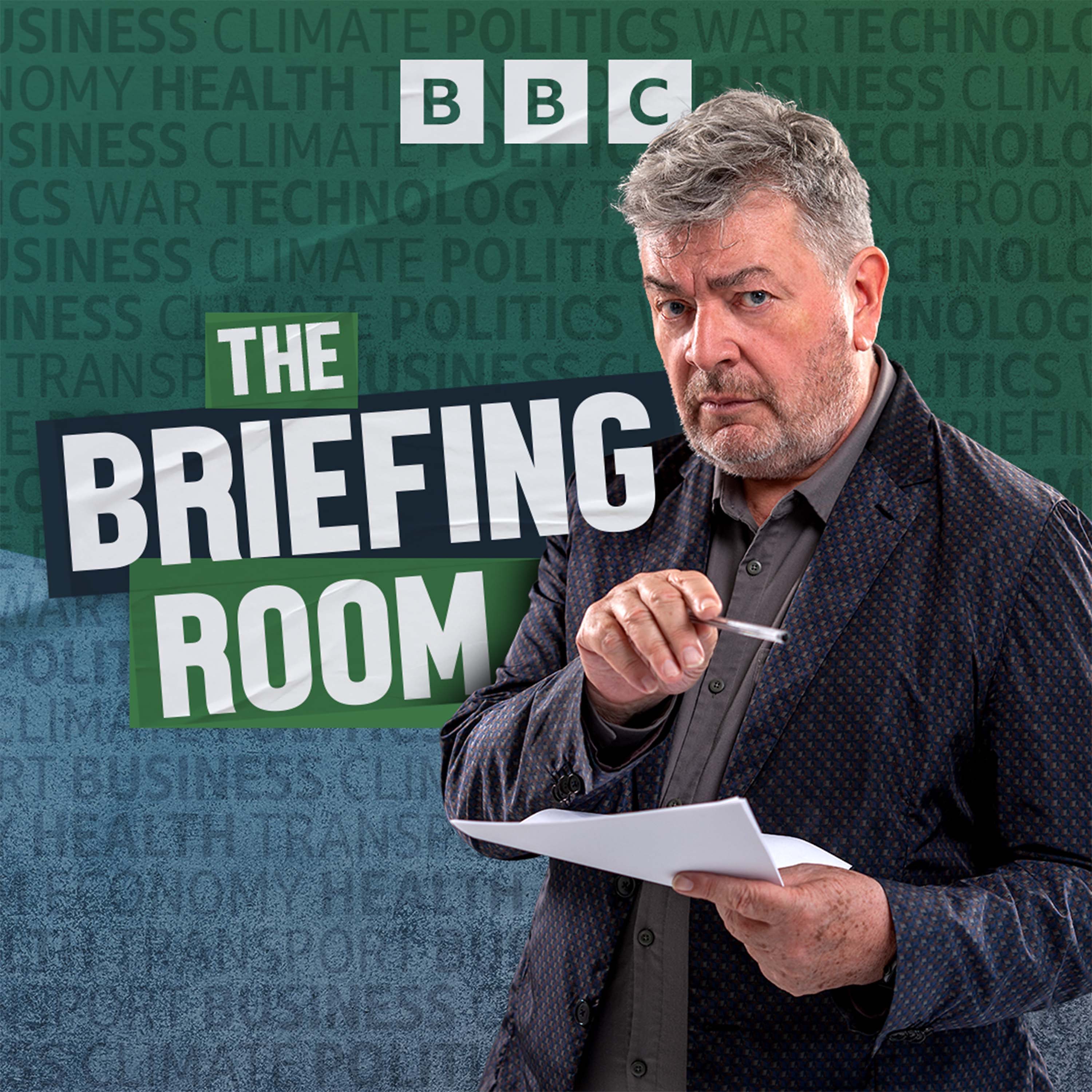
The Briefing Room
BBC Radio 4
David Aaronovitch and a panel of experts and insiders present in-depth explainers on big issues in the news
Episodes
Mentioned books

Feb 4, 2021 • 29min
GameStop Shock
There was pandemonium on the US stock market when shares in a chain of video game shops went through the roof. At one point GameStop’s stock, which averaged just seven dollars last year, was valued at more than 480 dollars. The frenzy was fuelled by cheerleaders on Reddit. Investors were being encouraged to buy the stock even as it became clear that they would probably lose most of their investment. There was a mood of rebellion online and clear hostility to millionaire hedge fund managers. Then one of the platforms that offered small investors free access to the market said it would temporarily no longer allow new purchases of GameStop stock. This prompted furious claims of unfairness; accusations that Wall Street had shut out the little guy; that there was one rule for the big investor and another for the amateur. So what did actually happen? Was this truly a battle between the Davids and the Goliaths of the financial world? What will happen next? And why does it matter?Contributors:Elizabeth Lopatto, The VergeSebastian Mallaby, The Council on Foreign Relations and Washington PostPhilip Coggan, The EconomistSusannah Streeter, Hargreaves LansdownProducers: Tim Mansel, Sally Abrahams, Kirsteen Knight
Editor: Jasper Corbett
Jan 28, 2021 • 29min
The Irish Question
This year marks 100 years since the creation of Northern Ireland, in May 1921. But in the light of Brexit, which has left Northern Ireland inside the EU’s single market and customs union, creating, in effect, a border in the Irish Sea, conversations about the possibility of Irish reunification are getting louder. One opinion poll suggested there is now a slender majority in Northern Ireland in favour of holding what’s known as a “border poll”, a referendum on the reunification of Ireland, within five years. So has Brexit made reunification any more likely? With Margaret O’Callaghan of Queen’s University, Belfast; Alan Renwick of University College London; Sam McBride of The News Letter; and Etain Tannam of Trinity College, Dublin.Presenter: David Aaronovitch
Editor: Jasper Corbett
Producers: Tim Mansel, Sally Abrahams, Kirsteen Knight
Jan 21, 2021 • 29min
Putin vs Navalny
Millions of people have been watching a film in the past two days that was released by Alexei Navalny, Russia's leading opposition figure, even as he languished in a Moscow jail. The film, presented by Navalny, accuses the Russian president, Vladimir Putin, of embezzlement on the grandest of scales. Mr. Putin is said to be furious. Last year there was an attempt on Mr. Navalny’s life using the nerve agent, novichok. Fingers were pointed at the Kremlin, which has denied any involvement. Navalny went to Germany for hospital treatment and convalescence. He returned to Russia on Sunday and was arrested on arrival in Moscow. Navalny seems likely to find himself behind bars for several years, but he’s called on his supporters to take to the streets. The Kremlin’s reaction to his return indicates its nervousness. There are parliamentary elections later this year. So what has Vladimir Putin to fear from Alexei Navalny?
With: Arkady Ostrovsky, Russia Editor at The Economist; Steve Rosenberg, BBC Moscow Correspondent; Catherine Belton, author of the book, Putin’s People; and Nikolai Petrov, Senior Research Fellow at Chatham House.Producers: Tim Mansel, Sally Abrahams, Kirsteen Knight
Editor: Jasper Corbett
Jan 14, 2021 • 30min
Covid and the NHS
More than 80 thousand people in the UK have now died with Covid-19; there are currently more than three million confirmed cases across the country and in the worst affected areas one person in 20 is infected. Even with the whole of the UK now in some form of lockdown, there are more than 35,000 people in hospital with the virus. That is around 50 per cent more than at the peak of the epidemic in the UK last spring. As hospitals reprioritise to deal with Covid cases, patients with other conditions are bearing the brunt, with one London hospital trust announcing it was cancelling some cancer operations. So how is the NHS coping with the Covid crisis?Contributors: Jennifer Dixon of the Health FoundationNigel Edwards of the Nuffield TrustSiva Anandaciva of the King’s FundDavid Salisbury, the former head of immunisation at the Department of Health.Producers: Tim Mansel, Sally Abrahams, Kirsteen Knight, May Cameron
Editor: Jasper Corbett
Jan 7, 2021 • 29min
America: what just happened?
The past day has been an extraordinary one in the history of modern America. Firstly, the Democrats secured a majority in both houses of Congress. Secondly, Congress certified Joe Biden’s election victory - although many Republicans challenged the votes of some states. Thirdly, while the political debates were underway, pro-Trump supporters stormed the Capitol and four people died. David Aaronovitch is joined by an expert panel of guests to examine what just happened and what does this mean for the United States, its institutions and its politics.Producers: Tim Mansel, Kirsteen Knight and May Cameron
Editor: Jasper Corbett
Dec 31, 2020 • 29min
Facebook's Monopoly Problem
US federal regulators and dozens of state prosecutors are suing Facebook accusing it of illegal actions in buying up rivals and stifling competition. It's one of the biggest antitrusts in US history and is one of several cases being taken against big tech companies. David Aaronovitch explores the case against Facebook and the evolution of antitrust law in the US. What is the basis on which these companies are being held to account, and is this law an outdated tool in confronting tech titans? GUESTS:
Gilad Edelman - Political writer at Wired magazine
Scott Hemphill - Professor of Law at the University of New York
Lina Khan - Associate Professor at Columbia Law School
Ariel Ezrachi - Professor of Law at the University of OxfordProducers: Serena Tarling, Viv Jones
Editor: Jasper Corbett
Dec 17, 2020 • 29min
The Climate Crisis: Are We Moving Fast Enough?
While the world’s attention has been distracted by Covid, the climate crisis has continued to pose an existential threat. But there have been significant developments this year, not least the announcement by China that it has set 2060 as the year when it will become carbon neutral. Joe Biden was elected president of the United States with promises to set a carbon neutral target of his own and to spend trillions of dollars on new green jobs and new green infrastructure. The EU, Japan and South Korea have all designated 2050 as the year they will reach net zero emissions. Meanwhile the world continues to get hotter. So is this all too little, too late? Hopefully not, especially, as we’ll hear, given the way that industry and finance are now reorganising.Contributors: Professor Mark Maslin of University College LondonByford Tsang of the climate change think tank E3GPete Ogden, who worked on climate change in the Obama White House and is now at the United Nations FoundationDr Gabrielle Walker, a writer and consultant to private industry on climate change adaptation.Producers: Tim Mansel, Sally Abrahams, Kirsteen Knight
Editor: Jasper Corbett
Dec 10, 2020 • 29min
Living with the Taliban
The war in Afghanistan has just entered its twentieth year. It has come at an enormous cost, most notably to Afghan civilians, but also to Britain. Nearly 500 British military personnel have lost their lives there since 2001. But now, for the first time the Taliban and the elected Afghan government are involved in direct peace negotiations. The talks in Doha, which have been going on since September, follow an agreement reached earlier this year between the US government and the Taliban. Under that agreement the US promised to withdraw its remaining troops within 14 months and the Taliban said it would cut all ties with terrorist groups, including Al Qaeda. The Taliban’s place at the negotiating table reflects its strength on the ground in Afghanistan as a fighting force; and it implies that it the way is open for a return to government in Kabul. But, given memories of public executions, the exclusion of women from public life, and the banning of music and kite flying, how acceptable will that be to the Afghan people? And how easy will it be for western governments to do business with the Taliban?David Aaronovitch is joined by:
Lyse Doucet, the BBC's Chief International Correspondent
Orzala Neemat, Director of the Afghan Research and Evaluation Unit,
Annie Pforzheimer, a former deputy Head of Mission at the US Embassy in Kabul.Producers: Tim Mansel, Kirsteen Knight, Sally Abrahams
Editor: Jasper Corbett
Dec 3, 2020 • 58min
Brexit: Is It Oven Ready?
With just weeks to go till the Brexit transition period ends, David Aaronovitch and The Briefing Room team explore Britain’s readiness for 2021. What will it mean for you? What have supermarkets, airlines, businesses, ports and the government done to get ready – and will it be enough?Producers: Serena Tarling, Kirsteen Knight, Sally Abrahams
Editor: Jasper Corbett
Nov 26, 2020 • 28min
How Broke is Britain?
Thanks to the pandemic, Britain’s borrowing is forecast to hit nearly £400bn this year, and the economy is expected to contract by more than 11 per cent. How can we afford this, and what can the government do to bring public spending under control?David Aaronovitch is joined by:Jagjit Chadha - Director of the National Institute of Economic and Social Research (NIESR)Nicholas Crafts - Professor of Economics and Economic History at the University of WarwickAdam Posen - President of the Peterson Institute for International Economics (PIIE)Gemma Tetlow - Chief Economist at the Institute for GovernmentAbigail Adams-Prassl - Associate Professor of Economics at the University of Oxford

