

Jack Roycroft-Sherry
Jack Roycroft-Sherry
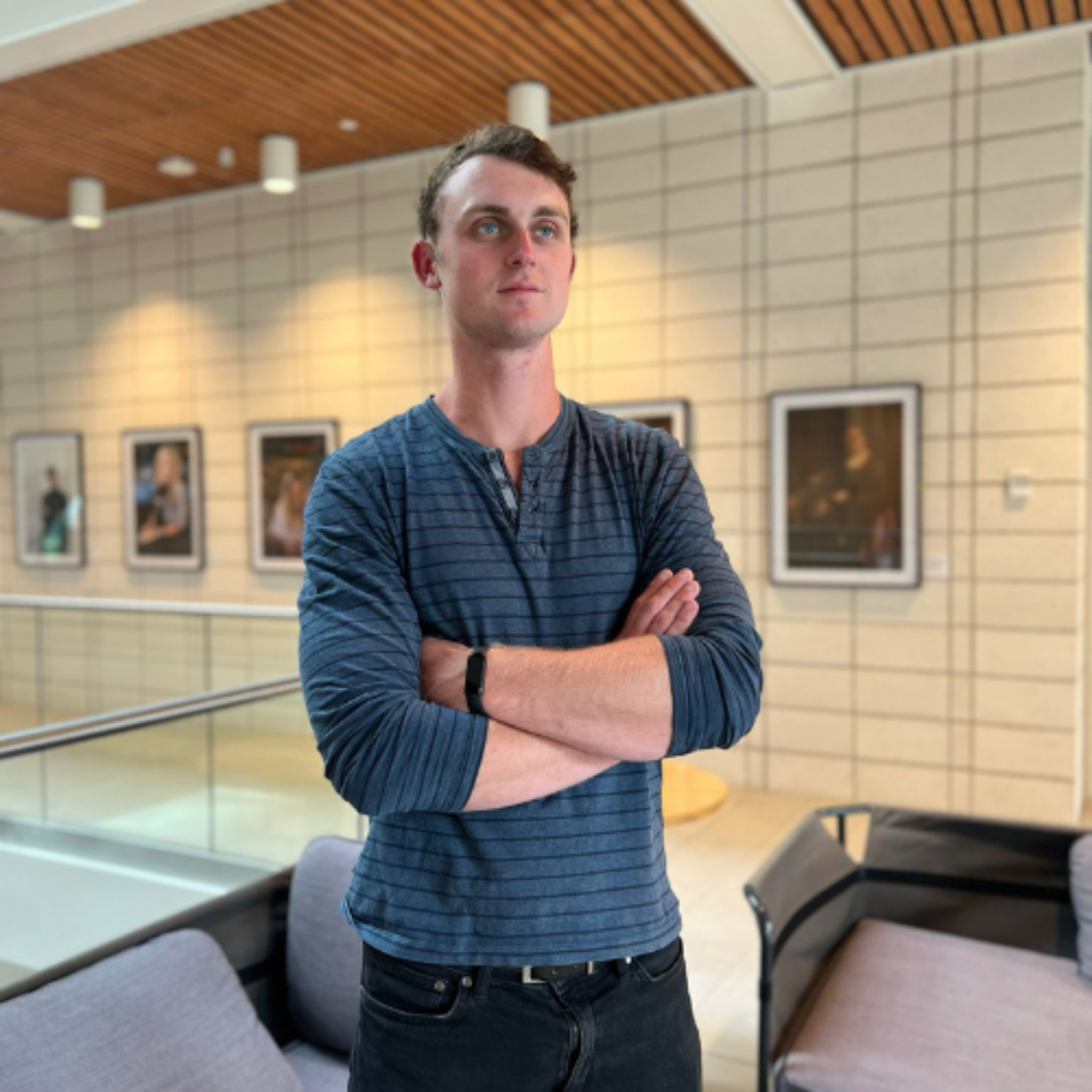
I'm Jack, an Economics and Data Science student in the beautiful town of Nottingham, England. Stick around if you like hearing from cognitive scientists, psychologists, economists and philosophers.
Episodes
Mentioned books

Aug 29, 2024 • 1h 3min
Biological AI, Mortal Computation, Anthrobots & AGI | Alexander Ororbia
Alexander Ororbia is a computer scientist and neuroscientist.
AI today is built upon silicon-based computers, but what would
artificial intelligence look like if it were based on biological
materials and principles?
In this podcast, expect to learn how biological intelligence differs
from silicon-based intelligence, the concept of "mortal computers"
(computers that die), how cognition extends beyond neurons, examples of
mortal computers such as anthrobots and xenobots, and more...
00:00 Biological vs Silicon; Mortal vs Immortal
05:06 Mortal Computers vs Standard Computers
09:52 The Importance of Death in Intelligence
18:23 Embodiment and Inactivism in Biological Intelligence
26:16 Limits of Current AI
36:35 Benefits of Mortal Computers Over Standard AI
39:50 Mortal Compter Examples: Anthrobots and Xenobots
45:50 How Good are ChatGPT and LLMs? Efficiency of Mortal Computers
50:50 Will LLMs Ever Get to AGI?
Find Alexander's work:
-Mortal Computation paper: https://arxiv.org/abs/2311.09589
-Survey on brain-inspired learning: https://arxiv.org/abs/2312.09257
-Review of neuroscience machine learning: https://arxiv.org/abs/2403.18929
-Survey on predictive coding / biomimetic learning: https://arxiv.org/abs/2308.07870
Aug 27, 2024 • 23min
Synesthesia: Smelling Sounds, Tasting Colours & Other Mixed Senses
Jamie Ward is a cognitive scientist and an expert on why people's brains
and cognition differ across individuals.
Roughly 3% of the world experiences synesthesia—the mixing of senses
where you might taste words, smell colors, and other such phenomena.
In this discussion, expect to learn about the range of experiences among
synesthetes, the types of people who have synesthesia, the relationship
between psychedelics and synesthesia, why people have synesthesia, and
much more.
Timestamps:
00:00 What is Synesthesia?
01:24 The Range of Experiences
03:01 Personality Traits and Abilities
05:19 Improved Memory Among Synesthetes
07:35 Differences in Pattern Recognition
12:05 Living With Synesthesia
14:29 Synesthesia and Psychedelics
18:49 Expectations, Perception, Cognition
Aug 17, 2024 • 1h 1min
Collective Intelligence, Mathematical Agency, Economics & Cognition | Benjamin Lyons
Benjamin Lyons works on issues of collective intelligence within
economics, biology & mathematics.
We typically think that agency can only be found in brains and organisms
like us. But what if we could find agency in something as fundamental
as mathematics? Or in something as large and distributed as an economy?
In this podcast expect to learn about how agency can be seen in
mathematics, about the hidden competencies within mathematics, whether
we should be suprised by level of intelligence found in biology, the
economy as a cognitive system, and more...
Timestamps:
00:00 - Even Mathematics Has Agency
02:16 - The Role of Choice in Mathematics
05:47 - Hidden Competencies in Mathematics
09:20 - Implications for Biological Systems
34:39 - The Economy as a Collective Intelligence System
44:49 - The Role of the Price System in Collective Intelligence
48:57 - Understanding Self-Interest in Economics
51:40 - The Function of Money in the Economy
55:54 - The Importance of Mainstream Economics
01:00:31 - Closing Remarks
Find Benjamin
-Website: https://benjaminflyons.com
-Agency in Mathematics talk: https://www.youtube.com/watch?v=1tT0pFAE36c&t=231s
-Talk with Michael Levin: https://youtu.be/0Oo4ng6dWrQ?si=4fuTiAQ9vDdH9D5X
Aug 17, 2024 • 1h 3min
Science Post-Replication Crisis, Meta-science, Fraud, Misreporting | Randy Ellis
Randy Ellis is a biologist and computational biologist.
It's been a few decades since cases of fraud in psychology began
science's "replication crisis". What has happened since then? What
problems remain? And what does the future hold?
In this podcast, expect to learn about fraud in science, the
misincentives in science that lead to too many positive results, why
replication has proven difficult in science, ways science's problems
could be fixed, and more...
Timestamps:
00:00 The Replication Crisis in Science
08:08 Why Are Replication Rates So Bad?
16:13 Fraud in Science
23:32 Confirmation Bias From Scientists Meta-Science and Improving Scientific Practices
27:54 Enhancing Credibility and Reproducibility in Science
43:30 Future of Science
47:14 Problems in Clinical Trials
53:04 Problems of Citation Metrics
Find Randy:
randalljellis.github.io
Aug 2, 2024 • 56min
Mind, Imagination, AI, Magic & Psychedelics | Juensung Kim ( EP 61)
Juensung Kim is a cognitive scientist.
Cultures have used magical practices for millennia. Are they real? Do
they work? What even is magic? This podcast explores the cognitive
underpinnings of magic, providing a scientific perspective on such
ancient wisdom.
In this podcast, expect to learn about the cognitive machinery that
allows for magic to work, how divination and fortune-telling could be
explained scientifically, the study of the mind and imagination, the
dangers of psychedelics and insight, and more.
Timestamps:
00:00 What Really is Magic?
09:04 Imagination vs Perception vs Reality
17:29 Intelligence of the Ancients (What counts as knowledge?)
21:27 Pattern Recognition and Fortune Telling
24:47 AI vs Human Intelligence
30:40 Mental Time Travel and Origins of Science and Magic
34:11 Understanding the World and Developing a Relationship
42:00 The Problem of Psychedelics
48:50 Awe and Vastness Experiences
Jul 24, 2024 • 50min
Origins of Civilization, Future of Money, & The Sacred | Zack Baker (#60)
Zack Baker is a writer and researcher who works with Center Studies.
Humans are unique: we have language, money, and culture. How did we get
here? And what might the future look like?
In this podcast, expect to learn about how civilization got off the
ground, a theory of how language could have emerged, why humans have a
unique ability to defer violence, the role of religion and the sacred,
the future of money and politics, and more...
Timestamps:
00:00 Center Studies' Radical Hypothesis on Human Nature
05:59 Humans' Unique Capacity for Shared Attention
10:18 The Emergence of Language
17:25 How Civilization Defers Violence Through Language
25:37 Religion, Liberalism, Planetary Governance
27:10 Long-Term Projects and Meaningful Human Teams
32:02 Jesus Christ and a Post-Sacrificial World
33:26 Inventing New Ways of Thinking and Speaking
38:02 Fiat Currency and the End of Money
44:31 Future of Currency and Civilization
Find Zack
-twitter: @zackabaker
Find Center Studies
-twitter: @centerstudy_
-website: https://centerstudycenter.xyz/
Jul 17, 2024 • 1h 10min
Paradigm Shifts, Human Experience, Panpsychism, Spirits & Psychedelics | Matthew Segall
Mathew Segall is a philosopher and writer of the popular blog
Footnotes2Plato.
Science must always make philosophical and metaphysical assumptions.
What are these? What really is science, how does it compare to philsophy
and religion, and how might it radically change in the future?
Expect to learn about how radical science becomes philosophical, how
religion cannot be separated from science, how Whitehead's process
philosophy could help science's mind-body problem, the role of
psychedelics and mystical states in gaining scientific insights, and
more.
Timestamps:
00:00 Science vs Philosophy
09:25 Why Science Can't Ignore Human Experience
14:08 Science vs Religion
21:32 Metaphysical and Theological Dimensions of Economics
34:11 Egregores and Spirits
40:25 Whitehead's Process Philosophy
46:45 Panpsychism and Mind in Science
53:30 How Michael Levin Changed His Views on Agency
59:19The Potential Impact of Psychedelics on Science and Philosophy
Find Matthew:
-X: @ThouArtThat
-Substack: https://footnotes2plato.substack.com/
-Blog: https://footnotes2plato.com/
Jul 4, 2024 • 1h 14min
Egregores, Consciousness, Jung, AI & Spiritual Entities | Kenneth Michael Florence (#58)
Kenneth Michael Florence is a writer, artist, and musician.
An egregore is the concept in Western esotericism of a non-physical
entity or thoughtform that arises from the collective thoughts and
emotions of a group of individuals. Is the concept useful for describing
collective entities like economies, corporations and nations in today's
world? Are collective entities reducible to the psychic, or is there
more to them?
In this podcast expect to learn about whether collective beings are
conscious, the relationship between personhood and souls, Carl Jung's
collective unconscious in relation to spiritual realities, how Rudolf
Steiner's four domains of reality help us understand egregores,
understanding AI in spiritual terms, and more...
00:00 Kenneth's Article on Egregores
07:13 Are Collective Entities Conscious?
12:44 Personhood and Identity
21:13 Carl Jung's Higher Self and Psychic Realities
28:25 Psyche vs. Spirit (Can Spirits Be Reduced to Psyche?)
38:54 Rudolf Steiner's Four Domains of Reality
47:35 Egregores as Headless Beings
01:00:20 Spiritual Realities Non-Reducible to the Material
01:05:18 AI as an Astral Entity Susceptible to Spirits
Find Kenneth
Egregores article: https://thesymbolicworld.com/content/the-symbolic-world-vs-egregores-part-1
Website: https://www.kennethmichaelflorence.com/bio
Substack: https://kennethmichaelflorence.substack.com/
Jun 26, 2024 • 54min
Hybrid Organisms, Cyborgs, Chimeras & AI | Wesley Clawson (#57)
Wesley Clawson is a neuroscientist working with Michael Levin at Tufts
University.
What happens when you merge two organisms together? What happens when
you merge organisms with AI? This podcast explores the growing field of
synthetic and artificial biology—biology that doesn't exist naturally.
Expect to learn about the future of human-technology hybrids, the
implications of artificial biology for medicine, the goal-directedness
of biology, the limits of biological intelligence, evolution, and
more...
Timestamps:
00:00 Endless Forms Most Beautiful Paper with Dr. Levin
05:28 Fusion of Biology and Technology
10:02 Biology Merged with AI
13:42 How Synthetic Organisms Change Our Understanding of Biology
25:00 Trying to Understand Natural Selection in Light of Synthetic Organisms
28:16 Natural Selection & Collective Intelligences
33:19 The Benefits and Dangers of Synthetic Organisms
43:35 Technology and Cyborgs
48:08 Future of Human-Technology Fusions
Find Wesley:
X: @wesleyclawson6891
Website: https://www.wesleyclawson.com/
Papers Mentioned:
-Endless Formles Most Beautiful: https://academic.oup.com/biolinnean/article/139/4/457/6643577?login=false
-Technological Approach to Mind Everywhere: https://www.frontiersin.org/articles/10.3389/fnsys.2022.768201/full

Jun 19, 2024 • 56min
Cognitive Economics, Consciousness, Extended Minds - Patrick Schotanus (EP 56)
Patrick Schotanus is an academic developing his Market Mind Hypothesis, a
theory that uses cognitive science and philosophy to understand the
market as a form of collective consciousness.
We often hear the term "the mind of the market" to describe the wild
emotions, fears, and animal spirits driving market behavior. Is this
just a metaphor? Or is there a deeper truth in understanding economics
as a kind of mind?
Expect to learn about consciousness in the economy, how cognitive
science can be applied to economics, the importance of creativity and
discovery in economics, the nature of consciousness in collective
entities, and more...
Timestamps:
00:00 The Market Mind Hypothesis
06:19 The Role of Consciousness in Economics
12:38 Mind-Body Problem in Economics
17:37 Why We Must Have Economics Education From a Young Age
20:52 What Does the Market Being Conscious Mean?
28:12 The Market as a Distributed Cognitive System
33:36 The Influence of Money on Perception and Values
40:06 The Importance of Free Markets and Transparency
42:23 Does the Economy Change Who We Are?
52:03 The Future of the Market Mind Hypothesis
Patrick and the Market-Mind Hypothesis:
-Youtube: @marketmindhypothesis7363
-Website: marketmind.org

