

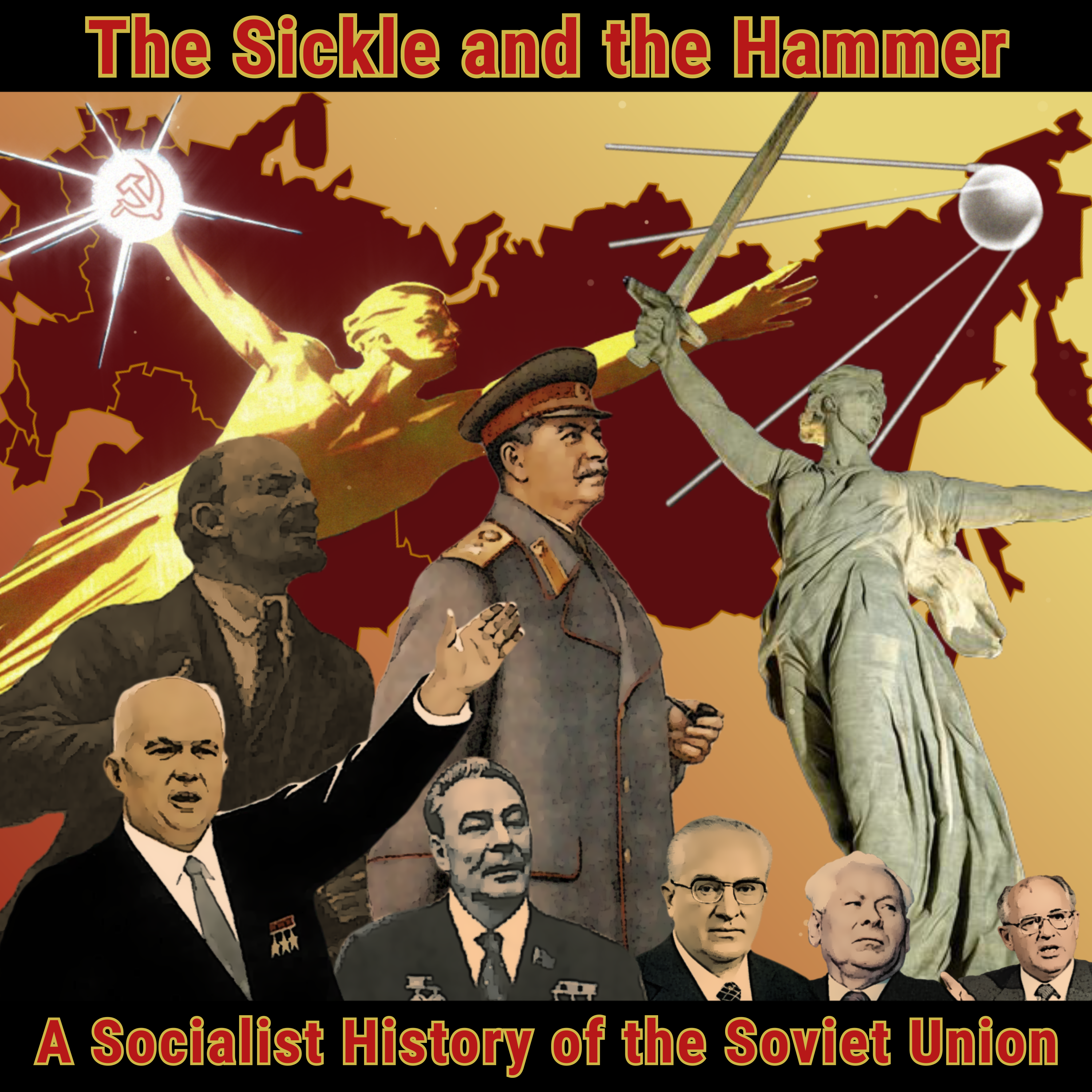
The Sickle and the Hammer: A Socialist History of the Soviet Union
Daniel
We are often told the USSR was an oppressive, authoritarian society, lacking freedom and democracy. There were endless purges that claimed the lives of millions of “dissidents,” purges that were designed for one thing and one thing only: to keep power in the hands of those who wielded it.And as we all know, the economy was based on socialist and communist principles, which is why it barely functioned at all. There were endless famines, genocides against minorities within the nation, and an industrial base that was constantly tottering on the edge of collapse.But instead of trying to address these issues at home, the leaders of the USSR were fixated only on world domination, on spreading communism in order to destroy freedom around the world. From Europe and Asia to Latin America and Africa, the Communists were a threat to freedom the world over.…. Or were they?Learn the story of the Union of Soviet Socialists Republic you’ve never heard! What was life really like in the Soviet Union? How authoritarian was it? Did a “totalitarian” state really exist? How did the economy function to meet the needs of its citizens? How were the governing apparatus structured? And were the Soviets hell-bent on world domination…. Or world liberation? Or neither?Subscribe to find out!Please consider supporting me on Patreon at patreon.com/sovietpodYouTube: @TheSickleandtheHammerBlueSky: @sovietpod.bsky.socialThumbnail from Toni Strauß. Find them at:https://www.youtube.com/@1framedhttps://pin.it/5Al9BA2jo
Episodes
Mentioned books

Sep 6, 2026 • 52min
29 - Setting the Stage II - Civil War Edition!
Forget Marvel. This is the Socialist Cinematic Universe!Please consider supporting me at patreon.com/sovietpod, or buymeacoffee.com/sovietpod.Sources:Veller, M. I. and Burovsky, A. M. Grazhdanskay Istoria Bezumnoi Voiny. Izdatelstvo ACT, Moskva, 2007.Istoria Grazhdanskoi Voiny v SSSR, vol. 3. Institute of Marxism-Leninism of the Central Bureau of the KPSS. Published by the State Publisher of Political Literature, Mosvka, 1958. PDF downloaded from leninism.su.

Jul 6, 2026 • 1h 10min
28 - Economy? What Economy?
“In order for economic development to take place, one must first have an economy.” - Karl Vladimir Stalin, 2026Please consider supporting me on Patreon at patreon.com/sovietpod or buymeacoffee.com/sovietpod.Sources:Carr, E. H. The Bolsheviks Revolution: 1917-1923, vol. 2. Pelican Books, 1966Nove, Alec. An Economic History of the Soviet Union: 1917-1991. Penguin Books, 1992.Dobb, Maurice. Soviet Economic Development since 1917. Routledge and Kegan Paul, 1948.Cliff, Tony. Revolution Besieged: Lenin 1917-1923. 1976, republished by Haymarket Books, 2004.“The Soviet Union: Facts, Descriptions, Statistics.” Soviet Union Information Bureau, Washington, DC. 1929. Found on marxist.org

Jun 7, 2026 • 4min
27.a - The Declaration of the Rights of the Peoples of Russia
Source: https://www.hist.msu.ru/ER/Etext/DEKRET/peoples.htm

Jun 7, 2026 • 58min
27 - Introduction to the National Question
What attitude ought socialists and communists have to the question of national self-determination? Survey says: Ask Lenin and Stalin!Please consider supporting me on Patreon at patreon.com/sovietpod or buymeacoffee.com/sovietpod.Sources:Natsional’ny Vopros v Nashei Programme - V. I. Lenin, published in “Iskra” 15 July 1903Kriticheskie zametki o natsional’nom voproce - V. I. Lenin, published in “Prosveshchenie”, November-December 1913Rabochii klass i natsional’ny vopros - V. I. Lenin, published in “Pravda” 10 May 1913Nuzhen li obyazatelny yazyk? - V. I. Lenin, published in “Proletarskaya Pravda” 18 January 1914O Prave Natsii Na Samoopredelenie - V. I. Lenin, 1914O Natsional’noi Gordosti Velikorossov - V. I. Lenin, published in “Sotsial-Demokrat”, 12 December 1914Revoliutsionny Proletariat i Pravo Natsii na Samoopredelenie - V. I. Lenin, 16 October 1915Marksizm i Natsional’ny Vopros, J. V. Stalin, 1906.Texts found on leninism.su and marxist.org

Apr 27, 2026 • 40min
26 - Epilogue to Brest-Litovsk
The narrative is over. Now comes the fun part: analysis!Please consider supporting me on Patreon at patreon.com/sovietpod or buymeacoffee.com/sovietpod.

Apr 20, 2026 • 4min
25.a - The Socialist Fatherland Is In Danger!
Source: https://www.hist.msu.ru/ER/Etext/DEKRET/opasnost.htmPlease consider supporting me on Patreon: patreon.com/sovietpod, or buymeacoffee.com/sovietpod

Apr 20, 2026 • 1h 3min
25 - An Unacceptable Peace, Ratified
The saga of ending Soviet Russia’s participation in World War 1 comes to an end.Please consider supporting me on Patreon at patreon.com/sovietpod or buymeacoffee.com/sovietpod.Sources:Rabinowitch, Alexander. The Bolsheviks in Power: The First Year of Soviet Rule in Petrograd. Indiana University Press, 2007.Gluckstein, Donny. The Tragedy of Bukharin. Pluto Press, 1994.“Sedmoi S’ezd RKP(b).” Bolshaya Sovietskaya Entsiklopedia, 3rd edition. Accessed via booksite.ru“Brestskii Mir.” Bolshaya Sovietskaya Entsiklopedia, 3rd edition. Accessed via booksite.ru“Chresvychainy Chetvyorty Vserossiiskii S’ezd Sovietov.” Bolshaya Sovietskaya Entsiklopedia, 3rd edition. Accessed via booksite.ru

Mar 28, 2026 • 21min
24.a - Theses on the Question of the Immediate Conclusion of a Separate and Annexationist Peace
Source: https://uaio.ru/vil/35.htm

Mar 28, 2026 • 57min
24 - An Unacceptable Peace, Accepted
To fight or not to fight… that is the question!Please consider supporting me on Patreon at patreon.com/sovietpod or buymeacoffee.com/sovietpod.Sources:Rabinowitch, Alexander. The Bolsheviks In Power: The First Year of Soviet Rule in Petrograd. Indiana University Press, 2007.Gluckstein, Donny. The Tragedy of Bukharin. Pluto Press, 1994.Cliff, Tony. Revolution Besieged: Lenin 1917-1924. Republished by Haymarket Books, 2012.Veller, M. and Burovskii, A. Grazhdanskaya Istoria Bezumnoi Voiny. Izdatelstvo ACT Moskva, 2007.

Mar 5, 2026 • 48min
23 - Prologue to Brest-Litovsk
It’s that episode on the international aspects of the Russian Revolution you’ve been waiting for!Please consider supporting me on Patreon at patreon.com/sovietpod or buymeacoffee.com/sovietpod.Source:Rabinowitch, Alexander. The Bolsheviks In Power: The First Year of Soviet Rule in Petrograd. Indiana University Press, 2007.

