

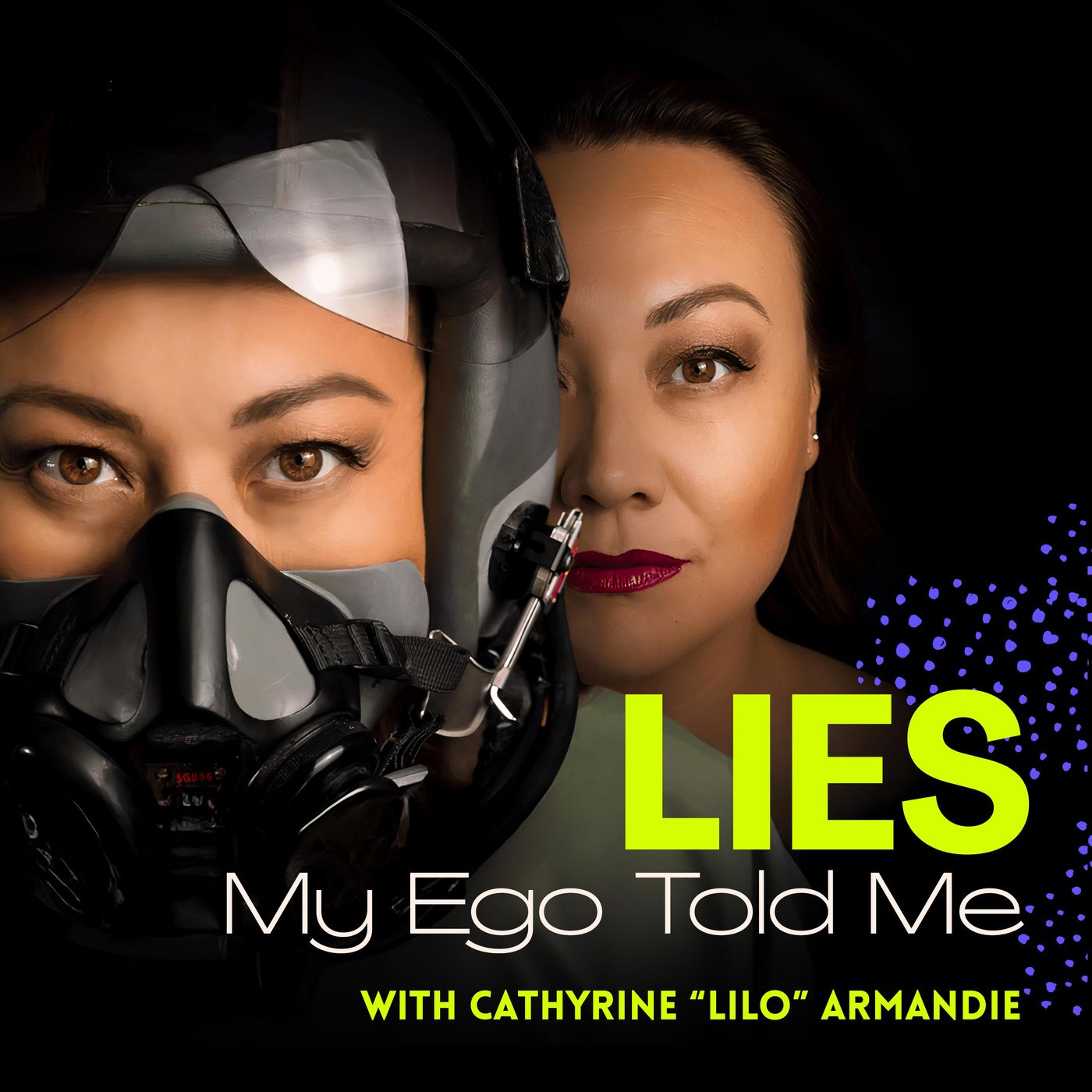
Lies My Ego Told Me
Cathyrine "Lilo" Armandie
Lies My Ego Told Me is a bold and deeply human podcast about mental health hosted by Cathyrine “Lilo” Armandie—a military veteran, leader, and mother who knows firsthand how the ego can be both a fierce protector and a persistent saboteur.In each episode, Lilo sits down with guests from all walks of life to explore the pivotal moments when ego-driven stories began to unravel—and the deeper truths that emerged in their place. With raw honesty, vulnerability, and occasional humor, these conversations dive into the personal lies we tell ourselves to feel safe, strong, or worthy—and the courage it takes to outgrow them. If you’re on a journey of self-discovery, healing, or personal growth, this podcast will inspire you to challenge your own narrative and reclaim your truth.
Episodes
Mentioned books

Jan 20, 2026 • 1h 7min
Ep. 17: I can Carry the Weight, with Theresa Claiborne
Season two of Lies My Ego Told Me takes off with aviation trailblazer Theresa “TC” Claiborne, the first Black woman to graduate from U.S. Air Force pilot training. She shares the lie that shaped her life: “I can carry the weight.” From being deliberately minimized at a historic milestone to proving herself again and again in the cockpit and beyond, Theresa opens up about invisibility, the quiet pressure of being “the first,” and why she now sees that weight as both burden and gift.In this episode:Who is Theresa “TC” Claiborne?Theresa “TC” Claiborne is an aviation pioneer who became the first Black woman to graduate from U.S. Air Force pilot training. She later flew for United Airlines for more than 34 years, retiring in May 2024 as a Boeing 787 Captain.What is Theresa Claiborne known for?She is known for breaking barriers in military aviation, serving as a KC-135 pilot in the Air Force and Reserves, and becoming a long-tenured United Airlines captain while advocating for representation, mentorship, and equity in aviation.Why wasn’t Theresa Claiborne’s graduation widely celebrated?Theresa describes how media interest was high, but decisions were made to limit coverage—minimizing her achievement despite its historic significance and impact.What advice does Theresa give to people carrying heavy responsibility?Theresa encourages people to keep moving forward, lean on community, and remember they don’t have to carry everything alone—while still honoring the reality that the burden is often placed unfairly.Resources & LinksShow: Lies My Ego Told MeEpisode page, resources, and links: liesmyego.comLeave a 5-star rating and written review on Apple Podcasts to support the show.For more resources: liesmyego.com
Dec 2, 2025 • 1h
Ep. 16: Never Leave Your Wingman Behind, with Nicole Malachowski
In the season finale of the now award-winning Lies My Ego Told Me, Lilo sits down with her longtime hero, Colonel (Ret.) Nicole “FiFi” Malachowski — the first woman to fly with the U.S. Air Force Thunderbirds. What begins as a story of breaking barriers in the F-15E Strike Eagle becomes a raw account of institutional betrayal, medical gaslighting, and the years Nicole spent fighting for an accurate diagnosis after tick-borne illness left her bedridden. This conversation explores how she turned that devastation into advocacy, becoming a powerful wingman for patients with chronic Lyme.More about this episode:Who is Nicole “FiFi” Malachowski?Nicole Malachowski is a retired U.S. Air Force Colonel, the first woman to fly with the Thunderbirds, a combat-proven F-15E Strike Eagle pilot, a former White House fellow, and a national advocate for tick-borne illness patients.What happened to Nicole after her tick bites?Nicole developed over 60 symptoms, experienced cognitive decline, paralysis, and periods resembling locked-in syndrome. Despite clear signs of Lyme disease, she was repeatedly dismissed by doctors and endured 24+ specialist visits before receiving a correct diagnosis.Why did Nicole feel abandoned by the Air Force and the medical system?Nicole was told her symptoms were psychosomatic, advised to “retire,” and left without support during two years bedridden. Her final years in uniform were marked by institutional gaslighting, a lack of follow-up, and a retirement handled without ceremony or acknowledgment.How did she turn her experience into advocacy?Nicole helped shape Air Force policy on complex medical conditions, became a keynote speaker, and co-authored a National Academies of Sciences report that officially recognizes Lyme infection–associated chronic illness.What can friends or colleagues do to support someone with chronic illness?Nicole emphasizes simple acts: consistent check-ins, listening without judgment, learning about the illness, helping the caregiver, and showing up without waiting to be asked.Resources & LinksNicoleMalachowski.com – Advocacy, speaking, and resourcesLivLymeFoundation.org – Tick-borne illness supportLymeDisease.org – Research, education, and patient toolsShow: Lies My Ego Told MeEpisode page, resources, and links: liesmyego.comLeave a 5-star rating and written review on Apple Podcasts to support the show.For more resources: liesmyego.com
Nov 18, 2025 • 1h 1min
Ep. 15: Fragility is Weakness, with Charlie Cannon
Lilo sits down with performance coach and resiliency strategist Charlie Cannon to unpack the lie that shaped his life: that fragility and sensitivity are weakness. From a traumatic car accident that nearly killed his sister to the hidden wounds of elite boarding school and abuse, Charlie shares how survivor guilt, partying, and a “survival mask” kept him running from his pain—until he chose to turn toward it. He explains his crumple zone approach to resilience, the healing power of movement and somatic work, and what it really means to live with authentic strength, vulnerability, and wholeness.More about this episode:Who is Charlie Cannon?Charlie Cannon is a performance coach, educator, and resiliency strategist who works with elite teams, executives, and high-performing individuals. He is known for his crumple zone philosophy, which teaches that resilience comes from flexibility, not rigid toughness. His story appears in the documentary Boarding on Insanity and in Joe Foster’s bestselling book How to Survive and Thrive.What happened during Charlie’s 1997 accident?On July 7, 1997 at 7:17 a.m., Charlie fell asleep at the wheel, causing a catastrophic car accident that left his sister in a coma. He walked away with minor injuries, which triggered deep survivor guilt, trauma, and emotional collapse. The accident eventually became the catalyst for his healing and purpose.How did boarding school trauma affect him?Charlie was sent to boarding school at age eight, where he experienced emotional abandonment, dissociation, and later revealed abuse, which led to the eventual imprisonment of two teachers. This environment taught him to hide vulnerability, disconnect from emotions, and build a “survival mask” based on self-reliance, approval-seeking, and emotional detachment.What is “privileged abandonment”?“Privileged abandonment” refers to children raised in elite institutions where material privilege exists but emotional safety, attunement, and consistent parental presence do not. Charlie explains how this dynamic affects attachment, emotional regulation, intimacy, and leadership.What is the “crumple zone” philosophy of resilience?Charlie teaches that resilience requires strength + flexibility. Just as a car’s crumple zone absorbs impact, humans need emotional softness, adaptability, psychological flexibility, and centeredness to withstand life’s disruptions. Rigid toughness breaks; flexible strength bends and rebuilds.What message does Charlie have for survivors still living in silence?You are not alone. Your story matters. There are people who will believe you and support you. Reclaiming your voice—one small step at a time—is an act of strength.Resources & LinksCharlie Cannon Coaching: charliecannon.comDocumentary: Boarding on Insanity (on privileged abandonment and boarding school trauma)Book: How to Survive and Thrive by Joe Foster, featuring Charlie’s storyChildHelp National Child Abuse HotlineShow: Lies My Ego Told MeEpisode page, resources, and links: liesmyego.comLeave a 5-star rating and written review on Apple Podcasts to support the show.For more resources: liesmyego.com
Nov 4, 2025 • 55min
Ep. 14: Quitting is Failing, with Kelly Poquiz-Burke
Host Lilo talks with Kelly Poquiz-Burke—executive coach, CEO of Career Slay, and former brand marketing executive for Doritos, Chick-fil-A, and Avocados From Mexico—about the lie her ego clung to for decades: “Quitting is failing.” From a breast cancer diagnosis while pregnant to stress hives, brain scans, and a three-year-old’s pleas—“Don’t leave us”—Kelly shares how she walked away from the corner office, redefined success, and learned that sometimes quitting is actually choosing yourself.About this episode:Who is Kelly Poquiz-Burke?Kelly Poquiz-Burke is an executive coach and CEO of Career Slay, and a former brand marketing executive who led multi-billion dollar portfolios at major brands. She’s also a breast cancer survivor, keynote speaker, and mom who helps high achievers become fearless leaders without burning out.Why did quitting her corporate job feel scarier than a cancer diagnosis?Cancer “happened” to her, but quitting was a choice. Leaving her high-status roles felt like letting go of her identity, income, and traditional markers of success. She feared it meant she “couldn’t cut it.” Over time, she realized quitting wasn’t failure—it was reclaiming her power and choosing an environment aligned with her valuesWhat is Career Slay and what does Kelly do now?Career Slay began as a podcast and evolved into a coaching and speaking business. Kelly now coaches high-achieving professionals and leaders to:Redefine success beyond titles and salaryNavigate big career pivots with courageBuild sustainable careers that honor their health, values, and familiesShe uses her corporate background and cancer journey to help others create careers that don’t require self-destruction.How does Kelly define success?Success is no longer about titles, awards, or massive brand budgets. For Kelly, success means:Freedom and flexibility in her workBeing a present parent and partnerDoing meaningful, purpose-driven work (coaching, speaking, podcasting)Living in alignment with her values instead of chasing external validationWhat’s the difference between quitting and giving up?Kelly draws a clear line:Giving up is resigning yourself to failure and hopelessness.Quitting is a conscious pivot away from harm—leaving environments, roles, or expectations that no longer align with your health, values, or purpose. Quitting can be an act of power, not of defeat.How can high achievers realign ambition, success, and well-being?Kelly uses a “compass” framework:North – North Star: Your long-term vision for life and workEast – Energy: What genuinely energizes and excites youSouth – Sense of Self: Your core values and priorities (health, family, freedom, creativity, etc.)West – Why: Your deeper purpose and impact on othersWhen your job, goals, and daily actions align with this compass, ambition becomes sustainable instead of destructive.Resources & LinksGuest: Kelly Poquiz-Burke – Executive Coach & CEO, Career SlayWebsite & Coaching: careerslay.comPodcast: Career Slay (search in your favorite podcast app)Show: Lies My Ego Told MeEpisode page, resources, and links: liesmyego.comLeave a 5-star rating and written review on Apple Podcasts to support the show.For more resources: liesmyego.com
4 snips
Oct 21, 2025 • 55min
Ep. 13: Success Should Speak for Itself, with Ellen Di Resta
Ellen Di Resta, an innovation strategist and founder of The Idea Builders Guild, challenges the myth that good work automatically leads to recognition. She reveals how intangible assets, such as design thinking and collaboration, are often overlooked in favor of measurable metrics. Ellen introduces her Four Pillars Framework, emphasizing the need to understand customer perceptions and interactions. She shares insights into why many R&D projects fail and offers advice for high performers who feel underrecognized, urging them to embrace new ways of showcasing their contributions.
Oct 7, 2025 • 1h 17min
Ep. 12: I Don’t Deserve to Dream This Big, with Shaesta Waiz
From an Afghan refugee camp to the skies above every continent, Shaesta Waiz shattered barriers as the youngest woman to fly solo around the world in a single-engine aircraft. But before she could take flight, she had to confront the lie that she didn’t deserve to dream big. In this powerful conversation, Lilo interviews Shaesta about breaking free from cultural constraints, the courage to redefine identity, and finding purpose in advocacy for women and girls left behind in Afghanistan. In this episode:Who is Shaesta Waiz?An Afghan-American pilot who, in 2017, became the youngest woman to circumnavigate the globe solo in a single-engine plane. She founded Dreams Soar to inspire and resource the next generation in aviation and STEM.What “ego lie” did she believe?“I don’t deserve to dream this big.” Growing up between Afghan traditions at home and American culture at school, she internalized limits about what a girl “should” do.What shaped that belief?A strict, traditional household, limited role models, language barriers, and community pressure not to “draw attention.” Her mother encouraged possibility; her father valued practicality—creating both support and constraint.How did she discover aviation?On a first solo commercial trip as a young adult, the takeoff moment “unlocked” possibility. The cockpit became a place free of judgment where only skill and focus mattered.What is Dreams Soar?A nonprofit she launched to pair her global flight with on-the-ground outreach for students—turning a record attempt into a purpose-driven mission.What was the Athens orphanage moment?Many kids—refugees—weren’t moved by aviation talk. She sat in a circle, listened, and met Sara, a Farsi-speaking Afghan girl newly separated from her mother. Speaking in Farsi, Shaesta explained what was happening and stayed until Sara felt safe—realizing her mission was about people first, inspiration second.Did she make it to Afghanistan?Yes—via commercial flight (insurance wouldn’t cover GA), coordinated with the UN. Hundreds of Afghan girls welcomed her. She also reunited with her father, who—proudly—helped translate and celebrate her journey.Resources & Ways To SupportBook: Fly Girl Fly: Shaesta Waiz Soars Around the World — proceeds support Dreams Soar scholarships.Dreams Soar: Learn, give, or partner to expand aviation access and STEM outreach. www.shaestawaiz.com Episode action: Share this episode with someone who needs permission to dream big; leave a review to amplify these stories.Subscribe to Lies My Ego Told Me wherever you get your podcasts, leave a review, and visit liesmyego.com for more resources. For more resources: liesmyego.com
Sep 23, 2025 • 53min
Ep. 11: I Know What I Want, with Dr. Graham Norris
Futurist and leadership expert Dr. Graham Norris joins host Lilo Armandie explore how to make better decisions under uncertainty. Learn practical ways to overcome perfectionism, overachievement, and feeling overwhelmed. Drawing on research, global experience, and his own pivots, Graham shows how imagination (not prediction) helps us navigate uncertainty, make better decisions, and design futures that actually fit who we are. If you’ve ever climbed a ladder only to wonder why it feels empty, this conversation will help you step forward with curiosity instead of fear. Q: Who is the guest?Dr. Graham Norris is an award-winning futurist, keynote speaker, and leadership expert. He’s advised leaders at Intel, Microsoft, and Adidas on how to think clearly about tomorrow.Q: What’s the “lie” explored in this episode?The belief that you must know exactly what you want—or predict every outcome—before you can move forward. Graham calls this the “lie of certainty.”Q: What topics are discussed?Why perfectionism, overachievement, and overwhelm keep high performers stuckHow to use imagination (not prediction) to navigate uncertaintyDecision-making traps: analysis paralysis, arrival fallacy, and too many choicesLessons from aviation, medicine, and psychology about learning from mistakesBalancing planning and flexibility when life or work goes off the railsAligning goals with personal values as they evolve over timeQ: What will listeners learn?You’ll learn practical tools to:Build “future confidence” instead of chasing impossible certaintyAsk what’s truly important to you and design steps toward itReplace fear of being wrong with curiosity, experimentation, and growthQ: Who should listen?Leaders, professionals, and anyone rethinking success or feeling stuck between options will benefit from Graham’s insights.Call to ActionSubscribe to Lies My Ego Told Me wherever you get your podcasts, leave a review, and visit liesmyego.com for more resources. Explore Graham’s newsletter, The DIY Futurist, at grahamnorris.me.For more resources: liesmyego.com
Sep 9, 2025 • 52min
Ep. 10: We Want the Best & the Brightest, with Col. Bree Fram
Space Force Guardian and rocket scientist Col. Bree Fram joins Lilo for a candid conversation about service, leadership, and the myth of meritocracy. Bree traces a 23-year career of deployments, command, and showing up authentically—then reckons with an executive policy shift that branded loyal service members as “problems,” sidelining talent in the name of politics. Together they unpack institutional betrayal, what real readiness requires, why vulnerability makes better leaders, and what’s at stake when a nation tells devoted people they no longer belong. Who is Bree Fram (she/her)?Bree Fram is an astronautical engineer, author, podcaster, speaker, and active-duty colonel in the United States Space Force. She is currently on administrative leave, pending separation due to Presidential policy regarding transgender people at the end of 2025. In her final assignment she was stationed at the Pentagon where she developed the requirements for future Space Force capabilities.Where can I learn more about Bree Fram?Find Bree Fram's books and Forged in Fire podcast at https://www.breefram.com/#/Are transgender troops a security concern?No. Decades of service and multiple studies show transgender service members meet the same standards of readiness, leadership, and deployability as any other troops. Courts and military data confirm there is no evidence of unique security risks. In fact, serving authentically often strengthens trust, cohesion, and performance within units.Where can I find more Lies My Ego Told Me podcast resources? liesmyego.comFor more resources: liesmyego.com
Aug 26, 2025 • 56min
Ep. 9: Neurodivergence: My Difference is My Defect, with Kathleen Perley
What if the very things you thought would hold you back were actually your greatest strengths? In this episode, linguist-turned-CEO Kathleen Perley shares how living with dyslexia, dysgraphia, and ADHD once convinced her she could never succeed. Instead, those differences became her superpower — fueling a multimillion-dollar business, a career in AI strategy, and a passion for redefining what intelligence really means. Her story is one of resilience, rebellion, and embracing the nonlinear path to success.Read Kathleen’s new book, AI Made Simple. Results Made Real.For more resources: liesmyego.comEpisode highlights:How did Kathleen turn learning challenges into career strengths?Kathleen leaned into nonlinear thinking, problem-solving, and pattern recognition. Her unconventional mind made her stand out in linguistics, technology, and AI. What once looked like chaos became her superpower in strategy and innovation.How should parents and teachers of neurodivergent kids handle the learning disabilities?Be careful with your words. Find and celebrate their strengths. Small wins build momentum. A single teacher’s encouragement can change a child’s trajectory.What advice does she give to neurodivergent professionals?Stop hiding, lean into your different lens, and know that perceived weaknesses can become your edge. Don’t waste energy perfecting skills you dislike; instead, amplify the work that sparks joy.About KathleenKathleen is a linguist-turned-entrepreneur and a recognized thought leader in artificial intelligence integration, dedicated to bridging the gap between AI and business leadership. As Faculty and AI Advisor to the Deans at Rice University’s Jones Graduate School of Business, she develops and teaches courses on AI strategy, generative AI applications, and AI implementation, equipping executives and students with the skills to navigate AI-driven transformation. In this role, she also advises university leadership on AI adoption, training faculty on emerging technologies, and shaping AI education across the business school. Beyond academia, Kathleen is the CEO and Founder of DemystifAI, an AI consulting and education firm that helps mid-sized businesses integrate AI to drive innovation, efficiency, and growth. She previously founded Decode, a digital agency that scaled to $17M in annual revenue and specialized in healthcare digital transformation before being acquired by private equity-backed Unlock Health. For more resources: liesmyego.com
Aug 12, 2025 • 56min
Ep. 8: I'm Not Qualified, with Ashley Peebles
Ashley Peebles spent years quietly believing she wasn’t good enough — that her background, education, and skills didn’t measure up. In this candid conversation, she shares with Lilo how that lie shaped her choices, from passing on opportunities to undervaluing her own achievements. Ashley takes us through the turning points that rewired her self-worth, from life as a military spouse to building a thriving business, losing it overnight, and rebuilding on her own terms. Her story is a masterclass in resilience, self-belief, and finally checking the box.Learn more at https://liesmyego.com/resources/For more resources: liesmyego.com

