

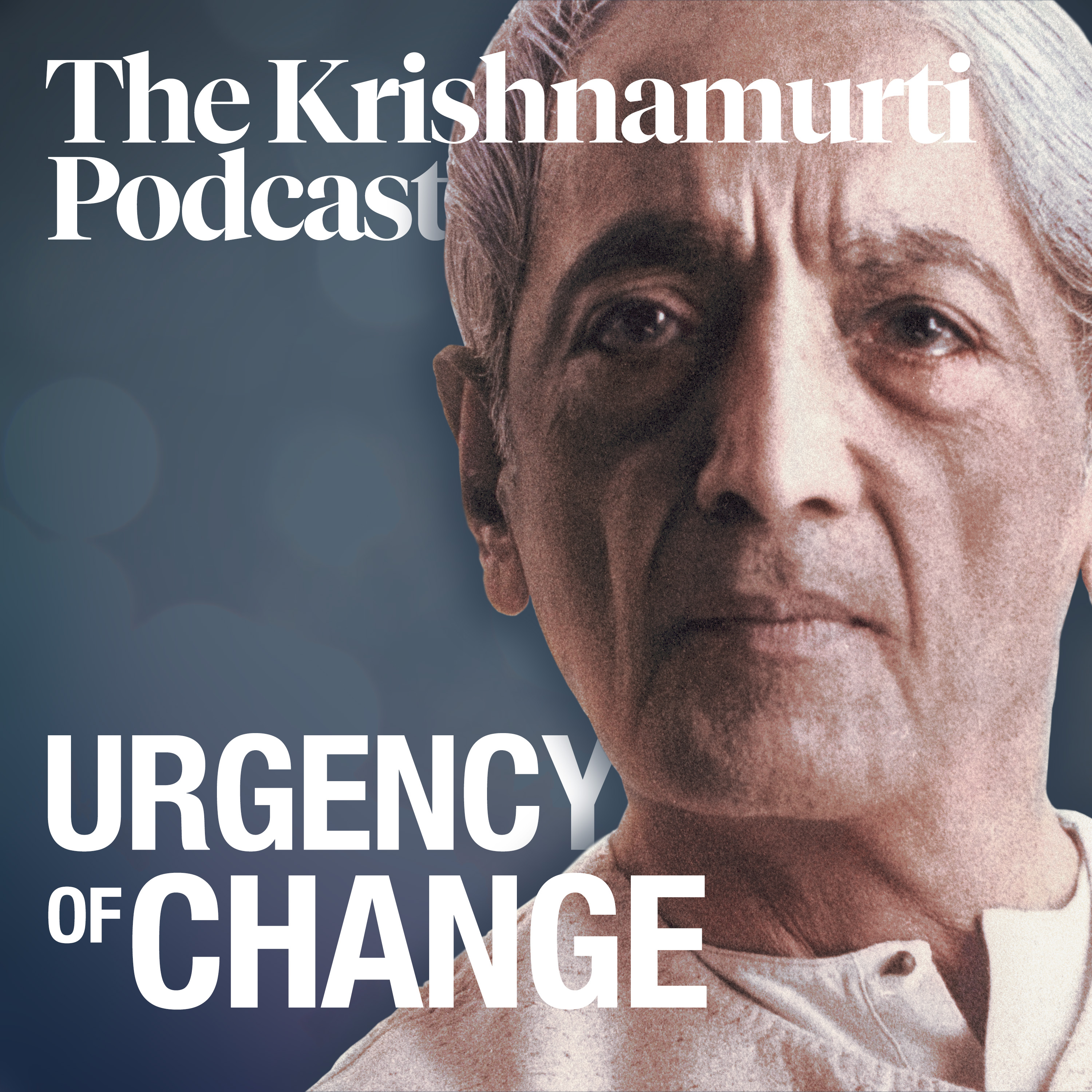
Urgency of Change • The Krishnamurti Podcast
Krishnamurti Foundation Trust
What are you doing with your life? Can anyone show you the way, or must you be a light to yourself? Do we see the urgency of change?
One of the greatest spiritual teachers and philosophers of all time, J. Krishnamurti challenges us to question all that we know and discover our true nature in the here and now.
This official podcast from Krishnamurti Foundation Trust now has over 250 episodes. Episodes 1-50 feature conversations between Krishnamurti and luminaries from many paths, along with readings of the classic book Commentaries on Living by actor Terence Stamp. Episode 51 onwards features carefully chosen extracts based on a theme explored by Krishnamurti. The extracts from our archives have been carefully selected to represent his different approaches to each of these universal and timelessly relevant themes.
Get in touch at podcast@kfoundation.org. Please consider leaving a review, which helps the visibility of the podcast.
One of the greatest spiritual teachers and philosophers of all time, J. Krishnamurti challenges us to question all that we know and discover our true nature in the here and now.
This official podcast from Krishnamurti Foundation Trust now has over 250 episodes. Episodes 1-50 feature conversations between Krishnamurti and luminaries from many paths, along with readings of the classic book Commentaries on Living by actor Terence Stamp. Episode 51 onwards features carefully chosen extracts based on a theme explored by Krishnamurti. The extracts from our archives have been carefully selected to represent his different approaches to each of these universal and timelessly relevant themes.
Get in touch at podcast@kfoundation.org. Please consider leaving a review, which helps the visibility of the podcast.
Episodes
Mentioned books

Dec 18, 2019 • 40min
Krishnamurti with Chogyam Trungpa Rinpoche
Chogyam Trungpa Rimpoche was a Buddhist meditation master and a major figure in the dissemination of Buddhism to the West. He founded more than one hundred meditation centres throughout the world, including Naropa University in Boulder, Colorado, where Pema Chodron, Allen Gingberg and Ken Wilber were among his many students. He wished to present the path of meditation in secular terms, developing a programme called Shambhala Training.
This conversation with Krishnamurti was recorded in San Diego, California in 1972. In it, the pair ask: what is the quality of the mind that is no longer held in the matrix of experience? What is meditation and why should one meditate? They inquire into seeing without the 'me', and the possibility of a total observation without time and memory.
Find us online at kfoundation.org and on social media as Krishnamurti Foundation Trust
Dec 11, 2019 • 27min
Interview by Oliver Hunkin
Oliver Hunkin was head of religious programmes at the BBC, where he revolutionised the format. He was also an author and cartoonist. In his memoirs he wrote: ‘We have to admit there is an air of antique unreality about organised religion. The majority of people do not see the point of it. Have we lost track of the fact that religion is a specific experience rather than a system of dogma?’ Indeed, he had a revelatory spiritual experience one evening whilst driving, later saying: ‘I felt totally at one with the landscape, and with myself, and with all creation. The memory of it has affected my attitude to life ever since’.
This interview with Krishnamurti was recorded at Brockwood Park in 1970. In the conversation, Krishnamurti states that authority has crippled the mind, religiously and inwardly. The authority of belief, imposed by religions, destroys the discovery of reality. One relies on authority because one is afraid to stand alone. To understand fear one must also understand pleasure, as they are two sides of the same coin. Are we seeing each other with an image? There is love only when I have understood myself and so in myself there is no fragmentation, anger, ambition or greed. Effort is a contradiction of energies. A meditative mind is a very silent mind.
Find us online at kfoundation.org and on social media as Krishnamurti Foundation Trust
Dec 4, 2019 • 31min
Krishnamurti with Mary Zimbalist (Part 2) – Fear
In her early working life, Mary Zimbalist was a model and actress. She first heard Krishnamurti speak in the 1940s and in the 1960s began helping Krishnamurti, becoming his assistant and friend. Her memoirs chronicling her time with Krishnamurti are online free of charge, and form the book In the Presence of Krishnamurti, which is available at our online bookstore.
This second conversation with Krishnamurti concerns the topic of fear. They ask whether, in the very act of looking at fear, we can discover its origin. Can we look at fear as we would an extraordinary jewel? Can we not look at a particular branch of fear but at the whole nature, structure and quality of fear?
Find us online at kfoundation.org and on social media as Krishnamurti Foundation Trust
Nov 27, 2019 • 31min
Krishnamurti with Mary Zimbalist (Part 1) – Conditioning
Mary Zimbalist was Krishnamurti’s assistant from the 1960s until his death in 1986. Her unfinished memoirs chronicling her time with Krishnamurti are online free of charge, and in the book In the Presence of Krishnamurti, which is available on our website kfoundation.org.
This conversation with Krishnamurti was recorded in 1984. Topics covered include: Can the brain be free from all the programming it has received? Is this possible through watching the very activity of thought? Watchfulness makes the brain extraordinarily acute, sharp and clear. This clarity is freedom.
Find us online at kfoundation.org and on social media as Krishnamurti Foundation Trust
Nov 20, 2019 • 1h 2min
Krishnamurti with Huston Smith
In a riveting discussion, spiritual teacher J. Krishnamurti and religious studies scholar Huston Smith interrogate the essence of authority and its impact on freedom. They explore living with clarity amidst chaos, emphasizing the need for self-reliance. With a deep dive into confronting fear, they argue for open observation rather than avoidance. The conversation also investigates the link between consciousness and personal transformation, urging listeners to embrace the present and redefine their understanding of love beyond possession.
9 snips
Nov 13, 2019 • 1h 2min
Krishnamurti with David Shainberg
Memory, thought and the illusion of continuity.
Shainberg trained at the American Institute for Psychoanalysis and worked in New York. He was a leading force behind the integration of eastern and western philosophies in the understanding of consciousness and experience. Shainberg was the first to bring psychoanalysts and eastern spiritual leaders together. He retired from practice in 1981 in order to devote more time to painting.
Recorded in New York in 1983, the conversation between Krishnamurti and Shainberg inquires into why illusion and thought have such power. What can a person do for another who is caught up in their illusions? Why do human beings give importance to their own self-centred activity? The very idea of protecting oneself brings about isolation. The ‘me’ is not something separate from memory. Memory is the only thing that continues, but represents something that is dead, finished. Our psyche is being programmed by ideologies, which have been put together by thought.
Find us online at kfoundation.org and on social media as Krishnamurti Foundation Trust
Nov 6, 2019 • 40min
Krishnamurti with Iris Murdoch (second conversation)
Second conversation with Iris Murdoch 2: What do we mean by conditioning?
Iris Murdoch was a Booker prize winning novelist and philosopher. Her many books include The Bell, The Black Prince, and The Sea, The Sea.
In this second conversation, Krishnamurti and Iris Murdoch look at why we are fragmented, how our way of thinking and acting is comparatively like the rest of mankind, and that we are the rest of humanity mankind because we all suffer. Krishnamurti states that when there is love, there is truth and beauty.
Find us online at kfoundation.org and on social media as Krishnamurti Foundation Trust
9 snips
Oct 30, 2019 • 1h 3min
Krishnamurti with Iris Murdoch (first conversation)
First conversation with Iris Murdoch: There is no love where there is self-interest.
Iris Murdoch was a well-known novelist and philosopher. Her books explore themes such as good and evil, morality, and the power of the unconscious. They emphasise the inner lives of individuals, in the tradition of Dostoyevski and Tolstoy, whilst her philosophical works reinterpret Aristotle and Plato.
In this first conversation, Krishnamurti and Iris Murdoch inquire into love, discovering that love is not desire or pleasure; love is not the opposite of hate; love has no relationship to jealousy; and that love can never bring conflict.
Find us online at kfoundation.org and on social media as Krishnamurti Foundation Trust
Oct 23, 2019 • 30min
Ross Saunders Interview
Krishnamurti Interviewed by Ross Saunders. This interview was recorded for the Australian television show ‘This Day Tonight’. The programme is half an hour long and was recorded in 1970.
Describing the interview in her diary, Mary Zimbalist, Krishnamurti’s assistant, said that Krishnamurti ‘demolished belief and religion then went on with such fresh clarity until the end of the half hour, covering a great deal with simplicity and eloquence.’
Questions explored include: Is it possible for a mind to be free from yesterday and from belief? How can an individual, who is part of the system, get outside the system in order to observe it and himself? Do the younger generation have a thirst for awareness and self-knowledge? You have been critical of religions. Could you tell me your own particular outlook on religion? What do you make of death? More than 40 years after you dissolved the Order of the Star, how would you summarise your aims?
Find us online at kfoundation.org and on social media as Krishnamurti Foundation Trust
18 snips
Oct 16, 2019 • 1h 10min
The Future of Humanity with David Bohm (Part 2)
The second and final part of The Future Of Humanity explores whether there is evolution of consciousness. Can the consciousness of mankind be changed through time? Is psychological conditioning centred in the self? Can our conditioned brain cells change? The pair then inquire into the relationship between the mind and the brain, suggesting that as long as the brain is conditioned, its relationship to the mind is limited. The then look at perception and intelligence.
David Bohm has been described as one of the most significant theoretical physicists of the 20th century and was a fellow of the royal society. He worked with Einstein at the Institute for Advanced Study, and on the Manhattan Project with Oppenheimer. Later he pioneered research into quantum physics and models of the brain, being increasingly interested in consciousness, order and thought. His books include Wholeness and the Implicate Order, Science, Order and Creativity, and Causation and Chance in Modern Physics.
Bohm’s contact with Krishnamurti began in the early 60s and continued into the 80s. Their dialogues are far-reaching and profound. Over 30 audios or videos are available on our YouTube channel at https://bit.ly/2EfqsCU, and are published in the books Truth and Actuality, The Transformation of Man, and The Ending of Time. Recorded in 1983, The Future of Humanity represents Bohm’s and Krishnamurti’s final dialogues together.
Find us online at kfoundation.org and on social media as Krishnamurti Foundation Trust

