

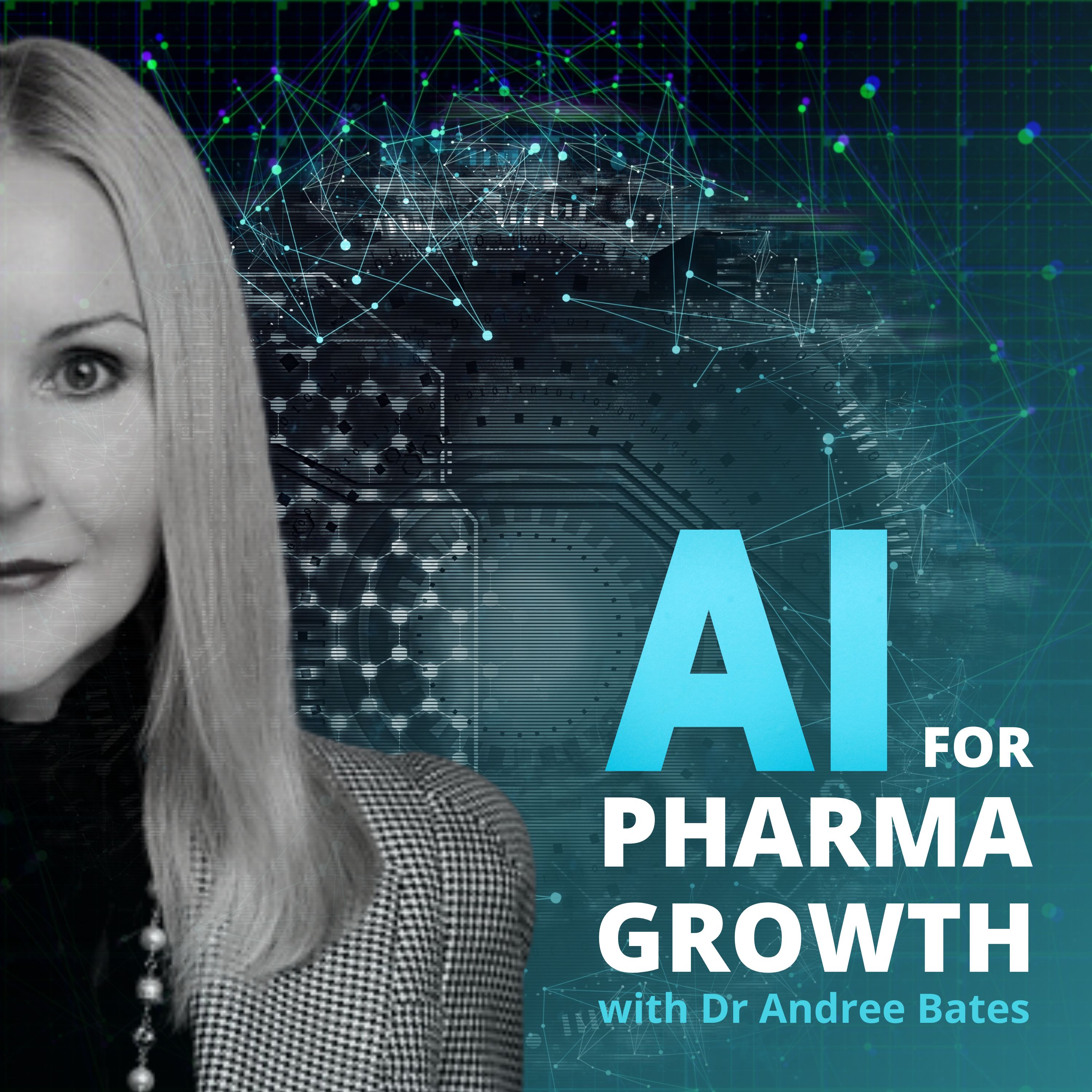
AI For Pharma Growth
Dr Andree Bates
AI For Pharma Growth is the podcast from pioneering Artificial Intelligence entrepreneur Dr. Andree Bates created to help Pharma, Biotech and other Healthcare companies understand how the use of AI-based technologies can easily save them time and grow their brands and company results.
This show blends deep experience in the sector with demystifying AI for biopharma execs from biotech start-ups right through to big pharma. In this podcast, Dr Andree will teach you the tried and true secrets to building results in a pharma company using AI and alert you to some fascinating new tools and applications to benefit you and your company.
As the author of many peer-reviewed journals in pharma AI, and having addressed over 500 industry conferences across the globe, Dr Andree Bates uses her obsession with all things AI, futuretech, healthcare and pharma to help you to navigate through the, sometimes confusing, but magical world of AI powered tools to achieve real-world results.
This podcast features many experts who have developed powerful AI-powered tools that are the secret behind some time-saving and supercharged revenue-generating business results. Those who share their stories and expertise show how AI can be applied to Discovery, R&D, clinical trials, market access, medical affairs, regulatory, market research, business insights, sales, marketing, including digital marketing, and so much more.
This show blends deep experience in the sector with demystifying AI for biopharma execs from biotech start-ups right through to big pharma. In this podcast, Dr Andree will teach you the tried and true secrets to building results in a pharma company using AI and alert you to some fascinating new tools and applications to benefit you and your company.
As the author of many peer-reviewed journals in pharma AI, and having addressed over 500 industry conferences across the globe, Dr Andree Bates uses her obsession with all things AI, futuretech, healthcare and pharma to help you to navigate through the, sometimes confusing, but magical world of AI powered tools to achieve real-world results.
This podcast features many experts who have developed powerful AI-powered tools that are the secret behind some time-saving and supercharged revenue-generating business results. Those who share their stories and expertise show how AI can be applied to Discovery, R&D, clinical trials, market access, medical affairs, regulatory, market research, business insights, sales, marketing, including digital marketing, and so much more.
Episodes
Mentioned books

Oct 13, 2026 • 35min
E239: How to Speed Up Drug Development Without Compromising Compliance
Clara Bernardes, co-founder and Chief Scientific Officer of Biorce, combines life sciences, law, and clinical operations expertise. She explores how AI can accelerate protocol design, reduce avoidable trial amendments, and learn from nearly one million annotated protocols. The conversation also examines explainability, ethics, regulatory compliance, human oversight, and what sponsors should ask AI vendors.

Oct 6, 2026 • 39min
E238: The diagnostic room: The Fifteen Failures Only Human Judgement Catches
Polished AI can hide serious risks in pharma: fabricated citations, distorted claims, dropped qualifiers, stale guidance, and planted instructions. Explore how automation bias and anchoring weaken review, why hallucination is only part of the problem, and practical ways to trace claims, test stability, challenge assumptions, and strengthen human oversight.

Sep 29, 2026 • 30min
E237: Beyond the Pill: How AI is Unlocking the Preventative Medicine Opportunity Pharma Can't Afford to Miss
Rebecca Maff, cancer biologist, health educator, and TEDx speaker known as the Healthy Biologist, explores how AI could move healthcare upstream. They discuss cancer risk prediction, early biomarkers, personalized screening, metabolic health, and behavior change. The conversation also examines pharma’s prevention opportunity, patient-data trust, responsible AI, and what GLP-1s reveal about a more proactive model of care.

Sep 22, 2026 • 34min
E236: Why 90% of Trials Still Fail — and What AI Can (and Can't) Fix
In this episode of AI For Pharma Growth, Dr Andree Bates speaks with Raviv Pryluk, co-founder and CEO of PhaseV, about why so many clinical trials still fail and where AI can genuinely improve the odds.Raviv argues that failure is often not because the drug itself is wrong. Trials can fail because of the wrong patient population, indication, dose, design, sites, monitoring or interpretation of the data. PhaseV uses causal machine learning, adaptive trial design and large-scale simulation to help sponsors make better decisions across those areas.The conversation explores why explainability and validation matter in clinical development. Raviv explains that a 95% prediction is not enough on its own. Sponsors and regulators need to understand why a recommendation is being made, which evidence supports it, and whether the result is statistically and clinically defensible.They also discuss using existing trial data to identify responder subgroups, stress-testing designs before patients are enrolled, adapting trials mid-flight and connecting protocol design more closely with clinical operations.Topics CoveredWhy clinical trials still failCausal ML versus predictive modellingPatient selection and responder subgroupsAdaptive trial designSimulating trials before enrolmentSite selection and recruitmentValidation, explainability and statistical guaranteesGo/no-go portfolio decisionsAbout EularisEularis builds AI capability inside pharma and biotech — over 20 years applying AI to real pharmaceutical problems, inside real pharmaceutical and biotech companies.Keynotes and live sessions — Working sessions for pharma teams where nobody leaves with notes. They leave with working prompts and real capability they've already run on their own work.The AI Enablement Institute — Strategy and a workshop get you started; neither stays current. Most pharma companies already have a generic AI course library. None of it is written for a regulatory writer, an MSL or a market access lead trying to get today's work done. Training is an event; enablement is capability that stays current. The Institute runs shared foundations for the regulated constraints, then tracks by business unit function, with new content monthly, live office hours with Dr Andree Bates, and per-person records a sponsor can show an auditor. One price per business unit, no per-seat charges.AI Strategic Blueprint and Governance — Board-ready strategy that links initiatives to commercial outcomes, with the sequencing, governance, capability and financial logic to survive scrutiny.AI Custom Builds for BioPharma — Design and build of the AI solutions that make strategic sense in your operating reality, tied back to the Blueprint.Start with the Institute → https://eularis.com/institute/Everything else → https://eularis.comAbout the PodcastAI For Pharma Growth is the podcast from Dr Andree Bates, helping pharma, biotech and healthcare organisations understand how AI-based technologies can save time, grow brands and improve company results. The show demystifies AI for biopharma leaders, from start-up biotech through to Big Pharma.Dr. Andree Bates LinkedIn | Facebook | X

Sep 15, 2026 • 31min
E235: AI created a trust crisis and nobody is talking about it
In this episode of AI For Pharma Growth, Dr Andree Bates speaks with Dan Pratl, founder and CEO of Quadron Inc, about a trust problem emerging as AI moves deeper into pharma: how do organisations preserve confidence when more work is generated, shaped and accelerated by machines?Dan argues that verified output alone is not enough. Pharma already has human review, MLR, regulatory sign-off and quality controls, but trust also depends on understanding where data came from, which models were used, where human judgement entered the process and whether that chain can be audited.The conversation explores why human expertise may become more valuable, not less, as AI spreads. Dan discusses shadow AI, the limits of forcing employees onto a single approved model, and why organisations need to reward people for curating, verifying and applying judgement across tools rather than treating AI usage itself as productivity.They also examine the risk of losing the junior work that traditionally builds expertise, the need for stronger audit trails, and why redesigning systems around AI may matter more than simply adding another governance dashboard.Topics CoveredAI and pharma's emerging trust problemWhy verified output is not the whole answerHuman judgement as a scarce resourceShadow AI and unsanctioned modelsAudit trails across humans, models and dataThe danger of equating token use with productivityBuilding future expertise in an AI-enabled workforceWhy trust requires incentives as well as governanceAbout EularisEularis builds AI capability inside pharma and biotech — over 20 years applying AI to real pharmaceutical problems, inside real pharmaceutical and biotech companies.Keynotes and live sessions — Working sessions for pharma teams where nobody leaves with notes. They leave with working prompts and real capability they've already run on their own work.The AI Enablement Institute — Strategy and a workshop get you started; neither stays current. Most pharma companies already have a generic AI course library. None of it is written for a regulatory writer, an MSL or a market access lead trying to get today's work done. Training is an event; enablement is capability that stays current. The Institute runs shared foundations for the regulated constraints, then tracks by business unit function, with new content monthly, live office hours with Dr Andree Bates, and per-person records a sponsor can show an auditor. One price per business unit, no per-seat charges.AI Strategic Blueprint and Governance — Board-ready strategy that links initiatives to commercial outcomes, with the sequencing, governance, capability and financial logic to survive scrutiny.AI Custom Builds for BioPharma — Design and build of the AI solutions that make strategic sense in your operating reality, tied back to the Blueprint.Start with the Institute → https://eularis.com/institute/Everything else → https://eularis.comAbout the PodcastAI For Pharma Growth is the podcast from Dr Andree Bates, helping pharma, biotech and healthcare organisations understand how AI-based technologies can save time, grow brands and improve company results. The show demystifies AI for biopharma leaders, from start-up biotech through to Big Pharma.Dr. Andree Bates LinkedIn | Facebook | X

Sep 8, 2026 • 44min
E234: The contrarian case for physics over data: can deterministic, training-free models beat ML in lead optimization?
In this episode of AI For Pharma Growth, Dr Andree Bates speaks with Dr. Jacek Marczyk, co-founder and CEO of BioDynLab, about a contrarian view of computational drug discovery: that the next leap may come not from more data and bigger models, but from physics.Dr. Marczyk brings a background in aerospace engineering, automotive, Silicon Graphics and complexity science. His work led to quantitative complexity theory, which he now applies to molecules through BioDynLab’s deterministic, training-free approach.The conversation explores why high precision and high complexity cannot coexist, and why throwing more compute at biological problems does not automatically produce useful knowledge. Dr. Marczyk argues that machine learning can produce impressive outputs, but without explainability, teams may get a result without understanding the physics behind it.He explains how BioDynLab uses molecular dynamics and complexity theory to study how atoms and amino acids move, how information flows through molecules, and which residues act as key “hotspots” in that dynamic system. Instead of treating molecules as static structures, this approach looks at the motion and information patterns that help determine biological function.The key message is that AI and physics should not be seen as enemies. In data-sparse areas such as rare diseases, novel targets and first-in-class chemistry, physics-led methods may offer a complementary route to insight, especially where machine learning has little or no training data to rely on.Topics CoveredWhy pharma’s AI gold rush may miss key biologyThe principle of incompatibilityPhysics-first drug discoveryQuantitative complexity theoryWhy explainability mattersMolecular dynamics and information flowAtomic and amino acid participation factorsComplexity hotspots in moleculesStatic structures versus molecular motionRare disease and data-sparse discoveryAbout EularisEularis builds AI capability inside pharma and biotech — over 20 years applying AI to real pharmaceutical problems, inside real pharmaceutical and biotech companies.Keynotes and live sessions — Working sessions for pharma teams where nobody leaves with notes. They leave with working prompts and real capability they've already run on their own work.The AI Enablement Institute — Strategy and a workshop get you started; neither stays current. Most pharma companies already have a generic AI course library. None of it is written for a regulatory writer, an MSL or a market access lead trying to get today's work done. Training is an event; enablement is capability that stays current. The Institute runs shared foundations for the regulated constraints, then tracks by business unit function, with new content monthly, live office hours with Dr Andree Bates, and per-person records a sponsor can show an auditor. One price per business unit, no per-seat charges.AI Strategic Blueprint and Governance — Board-ready strategy that links initiatives to commercial outcomes, with the sequencing, governance, capability and financial logic to survive scrutiny.AI Custom Builds for BioPharma — Design and build of the AI solutions that make strategic sense in your operating reality, tied back to the Blueprint.Start with the Institute → https://eularis.com/institute/Everything else → https://eularis.comDr. Andree Bates LinkedIn | Facebook | X

Sep 1, 2026 • 43min
E233: The Diagnostic Room: The AI Capability Problem Pharma Hasn't Named
In this solo episode of AI For Pharma Growth, Dr Andree Bates explores the AI capability problem pharma has not properly named: training that works in the room, but fails to hold inside the organisation.Dr Andree explains why one-off workshops, generic AI fluency programmes and broad learning platforms are not enough. They may teach people what AI is, what it can do and where it can fail, but they rarely teach the exact workflows, judgement calls and regulatory context people need for their own roles.The episode looks at why AI capability fades over time. Some people leave training and build valuable new workflows, while others forget how to apply what they learned within weeks or months. In pharma, that matters because many AI use cases depend on cognitive, accuracy-based judgement: deciding whether a generated summary faithfully represents a source, whether a claim is substantiated, or whether an output can safely enter a regulated workflow.Dr Andree also explains why generic training can create risk. If usage rises faster than judgement, teams may become more confident with AI without becoming more capable in the workflows where mistakes carry regulatory, compliance or patient safety consequences.The key message is clear: AI capability needs to be maintained, role-specific and grounded in pharma reality. Training once, or training generically, is not a capability plan.Topics CoveredWhy AI training often fails to holdThe difference between awareness and capabilityWhy generic AI fluency is not enoughRole-specific AI workflows in pharmaSkill decay and why 90 days mattersCognitive judgement and regulatory riskWhy confidence can outpace competenceShadow AI and unmanaged tool useWhat real AI capability support must includeThe Pharma AI Enablement InstituteThe Pharma AI Enablement Institute is the structure this episode describes.Foundations everyone starts with, because the regulated reality is common. Then tracks that split by function - every function, from discovery and clinical through regulatory, safety, medical affairs, market access, manufacturing and commercial, up to leadership. Monthly live office hours with Dr Andree Bates. Prompt libraries maintained as the models change. Per-person records a functional sponsor can act on and show an auditor.Hit a problem mid-workflow and your team asks the library in plain language, then lands on the exact video and timestamp where it has already been answered.One price per business unit, banded by size. No per-seat charges — because per-seat pricing is what causes the failure this episode is about.See what the curriculum contains for your function →https://eularis.com/institute/ Read the long-form argument, including what changed in Article 4 of the EU AI Act in July → eularis.com/your-ai-training-worked-thats-the-problem-the-ai-capability-problem-pharma-hasnt-named About the PodcastAI For Pharma Growth is the podcast from Dr Andree Bates, helping pharma, biotech and healthcare organisations understand how AI-based technologies can save time, grow brands and improve company results. The show demystifies AI for biopharma leaders, from start-up biotech through to Big Pharma.Dr. Andree Bates LinkedIn | Facebook | X

Aug 25, 2026 • 28min
E232: The Early Readout: Upgrading the Interim Analysis to Catch Futility and Success Years Sooner
In this episode of AI For Pharma Growth, Dr Andree Bates speaks with Tom Coates, CEO of Presentient, about why interim analysis in clinical trials is ready for a major upgrade.Interim analyses allow sponsors to look at trial data mid-flight and assess whether a study is likely to succeed or fail, using pre-specified rules. But Tom explains that many phase two and three commercial trials still do not include a pre-planned interim analysis, meaning sponsors often wait far longer than necessary to detect futility or act on early signs of success.The conversation explores how Presentient is working on next-generation interim analysis and readout strategies, including the BRX platform, which is designed to handle unblinded data while protecting trial integrity. Tom explains why it is not enough to have a powerful algorithm. Sponsors also need secure architecture, audit trails and methods that regulators and data monitoring committees can trust.Tom also discusses where AI does and does not belong. For high-stakes stop or go decisions, explainability, reproducibility and regulatory confidence matter more than hype. But model-based methods, synthetic data and subgrouping engines may help sponsors better understand which patients benefit, who does not, and how to design trials around more meaningful treatment signals.The key message is that interim analysis should not be an underused checkpoint. Done well, it can help sponsors stop failing trials earlier, prepare for success sooner and make better decisions with greater confidence.Topics CoveredWhy interim analysis is underusedStopping trials early for futility or successProtecting blinding and trial integritySecure handling of unblinded dataWhat data monitoring committees need to seeWhere AI fits, and where it does notSubgrouping and individual treatment effectsSynthetic data and trial simulationRegulatory confidence and audit trailsThe future of continuous trial monitoringEularis helps pharma and biotech leaders turn AI activity into board-defensible governed strategy and measurable commercial outcomes.If your CFO asked tomorrow for the projected return of each major AI initiative - by year, across three years, with explicit adoption, operating cost and redeployment assumptions - could you produce an answer that survives scrutiny?And if you could: would you know which of those initiatives most moves the company toward the outcomes it's exposed on over the next three years? Those are two different questions, and most organisations can't answer either. A strong initiative-level ROI tells you a project is defensible. It doesn't tell you it belongs among your top five. Capital spent on a second-order opportunity is capital no longer available for a first-order one — and no amount of downstream rigour recovers value that was never strategically prioritised.The Eularis AI Strategic Blueprint models both levels: a financial case for every prioritised initiative, and a rigorously modelled ranking of which ones create the most material value against your commercial objectives — then sequences them by dependency rather than enthusiasm, with governance designed for pharma's regulatory reality. See what a board-defensible AI strategy contains → eularis.com/ai-strategic-blueprint-for-pharmaAbout the PodcastAI For Pharma Growth is the podcast from Dr Andree Bates, helping pharma, biotech and healthcare organisations understand how AI-based technologies can save time, grow brands and improve company results. The show demystifies AI for biopharma leaders, from start-up biotech through to Big Pharma.Dr. Andree Bates LinkedIn | Facebook | X

Aug 18, 2026 • 37min
E231: The Diagnostic Room: You didn't have an AI problem. You had a capability problem.
In this solo episode of AI For Pharma Growth, Dr Andree Bates explores why many pharma teams do not have an AI problem at all. They have a capability problem.Dr Andree starts with a simple question: when was your team last properly trained on AI for their specific role? Not when they were given access to tools, licences or a generic use policy, but when they were trained to use AI effectively, safely and compliantly in their actual workflow.The episode challenges the usual explanations for disappointing AI results: the model was not good enough, the vendor was wrong, the data was not ready, or the organisation resisted change. In many cases, the tools work, the pilots are useful and the training lands. But the working knowledge needed to use AI well is uneven, fragile and decays over time.Dr Andree explains why this matters so much in pharma. High-value AI work is often judgement-led: medical information responses, payer materials, safety narratives, regulatory documents and MLR-compatible content. AI can support these tasks, but only when users can tell the difference between a strong draft and a merely plausible one.She also discusses the research behind skill decay, including why cognitive and accuracy-dependent skills fade faster than simple speed-based or physical skills. That is especially important in pharma, where the cost of a confident but wrong output can become a compliance, regulatory or patient safety issue.The key message is clear: AI capability is not something you achieve once. It has to be maintained. The functions that lead in AI will not simply be the ones with the most licences or training events. They will be the ones that treat capability as something with a rate of decay and build systems to keep it current.Topics CoveredWhy AI underperformance is often a capability problemThe difference between access, policy and real trainingWhy confident AI use varies across teamsAI in judgement-led pharma workflowsSkill decay and why 90 days mattersWhy high-value AI workflows are often forgotten fastestThe risk of outdated working knowledgeWhy training is ignition, not maintenanceThe limits of AI champions and internal portalsThree questions to ask your function this weekEularis helps pharma and biotech leaders turn AI activity into board-defensible governed strategy and measurable commercial outcomes.If your CFO asked tomorrow for the projected return of each major AI initiative - by year, across three years, with explicit adoption, operating cost and redeployment assumptions - could you produce an answer that survives scrutiny?And if you could: would you know which of those initiatives most moves the company toward the outcomes it's exposed on over the next three years? Those are two different questions, and most organisations can't answer either. A strong initiative-level ROI tells you a project is defensible. It doesn't tell you it belongs among your top five. Capital spent on a second-order opportunity is capital no longer available for a first-order one — and no amount of downstream rigour recovers value that was never strategically prioritised.The Eularis AI Strategic Blueprint models both levels: a financial case for every prioritised initiative, and a rigorously modelled ranking of which ones create the most material value against your commercial objectives — then sequences them by dependency rather than enthusiasm, with governance designed for pharma's regulatory reality. See what a board-defensible AI strategy contains → eularis.com/ai-strategic-blueprint-for-pharmaAbout the PodcastAI For Pharma Growth is the podcast from Dr Andree Bates, helping pharma, biotech and healthcare organisations understand how AI-based technologies can save time, grow brands and improve company results. The show demystifies AI for biopharma leaders, from start-up biotech through to Big Pharma.Dr. Andree Bates LinkedIn | Facebook | X

Aug 11, 2026 • 24min
E230: The Last Untouched Dataset
In this episode of AI For Pharma Growth, Dr Andree Bates speaks with Nijat Ahmadov, CEO of Nucs AI, about molecular imaging as one of pharma’s most underused data assets.Nijat explains why PET, CT and other molecular imaging data remain largely “untouched”: clinically valuable and created at scale, but still too often trapped in qualitative reads rather than structured, standardised data that can support decision making. As radioligand therapies expand in oncology, that gap becomes harder to ignore.The conversation explores how AI can help turn molecular imaging into computable, decision-grade data for patient selection, response monitoring and companion diagnostic strategy. Nijat argues that AI is no longer a nice-to-have in this space. Without it, pharma risks losing confidence in the outcomes that affect adoption, reimbursement and commercial success.They also discuss what it will take for AI-derived imaging biomarkers to become regulatory grade: analytical validation, reproducibility, diverse data sets, clinical validation and evidence that endpoints are meaningful, not just technically impressive.The key message is that imaging is not only diagnostic. Once structured properly, it can reveal predictive signals about disease behaviour and treatment response, making it a powerful asset for pharma teams building the next generation of oncology trials.Topics CoveredWhy molecular imaging is still underusedTurning PET and CT scans into structured dataRadioligand therapy and patient selectionMoving beyond eligible vs not eligibleAI-derived imaging biomarkersClinical validation and regulatory trustImaging data as a competitive moatWhy prediction matters more than diagnosisEularis helps pharma and biotech leaders turn AI activity into board-defensible governed strategy and measurable commercial outcomes.If your CFO asked tomorrow for the projected return of each major AI initiative - by year, across three years, with explicit adoption, operating cost and redeployment assumptions - could you produce an answer that survives scrutiny?And if you could: would you know which of those initiatives most moves the company toward the outcomes it's exposed on over the next three years? Those are two different questions, and most organisations can't answer either. A strong initiative-level ROI tells you a project is defensible. It doesn't tell you it belongs among your top five. Capital spent on a second-order opportunity is capital no longer available for a first-order one — and no amount of downstream rigour recovers value that was never strategically prioritised.The Eularis AI Strategic Blueprint models both levels: a financial case for every prioritised initiative, and a rigorously modelled ranking of which ones create the most material value against your commercial objectives — then sequences them by dependency rather than enthusiasm, with governance designed for pharma's regulatory reality. See what a board-defensible AI strategy contains → eularis.com/ai-strategic-blueprint-for-pharmaAbout the PodcastAI For Pharma Growth is the podcast from Dr Andree Bates, helping pharma, biotech and healthcare organisations understand how AI-based technologies can save time, grow brands and improve company results. The show demystifies AI for biopharma leaders, from start-up biotech through to Big Pharma.Dr. Andree Bates LinkedIn | Facebook | X

