

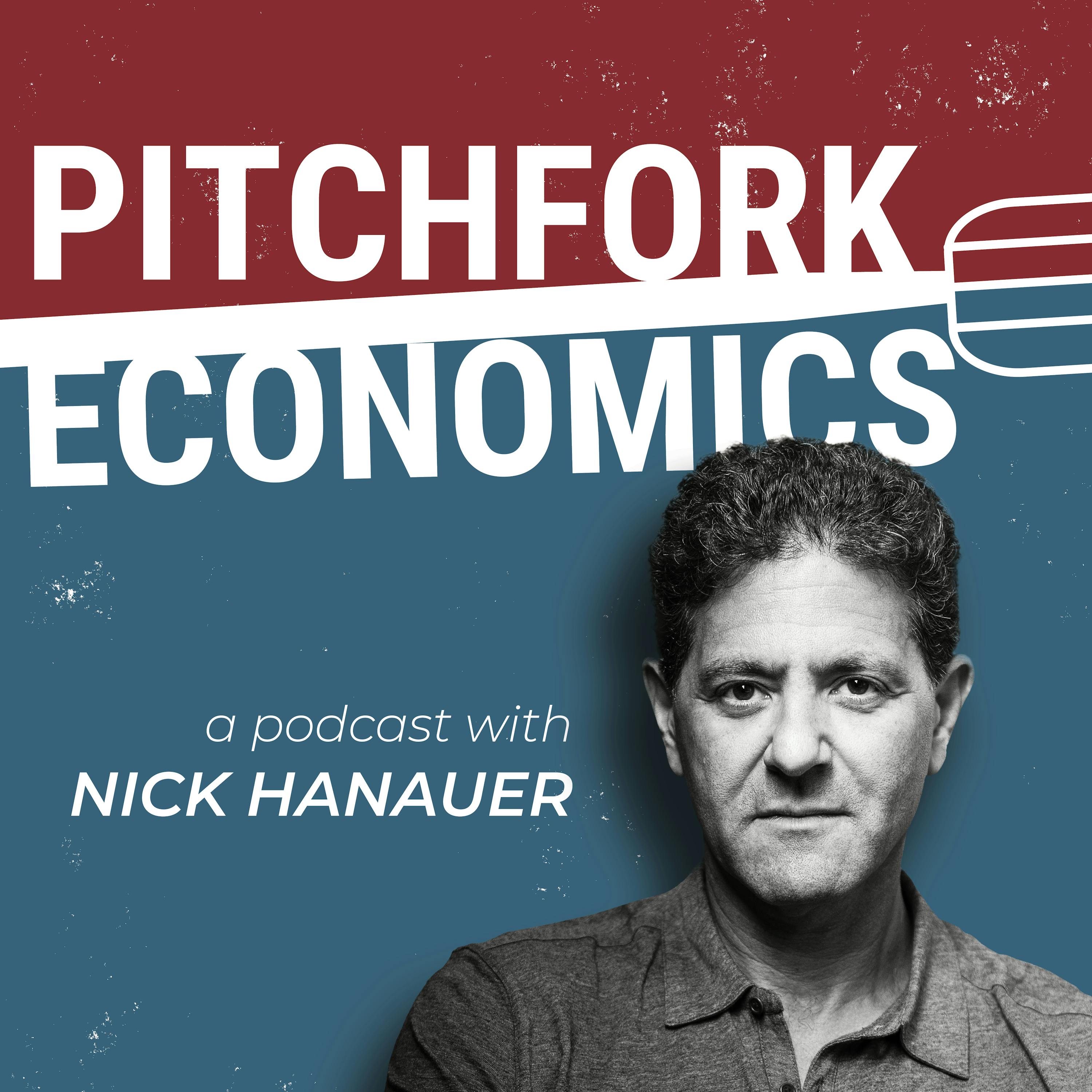
Pitchfork Economics with Nick Hanauer
Civic Ventures
We are living through a paradigm shift from trickle-down neoliberalism to middle-out economics — a new understanding of who gets what and why. Join zillionaire class-traitor Nick Hanauer and some of the world’s leading economic and political thinkers as they explore the latest thinking on how the economy actually works.
Episodes
Mentioned books

Sep 5, 2023 • 31min
What labor shortage? (with Heidi Shierholz)
EPI President, Heidi Shierholz, discusses the wage shortage disguised as a labor shortage. Raising wages in industries like restaurants proves effective. The negative consequences of reducing unemployment benefits are explored. Potential lasting changes to the labor market and the impact of unemployment insurance on labor shortages are examined.
4 snips
Aug 29, 2023 • 38min
Why don't we fight poverty by just giving people money? (with Paul Niehaus)
Paul Niehaus, co-founder of GiveDirectly, discusses the impact of giving cash directly to people living in extreme poverty. He explores the logistics of implementing digital cash transfers in Sub-Saharan Africa and the positive outcomes it can have on nutrition, teen pregnancies, child marriages, and mental health. The podcast also explores the feasibility of eradicating global poverty through cash transfers, government partnerships and innovations during the pandemic, and the role of higher tax rates in fighting poverty.
4 snips
Aug 22, 2023 • 53min
Power, progress, and technology (with Daron Acemoglu)
Daron Acemoglu discusses the impact of technology on society. He emphasizes the power dynamics in technological progress and the need for shared benefits. The podcast explores historical examples, the Industrial Revolution's effects, and proposes policy solutions for a more inclusive economy.
Aug 15, 2023 • 29min
Ask Nick Anything
Nick and Goldy answer more of your questions! What happens to current economic systems if world population growth goes to zero? Should I feel guilty for wanting my stocks to do well? What could be a good methodology to measure how progressive a tax is? And more!If you have questions for a future “Ask Me Anything” episode, leave us a voicemail at 731-388-9334.Website: http://pitchforkeconomics.comTwitter: @PitchforkEconInstagram: @pitchforkeconomicsNick’s twitter: @NickHanauer
Aug 8, 2023 • 41min
Wages need a revolution (with Michael Lind)
Today we’re talking about wages—specifically, how the widespread suppression of wages is destroying the American economy. Author, professor, and fellow traveler Michael Lind just published a new book titled “Hell to Pay” that argues America is in need of a revolution in the way we think about work and wages. Lind warns that if American worker power isn’t restored to its previous highs, there’ll be hell to pay. (Sounds a bit like “the pitchforks are coming,” doesn’t it?)Michael Lind is the author of more than a dozen books. He is a columnist for Tablet and has been an editor or staff writer for The New Yorker, Harper’s, The New Republic, and The National Interest. He’s one of the founders of the New America Foundation. He has taught at Harvard and Johns Hopkins and is currently a professor of practice at the Lyndon B. Johnson School of Public Affairs at the University of Texas at Austin.Hell to Pay https://www.penguinrandomhouse.com/books/690656/hell-to-pay-by-michael-lind “Hell To Pay”: Michael Lind On A True Good Jobs Strategy https://www.forbes.com/sites/michaelbernick/2023/05/16/hell-to-pay-michael-lind-on-a-true-good-jobs-strategy/?sh=c4e0c584d160 Website: http://pitchforkeconomics.comTwitter: @PitchforkEconInstagram: @pitchforkeconomicsNick’s twitter: @NickHanauer
Aug 1, 2023 • 35min
How Industrial Policy actually works (with Isabel Estevez)
Industrial Policy (IP) has dominated conversations in economic and political circles thanks to President Biden’s big investments in manufacturing, infrastructure, and working Americans. But according to today’s guest, development economist Isabel Estevez, the conversation around IP is too narrow. IP is not just about manufacturing and clean energy, she argues—smart IP also encompasses policies that improve outcomes for people, like reducing child poverty and cleaning our drinking water.Isabel Estevez is the Deputy Director of Industrial Policy and Trade at the Roosevelt Institute. She conducts research at the intersection of industrial and trade policy, with a focus on the transformation and decarbonization of heavy industries, such as steel and aluminum.Twitter: @Isabel_Estevez_Industrial Transformations https://www.phenomenalworld.org/analysis/industrial-transformations The American Industrial Policy Series https://rooseveltinstitute.org/think-tank/climate-and-economic-transformation/the-american-industrial-policy-series Website: http://pitchforkeconomics.comTwitter: @PitchforkEconInstagram: @pitchforkeconomicsNick’s twitter: @NickHanauer
Jul 25, 2023 • 33min
Private equity’s plan to pillage America (with Brendan Ballou)
Brendan Ballou, a federal prosecutor and author of 'Plunder: Private Equity's Plan to Pillage America', dives into how private equity is reshaping the economy. He reveals the devastating impact on industries, including retail and healthcare, leading to significant job losses. Brendan explains the insidious nature of leveraged buyouts, short-term profit motives, and legal structures that shield private equity firms from accountability. He discusses critical reforms needed to curb their harmful tactics and emphasizes the importance of an economy that works for everyone.
Jul 18, 2023 • 43min
Bidenomics (with Bharat Ramamurti)
“Bidenomics” is closely aligned with many—probably even most—of the middle-out economic principles that we discuss on this podcast every week. Much to our surprise and delight, Joe Biden has become the first President in 40 years to reject trickle-down economics in favor of building the economy from the middle out, and the results speak for themselves: Since the pandemic began, America has seen the strongest growth of any leading economy in the world. The economy has added 13 million jobs, inflation has fallen for 12 straight months, and a recession is no longer on the horizon. National Economic Council Deputy Director Bharat Ramamurti returns to the show to explain why Bidenomics has been so successful.Bharat Ramamurti is the Deputy Director of National Economic Council (NEC) for The White House. He previously served as a Member of the Congressional Oversight Commission for the CARES Act, and as the Managing Director of the Corporate Power program at the Roosevelt Institute. Twitter: @BharatRamamurtiBidenomics is Working https://www.whitehouse.gov/briefing-room/statements-releases/2023/06/28/bidenomics-is-working-the-presidents-plan-grows-the-economy-from-the-middle-out-and-bottom-up-not-the-top-down The Transformation at the Heart of Biden’s Middle-Out Economic Agenda https://prospect.org/economy/2023-02-09-biden-middle-out-agenda Website: http://pitchforkeconomics.comTwitter: @PitchforkEconInstagram: @pitchforkeconomicsNick’s twitter: @NickHanauer
Jul 11, 2023 • 44min
Why good jobs are good for business (with Zeynep Ton)
Low pay is obviously terrible for workers, but a growing body of research proves that it’s bad for businesses, too. Smaller paychecks lead to higher turnover, decreased productivity, and poor sales. Will low-wage employers in the grocery, retail, and restaurant industries ever understand that their employees are their most important asset? Zeynep Ton hopes so. She’s written a book explaining how labor investments can pay for themselves, and she joins us today to explain why better-paying jobs are good for everyone in the long run.Zeynep Ton is a Professor of the Practice in the Operations Management group at MIT Sloan School of Management. She is also president of the nonprofit Good Jobs Institute, where she works with companies to improve their operations in a way that satisfies employees, customers, and investors alike.Twitter: @zeyneptonGood Jobs are Good Business https://time.com/6285516/good-jobs-good-businessThe Case for Good Jobs: How Great Companies Bring Dignity, Pay, and Meaning to Everyone’s Work https://store.hbr.org/product/the-case-for-good-jobs-how-great-companies-bring-dignity-pay-and-meaning-to-everyone-s-work/10579Website: http://pitchforkeconomics.comTwitter: @PitchforkEconInstagram: @pitchforkeconomicsNick’s twitter: @NickHanauer
Jul 4, 2023 • 42min
How economics can create a more sustainable planet (with Sarah Bloom Raskin)
In the 21st century, summertime isn’t just for lounging on the beach and trips to the ice cream shop. Climate change has made summer much more unpleasant—and even dangerous. This year alone, New York City and Chicago have been choked with wildfire smoke and the southern U.S. suffered through a wave of record-breaking high temperatures. That’s why we’re revisiting our conversation with financial regulation expert Sarah Bloom Raskin about how fiscal policy can help save the environment. She explains what levers already exist to steer monetary policy toward lasting sustainability, and which proposed regulatory strategies could create transformative climate outcomes.This episode originally aired on July 20, 2021. Sarah Bloom Raskin is the former Deputy Secretary of the U.S. Department of the Treasury and a former Governor of the Federal Reserve Board. She is currently a visiting professor and distinguished fellow at Duke Law School’s Global Financial Markets Center, and a member of President Biden’s Regenerative Crisis Response Committee.Twitter: @SBloomRaskinNews clips from: CBS News, PBS NewsHour, and TODAYLearn more about the Regenerative Crisis Response Committee here: https://regenerativecrisisresponsecommittee.orgDoes environmental regulation kill or create jobs? https://policyintegrity.org/files/media/Jobs_and_Regulation_Factsheet.pdfDo regulations really kill jobs? https://www.theatlantic.com/business/archive/2017/01/regulations-jobs/513563Website: http://pitchforkeconomics.comTwitter: @PitchforkEconInstagram: @pitchforkeconomicsNick’s twitter: @NickHanauer

