

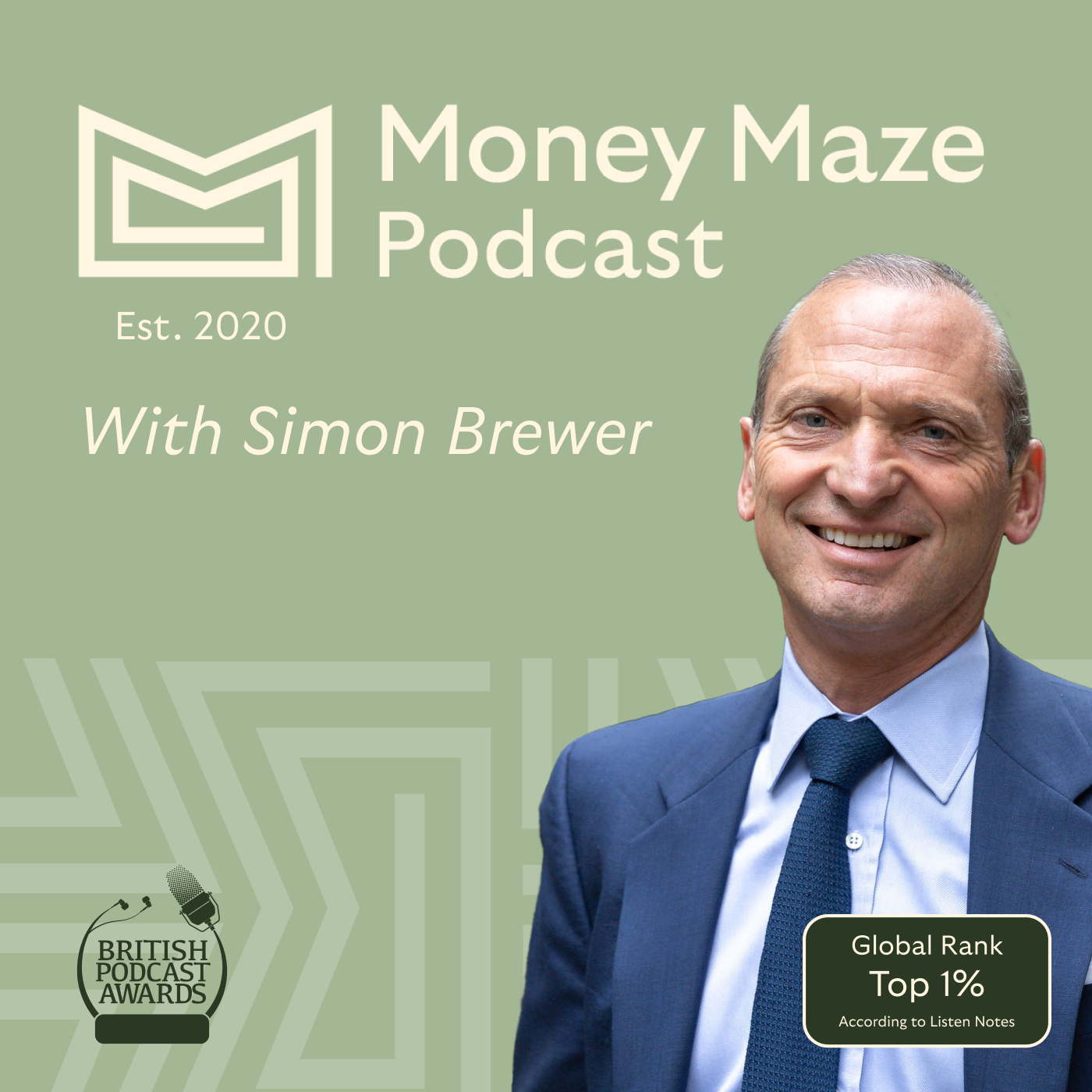
Money Maze Podcast
Money Maze Podcast
The world of finance has a huge impact on all of us. This show aims to explore and unravel some of the mysteries surrounding the investing business, via interviews with masters of the real life money maze.
Expect tips for mastering capital allocation, making better business decisions, strategies for taking your career to the next level, and revelatory profiles of leading industry figures.
Whether you're a current or aspiring investment professional, a regular investor, or a student exploring career options, we hope you gain some helpful insights and enjoy the shows. Thank you for listening!
Visit our website to learn more & access further content: moneymazepodcast.com
Expect tips for mastering capital allocation, making better business decisions, strategies for taking your career to the next level, and revelatory profiles of leading industry figures.
Whether you're a current or aspiring investment professional, a regular investor, or a student exploring career options, we hope you gain some helpful insights and enjoy the shows. Thank you for listening!
Visit our website to learn more & access further content: moneymazepodcast.com
Episodes
Mentioned books

May 28, 2020 • 32min
4: Anthony Dalwood, CEO, Gresham House Plc
Sign up to our newsletter for more in-depth insights | Follow us on LinkedIn
Tony Dalwood studied Economics and Accounting at Bristol University and then Management and Business at Cambridge, where he took his post graduate degree and won a Blue playing Rugby. He then played Rugby for Saracens and Rosslyn Park, before his journey into Asset Management. He talks of his career, beginning as a value-orientated equity manager, and his transition into the world of private equity, at that stage, an embryonic asset class. He discusses his subsequent roles as CEO of Schroder Ventures (London), and work as Chairman of the London Pensions Fund Authority Investment Panel. The conversation moves to life as CEO of Gresham House, a quoted company investing in alternative assets. He discusses real asset investing, describing the investment characteristics and approach to investing in Forestry, New Energy, Housing and Infrastructure. He then talks of today’s narrow equity markets, some of the parallels with the situation 20 years ago, and of today’s equity market disenchantment with the approach to value investing. Finally he discusses small cap investing in the UK, the challenges facing public markets and the likely composition of portfolios in the future.

May 14, 2020 • 28min
3: Sarah Gordon, CEO, Impact Investing Institute
Sign up to our newsletter for more in-depth insights | Follow us on LinkedIn
Our conversation begins with a glimpse of Sarah’s inspiring journey from finance, to journalism and now to the critical world of impact investing.
Sarah talks about the 18 years spent at the FT where she ran the FT’s corporate coverage during the financial crisis and her ascent to become the FT’s business editor.
She describes her motivation and the challenges involved with her new role as CEO of the Impact Investing Institute, and her passion about impact investing and its immediate relevance. She speaks frankly about the need for an intelligent and reasoned approach to the ESG debate and provides some invaluable advice for corporations wishing to improve their governance and operate more effectively. She also offers equally important advice for young people thinking about their careers and some additional invaluable insights.
Apr 21, 2020 • 37min
2: Nick Finegold, CEO, Curation Corporation
Sign up to our newsletter for more in-depth insights | Follow us on LinkedIn
Nick Finegold describes his journey through the world of finance, first in equity sales, then as the founder of his own brokerage business, Execution Ltd. He talks about building the business into a firm with revenues of $100 million and selling it 10 years later, becoming Chairman of Espirito Santo Investment Bank, in London.
He then explains the decision to establish the Curation Corporation, 8 years ago, where he remains the CEO, and its mission to allow organisations to better understand the risks and opportunities provided by climate change. The aim is to help firms identify solutions to help transition to a more purposeful and sustainable future.
The discussion covers lessons from Bill Gates about the Nuclear alternative for cutting carbon emissions, rethinking the approach to collaboration of pharmaceutical companies, and how the post-COVID world will impact supply chains, home-working and may a engender a more humane approach to capitalism.
Mar 25, 2020 • 36min
1: Peter Harrison CEO, Schroders PLC.
Sign up to our newsletter for more in-depth insights | Follow us on LinkedIn
Peter Harrison, included in Debrett’s 500 most influential people, starts by describing a rebellious youth that led him to reject his family’s wish to study Theology at Oxbridge and instead to make a decision to go to Bath University to study Business in the 1980s.
From there he talks of his first job at Schroders, working as an analyst, and further experiences he had at Newton, Flemings, Deutsche Asset Management and then a start-up, RWC. Peter describes their merger with Schroders and his ascent to CEO, and the journey from managing money to managing an investment business.
The conversation moves to him talking about the compelling opportunities in Global Asset Management, contrary to some gloomy commentaries that we often read. He talks of the shift to managing money to solve problems and not simply to be benchmarked, and the evolution of active and passive strategies. He describes Schroder’s vision of serving the individual customer, both affluent and high net worth, with the help of more electronic applications, a wider public and private offering and trying to help them avoid classic pitfalls of poor timing in entering and exiting the market.
He also explains why although he thinks ESG must be embedded in your investment process, it will morph into a more coherent drive for impact investing. Peter also gives his thoughts on the growth of private equity, and the challenge facing stock markets buffeted by weighty regulation and diminished liquidity.
He then discusses advice for the young thinking about future career, and some of the characteristics he looks for in potential hires.

