

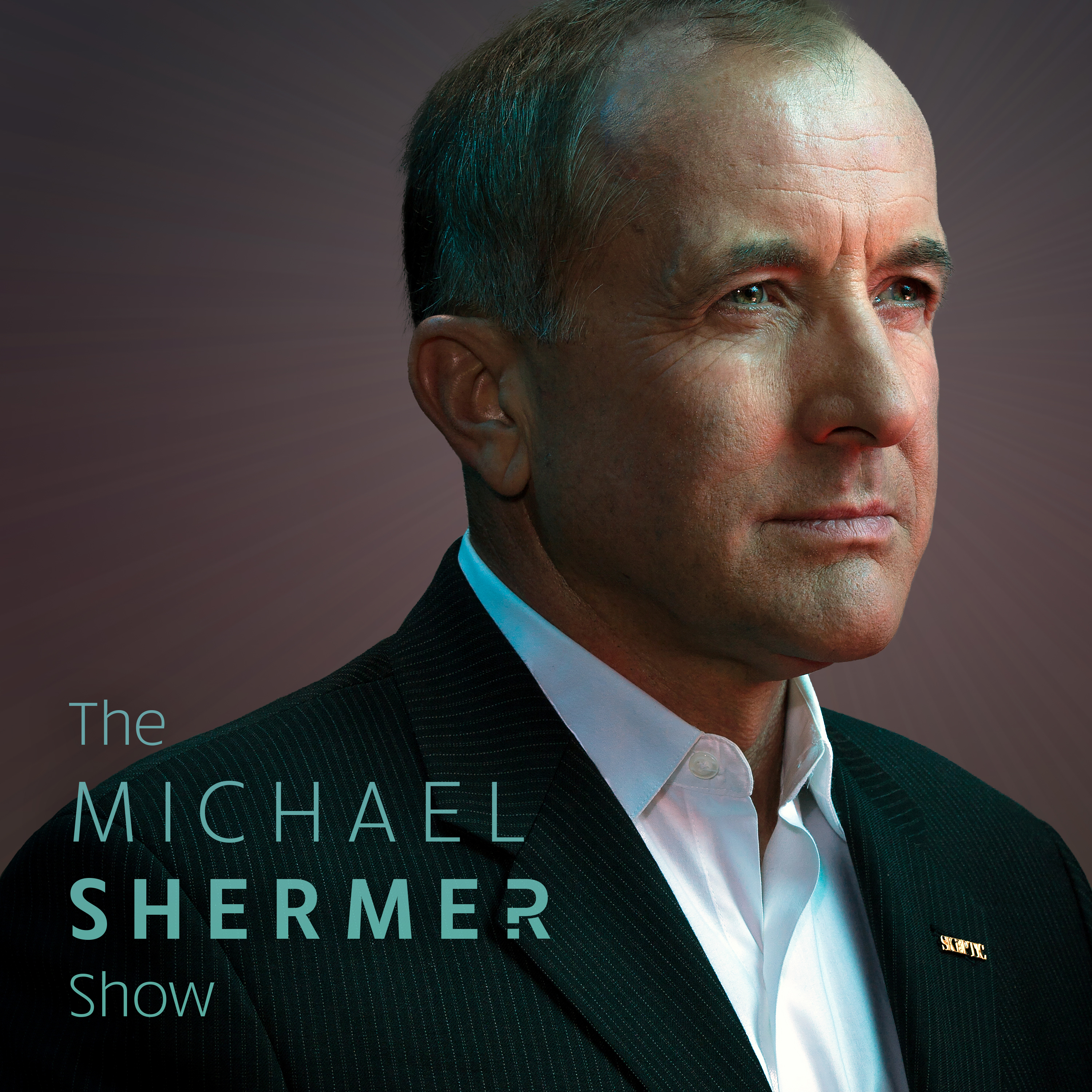
The Michael Shermer Show
Michael Shermer
The Michael Shermer Show is a series of long-form conversations between Dr. Michael Shermer and leading scientists, philosophers, historians, scholars, writers and thinkers about the most important issues of our time.
Episodes
Mentioned books

Jan 1, 2019 • 1h 25min
49. Dr. Gad Saad — Doing Gad's Work
In this episode of the Science Salon Podcast, Michael Shermer talks to the renowned evolutionary behavioral scientist and Concordia University professor Dr. Gad Saad. Starting with his escape to Canada from war-torn Lebanon, Dr. Saad recounts how he got interested in the study of human nature in general and consumer behavior in particular through the evolutionary lens, why people make the choices they do in the marketplace, why evolutionary psychology is an equal-opportunity offender to both the political left and right, what's wrong with the Blank Slate model of human nature, what it means to hypothesize that something evolved "for" an adaptive reason, how evolutionary psychologists test their claims, the consilience of human knowledge, epistemological humility, postmodernism and how it has corrupted the academy, and the vital importance of free speech and free inquiry in science and society. Dr. Gad Saad held the Concordia University Research Chair in Evolutionary Behavioral Sciences and Darwinian Consumption from 2008 to 2018. He is the author of The Consuming Instinct (2011, Prometheus Books) and The Evolutionary Bases of Consumption (2007, Lawrence Erlbaum), editor of Evolutionary Psychology in the Business Sciences (2011, Springer), and is finishing his next book on idea pathogens and how they have spread like a contagion in the academy, now spilling out into government and corporations. He is the host of the popular podcast The Saad Truth, which focuses on science, religion, political correctness, multiculturalism, postmodernism, third-wave feminism, Islam, safe spaces, trigger warnings, and many other topics. Listen to Science Salon via iTunes, Spotify, Google Play Music, Stitcher, iHeartRadio, TuneIn, and Soundcloud. This Science Salon was recorded on December 26, 2018.
Dec 25, 2018 • 1h 41min
48. Sir Martin Rees — On the Future: Prospects for Humanity
In this wide-ranging dialogue Michael Shermer talks to Martin Rees about: his early education and how he got interested in astronomy and cosmology • how the Big Bang theory won out over the Steady State theory • origin of life, SETI, and the search for a second genesis • Fermi Paradox (if life is abundant in the universe…where is everyone?) • space exploration (human or robotic or both?) • future of humanity as sentient A.I. (to the stars…inside computers!) • limits of scientific knowledge (are we nearing the "end of science"? No says Dr. Rees!) • threats and challenges facing humanity (nuclear weapons, climate change, overpopulation, sustainable energy sources, artificial intelligence, income inequality, political instability, and others) • role of religion in modern society (why Dr. Rees is an atheist but not a "new atheist") • do we need to replace religion with a secular equivalent? Sir Martin Rees is a leading astrophysicist as well as a senior figure in UK science and a public intellectual in England and America. He has conducted influential theoretical work on subjects as diverse as black hole formation and extragalactic radio sources, and in the 1960s his research provided key evidence to contradict the Steady State theory of the evolution of the Universe. Dr. Rees was also one of the first to predict the uneven distribution of matter in the Universe, and proposed observational tests to determine the clustering of stars and galaxies. Much of his most valuable research has focused on the end of the so-called cosmic dark ages —a period shortly after the Big Bang when the Universe was as yet without light sources. As Astronomer Royal and a Past President of the Royal Society, Martin is a prominent scientific spokesperson and the author of seven books of popular science. After receiving a knighthood in 1992 for his services to science, he was elevated to the title of Baron Rees of Ludlow in 2005. His latest book is On the Future: Prospects for Humanity. His other books include: Before the Beginning: Our Universe and Others (1997) • Just Six Numbers: The Deep Forces That Shape the Universe (1999) • Our Cosmic Habitat (2001) • Our Final Hour: A Scientist's Warning —How terror, error, and environmental disaster threaten humankind's future in this century —on earth and beyond (2004) • What We Still Don't Know (2009) • From Here to Infinity: Scientific Horizons (2011). Listen to Science Salon via iTunes, Spotify, Google Play Music, Stitcher, iHeartRadio, TuneIn, and Soundcloud. This Science Salon was recorded on December 12, 2018.
Dec 4, 2018 • 1h 22min
47. Dr. Susan Blackmore — Altered States and Conscious Beings
Dr. Susan Blackmore is no stranger to skeptics. Dr. Shermer has known Dr. Blackmore since the early 1990s. When the Skeptics Society and Skeptic magazine were founded in 1992 she was already a rock star in the skeptical movement, having moved from believing in the paranormal, ESP, telepathy, and all the rest, to being an arch skeptic of all such claims. After earning a Ph.D. in the paranormal she devoted a decade to testing various phenomena under rigorous laboratory conditions, and continually found null results. That is, the tighter the controls she implemented and the more rigorous the research protocols, the weaker the paranormal effects became until they disappeared entirely. She went on from there to develop a theory about the neural correlates of such altered states of consciousness as Out of Body Experiences and Near Death Experiences, and after that wrote her bestselling book The Meme Machine, in which she developed a theory of how memes can be replicated and selected in a manner first proposed by Richard Dawkins in The Selfish Gene, when he coined the term. Dr. Blackmore went on to publish one of the leading textbooks on consciousness and is now working on a theory of tremes, or technological memes and how they can be replicated and selected in machines without human input. Listen to Science Salon via iTunes, Spotify, Google Play Music, Stitcher, iHeartRadio, TuneIn, and Soundcloud. This Science Salon was recorded on November 7, 2018.
Nov 27, 2018 • 46min
46. Zac Sechler interviews Michael Shermer about Why People Believe in God
In this unusual Science Salon we bring you an interview of Dr. Shermer by Zac Sechler, a high school senior at Grace Prep High School in State College, PA. Zac is interested in studying areas such as religion, science, and history. He plans on studying history in college and hopes to work in the education field. This interview was for his Senior Project, on studying different worldviews that people hold on religion, and why they believe what they believe. Dr. Shermer's contribution was as an atheist and skeptic, although as he points out to Zac, atheism and skepticism are not worldviews. Atheism is simply a lack of belief in God, full stop. Skepticism is just a scientific way of exploring the world and confronting claims about it. Listen to Science Salon via iTunes, Spotify, Google Play Music, Stitcher, iHeartRadio, TuneIn, and Soundcloud. This Science Salon was recorded in audio format only on October 10, 2018.
Nov 13, 2018 • 1h 23min
45. Daniel de Visé — On Comebacks in Sports and Life
In this unusual dialogue Dr. Shermer talks to author and journalist Daniel de Visé about one of the greatest athletes in American history, three-time Tour de France winner Greg LeMond and de Vise's new book about the cyclist, The Comeback: Greg LeMond, the True King of American Cycling, and a Legendary Tour de France. They also get into what constitutes fairness in sports, Lance Armstrong and the era of doping in sports in which nearly every professional athlete (not just in cycling) was using Performing Enhancing Drugs, and the ethics of how something can be immoral if everyone is doing it. Shermer explains his game theory analysis of cheating and how to tilt the incentive matrix to encourage fair play among all agents in a system. They also touch on de Vise's prior bestselling book Andy and Don, the story of Andy Griffith and Don Knotts and their classic American television series. Daniel de Visé is an author and journalist. He has worked at the Washington Post, the Miami Herald, and in 2001 shared a Pulitzer Prize for his investigative journalism of the on-the-scene coverage of the pre-dawn raid by federal agents that took the Cuban boy Elian Gonzalez from his Miami relatives and reunited him with his Cuban father. His investigative reporting twice led to the release of wrongly convicted men from life terms in prison. He is the author of I Forgot to Remember and Andy and Don: The Making of a Friendship and a Classic American TV Show. Listen to Science Salon via iTunes, Spotify, Google Play Music, Stitcher, iHeartRadio, TuneIn, and Soundcloud. This Science Salon was recorded on September 14, 2018.
Nov 6, 2018 • 1h 33min
44. Dr. David P. Barash — Human Nature Through a Glass Brightly
Humans have long seen ourselves as the center of the universe, the apple of God's eye, specially-created creatures who are somehow above and beyond the natural world. This viewpoint — a persistent paradigm of our own unique self-importance — is as dangerous as it is false. In this conversation with Michael Shermer based on his new book Through a Glass Brightly, noted biologist and evolutionary psychologist David Barash explores the process by which science has, throughout time, cut humanity "down to size," and how humanity has responded. Shermer and Barash also explore how evolutionary psychology became politicized, with the Right embracing it and the Left looking askance at it, based on a deeper commitment to human nature as grounded deeply in our biology and genetics vs. human nature as malleable and shaped primarily by culture. A lifelong liberal and social activist, Dr. Barash nevertheless accepts the science wherever it leads, regardless of ideology. From there Barash and Shermer discuss human aggression and violence, whether or not war is part of our nature, game theory and nuclear deterrence and why Barash thinks MAD (Mutual Assured Destruction) is a dangerous and fraudulent game to play with extinction on the line, how we can get to Nuclear Zero, and whether we should be optimistic or pessimistic for our species' future. Listen to Science Salon via iTunes, Spotify, Google Play Music, Stitcher, iHeartRadio, TuneIn, and Soundcloud. This Science Salon was recorded in audio format only on October 19, 2018.
Oct 30, 2018 • 1h 15min
43. Dr. Jonathan Haidt — Coming Apart
A lecture by and follow-up discussion with Jonathan Haidt about the excessive divisiveness of American politics and culture the past several years. Dr. Haidt visited the campus of Chapman University on October 18 on his book tour for The Coddling of the American Mind, about which Dr. Shermer talked to him in Science Salon # 36. While on campus Professor Haidt made a guest appearance in Professor Shermer's class, Skepticism 101, and gave a lecture about his deep concerns of what is happening in America and what we should do about it, followed by an "in conversation" with Dr. Shermer in front of the class on several of these themes, including to what extent science and determine human values, what business America has in telling other countries and cultures what their values should be, his thoughts on the Harvard discrimination lawsuit, the deplatforming of Steve Bannon by The New Yorker, the legalization or criminalization of polygamy and prostitution, welfare programs and Universal Basic Income, and our moral obligation to help those who cannot help themselves. Listen to Science Salon via iTunes, Spotify, Google Play Music, Stitcher, iHeartRadio, TuneIn, and Soundcloud. This Science Salon was recorded in audio format only on October 18, 2018.
Oct 17, 2018 • 2h 1min
42. Dr. Clay Routledge — The Meaning of Life, the Universe, and Everything
In this dialogue on life's deepest and most meaningful issues Michael Shermer talks with psychologist Clay Routledge about: the evolution of motivation and goals in animals and humans ● what a "purpose driven life" really means ● how atheists and nonbelievers can create meaningful and purposeful lives ● the self, personal identity, and existential psychology ● why people believe in God and fear death ● why religious people live longer and healthier lives ● the different types of atheists ● why one-third of atheists believe in some type of life after death ● free will as a useful fiction ● trans-humanism as a faux religion ● what should an atheist say to someone who is dying or has a loved-one who passed away ● terrorism as motivated by religion or politics or both. Dr. Clay Routledge is an author, psychological scientist, consultant, public speaker, and professor. He is a professor at North Dakota State University. He studies basic psychological needs and how these needs influence wellbeing, physical health, and intergroup relations.Much of his research focuses on the need for meaning in life and the need to belong.He has published 95 scholarly papers, co-edited two books on existential psychology, and authored the book Nostalgia: A Psychological Resource. He was the lead writer for the TED-Ed animated lesson Why Do We Feel Nostalgia? His new book Supernatural: Death, Meaning, and the Power of the Invisible World was published in July 2018. Listen to Science Salon via iTunes, Spotify, Google Play Music, Stitcher, iHeartRadio, TuneIn, and Soundcloud. This remote Science Salon was recorded on September 12, 2018.
Oct 3, 2018 • 1h 32min
40. Dr. Kwame Anthony Appiah — Who Am I? Who Are You? The Lies That Bind: Rethinking Identity
In this wide-ranging conversation Dr. Appiah and Dr. Shermer review the 5 "Cs" of identity—Creed, Country, Color, Class, and Culture—and what they tell us about who we are, or at least who we think we are. Dr. Appiah's new book The Lies That Bind: Rethinking Identity explores the nature and history of the identities that define us. It challenges our assumptions about how identities work. We all know there are conflicts between identities, but Appiah shows how identities are created by conflict. Religion, he demonstrates, gains power because it isn't primarily about belief. Our everyday notions of race are the detritus of discarded nineteenth-century science. Our cherished concept of the sovereign nation—of self-rule—is incoherent and unstable. Class systems can become entrenched by efforts to reform them. Even the very idea of Western culture is a shimmering mirage. These "mistaken identities," Appiah explains, can fuel some of our worst atrocities—from chattel slavery to genocide. And yet, he argues that social identities aren't something we can simply do away with. They can usher in moral progress and bring significance to our lives by connecting the small scale of our daily existence with larger movements, causes, and concerns. Elaborating a bold and clarifying new theory of identity, The Lies That Bind is a ringing philosophical statement for the anxious, conflict-ridden twenty-first century. This book will transform the way we think about who—and what—"we" are. Kwame Anthony Appiah is a professor at NYU in the department of philosophy and the school of law, the Ethicist column for the New York Times, and the author of Cosmopolitanism: Ethics in a World of Strangers, The Honor Code: How Moral Revolutions Happen, Experiments in Ethics, and most recently The Lies That Bind: Rethinking Identity. Listen to Science Salon via iTunes, Spotify, Google Play Music, Stitcher, iHeartRadio, TuneIn, and Soundcloud. This remote Science Salon was recorded on August 21, 2018.
Sep 26, 2018 • 1h 39min
39. Heather Mac Donald — The Diversity Delusion: How Race and Gender Pandering Corrupt the University and Undermine Our Culture
In this riveting review of the campus craziness investigative journals, writer, and lawyer Heather Mac Donald and Michael Shermer dive deep into the root causes of what has gone wrong on college campuses, in corporations, and in government agencies, over the decades that has led to a crisis in higher education … and beyond. Race and gender form the core of Identity Politics, which Mac Donald and Shermer discuss in dunking the myth that American society in general — and academia in particular — are rampant environments of bigotry and prejudice. Just the opposite is the case, as there has never been a safer and more inviting space to be than a college campus in 2018 America. The discussion revolves around Mac Donald's new book, The Diversity Delusion: How Race and Gender Pandering Corrupt the University and Undermine Our Culture, in which she shows how toxic ideas first spread by higher education have undermined humanistic values, fueled intolerance, and widened divisions in our larger culture. Chaucer, Shakespeare and Milton? Oppressive. American history? Tyranny. Professors correcting grammar and spelling, or employers hiring by merit? Racist and sexist. Students emerge into the working world believing that human beings are defined by their skin color, gender, and sexual preference, and that oppression based on these characteristics is the American experience. Speech that challenges these campus orthodoxies is silenced with brute force. Heather Mac Donald is a self-described secular conservative (she's an atheist) who writes extensively on American politics and culture. She is the Thomas W. Smith Fellow of the Manhattan Institute and a contributing editor to New York's City Journal. Her previous books include The War on Cops, Are Cops Racist?, The Immigration Solution, and The Burden of Bad Ideas. Listen to Science Salon via iTunes, Spotify, Google Play Music, Stitcher, iHeartRadio, TuneIn, and Soundcloud. This remote Science Salon was recorded on September 10, 2018.

