

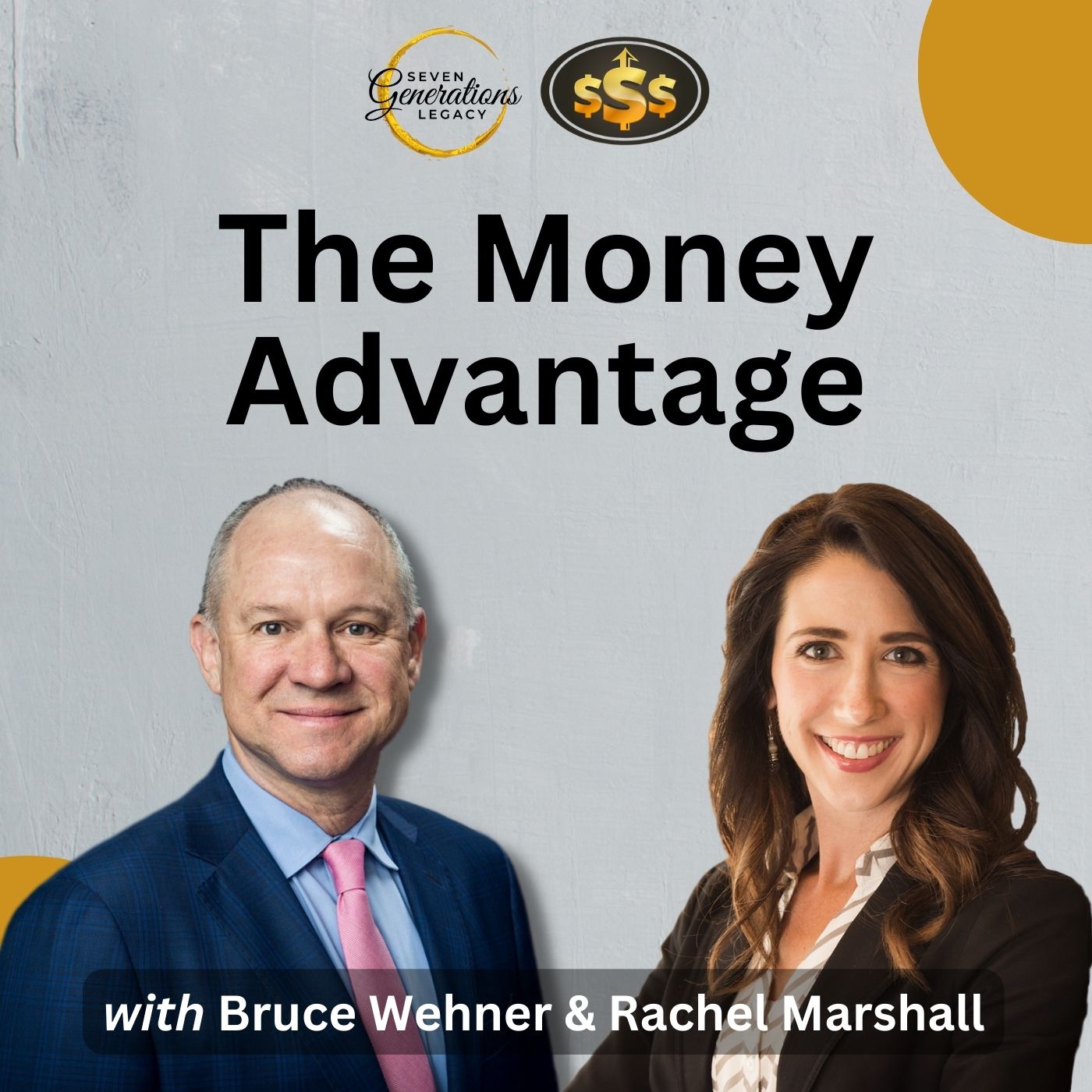
The Money Advantage Podcast
Bruce Wehner & Rachel Marshall
Personal Finance for the Entrepreneurially-Minded!
Episodes
Mentioned books

Aug 10, 2020 • 58min
Estate Plans that Transcend Generations with Andrew Howell
https://www.youtube.com/watch?v=uvUp3vuKYjA
Do you want to leave a legacy with an estate plan that transfers wealth and empowers the next generation? Find someone who is helping others do it successfully. And that means tailoring a customized, bespoke plan specifically to your family.
Today, we’re talking with highly recognized estate planning attorney, Andrew Howell, about the principles and wisdom he’s distilled from working with ultra-high net worth families and business owners.
If you want to know how to entrust wealth to future generations, provide for unity within the family, and leave a legacy of wisdom and opportunity, so you can create an estate plan that transcends generations, tune in now!
In This Episode About Estate Planning to Bridge Generations, You’ll Discover:Where Estate Planning Fits into Your Cashflow Creation SystemFamily Vision, Mission, and ValuesHow to Transcend GenerationsRole of Professionals in Building Legacy PlansAbout Andrew Howell Find Out More About Andrew HowellBook A Strategy Call
In This Episode About Estate Planning to Bridge Generations, You’ll Discover:
Why traditional estate planning fails at increasing family wealth and promoting character development.
How the core of the Entrusted model of estate planning is about meaningful relationships.
How to transfer wealth in a way that incentivizes work and stewardship instead of producing entitlement.
The top 3 eroding effects on generational wealth.
Why traditional estate planning that divides assets limits your family's ability to make an impact.
Why leaving your money to charity creates a lost opportunity for your family.
How to set up your family wealth as a bank to create opportunity, entrepreneurship, and accountability.
Why the first priority in leaving a legacy is to know who you are as individuals and a family.
Where Estate Planning Fits into Your Cashflow Creation System
Encircling your family and assets with a bulletproof estate plan will maximize your peace of mind. But it’s just one small step of a greater journey.
That’s why we’ve put together the 3-step Entrepreneur’s Cash Flow System.
The first step is keeping more of the money you make. This includes tax planning, debt restructuring, cash flow awareness, and restructuring your savings so you can access them as an emergency/opportunity fund. This step frees up and increases your cash flow, allowing you to save more and consequently invest more.
Then, you’ll protect your money with savings, privatized banking, and legal protection. This is where estate planning fits in. You’ll know that no matter what happens to you, your wishes will be carried out, your assets will remain intact, and your wisdom will empower generations after you.
Finally, you’ll put your money to work and get it to make more by investing in cash-flowing assets to build time and money freedom and leave a rich legacy.
Family Vision, Mission, and Values
A successful estate plan isn’t just about legal frameworks - it’s also about meaning. According to Andrew Howell, families that thrive across generations often share more than just money. They also share a common vision, values, and a mission that unites them.
While this might sound like typical corporate jargon, it’s actually a practical way to keep your family unified when managing and distributing wealth. When your estate plan reflects your family’s shared beliefs and long-term goals, it becomes so much more than simple paperwork: you might describe it as a blueprint for continuity and stewardship.
Whether it’s entrepreneurship, education, or service, documenting your family’s purpose can help future generations make informed decisions about their own lives. In essence, that’s what makes a plan enduring, not just wealth transfer, but clarity of identity.
How to Transcend Generations
If your goal is to build something that outlives you, then your estate plan needs to do more than just pass down assets. It must create a system for longevity. That’s how you transcend generations, by equipping your heirs with not only resources but also the tools to manage, protect, and expand them.
Andrew Howell’s approach encourages families to think of their wealth like a business or bank, one that future members contribute to, borrow from, and are accountable within. This framework encourages responsibility and purpose, rather than mere entitlement.
More than legal documents, this kind of planning builds culture. And when your strategy includes financial literacy, leadership development, and stewardship training, it does more than transfer money; it rewires how your family relates to wealth.
Role of Professionals in Building Legacy Plans
Creating an estate plan that lasts beyond your lifetime isn’t a solo effort. It’s a team sport, of sorts. While your attorney plays a key role in drafting and structuring the plan, there’s often more at stake, especially when your family’s business, charitable giving, or tax strategy is involved.
Andrew Howell emphasizes the importance of a coordinated team, comprising an attorney, CPA, and financial advisor.
Each brings a different piece to the puzzle. Your attorney ensures legal strength and clarity. Your CPA helps maintain tax efficiency across generations. And your financial advisor helps align your family’s investments with long-term goals.
When these professionals collaborate, your plan isn’t just legally compliant, it’s strategic, flexible, and built for the future. Andrew’s most successful clients are those who view estate planning as an integrated process, rather than a one-time event. Together, your team can help ensure your family legacy isn’t just preserved but thoughtfully carried forward.
About Andrew Howell
Andrew L. Howell is a Co-Founder of the Salt Lake City law firm York Howell & Guymon. His focus is on estate planning, asset protection planning, probate and estate administration, charitable giving, sophisticated business structuring and transactions, and tax planning.
Additionally, he is passionate about (and regularly assists clients with) family legacy planning, stock and asset sales and purchases, buy-sell and shareholder agreements, and business buy-out and business succession planning. Mr. Howell’s practice has a specific focus on ultra-high-net-worth families and business owners.
Mr. Howell is a leader at the forefront of responding to the industry-wide shift in estate planning resulting from client demand for a more holistic approach to wealth transfer. He assists his ultra-high-net-worth clientele in creating dynamic estate plans, focusing on what they can do to increase harmony and purpose in their planning.
Mr. Howell is the co-author of Entrusted: Building a Legacy That Lasts, which features seven core disciplines of successful wealth transfer of high-net-worth families going back hundreds of years, as well as Riveted: 44 Values That Change the World.
Andrew Howell is routinely recognized as a Mountain States Top Lawyer and was credited by Salt Lake Magazine as a Rising Star on the Mountain States Super Lawyers List in 2010, 2015, 2016, 2017, 2018, and 2019. Utah Business Magazine named him among Utah Legal Elite from 2011 through 2016. Mr. Howell is recommended as one of the Top 100 Lawyers in Utah by The National Advocates.
York Howell & Guymon was celebrated as one of Utah’s Fast 50: Emerging 8 companies in 2016 and is ranked #1,073 on Inc. 5000’s Fastest Growing Companies in America. During Mr. Howell’s five years as Managing Partner, the Firm has grown from three lawyers to sixteen and now employs thirty-five people.
Find Out More About Andrew Howell
Learn more about how you can improve your results by entrusting wealth to future generations.
Discover more about Andrew Howell and the Entrusted planning process, or contact them directly at teamandrew@yorkhowell.com.
Book A Strategy Call
Are you ready to take control of your finances and build a lasting legacy? We offer two powerful ways to help you create lasting impact:
Legacy Strategy Call: If you want to uncover your family values, mission, and vision, and create a legacy that’s about more than just money, we can guide you through the process of financial stewardship and family leadership. Save time coordinating your family’s finances while building a lasting legacy for generations. Book a Legacy Strategy Call to learn more about how we can help.
Financial Strategy Call: Discover how Privatized Banking, alternative investments, tax-mitigation, and cash flow strategies can accelerate your time and money freedom while improving your life today. Let us show you how to align your financial resources for maximum growth and efficiency. Book a Strategy Call with our team today.
Aug 3, 2020 • 1h 1min
Maximizing Retirement Income with Whole Life Insurance – Dr. Wade Pfau
https://www.youtube.com/watch?v=AO7Y3RkLaFI
Want to get the most income later in life? Your success depends not on one product, but the coordination of financial tools and your entire personal financial system. Whether your focus is on acquiring cash-flowing assets or you have a more typical investment portfolio, whole life insurance and annuities can play a critical role. That's why we’re talking with Dr. Wade Pfau, a widely-recognized expert on income strategies with whole life insurance.
So if you want to get the most income during retirement, have the greatest chance of not running out of money, leave the greatest legacy, and see why the higher premium of whole life is worth it over "buying term and investing the difference", tune in now!
In this episode, you'll find out:
Why the typical approach to retirement planning leaves so many in scarcity with the possibility of running out of money.
How an integrated strategy using life insurance products with an investment portfolio provides more income during retirement.
3 ways whole life insurance is more than an income replacement that's no longer needed after retirement.
Why a financial strategy that includes whole life outperforms “buying term and investing the difference.”
How you can spend more during retirement and pass on a bigger legacy.
How whole life insurance and annuities provide an “actuarial bond” environment to replace traditional bonds in the typical asset allocation. This divides the functions of growth and income into separate assets, and give you more growth and more income.
Why life insurance that uses bonds is better than buying bonds directly.
How to preserve your investment portfolio and minimize the sequence of return risk, giving you more income during later years.
About Dr. Wade Pfau
Wade D. Pfau, Ph.D., CFA, RICP, is the curriculum director of the Retirement Income Certified Professional designation and a Professor of Retirement Income at The American College of Financial Services in King of Prussia, PA.
He is also a Principal and Director for McLean Asset Management.
Dr. Pfau holds a doctorate in economics from Princeton University and publishes frequently in a wide variety of academic and practitioner research journals on topics related to retirement income.
He hosts the Retirement Researcher website, and is a contributor to Forbes, Advisor Perspectives, Journal of Financial Planning, and an Expert Panelist for the Wall Street Journal.
Dr. Pfau is the author of several books on retirement income strategies.
Dr. Wade Pfau Links and Mentions
RetirementResearcher.com
Safety-First Retirement Planning: An Integrated Approach for a Worry-Free Retirement
How Much Can I Spend in Retirement? A Guide to Investment-Based Retirement Income Strategies
Reverse Mortgages: How to Use Reverse Mortgages to Secure Your Retirement
Find Out Your Next Step to Time and Money Freedom
If you would like to assess your complete financial picture and find your personal best strategy to maximize your cash flow and control, we can help.
By the way, we have a free Quick and Easy Privatized Banking Guide that outlines just how Privatized Banking gives you the most powerful storage tank for your cash, PLUS it boosts investment returns, so you can more quickly get to the point where you never run out of cash.
If you are ready to personally implement Privatized Banking, alternative investments, or cash flow strategies to keep more of the money you make, book your strategy call with The Money Advantage advisors today.
Thanks for Tuning In!
Thanks so much for being with us this week. Have some feedback you’d like to share? Please leave a note in the comments section below!
Don’t forget to subscribe to the show to get automatic episode updates for The Money Advantage podcast!
And, finally, if you like these conversations about building time and money freedom, please rate and review our show on Apple Podcasts to help more people like you find our show.
Thanks for listening!
Jul 27, 2020 • 52min
The Conversation Between Generations
Do you want to leave a legacy for future generations to come, but worry about the gift corrupting them? Are you hoping to pass on meaning even more than the money itself? Do you wonder how to start the conversation? Do you worry if family dynamics will prevent you from communicating your points clearly and in a way that will be received and understood?
https://www.youtube.com/watch?v=xH3B2d53bVg
Today, we're bringing Tom Michler into the conversation. As a psychologist, he's helped families navigate the multi-generational conversation about financial planning. In addition to transferring financial assets from one generation to another.
If you want to give a gift or legacy to the next generation, not just transfer money, to have it do the most good in and through them, and to have healthy communication in the family so you can create a deeply-connected family AND long-lasting wealth, tune in now!
In this episode about the conversation between generations, you'll discover:Where Generational Conversations Fit In The Bigger PictureAbout Tom MichlerBook A Strategy Call
In this episode about the conversation between generations, you'll discover:
Dynamics of multi-generational conversations about the transfer of wealth.
How to get rid of regret.
Why the transfer of wealth needs a conversation between the giver and receiver about what it means, and how without it, the wealth supply becomes depleted.
The difference between a wealth transfer and a gift.
How to shift into functional and healthy dialogue about money.
How a generational belief system becomes accepted and adopted, and how to remove your blockages to money.
Where Generational Conversations Fit In The Bigger Picture
Building family wealth and creating a legacy is the capstone of a life well-lived. It’s the end goal of a life and business you love, and the greatest mission of our lives. But we need an entire financial system to support our ability to do the most good.
That’s why we’ve put together the 3-step Entrepreneur’s Cash Flow System.
The first step is keeping more of the money you make. This includes tax planning, debt restructuring, cash flow awareness, and restructuring your savings so you can access it as an emergency/opportunity fund. This step frees up and increases your cash flow, so you have more to save, and consequently, more to invest.
Then, you’ll protect your money with privatized banking, insurance, and legal protection.
Finally, you’ll put your money to work and get it to make more by investing in cash-flowing assets to build time and money freedom and leave a rich legacy.
About Tom Michler
Tom Michler is a Licensed Professional Counselor with over 25 years of experience. He works as an Organizational Development Consultant and Professional Facilitator. The consistent theme in Tom's career is working with groups of people from all walks of life. Tom's work also includes working with an adult homeless population (Peter and Paul Community), sexual offenders, (Vianney Renewal Center) refugee children/families (New Dimensions Soccer), and homeless teenagers (Covenant House).
Tom's specialty as a counselor is Family Counseling. Tom is also a Certified Energy Medicine practitioner. An interest in metaphysical concepts has evolved Tom’s business toward the facilitation of what is known as The Law of Attraction. For instance, this is for clients looking to maximize their life experience.
As an OD consultant, Tom has worked with numerous organizations in the areas of Mission/Vision development and delivery. In addition, hiring practices, leadership development, group facilitation and communication skills. Tom brings an understanding from the field of science as related to the quickly evolving field of energy and Conscious Awareness.
Tom's professional facilitation experience includes working with the St. Louis Archdiocese in regards to parish mergers, hosting teleseminars, working with numerous groups of area grade school and high school Principals, and was the host of his own radio show from 2011-2013, entitled Mind Games: The Psychology of Performance.
Tom is the co-founder of a local nonprofit organization, New Dimensions Soccer, which utilizes sports as a mechanism for life skill development/instruction for children living in under-resourced areas of St. Louis. Founded in 2004, NDS serves well over 1,000 children per year, in both afterschool settings and soccer leagues.
Tom is married with 2 grown children. His hobbies include fly fishing and gem mining. Tom is a follower and practitioner of the Wim Hof Method.
Book A Strategy Call
Are you ready to take control of your finances and legacy? We offer two powerful ways to help you create lasting impact:
Legacy Strategy Call – If you want to uncover your family values, mission, and vision, and create a legacy that’s about more than just money, we can guide you through the process of financial stewardship and family leadership. Save time coordinating your family’s finances while building a legacy that lasts for generations. Book a Legacy Strategy Call to learn more about how we can help.
Financial Strategy Call – Discover how Privatized Banking, alternative investments, tax-mitigation, and cash flow strategies can accelerate your time and money freedom while improving your life today. Let us show you how to align your financial resources for maximum growth and efficiency. Book a Strategy Call with our team today.
Jul 20, 2020 • 1h
Expat Living and Offshore Investing, with Mikkel Thorup
Have you considered investing offshore, or even becoming an expat and living abroad? Today, we’re talking with Mikkel Thorup, of The Escape Artist, about how to have more travel, freedom, and control.
https://www.youtube.com/watch?v=9Ju5Jyt4zEU
So if you want to travel and live overseas, invest internationally, shrink taxes and grow your wealth, tune in now!
In this episode, you'll discover:
Why living abroad is easier and more attainable than you may think.
How to work in another country to fund your travel - stories from experience with international travel and work visas.
How curiosity and an obsession to understand the world fueled nearly 20 years of continuous travel.
What to think about before becoming an expat.
Why diversify your investments geographically, politically, across currency, and across time.
Who Is Mikkel Thorup?
Mikkel Thorup is an expert in expat living and investing offshore.
He's the Best Selling author of Expat Secrets: How To Pay Zero Taxes, Live Overseas & Make Giant Piles Of Money.
Mikkel has spent nearly 20 years in continual travel around the world. He's visited more than 100 countries, including Colombia, North Korea, Zimbabwe and Iran. He's lived as an Expat since early 2000's, making his home in Central America, South Pacific, Asia, the Arctic, and North America, as well as the Middle East.
Throughout his explorations, Mikkel Thorup has kept a keen eye on different investments and businesses. Putting money where his mouth is and finding some very interesting and often very different opportunities.
Mikkel Thorup believes people should understand that just because someone was born in one country it doesn't mean that they need to spend their entire lives there, and it certainly doesn't mean they need to keep their money and investments there. Often there are huge tax advantages and economic benefits to building your business and wealth abroad.
A high school dropout, Mikkel started failing out of school at 12 and completely left school by 15 years old. But he never gave up his passion for learning. Now, he still enjoys reading over 100 books a year on topics such as entrepreneurship, marketing, economics, and investing.
Mikkel is a firm believer in continual education and chooses to reinvest a large portion of his income back into himself through courses, training and coaching every year.
He has made it his mission to serve others and constantly gives back to the community by sharing his knowledge in Entrepreneurship with the hopes of impacting others in a positive manner.
Learn More About Expat Living and Offshore Investing with Mikkel Thorup
If you'd like to learn about offshore bank accounts, offshore companies, and offshore trusts, or explore residency, visas, second passports, buying property or working in another country, or even learning another language, follow Mikkel's work.
Check out EscapeArtist.com.
Listen to The Expat Money Show here.
Get his book, Expat Secrets: How To Pay Zero Taxes, Live Overseas & Make Giant Piles Of Money.
Want to Talk About Life Insurance?
To discuss your life insurance strategy, or implement Infinite Banking, alternative investments, or passive cash flow strategies to keep more of the money you make, book your strategy call with The Money Advantage advisors today.
Thanks for Tuning In!
Thanks so much for being with us this week. Have some feedback you’d like to share? Please leave a note in the comments section below!
Don’t forget to subscribe to the show to get automatic episode updates for The Money Advantage podcast!
And, finally, please take a minute to leave us an honest review and rating on Apple Podcasts. They really help us out when it comes to the ranking of the show. And I make it a point to read every single one of the reviews we get.
Thanks for listening!
Jul 13, 2020 • 1h 5min
10/90 Premium Split & Blended Term PUA Rider Risks, with Rodney Mogen
https://youtu.be/FtpKs0X1SFs
Considering a 10/90 premium split (Base/PUA) policy design with a Blended Term PUA Rider for an IBC policy over a design truer to Nelson Nash's original 33/67 split? Was it because someone showed you that you can get more cash value in Year 1? Or an earlier break-even point, and still outperform the cash value by Year 30?
Unfortunately, this newest fad design hurts clients who want the best place to store cash and build investible capital. When you're looking for answers, it can be really hard to sort through what's best. And to separate what’s marketing vs. what’s true education.
We strive for simplicity but accuracy, disclosing without being confusing, breaking down without misleading. That's because our ultimate goal is empowering you to make decisions.
It's tough to make decisions through all this marketing noise. Because it takes your attention off of what really matters: control.
Today, Bruce and I are talking with MassMutual Brokerage Manager, Rodney Mogen about the risks of a stripped-down 10/90 premium split design.
10/90 Premium Split & Blended Term PUA Rider
We’ll discuss IBC policy design, the blended Term PUA rider, base/PUA premium split, and ideal whole life policy structure and answer:
What are the risks of a policy with too much PUA premium?
What is a MEC, and why do you want to avoid it?
Why is a Blended Term PUA Rider used with a 10/90 premium split design and how does it increase your risk as a policy owner?
Why and how do you give up long-term dividend growth when you have minimal base design?
Policy illustrations and marketing vs. actual policy performance.
The difference between long-term policy performance vs. short-term cash value.
The trend of companies that kept their dividends high over the last decade, now lowering dividends.
So, if you want to get the best Infinite Banking policy, maximize early access to cash value, and get the most guarantees and growth so you can maximize the use of every dollar towards creating time and money freedom, tune in now!
Where The Infinite Banking Concept Fits In The Bigger Picture
The Infinite Banking Concept is just one step in the greater Cash Flow System.
It’s the peanut butter to your cash flow sandwich.
While it’s nestled into Stage 2, Protection, it also improves everything else around it. Infinite Banking helps you keep more of the money you make in Stage 1, amplify your cash-flowing asset strategy in Stage 3, and accelerate your time and money freedom.
The Bottom Line About IBC and Premium Split
Nelson Nash, the Father of the Infinite Banking Concept, warned against people using the concept as a sales tool with improper policy design. No one should be nervous about IBC; they should be worried about policies that stray off course and take on risk.
Insurance is a risk transfer product.
The entire reason for using Whole Life Insurance over UL, IUL, VUL, EIUL, etc. is the safety and guarantees. So why would you add a rider that lacks guarantees?
Policies with too little base and Blended Term PUA riders are taking on more risk than is necessary. If you go the route of 10/90 premium split and Blended Term PUA’s, you are sacrificing safety and guarantees for a few extra thousand dollars in cash value today.
Stick with a ‘Pure’ PUA rider and a proper amount of base premium, and you can sleep well at night.
The safer approach will provide more certainty over a much longer time horizon and wider range of possibilities. Your cash value is supposed to be your safe tank to store cash in between the deals/investments you make outside your policy.
In general, the ideal funding ratio for a specially designed life insurance policy (IBC approved) is 33% base premium, to 67% PUA. This design gives you access to cash early, without compromising the ability for the policy to grow.
About Rodney Mogen
Rodney Mogen is a 20+ year veteran in the financial industry. He has been rated top planner quality by multiple organizations every year since 2001 through 2018 currently. He serves as the Brokerage Director for Mass Mutual South Texas and provides other strategies through Solve Ur Puzzles.
Rodney holds multiple doctorate degrees. As well as the LACP (life and Annuity Certified Producer), AAMS CRPC, CCS, and over 26 more designations.
Rodney has spoken in many state legislatures, and organizations to provide factual information to better serve you the client. He has also worked tirelessly with state and federal leaders to craft legislation favorable to our clients and to us. He is continuing to work with the SEC to build a more comprehensive and favorable ruling for all. Rodney is the Government/IFAPAC chair in Austin, and the state IFAPAC board.
Ready to Get Started with Infinite Banking?
If you would like to implement Privatized Banking, cash flow strategies, or alternative investments, we can help. We’ll review your situation to help you decide what moves are best for you.
To start the conversation, book a call with our advisor team.
Jul 6, 2020 • 1h 2min
Everything You Need to Know About Self-Directed IRAs, with Edwin Kelly
https://www.youtube.com/watch?v=RlydBGujc2k
Do you have money in a retirement account that you wish you could use to invest in real estate? Today, we’re talking about self-directed accounts and investment strategies, with Edwin Kelly, the CEO of Specialized Trust Company.
So, if you want to know how to best use qualified plan money to help you reach your financial goals and invest in real estate, figure out if you should continue funding self-directed IRAs, and maximize the ability to use your money and minimize taxes so you can best use every dollar towards creating time and money freedom, tune in now!
Who Is Edwin Kelly?
Edwin Kelly is America’s leading expert on Self Directed Retirement accounts and self-directed investment strategies. He has more than 24 years of experience in the Financial Services Industry. He worked for such notable companies like UBS and BISYS. Edwin is a Founder and currently serves as CEO of Specialized Trust Company.
Prior to founding Specialized Trust Company, Edwin helped grow one of the largest Self-Directed IRA Custodians in the industry.
Edwin is an avid educator. He adds value to clientele by developing significant knowledge assets at every company he has worked with. His passion for helping others learn about their Self-Directed IRA options has made Edwin a popular and engaging speaker. He is frequently invited to speak at seminars and workshops, in webinars, and as a radio guest. Edwin has made several special appearances on the Money Show, and his work and ideas have been featured in major national magazines and newspapers throughout the United States.
Topics he is frequently asked to speak about include:
What the average person can do to take charge of their finances so they can stop worrying about money and look forward to a comfortable retirement.Little-known investment strategies that have helped people retire sooner than they expected.Completely legal secrets to growing wealth tax-free.
Specialized Trust Company is a member of RITA (The Retirement Trust Association). Edwin attended The Ohio State University and holds an MBA from Franklin University. He is the co-author of the bestselling book Leverage Your IRA. He is currently writing his next two books: The Retirement Dilemma and 7 Specialized Strategies You Can Implement to Solve It, as well as The Shift.
Self-Directed Account Topics Covered:
The basic difference between plain vanilla qualified plans and self-directed retirement plans.How self-directed accounts provide a way to invest money inside a 401(k), 403(b), IRA, TSP, 529, Solo 401(k), SEP IRA, or Simple IRA into alternative investments like real estate, notes, precious metals, bitcoin, etc.Self-directed IRAs can be tax deferred or tax-free.Three steps to self-directing.The difference between tax deferral and tax free accounts.The types of alternative assets you can invest in with a self-directed account.Why you want to keep all self-directed investments at arms length to avoid self-dealing.When you would want to invest in real estate inside a self-directed IRA, and when you would want to invest in real estate outside a self-directed IRA.
Self-Directed IRA Top Takeaways:
Self-directed accounts are government-sponsored plans. If you use them, you have to play by the government's rules.If you defer a tax, you lose control because you postpone taxes to an unknown future tax environment.When deciding whether to invest in real estate inside or outside of a self-directed plan, you need to consider your goals. You can invest for appreciation inside a self-directed plan, but not for cash flow. That's because, inside a self-directed plan, you cannot depreciate real estate and you cannot personally receive the real estate cash flow. However, at the sale of the property, all income goes back into the self-directed account and you avoid capital gains taxes. So if you are investing for cash flow today to increase your net investible income, you would not want to use a self-directed IRA.Self-directed retirement plans are accumulation plans, with the objective to accumulate a dollar amount that will provide future income. This is in contrast with our cash flow goal to maximize your cash flow today.Comparing a Roth Self-Directed Account vs. Privatized Banking (also known as the Rich Man's Roth), both are tax advantaged. Here are the advantages of Privatized Banking: you can put in as much as you want, control the terms, invest how you want, and receive the cash flow. And Privatized Banking gives you the leverage to earn a return on the same money in two places at the same time. It also gives you a death benefit. No retirement plan allows you to do that.Depending on how much freedom is important to you, a self-directed account can be a good option to be able to use dollars you've already set aside in qualified accounts, if you don't want to pay the tax. However, if you want to continue building investment capital, our philosophy is that we would rather store money in Privatized Banking, where we can be the banker and have maximum safety, liquidity, and growth.
Self-Directed IRA Links and Mentions
Specialized Trust CompanyLeverage Your IRA
Find Out Your Next Step to Time and Money Freedom
If you would like to assess your complete financial picture and find your personal best strategy to maximize your cash flow and control, we can help.
By the way, we have a free Quick and Easy Privatized Banking Guide that outlines just how Privatized Banking gives you the most powerful storage tank for your cash, PLUS it boosts investment returns, so you can more quickly get to the point where you never run out of cash.
If you are ready to personally implement Privatized Banking, alternative investments, or cash flow strategies to keep more of the money you make, book your strategy call with The Money Advantage advisors today.
Thanks for Tuning In!
Thanks so much for being with us this week. Have some feedback you’d like to share? Please leave a note in the comments section below!
Don’t forget to subscribe to the show to get automatic episode updates for The Money Advantage podcast!
And, finally, if you like these conversations about building time and money freedom, please rate and review our show on Apple Podcasts to help more people like you find our show.
Thanks for listening!
Jun 29, 2020 • 58min
Buy The Avocado Toast, with Stephanie Bousley
https://www.youtube.com/watch?v=_gXkzuxoWaQ
Are you looking for unconventional ways to get out of student loan debt? Today, I’m talking with Stephanie Bousley, millennial debtor-turned-success story and author of Buy the Avocado Toast, about how she's creatively tackling $289K of student loans. (Hint: it wasn’t with mainstream advice.)
So if you want to pay off student loan debt, build faith in yourself, and crush the feeling of failure and guilt that comes with debt so you can live the life of your dreams, tune in now!
In this Episode, You'll Discover:
Why the mainstream advice about paying off debt never resonated with Stephanie and would have kept her living in scarcity for 20 years.How she saved $20 - $30K in taxes by living as an ex-pat in Singapore.Why you shouldn't always pay the minimum on your student loans, even if you qualify for income-based repayment.How she fixed her credit and paid off $150K of student loan debt in 8 years, without putting her life on hold to do it.Why the internal work of finding your worth, asking for what you want, and removing external validation from your goals is so critical to making financial progress.The Cash Flow Index strategy for evaluating which loans to pay off, based on how much cash flow they use up monthly.The #1 piece of advice for students selecting a degree program to make sure you don't select a degree program that prohibits you from working in your chosen field.How to repair your credit and refinance your loans.Why your underlying opinions of having money or not having enough are mental constructs that you may need to change to accomplish your goals.Why your debt doesn't define you.
Who is Stephanie Bousley?
Stephanie Bousley is the author of Buy the Avocado Toast: A Guide to Crushing Student Debt, Making More $$$, and Living Your Best Life.
She graduated from New York University’s Tisch School of the Arts with an MFA in Film Production with nearly $200,000 in student loan debt.
Three unpaid internships in the film industry later, the debt snowballed at interest rates of 8.5%, reaching $289,000 at its peak.
Then it all changed. A series of random events propelled her out of the U.S. to Singapore, where she got a job in finance, something she never expected to happen given her MFA degree.
A solid income and hefty bonuses rejuvenated her desire to get her life back on track on every level. What she learned can help so many people who, like her, feel hopeless about their student debt.
Get Your Copy of Buy The Avocado Toast
Find out more about Stephanie Bousley and get a copy of her book, Buy The Avocado Toast today at https://www.amazon.com/Buy-Avocado-Toast-Crush-Student/dp/1641702389.
Start Building Time and Money Freedom Today
Are you trying to decide which debts to pay off, whether to make extra payments and where you can best store your cash so it's growing and you can use it along the way?
If you would like to strategically evaluate your debt pay-off plan so that you have the maximum certainty and peace of mind, book a call with our advisor team here. We'll help you prioritize the best use of your cash, so you can gain control and increase your cash flow.
Thanks for Tuning In!
Thanks so much for being with us this week. Have some feedback you’d like to share? Please leave a note in the comments section below!
Don’t forget to subscribe to the show to get automatic episode updates for The Money Advantage podcast!
And, finally, please take a minute to leave us an honest review and rating on Apple Podcasts. They really help us out when it comes to the ranking of the show, and I make it a point to read every single one of the reviews we get.
Thanks for listening!
Jun 22, 2020 • 46min
Saving Time with Passive Cash Flow
https://www.youtube.com/watch?v=7HaB0RGNNJQ
Are you looking for practical guidance on how to create passive cash flow from real estate? Today, we’re talking with Lane Kawaoka, of SimplePassiveCashflow.com about real estate investing for cash flow.
He's a second-time guest on our show. We've brought him back because his work is so valuable to help you build time and money freedom. You can find his last interview here: https://themoneyadvantage.com/lane-kawaoka-simple-passive-cashflow/.
So if you want to find your tribe, know how to evaluate and find the best deals, and invest in the right deals so you can build an asset portfolio quickly, tune in now!
In this episode on passive cash flow, you'll discover:
The most important thing you need to get started with building passive cash flow.
Why Lane doesn't flip houses.
The top two time-wasters that keep people stuck and not moving forward with building cash flow quickly.
The three things that determine your blueprint for passive cash flow.
Why you don't need to read every chapter of every book to figure out passive investing.
The one thing you need to find out what markets to invest in.
The one simple financial formula you can use to calculate whether a single-family turnkey property is a good investment.
Why you should nourish the property management relationship first.
How to find out the rubric, steps, and order to take to build passive cash flow quickly.
About Lane Kawaoka
Lane has been investing for over a decade and now controls 3,500+ units.
As owner of CrowdfundAloha.com, SimplePassiveCashflow.com, and ReiAloha.com, Lane is responsible for finding investment opportunities, analysis, and marketing.
Lane obtained a BS in Industrial Engineer and MS in Civil Engineering and Construction Management from the University of Washington. In addition to an analytical engineering background, he has real-world experience in working as a project manager for over $250 million dollars of capital construction projects in both the public and private sectors.
Working as a high paid professional in Corporate America and frustrated by the traditional wealth-building dogma, Lane was compelled to inspire and mentor other working professionals via his Top-50 Investing podcast at SimplePassiveCashflow.com.
Speed Up Your Passive Cash Flow
If you want to get started with turnkey real estate, and your net worth is under $250K, check out Lane's free resources at https://thewealthelevator.com/, especially the first 12 podcasts.
To improve results and shortcut the process, get the curated rubric of what to look for and how to analyze properties with Lane's Passive Investor Accelerator eCourse.
Or, jump to the front of the line and join Lane's mastermind, too.
Find out what Lane is investing in and get access to deal flow through his real estate operations company and Hui Deal Investment Club, where he analyzes and purchases multifamily and mobile home parks for private placement and syndication. You'll get familiar with the vernacular like splits and reversion cap rates. It's free to join, and you don't have to be an accredited investor.
Want to Talk About Life Insurance?
If you have life insurance questions, we’d love to connect.
To discuss your life insurance strategy, or implement Infinite Banking, alternative investments, or passive cash flow strategies to keep more of the money you make, book your strategy call with The Money Advantage advisors today.
Thanks for Tuning In!
Thanks so much for being with us this week. Have some feedback you’d like to share? Please leave a note in the comments section below!
Don’t forget to subscribe to the show to get automatic episode updates for The Money Advantage podcast!
And, finally, please take a minute to leave us an honest review and rating on Apple Podcasts. They really help us out when it comes to the ranking of the show, and I make it a point to read every single one of the reviews we get.
Thanks for listening!
Jun 15, 2020 • 56min
Is Velocity Banking the Fastest Way to Pay Off Your House?
https://www.youtube.com/watch?v=YmwHe1SC70A
Want to pay off your house fast? Considering Velocity Banking? You’re not alone.
So many people are motivated, whether by culture, values, or something else, to pay off their house as quickly as possible.
This desire is completely normal. But it can leave you vulnerable to some pretty big unintended consequences.
When we’re emotionally driven to do something, we can be attracted like moths to a porchlight to anything that promises that thing.
When it comes to paying your house off fast, one such “porchlight” is Velocity Banking. The widely promoted strategy of velocity banking to pay off a mortgage uses a HELOC to replace your mortgage and pay off your house, usually within 5 – 10 years, and save interest.
The problem is that we can be misled when the messaging hits all of our hot buttons, even if it doesn’t entirely make sense to us.
Save time, save interest? Sounds good, let’s go, right?
Unfortunately, math can be used to tell whatever story you want, depending on what information you skip over or leave out altogether.
When the claims don’t add up, but we’d like them to be true, we reason that someone else already figured it out, so we can just trust them.
Unfortunately,
The lie is easier to tell than the truth is to explain.
Todd Langford
But when something doesn’t add up, it’s time to dig in and ask questions. Your questions are likely more valuable than the answers you find.
When it comes to your money, you deserve real answers so that you can make informed decisions.
That’s why we’re digging into a case study. We’ll answer the question: What is the fastest way to pay off your house?
So, if you want to have the most financial control while paying off your house, tune in now!
Table of contentsWhere Paying Off Your House Fits into the Cash Flow SystemThe Case StudyA HELOC Is Riskier Than a Typical MortgageRisks of the HELOCVariable Interest RatesHigher Interest Rates Than MortgagesIncreased Payment Required During the Repayment PeriodThe Draw PeriodThe Repayment PeriodExactly what will this new payment be? How could you solve this problem of a rate increase? Why does the minimum payment matter if the point of Velocity Banking is to pay maximum payments? Velocity Banking vs. Extra Payments: Which Is Truly Faster?What Is the Safest Way to Pay Off Your House?How to Pay Off Your House Fast and Stay in ControlFind Out More
Where Paying Off Your House Fits into the Cash Flow System
Many people looking at velocity banking to pay off a mortgage are missing where this strategy fits (or doesn't) in the broader Cash Flow System.
Owning a home requires paying for it. And paying for anything, no matter how you do so, affects how much of your money you keep. Making the best financing decisions gives you more to keep and put to work. But no matter how much money you keep, it’s just one small part in the bigger picture of building time and money freedom.
That’s why we have created the 3-step Business Owner’s Cash Flow System, your roadmap to take you from just surviving, to a life of significance, purpose, and financial freedom.
The first step is keeping more of what you make by fixing money leaks, becoming more efficient and profitable. Then, you’ll protect your money with insurance, legal protection, and Privatized Banking. Finally, you’ll put your money to work, increasing your income with cash-flowing assets.
Paying off your house happens right here in The Money Finder step of your financial foundation. When you find, recover, and keep more of the money you’re making, you put more gas into your cash flow machine. However, being debt-free isn't the same as being in control of your financial future.
The Case Study
We’ll walk through Truth Concept’s report by Todd Langford and Elizabeth Hagenlocher, Are Accelerated Mortgage Programs Using A Home Equity Line of Credit Effective?
The full report is available for you at the bottom of this article.
The report analyzes a Velocity Banking example where a person exchanged a 30-year mortgage with 25 years left for a HELOC, paid the house off in 10 years and 8 months, and supposedly saved $217,874.12. This is where velocity banking vs. extra payments becomes a real-world decision.
In the podcast, we compared and contrasted four options:
Paying the existing 30-year mortgage with minimum payments
Using a HELOC (Velocity Banking), which included extra payments
Making extra payments on the existing 30-year mortgage
Paying the existing 30-year mortgage with minimum payments and storing the monthly surplus in a Privatized Banking system
Here is what we found:
A HELOC Is Riskier Than a Typical Mortgage
The crux of Velocity Banking is that you pay off your house fast by making extra payments. But, rather than making these additional payments on an existing mortgage, you swap out the mortgage for a HELOC.
If you're comparing Velocity Banking vs. extra payments, it's important to evaluate the HELOC's risks and volatility. The stated advantages for using the HELOC over a typical mortgage are that you reduce interest, build equity faster, pay less volume of interest, and can take the money back out if you need it.
Risks of the HELOC
Velocity banking depends on a HELOC structure, and HELOCs carry risks that most homeowners underestimate. A HELOC is riskier than a mortgage for these reasons:
Variable interest rates creating potential open-ended rate increases
Higher interest rates than mortgages
Potential increasing required payments
And when it comes to accessing your equity, you may not be able to take your money out, even with an existing HELOC
Variable Interest Rates
With a mortgage, you typically have level, fixed interest rates for the term of the loan. And fixed interest rates mean you have a level payment throughout your mortgage, so it’s easy to plan for that known expense.
With a HELOC, you don’t get that consistency.
That’s because most HELOCs have a variable interest rate that is pegged to the prime rate. And the prime rate is based on the federal funds rate, which can change every six weeks. With a HELOC, you’d always be hoping that rates would stay low, but you’d have no guarantee they’d do so.
Just how variable is the prime rate? The current prime rate as of May 1, 2020, is historically low at 3.25%. But it was as high as 21.5% back in the ‘80s. History shows that you can’t project that prime will stay unprecedentedly low forever. And if prime rises while you have a HELOC, your HELOC rates will increase right along with the prime rate.
Higher Interest Rates Than Mortgages
And what kind of rates can you expect with a HELOC?
Generally, expect to pay about 1 – 2% above the prime rate. Today’s HELOC rates are hovering about 4.5 – 5.5%.
Now, you can fix the rate, so you don’t have the unpredictability of rate fluctuations, but you’ll generally pay about another 1%. Today’s interest on fixed-rate HELOCs is about 6 – 6.5%.
All this shows that interest rates are higher on a HELOC than on a fixed-rate mortgage. And the higher rate is where the bank makes its profit.
On two independent Velocity Banking resources, both project rate increases of 0.5% per year. If rates followed that trajectory, in 10 years, interest rates could rise from 5.25% to 10.25% on your HELOC.
Now, will the prime increase, pushing HELOC rates up?
When you’re at historic lows, there’s really only one direction they can go.
But couldn’t HELOC rates decrease as well?
Sure! The point is that you don’t have control when you don’t have a fixed, certain cost, so you’re gambling that everything you can’t control goes in your favor.
Increased Payment Required During the Repayment Period
Another risk of the HELOC is that your required payment increases when you convert from the draw period to the repayment period.
That’s because the HELOC has two distinct chunks of time.
The Draw Period
During the draw period, which is the first 5, 10, or 15 years of the HELOC, you have an interest-only required payment. During this period, you have great flexibility and often a much smaller required monthly payment than on a comparable mortgage.
The Repayment Period
However, once the draw period is over, you enter the HELOC’s repayment period, during which the balance must be paid in full. To accomplish that, the repayment period requires principal and interest.
That means as soon as your draw period is over, your minimum required payment jumps up. In some cases, it could even double.
Exactly what will this new payment be?
You won’t know for sure until you get there.
The principal amount is fixed to allow for a set pay-off date at the end of the HELOC.
But since the interest rate is variable, the interest portion of the payment can fluctuate. So, the new payment during your repayment window will be based on your outstanding HELOC balance, the duration of the repayment period, and the current interest rate at the start of the repayment period.
Furthermore, because the interest rate is variable, you can have open-ended increases in your required payment that make it very difficult to plan.
For instance, a 30-year HELOC with a 10-year draw period will have a 20-year repayment period. Similarly, a 15-year HELOC with a 10-year draw period will have a 5-year repayment period. A shorter repayment period will require a faster payoff with higher payments.
How could you solve this problem of a rate increase?
You could refinance to a new HELOC to begin the draw period over. The only challenge here is that you have to go back through the bank’s requirement process. And that means you’re not guaranteed to qualify for a new HELOC.
Why does the minimum payment matter if the point of Velocity Banking is to pay maximum payments?
Jun 8, 2020 • 1h 3min
Short-Term Rentals, with J. Massey
https://www.youtube.com/watch?v=5iloY--jnx4
Do you want to find out how to use short-term rentals to create cash flow right now?
Today, we're talking with J. Massey, CEO and Founder of Cashflow Diary, about how he built a 34-unit-and-counting short-term rental business from scratch.
So if you want to know why short-term rentals are the perfect fit for today's economic landscape, find out if they will work in your location, and how to get started, so you can start generating cash flow today, tune in now!
In this episode, you'll discover:
Why short-term rentals are the "gateway drug" for real estate investing.
How you can leverage short-term rentals without owning property.
How short-term rentals give you the opportunity to get your investment back in cash flow within 10 - 18 months.
The one and only thing you need before you can start a short-term rental business.
How to build a recession-proof business and scale by developing multiple points of distribution.
How to involve your kids in reaching business goals to transfer the one skill they need to be successful.
Who Is J. Massey?
J. is an expert in short-term rentals, who we're bringing back on the show for a second time. Check out his first interview about Creating Cash Flow with Real Estate here.
His accomplishments include:
CEO and Founder of Cash Flow Diary, a training and development brand for building short-term rental entrepreneurs.
Before Cashflow Diary, J. raised capital and invested in traditional real estate (single-family homes, note brokering and holding, cell phone towers, commercial real estate, and apartment buildings).
Eventually, he built his real estate investment training program to share what he learns continuously through his years of successful, real-world experience owning hundreds of traditional long-term housing units.
When one of his students asked him what he knew about the world of short-term rentals, the answer was, not very much.
Once J. started learning about short-term rental strategies, he saw a world of opportunity in front of him.
He built his very own 34-unit (46 bedrooms)-and-counting short-term rental business from scratch - which he still owns, grows, and operates - and has shifted his Cashflow Diary brand to focus exclusively on building and training short-term rental entrepreneurs.
Now he's built a community of thousands of like-minded people from 16 countries that he learns from every day and shares his knowledge through his Cashflow Diary podcast, YouTube channel, Facebook groups, and annual Short-Term Rental Summit training events.
Find Out Your Next Step to Time and Money Freedom
To secure a bunker to build investment capital that will magnify your investment returns, start your Privatized Banking System today.
By the way, we have a free Quick and Easy Privatized Banking Guide that outlines just how Privatized Banking is the most powerful storage tank for your cash, PLUS it boosts investment returns without taking on more risk.
If you are ready to personally implement Privatized Banking, alternative investments, or cash flow strategies to keep more of the money you make, book your strategy call with The Money Advantage advisors today.
Thanks for Tuning In!
Thanks so much for being with us this week. Have some feedback you’d like to share? Please leave a note in the comments section below!
Don’t forget to subscribe to the show to get automatic episode updates for The Money Advantage podcast!
And, finally, if you like these conversations about building time and money freedom, please rate and review our show on Apple Podcasts to help more people like you find our show.
Thanks for listening!

