

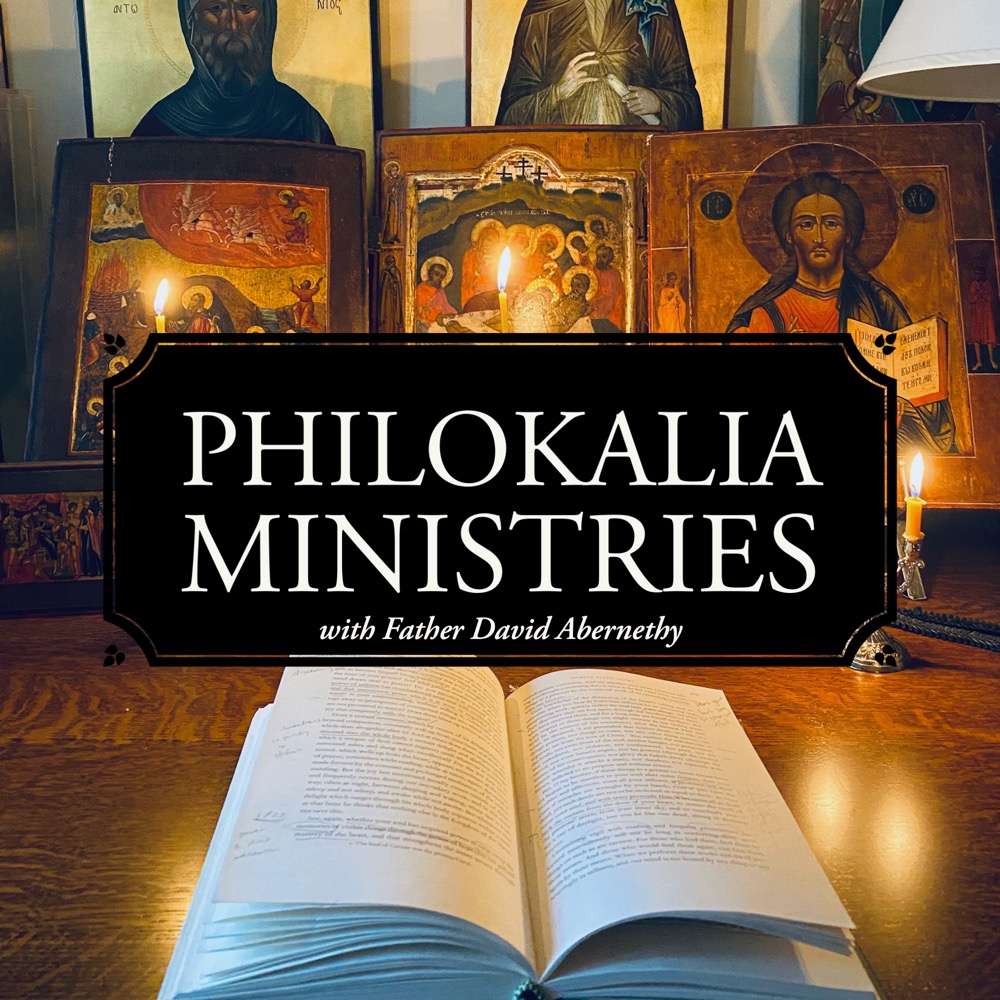
Philokalia Ministries
Father David Abernethy
Philokalia Ministries is the fruit of 30 years spent at the feet of the Fathers of the Church. Led by Father David Abernethy, Philokalia (Philo: Love of the Kalia: Beautiful) Ministries exists to re-form hearts and minds according to the mold of the Desert Fathers through the ascetic life, the example of the early Saints, the way of stillness, prayer, and purity of heart, the practice of the Jesus Prayer, and spiritual reading. Those who are involved in Philokalia Ministries - the podcasts, videos, social media posts, spiritual direction and online groups - are exposed to writings that make up the ancient, shared spiritual heritage of East and West: The Ladder of Divine Ascent, Saint Augustine, the Philokalia, the Conferences of Saint John Cassian, the Ascetical Homilies of Saint Isaac the Syrian, and the Evergetinos. In addition to these, more recent authors and writings, which draw deeply from the well of the desert, are read and discussed: Lorenzo Scupoli, Saint Theophan the Recluse, anonymous writings from Mount Athos, the Cloud of Unknowing, Saint John of the Cross, Thomas a Kempis, and many more.
Philokalia Ministries is offered to all, free of charge. However, there are real and immediate needs associated with it. You can support Philokalia Ministries with one-time, or recurring monthly donations, which are most appreciated. Your support truly makes this ministry possible. May Almighty God, who created you and fashioned you in His own Divine Image, restore you through His grace and make of you a true icon of our Lord and Savior Jesus Christ.
Philokalia Ministries is offered to all, free of charge. However, there are real and immediate needs associated with it. You can support Philokalia Ministries with one-time, or recurring monthly donations, which are most appreciated. Your support truly makes this ministry possible. May Almighty God, who created you and fashioned you in His own Divine Image, restore you through His grace and make of you a true icon of our Lord and Savior Jesus Christ.
Episodes
Mentioned books

Jan 22, 2015 • 1h 1min
Conferences of St. John Cassian - Conference Nine On Prayer, Part III
Germanus, Cassian's traveling companion, begins this section by talking about the mind's inconstancy and seeming inability to hold on to holy thoughts. He presses Abba Issac to move ahead with a discussion on how to pray without ceasing. But Abba Issac knows that there is work that must first be done in understanding the various aspects of prayer as outlined by the Apostle Paul and to see an example of the forms of prayer expressed perfectly and in unison by Jesus in the Our Father. No person's prayers are uniform and each is affected by their level of purity of heart.
A rather lengthy discussion ensued about the struggle with secularism and worldliness that impedes the freedom and simplicity necessary to allow prayer to become the focus and center of one's life.
Jan 15, 2015 • 1h 3min
Conferences of St. John Cassian - Conference Nine On Prayer, Part II
Picking up with Cassian's Conference 9 on Prayer, we continue to focus on the necessary dispositions for unceasing and pure prayer. We must not let anything, worldly vices or concerns, weigh us down; nor can we underestimate the impact of the actions and thoughts we may consider beneficial or of little significance hinder us. In fact, it is often that which appears good or innocent that is most destructive to our spiritual life because we pay it no attention and so don't struggle to overcome it. Sometimes we have hidden anxieties about worldly things and seek to find our identity in them or a sense of self worth and value in the eyes of others.
The simplicity of life and detachment that allows for true prayer often eludes us and we have to struggle as did the fathers to allow God to show us the depth of prayer He is calling us to in His wisdom.
Jan 8, 2015 • 1h 8min
Conferences of St. John Cassian - Conference Nine On Prayer, Part I
Prayer is the subject of conferences 9 and 10 and its importance is underlined at the very beginning of the 9th: "The end of every monk and the perfection of his heart incline him to constant and uninterrupted perseverance in prayer." But this constant prayer demands, in turn, perfection of heart and the virtues that go with it. This ninth conference serves as a kind of preliminary, among other things establishing the conditions for prayer and the different possible characteristics of prayer.
Nov 13, 2014 • 59min
Conferences of St. John Cassian - Conference Eight on Principalities Part III & Conference Nine On Prayer
After a brief hiatus due to illness, the group picked up with the final few pages of Conference Eight which was Abba Serenus' response to Germanus' questions as to whether demons could have had intercourse with the daughters of men and whether the devil had a father, given the words of Jn 8:44 "he is a liar and the father of it." Serenus responds to the first be asserting that a spiritual being could not have had carnal relations with a corporeal being. He explain the account in Gn 6:2, instead, in terms of the reprehensible intermarriages between the offspring of Seth and that of Cain. When they mingled with the wicked daughters of Cain, Seth's sons "abandoned that true discipline of natural philosophy which was handed down to them by their forebears and which that first man, who was at once immersed in the study of all natural things, was able to grasp clearly and to pass on in unambiguous fashion to this descendants. In particular, the group focused on a brief digression on how the law forbidding intermarriages such as these would have applied, since it was promulgated after the event. The old man points out that the holy ones of the OT had a natural and spontaneous knowledge of the law.
In response to Germanus's second question, Serenus says that God himself was the devil's father, for God created him. This issue, though perhaps not as pertinent in our day, was of great interest in Cassian's time. It had already been raised by heretics, who asserted that the devil was the offspring of a being other than God.
The group then moved on to Conference Nine which takes up the topic of prayer: the end of every monk (and of every Christan) and the perfection of his heart incline him to constant and uninterrupted perseverance in prayer. This constant prayer, Cassian teaches, requires in turn perfection of heart and the the virtues that go with it.
A rather lengthy discussion ensued about establishing such a clarity about the aims of the spiritual life and establishing not only the discipline but the simplicity of life that would foster such goals. The pursuit of such simplicity would set a Christian apart in a culture that values and exalts busyness.
Oct 24, 2014 • 58min
Conferences of St. John Cassian - Conference Eight on Principalities Part II
The group picked up with Abba Serenus' exposition of the nature and characteristics of demons - the fact that they occupy the airy void between heaven and earth, their hideous appearance, their mutual adversity (which is the result of their having befriended mutually opposed nations on earth), their titles, functions and hierarchy, and their assignment to individual human beings, such that each human being has a personal demon as well as a personal angel. It is fortunate that human beings cannot ordinarily see them, for otherwise they would either be horrified by their aspect or seek to imitate them in their wickedness. Finally , as aggressive as demons may be against humans, they may also obey them in one of two instances, either when rendered submissive by human holiness or when soothed by the sacrifices and incantations of the wicked.
Oct 16, 2014 • 1h 2min
Conferences of St. John Cassian - Conference Eight on Principalities Part I
The group took up Cassian’s eighth conference – listening once again to the wise counsel of Abba Serenus. This conference treats of demons in themselves and their origins. In particular, the question is raised: “Were they created by God, in all their variety, specifically to wage war against humankind?”
Serenus begins with some lengthy preliminaries about the interpretation of Scripture and about the possibility of understanding it both historically and allegorically. From there, he proceeds to affirm the goodness of everything that God created and hence those angelic beings that were created before the foundation of the visible world and that eventually fell came to be called demons. As far as their variety is concerned, the demons either maintained in hell the hierarchy that they originally had in heaven or imitated those ranks after the fall. Lucifer fell “a first time by pride, for which he deserved to be called a serpent, and a second fall followed as a result of envy.
A rather lengthy discussion ensued about the eternality of God and His foreknowledge of the Fall of angels.
Oct 13, 2014 • 1h 3min
Conferences of St. John Cassian - Conference Seven on the Changeableness of the Soul and on Evil Spirits Part IV
The group considered the closing sections of Conference Seven with Abba Serenus. The Divine Physician often will allow demons to afflict souls for the purposes of correction and at times that affliction will be severe; especially among the holy ones whose sin might seem slight in the eyes of the world but yet prevents the spiritual perfection to which God calls them. Serenus reminds Cassian and Germanus of the importance of praying ceaselessly for those who are afflicted and of encouraging frequent Communion as a means of spiritual healing.
Oct 2, 2014 • 1h 4min
Conferences of St. John Cassian - Conference Seven on the Changeableness of the Soul and on Evil Spirits Part III
The elder Serenus clarifies for Cassian and Germanus that the evil spirits, although capable of working in a kind of temporary accord, do not act in harmony with each other. Rather, a spirit must set out by itself to attack the mind in such a way that if it departs vanquished it gives it over to another spirit to be attacked more vehemently. Not all evil spirits are as powerful or fight with the same ferocity and with beginners and the weak only the weaker spirits are paired off in battle. The picture Serenus paints is of constant and intense warfare that only grows in its intensity with growth in virtue and holiness. The individual must learn to fight relentlessly and seek to completely defeat the enemy; developing a hatred for sin. If the power of demons seem blunted in our day in comparison to the early days of the anchorites it is most likely due to our negligence having made them milder and made them disdain to fight as they did against the more accomplished soldiers of Christ. This kind of a battle is used often by God to purify the soul of even the slightest sins; he chastises the ones whom he loves and scourges every son he receives in order to perfect them.
Sep 27, 2014 • 1h 21min
Conferences of St. John Cassian - Conference Seven on the Changeableness of the Soul and on Evil Spirits Part II
Germanus and Cassian continue to engage the elder Serenus about the action of evil spirits. Serenus with great patience and eloquence shows them that evil spirits only have the power to incite and that we as human beings remain capable of either rejecting or accepting their suggestions. We either choose to be deceived or fail quickly to oppose them. So called "possession" is only due to the weakening of the body that comes from the acceptance and embrace of sin; much akin to the effects of wine or fever on the human person. God alone is incorporeal and has access to the deepest part of our soul. Evil spirits, however, discern from bodily gestures and from perceptible movements whether temptation or suggestion has taken hold of the heart: for example, when a person has been silent, or sighing with a certain indignation, or his face pale or blush and thus they have a subtle knowledge of who is given to what vice.
Sep 18, 2014 • 1h 2min
Conferences of St. John Cassian - Conference Seven on the Changeableness of the Soul and on Evil Spirits
Cassian and Germanus seek out the guidance of the elder Serenus, whose name captures his character. Serenus had attained great purity of heart, peace, and freedom from the carnal desires of the flesh. Cassian and Germanus come to him in a state of despair; for although having labored for years they found their thoughts wandering and pulling them back to the things of the world and the passions. In their desolation they had begun to give up any hope of attaining such virtue and complain to Serenus that it is their nature that has prevented stability of mind and heart. Serenus in both his teaching and example is becomes the cypher though which we are meant to come to understand both the path to and nature of purity of heart. It is desire and thirst for God alone that can bring us to this freedom. Faith, Hope and Love are the weapons we use to engage in the battle (the theological virtues that have God as their end) and the depths of the heart is purified by the sharp sword of the Spirit. Once again the discussion was thoughtful and enriching and Cassian’s insights immeasurably valuable.

