

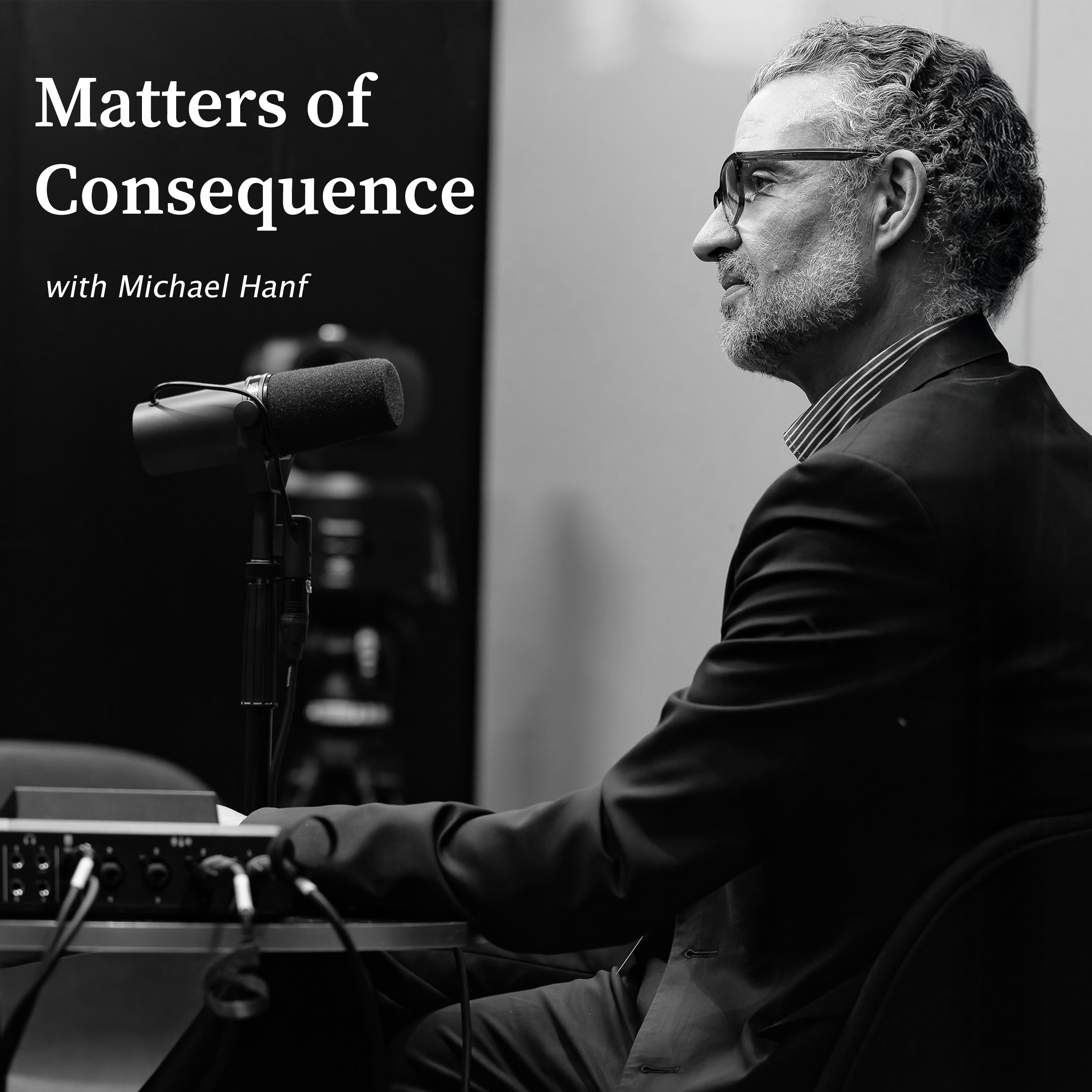
Matters of Consequence
Iksait Media
Matters of Consequence is a weekly podcast about interesting people and the things they are trying to change.Each episode is a conversation with someone engaged in work that feels meaningful. Sometimes it is ambitious and highly visible. Sometimes it is small, local, or quietly radical. This podcast is not about polished success stories or finished answers. It is about lived experience. About motivations, doubts, trade-offs, and responsibility. About what it feels like to try, to care, and to act in situations that are complex and unresolved.There is no fixed format and no attempt to extract lessons or frameworks. The focus is on listening, curiosity, and attention. On letting people speak in their own words, and letting conversations unfold in their own pace and direction.Matters of Consequence is hosted by Michael Hanf.You can find the podcast at: Matters of Consequence PodcastMatters of Consequence is also on LinkedIn: https://www.linkedin.com/company/106671921 Hosted on Acast. See acast.com/privacy for more information.
Episodes
Mentioned books

Jan 13, 2026 • 43min
Is it okay to laugh about the climate crisis?
In this episode of Matters of Consequence, Michael Hanf talks with Stuart Goldsmith. Stuart is a stand-up comedian who also describes himself as a climate comedian. He uses humour to talk about climate change, climate anxiety, and subjects that are often difficult to approach directly. Michael invited Stuart after seeing one of his performances and wondering how to feel about people laughing about the climate crisis. The conversation explores whether humour has a place in this context, and what it allows that other forms of communication might not. They talk about responsibility, hypocrisy, burnout, and the pressure to be perfect before speaking up. They also talk about comedy as a space where failure is allowed, and sometimes necessary. Hosted on Acast. See acast.com/privacy for more information.

Jan 6, 2026 • 2min
Let’s Start Here
This is a short introduction to Matters of Consequence.A podcast driven by curiosity, conversations, and the things people care about. Hosted on Acast. See acast.com/privacy for more information.

Dec 30, 2025 • 5min
A Closing Reflection
Over the past six months, The Future of Sustainability has explored how organisations, leaders, and societies respond to long-term challenges.This final episode reflects on what has changed during that time.As disruptions become more interconnected and consequences more systemic, many of the most important questions we face are no longer primarily technical. They are strategic. They are systemic. And they concern how decisions are made under uncertainty, and who carries their consequences.This episode closes The Future of Sustainability and explains why the conversation needs a different framing going forward. Hosted on Acast. See acast.com/privacy for more information.

Dec 16, 2025 • 28min
The Future of Project Management is Regenerative
How do we move from high-level sustainability ambitions to real impact in daily project work? In this episode of the Future of Sustainability podcast, host Michael Hanf speaks with Dr. Joel Carboni, Founder and President of GPM Global, and a pioneer in embedding sustainability directly into project management practice.Joel shares how his journey began as what he calls an “accidental project manager.” With a background in technology and local government projects, he saw that cost and schedule were managed in detail, but environmental and social impacts were barely addressed. That insight led him to create the P5 Standard for Sustainability in Project Management and the PRiSM methodology, tools now adopted globally and integrated into PMI’s portfolio.The P5 Standard reframes project success across five areas: People, Planet, Prosperity, Processes, and Products. Joel explains how this framework turns sustainability from an afterthought into a design principle. By setting thresholds at stage gates and embedding criteria into procurement and governance, teams can act before damage is done. “If you treat sustainability like cost or schedule, it becomes part of the conversation, not an extra,” he says.Joel also discusses the business case. Rather than trying to “sell” sustainability as an ethical add-on, he connects it directly to what CFOs already care about:Avoiding the trap of low upfront costs with high long-term expenses through life cycle costing.Cutting hidden costs through waste elimination.Reducing risk by embedding sustainability thresholds that prevent costly delays or reputational damage.Securing a license to operate by engaging stakeholders early and building trust.Drawing from his global work, Joel emphasizes the importance of cultural context. In Germany, precision and documentation define trust. In Bolivia, projects succeed only when communities are engaged as equal partners. “Principles are universal, but the playbook has to be local,” he explains.Looking ahead, Joel believes that “do no harm” is no longer enough. The new goal must be regeneration: leaving systems stronger than before. He describes how projects can move from harm minimization to active system improvement in areas like carbon, biodiversity, and equity. If project managers worldwide adopt this mindset, the compound effect will be transformative.Finally, Joel reflects on teaching future leaders. He sees younger generations arriving with strong expectations: they assume sustainability belongs in project management, and they want dashboards, predictive analytics, and measurable thresholds. They also choose employers based on values. “Organizations that embed sustainability will attract talent,” he observes.In this episode, you will hear Joel Carboni discuss:• How he developed the P5 Standard and PRiSM methodology• Why sustainability should be embedded into project controls, not added on later• How cost, risk, and resilience link directly to sustainable practices• Why culture shapes project delivery and how principles must adapt locally• Why regeneration is the new bar for success• What the next generation of project leaders expects from organizationsJoel’s message is clear: projects are how change shows up in the world. If project professionals embed sustainability into their work, small actions compound into global transformation. Hosted on Acast. See acast.com/privacy for more information.

Dec 2, 2025 • 34min
Evolving Capitalism Through Shared Prosperity
How can communities design systems that create prosperity for people, business, and the planet? In this episode of the Circular Coffee Break podcast, host Michael Hanf speaks with Barri Harris and Shane Lapp, Co-Leads of Circularity.One, a whole-systems initiative in British Columbia that is pioneering new approaches to community enterprise.Shane, an engineer turned community entrepreneur, and Barri, a former CFO and transformation consultant, share how their experiences in energy and finance led them to co-create a community enterprise framework. Their model blends private and community ownership, shared governance, and distributed decision-making to reimagine how value flows.The framework is being tested through a community-owned solar pilot, where residents, municipalities, and institutions invest together. Returns are steady over 25 years, utilities save on costly grid upgrades, low-income households see lower bills, and charities cut energy costs. As Barri puts it, “It becomes a win-win-win. Financial resilience for communities, operational benefits for utilities, and long-term sustainability for investors.”But Circularity.One is about more than solar. The model is expanding to address other complex community challenges, aiming to replace siloed fixes with integrated resilience. By mapping underlying systems and co-designing solutions, communities can address challenges such as homelessness or food insecurity with shared ownership and shared benefit.The conversation also explores the shift from power to trust in leadership. Instead of top-down control, Circularity.One practices consent-based governance and circle dialogue. Leaders must let go of fear, create role clarity, and help people build decision-making skills through mentorship and practice. As Shane notes, “When organizations move from heroic leaders to trust in collaboration, they unlock collective wisdom and resilience.”Barri and Shane are clear that capitalism itself is not the problem. The challenge is how it has been harnessed in recent decades. “We like to say we are evolving capitalism,” Barri explains. “It needs to be stewarded through shared values and a vision of prosperity that is bigger than the individual.”In this episode, you will hear:• How Circularity.One blends business discipline with community practice• Why value-stack data and shared ownership make solar viable even in low-cost markets• How consent-based governance creates trust and accelerates action• Why evolving capitalism means moving beyond quarterly profit to long-term stewardship• How to get started: from circle practice to piloting community wealth projectsBy 2030 and beyond, Harris and Lapp envision communities everywhere using this framework to manage energy, food, and housing in ways that are inclusive, resilient, and regenerative. They invite listeners to explore community wealth building, experiment with circle practice, and pilot projects that move from inspiration to action.Circularity.One’s story is not only about renewable energy. It is about rewriting prosperity itself — from extraction to stewardship, from power to trust, from silos to systems. Hosted on Acast. See acast.com/privacy for more information.

Nov 25, 2025 • 31min
FoS on the Road: Slush 2025
Slush 2025 made one thing unmistakably clear. Sustainability is no longer a side topic. It is the engine of a new wave of entrepreneurial innovation. In this special episode recorded live at Slush in Helsinki, Michael Hanf speaks with founders who are reshaping the future of energy, food, finance, and behavioural change.From wave energy devices designed for real world conditions, to next generation small wind turbines, to platforms that accelerate financing, planning, and grid integration, this episode explores the systems that are finally removing friction from the sustainability transition. We also look at how precision fermentation could rewrite the economics of protein production and how gamification can make sustainable behavior easier and more rewarding for young people.Guests include founders from Geco, Amertate Energy, Dowgo, Coeus AI, Synergi, Verley, and WasteSide. Together, their pitches reveal a transition that is speeding up and expanding in scope. The ideas presented at Slush show that the future of sustainability will be driven by simplicity, data, coordination, and a far more diverse mix of solutions than ever before. If you want a clear snapshot of where sustainable innovation is heading in 2025, this episode is a sharp and honest tour through the technologies and systems that matter most. Hosted on Acast. See acast.com/privacy for more information.

Nov 18, 2025 • 34min
The Sustainable Tourist: Carbon Transparency for the Guest Journey
What does it take to make sustainable travel the norm rather than the exception? In this episode of the Future of Sustainability podcast, Michael Hanf speaks with Rebecca Thompson, CEO and Founder of Sustainable Travel Tech, about how data and transparency can transform tourism.Rebecca’s journey began as a frustrated traveler. With a background in economics and climate policy, she knew the impact of tourism on emissions, but she struggled to find easy ways to book low-carbon trips. Blogs and certifications provided pieces of information, but nothing matched the seamless experience of mainstream platforms. This gap inspired her to build Sustainable Travel Tech, a B Corp social enterprise that helps accommodation providers measure their climate impact and present verified data at the point of booking.Travel is highly emotional, and people want their holidays to inspire joy rather than guilt. Rebecca stresses that the goal is not to shame travellers but to provide clear information so they can make the choices they already want to make. Surveys show most people prefer sustainable stays, but few have time to research. Verified data can make climate impact another simple metric alongside price and amenities, while storytelling around food, nature, and community experiences keeps the emotional side of travel intact.For accommodation providers, data is more than marketing. Measuring energy use and emissions creates a baseline, reveals hidden strengths, and guides investment in efficiency or renewables. Benchmarking against country averages can show where improvements are needed and highlight progress over time. As Rebecca puts it, “Without the data, you can’t show progress.”The conversation also explores broader challenges in tourism:Over-tourism concentrated in specific hotspots, often driven by social media.Certifications that are valuable but sometimes too complex or opaque for travellers to understand.Economic leakage, where local communities see little benefit from visitors.On greenwashing, Rebecca is clear: broad claims like “we are sustainable” no longer suffice. Operators should use specific, verifiable statements such as “50 percent of our energy is renewable.” At the same time, she warns against greenhushing, where fear of saying the wrong thing leads companies to stay silent about genuine progress. Verified, third-party data can help solve both problems by giving providers the confidence to communicate honestly.Looking ahead to 2030 and beyond, Rebecca envisions a travel industry where climate impact data for accommodation is as standard as flight emissions are today. Platforms like Skyscanner already display which flights have lower emissions. With enough property-level data, the same will be true for hotels, lodges, and resorts. This will create transparency for travellers, competitive pressure for providers, and better decision-making for tour operators and platforms.In this episode, recorded with Rebecca Thompson of Sustainable Travel Tech, you will hear:• Why she left policy to build practical tools for decarbonizing tourism• How emotional experiences and verified data can work together in travel decisions• Why measuring emissions is a competitive advantage for hotels• How greenwashing and greenhushing are shaping tourism marketing• What a sustainable booking process could look like in 2030The future of travel will not be defined by slogans but by trust. Data, transparency, and authenticity will determine whether sustainability becomes embedded in tourism or remains an afterthought. Hosted on Acast. See acast.com/privacy for more information.

Nov 4, 2025 • 33min
Building a wave of consensus for climate action
How do you talk about climate change in a way that opens minds instead of shutting down conversations?In this episode of the Future of Sustainability podcast, host Michael Hanf speaks with Kathleen Biggins, President and Founder of C-Change Conversations, a nonprofit dedicated to creating science-based, nonpartisan dialogue about climate change.Since founding C-Change in 2014, Kathleen has led the development of the C-Change Primer, a widely acclaimed multimedia presentation that has reached more than 23,000 people in 33 states and abroad. Rather than presenting climate change as a partisan or abstract environmental issue, the Primer reframes it as a risk management challenge with tangible implications for our health, economy, and national security.In their conversation, Kathleen shares why she founded C-Change Conversations after realizing that even friends, family, and colleagues lacked a clear understanding of climate risks. She explains how the organization developed strategies to "wake people up without turning them off" by grounding discussions in credible science, relatable examples, and the universal language of risk assessment.Listeners will learn:Why climate change is best understood not as politics, but as physics, chemistry, and riskHow different audiences respond to different entry points, from family safety and health to economic competitiveness and national securityThe evolution of the climate conversation in the United States, from denial to reluctant acceptance to concerns about costHow respectful engagement can transform skepticism into curiosity and open space for dialogueWhy personal actions, when visible and shared, can be contagious and help build momentum for systemic changeKathleen also discusses the challenges of working in polarized environments and highlights the importance of local action, personal agency, and community leadership. She argues that while global momentum toward clean energy is strong, the United States faces unique cultural and political headwinds that must be addressed through trust-building and consensus.Throughout the episode, one theme stands out: nobody wants to sacrifice their children's future. By framing climate change as a matter of stewardship, risk, and opportunity, C-Change Conversations is helping to create the social will that can unlock the political will for meaningful action.This episode is for anyone who has ever struggled to talk about climate change with colleagues, friends, or family, and for leaders looking to understand how to engage diverse audiences in one of the most important conversations of our time.Tune in to hear how Kathleen Biggins and C-Change Conversations are building a wave of consensus for climate action. Hosted on Acast. See acast.com/privacy for more information.

Oct 21, 2025 • 29min
State of the Ocean: Understanding Our Planet's Blue Heart
In this episode of The Future of Sustainability, host Michael Hanf speaks with Vidar Helgesen, IOC Executive Secretary of Intergovernmental Oceanographic Commission (IOC) of UNESCO and former Norwegian Minister of Climate and Environment. Helgesen shares his journey from politics and diplomacy to leading the UN’s central body for ocean science, and why safeguarding our oceans is one of the defining challenges of our time.The ocean is more than a vast expanse of water. It is Earth’s life-support system. It produces half the oxygen we breathe, regulates climate and weather, and sustains biodiversity and livelihoods worldwide. Yet it remains the least understood and least protected part of our planet. Only 27 percent of the seafloor has been mapped, and vast regions of marine life remain undiscovered. As Helgesen warns, “We need to learn more and faster about the ocean.”Together, Michael and Vidar explore:The role of Intergovernmental Oceanographic Commission (IOC) of UNESCO in coordinating global ocean science and turning knowledge into policyWhy investing in ocean observation such as satellites, buoys, tide gauges, and data sharing is critical for disaster preparedness, agriculture, fisheries, and climate actionThe growing importance of international agreements like the High Seas Treaty and the 30x30 biodiversity pledgeHow businesses and industries can support sustainable ocean economies and why innovation will be key to unlocking opportunities in food, health, and technologyThe challenges of public awareness, including why plastics have captured attention while issues like nutrient pollution, dead zones, and destructive fishing remain under the radarPractical steps individuals can take as consumers, from choosing sustainable seafood to supporting better ocean policiesHelgesen calls the ocean “the beating blue heart of our planet,” reminding us that all societies depend on its health, whether we live by the coast or thousands of kilometers inland. From rainfall patterns and food production to weather extremes and marine biodiversity, our futures are tied to the ocean’s fate.Looking ahead to 2030 and the UN Decade of Ocean Science for Sustainable Development, Helgesen envisions a world where ocean knowledge is not just generated by scientists but widely shared, owned, and acted upon by governments, industries, and citizens alike. Building this collective awareness, he argues, is the essential first step toward safeguarding the ocean for future generations.Tune in to hear why the ocean must move to the center of the sustainability agenda and what we can all do to keep our planet’s blue heart beating strong. Hosted on Acast. See acast.com/privacy for more information.

Oct 7, 2025 • 32min
Making biodiversity count for business
In this episode of the Future of Sustainability podcast, Michael Hanf speaks with Dr. Debbie Saunders, Co-Founder and CEO of NatureHelm and Founder and former CEO of Wildlife Drones. Debbie’s career spans more than 25 years as a conservation ecologist, moving from hands-on fieldwork with endangered migratory birds to building groundbreaking technologies that help businesses and researchers better understand and protect biodiversity.Debbie shares her personal journey from tracking parrots in Australia to founding two deep-tech ventures that are transforming how society engages with nature. With Wildlife Drones, she pioneered a radio-telemetry system that allows researchers to track dozens of animals simultaneously across challenging landscapes. Today, that technology supports conservation projects worldwide, from pangolins in Vietnam to finches in the Galápagos Islands. But her story didn’t stop there. Recognizing that biodiversity data was fragmented and underutilized, Debbie launched NatureHelm to bring clarity, intelligence, and actionable insights to corporations and supply chains.The discussion explores the intersection of science, technology, and entrepreneurship, and how these can work together to scale solutions for the planet. Debbie explains how NatureHelm aggregates data from diverse sources, integrates ecological knowledge, and leverages AI to identify risks, dependencies, and opportunities for businesses. Whether it’s understanding the role of pollinators in supply chains, visualizing global migratory patterns from a single urban site, or mapping the ecosystem services behind water use, NatureHelm helps companies move beyond reporting into meaningful action.Throughout the conversation, Debbie highlights the challenges and opportunities of building biodiversity intelligence:Why businesses often underestimate their biodiversity footprint and how to change that mindset.How regulatory frameworks like the Taskforce on Nature-related Financial Disclosures (TNFD) are driving corporate engagement.Why technology alone is not enough, and why user-centric design and storytelling are essential to building impact.The critical role of resilience, from regenerative cotton production in India to sustainable asset managers advancing industry standards.Debbie also offers candid insights into her entrepreneurial path: the importance of validating ideas, securing funding, and surrounding yourself with people who believe in your vision. Her advice to young researchers and aspiring change-makers is simple yet powerful, be passionate, create value, and keep going despite the sceptics.This episode is both a call to action and a source of hope. It shows that with the right blend of ecological expertise, innovative technology, and business leadership, companies can contribute to a nature-positive future while strengthening their own resilience. From parrots to platforms, Debbie Saunders’ journey illustrates how personal passion can grow into global impact.Tune in to hear how biodiversity intelligence is reshaping the future of sustainability and why every business, whether in fashion, food, technology, or finance, has a role to play in protecting the ecosystems that sustain us all. Hosted on Acast. See acast.com/privacy for more information.

