

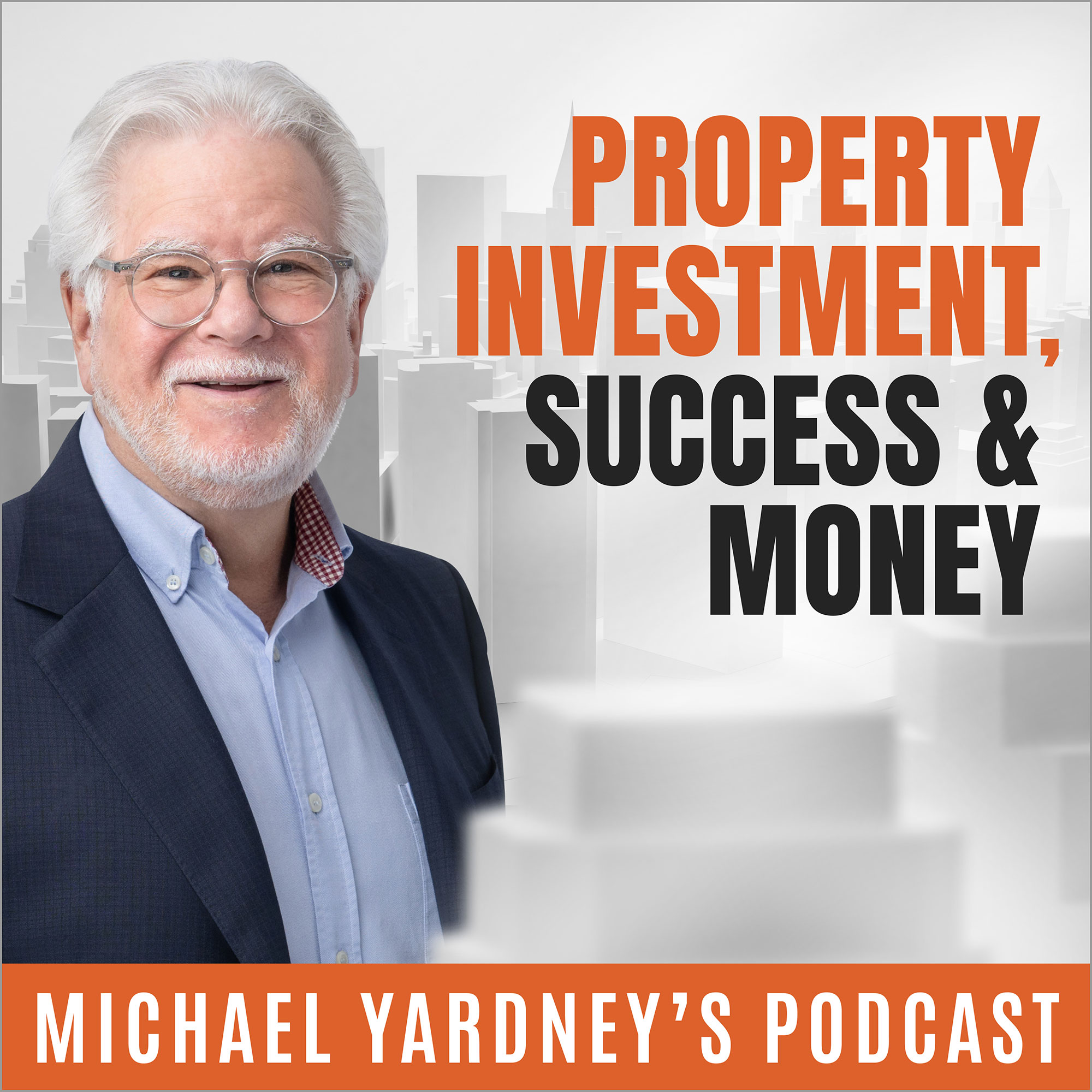
Property Investment, Success & Money | The Michael Yardney Podcast
Michael Yardney; Australia's authority in wealth creation thru property
If you want to create wealth through property investment, you're in the right place. Twice each week, Michael Yardney helps investors gain clarity amongst the confusion of the many mixed messages regarding the real estate markets so they can develop the financial freedom they are looking for. He does this by sharing Australian real estate market insights, smart property investment strategies, as well as the wealth creation, success and personal finance secrets of the rich, in about 30 minutes each show.
Michael has been voted one of Australia's top 50 Influential Thought Leaders. While he is best known as a real estate investment expert and property market commentator, he is also Australia's leading expert in the psychology of success and wealth creation and a #1 best-selling author of 9 books.
Michael frequently challenges traditional finance advice with innovative ideas on property investing, personal finance and wealth creation.
His wisdom stems from his personal experience and from mentoring over 3,000 business people, investors and entrepreneurs over the last 26 years.
Michael's message will be priceless regardless of the size of your real estate investment portfolio. Whether you're just starting investing in property or an experienced investor wanting to move to the next level, he will provide you with proven strategies for creating wealth through real estate, giving you a roadmap for real estate investing and financial success.
http://MichaelYardneyPodcast.com
Michael has been voted one of Australia's top 50 Influential Thought Leaders. While he is best known as a real estate investment expert and property market commentator, he is also Australia's leading expert in the psychology of success and wealth creation and a #1 best-selling author of 9 books.
Michael frequently challenges traditional finance advice with innovative ideas on property investing, personal finance and wealth creation.
His wisdom stems from his personal experience and from mentoring over 3,000 business people, investors and entrepreneurs over the last 26 years.
Michael's message will be priceless regardless of the size of your real estate investment portfolio. Whether you're just starting investing in property or an experienced investor wanting to move to the next level, he will provide you with proven strategies for creating wealth through real estate, giving you a roadmap for real estate investing and financial success.
http://MichaelYardneyPodcast.com
Episodes
Mentioned books

Jul 29, 2019 • 35min
Could Australia really fall into recession? | What if my investment property ends up on Airbnb?
Imagine you woke up one morning and found out your investment property was on Airbnb. Your tenant, who you thought was looking after your property is now letting anyone and everyone in. What are your rights? What would you do? Today we're going to have a chat with Leanne Jopson about what your rights are and how you can prevent this. I'm also going to share in my mindset moment, six things successful people only ever do once. In our first segment, I'm going to chat with Ken Raiss about whether Australia could fall into a recession. Are we in trouble? What could be ahead? What should we watch out for? You'll find out in today's episode. Could Australia really fall into recession? What is a recession? A recession measures how the economy is growing measuring GDP. Every quarter is measured against the previous quarter. A recession is when the value of goods and services (GDP) has fallen in two quarters in a row. According to Ken Raiss, if a recession did occur now, the bounce back would be relatively fast. The negatives at the moment are subdued property prices and wage growth. But more people have jobs than ever before and for most people, the ability to pay their living expenses and home expenses is driven because they have a job. The unemployment rate is at the lowest it's been for quite some time. The Australian economy has turned around in relation to property process, so the rate of decline has slowed. There's a lot of activity in the economy and money being generated. The RBA has relaxed its restrictions on home lending. APRA have reduced the gap that they require to show that people have an ability to repay. We also have a more stable government, we're seeing a stimulus by the government at both the state and federal level, and we're seeing growth in iron ore and coal, both in price and volume. Additionally, population growth is up. These are all signs that we should be optimistic about the future of Australia's economy. What if my investment property ends up on Airbnb? Leanne Jopson Every state has slightly different legislation, but landlords do have protection against their tenants letting out their properties on Airbnb. In Victoria, owners' corporations have the power to impose fines on owners of properties where their tenants who disturb other residents. They can be charged a separate fine for each resident affected. Across all states, landlords are protected because a tenant can't sublet your property without permission. That restriction was briefly lifted in 2016, but now it's back in place. In New South Wales, planning laws limit the number of nights that a property can be let on a short-term stay basis (like Airbnb). The key to finding out a tenant is subletting is having a professional property manager monitor for telltale signs. Some signs include: Key safes outside of properties Too many toothbrushes Empty or extra beds Lots of spare linen in the cupboards When it comes to insurance claims for damage caused by an Airbnb letting, if you granted permission for your tenants to let the property, you will need to have your policy adjusted to cover that risk. But if your tenants were letting the property without your permission or awareness, you'll be able to make a claim for your damages. Links and Resources: Michael Yardney Metropole's Strategic Property Plan – to help both beginning and experienced investors Ken Raiss – Metropole Wealth Advisory Organise a time to speak with Ken by clicking here: www.Wealth.Metropole.com.au Leanne Jopson – national director Metropole Property Management Some of our favourite quotes from the show: "Sometimes we ignore our gut instinct about people, and it can get us into hot water." – Michael Yardney "If you make decisions based on what you may think feels good in the moment, then it's very likely you're going to fail to take care of your long-term plans." –Michael Yardney "If you're not strong on detail, you'd better surround yourself with people who are." – Michael Yardney PLEASE LEAVE US A REVIEW Reviews are hugely important to me because they help new people discover this podcast. If you enjoyed listening to this episode, please leave a review on iTunes - it's your way of passing the message forward to others and saying thank you to me. Here's how
Jul 24, 2019 • 30min
Are we heading into dangerous territory? What the RBA minutes reveal - PROPERTY INSIDERS
The Reserve Bank's board meeting minutes for July paint a much more gloomy picture of the economy than the one governor Philip Lowe paints in public. The RBA has left the door open to even more interest rate cuts due to their ongoing concern about the state of the jobs market and the lack of wages growth. So what does this mean for our economy, for our property markets and for your pay packet? The RBA board members agreed jobs growth needed further acceleration when they cut the cash rate to a record low to 1% at the beginning of July, but the minutes from the central bank's latest board meeting confirmed that further rate reductions are on the table. In fact the money markets are pricing in a 78% chance of another 0.25% rate cut in November. Some of the topics we discuss: What is going on with our economy The RBA minutes seem to contradict the positive spin RBA governor Phillip Lowe put on things when he recently met with Treasurer Josh Frydenberg and said: "I agree 100 per cent with you that the Australian economy is growing and the fundamentals are strong." The Reserve Bank seems to have set itself some ambitious goals when it indicated that it wanted our unemployment rate to drop to 4.5 per cent, which they argued would mean full employment. At that level the RBA believe excess capacity in the labour market would be soaked up, wages would start to rising and in turn this would drive inflation back up into the RBA's target band. This looks like quite a challenge. The last time unemployment was that low was late 2008, and inflation has only been in their preferred range of 2-to-3 per cent a couple of times in the past five years. The big question is - where will all the new jobs come from. With the construction industry slowing down and retail spending languishing, it will be really hard to create the number of new jobs the RBA is hoping for. Will this lead to another property boom? Some commentators are suggesting we're on the cusp of another property boom with surging house prices. While lower rates and more jobs will be positive for our property markets, I don't see a property boom ahead. Sure prices will flatten out over the next few months and then start rising gently, but it is likely property values will only rise 3% to 5% in our 3 big capital cities next year. Of course our markets will, as always, be fragmented, so some areas will outperform. However if overall house prices do respond aggressively, this will create a policy dilemma for the RBA which doesn't want this to occur. What's happening on the jobs front The continued flood of new job seekers has pushed the participation rate to record highs and meant solid employment growth has made no inroads into the unemployment rate (5.2%) which has actually climbed a little over recent months. Why we are skeptical that lower rates will decrease the unemployment rate to the range the RBA is looking for. If the RBA expects growth will only return to trend "over coming years", then it's unclear how the economy will produce enough jobs to push the jobless rate to 4.5 per cent or below, which is where monetary policymakers now reckon it needs to be before we get some meaningful and sustainable wages growth. Links and Resources: Dr. Andrew Wilson, chief economist of MyHousingMarket.com.au Join us at our annual Property Renovations and Development Workshop in October – click here for more details This podcast was originally published as a video here:Are we heading into dangerous territory? What the RBA minutes reveal – PROPERTY INSIDERS VIDEO PLEASE LEAVE US A REVIEW Reviews are hugely important to me because they help new people discover this podcast. If you enjoyed listening to this episode, please leave a review on iTunes - it's your way of passing the message forward to others and saying thank you to me. Here's how
Jul 22, 2019 • 33min
This is what really moves property markets – and it's not what you think | Insights into how to fail | Tips to gain financial fitness
The mood for our property markets has definitely changed. If I were to ask you what moves our property markets, what would you say? Finance? Supply and demand? Today I'm going to discuss one of the major factors that move our property markets. It's one that most people don't talk about or understand. In my mindset moment I'm going to discuss ways to fail. This show is usually more about success than failure, but if you understand how to fail, you'll better understand what not to do so that you can become more successful. Finally, I will have a chat with Ken Raiss about some finance hacks about getting more financially fit. How investor mindset moves the markets Market movements are far from an exact science. The fundamentals are easy to monitor. Things like population growth, supply and demand, employment levels, interest rates, affordability, and inflationary pressures. However, one overriding factor that the experts have difficulty quantifying is investor sentiment. And that's what's really been behind market movements of late. We're not rational I've found that investors often suffer lapses of logic when investing and many of their investment decisions are driven by emotion. For example, we tend to extrapolate the present in the future. When things are booming we tend to think the good times will never end and when the market mood is glum, we have difficulty seeing the light at the end of the tunnel. Can you see how investor psychology, drives booms and busts? Can you see how the dominant investor mentality of the time helps drive the property cycle? Just to make things clear…homebuyers, who make up around 70% of property transactions drive our property markets. But investor activity creates our booms and busts. We follow the herd. Obviously, one or two misguided investors won't be able to influence property prices, but investor psychology is infectious. People tend to want to do what others are doing - they 'follow the herd' because going against popular opinion is perceived as risky. What if you make a mistake? What if "the crowd" is right and you are wrong? This behaviour stems back to the days of our ancestors when it was safer to remain part of the herd rather than leave the security of the pack and be eaten by a Saber-toothed Tiger. This "herd behaviour" is magnified by several things including; Mass communication enabling the behaviour to become infectious. Now more than ever we are bombarded with messages from the media that influence how we think and feel about things. When we hear that real estate is doomed, all but a handful of sophisticated investors get scared out of the game. And when the media tells us housing markets are booming everyone wants a piece of the action. Pressure to conform. If your friends or family are doing it, it must be right. Right? Human nature makes us reluctant to do the opposite of what our peers are doing. A major precipitating event can give rise to a general belief that motivates investor behaviour. The Global Financial Crisis that saw waves of investors scared out of the share and property markets. On the other hand, the resource boom enticed thousands of investors into mining town housing markets to cash in on the resulting property boom. A general belief that grows and spreads. When the belief that property values can only go one way, and that is up, spreads through an uneducated new generation of investors the enter the market pushing up prices, perpetuating the belief and helping make it a reality! Similarly, when the herd believes the market is going to crash, they steer clear, this gets reported in the media and the negative sentiment feeds on itself. When investor sentiment is positive, the crowd jumps in feet first, pushes up demand and places upward pressure on prices – causing boom conditions. Conversely, when sentiment is negative, the crowd backs off and frequently sells out of the game due to concerns that they're about to lose everything – causing market slumps. What can an investor learn from this? Our property markets aren't only driven by fundamentals, but also by the often irrational and erratic behaviour of unstable crowd investors. Booms never last forever, and neither do busts. Don't be surprised when they come around and don't overreact. This will stop you from getting sucked into the booms and spat out during the busts. Treat your property investments like a business and stick to a proven strategy to help take the emotion out of your decisions. Recognise that property is a long-term play and set up financial buffers to help you ride the property cycles. Invest counter cyclically I've always been an advocate of counter-cyclical investing because moving against the crowd often produces the best results and can mean the difference between outstanding gains in the property market and average ones. Sure, it takes some courage to do the opposite of what everyone else is doing, but the results of your contrary behaviour will ultimately speak for themselves. Now seems the best time in almost a decade to invest counter-cyclically. Tips to gain financial fitness – Ken Raiss Have a plan. You need to identify where you are now and what your goal is, then put a plan in place to achieve those goals. Have a savings regime. Deposit money from your income in savings before you see the money. Reinvest for growth. Compound growth helps you get a better result. Invest in capital growth assets. That capital base will give you the ultimate choice when you need to live on your investments in the future. Borrow, because it's leverage that will help you create wealth Find a good coach and mentor, and build a team around yourself. Find a winning formula and stick to it Don't beat yourself up for things you can't control. Make a plan that has some room for flexibility and safety nets for unexpected negatives. Think big and don't restrict your dreams. Get people around you who will help you achieve your dreams. Links and Resources: Michael Yardney Metropole Property Strategists Metropole's Strategic Property Plan – to help both beginning and experienced investors Ken Raiss – Metropole Wealth Advisory Some of our favourite quotes from the show: "To grow as a human being requires work, and more often than not, it requires embracing the unknown." –Michael Yardney "It comes up every time you speak with successful people about what you need to do to get there. Having goals and then having written plans comes up every time." – Michael Yardney "Building wealth isn't a solo game." –Michael Yardney PLEASE LEAVE US A REVIEW Reviews are hugely important to me because they help new people discover this podcast. If you enjoyed listening to this episode, please leave a review on iTunes - it's your way of passing the message forward to others and saying thank you to me. Here's how
Jul 17, 2019 • 22min
3 Pitfalls of building your business the wrong way | Build a Business, Not a Job Podcast
Want to build a business and not a job? If you're a business owner, entrepreneur or professional, you'll have to grow your business very differently to most people. The traditional way to build a business is to build a Level Two business. In a Level Two business, you as the business owner gather up the reins of power. If something should happen to you, your business would crumble. If you manage to somehow escape for a short vacation, you probably sneak your laptop or iPhone with you on the trip and check email when your spouse and kids aren't looking. What's wrong with building a level 2 business? Pitfall 1: It caps your income and your success. If your business revolves around you and your personal production, as you become more successful, you'll smack up against the ceiling of how much you personally are able to produce for your business. Pitfall 2: It puts everyone at greater risk. If you stop working or get injured, your business dies—quickly. This is risky for you, your family, your employees, your customers, and your investors. Pitfall 3: It eventually corners you in the Self-Employment Trap™— the more success you have, the more trapped you become inside your business. You're so busy doing the "job" of your business that you can't step back and focus on growing your business. What's the way out of the Self-Employment Trap? Simple: build a business, not a job. In the traditional Level Two approach, you try to escape by personally working harder. But that's like stepping on a treadmill and saying that the way to get off is to simply run faster. Not so. The faster you run, the faster the speed of the treadmill. You take on more overhead and hire more employees, but you put them into a Level Two model that merely increases your personal pressure to produce. A job is something that you do yourself; a business you build does your job for you! Getting your business to do more means building the infrastructure that profitably produces value in the market in a scalable way. This means building your business with the end in mind, the end being the day when it no longer needs your time and attention on a daily basis. As you enter Level Two, you'll face a crucial decision point at which you can settle for owning a Level Two job or instead choosing to raise your business to be a strong and independent entity that benefits from your involvement but is ultimately independent of it. The traditional Level Two approach is for you the owner to work harder, to do more—to work at the job of your business. The Level Three solution is for you to do less and get your business to do more. The 4 Building Blocks of All Level Three Businesses Every Level Three business is made up of these four key building blocks: Systems Team Controls Scalable solution Links and Resources: Metropole's Business Accelerator Mastermind Mark Creedon – Business Coach to some of Australia's leading entrepreneurs Some of our favourite quotes from the show: "I've learned over the years that it really is important to let go of control" –Michael Yardney "If everything's dependent upon you, what happens if something happens to you?" –Michael Yardney "Having a group of people around you who are already movers and shakers, who are already successful, that's so, so different to reading something on the internet. It's so different to reading a book or listening to a podcast." –Michael Yardney PLEASE LEAVE US A REVIEW Reviews are hugely important to me because they help new people discover this podcast. If you enjoyed listening to this episode, please leave a review on iTunes - it's your way of passing the message forward to others and saying thank you to me. Here's how.
Jul 15, 2019 • 31min
7 Tips for a better financial future | The investment that separates the rich from the poor
If you're looking for more money, more success or to learn to be a better property investor, today's show is for you. I'm going to share three important concepts in today's episode. Firstly, I'll be sharing some tips for a better financial future. Then, in my mindset moment, I'll explain the big investment that the rich make that the poor don't. Finally, I'll have a chat with Brett Warren, the Director of Metropole Properties in Brisbane, about the lessons that he would have liked to know earlier in life that would have helped him become a better investor and more successful person. 7 Tips for a better financial future Start paying attention to your finances Allocate where your money is going Faithfully follow your budget Keep track of your net worth Set some financial goals Pay off your debts Spend less than you earn, and start saving the rest The investment that separates the rich from the poor I'd like to share with you one surprising investment that separates the rich from the poor. And that's how you invest your time. That's going to determine how your financial future will unfold. People often tell me they can't invest because they don't have enough money, and I tell them that if they don't have enough money, invest their time. However, most people don't have enough time to invest either. They think working harder or longer is going to make them richer. But nothing could be further from the truth. The problem is most of us are working harder, but the inflation-adjusted wages have stayed stagnant. Working more doesn't mean making more or keeping more. Rich people work to build assets. This means businesses or investments that will bring cash flow whether the person is working or not. Adding assets doesn't mean working longer or harder. The more financially fluid you are, the less you'll need to work. Rich people know how to make their money, and other people's money, work for them. Lessons for Better Property Investing and Success Location does 80% of the heavy lifting Choose capital growth over cash flow Success comes from a series of small steps in the right direction Successful people have multiple streams of income Links and Resources: Michael Yardney Metropole Property Strategists Metropole's Strategic Property Plan – to help both beginning and experienced investors Brett Warren – Director Metropole Properties Brisbane Some of our favourite quotes from the show: "Debt takes away your options, and debt takes away your future financial freedom" –Michael Yardney "Never buy anything with your credit card that you can't pay off by the end of the month." –Michael Yardney "Success is a long-term journey, and along the way, as we've mentioned before, there's lots of little failures." –Michael Yardney PLEASE LEAVE US A REVIEW Reviews are hugely important to me because they help new people discover this podcast. If you enjoyed listening to this episode, please leave a review on iTunes - it's your way of passing the message forward to others and saying thank you to me. Here's how
Jul 10, 2019 • 28min
The latest Australia property market forecasts
Would you like to know where house prices are going to be at the end of this year and next year? Today, I'll share the latest forecasts from Domain, and we're going to run through them state by state and explain what might make them better or worse depending upon what happens in our economy. Then in my mindset moment, I'm going to show you how you won the lottery. Today's episode contains a lot of numbers and figures, but I think the trends that I'm going to explain will give you some comfort. What's Ahead for Australia's Property Market? Remember, it wasn't that long ago that our media was predicting housing market Armageddon. The property pessimists have again been proven wrong. Having said that, this has been the longest and the deepest property downturn in modern history. What's ahead? Remember there is not one property market nor one Sydney or Melbourne property market, but having said that, Trent Wilshire, economist for Domain, forecasts that property values are likely to stabilize in the capital cities by the end of the year, and in fact rise in some locations, and he predicts moderate growth in 2020. Forecast for Sydney: House and apartment prices will be 2% higher by the end of 2019 In 2020, house prices will increase by 3 to 5% Apartment prices will rise by 2 to 4% in 2020 About 25% of home loans in New South Wales in March went to first home buyers Prices of off-the-plan and new apartment in high rise towers Sydney are likely to fall Forecast for Melbourne: House prices have fallen about 11% since their peak, and apartment prices have fallen about 8% Prices are likely to increase by about 1% by the end of 2019 In 2020, house prices will increase by 1 to 3% Apartment prices will rise by 0 to 2% in 2020 Melbourne's population is predicted to rise by 10% in the next few years Forecast for Brisbane: Housing prices will bottom out in the next 6 months and rise by 1% by the end of this year and 3-5% in 2020 After bottoming out apartment prices in Brisbane will remain flat next year. Brisbane's fragmented market means that some areas will rise faster than others Forecast for Canberra House prices will rise by 2% by the end of 2019 Apartment prices will rise by 1% by the end of 2019 Canberra will be the strongest property market in 2020 House prices will grow by 4 to 6% in 2020 Apartment prices will be subdued by the oversupply of apartments Apartment prices will grow by 1 to 2% in 2020 Forecast for Perth: Prices will bottom out over the next 6 months After prices bottom out, there will be slow growth Perth will see 0 to 2% growth in 2020 Perth will see a rise in population growth Forecast for Hobart: Hobart has been the best performing property market in the last 3 years, but the boom is over Hobart will not see any growth in housing for the rest of 2019 Apartments will grow by 2% in Hobart by the end of the year There will be 2 to 4% growth in Hobart house prices in 2020 Forecast for Adelaide Adelaide property prices continue to rise slowly Adelaide will see 1% growth for houses in 2019 Adelaide will see 2% growth in apartments in 2019 In 2020, Adelaide's housing prices will rise by 1 to 3% Links and Resources: Michael Yardney Metropole Property Strategists Metropole's Strategic Property Plan – to help both beginning and experienced investors Some of our favourite quotes from the show: "Remember, Melbourne is rated as one of the 10 fastest growing large capital cities in the developed world." –Michael Yardney "Property prices are driven by investors in particular." –Michael Yardney "Entitlement gets us nothing but heartache. It blinds us to the magic of gratitude." –Michael Yardney PLEASE LEAVE US A REVIEW Reviews are hugely important to me because they help new people discover this podcast. If you enjoyed listening to this episode, please leave a review on iTunes - it's your way of passing the message forward to others and saying thank you to me. Here's how
Jul 8, 2019 • 23min
National Property Market Update – July 2019 with Dr. Andrew Wilson | PROPERTY INSIDERS
There is change in the air – our property markets are showing some promising signs And the biggest question buyers and sellers in Sydney and Melbourne are asking is: "Are we there yet?" In other words, they're wondering have our property markets hit the market floor and is it time to get back in again? We've also received the much anticipated second interest rate cut, which by the way isn't good news. In this month's Property Insiders market update Dr. Andrew Wilson and I bring you up to date on what's happening around our property markets. We discuss This month's interest rate announcement – the RBA is clearly targeting unemployment. They want to move the unemployment rate down into the low 4's to soak up the spare capacity in the employment market with the aim of impacting wages growth. The Global economic environment. The major story this month has been the trade tensions between the US and China. If they persist they could impacting global GDP but we did see some positive moves recently with a downgrading of the tensions. The Domestic economy – including GDP - we saw the March quarter GDP figure — growth for the March quarter of 0.4%, which meant that the annual pace of growth in the economy has dropped from 2.4% down to 1.8%. The unemployment rate in May was steady at 5.2%. There were 42,300 jobs created — the strongest monthly jobs growth in the past 12 months – 39,800 new part-time jobs were created, whereas only 2,400 jobs full-time. The participation rate rose to 66%, which is the highest it's ever been in terms of people looking to get employment. The Wilson Asking Price Index - There are mixed signs this month with asking prices improving in Sydney – but falling elsewhere Auction clearance rates What's ahead? Nationally our property markets are likely to bottom out in the next few months and property values are likely to be a little higher at the end of the year than they are today. While servicing a mortgage may become a little easier, the introduction of the Banking Code of Conduct and the expansion of Comprehensive Credit Reporting from the beginning of July means the scrutiny on loan applications will remain significantly greater than it has been in the past. Given this, don't expect a significant bounce in property values – the recovery in housing market conditions is likely to be slow and gradual. Links and Resources: Guest: Dr Andrew Wilson – MyHousingMarket.com.au July 2019 Housing Market Commentary | PROPERTY INSIDERS VIDEO PLEASE LEAVE US A REVIEW Reviews are hugely important to me because they help new people discover this podcast. If you enjoyed listening to this episode, please leave a review on iTunes - it's your way of passing the message forward to others and saying thank you to me. Here's how
Jul 3, 2019 • 25min
Success Habits Of The Rich – Part 4 | RICH HABITS, POOR HABITS Podcast
Our subconscious never sleeps, it keeps working tirelessly day in and day out. It's the seat of our emotions and our memory and it responds to our beliefs. That's what I want to talk to you about today. There's something in your brain called the reticular activating system that acts as a data filter. Our brains are constantly bombarded with millions of bits of information, and this system eliminates most of those, allowing in only the sounds it's preprogrammed to allow in. What I'm trying to show you in these sessions, is that some of the habits we have are engrained in the subconscious. We all have empowering and disempowering habits. In today's show, I want to go through with you the habits that differentiate between the successful people and the average person so you can learn to work on developing habits that will help you on your way to success. Success Habits of the Rich Successful people don't believe in or wait for fate, destiny, chance or luck to determine or shape their future. They believe in and are committed to actively and consciously creating their own best life. The poor think about money emotionally, while the rich think about money logically. Successful people have a plan for their lives and work methodically at turning that plan into a reality. Their lives are not a blundering series of unplanned events and outcomes. The poor often think that rich people are dishonest, while successful people know that rich people are ambitious. While the poor believe money is the root of all evil, wealthy people know that poverty is the root of all evil. The poor believe money changes people. The rich understand that money reveals people. The poor are worried that if they become rich they will lose their friends. The Rich believe being wealthy will expand their network. Successful people are resilient. When most would throw in the towel, they're just warming up. The poor believe their thinking is unrelated to their net worth. Successful people know their mindset is critical to their results. Many people believe you have to be educated and smart to be rich. Successful people know intelligence has little to do with getting rich, but know they have to be financially fluent. Links and Resources: Michael Yardney Metropole Rich Habits Poor Habits Some of our favourite quotes from the show: "People sabotage themselves and they don't get rich because they have these feelings that the rich are ugly greedy bad people, and that's not necessarily the case." –Michael Yardney "If you can change your habits, you're going to change your life." –Michael Yardney "Your mindset is critical to your results in life, in all areas of your life, including money." –Michael Yardney PLEASE LEAVE US A REVIEW Reviews are hugely important to me because they help new people discover this podcast. If you enjoyed listening to this episode, please leave a review on iTunes - it's your way of passing the message forward to others and saying thank you to me. Here's how.
Jul 1, 2019 • 29min
16 things I wish I knew when I started investing
I'm often asked what I would do differently if I could live my investing journey all over again. If you ask me, one of the keys to investment success is the ability to pick yourself up from setbacks, learn what you can from them (including your own limitations) and simply try again. So, to help prevent you from making the same mistakes, I've put together 16 things that I wish I'd known when I first started investing. The value of education My first couple of investments were successful, but the worst thing that can happen to a beginning investor is to get it right the first time – you think you're smarter than you are when in truth my early successes were because of a rising market rather than my own "brilliance". Thankfully, I recognised this and set about becoming better educated by reading books and seeking out teachers, mentors, and consultants for advice. And I still continue with my education and personal development to this very day. Goal setting Far too many people invest in property with no idea what they want to achieve or by when. They may buy one or two investment properties, usually in suburbs where they live or "understand", but they haven't set any clear long-term goals. Setting goals helps you focus because if you don't know where you're going, while any road may get you there, every road may also get you lost. Create a property team Because everyone has lived in a property of some sort, most people think they know a bit about property. While property investing may be simple, it's not easy and that's not a play on words – it takes skill. And sometimes those skills should come from other people who know more than you do. So, create a good team around you including mentors and advisors or your "brains trust" as I like to call it. However, if you're the smartest person in your team, you're probably in trouble. Think rich, not poor You probably believe that you deserve to be rich and successful. The problem is your income will seldom exceed your personal development. That's why it's important to develop the mindset of rich people and the rich habits of successful property investors. Have an abundance mindset To become successful, you'll also need an abundance mindset. What do I mean by that? An analogy is to think of yourself as a cup. If your cup is small you can only accumulate a small amount of money, any extra will spill over and you will lose it. You simply cannot have more money than the size of your cup. Instead, develop an abundance mindset in which your cup is big and deserving of being filled with success. Delaying gratification Far too many people can't resist the instant gratification of buying that shiny new toy using their credit card thinking the money in their limit is theirs. It's not – it's the bank's money you pay interest on for the privilege of using. To become rich, you must learn to delay gratification as wealth is the transfer of money from the impatient to the patient. Overcome your fears The truth of the matter is that fear is a powerful human emotion. While it can help us, it can also prevent us from investing because we illogically see it as too "risky". However, with a sound investment strategy, and a property team around you, you can minimise the risks. Don't let failure hold you back We all make mistakes. The difference between ultra-successful people and the average Australian is that successful people don't let failure hold them back. Instead, they get up and try again. What I mean is that, because we can't go back in time to change decisions that we've made, there really is little point in dwelling on them, is there? Instead, I prefer to learn from my mistakes and move forward smarter than I was before. And in the world of property investing, there is so much to learn and unfortunately, mistakes can be costly. Understanding the power of compounding and leverage One of the big secrets to successful property investment is the power of compounding and leverage. This means the earlier you start investing and the longer you hold your properties, the more time your money has to grow. And with a long-term horizon, you don't have to be overly concerned about the ups and downs of the market. It's not a get rich quick scheme Sure, Sydney's property market has made heaps of money for investors over the past six years. But for the 7 years before that, the market was actually flat. Having invested for over 40 years now, one of the many lessons I've learned is that property investment is not a "get rich quick" scheme. It's a get rich slow one! Ignore white noise You're probably aware how the media loves a real estate story – particularly those that "predict" a property bust. The truth is that a significant price falls in well located "investment-grade" capital cities properties is unlikely. So, learn to ignore the "white noise" and keep your eyes on your long-term goals while not taking notice of short-term market vagaries. Both capital growth and cash flow are important In my mind residential real estate is high-growth, relatively low yield investment vehicle and the key to wealth creation is to grow a substantial asset base of "investment grade" properties. But I learned an important lesson during "the recession we had to have" of the early 1990s. I realised that while capital growth gets you out of the rat race, you need solid cash flow to keep you in the game. Location is non-negotiable Remember that 80 percent of your property's performance will be due to its location and about 20 percent because of the property itself– so never compromise on location. Don't throw your money away To become rich, you will need to learn to spend less than you earn, save the difference and eventually invest it. The problem is that too many people throw away their money buying things they don't need with money they don't have to impress people they don't like. Gratitude is important Wealth means different things to different people. But I've learned over the years that true wealth has nothing to do with how many properties, or how much money, you have. True wealth is what you're left with when they take all your money and properties away. 16. Give back to the community and charity Apart from being grateful for what you have, you also need to give back to the community and charity. Our successful property investments and business have made us extraordinary lucky so I believe it's our responsibility to help others who are less financially fortunate. The lesson from all of this is that property investment is a long journey. There will be market ups and downs and lessons learned, along the way. But with the right education and the right support, you can create and live a wealthy and grateful life. And we can't ask for any more than that, can we? Links and Resources: Michael Yardney Metropole Property Strategists Metropole's Strategic Property Plan – to help both beginning and experienced investors Kate Forbes Some of our favourite quotes from the show: "At the start of my investing career, I believed that I knew enough to be successful, but that wasn't the case as, of course, I didn't know what I didn't know." –Michael Yardney "One of the keys, therefore, is to overcome your fears and learn to be comfortable with being a little uncomfortable, especially in the beginning." –Michael Yardney "Rather than look for the "next" hotspot, find a location that has a long history of strong capital growth and one that will continue to outperform the averages because of the demographics in the area." –Michael Yardney PLEASE LEAVE US A REVIEW Reviews are hugely important to me because they help new people discover this podcast. If you enjoyed listening to this episode, please leave a review on iTunes - it's your way of passing the message forward to others and saying thank you to me. Here's how
Jun 26, 2019 • 32min
How to pick the turning point in our property market | Lessons learned from past property downturns?
Do you want to know when our property markets are going to bottom out? Think about it…it wasn't that long ago that the media was telling us that we're in for even further property price falls. But look what's in the media today. Many people are asking how to pick the turning point in the property market. Is it too early to get in and buy countercyclically? Is this the right time? In this episode, we'll talk about what to look for to pick the turning point in the property market. Also, I'll share my views on buying counter cyclically. I'll also share some of the lessons that we've learned from past property downturns, and in my mindset moment, we'll have a chat about fears. How to pick the turning point in our property market Even the smartest economists armed with all the data can't pick the exact moment the market turns. But there are some signals you can look for. The macro economics – The property market doesn't work in a vacuum, so the world economy and the country's economy matter. Keep an eye on inflation and wages growth as well. Finance – Property markets are driven by the availability and affordability of finance. Keep track of data on credit growth. Credit growth is a leading indicator – it turns positive before the markets do. Market sentiment – Increased consumer and business confidence are good signs for the future. Supply and demand – The population is growing faster in Australia than any other country, and this fuels demand for property. Vendor discounts -- When sellers don't have to give as much of a discount to sell their home, that's a sign that property markets are starting to turn, and that will come before property values start to increase. Increase in the number of transactions – This will happen as buyers and sellers return to the markets Asking prices – Asking price is an accurate real-time indicator of what's happening in the market Option clearance rate – This is a good indicator of market confidence. Now is a good time to make a countercyclic purchase in Sydney or Melbourne or ride the property wave that started a while ago in Brisbane. Lessons learned from past property downturns I've been investing since the early 1970s, so as you can imagine, I've seen the ups, the downs, the stabilisation phases, and the booms come and go and repeat themselves. I'd like to share with you ten lessons I've learned from previous cycles. Booms never last forever – Every boom sets us up for the next downturn, so be prepared when it comes. Adhere to the strategy – Don't change your long-term strategy because of short-term factors. Getting rich quick is getting poor quick – Successful property investing takes time. There are no shortcuts. You need a long-term perspective – Keep your eye on the long-term horizon. Property investment is a game of finance with some houses thrown in the middle – Strategic investors buy time by having financial structures in place to ride through the cycle. Invest in locations with a future, not a past – Find a location where the local economic growth will lead to jobs and wages growth. You know less than you think – An overinflated ego will leave you worse off than you started. Surround yourself with mentors and experts who can teach you things you didn't know. Don't mistake money for wealth – True wealth hasn't got to do with how much money or property you have. It's what you have left when you lose it all. When good times seemingly turn bad, property pessimists and doomsayers come forward – Sophisticated investors ignore the white noise and focus on the long term. Opportunity is knocking – Take action when those around you are talking doom and gloom. Links and Resources: Michael Yardney Metropole Property Strategists Metropole's Strategic Property Plan – to help both beginning and experienced investors Some of our favourite quotes from the show: "As I see it, there really hasn't been as good a time to buy counter cyclically for over a decade." –Michael Yardney "A world without fear would be simultaneously more dangerous, less rewarding – just plain flat." –Michael Yardney "Don't be scared of bad things happening. Do your homework, do your research, and get on with it." PLEASE LEAVE US A REVIEW Reviews are hugely important to me because they help new people discover this podcast. If you enjoyed listening to this episode, please leave a review on iTunes - it's your way of passing the message forward to others and saying thank you to me. Here's how

