

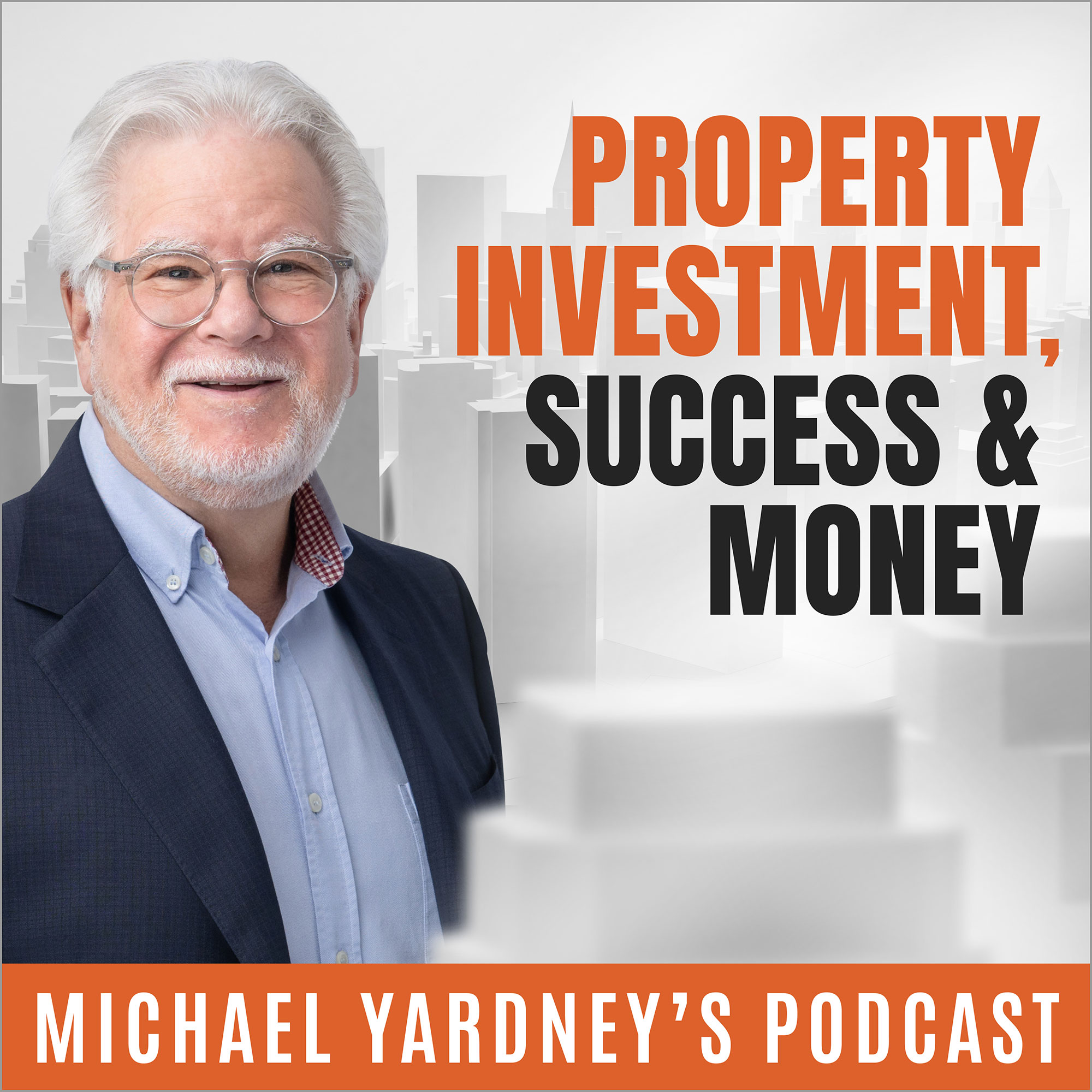
Property Investment, Success & Money | The Michael Yardney Podcast
Michael Yardney; Australia's authority in wealth creation thru property
If you want to create wealth through property investment, you're in the right place. Twice each week, Michael Yardney helps investors gain clarity amongst the confusion of the many mixed messages regarding the real estate markets so they can develop the financial freedom they are looking for. He does this by sharing Australian real estate market insights, smart property investment strategies, as well as the wealth creation, success and personal finance secrets of the rich, in about 30 minutes each show.
Michael has been voted one of Australia's top 50 Influential Thought Leaders. While he is best known as a real estate investment expert and property market commentator, he is also Australia's leading expert in the psychology of success and wealth creation and a #1 best-selling author of 9 books.
Michael frequently challenges traditional finance advice with innovative ideas on property investing, personal finance and wealth creation.
His wisdom stems from his personal experience and from mentoring over 3,000 business people, investors and entrepreneurs over the last 26 years.
Michael's message will be priceless regardless of the size of your real estate investment portfolio. Whether you're just starting investing in property or an experienced investor wanting to move to the next level, he will provide you with proven strategies for creating wealth through real estate, giving you a roadmap for real estate investing and financial success.
http://MichaelYardneyPodcast.com
Michael has been voted one of Australia's top 50 Influential Thought Leaders. While he is best known as a real estate investment expert and property market commentator, he is also Australia's leading expert in the psychology of success and wealth creation and a #1 best-selling author of 9 books.
Michael frequently challenges traditional finance advice with innovative ideas on property investing, personal finance and wealth creation.
His wisdom stems from his personal experience and from mentoring over 3,000 business people, investors and entrepreneurs over the last 26 years.
Michael's message will be priceless regardless of the size of your real estate investment portfolio. Whether you're just starting investing in property or an experienced investor wanting to move to the next level, he will provide you with proven strategies for creating wealth through real estate, giving you a roadmap for real estate investing and financial success.
http://MichaelYardneyPodcast.com
Episodes
Mentioned books

Feb 3, 2020 • 41min
5 Property myths that aren't true |7 Ways Australia's property markets are different with Dr. Andrew Wilson
Our property markets have been on the move for a while now. But some people are saying no, it's all going to end, there's still a property crash coming. Others are saying that Australia's property markets are different. But are they really different? That's what we're going to discuss today with Dr. Andrew Wilson. But first, we're going to bust another 5 property market myths so that you don't get fooled. I also have a great mindset moment today. At the end of this episode, you're going to be a more informed property investor. Property Myths Busted Myth: Buying near capital cities is a certain money-spinner Fact: Capital cities are a good choice for investment-grade properties, but that doesn't necessarily mean that properties there are automatically successful. There will always be some suburbs that perform better than others. Some have socio-economic problems, some have better transport than others, and so on. It's a question of finding the right investment-grade locations and then the right properties in those locations. Myth: Property prices double every 7-10 years Fact: On average, that might be true. The problem is that average means that half all properties double in value every 7-10 years and the other half don't. Markets move in cycles, and there are multiple property markets – depending on location, price points, and property types. There's no guarantee that any property will double in value in 7-10 years. You have to do your due diligence. Myth: You can't lose with property Fact: Yes, you can. Not every property is an investment-grade property. Succeeding in property has to do with choosing the right property, in the right location, at the right time, and for the right price. Myth: Houses are a better investment because of their land component Fact: Land is the component that increases in value, so it can be a good choice to own a property with a high land to asset ratio. But land is not the only consideration, and not all land is the same. Desirability, demand, and location are also fundamental components of a successful property. Myth: It's too late for me to invest Fact: Sure, it's tougher to reap the rewards of property growth if you're older, but it's never too late. Even late in life, there's still the opportunity to grow your retirement funds and leave a legacy for your own children and grandchildren. The 7 Ways Australia's Property Markets Are Different with Dr. Andrew Wilson Population growth underpins our property markets Population growth is concentrated in our three big capital cities, creating a strong demand for housing. We have a sound banking system Australia's banking system is well regulated and risk averse. Australia has a long-term undersupply of the right type of property The supply of new dwellings has not kept up with demand, thanks mostly to an increase in immigration. Debt is not a real worry Much of Australia's debt is in the hands of borrowers who have the ability to service their loans. And much of the debt is good debt. Australian has a culture of homeownership This is different from overseas where many people expect to be tenants for life. Rental accommodation is in the hands of private investors In Australia, the majority of rental accommodation is owned by private investors. The government wants us to own property Because of Australia's culture of homeownership, the government encourages first home buyers with certain incentives and property investors with tax breaks. Links and Resources: Michael Yardney Metropole Property Strategists Metropole's Strategic Property Plan – to help both beginning and experienced investors Ahmad Imam- Director of Metropole Properties Sydney Dr. Andrew Wilson, chief economist of MyHousingMarket.com.au See the show notes plus more at the show web page 5 Property myths that aren't true |7 Ways Australia's property markets are different with Dr. Andrew Wilson Some of our favourite quotes from the show: "Not all land is created equal." – Michael Yardney "Your life is a reflection of what you are willing to tolerate." – Michael Yardney "If you want money in your life, you've got to give more value." – Michael Yardney PLEASE LEAVE US A REVIEW Reviews are hugely important to me because they help new people discover this podcast. If you enjoyed listening to this episode, please leave a review on iTunes - it's your way of passing the message forward to others and saying thank you to me. Here's how
Jan 29, 2020 • 54min
How I built my property empire – Summer Series
If you want to become successful at anything, whether it's property investment, business or entrepreneurship, a great strategy is to find yourself a mentor – someone who's achieved what you're wanting to achieve and study them, learn from them and emulate them. You can learn from their successes as well as their failures. In fact it's much cheaper to learn from your mentor's mistakes So please allow me to be one of your mentors. You see…I frequently get interviewed on the radio, television and on podcasts. And today I'd like to replay an interview that brought out a lot of great information about my youth, my successes and also the things I've done wrong. As I said…if you can learn from other people's mistakes, why not do that instead of making these yourself? Mike Mortlock from MCG Quantity Surveyors interviewed me for his podcast. This show is about double the length of our normal show, but there's a lot of good information there that both new and returning listeners will benefit from. Some of the topics we discuss during the interview How I got interested in property My first property What led me to start the Metropole Group of Companies How finding mentors and learning from mistakes helped me create the business that I have today Some of the mistakes I've made Patterns I've learned in the property cycles Strategies that I have used in my real estate investment journey Which locations are going to outperform in the long run Why investors should think like home buyers What opportunities exist for potential investors with limited budgets How long it really takes to become financially independent Some strategies for new investors Difficulties with getting financing when you have several properties A mistake that I sees property investors frequently make How investors can use renovations to add value Why behavioural finance and investment psychology are important subjects to understand How biases affect financial decision making The services that Metropole offers Links and Resources: Michael Yardney Metropole Property Strategists Michael Yardney's Mentorship Program Mike Mortlock MCG Quantity Surveyors Show notes plus more here: How I built my property empire – Summer Series Some of our favourite quotes from the show: "I'm actually a real success at failure. I guess there's been tenacity to keep going." –Michael Yardney "The good and the bad times are keep coming, so be prepared for them. Maximise your upside and be prepared to cover your downside." "One of the big lessons of successful investors, business people, is to delay gratification. Wealth is the transfer of money from the impatient to the patient." –Michael Yardney PLEASE LEAVE US A REVIEW Reviews are hugely important to me because they help new people discover this podcast. If you enjoyed listening to this episode, please leave a review on iTunes - it's your way of passing the message forward to others and saying thank you to me. Here's how.
Jan 27, 2020 • 33min
Don't worry about an Australian property bubble – take our advice. With Pete Wargent
Fears of the property bubble are back. It's a new year, and the naysayers and the property pessimists are out telling us we've got a property bubble. That's what we're going to unpack today as I chat with Pete Wargent. First-time homebuyers are back, established homeowners are back and investors are back in the property market because they fear missing out, particularly in our two big capital cities. Add to that a number of interest rate cuts, easier lending, and a friendly media that has been encouraging people to get back into the property market. But are we in a property bubble? Topics Covered in my Talk with Pete Wargent: The definition of a property bubble The efficient market hypothesis The cause of rising house prices The indicators of a bubble It's easy to predict a bubble because it's difficult to prove that the prediction is wrong Predicting bubbles can make people feel smart or sophisticated How the property cycles repeat What would happen if there is a price drop Where things are going to be in ten years' time Links and Resources: Michael Yardney Metropole Property Strategists Pete Wargent Next Level Wealth Get the team at Metropole to help build your personal Strategic Property Plan Click here and have a chat with us Join Michael Yardney and a group of Australia's leading experts at his annual Property and Economic Market updates – in Sydney, Brisbane, and Melbourne Use the coupon code PODCAST and come as our guest. Show notes plus more here: Don't worry about an Australian property bubble – take our advice. With Pete Wargent Some of our favourite quotes from the show: "It's homebuyers who make the property market." – Michael Yardney "The property market cycle is what we've been seeing, as opposed to the hyperinflation of property prices which you'd see in a bubble." – Michael Yardney "I believe that the market tends to correct itself, and it has this time around." –Michael Yardney PLEASE LEAVE US A REVIEW Reviews are hugely important to me because they help new people discover this podcast. If you enjoyed listening to this episode, please leave a review on iTunes - it's your way of passing the message forward to others and saying thank you to me. Here's how
Jan 24, 2020 • 36min
9 Property Investment Rules You Must Understand | 10 Major Differences Between The Rich and The Poor - Summer Series
I was recently asked to put together a list of simple rules that distilled my property investment philosophy, so in today's episode, I'll give you 9 simple property investment rules to go by. In my mindset moment, I'll share 2 inspirational quotes that have helped me and that might be helpful for you as well. Then we'll discuss some of the differences that separate rich people and poor people. Hopefully, by the end of the episode, you'll be a little wiser when it comes to money, property, and success. 9 Property Investment Rules Become financially fluent – You need to understand how money, finance, the property market, and the economy work. Adopt a proven investment strategy – Real estate is a high-growth, low-yield investment, so it's best to invest for capital growth. Not every property is investment property – you want properties that are going to out-perform the averages in capital growth. Demographics drive markets – Demographics are more important than short-term ups and downs when it comes to shaping our markets. Real estate investing is a game of finance with some properties thrown in the middle – property is a long-term game, so you'll need financial buffers along the way. The economy and our property markets move in cycles – each boom sets up the next downturn, and each downturn sets the stage for the next boom Follow my 6 Stranded Strategic Approach and only buy a property – properties should: Appeal to owner occupiers Be priced below intrinsic value Have a high land to asset ratio Be located in an area that continually outperforms the averages Have a twist that adds value Come with the potential to manufacture capital growth Don't focus on bargains -- Properties that no one else wants today will probably be the type of property that no one else will want in 5 years' time. Allow for an X-factor – unforeseen events can be positive or negative, but they're sure to happen. 10 major differences between rich and poor people If you've been listening to my podcast you'd realise that I believe wealth is a choice that we must all make. Wealth is a mindset Bill Gates once said, "It's not your fault if you were born poor, but it's your fault if you die poor." In Australia, there's no reason why you should live in poverty. Wealth is waiting for you, but you have to make up your mind if you want it in your life. For years I studied the rich then I became one of them, and for the last decade I've mentored over 2,000 people to become rich Here are 10 of the major differences I've realised that separate rich and poor people: 1a. Poor people are skeptical. I distinctly remember a nephew of mine saying, "Those plumbers are a rip-off! They'll charge for things they haven't done. He thought that everyone unjustly wanted his money and that everyone is out there to get him. Do you know someone like that? 1b. Rich people are trusting. Rich people have the tendency to trust those they meet (within reason) and give others the opportunity to be themselves. 2a. Poor people find fault. People who are poor are always looking for the problems instead of the solutions. They end up blaming their environment, circumstances, jobs, weather, government and will make an extensive list of excuses as to why they cannot be successful. 2b. Rich people find success. Rich people understand that everything happens for a reason. Rather than letting life happen to them, they take direct action and make big things happen. They put aside all the excuses and eradicate their blame lists because they have to do what must be done. 3a. Poor people make assumptions. When it comes to knowing the truth, poor people often make assumptions. If they want to reach out to a someone, they might say, "They probably don't have time to talk to me." Instead of checking the facts or asking questions, they never make a true attempt when it comes to getting what they want. 3b. Rich people ask questions. Many rich people ask the question, "What if?" For instance, "What if I wrote an email to that person and he or she answers?" If you begin to ask questions, you will save yourself a lot of hassle. The power is in the hands of those who ask the right questions. Then don't answer your questions, question your answers. 4a. Poor people say, 'they' and 'them.' Have you noticed how the people at the checkout at the supermarket say, "They never have enough cashiers. I don't know what's wrong with them." Obviously, these people don't take any ownership and responsibility for their job. They certainly separate themselves from the job that was paying her. 4b. Rich people say, 'we.' At one of my favourite restaurants, the server said, "We take great delight in cooking our steaks in real fire." Her sense of pride and ownership stimulated me, which allowed me to give her an honourable tip. Surely, you will be rich when you invest more into what you believe in. 5a. Poor people want the cheapest way. Have you noticed how poor people tend to look for the cheapest items, bargains, free advice. Unfortunately, cheap is always cheap. 5b. Rich people want the best way. Rich people will go the extra mile to find quality – they recognise that price is what you pay and value is what you get. They don't limit themselves to price and often seek service while they shop. They're prepared to pay for mentors, coaches, and advisors 6a. Poor people think money is more important than time. Millions of people all over the world are trading their precious time for money. You can always get $500 back, but you can't get 50 hours again. Nonetheless, the majority of people trade time for money and never realize their true potential because of it. 6b. Rich people know that time is more important than money. Rich people never trade time for money. Moreover, they seek fulfilling experiences that dramatically alter their lives. Their careers are more focused on doing what they love and helping others, instead of merely clocking in for a meager paycheck. 7a. Poor people compete. When a poor person sees an opportunity, they find out how others are doing it and copy them. Most often, they never consider another way of doing it. Instead, they settle in the belief that doing what others are doing is the best thing they can do for themselves. 7b. Rich people create. On the other hand, the rich like to think outside the box and find new opportunities 8a. Poor people complain, condemn, and criticize. Most poor people have learned how to be poor from their parents. Their family members have conditioned them to believe that everything is "wrong" instead of right. If you've ever heard someone ask, "What's wrong?" you'll know what I mean. 8b. Rich people praise and enjoy their blessings. Rich people know that they have many privileges and they don't take it for granted. Because of their appreciation of gifts, love, and circumstances, they are able to generate more. 9a. Poor people seek amateur advice. They often listen to the opinions of others and seek approval from acquaintances. They believe almost everything they hear without questioning authority. They accept opinions as facts and prohibit themselves from doing research once satisfied with an answer. 9b. Rich people seek expert advice. Those who are rich have learned to think for themselves. If they cannot figure out something, they seek expert advice. Usually, they pay for the advice and are given a wide variety of options. They learn the experts only make suggestions, which means that they aren't particularly confined to a specific action. 10a. Poor people have big television sets. Poor people use their free time to avoid the art of thinking (which is the most challenging task) and zone out to what many have conformed to believe is "entertainment." 10b. Rich people have big libraries. Wealthy people are educated and read a lot of books. They use their knowledge in a way that benefits them. Instead of drifting off in random activities, they seek to get within their minds to understand themselves, others, and the world in which they live. Bottom line: To get a true perspective on how to become rich, you must study rich people. After all, you become what you study. If you're currently surrounded by people who aren't yet rich, just do the opposite of what they do. Soon enough, you'll be able to reach your financial dreams! Links and Resources: Michael YardneyMetropole Property StrategistsRich Habits Poor HabitsMichael Yardney's Mentorship ProgramNational Property and Economic Market Update 1 day Trainings Show notes plus more: 9 Property Investment Rules You Must Understand | 10 Major Differences Between The Rich and The Poor - Summer Series Some of our favourite quotes from the show: "It's really critical to understand if you're being impartial advice, or if you're being taken advantage of by the many vested interests out there after your money." –Michael Yardney "Trying to make something perfect actually prevents us from making it just good." –Michael Yardney "What if what you know is only one of the many possibilities, and there are some better ones, other ones, different ones? What if what you know could be further enhanced by what other people know? What if what you already know is actually wrong?" –Michael Yardney PLEASE LEAVE US A REVIEW Reviews are hugely important to me because they help new people discover this podcast. If you enjoyed listening to this episode, please leave a review on iTunes - it's your way of passing the message forward to others and saying thank you to me. Here's how.
Jan 22, 2020 • 27min
Where did my new year's resolution go? 9 Strategies to Rescue Them | Build a Business, Not a Job Podcast
The custom of making New Year's resolutions has been around for thousands of years, but it hasn't always looked the way it does today. The ancient Babylonians held their new year's celebrations in mid-March when the crops were planted. They made promises to pay their debts or return items they borrowed. These promises were the forerunners of our new year's resolutions. Today, we're going to take about how to restore some of your New Year's resolutions that may have fallen by the wayside. Where did my New Year's resolution go? I bet you made some New' Year's resolutions. Most of us did because resolve comes easily on December 31st. But give it a few weeks and many of the resolutions you made might already be in disarray, compromised, abandoned. And the resolute determination to make this year the year that you stick to your resolutions has probably forgotten altogether. I'm not writing this to make you feel guilty over this abandonment. Instead, it is about the real reasons resolutions and the determination to achieve them are lost, year after year, and how to change things so that this year you'll get on track to systematically set and achieve new goals. So here are 9 strategies to rescue them You can't achieve new goals or make desired changes without allocating time to do so. One of the big reasons that resolutions never become reality is that no room is made for them in your daily schedule. There are obviously some things you're going to need to keep doing, some new things you'll need to do and a bunch of things you'll have to stop doing to make room for the new more productive activities. Priorities should govern schedule, schedule shouldn't govern priorities. Another mistake made by the vast majority of business owners and entrepreneurs is they operate like workers instead of bosses and leaders. To have a better year this year you'll have to wrest control away from others' priorities and be governed by your own priorities. Resolutions aren't resolutions without resolve. Only you can decide what really matters to you. So don't bother making resolutions to appease or satisfy others. Be honest with yourself – that's a prerequisite for success. Resolutions require resources. Almost anything you decide to do, any change you decide to make, any goal you set out to achieve requires new or different resources. You aren't really serious about a resolution unless you invest in and gather the required resources. Sometimes investment motivates follow-through, too since you've expended time effort and money in it. Daily progress. Take your goals, your objectives and break them down to a timeline and to-do list for each day, from now to fruition. Here is the discipline that is guaranteed certain to move you closer to any goal each and every day: refuse to end any day without doing something, no matter how small, that moves you toward the goal! Who motivates the motivator? As a businessperson, as an entrepreneur, as the leader you may be doing a lot of motivating of others, but who motivates you? Any professional sports coach will tell you: measurement automatically improves performance, and measurement monitored by someone else further improves performance. Build up to change. Say you resolve to get up an hour earlier every morning to work on some project. You could start with 15 minutes for two weeks, then 20 minutes for two weeks, then 30 for a month, then 45 for two weeks. It's not too late to regroup! You may already have let your resolutions slip away. It doesn't matter. Today, tonight, tomorrow morning at the latest, block out a couple of hours, bolt the door, unplug the phone, and re-group. Review the resolutions. Pick one or two that mean that most, and apply the seven ideas I've just shared with you. Don't try and do it all on your own. Resolve weakens under pressure, under stress, when you feel your time is out of your control. As I mentioned above it's really hard to be successful on your own. You need a coach, an unreasonable friend, a mentor to hold you accountable. And as a business coach to some of Australia's leading entrepreneurs and business people, that's why I specialise in. Do you need guidance, motivation, and accountability to push your business through to the next level? Are you frustrated that your business isn't growing as fast as it could be? Would you like your business to be less dependent on you? Would you like step-by-step proven strategies to generate more business and sales in the next 90 days? Would you like access to behind the scenes templates and tools used only by the top 1% of successful businesspeople? Then click here now and find out all about Business Accelerator Mastermind. This community is for you if you're a businessperson, entrepreneur or professional who wants to 10x your income, elevate your ability to give, and leave a massive impact on your community and the world by up-leveling your tribe and improving your business acumen. Why not make another New Year's resolution and join our Mastermind group and get the advantage of having a coach on your side? Please click here now and find out all about how you could benefit from this. Links and Resources: Why not join Metropole's Business Accelerator Mastermind Learn more about Mark Creedon – Business Coach to some of Australia's leading entrepreneurs Show notes plus more: Where did my new year's resolution go? 9 Strategies to Rescue Them | Build a Business, Not a Job Podcast Some of our favourite quotes from the show: "You've really got to decide what's important to you, what matters to you." – Mark Creedon "I think if you do invest the time, effort, money in getting resources, it is likely to motivate you more to actually keep going." – Michael Yardney "First of all, tell other people about your resolutions, because when you do make it public, you're more likely to stick to them." – Mark Creedon PLEASE LEAVE US A REVIEW Reviews are hugely important to me because they help new people discover this podcast. If you enjoyed listening to this episode, please leave a review on iTunes - it's your way of passing the message forward to others and saying thank you to me. Here's how.
Jan 20, 2020 • 41min
Don't get hoodwinked by property spruikers with John Lindeman
It's already turning out to be an interesting year for property in 2020. Some commentators are suggesting double-digit capital growth in some of our capital cities, others are suggesting more subdued growth. The question is, who are you going to listen to? Whose advice are you going to take? Because if history repeats itself, and it surely will, many property investors are going to get it wrong this year and in this new decade. In today's show, I chat with property researcher John Lindeman to give you some warnings about a new breed of property spruikers who are out there to get you and take advantage of you. By the end of the show, you'll have a better understanding of whose advice to take and what traps to watch out for. Don't get hoodwinked by property spruikers Whenever the market starts to move, the spruikers come out to promote their wares. And they may twist facts and research to do so. Research can be twisted to give any result you want. There are a number of statistics that can be used to paint a misleading picture. For example, a spruiker might preset statistics showing that values in a particular neighbourhood have grown over the past 12 months. However, if you looked at the statistics for the past five years, you would realize that while values in that neighbourhood may currently be on the rise, they're still below the level they were at five years ago. In other words, the deal is not as good as the last 12 months of statistics alone make it appear to be. You also need to be wary of high-pressure sales tactics. Look out for free events that come with lots of perks. It may sound good at the time, but these events are often an excuse to give you a hard sell. Who should you be asking for property advice? Probably not family and friends, unless they happen to be property experts as well. Realtors are there to represent the seller, not you. And you certainly don't want to be taken in by spruikers. But you need reliable advice from somewhere. Independent investment advice, such as the kind offered by the Property Strategists at Metropole, is your best bet. These advisors aren't selling property, so they're not invested in urging you to buy property that might not pay off for you in the long run. Instead, they're invested in giving you the unbiased property advice that you need to succeed. Links and Resources: Michael Yardney Metropole Property Strategists Metropole's Strategic Property Plan – to help both beginning and experienced investors Join Michael and a group of property experts at their annual Property and Economic Market Updates in Sydney, Melbourne, and Brisbane John Lindeman, Lindeman Reports Show notes plus more: Don't get hoodwinked by property spruikers with John Lindeman Some of our favourite quotes from the show: "Others ask family and friends, and unless they're property experts, have a fun chat with them but don't take their advice." – Michael Yardney "Be careful about people who talk a little about investing but who have never done it themselves." –Michael Yardney "Without action, dreams are really just a belief." – Michael Yardney PLEASE LEAVE US A REVIEW Reviews are hugely important to me because they help new people discover this podcast. If you enjoyed listening to this episode, please leave a review on iTunes - it's your way of passing the message forward to others and saying thank you to me. Here's how
Jan 17, 2020 • 52min
Confessions of a real estate entrepreneur – Summer Series
If you want to become more successful in life, business, and investing, you're going to get a lot out of today's show. Even if you're not an entrepreneur in the sense that you would normally use that word, if you want to be more successful than the average property investor you will need to be entrepreneurial. In this episode, you'll hear me being interviewed by Brett Warren and I'll be answering questions that have been left on the website by my blog readers and my podcast listeners, as well as a few questions that Brett himself came up with. Highlights from the Interview with Brett Warren Why I got involved in property investment My first investment property What I enjoys about property The four ways to get money out of property How I suggest you choose a location to buy property When the best time is for someone to start investing in property What type of property I'm investing in and why The essential qualities of a successful property investor Why I'm still working and 0what drives me The most important lesson I have learned about property investment When I learned about the importance of mindset motivation How to make a mindset change Why successful people fail more often than unsuccessful people How Metropole can help potential property investors Why a buyer's agent is important, even in this economy Links and Resources: Michael Yardney Metropole Property Strategists Rich Habits Poor Habits Michael Yardney's Mentorship Program Brett Warren – director Metropole Property Strategists Brisbane Show notes plus more here: Confessions of a real estate entrepreneur – Summer Series Some of our favourite quotes from the show: "Performance isn't possible in an empty theater. So what a privilege it is that I have a large and ever-growing number of people with sustained and enduring interest in what I have to do, what I say, and what I teach." –Michael Yardney "My first property that I bought for $18,000 I still have now …is worth well over 2 million dollars." – Michael Yardney "In my mind, you've got to invest for capital growth until you've built enough of an asset base. If you want cash flow, don't buy real estate." –Michael Yardney PLEASE LEAVE US A REVIEW Reviews are hugely important to me because they help new people discover this podcast. If you enjoyed listening to this episode, please leave a review on iTunes - it's your way of passing the message forward to others and saying thank you to me. Here's how
Jan 15, 2020 • 32min
The 3 big lessons I learned from successful investors at Wealth Retreat with Pete Wargent
While you're listening to this podcast, my wife and I are away on a cruise. We're able to do that again this year because we've built a substantial property portfolio that gives us the lifestyle we enjoy. I'm not showing off. What I'm suggesting is you should also build a substantial asset base to give you choices in life. How are you going to do that? How are you going to be different from all those investors who don't get past their first or second property? The answer is to learn from those who have already succeeded – who've achieved what you want to achieve. That's what Pete Wargent and I are going to talk about in today's show. Pete will tell us what he learned from successful investors at last year's wealth retreat. I'll also share something special in today's mindset moment. Wealth Retreat Pete Wargent is one of the regular presenters at Wealth Retreat. But he attends to learn as well as present. Today he's going to share some of the tips he learned at last year's Wealth Retreat. There's not one property market There are multiple property markets around Australia all at different stages of their own cycle. In a boom, everything sells. But when a downturn comes, you can see how much better well-appointed properties hold their value. That's why you need a tried and tested formula and an investment strategy that always works, not one that only works right now. If you want to grow your business, you need a business coach You never know which nuggets of advice are going to make all the difference. Even if you're already successful in your own right, you can still use advice from other successful people. It helps to have someone to hold you accountable. The power of networking The most successful people always have the most powerful networks, so anything that you can do to build a network of successful, like-minded, and powerful people can only help. But there's only so much time in your life to make connections, so an event like the Wealth Retreat is a perfect opportunity to meet with the right sort of people. Links and Resources: Michael Yardney Metropole Property Strategists Pete Wargent Join us at Wealth Retreat 2020 in June 2020 – read all about it here now and express your interest Show notes plus more: The 3 big lessons I learned from successful investors at Wealth Retreat with Pete Wargent Some of our favourite quotes from the show: "It's isolating, it's hard on your own and you need a tribe around you. But you need the right people." – Michael Yardney "Why not, while you are an employee, set up your own business on the side." – Michael Yardney "Failure is never permanent. That sinking feeling that you've got, that will never last forever." – Michael Yardney PLEASE LEAVE US A REVIEW Reviews are hugely important to me because they help new people discover this podcast. If you enjoyed listening to this episode, please leave a review on iTunes - it's your way of passing the message forward to others and saying thank you to me. Here's how
Jan 13, 2020 • 31min
24 Things everyone should know about investing and the economy – Summer Series
These are times of financial and economic turmoil. With the current uncertainty and many changes on the horizon, it's time to go back to the big picture. In today's episode, I'll be discussing 24 things all investors and entrepreneurs should understand about the way property investing and the economy work. A favourite columnist of mine, Morgan Housel, wrote a great column about 122 things everyone should know about investing and the economy. Today we're going to talk about 24 of those big picture ideas that everyone should understand about investing and the economy. Saying "I'll be greedy when others are fearful" is easier than actually doing it. When most people say they want to be a millionaire, what they really mean is "I want to spend $1 million," which is literally the opposite of being a millionaire. Daniel Kahneman's book Thinking Fast and Slow begins, "The premise of this book is that it is easier to recognise other people's mistakes than your own." This should be every market commentator's motto. As Erik Falkenstein says: "In expert tennis, 80% of the points are won, while in amateur tennis, 80% are lost. The same is true for wrestling, chess, and investing: Beginners should focus on avoiding mistakes, experts on making great moves." There is a difference between, "He predicted the crash of 2008," and "He predicted crashes, one of which happened to occur in 2008." It's important to know the difference when praising investors. Wealth is relative. As comedian Chris Rock said, "If Bill Gates woke up with Oprah's money he'd jump out the window." The Financial Times wrote, "In 2008 the three most admired personalities in sport were probably Tiger Woods, Lance Armstrong and Oscar Pistorius." The same falls from grace happen in investing. Choose your role models carefully. Investor Nick Murray once said, "Timing the market is a fool's game, whereas time in the market is your greatest natural advantage." Remember this the next time you're compelled to cash out. Jason Zweig writes, "The advice that sounds the best in the short run is always the most dangerous in the long run." Billionaire investor Ray Dalio once said, "The more you think you know, the more closed-minded you'll be." Repeat this line to yourself the next time you're certain of something. John Reed once wrote, "When you first start to study a field, it seems like you have to memorise a zillion things. You don't. What you need is to identify the core principles — generally three to twelve of them — that govern the field. The million things you thought you had to memorise are simply various combinations of the core principles." Keep that in mind when getting frustrated over complicated financial formulas. James Grant says, "Successful investing is about having people agree with you … later." Scott Adams writes, "A person with a flexible schedule and average resources will be happier than a rich person who has everything except a flexible schedule. Step one in your search for happiness is to continually work toward having control of your schedule." Investors want to believe in someone. Forecasters want to earn a living. One of those groups is going to be disappointed. I think you know which. As the saying goes, "Save a little bit of money each month, and at the end of the year you'll be surprised at how little you still have." John Maynard Keynes once wrote, "It is safer to be a speculator than an investor in the sense that a speculator is one who runs risks of which he is aware and an investor is one who runs risks of which he is unaware." Our memories of financial history seem to extend about a decade back. "Time heals all wounds," the saying goes. It also erases many important lessons. You are under no obligation to read or watch financial news. If you do, you are under no obligation to take any of it seriously. Most economic news that we think is important doesn't matter in the long run. Derek Thompson of The Atlantic once wrote, "I've written hundreds of articles about the economy in the last two years. But I think I can reduce those thousands of words to one sentence. Things got better, slowly." The "evidence is unequivocal," Daniel Kahneman writes, "there's a great deal more luck than skill in people getting very rich." There is a strong correlation between knowledge and humility. The best investors realise how little they know. Not a single person in the world knows what the market will do in the short run. The more someone is on TV, the less likely his or her predictions are to come true. How long you stay invested for will likely be the single most important factor determining how well you do at investing. Links and Resources: Michael Yardney Metropole Property Strategists National Property and Economic Market Update 1 day Trainings use the coupon code: PODCAST 122 Things Everyone Should Know About Investing and the Economy by Morgan Housel Show notes plus more here: 24 Things everyone should know about investing and the economy – Summer Series Some of our favourite quotes from the show: "As rational people, we often act very irrationally when it comes to money." –Michael Yardney "Don't compare your life with the highlight reel that people put on Facebook and Instagram." –Michael Yardney "Those people who are prepared to take action today, in five years' time or ten years' time are going to look smart." –Michael Yardney PLEASE LEAVE US A REVIEW Reviews are hugely important to me because they help new people discover this podcast. If you enjoyed listening to this episode, please leave a review on iTunes - it's your way of passing the message forward to others and saying thank you to me. Here's how.
Jan 10, 2020 • 31min
How to Research the Property Markets Like a Professional – Summer Series
Have you ever wondered how property professionals do their research? If you're interested in finding properties that will outperform the market, this episode is for you. The most research many property investors do is finding a property that they already like, then looking for information that confirms their biases. However, sophisticated investors take a more strategic approach. Today, Kate Forbes, National Director of Property Strategy at Metropole, gives us a detailed picture of how the professionals at Metropole do their research. Metropole's top down approach This starts with examining the macro factors affecting our property markets and drills down to the micro level. Start by looking at the big picture – the macro-economic environment. Look for the right state in which to invest – one that will outperform the Australian market averages because of its economic growth and population growth. Within that state, look for the suburbs that will outperform with regards to capital growth. It's all about demographics. These suburbs tend to be areas where more owner-occupiers want to live because of lifestyle choices and where the locals can afford to and will be prepared to pay a premium to live because they have higher disposable incomes. Look for the right location within that suburb. Some livable streets will always outperform others and in those streets, some properties will always be more desirable than others. Then within that location look for the right property. And finally, only buy at... The right price, but I'm not suggesting a "cheap" property – there will always be cheap properties around in secondary locations. I mean the right property at a good price. 6 Stranded Strategic Approach Only buy a property: That would appeal to owner occupiers. Not because you plan to sell the property, but because owner occupiers will buy similar properties pushing up local real estate values. This will be particularly important in the future as the percentage of investors in the market is likely to diminish That is below intrinsic value – that's why you should avoid new and off-the-plan properties which come at a premium price. With a high land to asset ratio – that doesn't necessarily mean a large block of land, but one where the land component makes up a significant part of the asset value. That is in an area that has a long history of strong capital growth and that will continue to outperform the averages because of the demographics in the area as mentioned above. That has a twist – something unique, or special, different or scarce about the property, and finally; Where you can manufacture capital growth through refurbishment, renovations or redevelopment rather than waiting for the market to do the heavy lifting as we're heading into a period of lower capital growth. By following my 6 Stranded Strategic Approach, you minimise your risks and maximise your upside. Each strand represents a way of making money from property and combining all six is a powerful way of putting the odds in your favour. If one strand lets you down, they have two or three others supporting their property's performance. When you look at it this way, buying a property strategically takes a lot of time, effort, research and something most investors never attain – perspective. What I mean by this is you can gain a lot of knowledge over the Internet or by reading books or magazines but what you can't gain is experience. It takes many years to develop the perspective to understand what makes an investment grade property. Links and Resources: Michael Yardney Metropole Michael Yardney's Mentorship Program Kate Forbes Show notes plus more : How to Research the Property Markets Like a Professional Some of our favourite quotes from the show: "We're not looking for properties that are affordable to everybody, we're looking for areas where people have got a high disposable income and can afford to, but more importantly are prepared to, pay a premium." – Michael Yardney "If you buy a property to which you can add value through renovations or refurbishments, that will allow you to add some capital growth." – Michael Yardney "Understanding the neighbourhood is not the same as understanding the market. You may understand where the shops are and where the school zones are, but that's very different to understanding the depth of the market." – Michael Yardney PLEASE LEAVE US A REVIEW Reviews are hugely important to me because they help new people discover this podcast. If you enjoyed listening to this episode, please leave a review on iTunes – it's your way of passing the message forward to others and saying thank you to me. Here's how.

