

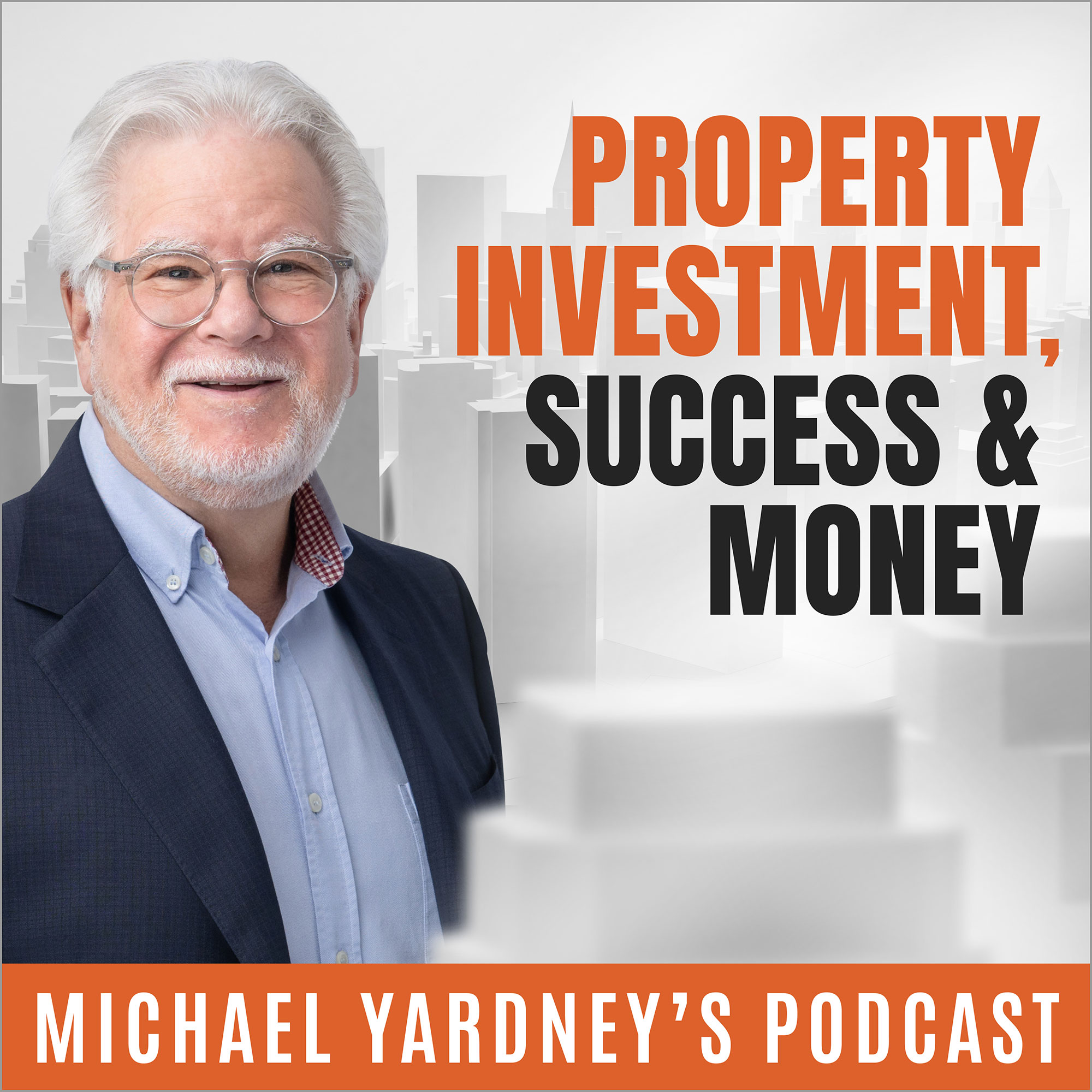
Property Investment, Success & Money | The Michael Yardney Podcast
Michael Yardney; Australia's authority in wealth creation thru property
If you want to create wealth through property investment, you're in the right place. Twice each week, Michael Yardney helps investors gain clarity amongst the confusion of the many mixed messages regarding the real estate markets so they can develop the financial freedom they are looking for. He does this by sharing Australian real estate market insights, smart property investment strategies, as well as the wealth creation, success and personal finance secrets of the rich, in about 30 minutes each show.
Michael has been voted one of Australia's top 50 Influential Thought Leaders. While he is best known as a real estate investment expert and property market commentator, he is also Australia's leading expert in the psychology of success and wealth creation and a #1 best-selling author of 9 books.
Michael frequently challenges traditional finance advice with innovative ideas on property investing, personal finance and wealth creation.
His wisdom stems from his personal experience and from mentoring over 3,000 business people, investors and entrepreneurs over the last 26 years.
Michael's message will be priceless regardless of the size of your real estate investment portfolio. Whether you're just starting investing in property or an experienced investor wanting to move to the next level, he will provide you with proven strategies for creating wealth through real estate, giving you a roadmap for real estate investing and financial success.
http://MichaelYardneyPodcast.com
Michael has been voted one of Australia's top 50 Influential Thought Leaders. While he is best known as a real estate investment expert and property market commentator, he is also Australia's leading expert in the psychology of success and wealth creation and a #1 best-selling author of 9 books.
Michael frequently challenges traditional finance advice with innovative ideas on property investing, personal finance and wealth creation.
His wisdom stems from his personal experience and from mentoring over 3,000 business people, investors and entrepreneurs over the last 26 years.
Michael's message will be priceless regardless of the size of your real estate investment portfolio. Whether you're just starting investing in property or an experienced investor wanting to move to the next level, he will provide you with proven strategies for creating wealth through real estate, giving you a roadmap for real estate investing and financial success.
http://MichaelYardneyPodcast.com
Episodes
Mentioned books

Feb 2, 2022 • 33min
Dr. Andrew Wilson's property trends and forecasts for 2022
Well, our property markets are up and running for 2022 and already there are mixed messages in the media about what's ahead. But today you'll get some clear indication from Australia's leading housing Economist Dr. Andrew Wilson, whose forecasts have proven to be very correct. I don't know if you've noticed seem to be two types of opinions flouted by the commentators On the one side is the glass half empty crew who see interest rates rising, Omicron repercussions and they're suggesting you've missed the peak of the property opportunities this cycle. On the other side of the market is the glass half full crew who feel more market opportunities are ahead of us, our economy is improving as we are coming out of the pandemic and with our borders reopening opportunities abound. I've been producing a weekly Property Insiders video each week with Dr. Andrew Wilson, so our forecast and commentary are on the record, and as I said, our forecasts have, so far, been very accurate, so I'm sure you'll enjoy today's podcast which is the audio of one of our recent video chats. Topics I discuss with Dr. Andrew Wilson Will RBA Rates Rise in August? - Nonsense Reflecting current data, the latest RBA statements and depressing covid outlook predictions of official interest rate rises as soon as August are clearly non-sensical according to Dr. Will property values will continue rising in 2022? In general property values should increase throughout 2022, but at a slower rate of growth than in Will 2022 be the year of rising rents? Rents should also keep increasing in 2022 as vacancy rates tighten as there is currently a desperate shortage of good rental accommodation around Australia. Are we in for a 2-tier property market moving forward? I can see properties located in the more inner and middle-ring suburbs, particularly in the more affluent suburbs and in gentrifying locations, significantly outperforming cheaper properties in the outer suburbs. Will more property investors will return to the market in 2022? So far this property cycle has been driven by owner-occupiers and first home buyers, but now more and more investors are getting into the market. However, if history repeats itself, and it most likely will, many of these investors will sell up over the next few years as they realize that property investment may be simple, but it's not easy. Will there be a flight to Quality? During the last few years, FOMO (fear of missing out) led inexperienced investors and homebuyers to purchase almost any property that their budget would allow, and they were fortunate as a rising tide lifted all ships. But as the market matures, we will see a flight to quality with well-located A-class homes and investment-grade properties still selling well, but secondary properties having trouble finding buyers. Will our economy will continue improving? With the prolonged lockdowns in Australia's two largest cities keeping people indoors and spending less, households have squirreled away an estimated $200 billion this year. Much of this will be spent over the next few years in an economy-boosting wave of consumption as life returns to normal. Some of it will go to paying down debt and some will go into buying assets. What will APRA do as they watch the market carefully? So far APRA has only really tapped its foot on the brake pedal; it hasn't really pushed down hard on the brake to slow our markets down, but if the property markets continue growing too fast for their liking they are likely to introduce stricter measures. Will most property predictions will be wrong? The property pessimists will still be out there next year telling us not to invest and that our property markets are going to crash. And as has been the case for the last few decades – they will be wrong. The bottom line Clearly, many of us would like to forget the last few years, but that won't be easy. Let's hope 2022 will be a year we are going to want to remember. It will be interesting to look back at the end of the year and see how many of these trends have eventuated. Shownotes plus more here: Dr. Andrew Wilson's property trends and forecasts for 2022 Links and Resources: Michael Yardney Get the team at Metropole to help build your personal Strategic Property Plan Click here and have a chat with us Dr. Andrew Wilson, Chief Economist My Housing Market Subscribe to our weekly Property Insiders videos – www.PropertyInsiders.info Some of our favourite quotes from the show: "The higher end of the market can often still afford to buy properties at this stage of the cycle because they've got multiple sources of income, their businesses share dividends, and their properties have gone up in value." – https://propertyupdate.com.au/australian-property-market/ "Well-located A-grade homes and investment-grade properties are still going to sell well, but secondary properties, they may have a bit of trouble finding a buyer." – Michael Yardney "You only need one thing to succeed. Forget all the reasons why it won't work and believe in the one reason why it will." – Michael Yardney PLEASE LEAVE US A REVIEW Reviews are hugely important to me because they help new people discover this podcast. If you enjoyed listening to this episode, please leave a review on iTunes - it's your way of passing the message forward to others and saying thank you to me. Here's how
Jan 31, 2022 • 39min
Guess how many property records were broken in 2021? With Brett Warren
2021 was a truly unusual year. After 2020, a year fraught with the effects of the global COVID-19 pandemic that wreaked havoc on world markets, forcing families into their homes with lockdowns and businesses to shutter their doors, 2021 saw the advent of safe & effective vaccines and despite the lockdowns experienced in our Southeastern states, 2021 was an amazing year for anyone involved in property. For many people, their home or investment properties earned more than they did as property values reached new highs and real estate records were broken. 2021 has rewritten the property record books. From property price growth to interest rates, to new home buyers, to refinancing – no matter which way you look records are being broken. To discuss these and which new records we think will be set in 2022 I'm joined by my business partner Brett Warren - national director of the Metropole Properties. One of the records that must have been broken is the extraordinarily strong market appetite for property, but let's dig into a few more records that have been shattered. Prices rose at the fastest pace in more than three decades In 2021 we experienced a property boom, the strength of which no one envisaged at the beginning of the year. The level of price growth has been the fastest in more than 3 decades, but in real terms, it's the 3rd fastest in a century. However, not all property markets will continue growing strongly moving forward. We're in for a 2-tier property market moving forward. Properties located in the inner and middle-ring suburbs, particularly in gentrifying locations, will outperform cheaper properties in the outer suburbs. Australians became wealthier than ever before Australian households just keep getting wealthier. A combination of surging property prices and solid share market gains saw total Aussie household wealth grow 4.4% or $590 billion in the September quarter. Wealth is up 20.2% on a year ago – the strongest annual gain in 11 1/2 years. And the number of Australian millionaires is expected to grow to 3,100,000 by 2025. Mortgage rates hit historic lows In 2021 low interest rates and the easy availability of finance spurred record demand for property pushing prices higher Australia-wide. New lending and refinancing also hit an all-time high – I guess that's another record that was set. A record number of new listings of properties for sale The number of properties listed for sale on realestate.com.au hit a historic low in June 2021. However, as lockdowns lifted and restrictions eased, new listings of property sales come to 22.8% in the last three months of the year. This is made for a robust spring selling season with new listings finishing 19.2% higher than the five-year average. Demand for housing hit record highs 2021 was a year that many Australian families upgraded their homes while a record number of Aussies became first home buyers. The combination of low interest rates, the impetus from shifting lifestyle preferences, an influx of ex-pats, low supply of properties for sale, forced savings, and government support measures have all fuelled Australia's insatiable appetite for property to historic highs for much of this year. Properties sold at record speed across the country. With multiple buyers keen to purchase the limited number of good properties for sale, many were forced to make quick decisions and, in some cases, pay a premium to purchase their property. As for the records broken - in November, the median number of days a property was listed on realestate.com.au before it was sold was 30 days, a historic low. Property sales volumes soared An estimated 614,635 properties changed hands in the past 12 months, the highest level in almost 18 years. In fact, in November property transactions were 32.6% above the decade annual average. Rentals finally rose After several years of slow rental growth, in the year to November Australian rent for using Chris 9.4% which was the strongest and you will appreciate any rent since January 2008. Capital cities experienced a net loss of people Australia's closed borders put a halt to immigration in 2021, but tight borders didn't stop Aussies from moving house. In the March quarter of 2021, data from the ABS showed our capital cities recorded a net loss of 11,800 people. This is more than double the decade average and the largest quarterly loss on record. This was prior to the arrival of the delta variant. Demand for luxury property soared and the $3 million club doubled While the value of most properties increased in 2021 the year finished with the luxury end of the market outperforming. Australia's $3 million suburb club doubled again in 2021. Demand for regional property soared, fuelling record-breaking price growth One of the side effects of the pandemic and the resultant lockdowns was that both net regional and interstate migration trending above long run averages This resulted in 2021 being the year when combined regional housing markets have outperformed, combined capital cities in terms of price growth. And as the year ended this trend has reversed with our capital cities outperforming. Links and Resources: Michael Yardney Brett Warren – National Director Metropole Property Strategists Get the team at Metropole to help build your personal Strategic Property Plan Click here and have a chat with us Shownotes plus more here: Guess how many property records were broken in 2021? With Brett Warren Some of our favorite quotes from the show: "It was just too easy to let FOMO get in and make silly decisions, cut corners, and not do your due diligence." – Michael Yardney "Almost anyone could look good last year, because if you bought in the wrong location, it still went up 10%, and you thought hey, look how smart I am!" – Michael Yardney "Life is worthwhile if you try. It doesn't mean you can do everything, but there are a lot of things you can do if you try." – Michael Yardney Reviews are hugely important to me because they help new people discover this podcast. If you enjoyed listening to this episode, please leave a review on iTunes - it's your way of passing the message forward to others and saying thank you to me. Here's how
Jan 28, 2022 • 27min
The #1 Factor That Makes Poor People Rich with Tom Corley | Summer Series
There are many definitions of what it means to be rich. In today's podcast, we're going to discuss the #1 factor that makes poor people rich. Being rich is more a state of mind than a dollar amount, though – the rich can be poor and the poor can be rich. Being rich is really more about having what you want and being able to enjoy your wealth. You need a sense of balance, and true wealth isn't about money or how many properties or shares you have. You need your health. You need time to enjoy and appreciate things. You need somebody to love and someone to love you. You've got to have the ability to give back to the community. You need spirituality. You need to be able to grow and learn. In these podcasts, I talk a lot about money, but money isn't a zero-sum game. One person's wealth can't stop you from becoming wealthy as well. And in today's episode, you'll hear more about building the habits that can help you become wealthy. How can poor people become rich? If no poor person on the face of the earth ever rose from poverty to wealth, you might have a case that it's impossible to become rich if you were born and raised poor. But, reality paints a very different picture. There are thousands of poor people every day who become rich. According to Forbes Magazine, just in America, there are approximately 1,700 working-class people a day who become millionaires. And, according to Tom Corley's Rich Habits study, 41% of the 177 self-made millionaires he studied were born and raised in poverty. What was the #1 factor that helped them shake off the chains of poverty and become wealthy? Changing their daily habits. Changing your habits can be hard, especially if you don't know how. Here are some short-cuts to changing habits. Habit Merging When an old habit does not perceive a new habit as a threat, it does not wage war against the formation of the new habit. Law of Association Old habits can be triggered by the individuals you associate with. If you are trying to get rid of some old, bad habits you need to limit the time you spend associating with those individuals who act as a triggers for those bad habits and begin associating with individuals who possess the new good habits you are trying to adopt. You can find these new individuals in network groups, non-profit groups, trade groups or any group that is focused on pursuing similar goals. Changes in Your Environment It is much easier to abandon old habits and form new habits when your environment changes. New home, new neighbors, new friends, new job, new colleagues, new cities, etc., all offer an opportunity to forge new habits. When your environment changes, you are forced to think your way through each day. Start Small It is far easier to change your habits if you start with small habits. Small habit change involves adding habits that require very little effort. Examples include drinking more water during the day, taking vitamin supplements or listening to audiobooks while you commute to work. Schedule Your New Habits Sixty-seven percent of self-made millionaires in my study maintained a to-do list. To-do lists are a way of processing success into your life. One of the tricks self-made millionaires use is to incorporate certain good daily habits onto their to-do list. Firewall Your Bad Habits One trick to habit change is to make it harder for you to engage in a bad habit by creating some type of firewall between you and the bad habit. Links and Resources: Michael Yardney Tom Corley - Rich Habits Get your own copy of our international bestseller Rich Habits Poor Habits Join Michael Yardney and Tom Corley at Wealth Retreat 2020 – click here and register your interest Wondering what's ahead for our property markets? Organize a time to speak with the team at Metropole by clicking here Shownotes plus more here: The #1 Factor That Makes Poor People Rich with Tom Corley | Summer Series Some of our favourite quotes from the show: "At no other point in history have so many people escaped bitter poverty in such a short time as in China." – Michael Yardney "Small changes give you momentum. They increase your confidence." – Michael Yardney "I think the message is, if other people can do it, you can do it." – Michael Yardney PLEASE LEAVE US A REVIEW Reviews are hugely important to me because they help new people discover this podcast. If you enjoyed listening to this episode, please leave a review on iTunes - it's your way of passing the message forward to others and saying thank you to me. Here's how.
Jan 26, 2022 • 32min
7 tips to make sure your children grow up rich (This is even for you if you don't have children) | Summer Series
Do you have children or are you planning to have children? How about grandchildren? If so, this episode is for you. Even if you haven't got children, you'll get some great money lessons from this episode. Today we'll share seven tips to make sure your children grow up rich. And it's not just about money. We're talking about tips that will help children find success in all areas of life. So how do you go about creating a rich child? Here are some of the things we discuss: Reading to Learn Tom Corley found that 88% of the rich folks in his study spent 30 minutes or more every day reading to learn, whether it was about money, how to succeed in their industry, self-help, biographies of successful people and history. Cultivating relationships: You want to associate with those people that typically upbeat, optimistic, enthusiastic, positive types. If you're not in a circle that meets those criteria, volunteering at a community nonprofit is a good way to find them. Exercising: Because exercise improves brain performance by increasing the amount of oxygen and helping the health of the neurons, people who exercise think faster and have better memories—which make you more competitive in the workplace. Managing anger: It's normal to feel anger and frustration, but how you express it can make or break your success. Exploring talents: When kids are little, they get to do a lot of activities such as art, music, theater, and sports. But as they get older, they focus on just one or two. But that's a mistake. Exposing kids to numerous activities helps them explore their talents Keeping an abundance mindset: Of all the habits, this is the most significant that plays out in every aspect of our lives. Our brains are wired to emulate our parents from the start. Dream-setting: Dream-setting is a process. It's visualizing what your ideal life would be. The self-made millionaires in his study would map out what their dreams are at least 10 years into the future, and then build goals around the dream to make it a reality. Shownotes plus more here: 7 tips to make sure your children grow up rich (This is even for you if you don't have children) | Summer Series Some of our favourite quotes from the show: "Being rich is about wealth in all facets of life." –Michael Yardney "You definitely have to grow and learn by having that habit of reading. It's a success habit not just of children, but of adults." – Michael Yardney "I want an expandable pie where if we all do well, are more productive, our country is better. There's enough for everybody." – Michael Yardney PLEASE LEAVE US A REVIEW Reviews are hugely important to me because they help new people discover this podcast. If you enjoyed listening to this episode, please leave a review on iTunes - it's your way of passing the message forward to others and saying thank you to me. Here's how.
Jan 24, 2022 • 1h 37min
Australia's leading property economist busts some myths and gives his forecasts for 2022
As we start a new year it's interesting to look back and reflect on the challenging year we experienced in 2021, and how well the Australian economy and Australians in general have survived. It wasn't really that long ago that there were credible predictions that tens of the thousands of Australians would lose their lives, the health system wouldn't cope, there would be mass unemployment and the economy would fall into an abyss. But fortunately, 2021 finished with our economy in recovery mode, and throughout the year we experienced a once in a generation property boom with our property markets breaking multiple records and finishing at record high levels. Last year the number of suburbs where the median house price is more than $1 million has doubled, as a have the number of suburbs where the median price is over $3milion and the average Australian household is wealthier than they ever have been. No doubt there are challenges ahead, but there's also lots of good news to start off the year and that's what I discussed with Dr Andrew Wilson, chief economist of My Housing Market, in a 90 minute online live Masterclass at the end of the year. And the feedback I received after the event was amazing – I've never had as many people during event leave such positive comments in the chat room or as many positive emails afterwards, so I thought I must share this with you as a subscriber to my podcast. This particular episode of my podcast is much longer than usual because Dr Wilson gave so much great information, but it's not the whole event. But it's definitely worth staying to the end to hear Dr Wilson is forecast for property around Australia for 2022. If you happened to be on that event, I think it's worth listening to the gold that Dr Andrew gave us once again, and if you weren't at the event I suggest after listening you going to the live webinar replay where you can see many of the charts that Andrew and I discussed. I'll leave a link in the show notes. Some of the Topics Discussed in Dr Andrew Wilson's Presentation The big growth markets are starting to stabilize and push buyers out of the market The effect migration has on the property market The underlying supply position in Australia The changes in predictions for interest rates Interest rates generate house The effects of the reserve bank's rate cuts Why Brisbane is a boom market now Adelaide's recent strong performance The relationship between higher interest rates and lower house prices, and vice versa Affordability and rental crises Whether Australia will be affected by the inflation overseas Specific industries that are having challenges Why higher interest rates are being predicted over the next year or so Why the bank economists are suggesting locking into loans with today's interest rates The out-of-cycle interest rate rises How often the forecasts change What the rental markets are like at the moment The latest data on house prices Whether there are concerns about the drop in auction clearance rates Links and Resources: Michael Yardney Get the team at Metropole to help build your personal Strategic Property Plan Click here and have a chat with us Dr. Andrew Wilson, Chief Economist My Housing Market Watch the replay of the whole Masterclass with Dr. Andrew Wilson by clicking here Shownotes plus more here: Australia's leading property economist busts some myths and gives his forecasts for 2022 Some of our favourite quotes from the show: "We're not just going to have an affordability crisis, we're going to have a rental crisis where all these people are going to need to live somewhere." – Michael Yardney "Think outside the square. Stop following everyone else's catchy little headlines like a bunch of sheep." – Dr. Andrew Wilson "It looks like now the top affluent areas and the gentrifying suburbs are overperforming moving forward." – Michael Yardney PLEASE LEAVE US A REVIEW Reviews are hugely important to me because they help new people discover this podcast. If you enjoyed listening to this episode, please leave a review on iTunes - it's your way of passing the message forward to others and saying thank you to me. Here's how
Jan 21, 2022 • 35min
12 habits of highly successful people with Mark Creedon | Summer Series
Success is no accident. The most successful people in life may not always seem like they have much in common. How are The Beatles similar to Steve Jobs? Or Warren Buffett and Shane Warne? But when their traits, habits, and work ethics are distilled down, these unlikely characters share many similarities. They do the work, they turn up, they believe in themselves and sometimes, they even wear the same clothes. In today's Build a Business not a Job Podcast I chat with Mark Creedon, founder of Business Accelerator Mastermind about a dozen techniques to triumph. Drive – know where you're going Whether it is the drive to be the best in the world at a specific skill – spin bowling – or the passion to build the most user-friendly tech experience at Apple, successful people are focused on their end goal. Proven losers Once people have the ability to spring back from their losses, they are more able to take the risks and challenges life inevitably throws out. And once that mindset is in place, coupled with a focus on achievement, a loss can create a gain. Let others do their part There is a necessary time to allow others into the business and to allow them to do the job in their way. By allowing others to take the load and share their knowledge, the outcome can be greater than the sum of its parts. Avoid distractions – from their goal and in daily life Achieving a distraction-free state of flow is the best and most efficient way to work and get things done. Communicate. Without it, 'It's like winking at a girl in the dark' Berkshire Hathaway founder Warren Buffet says communication skills are the most important traits for success. "If you can't communicate, somebody said, it's like winking at a girl in the dark," he says. "Nothing happens." Break the mold Successful people are often willing to stand out. Test cricketer Stuart McGill says spin legend Shane Warne "broke the mold" in cricket, not only with his spin action but also with his off-field antics. This pairing of performance and personality brought new followers to the game. Think on your feet The ability to be agile and take chances – even if they fail – is a key habit of the successful. Let's do it People who thrive see the outcome. They determine a course of action and set their minds to achieve it. Routine is a common element for those who succeed. Yes, yes, yes, no. Make the decision Successful people are decisive. They may not always be right, but at least they make a decision, which allows for a speedier process and new possibilities. 'Done is better than perfect' This leads on from decisiveness. The philosophy is about achieving small steps, not about sacrificing quality. As there is no such thing as perfection – which is different for different people – many successes consider milestones and progress more important than a mythical ideal. 'I get knocked down, but I get up again' Resilience is considered the most important characteristic for success. People will inevitably get knocked down, criticised, rejected, or considered wrong, but with stamina and grit, many people overcome. Old-fashioned hard work, turning up every day, gets results. T-shirt and jeans Many successful people have systematized their life to strip back distractions. By either planning ahead or making a routine of everyday tasks, they can reclaim time and energy to think about other outcome-focused enterprises. Links and Resources: Why not join Metropole's Business Accelerator Mastermind Learn more about Mark Creedon – Business Coach to some of Australia's leading entrepreneurs Join us at Wealth Retreat late in 2020 in join- find and more and register your interest here Shownotes plus more here: 12 habits of highly successful people with Mark Creedon | Summer Series Some of our favourite quotes from the show: "I think one of the worst things that can happen is to get it right the first time." – Michael Yardney "I think one of the traits of successful entrepreneurs, businesspeople, professionals, is that they get going knowing they don't know it all, but they know enough to get going and understand that they're going to learn the rest along the way." – Michael Yardney "It's just too hard to do it on your own." – Michael Yardney PLEASE LEAVE US A REVIEW Reviews are hugely important to me because they help new people discover this podcast. If you enjoyed listening to this episode, please leave a review on iTunes - it's your way of passing the message forward to others and saying thank you to me. Here's how.
Jan 19, 2022 • 35min
It's important to understand these things that never change in a world that never stops changing + Estate planning with Ken Raiss | Summer Series
What will life be like when the COVID-19 crisis passes? What aspects will stay with us, and what will disappear? We've been thrust into a moment of rapid change, but most of us don't like change. It makes us feel uncomfortable. We like a level of certainty about our future, health, and jobs, as well about the worlds of finance and property that most of us are interested in. But there are lessons in history that can provide us with valuable insights. In today's episode, we'll talk about some of the things that never change in a world that never stops changing. Successful investors and businesspeople need to be prepared for change but also understand the things that don't change. So, by the end of today's show, you'll come out with some ideas about how to get some more certainty in these uncertain times. I'm also going to share a mindset moment from one of my mentors and have a chat with Ken Raiss about estate planning. Some things that never change in a world that never stops changing The things that never change are the most important things to pay attention to. However, change gets the most attention because it's exciting, it's surprising, it's something that the media can comment on. You see…predicting the future is hard. Very few can do it. On the other hand, understanding what stays the same is very useful. Particularly in challenging times like we're currently experiencing. Of course, I still have no idea what's going to happen in the future, but I'm a little less surprised whatever does happen if I have a handful of assumptions that I can put my faith into to guide me moving forward. So, let's look at some things that never change in a world that never stops changing. More people wake up every morning wanting to solve problems than wake up looking to cause harm. I'm an optimist and have faith in society, but I recognise that those with a negative message get more airplay in the media and incite negative sentiment in our community. Fact is… in life you get whatever you expect to get. The only question is, what do you want? If we were not optimistic, none of us would bother setting up a business, employing people, taking risks, or investing in property. If we were totally realistic about how often people fail, how often things go wrong, how most property investors never build a substantial property portfolio, we would never even bother getting started. Your outside world is a reflection of what's happening inside your mind. So, feed it with positive, optimistic thoughts. The world breaks about once a decade. This is an interesting expression I learned from columnist Morgan Housel of the Collaborative Fund. But it's true and there seem to be very few exceptions to this. There is a major disruption every decade or so. It could be an economic, political, military, or social issue. The bad news is never as bad as it sounds How many times does the end of the world as we know it need to arrive before we realise that it's not the end of the world as we know it? Of course, those with a long-term perspective, who have lived through a number of economic shocks and property cycles, tend not to get as shocked when major events like we're now experiencing hit us. However, those who have not experienced these types of shocks tend to worry more and imagine the worst because they have no perspective to rely on. 4. This too shall pass Nothing too good or too bad stays that way forever. I've found these types of major upheavals are not as scary if you have the underlying belief that they'll keep happening but that in the long term they don't prevent the long-term growth of our economy and our property markets. History doesn't really repeat itself. We've all heard it before - "History repeats itself!" It's an inane statement that seems so wise on the surface but crumbles under serious scrutiny. Morgan Housel wisely said: "History is mostly the study of unprecedented events, which, ironically, we then use as a map for what could happen in the future." Estate Planning with Ken Raiss Estate planning is something a lot of people don't think about until it's too late. But you want to be able to pass on your wealth in an efficient manner, and estate planning is crucial to your overall wealth plan. Some critical estate planning documents: A will – your will should be set up so that instead of passing on your assets to your beneficiaries directly, they're passed on in a testamentary trust. This has tax benefits and helps to ensure that wealth remains in the family. Non-Estate Assets – You may need either a Binding Death Nomination or Superannuation Will in order to distribute superannuation funds. Enduring Power of Attorney – this document pass decision making authority onto another person in the event that you're physically or mentally incapacitated. These documents can give authority that is as broad or as specific and narrow as necessary. Medical Power of Attorney – This document helps you to finalize your wishes in relation to things like organ donation. Personal Details – This is a non-legal document that can help you pass on things like account numbers, passwords, where to find policies and valuable items, information necessary for paying bills, subscription information, and so on. Links and Resources: In these challenging times why not get the team at Metropole to build you a personalised Strategic Property Plan – this will help both beginning and experienced investors. Why not have a chat with Ken Raiss of Metropole Wealth Advisory Shownotes plus more here: It's important to understand these things that never change in a world that never stops changing + Estate planning with Ken Raiss | Summer Series Some of our favourite quotes from the show: "In my mentorship program, I know that those people who write down their plans, write down their goals, and visualize them are much, much more likely to get them." – Michael Yardney "Your reticular activating system is that part of your brain that cuts out all the surplus extraneous information that's coming in and hones in. It's your GPS." – Michael Yardney "In summary, prepare for the inevitable by having somebody on your side preparing a number of documents, including a will." – Michael Yardney PLEASE LEAVE US A REVIEW Reviews are hugely important to me because they help new people discover this podcast. If you enjoyed listening to this episode, please leave a review on iTunes - it's your way of passing the message forward to others and saying thank you to me. Here's how
Jan 17, 2022 • 50min
How steeply will house prices fall after this boom? With Brett Warren
Can property prices really keep rising considering where they are today? And how much are property prices likely to fall once this cycle comes to an end? These are some of the questions Brett Warren and I are going to discuss in today's podcast To do this we are going to look back at history and see what we can learn from the past 50 years of economic and property price changes and what has driven them to help give you some clarity on what's ahead for our property markets and the value of your and my home. What History Tells Us About What's Coming It's interesting how the narrative in the media has changed – only a few months ago it was about a booming property market and now the media is full of questions about how long this boom can last and how far property values are going to fall once it's over. Can property prices really keep rising? The simple answer is yes property values can keep rising, but not everywhere and not to the same extent as they have over the last year. What's going to happen to property prices in the short term? Will they fall after this boom ends? While property prices are notoriously difficult to forecast, in my mind it's hard to see the same size downturn befalling the current market, at least in the near-term. Let's look back and see what we can learn if I look back on close to 5 decades of investing, and see what may be ahead. In 1970, the median Sydney house price was $18,700 The median price in Perth was a relatively $17,500 In Melbourne, median price was just $12,800. In 1971, house prices were $11,900 in Adelaide They were $18,000 in Canberra They were $11,875 in Hobart The earliest data for Brisbane is for 1973, when the median house price was $17,500. In 1965, the unemployment rate was 1.3 percent For the period from 1964 to 1971, the unemployment rate was 1.9 percent or lower. In both 1974 and 1975, annual inflation was over 15 percent From 1973 to 1983, inflation averaged 11 per cent per annum. So why has inflation been so low for the last decade or more? Firstly, unionised labour is now a fraction of what it used to be. Second, the world has been investing heavily in technology and in particular, automation for the last decade. Thirdly, globalization. Open trade has also led to higher rates of immigration. Four, immigration. There is little doubt that a high level of immigration, especially when a large proportion of the migrant influx is looking for work, limits domestic wage growth. Five, Long Covid #1. We see a repeat of 2021, being that we remain constrained due to new Covid mutations. We spend less when we are locked down What about affordability? There are a number of affordability measures used and most of them are not very useful Ratio of dwelling values to income – this is the most widely used and internationally comparable method The number of years it takes to save a 20% deposit The proportion of household income required to service a new mortgage The proportion of household income required to pay rent So, on the one hand, it is difficult to get into the property market at present, and I know I'm going to annoy some people, but it's not just an issue of affordability – it's also an issue of expectations. Some young millennials are expecting to start their property journey in the type of house it took their parents to 30 or 40 years to acquire What about mortgage stress? In my mind, the best measure of mortgage stress is home loan arrears or home loan defaults. Currently, home loan arrears (those more than 30 days late) are only 1.14% Is there really a debt bomb waiting to blow up? No. We have a stable banking system. We have jobs and Income security We've stashed our cash and most households are better off financially than before the pandemic. So what's likely to happen to property values in 2022? I see house prices growing more slowly in 2022 and then the market peaking around in 2023 or whenever APRA or the Reserve Bank intervenes. In general, I agree with the latest house price forecast of the big banks suggesting that property values may increase around 6 to 8% in 2022. If our economy picks up as well as the RBA hopes it will, and if we get the 200,000+ migrants coming to Australia next year, and a big if is if that if there are no more major variants to Covid, our property markets could perform even better than that. At the same time our rental markets, which are currently very undersupplied, will experience strong rental growth. However, as we said earlier, moving forward they will be a two-tier property market where properties in the lower price brackets and some of the regional areas will become affordable to the locals and therefore not increase much in value. So don't count on the rising tide lifting all ships. Links and Resources: Michael Yardney Brett Warren – National Director Metropole Property Strategists Get the team at Metropole to help build your personal Strategic Property Plan Click here and have a chat with us Shownotes plus more here: How steeply will house prices fall after this boom? With Brett Warren Some of our favourite quotes from the show: "It's unfathomable unthinkable how our economy and how our cities and how our society has changed in the last half a century." – Michael Yardney "Demography moves slowly – you can see as people change through their stages in life what their requirements are going to be." – Michael Yardney "Most households in Australia are better off financially than before the pandemic." – Michael Yardney PLEASE LEAVE US A REVIEW Reviews are hugely important to me because they help new people discover this podcast. If you enjoyed listening to this episode, please leave a review on iTunes - it's your way of passing the message forward to others and saying thank you to me. Here's how
Jan 14, 2022 • 40min
Learn how to be a top negotiator, influencer and persuader, from the person who wrote the book | Summer Series
If you're a poor negotiator, you're going to spend a fortune, if you're a good negotiator, you'll save a fortune, if you're a great negotiator, hopefully you'll make a fortune. Success in life depends upon your ability to influence. And I've just recently had my 9th book published - Negotiate, Influence, Persuade. In today's podcast, Mark Creedon has a chat with me and I share some tips from my book. Now if you think about it, life is one long negotiation. Either you're buying what somebody else is telling you or selling you, or they're buying what you're saying. And you negotiate all day in your life, with your spouse, your children, your work colleagues, your customers, and your clients. At the end of today's show, I hope you're going to know some negotiating rules and you're going to be a better influencer and more persuasive. Some of the topics we discuss in today's episode: Why negotiation is so important Whether you realize it or not, you're negotiating all of the time, not just in business, but in life. You need to know more than just negotiating techniques. You need to know how to communicate with people, how to do it in different ways, such as digitally, and how to ethically influence and persuade people. How Negotiate, Influence, Persuade is about more than just negotiation The book isn't just for salespeople, it's also for consumers, because we all negotiate every day. The book is meant to help readers get the best deal whether they're buying or selling. Further, the book is meant to help readers get what they want when they want while still maintaining good relationships. It includes a theme of using negotiating skills in an ethical way The book includes 27 rules of negotiation. These are three of them Everything's negotiable. That doesn't mean you're always going to get what you want, but it means that the potential for negotiation is always there. You should know what you want before you negotiate. Know what the highest price you'll be willing to pay is, or the lowest price you're willing to sell for Treat negotiation as a game. If you're too emotionally involved, you'll lose perspective You often hear that you should never be the one to make the first offer Actually, people who make the first offer actually usually have the upper hand. How important preparation is in negotiation It's important to know what you'll be willing to pay or accept It's also necessary to understand the other person and what they're trying to achieve. Why building rapport is such an important part of the negotiating process 95% of persuasion occurs at the subconscious level Some of the different types of bias in a negotiation: Cognitive bias Anchoring bias Bandwagon bias We don't always realize how much we negotiate. You're negotiating when you're trying to get the best table at the restaurant, decide who will take out the trash, or determine what to watch on TV 3 sources of power in negotiation: Time power Information power Alternative options power Links and Resources: Michael Yardney Get the team at Metropole to help build your personal Strategic Property Plan. Click here and have a chat with us Get your own copy of Negotiate, Influence, Persuade by clicking here Some of our favourite quotes from the show: "If you're a poor negotiator, you're going to spend a fortune, if you're a good negotiator, you'll save a fortune, if you're a great negotiator, hopefully you'll make a fortune." – Michael Yardney "In my mind to become a power negotiator, you need to understand human psychology, human nature." – Michael Yardney "If you want to become a better negotiator, you're going to have to understand how the mind works, yours and the prospect's mind." – Michael Yardney PLEASE LEAVE US A REVIEW Reviews are hugely important to me because they help new people discover this podcast. If you enjoyed listening to this episode, please leave a review on iTunes - it's your way of passing the message forward to others and saying thank you to me. Here's how
Jan 12, 2022 • 49min
Property forecasts and trends for 2022, with Pete Wargent
What's ahead for property in 2022? If you're curious about what will be affecting our property markets in 2022, you will love today's show, because Pete Wargent and I discuss 8 trends that will shape the property markets for 2022 and beyond. Property trends for 2022 We experienced a wild ride in property in 2021, didn't we, so what's ahead for 2022? While our property markets are slowing down as the year ends, there is still significant momentum, so the main factors which will determine what happens to property next year will depend on what the RBA does to interest rates and if APRA tightens the screws further on lending. But despite the best predictions, if history has taught me anything, it is that there will be an unexpected X factor coming out of the blue to undo the most seasoned property forecasts, either on the upside or the downside. However here are seven property trends I expect to happen in 2022 Property values will continue to rise While many factors affect property values, the main drivers of property price growth are consumer confidence, low interest rates, economic growth, and a favourable supply and demand ratio. As always, there are multiple real estate markets around Australia, but in general property values should increase throughout 2022, but at a slower rate of growth than 2021. We're in for a 2-tier property market moving forward. While most property markets around Australia have performed strongly so far this cycle, moving forward the rate of property price growth will slow and there are several reasons for this including: Affordability issues will constrain many buyers. The impetus of low interest rates allowing borrowers to pay more has worked its way through the system and with property values being 20- 30% higher than at the beginning of this cycle at a time when wages growth has been moderate at best and minimal in real terms for most Australians, means that the average home buyer won't have more money in their pocket to pay more for their home. The pent-up demand is waning – While there are always people wanting to move house and many delayed their plans over the last few years because of Covid, there are only so many buyers and sellers out there and there will be fewer looking to buy in 2022. APRA – is intent on slowing our markets using macroprudential controls This will lead to a two-tier property market - in other words, not all locations will continue growing strongly moving forward. I can see properties located in the inner and middle-ring suburbs, particularly in gentrifying locations, significantly outperforming cheaper properties in the outer suburbs. Our economy will pick up Households have squirreled away an estimated $200 billion this year, with the prolonged lockdowns in Australia's two largest cities keeping people indoors and spending less. Some of it will go to paying down debt and some will go into buying assets. We're already seeing this in retail spending, and it's been apparent in our property markets throughout the year as many homeowners upgraded. The "official" interest rate will remain unchanged In my mind, the official RBA interest rate is likely to remain unchanged throughout 2022. Australia's economy is still operating below its potential with economic growth and wages growth not strong enough to justify an interest rate increase. APRA is likely to tighten its macro-prudential measures APRA has only really tapped its foot on the brake pedal; it hasn't really pushed down hard on the brake to slow our markets down so if the property markets continue growing too fast for their liking, they are likely to introduce stricter measures. A flight to quality As the market matures, we will see a flight to quality with well-located A-class homes and investment-grade properties still selling well, but secondary properties having trouble finding buyers. More property investors return to the market So far this property cycle has been driven by owner-occupiers and first home buyers, but now more and more investors are getting in the market. Of course, this always happens after a period of strong housing price growth when a whole new generation of investors read how well others have done by owning property. Here's something I can guarantee will happen in 2022 The property pessimists will still be out there telling us not to invest and that our property markets are going to crash. And as has been the case for the last few decades - they will be wrong. Where to buy your next property? If you want to outperform the average investor, if you want to develop financial freedom through property investing, then don't start by selecting a location, or looking for that ideal property. Things have to be done in the right order – and selecting the property comes right at the end of the process. The property you will eventually buy will be the result of a sequence of questions you will need to ask and answer and a series of decisions you'll need to make before you even start looking at locations. So, my first recommendation to anyone asking where to invest is to sit with an independent property strategist to formulate their plan. It's just too difficult to do on your own and I've found most investors tend to be too emotionally involved to see their situation objectively. The benefits of formulating such a plan include: It will help you define your financial goals. You'll discover whether your goals are realistic, especially for your time frame. You'll find out what you've done right and what you've done wrong along your financial journey so far and what you can do about it. You'll be able to measure your progress towards your goals and whether your property portfolio is working for you, or if you're working for it. Your plan will help you identify risks you hadn't thought of. By following a documented plan, the real benefit is that you'll be able to grow your wealth through your property portfolio faster and more safely than the average investor, without making any more costly mistakes along the way. When selecting a location, I would initially start by eliminating locations. For example, I would not be investing in regional Australia or in the smaller capital cities. There's no doubt that some better performing regional locations or certain suburbs in our small capital city will outperform the poorer performing suburbs of our three big capital cities. But when I suggest you should only consider investing in Australia's big three capital cities, I'm also saying that it's important to be very selective in choosing suburbs in these cities – investment grade suburbs that are likely to outperform. I look for suburbs where wages (and therefore disposable income) are increasing above average. These will either be: Discretionary Locations These are the most expensive locations in our capital cities – the "established money" locations where most of the residents have lived for a long time and where many residents have paid off their home loans years ago. Aspirational Locations These are the upper-middle-class areas and gentrifying locations of our big cities. Avoid affordable suburbs This is where most homeowners and many investors look because that's where they can afford to buy. Avoid last choice locations In every city, there are suburbs where people live because they really have no choice. But it's not only the location that's important. While I believe that 80% of your property's performance is related to its location, the other 20% or so is related to buying the right property in that location. Even in the best suburbs, there are some properties I would avoid – they just don't make good investments and others I would be keen to have in my portfolio. Links and Resources: Michael Yardney Metropole's Strategic Property Plan – to help both beginning and experienced investors Join Michael's Property Update private Facebook group by clicking here Pete Wargent's new Podcast Shownotes plus more here: Property forecasts and trends for 2022, with Pete Wargent Some of our favourite quotes from the show: "Most investors get it wrong because they come in at the end of the cycle when they've heard in the media that auction clearance rates are high and property values are high and now rentals are going up." – Michael Yardney "Neither APRA nor the Reserve Bank want the property markets to crash." – Michael Yardney "In my mind, property investment is a high-growth, relatively low-yield investment." – Michael Yardney PLEASE LEAVE US A REVIEW Reviews are hugely important to me because they help new people discover this podcast. If you enjoyed listening to this episode, please leave a review on iTunes - it's your way of passing the message forward to others and saying thank you to me. Here's how

