

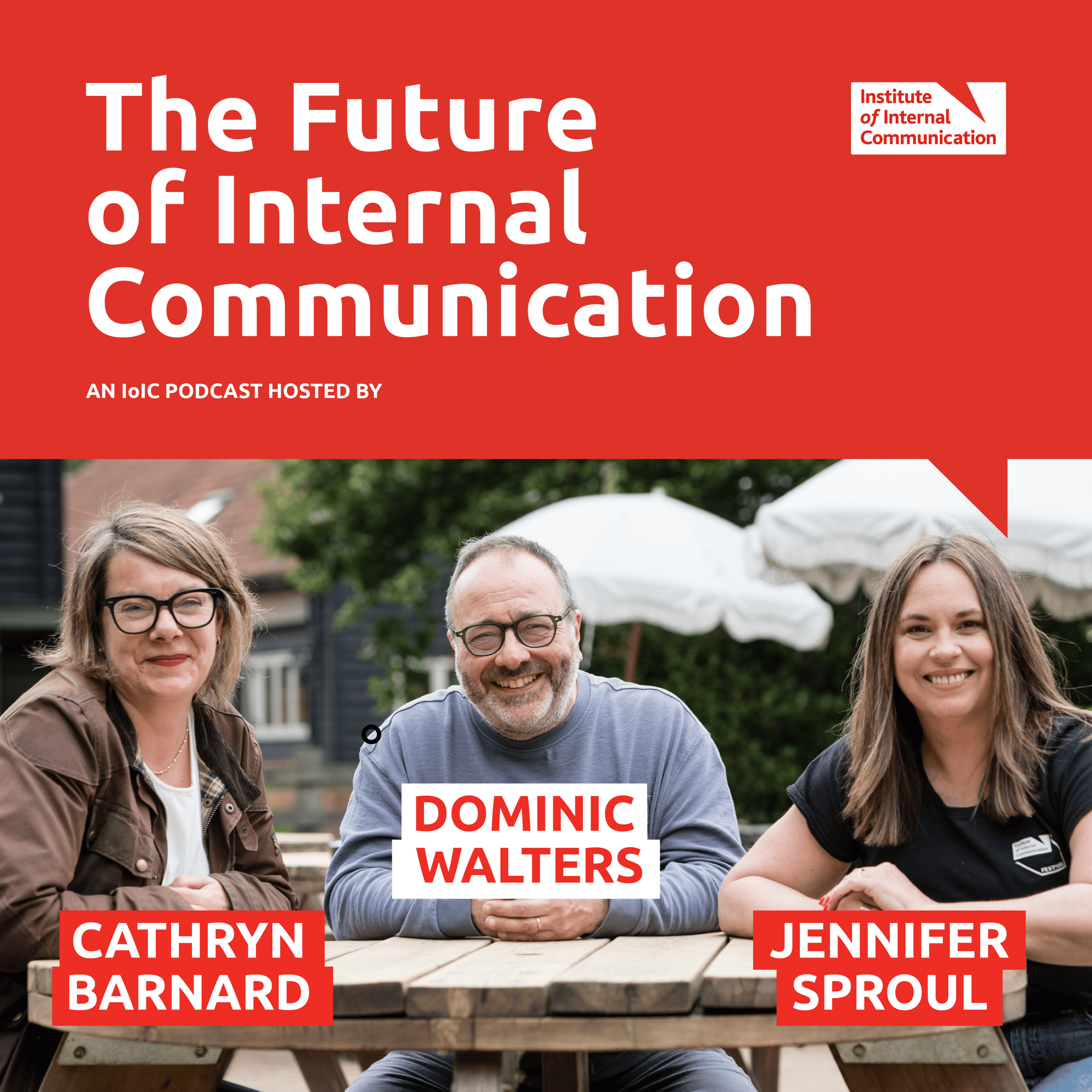
The Future of Internal Communication
Institute of Internal Communication
The Future of Internal Communication podcast is a series commissioned by The Institute of Internal Communication.
Organisations today face widespread and continuous disruption. The way communication takes place within and across teams, departments and business units is more critical than ever.
The podcast hosts subject matter experts from within and outside internal communication, each sharing their insights on the future of work and the role of communication as an essential driver of workplace trust, connection, culture, innovation, resilience and performance.
Hosts Jennifer Sproul, Dominic Walters and Cat Barnard explore opportunity for internal communicators. In increasingly digital, data driven, distributed and on-demand work landscapes, their conversations with thought-leaders examine the human side of work.
Organisations today face widespread and continuous disruption. The way communication takes place within and across teams, departments and business units is more critical than ever.
The podcast hosts subject matter experts from within and outside internal communication, each sharing their insights on the future of work and the role of communication as an essential driver of workplace trust, connection, culture, innovation, resilience and performance.
Hosts Jennifer Sproul, Dominic Walters and Cat Barnard explore opportunity for internal communicators. In increasingly digital, data driven, distributed and on-demand work landscapes, their conversations with thought-leaders examine the human side of work.
Episodes
Mentioned books

Jul 9, 2025 • 47min
Exploring money basics with Peter Komolafe
As economic conditions deteriorate, fears of redundancy and anxiety regarding the cost of living once again grip the UK. Financial wellbeing is a key pillar of wider health and wellbeing. Sadly, it’s often overlooked by employers striving to tick the box of colleague wellbeing in the most efficient way possible.
Having struggled with debt through his twenties and thirties, Peter Komolafe is today a qualified financial advisor. He has harnessed his personal experience to help ordinary people create financial security through positive financial habits. In 2020, he founded Conversation of Money (a YouTube Channel and weekly Podcast) to have conversations he wished someone had had with him when he was younger.
Following his delivery of a compelling session at the IoIC festival in 2023, in this conversation, Jen, Dom and Cat chat with Peter about the link between financial wellbeing and engagement and explore how internal communicators can help alleviate monetary worries.
About Peter Komolafe
Peter Komolafe is a best-selling author, award-winning content creator, financial expert, and TV presenter with 18 years’ experience in the financial services industry. He’s worked across retail banking, corporate banking, and wealth management with some of the UK’s top institutions, including NatWest, MetLife, St. James’s Place, and Investec.
In 2020, Peter launched Conversation of Money, a platform that’s helped tens of thousands of people make smarter financial decisions through engaging videos and podcasts. His YouTube channel has over 60,000 subscribers, more than 4 million views, and he’s become a trusted voice in the media, regularly appearing on shows like Lorraine, Steph’s Packed Lunch, and Channel 4’s Secret Spender, as well as Sky News and major national papers.
Find Peter on LinkedIn: https://www.linkedin.com/in/peterkomolafe/
Peter’s website: https://peterkomolafe.com/
Peter’s YouTube channel: https://www.youtube.com/c/conversationofmoney
Peter’s podcast: https://open.spotify.com/show/4cry36NzOhlsg7R2uuhDAp

Jun 25, 2025 • 40min
How to build community at work with Adele McIntosh
Workplaces across the board are increasingly challenged by complex problems that demand an overhaul of the way work itself is undertaken. AI, geopolitical tensions, shifting attitudes to work, intergenerational differences, the climate crisis and more can easily create internal rifts and tensions that are hard to overcome. Unless, of course, the organisation makes a full-blooded commitment to connection and community.
In this episode, Jen, Dom and Cat chat with Adele McIntosh, VP of Internal Communication and Community at Arm. She shares why Arm chose to prioritise community, the benefits this has yielded and some of her top tips for creating community at work.
As work becomes increasingly fast-paced and fragmented, creating and sustaining a sense of togetherness and belonging is vital. Internal communicators are ideally positioned to deliver this strategic value to their employers.
Find Adele on LinkedIn: https://www.linkedin.com/in/adelekmcintosh/

Jun 4, 2025 • 49min
Let’s talk about cancer with Alyssa Burkus
Cancer is a word that instils dread into all of us. Long regarded as a disease with no cure, today, one in two of us will be diagnosed with cancer at some point in our lifetime. This means we will all know someone who has to deal with the implications of this illness, whether for themselves or for a close family member or friend.
Yet despite the escalating prevalence of the disease and improved survival rates, we are still incredibly ill-equipped to speak about it. And when we don’t speak about it, we can’t support those navigating its ramifications. We can’t help colleagues who must adapt their work patterns to either fit around treatment plans or care for loved ones.
In this episode Cat, Jen and Dom chat with Alyssa Burkus – a three-time cancer survivor and volunteer cancer recovery coach. They talk about the incumbent systems that make cancer so hard to navigate and explore what organisations can do to demonstrate care, compassion and support at this most vulnerable of times.
About Alyssa Burkus
Alyssa Burkus is the founder of Shift Wisdom, a thought leadership agency that helps founders and business leaders increase their influence and authority through writing. Her work includes thought leadership strategy, ghostwriting and writing coaching, focused on leadership, change and future of work themes.
Before starting Shift Wisdom, she was an enterprise change consultant for 20 years, working with companies ranging from tech startups to Fortune 500s, and spent much of her time ghostwriting for senior executives. Alyssa is also a three-time cancer survivor and volunteer cancer recovery coach, based near Toronto, Canada.
Find Alyssa on LinkedIn: https://www.linkedin.com/in/alyssaburkus/
Alyssa’s website: https://www.shiftwisdom.com/
Alyssa’s newsletter: https://newsletter.shiftwisdom.com/
Cancer Support Resources UK: https://cancersupportuk.org/
Cancer Support Resources Canada: https://wellspring.ca/
Cancer Support Resources US: https://www.cancercare.org/

May 28, 2025 • 46min
Exploring the last human job and the role of connective labour with Allison Pugh
Since the public launch of ChatGPT in late 2022, scarcely a day goes by without a news headline forewarning of mass redundancies caused by technological efficiency.
But aren’t there some jobs or vocations where, no matter how sophisticated technology becomes, it simply won’t be able to replicate human empathy, reason and oversight?
In this episode Cat, Jen and Dom chat with sociology Professor Allison Pugh of John Hopkins University, drawing on her book The Last Human Job. They examine the role of connective labour and empathic communication in building goodwill, trust, mutuality and human connection, never more urgently needed in workplaces across the board.
About Allison Pugh
Allison Pugh is Research Professor of Sociology at Johns Hopkins University, and the author of four books, most recently The Last Human Job: The Work of Connecting in a Disconnected World (Princeton 2024). The 2024-5 Vice President of the American Sociological Association, Pugh has given more than 100 invited talks and has had visiting appointments in Australia, France and Germany. She is a former journalist, and her writing has appeared in The New Yorker, The New York Times, and other outlets. Pugh has served as a US diplomat in Honduras, cofounded an elementary school in California, waited on tables at the US Tennis Open and was an intern at Ms. Magazine. She and her husband have three children and live in Washington DC.
Find Allison on LinkedIn: https://www.linkedin.com/in/allison-pugh-b6169467/
Allison’s website: https://www.allisonpugh.com/

May 14, 2025 • 37min
Internal communication as a vital enabler of colleague engagement with Dr. Sarah Pass
Since the MacLeod report was first published in 2009, Engage for Success (EFS) has become a flourishing all-volunteer collective for those passionate about colleague engagement.
A senior lecturer at Nottingham Business School, Dr. Sarah Pass is a practice-oriented academic who concentrates on employee experience and engagement. As a member of the Engage for Success (EFS) Advisory Board, she co-leads the EFS annual survey, which benchmarks the engagement levels of the UK working population.
In this episode, Sarah and Jen discuss the findings of the latest EFS survey, explore the four enablers of engagement and dig into why colleague voice is so important when seeking to build motivation and goodwill at work.
About Dr Sarah Pass
Dr Sarah Pass is a practice-oriented academic who concentrates on employee experience and engagement. She is a member of the Engage for Success (EFS) Advisory Board and co-leads the EFS annual survey, which benchmarks the engagement levels of the UK working population. Sarah leads EFS projects focusing on different aspects and influences of engagement in practice and is also Chair of the EFS East Midlands Area Network.
Sarah is a Fellow of the RSA, an Academic Associate of the CIPD, and a member of the Involvement and Participation Association (IPA) Working Insights Group. In 2023, Sarah was ranked by HR Magazine as an Influential Thinker in HR. Sarah currently works as a Senior Lecturer at Nottingham Business School (NTU).
Find Sarah on LinkedIn: https://www.linkedin.com/in/sarahpass/
Sarah at Nottingham Business School: https://www.ntu.ac.uk/staff-profiles/business/sarah-pass
Engage for Success: https://engageforsuccess.org/

Apr 16, 2025 • 49min
Harnessing inclusion for a better society with Ryan Curtis-Johnson
In 2025, workplace inclusion remains a key issue for the UK labour market. In summer 2024, the ONS reported the highest number of economically inactive people since 2012. While this label includes students and the retired, it more worryingly includes those who are unable to access the labour market due to either ill health or accessibility issues.
As the working population across the Global North declines, access to employment opportunity is a social and economic issue. But too many modern workplaces are too slow redesign their hiring and employment processes to maximise inclusivity.
In this episode, Dom, Jen and Cat chat with Ryan Curtis-Johnson from the Valuable500. He explains why inclusion is such a critical issue, not least when neurodivergence is on the rise. This conversation explores the opportunity for internal communication to create work cultures that boost diversity for enhanced organisational resilience.
Takeaways
Inclusion is essential for a better society.
The Valuable 500 aims to end disability exclusion.
Businesses must navigate the fear of discussing disability.
What's good for business is good for society.
Inclusion should be embedded in all business practices.
Neurodivergent individuals can bring unique strengths to the workplace.
Organisations need to be flexible and inclusive in their policies.
Diversity in problem-solving leads to better outcomes.
Internal communication plays a crucial role in promoting inclusion.
Sharing resources and knowledge fosters collaboration in inclusion efforts. Sharing best practices fosters inclusivity and learning.
Disability should be embraced, not feared.
Inclusion must be inherent in organisational behavior.
Internal communicators play a vital role in promoting accessibility.
Training on accessibility is essential for all employees.
Care in communication can address societal challenges.
Celebrating diversity can change negative perceptions.
All employees should be allies for inclusivity.
Inclusivity is a long journey that requires commitment.
+++++
Find Ryan on LinkedIn: https://www.linkedin.com/in/ryan-curtis-johnson-b2233330/
The Valuable 500: https://www.thevaluable500.com/

Apr 2, 2025 • 1h 2min
The rise and rise of workplace activism and the power of speak up cultures with Megan Reitz and John Higgins
With so many pressing environmental and social challenges to address, workplace activism is on the rise. Concerned citizens are increasingly using whatever means they have – whether as consumers, shareholders, or increasingly now, workers – to raise awareness and effect change for the issues that matter to them.
This has dynamic consequences for business. Organisations must work out how best to respond to colleagues who bring social and environmental justice issues to work. Those that refuse to listen to the concerns of their staff face disengagement, or worse, mutiny.
How can – and should - leaders shift from traditionally hierarchical ways of thinking about the views and opinions of their workers towards leveraging and integrating those views for the benefit of all?
In this episode, Jen, Dom and Cat speak to Megan Reitz and John Higgins, co-authors of Speak Up: Say What Needs to be Said and Hear What Needs to be Heard. They explore the role of colleague voice in engagement and look at the role of internal communication in helping organisations become better equipped to hear – and leverage – the views that matter.
+++++
Find Megan on LinkedIn: https://www.linkedin.com/in/meganreitz/
Megan’s website: https://www.meganreitz.com/
John’s website: http://www.johnhigginsresearch.com

Mar 19, 2025 • 42min
Beating burnout with Tracey Hewett
According to Mental Health UK, 90% of adults experienced high or extreme levels of stress in 2023, a figure that was consistent across all ages. The same research found 20% of people of working age needed to take time off due to poor mental health.
In 2025, there are all manner of reasons why people are anxious, stressed and close to burnout. The way we work isn’t working for far too many of us.
But what are the signs of burnout and what support is available? What can organisations do to help colleagues better manage their workloads? And what part can internal communication play?
In this episode, Jen, Cat and Dom chat with Tracey Hewett, a worklife coach and wellbeing trainer to understand the risks and how to avoid them.
Takeaways
Burnout has been on the rise since the pandemic.
Work-related stress is a significant issue affecting many employees.
The World Health Organisation defines burnout as a syndrome from chronic workplace stress.
Leisure activities are essential for recovery and should not be overlooked.
Learning to say no is a powerful tool for managing workload.
Organisations have a legal duty to ensure psychological health.
Effective communication is key to alleviating burnout.
Internal communicators can model supportive behaviours in the workplace.
Recognising the signs of burnout is crucial for prevention.
Self-care is essential for maintaining wellbeing in high-pressure environments.
+++++
Find Tracey on LinkedIn: https://www.linkedin.com/in/traceyhewett/
Worklife Mindfulness: https://www.worklifemindfulness.com/
HSE - employer’s legal duty: https://www.hse.gov.uk/stress/overview.htm
Tracey’s stress audit: https://www.worklifemindfulness.com/work-related-stress-audit
Tracey’s blog about burnout: 19 things I learned from a stay at Burnout Hotel
https://www.worklifemindfulness.com/post/things-i-learned-from-burnout

Mar 5, 2025 • 51min
Exploring the IoIC’s AI ethics Charter with Joe McMann and Adele McIntosh
In February 2025, the IoIC launched its AI ethics Charter for internal communication. As GenerativeAI adoption goes mainstream, there are many moral and ethical considerations that require contemplation and resolution. Its implementation requires human care, stewardship and oversight.
The goal of the AI Charter is to present some of the most pressing points for organisations to reflect and agree on and to catalyse a live and ongoing membership conversation about how best to adopt AI while sustaining access to good, purposeful work for colleagues.
In this conversation, we are joined by AI taskforce members Adele McIntosh and Joe McMann. As VP Internal Communication and Community for Arm (Adele) and Director of Internal and Executive Communication (EMEA) for Marriott International (Joe), they were expertly placed to help evaluate what an AI ethics Charter might include. We discuss what drew them to the taskforce and the role internal communication can play in helping organisations harness the full potential of AI.
Takeaways
AI is a significant part of organisational development.
The AI Ethics Charter aims to address ethical and human-centered AI adoption.
Internal communicators play a crucial role in AI integration.
The charter will evolve as technology progresses.
AI presents both risks and opportunities for organizations.
Community building is essential in navigating AI challenges.
Transparency and ethics are vital in AI communication.
Understanding AI's impact on jobs is crucial for employee engagement.
Internal communication can help demystify AI for employees.
A strategic narrative around AI is necessary for effective communication. AI presents a significant opportunity for internal communicators.
Maintaining human connection is crucial in the age of AI.
The roles of communicators will evolve with AI integration.
Authenticity and trust may be at risk with automation.
Organizations must embrace AI to thrive in the future.
Disengagement and loneliness are pressing issues in communication.
AI can enhance efficiency but should not replace human insight.
Ethical considerations are paramount in AI adoption.
Communication about AI is essential to mitigate risks.
Continuous learning and adaptation are necessary for success.
+++++
Find Adele on LinkedIn: https://www.linkedin.com/in/adelekmcintosh/
Find Joe on LinkedIn: https://www.linkedin.com/in/joe-mcmann-364a1b11/
Download the AI ethics Charter

Feb 19, 2025 • 53min
Learning how to learn, unlearn and relearn with Beth Salyers
AI and associated technologies are changing the work people do and the way business gets done. As work becomes increasingly digital, scant few of us can remain complacent with our current skills and expertise – we must all upskill to remain relevant and future-ready.
This raises interesting questions. We are rapidly shifting away from an era where organisations trained their staff for efficiency and compliance. Instead, we must all become continuous learners – learning in the flow of work we do each day. Simply put, the skills that upheld business as usual up until now are no longer sufficient to navigate today’s challenges.
In this episode Cat, Jen and Dom chat with learning designer Beth Salyers to understand how we best learn and, more poignantly, what role communication plays in social learning.
Takeaways
Continuous learning should be integrated into daily work.
Traditional education models are outdated and need rethinking.
Identity plays a crucial role in how we learn.
Creating safe spaces is essential for effective learning.
Learning experiences should be designed for engagement.
Trusting learners is key to fostering a learning culture.
Curiosity should drive our approach to learning.
Organizations must meet learners where they are.
Engagement is critical for effective learning outcomes.
Reluctant learners can be engaged through shared agendas. Meeting people where they are is essential for effective communication.
Engagement in learning is often a challenge due to preconceived notions.
Curiosity is a key driver for meaningful learning experiences.
Continuous learning should be integrated into the fabric of organisations.
The focus should shift from skills to capabilities in learning design.
Learning is inherently social and should be treated as such.
Organisations must navigate the future of work with a focus on empathy and understanding.
Internal communicators play a crucial role in facilitating learning.
Communication strategies should guide and support continuous learning.
A collaborative approach between L&D and internal communication is vital.
About Beth Salyers
Beth Salyers, Ph.D. is a former public school classroom teacher and current learning experience designer for social impact organisations, including for-profits, nonprofits, and schools and universities through her consulting business, Custom Learning Atelier. She knows herself and the world first and foremost through the arts and music, is a practitioner of human-centered circular design thinking methodologies, and a big soccer fan. In 2025 she's embarking on an external-facing personal creative project called #CuriosityTour2025 as a way to regeneratively navigate (another trump administration) whatever in the hell is happening in the U.S. right now. (thought I'd make you laugh).

