

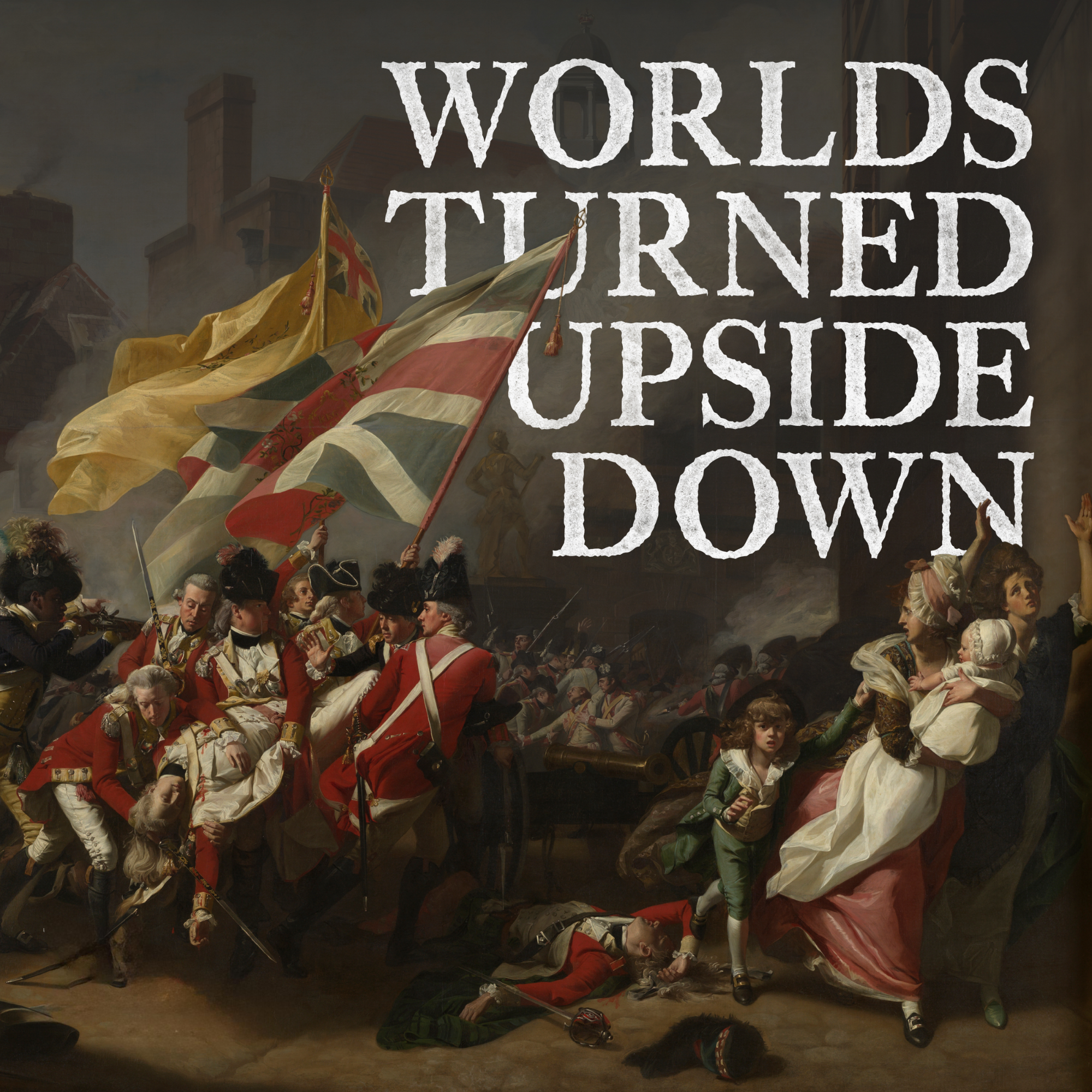
Worlds Turned Upside Down
Roy Rosenzweig Center for History and New Media
Worlds Turned Upside Down tells the story of the American Revolution as a transatlantic crisis and imperial civil war through the lives of people who experienced it. For many modern citizens of the United States, "the cause of America" that gave birth to a new nation in 1776 and the heroic stories we tell ourselves about its founding remains "in great measure the cause of all mankind." But for the people who lived through it, the revolutionary era upended their lives in ways they could have never imagined. The crisis that engulfed the Atlantic world in the late eighteenth century inspired British Americans, Indigenous nations, enslaved Africans and African Americans, Europeans, and other peoples to question their loyalties, challenge authority, seek freedom, and resist revolutionary change.
Worlds Turned Upside Down is narrated and written by Dr. Jim Ambuske.
Worlds Turned Upside Down is narrated and written by Dr. Jim Ambuske.
Episodes
Mentioned books

Dec 18, 2024 • 1h 19min
Episode 12: The Conspiracy
Join historians Patrick Griffin, an expert on British imperial policy, Rosemarie Zagarri, who explores women's roles in colonial boycotts, and Christopher Minty, who delves into New York's political landscape. They discuss the fallout of the Stamp Act Crisis, the significance of Charles Townshend's taxing strategy, and the powerful non-importation movements spurred by colonial opposition. Discover how women mobilized, the conflicts in New York politics, and the escalating tensions leading up to protests that would ignite the Revolutionary spirit.
Oct 22, 2024 • 1h 17min
Episode 11: The Resistance
Wendy Bellion, an American art historian and professor, sheds light on Liberty Poles' significance in colonial America as symbols of resistance. Shira Lurie, an assistant professor of American history, explains how colonial theories of resistance shaped notions of liberty and protest. Their discussion reveals how celebrations after the Stamp Act’s repeal led to tensions in New York City, culminating in confrontations between the Sons of Liberty and British soldiers, showcasing the complex dynamics of emerging American identity.
Sep 13, 2024 • 1h 14min
Episode 10: The Stamp
In this engaging discussion, historian Jon Kukla delves into the British government's strategic fear of France, leading to plans for a standing army and the controversial Stamp Act. Alexandra Montgomery highlights the land rushes in Nova Scotia as colonists scrambled to beat the impending tax deadline. The conversation also explores the growing unrest among colonists, their fierce resistance through riots and protests, and the eventual economic pressures that led to the Stamp Act's repeal. A fascinating look at a foundational moment in American history!
Jul 26, 2024 • 1h 9min
Episode 9: The Sugar
Mary Draper, an expert on Caribbean plantation societies, discusses Antigua's unique ecological and social challenges. Andrew O'Shaughnessy, a historian of the British Caribbean, highlights Jamaica's pivotal role in Britain's economy and imperial strategy. Trevor Bernard explores the stark social inequalities in Jamaica's settler society rooted in slavery. Brooke Newman delves into Jamaica's demographics and wealth dynamics, emphasizing the lethal nature of sugar production and its reliance on the brutal transatlantic slave trade.
Jun 8, 2024 • 1h 15min
Episode 8: The Trade
Join Emma Hart, a historian focused on early American marketplaces, Ann Smart Martin, an expert in material culture, Hannah Knox Tucker, a maritime commerce historian, and Hannah Farber, who specializes in financial history. They dive into the complexities of 18th-century trade, exploring the tension between public good and profit while outlining the critical role of marine insurance. The discussion reveals how enslaved labor supported lucrative exports and how women navigated the commerce landscape, making significant contributions behind the scenes.
May 2, 2024 • 1h 1min
Episode 7: The Divide
Explore the ambitious efforts to map North America as Britain sought to reorder its colonies post-war. Delve into the imaginary boundaries drawn and the military standards for surveying. Hear about the role of the Haudenosaunee in negotiations and the complexities of colonial resistance. Discover how Native leaders pragmatically navigated land sales and the ramifications of treaties like Fort Niagara. The podcast paints a vivid picture of diplomacy, boundary-making, and the clash of cultures in this transformative era.
Mar 23, 2024 • 1h 6min
Episode 6: The Proclamation
Fred Anderson, a historian focusing on 18th-century British imperial policy, and Alexandra Montgomery, a digital history scholar specializing in Nova Scotia, dive into the complexities of British imperial reform post-Pontiac’s War. They explore Halifax's unique governance experiments and its role as a blueprint for a coherent empire. The discussion covers the significant impact of the Royal Proclamation on Indigenous relations, colonial administration, and the strategic designs behind the founding of Halifax amidst resistance from the Mi'kmaq and Acadians.
Jan 31, 2024 • 1h 14min
Episode 5: The Uprising
The aftermath of the Seven Years' War ignites Indigenous resistance as leaders like Neolin advocate for cultural revitalization. Ojibwe assert their sovereignty amid shifting alliances while Haudenosaunee adapt European goods to forge identity. Tensions rise with British trade regulations, culminating in the Cherokee-British War. Pontiac unites tribes for a pan-Indigenous movement, leading to notable successes in confrontations against British forts. Meanwhile, social strife intensifies with the Paxton Boys' massacre, painting a complex portrait of survival and resistance.
Dec 12, 2023 • 1h 12min
Episode 4: The Empire
Fred Anderson, a renowned historian, dives into the aftermath of the Seven Years' War, revealing how Britain's victory reshaped North America and its global power. Max Edelson unpacks Britain's strategic advantage during the Treaty of Paris, detailing territorial negotiations that aimed to mitigate future threats. John Kukla discusses the political upheavals in Britain, highlighting how shifts in leadership influenced peace decisions. The guests also explore the staggering financial costs of the war, colonial frustrations over taxes, and plans for imperial governance.
Nov 14, 2023 • 1h 19min
Episode 3: The Triumph
Fred Anderson, a prominent historian specializing in colonial American history, and Matthew Janique, an expert on British imperial history, discuss the pivotal turning points of the Seven Years' War. They delve into Indigenous diplomacy and how it shaped the conflict's outcome, highlighting the strategic importance of alliances. Janique also contrasts romanticized Highland poetry with the harsh realities faced by Scottish recruits. The duo emphasizes the significant roles of colonial troops and the evolving military strategies that ultimately led to British successes.

