

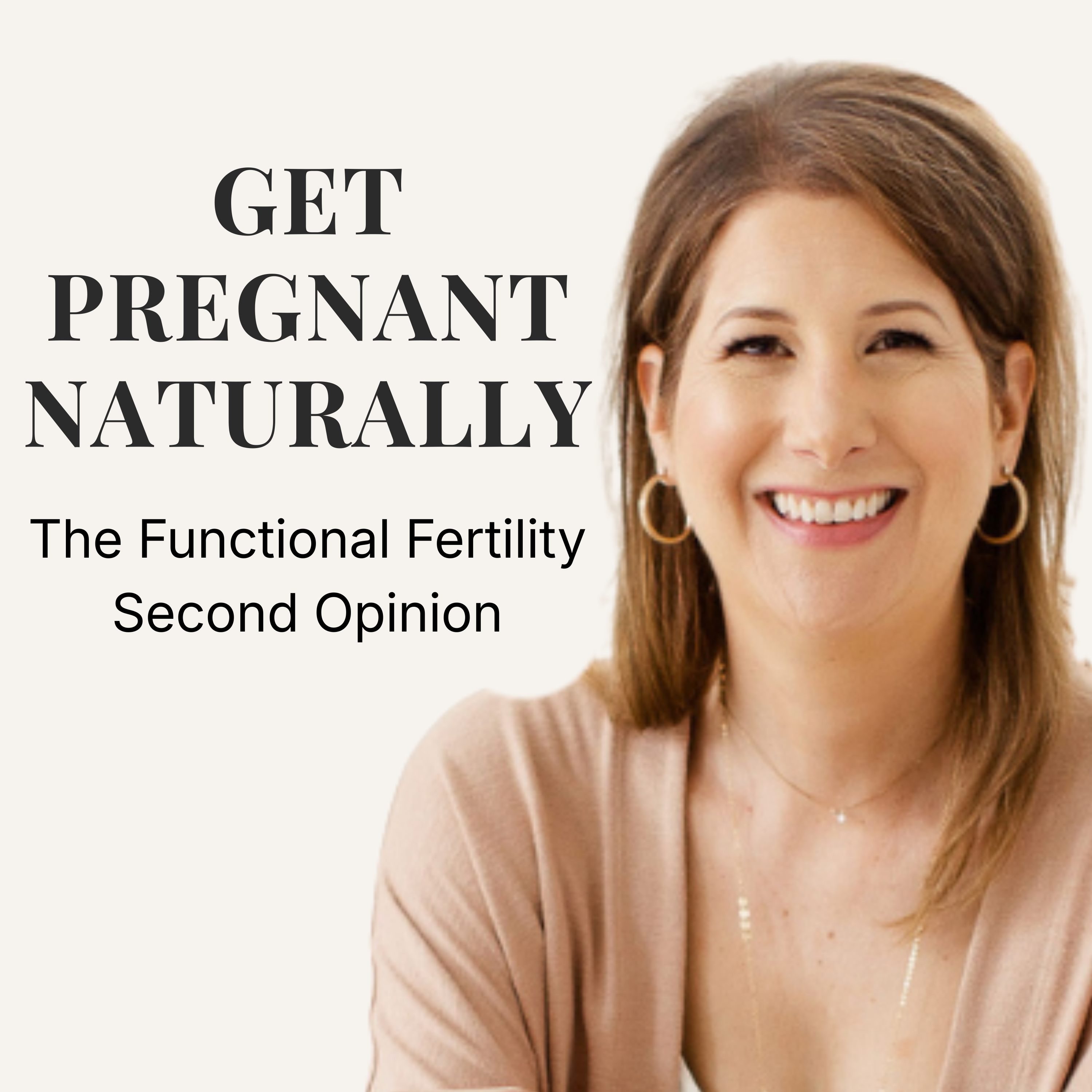
Get Pregnant Naturally
Sarah Clark
Get Pregnant Naturally is the podcast for women and couples facing low AMH, high FSH, failed IVF, miscarriage, premature ovarian insufficiency (POI), diminished ovarian reserve (DOR), or a donor egg recommendation, and who are not ready to accept that recommendation before the full picture has been investigated.
Hosted by Sarah Clark, founder of Fab Fertile, author of Fabulously Fertile, and host of a podcast with over one million downloads, Get Pregnant Naturally offers a functional fertility second opinion. Each week, Sarah walks through the lab work most fertility clinics do not run: gut microbiome, food sensitivity, vaginal microbiome, nutrigenomics, HTMA, DUTCH, full thyroid panel, the iron panel, and inflammation markers, alongside nervous system work. Inside the Fab Fertile program, the full team works with each couple. On the podcast, Sarah brings you what she sees across more than a decade of cases.
This podcast is for the woman who heard donor eggs and walked out, wondering what was missed. The woman whose REI looked at her AMH, her FSH, and her antral follicle count, and stopped there. We work alongside your medical team, not instead of them. The decision still belongs to you. The investigation should happen before the decision.
Subscribe for weekly episodes on what your fertility clinic may not have tested before the next recommendation gets made.
Hosted by Sarah Clark, founder of Fab Fertile, author of Fabulously Fertile, and host of a podcast with over one million downloads, Get Pregnant Naturally offers a functional fertility second opinion. Each week, Sarah walks through the lab work most fertility clinics do not run: gut microbiome, food sensitivity, vaginal microbiome, nutrigenomics, HTMA, DUTCH, full thyroid panel, the iron panel, and inflammation markers, alongside nervous system work. Inside the Fab Fertile program, the full team works with each couple. On the podcast, Sarah brings you what she sees across more than a decade of cases.
This podcast is for the woman who heard donor eggs and walked out, wondering what was missed. The woman whose REI looked at her AMH, her FSH, and her antral follicle count, and stopped there. We work alongside your medical team, not instead of them. The decision still belongs to you. The investigation should happen before the decision.
Subscribe for weekly episodes on what your fertility clinic may not have tested before the next recommendation gets made.
Episodes
Mentioned books

Oct 5, 2026 • 14min
Low AMH? Why It's a Poor Predictor of Getting Pregnant Naturally
Low AMH? High FSH? Diminished ovarian reserve or POI? Book a free Functional Fertility Second Opinion before your next fertility decision → fabfertile.com Your AMH came back low. Your FSH is elevated. You've been told you have diminished ovarian reserve and may not respond well to IVF. And very quickly, that gets translated into: I'm not going to get pregnant. That isn't what AMH was designed to tell you. AMH is useful for helping predict how your ovaries may respond to stimulation and how many eggs may be retrieved during IVF. On its own, it's a poor predictor of whether you'll conceive naturally, and it can't tell you the quality of your eggs. So instead of building your whole plan around raising that number, the better question is what else deserves a look. In this episode: What low AMH can and can't tell you about IVF response, natural conception, and egg quality Why chasing a higher AMH isn't the main goal, even when we do see it move What may be shaping the environment your eggs are developing in, including inflammation, thyroid health, blood sugar, nutrient status, gut and vaginal microbiome, and the nervous system Why your partner's health matters and why a normal semen analysis isn't always the full picture Low AMH is important information. It isn't your entire fertility story. CHAPTERS 00:00 When AMH becomes the explanation for everything 02:00 What AMH can and can't tell you 03:00 Why did this happen? 04:00 The environment your eggs develop in 07:00 His side and what hasn't been investigated FUNCTIONAL FERTILITY SECOND OPINION Book with your partner and load your labs and testing into our secure portal. We look at patterns across your fertility history, bloodwork, existing testing, and the health of both partners to identify what may not have been investigated. Whether you're trying naturally, preparing for IVF or deciding what to do after a failed cycle, we'll help you understand what deserves your attention next. Book here ABOUT THE HOST I'm Sarah Clark, founder of Fab Fertile and host of Get Pregnant Naturally, a podcast with over one million downloads. For almost 12 years, my team and I have worked with couples navigating low AMH, diminished ovarian reserve, high FSH, POI, recurrent pregnancy loss and failed IVF. We look across fertility history, previous treatment, bloodwork, functional testing, and the health of both partners to identify patterns that may not have been explored. We work alongside your fertility clinic, not instead of it. Sarah Clark, founder of Fab Fertile, host of Get Pregnant Naturally (1M+ downloads), and author of Fabulously Fertile.
Sep 28, 2026 • 12min
Failed IVF, Low AMH or Told Donor Eggs? Stuck Deciding What to Do Next
Failed IVF? Low AMH? High FSH? Told donor eggs? Book a free Functional Fertility Second Opinion before your next fertility decision → fabfertile.com Your AMH is 0.2 ng/mL. Your FSH is 40. Another IVF cycle has failed, you've experienced another loss, or donor eggs are now on the table. So you research. You ask ChatGPT fifteen versions of what should I do next? and every answer gives you five more things to investigate. You have more fertility information than ever, and you're still terrified of making the wrong decision. Information and certainty are not the same thing. No one can guarantee another IVF cycle, a different protocol, PRP, or donor eggs will work. You don't need to know your decision is going to work. You need to know why you're making it. In this episode, I walk through when you genuinely need more information after failed IVF, recurrent pregnancy loss, low AMH or high FSH, and when research has become the thing keeping you stuck. We look at what has actually been investigated for both partners, including autoimmune history, inflammation, food sensitivity, bloating, skin changes, male bloodwork and sperm DNA fragmentation beyond a semen analysis that came back And instead of asking what else should I research? I give you a different question: What information would actually change my decision? Whether that's IVF number four, trying again after loss, continuing with your own eggs, or moving to donor eggs. Preparing is not the same as being evaluated. CHAPTERS 00:00 AMH 0.2, FSH 40 and fifteen versions of the same question 01:20 When you do need more information 02:20 What has actually been investigated, for both of you 05:20 What information would change your decision 08:10 Fear about time, fear of choosing wrong, and certainty FUNCTIONAL FERTILITY SECOND OPINION Book with your partner and load your labs into the secure portal. We look at your history, your bloodwork, what you've already tried and your current plan, and talk through what has not been investigated and how to work on it alongside your clinic, in parallel. It is not IVF or your health. It is both. Book here → https://fabfertile.com/pages/second-opinion ABOUT THE HOST I'm Sarah Clark, founder of Fab Fertile and host of Get Pregnant Naturally, a podcast with over one million downloads. My functional fertility team works with couples navigating low AMH and failed IVF, reviewing functional lab results, gut microbiome, food sensitivity, vaginal microbiome, nutrigenomics, HTMA, DUTCH, toxin testing, and bloodwork alongside nervous system work, to help identify patterns that may not have been considered. We work alongside your medical team, not instead of them. Sarah Clark, founder of Fab Fertile, host of Get Pregnant Naturally (1M+ downloads), and author of Fabulously Fertile.
Sep 21, 2026 • 31min
Pregnant at 37 With POI: Her Low AMH and High FSH Story
POI? Low AMH? High FSH? Told donor eggs are your only option? Book a free Functional Fertility Second Opinion before your next fertility decision → fabfertile.com *]:pointer-events-auto R6Vx5W_threadScrollVars scroll-mb-[calc(var(--scroll-root-safe-area-inset-bottom,0px)+var(--thread-response-height))] scroll-mt-[calc(var(--header-height)+min(200px,max(70px,20svh)))]" dir="auto" data-turn-id= "request-WEB:9a98f112-4419-4d46-93c0-adaa0a2bc62a-233" data-turn-id-container= "request-WEB:9a98f112-4419-4d46-93c0-adaa0a2bc62a-233" data-testid= "conversation-turn-388" data-turn="assistant"> She was diagnosed with POI at 37. Her AMH was 0.16, her FSH was hovering around 45, and her ultrasound showed three follicles and at one point, none. Her IUI cycles were cancelled, and she was labeled a poor responder. Then she was told she was not a candidate for IUI or IVF and that donor eggs were her only option. But she wanted to know what else might be going on with her health. In this episode, I walk through our client's POI success story, including her Hashimoto's, inflammation, low vitamin D, B12 and iron, chronic stress, gut and vaginal microbiome, her partner's health, and what happened the month before her planned IVF. After eight months of following the Fab Fertile Method, she became pregnant naturally the month before she was planning to start IVF. This is her story of looking beyond AMH and FSH and asking: what else might have been missed? CHAPTERS 00:00 POI at 37 with an AMH of 0.16 and an FSH of 45 04:00 Told donor eggs were her only option 06:30 Inflammation, nutrients, stress and her gut 20:10 PRP timing and the month before her planned IVF 24:20 Why AMH and FSH alone are not the whole picture FUNCTIONAL FERTILITY SECOND OPINION Book with your partner and load your labs into the secure portal. We review your bloodwork for patterns and talk through what is worth digging into before another IVF cycle. Book your call with your partner here. ABOUT THE HOST I'm Sarah Clark, founder of Fab Fertile and host of Get Pregnant Naturally, a podcast with over one million downloads. My functional fertility team works with couples navigating low AMH and failed IVF, reviewing functional lab results, gut microbiome, food sensitivity, vaginal microbiome, nutrigenomics, HTMA, DUTCH, toxin testing, and bloodwork alongside nervous system work, to help identify patterns that may not have been considered. We work alongside your medical team, not instead of them. Sarah Clark, founder of Fab Fertile, host of Get Pregnant Naturally (1M+ downloads), and author of Fabulously Fertile.
Sep 14, 2026 • 17min
Embryos Stopped Growing at Day 3? 3 Questions Before You Go Again
Failed IVF? Embryos arrested at Day 3? Told it was your egg quality? Book a free Functional Fertility Second Opinion before your next retrieval → fabfertile.com Day three, you got the call that your embryos were developing, and you let yourself feel hopeful. Day five, there is nothing to transfer, and you are told it was your egg quality. Then you read online that embryos stopping after day three could point to sperm. So now you do not know what actually happened, or whether anything is left to investigate before you go again. Your clinic may have had good reasons for saying egg quality. They also cannot test it directly. That makes it a conclusion rather than a finding, and it is usually where the investigation stops. In this episode, what I would want looked at before another retrieval includes the 90 days before stimulation started and his side beyond a semen analysis that came back fine. Preparing is not the same as being evaluated. CHAPTERS 00:00 Day three looked fine. Day five, there was nothing to transfer 01:20 Why egg quality is a conclusion, not a test result 04:00 The 90 days before the retrieval, for both of you 05:30 Blood sugar, the full thyroid picture, inflammation and nutrients 09:30 His side beyond the semen analysis FUNCTIONAL FERTILITY SECOND OPINION Book with your partner and load your labs. We review your bloodwork for patterns your clinic is not set up to examine, and talk through what is worth investigating before another retrieval or transfer. It is not IVF or your health. It is both. Book here → second opinion ABOUT THE HOST I'm Sarah Clark, founder of Fab Fertile and host of Get Pregnant Naturally, a podcast with over one million downloads. My functional fertility team works with couples navigating low AMH and failed IVF, reviewing functional lab results, gut microbiome, food sensitivity, vaginal microbiome, nutrigenomics, HTMA, DUTCH, toxin testing, and bloodwork alongside nervous system work, to help identify patterns that may not have been considered. We work alongside your medical team, not instead of them. Sarah Clark, founder of Fab Fertile, host of Get Pregnant Naturally (1M+ downloads), and author of Fabulously Fertile.
Sep 7, 2026 • 14min
Low AMH, Failed IVF and Miscarriage: What Changed for This Couple
Told donor eggs after failed IVF and miscarriage? Book a free Functional Fertility Second Opinion before your next cycle → here. Heather had been trying for five years. Three failed IVFs. Two losses. At 38, with diminished ovarian reserve, she was told donor eggs were her only option. She had a 10-day luteal phase, daily fatigue, PMS, body aches she had been told were normal, and a decade of hormonal birth control behind her. None of it had been connected to her fertility. Her partner's semen analysis was not clean either, and he had DNA fragmentation that had never been tested for. She followed our Fab Fertile Method and did one more IVF. That transfer worked, and they had their daughter. This is one couple, and it is not a promise. What it shows is what a complete investigation looked like before that last cycle. CHAPTERS 00:00 Three failed IVFs, two losses, and a donor egg recommendation 01:20 Told donor eggs at 28. Why I never got a second opinion 03:00 A 10-day luteal phase and the symptoms nobody counted 04:30 What testing showed: absorption, inflammation, and a decade of birth control 06:30 His side. Sleep, headaches, and DNA fragmentation nobody had looked for 11:45 What changed before the last transfer FUNCTIONAL FERTILITY SECOND OPINION Book with your partner and load your labs. We review your bloodwork for patterns your clinic is not set up to examine, and talk through what is worth investigating before another cycle or transfer. It is not IVF or your health. It is both. Book here → ABOUT THE HOST I'm Sarah Clark, founder of Fab Fertile and host of Get Pregnant Naturally, a podcast with over one million downloads. My functional fertility team works with couples navigating low AMH and failed IVF, reviewing functional lab results, gut microbiome, food sensitivity, vaginal microbiome, nutrigenomics, HTMA, DUTCH, toxin testing, and bloodwork alongside nervous system work, to help identify patterns that may not have been considered. We work alongside your medical team, not instead of them. Sarah Clark, founder of Fab Fertile, host of Get Pregnant Naturally (1M+ downloads), and author of Fabulously Fertile.
Aug 31, 2026 • 13min
Follicles Not Responding? Is Low AMH the Whole Explanation
Follicles not responding? Cycle cancelled? Told it is your low AMH? Book a free Functional Fertility Second Opinion before your next IVF decision → fabfertile.com You have done the injections. You have gone in for monitoring. They may have increased the medication already. And then you hear it again. The follicles are not responding. There are one or two growing. Maybe the cycle gets cancelled. Maybe you make it all the way to retrieval and get one egg. When you ask why, the answer comes back the same way every time. It is your low AMH. It is your age. You are a poor responder. Those are real factors, and I am not going to tell you the AMH does not matter. But if you are about to put your body, your finances, and yourself through another cycle, there is a bigger question worth asking. Is low AMH the whole explanation? Because these are two separate statements: I have diminished ovarian reserve, and low AMH explains everything that happened during that cycle. They are not the same statement. In this episode I walk through what AMH does and does not tell you, what I would want to understand about the 90 days before stimulation started, and what to ask your clinic before you go again. The full thyroid panel, including antibodies rather than TSH alone. Blood sugar and how it moves across a day. hs-CRP and unnecessary inflammation. Vitamin D you may be taking and may not be absorbing. Gut health, food sensitivity, the vaginal microbiome, nutrient status, and an autoimmune issue that gets mentioned as an afterthought when it belongs at the front of the file. CHAPTERS 00:00 The follicles are not responding 01:00 About Sarah and the team 01:20 What AMH does and does not tell you 02:00 Two statements that are not the same 02:20 The 90 days before stimulation started 02:40 hs-CRP and unnecessary inflammation 03:00 Optimal, not normal 03:20 Blood sugar regulation across the day 03:30 The full thyroid panel including antibodies 03:50 Nutrient depletion and secondary infertility 04:10 The vitamin D you may not be absorbing 04:30 An autoimmune issue is not a by the way 05:00 A clean diet that may not be the right diet for you 05:30 Hypervigilance and nervous system load 06:20 One client who did not have enough follicles to qualify 06:40 What I am not claiming 08:00 Annie and Miles. AMH 0.15, FSH 33 08:40 What Your Clinic Missed 09:00 What to ask before another IVF 09:40 Thirty days without medication, and doing this in parallel 11:00 Book a Second Opinion with your partner WHAT YOUR CLINIC MISSED If you have no idea which of these markers to run, we have a checklist called What Your Clinic Missed. It is a list of markers worth reviewing before a donor egg decision or before another IVF, so you can look at your own results and go from there. Email [email protected] with MISSED in the subject line and we will send it to you. FUNCTIONAL FERTILITY SECOND OPINION Book with your partner and load your labs into the secure portal. Before the call I review your fertility history and bloodwork from both partners, looking for patterns, unanswered questions and gaps. We are not diagnosing. Sometimes the review confirms that moving forward with the next IVF makes sense. Sometimes there are questions worth addressing first. Book your call with your partner at fabfertile.com If you want to know whether the call is right for you first, email [email protected] with FERTILE in the subject line and tell me a little about your situation. ABOUT THE HOST I'm Sarah Clark, founder of Fab Fertile and host of Get Pregnant Naturally, a podcast with over one million downloads. My functional fertility team works with couples navigating low AMH and failed IVF, reviewing functional lab results, gut microbiome, food sensitivity, vaginal microbiome, nutrigenomics, HTMA, DUTCH, toxin testing, and bloodwork alongside nervous system work, to help identify patterns that may not have been considered. We work alongside your medical team, not instead of them. Sarah Clark, founder of Fab Fertile, host of Get Pregnant Naturally (1M+ downloads), and author of Fabulously Fertile. If this episode helped, leave a review. It is how other women find this work.
Aug 24, 2026 • 10min
Failed IVF and No Embryos to Transfer? 3 Questions Before You Go Again (Low AMH, Embryo Arrest, Donor Eggs)
Failed IVF? Low AMH? High FSH? Told donor eggs? Book a free Functional Fertility Second Opinion before your next fertility decision → fabfertile.com You got eggs. After everything, that part finally went right. Then day one, this many fertilized. Day three, this many are still growing. Then the call where someone tells you none of them made it. And what comes next, almost word for word on call after call, is you going back through your twenties. The years when maybe you weren't taking the best care of yourself. Maybe you drank more, were under a lot of stress, or simply weren't thinking about your fertility yet. And you start wondering, Did I cause this? Is that why this happened? But then you come back to the same thing: I'm healthy now. I'm active. I take care of myself. So what am I missing? Your age is real, and we are not going to ignore it. It usually is not the only thing on the table. In this episode, I walk through the three questions I want answered before you go again. What that cycle actually told us, and what it could not tell us about the 90 days before the injections started. What was investigated and what was not, including the full thyroid panel, triglycerides and insulin rather than A1C alone, hs-CRP, vitamin D absorption, the gut and vaginal microbiome, food sensitivity, and his side beyond a count. And if you do another retrieval, what specifically is changing and why. Preparing is not the same as being evaluated. CHAPTERS 00:00 None of them made it 01:00 About Sarah and the team 01:20 Question 1. What did that cycle actually tell us 02:00 The 90 days before stimulation started 02:30 Preparing is not the same as being evaluated 03:00 Where the nervous system fits 03:30 Question 2. What was investigated and what was not 03:50 Full blood chemistry, thyroid and triglycerides 04:20 hs-CRP, vitamin D absorption and gut infections 04:40 The vaginal and gut microbiome 05:00 Clean eating that may still be driving inflammation 06:00 His side. DNA fragmentation and bloodwork 06:30 The body is not a silo 07:10 What Your Clinic Missed 07:30 Question 3. If you go again, what will actually be different 08:10 Book a Second Opinion with your partner WHAT YOUR CLINIC MISSED If you are not sure what can be investigated or which way to go next, we have a guide called What Your Clinic Missed. It gives you the patterns and themes to look at before you consider your next move. Email [email protected] with MISSED in the subject line. FUNCTIONAL FERTILITY SECOND OPINION Book with your partner and load your labs into the secure portal. We review your bloodwork for patterns your clinic is not set up to examine, and talk through what is worth digging into before another IVF cycle. It is not IVF or your health. It is both. Book your call with your partner here. If you want to know whether the call is right for you first, email [email protected] with FERTILE in the subject line and tell me a little about your situation. ABOUT THE HOST I'm Sarah Clark, founder of Fab Fertile and host of Get Pregnant Naturally, a podcast with over one million downloads. My functional fertility team works with couples navigating low AMH and failed IVF, reviewing functional lab results, gut microbiome, food sensitivity, vaginal microbiome, nutrigenomics, HTMA, DUTCH, toxin testing, and bloodwork alongside nervous system work, to help identify patterns that may not have been considered. We work alongside your medical team, not instead of them. Sarah Clark, founder of Fab Fertile, host of Get Pregnant Naturally (1M+ downloads), and author of Fabulously Fertile. If this episode helped, leave a review. It is how other women find this work.
Aug 17, 2026 • 10min
Poor Responder After a Cancelled IVF Cycle: 3 Questions to Ask Before You Go Again (Low AMH, Failed IVF, Diminished Ovarian Reserve)
Failed IVF? Low AMH? High FSH? Told donor eggs? Book a free Functional Fertility Second Opinion before your next fertility decision → fabfertile.com Your cycle was cancelled on day eight or day nine. Someone called and said there were not enough follicles and it was not worth going ahead. At the follow up, you heard the words poor responder. What do you actually do with that? Change the protocol. Go again next month. Take three months off and work on your health. Get another opinion. Or accept that this is what your ovaries are capable of and stop looking for an explanation. This is where I see women get stuck, because if you are listening to this, you have already done a lot. Clean eating, the supplements, CoQ10, a methylfolate prenatal, vitamin D, no alcohol, no plastics, acupuncture twice a week, reading It Starts With The Egg. Almost nobody walks into IVF blindly. None of that answers the question in front of you now. What should I actually do before another retrieval? In this episode, I walk through the three questions I would want answered. None of them are more supplements, and none of them are another checklist. A cancelled cycle tells you how your ovaries responded to medication. It was never designed to tell you about the environment those eggs were developing in during the ninety days before the injections started. What I cover: what the cycle actually established and what it was never built to answer. What happened in those ninety days, including the full thyroid panel with antibodies rather than TSH alone, ferritin where we look at 80 to 100, high sensitivity CRP where we like it below one, and absorption. Your partner's side, including DNA fragmentation, sperm antibodies and the seminal microbiome across his seventy-four days. And the question to ask your fertility team before you agree to another retrieval: what exactly are we changing, and why? I am not telling you which protocol to be on. That is a conversation with your fertility team. I am also not saying any one of these markers explains a cancelled cycle. That is not the claim I am making. It is about whether the investigation was finished before the next decision. CHAPTERS 00:00 Your cycle was cancelled and you heard poor responder 01:00 Question one, what did the cycle actually tell us 02:00 Everything you had already done before the cycle 03:00 Question two, what happened in the ninety days before stimulation 04:00 Full thyroid panel, ferritin, high sensitivity CRP and absorption 05:00 His side, DNA fragmentation, and why this is personal for me 06:00 What Your Clinic Missed, and what we actually look at 07:00 Question three, if you go again, what will be different 08:00 The Functional Fertility Second Opinion 09:00 Closing WHAT YOUR CLINIC MISSED A list of markers worth reviewing before another IVF cycle or a donor egg decision. It also gives you a sense of what we look at with clients, beyond bloodwork. Email [email protected], subject line MISSED, and we will send you the guide. FUNCTIONAL FERTILITY SECOND OPINION A free 45-minute call where I review your bloodwork, your history, and your partner's results with you. Bring your partner and load your labs before the call. Email [email protected], subject line FERTILE, or book here. ABOUT THE HOST I'm Sarah Clark, founder of Fab Fertile and host of Get Pregnant Naturally, a podcast with over one million downloads. My functional fertility team works with couples navigating low AMH and failed IVF, reviewing functional lab results, gut microbiome, food sensitivity, vaginal microbiome, nutrigenomics, HTMA, DUTCH, toxin testing, and bloodwork alongside nervous system work, to help identify patterns that may not have been considered. We work alongside your medical team, not instead of them. Sarah Clark, founder of Fab Fertile, host of Get Pregnant Naturally (1M+ downloads), and author of Fabulously Fertile. If this episode helped, leave a review on Apple Podcasts. It is how other women find this work.
Aug 10, 2026 • 11min
Failed IVF? 5 Questions to Ask Before Another IVF Cycle
Failed IVF? Low AMH? High FSH? Told donor eggs? Book a free Functional Fertility Second Opinion before your next fertility decision → fabfertile.com After a failed cycle, the pressure to decide arrives fast. Another retrieval. A different protocol. A different clinic. Donor eggs. And underneath all of it, the question of what to do next. This episode is not an argument against IVF. It is the opposite. It is about walking into the next cycle having looked at the whole picture rather than only the protocol. These are the five questions I would ask if we were sitting together reviewing your case. What your last cycle actually told us, and why stimulation works with the eggs your body has already been developing rather than creating egg quality. What has genuinely changed since the last cycle beyond the medication. Whether investigating costs you time, or whether the two can run in parallel. Whether both partners have been evaluated, or only one. And what information would let you feel settled about the decision either way. I also share what I would do differently. I was 28 when I was told donor eggs were my only option. I did not know there were other questions to ask. CHAPTERS 00:00 The pressure to decide after a failed cycle 00:52 Review ask 01:00 What our team reviews and how we work 02:30 The type A pattern, and the tracking data that still has not answered it 03:10 Question 1. What did your IVF cycle actually tell us 03:40 Stimulation does not create egg quality 03:55 Question 2. What has actually changed since your last cycle 04:30 His full workup, beyond count and motility 05:00 Question 3. Will investigating cost me time 05:50 What is happening to your eggs while you gather information 06:15 Running functional work and IVF in parallel 06:50 Question 4. Have we looked at both partners 07:20 The 70 to 80 day window before conception 07:35 Question 5. What would help you feel confident either way 08:05 Medical gaslighting, and the symptoms nobody connected 08:30 I was 28 and I did not know what to ask 09:15 The Functional Fertility Second Opinion, and how parallel timing works FUNCTIONAL FERTILITY SECOND OPINION A free 45-minute call. Upload your bloodwork and IVF records to the portal beforehand and we go through what has already been investigated, where the gaps are, and whether our approach is a fit. If you have a retrieval scheduled we can still work with you. Email [email protected], subject line FERTILE, or book at fabfertile.com ABOUT THE HOST I'm Sarah Clark, founder of Fab Fertile and host of Get Pregnant Naturally, a podcast with over one million downloads. My functional fertility team works with couples navigating low AMH and failed IVF, reviewing functional lab results, gut microbiome, food sensitivity, vaginal microbiome, nutrigenomics, HTMA, DUTCH, toxin testing, and bloodwork alongside nervous system work, to help identify patterns that may not have been considered. We work alongside your medical team, not instead of them. Sarah Clark, founder of Fab Fertile, host of Get Pregnant Naturally (1M+ downloads), and author of Fabulously Fertile. If this episode helped, leave a review on Apple Podcasts. It is how other women find this work.
Aug 3, 2026 • 15min
High FSH and Told Donor Eggs? What Should the Number Actually Decide?
Failed IVF? Low AMH? High FSH? Told donor eggs? Book a free Functional Fertility Second Opinion before your next fertility decision.→ fabfertile.com You knew before the nurse called. You had been checking the portal, and there it was. FSH, flagged high. You read the range beside it several times, then searched the number late at night hoping it would tell you what it meant for your future. What came back was not an explanation. It felt like a verdict. Diminished ovarian reserve. Poor responder. Consider donor eggs. A high FSH is a real finding, and this episode does not pretend otherwise. But a number tells you where you are standing. It does not tell you how you got there, and it does not decide for you. In this episode, I walk through what a high FSH does tell us, what it does not, and the questions I would want answered before making another fertility decision. That includes the cycle day the sample was drawn on, whether estradiol was measured alongside it, whether the result has ever been repeated, and the layer of health that sits underneath the number and rarely gets examined. I also share the outcomes I have seen across ten years. Some couples conceive naturally. Some go on to IVF, and it works. Some choose donor eggs. Some choose adoption. Some decide not to pursue children and feel better than they have in years. The goal of this work is clarity, not a promise. CHAPTERS 00:00 The portal, the result, and what it felt like 01:00 What our team reviews and why it looks different 02:00 Both partners, and why this is multifactorial 03:00 What FSH is actually telling us 04:00 Cycle day, estradiol, and whether the test was repeated 05:00 What could be contributing to the bigger picture 06:00 Thyroid, ferritin, vitamin D, blood sugar, inflammation 07:00 Autoimmunity, gut health, endometriosis, sleep, nutrition 08:00 Under-fueling, chronic stress, and what the DUTCH test shows 09:00 The pattern I see in type A women, and my own diagnosis at 28 11:00 Every path we have helped couples take 12:00 What Your Clinic Missed 12:30 Three questions before your next decision 13:30 The Functional Fertility Second Opinion WHAT YOUR CLINIC MISSED The companion guide walks through the markers worth reviewing before a donor egg decision, so you can go through your own results and see what is there. Email [email protected], subject line MISSED, and we will send you the guide. FUNCTIONAL FERTILITY SECOND OPINION A free 45-minute call. Before we speak, I review your bloodwork, your history, your previous treatment, and both partners' health, so the conversation focuses on what has been explored and what questions remain. Email [email protected], subject line FERTILE, or book here. ABOUT THE HOST I'm Sarah Clark, founder of Fab Fertile and host of Get Pregnant Naturally, a podcast with over one million downloads. My functional fertility team works with couples navigating low AMH and failed IVF, reviewing functional lab results, gut microbiome, food sensitivity, vaginal microbiome, nutrigenomics, HTMA, DUTCH, toxin testing, and bloodwork alongside nervous system work, to help identify patterns that may not have been considered. We work alongside your medical team, not instead of them. Sarah Clark, founder of Fab Fertile, host of Get Pregnant Naturally (1M+ downloads), and author of Fabulously Fertile. If this episode helped, leave a review on Apple Podcasts. It is how other women find this work.

