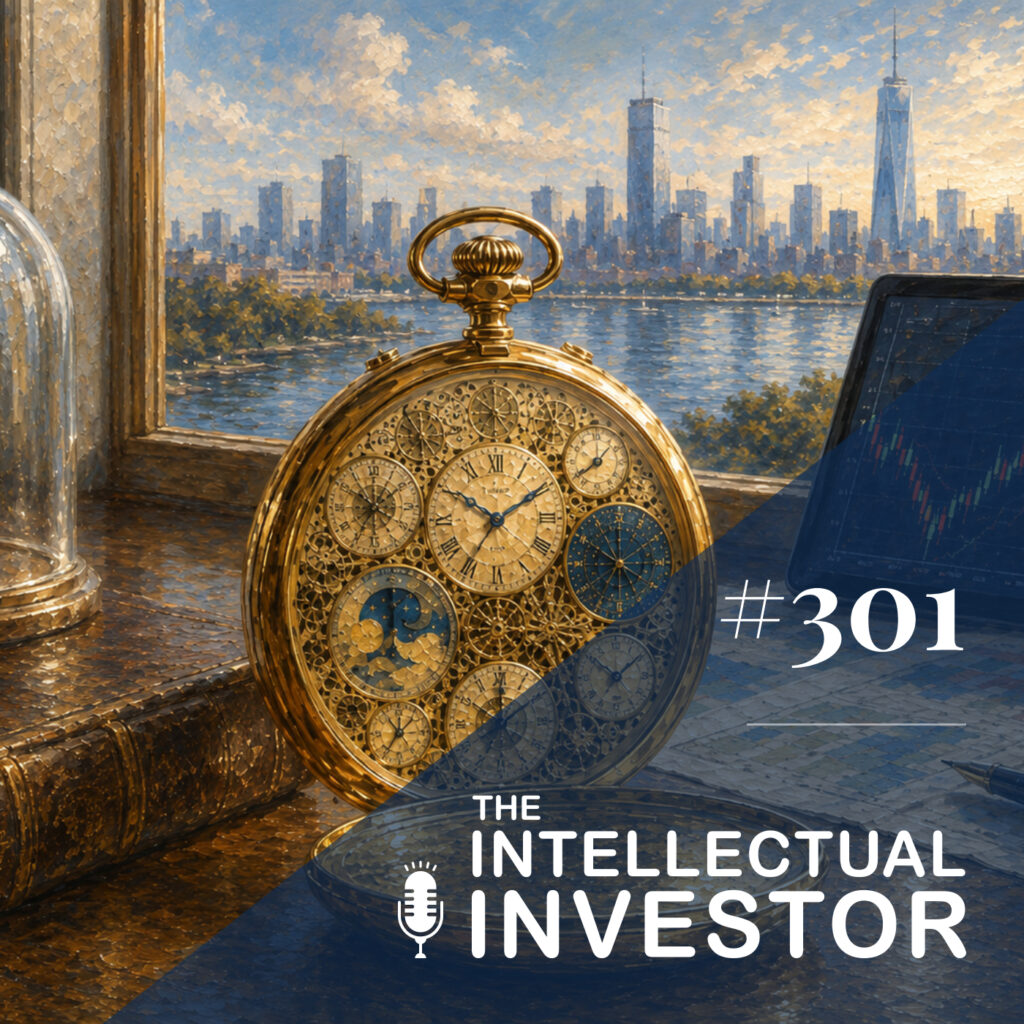
Rising Treasury yields trigger an unsettling look at government intervention, fiscal stress, inflation, and confidence in the US dollar. A watchmaking comeback inspires a framework for sudden shifts in market narratives. The discussion also explores stocks in inflationary periods, unusual S&P 500 correlations, and the widening divide between AI-driven companies and the broader economy.
00:00
forum Ask episode
web_stories AI Snips
view_agenda Chapters
auto_awesome Transcript
info_circle Episode notes
question_answer ANECDOTE
How Caliber 89 Revived Mechanical Watches
Patek Philippe’s Caliber 89 helped end the quartz crisis by making mechanical watches culturally compelling again.
The two-pound watch had 33 complications, surpassed a 24-complication record, and sold for about $3 million in 1989.
insights INSIGHT
Human Behavior Drives Market Narrative Shifts
Markets and economies follow soft laws because human behavior can overwhelm rational valuation for years.
Shifts from euphoria to despair resemble narrative changes rather than purely mechanical responses to fundamentals.
question_answer ANECDOTE
Treasury Intervention Failed To Hold Yields Down
When long-term Treasury yields surged, the Treasury bought its own bonds and funded the purchases with short-term debt.
Yields briefly declined before rising again, suggesting bond investors rejected the intervention.
Get the Snipd Podcast app to discover more snips from this episode
In mid-August 2026, the 30-year Treasury yield hit its highest level in 19 years, above 5.3%, and the 10-year touched 4.75%. What happened next did not shock me, but it worries me: the US Treasury bought back its own long bonds to push yields down, financing the purchase by issuing short-term Treasuries. Yields fell for a day and then went right back up.
This is the first half of my latest client letter. I sat down to write about individual stocks and kept ending up somewhere else. I get a feeling we are having a Caliber 89 moment.
Caliber 89 was the two-pound Patek Philippe pocket watch with 33 complications that marked the bottom of the Quartz Crisis in 1989. It was a narrative-change moment, a reversal of mass behavior after a decade when everyone thought mechanical watches were dead. I walk through why August 2026 may be that kind of moment for the US dollar and for inflation, and what it means when the Treasury starts intervening in interest rates and propping up the Japanese yen during what is supposedly a booming economy.
I also get into why we spend more on interest payments than on defense, why I would not buy a 10-year Treasury even at 6%, and the strange fact that 120 of the 500 stocks in the S&P 500 now have negative correlation to the market, something last seen in 1999. The AI economy and everything else are no longer the same economy.
Part 2, on why I have reluctantly turned bullish on gold, arrives in the next episode. Read the full letter at investor.fm.
_________________________________________________________ WHO AM I: Vitaliy Katsenelson is the CEO of Investment Management Associates (IMA) and an award-winning writer. Forbes Magazine called him “The New Benjamin Graham.” His work has appeared in the Financial Times, The Wall Street Journal, Barron’s, Fortune, Institutional Investor, and Foreign Policy. He is the author of three books, including Soul in the Game: The Art of a Meaningful Life. _________________________________________________________ Please read the following important disclosure: https://investor.fm/disclosure/
View IMA’s regulatory filings — including ADV Part 2A & 2B, Form CRS, firm brochure, conflicts of interest disclosures, sample quarterly letters, and privacy policy — at imausa.com.


 The Intellectual Investor – Value Investing by Vitaliy Katsenelson