


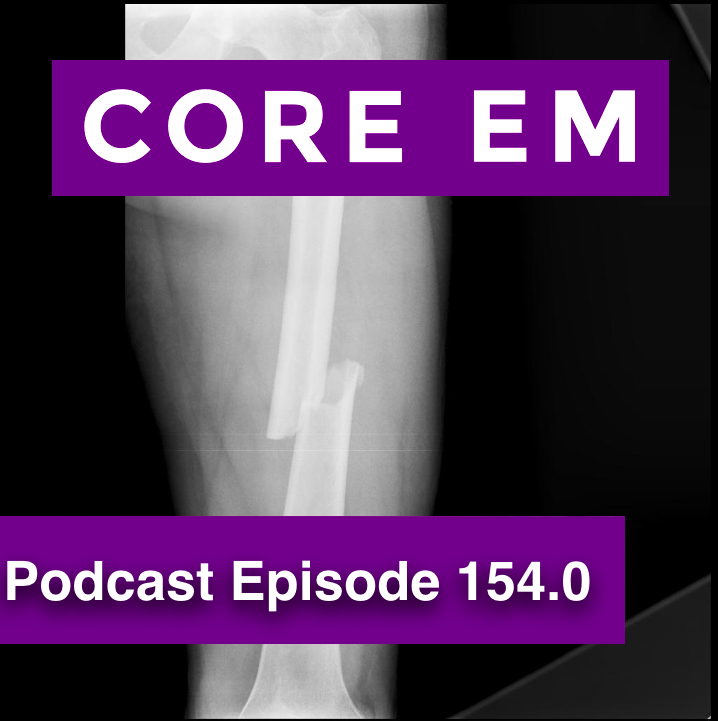
This week we review femoral shaft fractures with a focus on assessment and analgesia

 Core EM - Emergency Medicine Podcast
Episode 154.0 – Femoral Shaft Fractures
Jul 16, 2018
A focused conversation on recognizing femoral shaft fractures and how they differ from hip or knee breaks. They explore mechanisms across age groups and the risk of major hemorrhage and compartment issues. Practical topics include initial splinting, pain control in the field, imaging decisions, and the role and safety of ultrasound-guided femoral nerve blocks.
AI Snips
Chapters
Books
Transcript
Episode notes
Definition And Typical Mechanisms Of Femoral Shaft Fractures
- Femoral shaft refers to bone segment from the lesser trochanter to the femoral condyles.
- This excludes proximal hip and distal knee fractures and explains mechanism differences: low-energy falls in elderly versus high-energy trauma in younger patients.
Vascular Risk And Nerve Protection In Femur Breaks
- Profunda femoris artery supplies most of the femur and may be injured, causing significant hemorrhage.
- Sciatic and femoral nerve injury is uncommon because thigh musculature usually shields the nerves.
Always Perform A Complete Trauma Survey
- Do a full trauma survey and search for other injuries even when a femoral shaft fracture is obvious.
- Remember ipsilateral femoral neck fractures occur in up to 10% of these cases, so assess the hip specifically.