

Childlike Faith vs. Childish Faith. (TAW052)
The Apprenticeship Way with Marc Alan Schelske
Embracing Childlike Faith Over Childish Behavior
This chapter contrasts selfish, insecure childish faith with the inclusive nature of childlike faith. It calls for a transformation within the Western church towards a more communal, nurturing, and relational approach to spirituality.
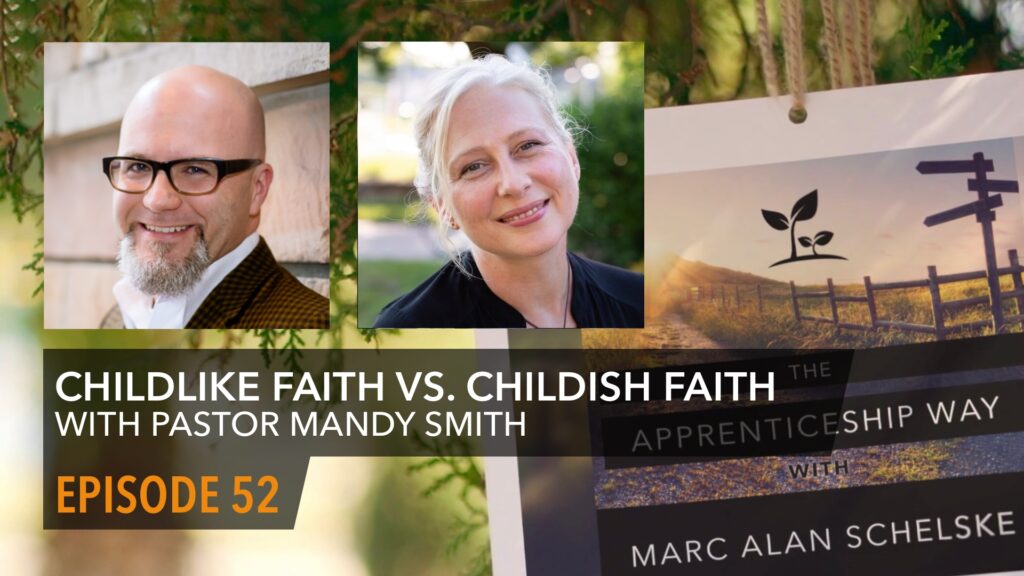
Episode 052 – Childlike Faith vs. Childish Faith (With Pastor Mandy Smith)
Often the church seems in a panic to avoid the influence of culture, but what if the church is already fully bought into the assumptions of culture? Western culture assumes that strength, leadership, and being right are the way of success. Does the way of Jesus calls us to something different?.
Show Notes
- Get Mandy’s books:
- Mandy’s Website: www.TheWayIsTheWay.org
- Scroll down for a full transcript of this episode.
- You can also watch and share the video version on Youtube.
More about My Conversation Partners
Mandy Smith is a pastor, author, and speaker. She pastors St. Lucia Uniting Church, in St. Lucia, in Queensland, Australia. She’s a regular contributor to Christianity Today and Missio Alliance.
- Find Mandy at www.TheWayIsTheWay.org
- Twitter: @MandySmithHopes
- Facebook: Mandy Smith
Today’s Sponsor
- The Untangled Heart Course – We don’t need to live with fear that our emotions will overwhelm us. We can learn to experience them in a way that allows us access to the wisdom they carry!
More from Marc
- Get The Anchor Prayer: A Prayer and Process for Remaining Grounded in a Chaotic World – This little book is free for you by opting into my email list.
- Discovering your Authentic Core Values: A Step-by-step Guide
- Subscribe to my Email List. You’ll get a free copy of a little book called The Anchor Prayer: A Prayer & Process for Remaining Grounded in a Chaotic World.
Transcription
Marc Schelske 0:00
Hey friends, I’m Marc Alan Schelske, and this is The Apprenticeship Way, a podcast about spiritual growth following the way of Jesus. This is episode 52. Childlike faith is better than childish faith.
TODAY’S SPONSOR
Marc Schelske 0:18
Today’s podcast is made possible by the Untangled Workshop. Some of us don’t do too well with emotions, ours, other peoples’. It doesn’t matter. For some of us, they’re confusing. For some of us, they’re overwhelming. For some of us, it feels like we live at the whim of emotions that are explosively beyond our control. Others of us can’t seem to feel anything at all, even when it seems like we should.
For most of my life, emotions were a deep struggle for me. I had no idea how much my early childhood trauma had shaped the way I experienced my emotions. I just knew that my emotions, other people’s emotions, anyone’s emotions made me uncomfortable. Things are much better for me now, but I remember what that ache was like. And that’s why I teamed up with a skilled trauma therapist, Byron Kehler, to create The Untangled Workshop, a roadmap for understanding and navigating our emotions.
We filmed this training live, and then created an on-demand video course that you can watch on your own time and review as needed. In this workshop, you’ll learn why we often disconnect from our emotions, how our emotions serve a vital role in living a fulfilled life, and what’s happening in our brain and body when we feel an emotion. In addition, we’ll teach you a simple to understand roadmap for how to experience, to sit with your emotions and understand what your emotions might be telling you, and then give you some tools you can immediately use to improve your own emotional life and your emotional connection with others.
The course cost $65. That includes ten sessions with five hours of video teaching, multiple questions for each session that allow you to journal and reflect on the content and process what you’re learning, a 23-page downloadable notes packet and a two-page full color downloadable emotions reference card, something that was really really helpful and important to me in my own emotional recovery. Along with that you get the ability to ask clarifying questions and get answers directly from me. For more information, or to buy the course, head over to www.UntangledHeartCourse.com.
INTRODUCTION
In the church I grew up in, we were regularly warned about the danger of culture. The gospel was going to be watered down by culture. Our witness was going to be undermined if we got too involved in culture. We were supposed to be countercultural, but not not like the hippies! We stood for truth and truth had to be protected from the infiltration of culture.
Now, there’s something reasonable about this fear. Culture is a powerful force. We all grow up within a culture, it’s unavoidable. The culture that we were raised in shapes our thinking and our view of ourselves and others. In this sense, culture is the sum total of the norms, expectations, commitments, and presuppositions that most everyone around us implicitly assumes. There are certain visible expressions of culture like music and movies. But behind all of this are these shared common assumptions. So this concern the church has about the danger of the influence of culture makes some sense. We can and often do find ourselves living in a culture that operates from very different values than what we want to live by, or from what we believe God’s calling us to live by. In the normal process of getting along in life, it’s very easy to accommodate and normalize attitudes and values that we disagree with. When the values of Jesus conflict with the values of the world that we find ourselves in, we ought to pause and consider our participation. That all makes sense.
But the particular concerns we had, at least in the church tradition that formed me, were quite narrow. We were concerned with things like movies and music and entertainment. We were quite worried about particular folks that we thought would lead us away from our supposedly Biblical worldview, like feminists and liberals! And yet, as a child of the church who has been observing and thinking about this stuff for a long time, I’ve long suspected that maybe we’ve been focused on some of the wrong things. And perhaps by being so distracted by our particular list of moral concerns and cultural enemies, we failed to notice other much more significant ways that our culture has shaped the church.
This past year, I was introduced to pastor Mandy Smith. She has been thinking about how we follow Jesus for a long time. Her first book, The Vulnerable Pastor: How Human Limitations Empower Our Ministry, suggested that maybe some of our foundational ideas about leadershi– being in charge, being strong, being the person up on the stage–are actually getting in the way of following Jesus well. But her next book… man, the subtitle of this book really intrigued me. The book is called, Unfettered: Imagining a Childlike Faith Beyond the Baggage of Western Culture. In this book, she spoke directly to this concern I’ve been feeling. Is there something in the culture that formed me, something deeper than the concerns I grew up with in my church community, that was twisting the way I was living and experiencing the way of Jesus, that was even twisting the way the church shapes itself in the world.
In the introduction to Unfettered, Mandy talks about two postures that are deeply embedded in us, at least those of us formed by the pervasive influence of Western post-enlightenment culture, I think, therefore, I am. And I do therefore I am. She suggested that these two postures are an inheritance from Western culture, actually some of the foundational drivers of why our culture is the way that it is. And then she suggests that when we are led by these motivations, we live in ways that don’t seem very much like the good news of Jesus at all. So I asked her to unpack that with me.
INTERVIEW
Mandy Smith 6:14
I’ve also had experience in a church that was very worried about being pure in a in a culture that was going to taint our faith. And in a way, those kinds of concerns about movies or music or whatever are easier concerns, because you can see them, you can see…
Marc Schelske 6:35
Right.
Mandy Smith 6:35
…oh, that movie has this scene in it, s o therefore I will not watch that movie. The kinds of things I’m talking about are just in the water, harder for us to really name. And sometimes even the way that we do the kind of critique of culture that we were just talking about, is more telling of the way that we’re shaped by culture. The way we do things is a part of our theology as well. And so if we bring in all of the polarization from culture, for example, into the way that we’re dealing with the more obvious elements of culture than it just shows how we’ve been shaped in our culture. We’ve been shaped in our own character, in the very foundations of our faith in ways that, sadly, are more challenging. We’ve been discipled, really, by our education, by the media, by culture. It’s just what we swim in.
So the trickier thing is to stop and be aware of these habits that we have, which makes sense when we live in a culture that that is secular, that in many ways doesn’t even claim to be founded on submission to God. So we shouldn’t be surprised. It’s not being dishonest about it. But if the culture that we live in is shaped by an assumption that ultimately human agency and human intellect is our hope, then of course that will become how we are shaped even as Christian people. And so, I’ve noticed in myself, even, you know, daily things, that I am doing very Christian things… you know, as a pastor, even the way that I prepare to preach, which would feel like one of the most Christian things you could do perhaps…
Marc Schelske 8:27
Yeah…
Mandy Smith 8:27
…It’s so easy to do in a secular way. It’s so easy to do in the way that the world would do it, which begins with the assumption that it’s all up to me.
Marc Schelske 8:37
Okay.
Mandy Smith 8:37
And while I would claim… if you asked me consciously, “Is God helping you write your sermons?” I would say, “Yes, of course.” My theology, my conscious theology, is one way, but theology is also expressed in our habits, and our instincts and how we actually make choices in the moment. So in the moment when I’m anxious about whether my sermon is going to be very good, and every single week, I have a fear that this is the week I have nothing to say, every single moment, you know, every time when I’m like, Okay, it’s time to get work on that sermon, and the anxiety is there, and everything in my culture has taught told me, when you feel that anxiety, that’s a sign you’ve got to really work hard.
Marc Schelske 9:19
Mmm, Okay.
Mandy Smith 9:20
And so the first thing I want to do is get in front of my laptop and just bang away feel, like I accomplished something. But if I really believe what I claim to believe, that God is the author of every sermon, that God is writing the sermon in me, that God is already working in my congregation, and knows how this passage of Scripture is going to mean something to each single one of them, then wouldn’t I actually begin in a different way? Wouldn’t I stop to say, maybe there’s already a power at work that I just need to somehow join. I need to set aside my own power long enough to figure out a way to join this thing that’s already surging in and around me. But it’s really deeply ingrained to do the other thing.
Marc Schelske 10:06
Yeah, I mean, that idea that the whole goal of life is about attaining, holding on to, and expressing power–that is the world that we are just soaked in. Competence is one form of that. Hustle culture is a form of that. And we’re not even talking about expressly Christian things. And yet, as you say, these are ways that we engage our life in our faith, our relationships, even inside the community of folks who’ve said, “Yep, I follow Jesus, Jesus way is What matters to me.” Your statement, “theology is expressed in habits,” really grabs my attention. I’d love to hear you talk a little bit more about that.
Mandy Smith 10:54
One way that really is telling is when suddenly there’s a crisis. You know, you’re in an elders meeting, and you’ve just discovered that the offering is tanking, and you got to fix this now. Or I’m often in spaces where it’s a denominational, kind of level, and there’s a problem. All the churches are shrinking, and we got to fix this thing. And it is interesting, because the more evangelical or conservative spaces often go to a place of strategizin. You know, get the consultant in, get some guy in to come and tell us how to fix it, or read a book, we’ll do a thing. Sometimes when I’m in the more progressive spaces, it becomes this kind of… let’s just have a think tank, you know, we’ll have a collaborative conversation, and we’ll get to the bottom of this thing. We’ll lament, and… you know. I’ve been in both of those kinds of rooms, and I don’t want to make fun of other people, because I do the same thing.
When I’m chairing the meeting, it still goes the same way, but it’s more… maybe it’s easier when someone else is chairing the meeting to notice it. That it just spirals. It spirals into anxious… a kind of despair, a kind of desperation. It’s that feeling that often makes me think, hang on a second. This is this is a sure sign God is not in this, because even when things aren’t great, and we haven’t got the answers yet, when God is involved in the conversation, there’s a lightness about it. You know, there’s a… when you see all the psalms of lament, Yes, something’s wrong, but the Psalmist just pours that out to God, and there’s a space where you feel seen and held in that, even even before any resolution comes or any change is possible. You see in those psalms, almost all of them turn to praise and thanksgiving.
Marc Schelske 12:52
Yeah, and the thing’s not even fixed yet. If we think about the narrative sequence of the Psalm, whatever was causing the lament is still probably going on!
Mandy Smith 13:03
Yeah. So this is not to say that we shouldn’t have conversations, and have think tanks, and that we shouldn’t have a strategy. My question is what’s the order of this? So the way I often put it is that our western culture has taught us that it’s all up to you. This is why we’re all burned out and exhausted and doubting. It’s because there’s this fundamental kind of assumption underneath it all that It’s all up to you.
Marc Schelske 13:31
Yes!
Mandy Smith 13:32
Which is not a hopeful space to be in. No wonder we’re all depressed and anxious. And so in that moment, the knee jerk response… you know, there’s a crisis. It’s just hit the fan in our personal life, or in our church, or in our denomination or whatever, and we have been shaped by a culture that says, respond, respond, respond, respond, fix it, answer it, solve it, go, now. And we just do not have everything at our disposal to be able to do that. It’s always going to be a desperate endeavor. So, I see us as Christian people, who would claim to trust that God ultimately is carrying everything… we kind of ping pong back and forth from “It’s all up to God” to “It’s all up to me,” and back to, “It’s all up to God.” Because it feels really spiritual to say, “Well, it’s all up to God.” But we still have to do things. We still have to get up and preach that sermon or plan that thing.
Marc Schelske 14:31
Right!
Mandy Smith 14:33
And so then once we’re engaged, then it’s back to being all up to us again. And neither of those actually requires any partnership with God because either he’s doing it all or we’re doing it all.
Marc Schelske 14:44
Right. It’s almost like we don’t know, we don’t have a model, maybe, of what that partnership looks like. Because the response of saying, “Well, it’s all up to God,” I think for many of us feels like we’re saying, “Well, I should be passive. I should not take action. When I should not push… on the progressive end of things I could sense myself saying, “Well, I don’t want to impose power into this situation. I want to step back and not drive it. And even that is a kind of passivity which we, sort of from life experience, we’re like, “well, that’s not going to get anything done.” And it’s going to leave a vacuum for somebody else to step in, and they’re just going to do the thing that I’m not doing. They’re going to take charge.
Mandy Smith 15:25
Right.
Marc Schelske 15:25
So we have all this going on in our head. So what does it look like? Maybe this is a conversation worth digging into, then. What does it look like to try doing those things in a different way? What does that different way even mean?
Mandy Smith 15:41
Yeah. So we still do have a call to respond. Passivity is not… I don’t know why we think passivity is this inherently Christian thing? Jesus emptied, yeah… but he got up and he did stuff all day long, you know. He said, “Yes” to the Father. So, what I propose, and it starts… It’s Alliterative, so it must be true–is that we do have a response, but it’s not the first thing. So I say Rest is our first response. And from that Rest, we always Receive something. When we’ve set aside our own agenda and our own power, we always Receive something and then we know how to Respond. And that rest may be, you know, go on a sabbatical.
Oftentimes, it just means take a breath, stop. I’ve been in so many rooms, where there has been some kind of crisis that’s just hit the fan and somebody is good enough to think, hang on a second, let’s pray. Let’s sing a worship song, or let’s read a passage of scripture. And I’ve never seen that happen without it bringing some kind of… it’s like someone just open a window and the air is just different. And it doesn’t mean that it’s been resolved necessarily. We may not know the answer yet. But in every situation I’ve seen it happen, it’s brought just a different peace. It’s reminded us, okay, we don’t have to fix this this second. Or it’s reminded us of something from from our past. It’s given us a new imagination of the future. It’s maybe made us remember, oh, there’s a person we need to bring into this conversation. It’s just brought a different something into the room that’s reminding us we’re not alone in this.
And this, for me, comes from Jesus saying, “Come to me all you who are weary and heavy laden, and I will give you rest, and take my yoke upon you.” It’s kind of an oxymoron, but this is the kind of rest that He invites us into, that is not rest and do nothing. Like, “You chill, I’ll take care of the world for you.” And it’s not, “You’re out there doing everything in your own strengths. And I’m chilling back in the throne room, because I’ve sent you out to do my mission on on my behalf.” I don’t know where I pick it up, maybe youth group camp or something, this sense of like… maybe it comes from like pilgrimage days, or crusades, or something of like, the king has called me into the throne room, and he’s given me a mission, and he sent me out. And in that metaphor, he’s still back there in the throne room, and he’s sent me to do hard stuff. And so when it gets really hard, I resent him. And that doesn’t feel very hopeful.
But what about this possibility that God is already on mission in the world. And for some reason, he wants us to deal with him, like we bring something to it. Maybe the joy of watching it unfold, and the the way that we’ll need to depend on him when it gets really hard. I don’t really know exactly why he doesn’t want to do it by himself. But I love to imagine instead, that we have the kind of father who just wakes us up in the morning really early, and it’s like, “There’s something going on today. I want you to be a part of it. Grab a few things. We’re going. Like, there’s an adventure in store. And it is going to be hard, but I’ll be there with you when it gets hard. And so then the partnership is possible, and then when it’s difficult, it just it requires us to dig even deeper into our reliance on him.
So I summed it up with this, with this invitation to begin with rest, which is the opposite of what our culture tells us. But if it’s not all up to us, we have that beat. You know we have that moment to say, “Yes, Jesus invites us to rest in Him.” And whatever yoke we take up is a yoke we share with him. You know, we have this image of this double yoke that that the older ox would carry most of the weight and be the one guiding the younger ox sharing this yoke together. And that feels more like partnership. That feels more like relationship.
Marc Schelske 20:00
Yeah.
Mandy Smith 20:01
And that feels more hopeful.
Marc Schelske 20:03
There’s a great deal of trust that is shifted there, right? Because the model that you ascribe to our western cultural heritage, the trust is really in me. If I’m trusting in myself, rest is about rejuvenating my resources. So the rest I do so that I can recharge whatever resource I have, so I can again, trust in my ability to get this job done. What I hear you saying is that the rest is actually because we’re trusting God’s presence, and we’re trusting God at work, and we’re trusting that somehow we’re caught up in what God is doing. And so the rest is about embodying that. I don’t have to rush into a solution, if I actually trust God is involved in this conversation already.
Mandy Smith 20:51
Oh, absolutely. Yes, it’s fundamental. And the things that we are longing to see, you know… we’re longing to see lives transformed, our own and others, we’re longing to see communities renewed, we’re longing to see the church actually remember her mission and be flourishing and fruitful again. We’re longing for the whole world to be restored. And maybe that happens on the other side of our control.
Marc Schelske 21:18
Maybe! Pretty sure…
Mandy Smith 21:21
Yeah. So the places where I have just been wrapped up, caught up in something that that was so transformative and beautiful, it’s been a space where I’ve had to step out of my comfort and, and say Yes to things that make me feel really stupid, or where I’m worried about being embarrassed, or I’m worried about being disappointed. And it makes sense, really, because of the really transformative moments are moments where nobody planned it. You know, where it just kind of happened. And it comes from this space of saying yes to things that we didn’t make happen. So even, you know, having a time of opening up the floor to somebody else in the middle of a church service, somebody who we don’t know what they’re going to say, and that very sense of not being in control and not understanding what’s about to happen is a transcendent moment. But it’s scary if we want to be making sure every minute is programmed and everything is controlled, you know.
Marc Schelske 22:20
In Unfettered, you play with this idea of trust, trusting rest, and the activity that grows out of that, if that’s a fair way to put it. You play with that idea using the language of childlike faith versus childish faith, I think. Can you talk a little bit about what those distinctions meant for you, how that was helpful for you and thinking through these things?
Mandy Smith 22:46
You know, this does not begin as a theological endeavor, or a primarily intellectual endeavor. It was a personal experience, that then I had to read and talk to people and figure out what on earth is happening to me. I was really surprised when I started looking into the childlikeness stuff, because Jesus specifically says, “Unless you become like a child, you can’t enter the kingdom.” And we’re all busily thinking, like, “How do we get into the kingdom?” And I don’t hear anybody saying, “Oh, he told us already. It’s really simple.” You know…”
Marc Schelske 23:16
Right. Be childlike.
Mandy Smith 23:18
And if we ever do see anything about that, it’s usually whimsy and wonder, which is lovely, but you can’t live in that space. That’s nice for when you’re on going for a walk or on vacation or something. And so then we don’t know how to actually live daily life like a child. And I think it has a lot… in the way that Jesus is talking about it, it seems to have a lot to do with not expecting to be in control, not being surprised that you’re small, not being ashamed that you’re limited. And so much of our western culture really does shame human limitation.
Marc Schelske 23:54
Right, yes!
Mandy Smith 23:55
There’s this there’s this kind of assumption that like, you know… most of our ads are like, something’s wrong with you, because you haven’t figured out how to keep your hair from falling out yet, or how to make your children eat their vegetables or whatever, so just buy this product, and you’ll be like everybody else who somehow doesn’t have to struggle with that human limitation. All of that reminds me so much of Jesus’ temptation in the in the wilderness. I feel like there was an ad campaign happening there, too, you know. He refused to be ashamed of his humanity or his humanness. I love him for it, because he was not ashamed our humaneness. The strange experience of being a human being is the experience that I think we were more comfortable with as children. So the whole point for me about the childlikeness is to remember we have done this before, and we can do this again. As human beings, we are limited, we get tired, we run out of ideas, we get old, we get sick, all of those things are true.
And as human beings, we also have this remarkable quality about us that has this capacity to create, and to love, and to make a difference in the world. God gave us… You know, in creation, God gave us this partnership with him to steward this beautiful creation that he’s made. You know, even if we didn’t have ideal childhoods, there still was a way when we were children that we were more comfortable being humans, that we weren’t surprised if we couldn’t solve all the problems. That would just remind us, we should ask for help. We weren’t ashamed if we couldn’t do everything ourselves, but we also knew… I’m gonna… I’m walking into this room, and I have something to say.
Marc Schelske 25:36
Yes.
Mandy Smith 25:37
And there’s something really beautiful about finding the balance of those two things. So for me, the childlikeness is being unafraid to be powerless. And I also talk about adultlikeness, which is being unafraid to be powerful, because we often don’t talk about the negative side of being an adult either. So, if you ever say, “We should be childlike,” somebody will always say, “But don’t be childish!” you know. And for me, “childish” is this kind of passivity of like, “Oh, I’ve got nothing to say, I’ve got nothing to bring,” which feels really humble, and feels kind of Christlike, but it actually can be disobedience if God is calling us to use our agency. Underuse of power is also power abuse.
Marc Schelske 26:22
Yeah.
Mandy Smith 26:23
The other kind of power abuse is the one that we talk about more often, which is adultishness, which is being afraid of powerlessness. So wanting to always be in control. And so the beauty, the balance is found in knowing we’re not everything, but knowing we still have something to bring, and stewarding that faithfully.
And I will just say this one thing, that I think it’s really important at this moment where we are thankfully, having really good conversations about abuse of power. I never know how to say this well, without sounding kind of bitter about this. But the reality is, most of the power abuse that we see in politics and in the church has been masculine power abuse, because women haven’t had a chance to. We don’t even know how women abuse power! I hope we get a chance to find that out. So this is not to say that men are the only ones who do it, they’ve just been the ones who’ve had the most opportunity. And so it would be really helpful, in my mind, if while we’re having these conversations, we talk about the ego, all that kind of stuff are the traditionally masculine ways that power is abused. And there may be some women who have used power in that way too. In my experience, and in the experience of many women that I talked to, power abuse looks more like avoiding power altogether.
At this moment, when we are saying, “Don’t seek the limelight, don’t reach for the microphone, don’t pursue positions of influence,” I see how that’s an overreaction to the abuses of power in the ego sense of things. But it has really done a number on me and people like me, that speaks directly to my temptation to avoid power, and to avoid the agency God has given me, I just think we need to be really careful because there’s there’s also a kind of power abuse in under-use of our agency, because God has called us to speak and proclaim something into the world, to make a difference in the world and to act on his behalf. Which is terrifying, because you can make a lot of mistakes! Yeah, it’s easier to do nothing. So that’s a long answer to your question. But that’s what comes to mind for me with childlikeness and childishness.
Marc Schelske 28:32
So maybe you could share some thoughts of how that shows up in practical ways, maybe in your own life experience or ministry experience.
Mandy Smith 28:41
Yeah, I remember being in an elders meeting a few years back, and we were making a big decision on behalf of the whole congregation. We’d gone through a whole process over about six months. We brought somebody in to help us think about it. We prayed about it. The elders had all made themselves available to the congregation. We’d had meetings and conversations. It was time to just make the decision. And we all felt like, “Yea, we should move ahead into this.” And in this elders meeting, somebody said, “Oh, but you know, we should just put it in the bulletin one more time and say, we’re thinking we’re going to go in this direction, unless somebody has a problem with that.”
And that sounds really humble. And I do think that that’s the kind of thing that we do when we are worried about power abuse. And I think this person had good motives, that they know, it has happened in churches many times before that the leaders just walk all over everybody. I get it, but I was surprisingly disturbed, because there was this roadblock in this ability to just say it’s time to make a decision and move forward. And that is a really risky moment. You know, that’s really scary. And this is What leadership is, is saying someone’s got to make a decision and risk failing and looking stupid.
And so, I actually preached a little sermon, and I think I was preaching it to myself at the same time, because I was just processing some of these things myself. I said, You know, Jesus had authority. Jesus astounded people with his authority. And we just think authority is a negative thing because it has been abused, but Jesus’ Authority came from his submission to the Father. He wasn’t just stomping all over everybody, he had emptied Himself, and so whatever he received from the Father, he has the right to bring… in the same way that a parent has authority over the child, not because the parent is just the boss, but because the parent has given so much for that child. You know, you’ve lost sleep, and you’ve prayed, and you’ve read books, and you’ve tried to figure out how to help this kid grow up. That doesn’t mean that a parent is 100% correct all the time, but it means the parent has a right to speak into that child’s life.
And so I kind of preached this little sermon to the elders and said, each one of you has had dozens of conversations with people in this congregation, we’ve prayed, we’ve given our time and our energy to this thing. We have authority because we have submitted to the needs of this congregation. We’ve listened and we’ve prayed. And now we have the right to act and make a decision. I think it’s really good for us to acknowledge that it is really scary to use that agency and to step into that authority, but the kind of authority that isn’t abusive is the kind that comes from our submission, our emptying. It’s not just “I get to stomp around and boss people around,” you know? It’s coming from how we’ve emptied.
Marc Schelske 31:30
That’s really good and helpful, I think. I tend to be on that side… because I’m so concerned about the way power has been abused in the church, I tend to be on that side of almost thinking of power in itself as a bad word. And to think of the emptying, the kenosis, that we get out of Philippians 2 in Jesus life… I mean, it’s clear looking at Jesus’s life, whether the kenosis refers to the incarnation, or whether it refers to his humble demeanor, or whether it refers to the cross, all of those things are acts of agency. Maybe agency is a word that I can use more safely than power. They’re all acts of agency, where he’s moving in a particular direction with a particular agenda. He is doing that, right? So then what would the emptying out be? Well, the emptying out is that it is entirely other-oriented, it is taking into account the real and authentic needs and experience of the people that he’s serving. It is not about self-building. It is not about self-protection. It is not about trying to appear strong or competent or brave or in charge, right? So if we strip out those things, which are the things we’re so used to being the definition of what it means to be a competent person, then maybe there is a model for agency that is self-giving and other-centered.
Mandy Smith 32:53
Yeah, yeah. Because for me, so the way this actually unfolded, I was on a sabbatical, and I was like, “What am I supposed to do with myself, Lord?” And I felt this permission to just be like a child for eight weeks. Just eat when I feel like eating, and go where I feel like going, and cry if I need to cry, and nap if I need to nap, which is great. Man, that sounds good, doesn’t it? I could use that right now. And what it ended up becoming was just remembering those little urges that you had as a child of like, “I just feel like lying in the grass and I’m gonna line the grass.” But it took a little while to get back… to kind of clear away that junk that’s in the way of those little moments of like, “Huh, I wonder if that moss is really soft, it looks really soft. I’m going to touch it.” And I promised myself I’m just going to say Yes to every single one of those things. As long as it’s not illegal or dangerous or whatever, I’m just going to say Yes. And it was so surprising how many adultish kinds of Western kinds of habits were keeping me from that joy and that childlikness. That it was like, “You know you’re gonna look stupid. You’re gonna be disappointed.”
Marc Schelske 34:04
Yeah.
Mandy Smith 34:04
Why would you bother? That’s a waste of time. You’re an important person. Important people don’t lie on the grass.
Marc Schelske 34:10
Right, right! Yeah, exactly.
Mandy Smith 34:12
And that started making me think, like what is it that so precious about these things that seem like nothing… Lying on in the grass seems like nothing, and yet there’s this almost like spiritual warfare happening when I’m wanting to do it. And it made me even more determined, like, dang it. I’m gonna lie in the grass, if it kills me.
Marc Schelske 34:32
Yeah, those formational voices are so loud and weirdly also, while being loud, easy to not notice.
Mandy Smith 34:42
Yes, it was just this kind of instinct that came along, there was this joyful instinct that just wanted to explore the world, wanted to partner with creation. And then there was this other instinct that was like, “Just protect yourself. Worry about what everybody else thinks,” which is this adultish kind of something in us, which just made me so sad. And so for eight weeks, I was like, I’m not listening to you. I don’t care. But it was real. I don’t want to minimize it. It was real. I remember one day, at the very beginning, I felt this instinct to drag a stick along a long fence in a park. And I was halfway along the fence, and I was like, “Oh, I’ve got to go back to the beginning of the fence now and find a stick.” And I couldn’t find a stick. It became this real project now. And so I was like, “Oh, I’m gonna drag this stick along this fence, if it kills me.” And I was really self conscious, because other grownups are walking past and I was like, “What are they gonna think of me, I’m supposed to be a lead pastor, I’m supposed to be, you know, sensible person.”
Anyway, all of this is just to say that when I was wrapping up my sabbatical, I had awoken something in me… I’d had eight weeks now, and I’d awoken something in me, and I could no longer tell the difference between my childlike instinct and the Spirit of God in me. I was just so awake, so open to the world. And when I went back to work, it took on a much more serious turn. This is where I had to learn about agency, because it wasn’t just like, “oh, doesn’t matter if I lined the grass or not.” Now it was the very first week I went back to work, we read the passage from James that says, “If anyone among you is sick, then call the elders and pray and they will be healed.” And when I heard that being read, I saw the picture in my mind of a woman from our congregation, who, if you would ask me, the person who was hardest to imagine being healed, it was this woman. And I just felt this childlike thing in me that was like, “Pray for her to be healed.” And I had to make a promise again, I’m going to say Yes, because all that junk came at me again. “You’re gonna look…” even more so! “You’re gonna look foolish, you’re gonna disappoint people, you’re going to be disappointed.”
I was not a part of a tradition that does healing prayer. I didn’t know how to do healing prayer. And I know that it can be abusive sometimes, too. That the person being prayed for can be wrung through the wringer. I know that’s traumatic for people sometimes. So I was like, I don’t want to do it, but I’ve promised God that I will say Yes to these prompts. And that took our whole congregation on this journey of learning how to pray well for people. And it started… At first, I didn’t do it, and I mentioned it in passing to someone else, and they said, “I had the same image in my head when we heard that passage.” So then I was like, Oh, dang it. Now we have to do something. And so I thought, well, the passage says to call the elders and pray for that person, so I just called the elders to pray. And the more people who heard about it, the more people said, “I’ve been wanting to ask the healing prayer for me as well.” So instead of us as elders praying for this one lady, twelve people came to ask for healing prayer.
I read the passage from the Garden of Gethsemane where Jesus says, “Father, all things are possible with you. Take this cup from me, and not my will, but yours be done,” which I think is the most perfect prayer. That’s not a model prayer that we think of in the way as the Lord’s Prayer, usually, but it’s such a beautiful prayer when you just really want something, but you also just want to give it over to God, whatever the outcome is. So we pray that prayer. We said, “God, you can do everything, heal this person, but not our will, but yours be done.” Which we summed up by saying, we don’t know What God will do, but we know What he can do. To live in that beautiful space where we’re gonna assume God is working, but we also can’t ever know exactly how he’s going to work.
So all of that is a very long way of saying, what began with just a childlike instinct of lying in the grass–and nobody saw me, and it doesn’t matter if I did it or not–became a very public… I mean, it became the way that I lead now.
Marc Schelske 38:52
Hmm, wow.
Mandy Smith 38:54
Leading, doing important things, of sensing a prompt from the Lord and saying Yes to it. And it’s terrifying, because I have no idea what’s going to become of it. And it also is the space where anything transformative, anything powerful and miraculous comes. I have to keep doing it. But, and I was actually just lying in bed this morning, praying for this podcast and remembering this, that sometimes the childlike Yes, sometimes that obedience takes you into really hard things.
Marc Schelske 39:26
Yeah.
Mandy Smith 39:28
So, this is where that adultlikeness comes in, of the perseverance, and the tenacity and the patience. So it’s not like, you know, that was wonderful because it became a wonderful prayer experience for our whole congregation, but that person wasn’t healed in the way we expected. In fact, they passed away. And right now my ministry, you know, I’m in a space of doing regeneration work in a congregation that has almost closed its doors, and there’s some really hard stuff. There’s something cruciform about that, that God… Jesus’ childlike obedience to the Father took him to the cross.
Marc Schelske 40:12
Yeah. Yeah, right.
Mandy Smith 40:14
So it doesn’t always become something fun. But also his childlike obedience to the Father is what got him up every morning to go out and proclaim good news in a world that needed it. And that got him rejected, that got him in so much trouble. But it brought the kingdom.
Marc Schelske 40:33
It sounds like when you tell that story, that in the initial experiences on your sabbatical–the grass and the fence–that there was almost a diagnostic function happening, where those silly activities were sort of surfacing these voices that were impeding you from hearing and responding to the Spirit. And that maybe to even get to the, like you said, sort of bigger, more important moments of listening to the spirit, that somehow these voices that are enculturated into us had to be had to be brought out. Like, I’m afraid, I’m afraid, I’m afraid of something, I’m afraid of looking like something… what’s going on?
Mandy Smith 41:17
Absolutely. It’s all the false selves in us, right? And this is what I’m realizing through experience, that we aren’t going to be transformed until we’re obedient. Because it’s in the discomfort of the obedience that all those false selves come up. So, if we are called to proclaim something, and we don’t understand it, or we’re worried about how we’re going to look, or if people are gonna like us, and we proclaim it anyway, we’re gonna be transformed by that. And when we get rejected… you know, probably some of the most transformative moments in my life have been the moments where I did what I thought I was being called to do, and it didn’t bring me to a place of success. In fact, it’s brought me to a place of rejection, which is… I’m a peacemaker, so that’s the worst thing for me. Then there’s a moment to come back to the Lord and say, “Who are you again? Who am I again? Why are we doing this?” You know, to hide in Him, and to find our identity in him, and every single time those false selves in us are healed, or we’re released from them as we come to know more and more who we actually are.
Marc Schelske 42:37
This is another place, I think, where the culture that has shaped us surfaces, right? Because the culture that shaped me certainly is an Up-and-to-the-right culture. History is improving. Technology is improving. If we just work hard things will get better. Everyone has the same 24 hours. What are you doing with yours? You know, and if we support someone with mental illness in the right way, and they get the right counseling, and the right drugs, their mental illness will go away, and they’ll become a normal contributing member of society. That’s the narrative of our culture, and I think you’re saying that maybe that’s part of the problem.
Mandy Smith 43:17
I guess the question is, what is improving? It may not look like the world’s idea of success, but if we are being made new, then that is a different kind of improvement. So our values are changed. Our goals are changed in all of this. I’m starting to see, you know, I used to talk a lot about how small the kingdom is, and Jesus talks about that all the time. This kingdom is like yeast. I think it’s just that we have to think about it in those terms, because that’s how it seems to us, but actually, it’s the most powerful thing. It has outlived the Roman Empire. The things that we think are really big and important, they can all be measured. You know, the Roman Empire could be. You could count all of its treasures, you could count all of its soldiers and chariots and fortresses. And that made it feel real, because it was physical and solid, and it had power, and, Yes, it did a lot of stuff. That was real. It did accomplish things in the world. But in some ways, because it’s so material, it can be overcome. Another army can come and take it apart.
Marc Schelske 44:32
Right.
Mandy Smith 44:32
The people can die, you know, but when we’re talking about the kingdom, that is a thing stirring in the human heart, You can’t see that, so it feels like nothing.
Marc Schelske 44:45
Yeah, right. Right.
Mandy Smith 44:47
But that’s the eternal thing, that’s the real thing that’s really happening here. And when that can be passed from one human heart to another human heart, then even in oppression, even in persecution, that’s happening underneath the surface. And so, I often like to remember that, you know, yeast seems small and insignificant, but once you knead just a tiny bit of yeast into a whole big lump of dough, you’re not getting that out. Like, if you really hoped to make sure that bread didn’t rise, you’re just out of luck, because it’s through the whole thing now. And so I’m trying… I can see my imagination slowly changing to realize, like… I actually feel sorry now for the things that are passing away, for the things that look so big and important, but which will not last, because the thing that Jesus has given us is forever, unfading, living in a place that nothing can touch it.
I’m reminded of Thomas Merton talking about this diamond. He says there’s a point of light in each of us. It’s like a diamond. That is God’s name written in us, and it’s the center of everything. It’s the center of our true selves. And I think maybe the more we become like Jesus, the more our whole self becomes that. It’s not just a little point in us anymore. It becomes… you know, prepared for an eternal glory. You know, I’m reminded of C.S. Lewis’s description of heaven in the great divorce, that heaven is the most real, and maybe we just need our imaginations restored to be able to embrace that.
Marc Schelske 46:42
As I said earlier, the church of my childhood was obsessed with avoiding the influence of the culture. As I survey the landscape of Western Christianity over these past two or three hundred years, I wonder if we ended up falling into the very ditch we were desperate to avoid. In our conversation, Mandy spoke with such gentle pastoral wisdom. Is your sacred imagination sparked? Mine is. Her distinction between childish faith and childlike faith really intrigues me. So much of human behavior is essentially childish: selfish, desperate for security, willing to take from others if it makes us feel better, excited to be the top dog on the playground, liable to argue that our dad’s bigger than your dad. Does that sound at all like the way the church is behaving? Does it sound at all like the way of Jesus?
What if the way of Jesus starts by not being ashamed of our limitations? What if all our attempts to be strong and right and in charge are actually part of what Paul was talking about, when he warned us of the influence of “the Flesh?” What if the posture of the warrior isn’t reflective of the way of Jesus? Honestly, I have a hard time imagining the western church without these fears.
I suspect the Spirit of God is inviting us to imagine something different. Something that looks more like a table gathering, and less like a conference or concert. Something that looks more like mutual aid and community service, rather than something that looks like a corporation or an empire. Something that is uncomfortably inclusive, and that has the courage to respond to the difficult prompts of the spirit, something that in Mandy’s language looks more childlike. If Mandy’s insight intrigues you, I recommend both of her books. You can find her and her writing at www.TheWayIsTheWay.org.
May you find the courage to let go of childish ways so that you can embrace a vibrant, childlike faith. Thanks for listening.
Notes for today’s episode and any other links that have been mentioned you can find at www.MarcAlanSchelske.com/TAW052.
Was this conversation helpful? Do you want more stuff like this? Then subscribe to my email list. I currently send it once a month. The email includes links to my newest writing, the next podcast episode, books that I recommend and more. I’ll never spam you. I’ll never give your email address to other people. You’ll get a free little book when you do. It’s called The Anchor Prayer: A Prayer and Practice for Remaining Grounded in a Chaotic World. In this short book, I teach a spiritual practice that has been so helpful to me as I face the anxiety and uncertainty of our time. Subscribe. Get that book, all at www.MarcOptIn.com.
Until next time, remember, in this one present moment, you are loved. You are known, and you are not alone.
The AI-powered Podcast Player

