

The UX Reckoning: What 2026 Holds for Our Industry
Boagworld: UX, Design Leadership, Marketing & Conversion Optimization
Outro
Paul and Marcus close the show with jokes, seasonal sign-off, and thank listeners.
In this episode, we kick off 2026 with a candid look at where the UX industry stands and where it's heading. We dig into a thought-provoking article from Nielsen Norman Group, share our hopes (and fears) for the year ahead, and explore a fantastic design pattern catalog focused on building user trust. Plus, we discuss why generalists might just be the unicorns the industry needs right now.
Topic of the Week: Preparing for 2026 and the UX Reckoning
We spent a good chunk of this episode discussing an article from the Nielsen Norman Group that, while technically published in early 2025, remains just as relevant today. Written by Kate Morin, Sarah Gibbons, and others at NNGroup, it tackles the challenges facing our industry head-on.
UX Is Back on the Chopping Block
Let's not sugarcoat it. It's been a tough time for UX professionals. Layoffs have hit hard, particularly in the US, and there's a palpable sense of doom and gloom floating around LinkedIn and other professional spaces. We've seen this before, though. We set up Headscape right in the middle of the dot-com bust, after being laid off ourselves. It wasn't fun, but times like these have a way of separating the wheat from the chaff.
Economic downturns tend to clear out people who jumped into UX because they saw easy opportunities, leaving behind those with genuine understanding and passion for the work. And despite all the negativity online, the World Economic Forum actually ranked UX design as one of the 8th fastest-growing industries. So the discipline itself isn't dying. There's just been a mismatch between the number of people entering the field and the reality of what the market can absorb.
The Rebranding Debate Is a Red Herring
Some people are suggesting we rebrand UX to "product design" or "experience design" to solve our problems. We don't think that's the answer. The word "design" does carry some baggage. In many business minds, it's seen as a luxury rather than a business-critical function. So when budgets get tight, "design" gets cut while "conversion optimization" and "customer retention" survive. That's a perception problem, not a naming problem.
The real issue is that there are too many low-quality UX practitioners who've been churned out through bootcamps. They've been taught a process to follow, and they follow it come what may. That's not their fault; they were taught that way. But six months of bootcamp doesn't prepare you for the messy, contextual reality of actual UX work.
The AI Reckoning
The negativity around AI on LinkedIn has been phenomenal lately. There's anger about "AI slop" and a general feeling that it's no good for anything. Paul posted about using AI to help create personas and do online research, and got absolutely slated for it.
AI is just a tool. Like any tool, if you use it badly, you get bad results. If you use it well, it can be genuinely helpful. The good news is that we're finally moving past the "AI for AI's sake" phase. We're starting to see thoughtful integration of AI into products and services, AI that actually solves real user needs.
Every technology goes through the same cycle. Remember video recorders? First, we were just amazed the technology worked at all. Big analog buttons, you started recording and stopped recording, and that was it. Then manufacturers added more and more features until the things became unusable with their tiny buttons and complicated preset systems. Then someone invented a code you could enter from the Radio Times to set recording times automatically. And finally, Sky came along with "press a button and it records." AI is going through that exact same evolution right now.
Shallow UX Is Suffering (and That's Okay)
Templates, processes, production-line UX: that stuff is really struggling, and it will continue to struggle. AI can do that now. You're not going to make money or build a career by blindly following the double diamond and churning out deliverables.
What you need going forward are distinctly human skills: critical thinking, taste, knowing whether something is heading in the right direction, and navigating messy organizational dynamics. Those are the skills that matter. Soft skills like relationship building, facilitation, and empathy are going to be far more valuable than whether you can use Figma.
Stop Worshipping Templates and Processes
UX is messy. You can't box it up the same way on every project. Templates and checklists are great starting points, but they're not a substitute for thinking. Context is everything.
There's no such thing as best practice. When someone from Google or Facebook says you need a 6-week discovery phase with facilitated usability testing of at least 6 people, and sure, that probably worked great for their situation, with their team, their product, and their stakeholders. But it doesn't mean it's right for your startup or your client with a third of the budget and massive internal politics.
If you've been taught a linear process, shift your mindset. Don't have a process. Have a toolkit of techniques you use as and when appropriate. You don't always need a discovery phase; sometimes a quick phone call is enough. You don't always need journey mapping; sometimes that's just not appropriate.
Don't Lose the Human Connection
Be careful that all these AI-powered conveniences don't cost you your connection with actual users. It's tempting to just run surveys, do unfacilitated remote testing, or let AI do online research. But you don't build real empathy that way.
When you sit down to write copy or design an interface, you want to be able to picture the person in your head. You want to feel who they are, what they'd say, what they'd struggle with. The more levels of abstraction between you and your users, the harder that becomes. Even if it's just talking to one or two customers, make sure you're seeing them as real people.
Become a Unicorn (a.k.a. Generalist)
For years, we've been told to specialize. But now? We need to become more comfortable wearing multiple hats. You might be doing wireframing, user research, strategy work, and training, all in the same week. You might need to understand adjacent fields like marketing, business strategy, data modeling, or product management.
AI can help extend your capabilities. Maybe you know a bit about accessibility or SEO, but not enough to do a full audit. With AI's help, you can now be better in those areas. Still not as good as a specialist, but better than you would have been alone.
Stop focusing so much on outputs (wireframes, reports) and start focusing on outcomes. Elevate your thinking from tactical to strategic.
If you want to dig deeper into this, check out Paul's free email course. It's 30+ emails on thinking more strategically and holistically about UX.
Read of the Week: Design Patterns Catalog by Projects by If
We stumbled across a brilliant resource from an agency called IF. They've created a design patterns catalog with a particular emphasis on building trust through transparency, user control, and thoughtful approaches to consent and data sharing.
This is increasingly important, especially as AI becomes more prevalent. It's not about slapping a testimonial on a page and calling it done. It's about baking trust into the experience itself. The catalog is beautifully illustrated and well-explained, making it a great scannable reference.
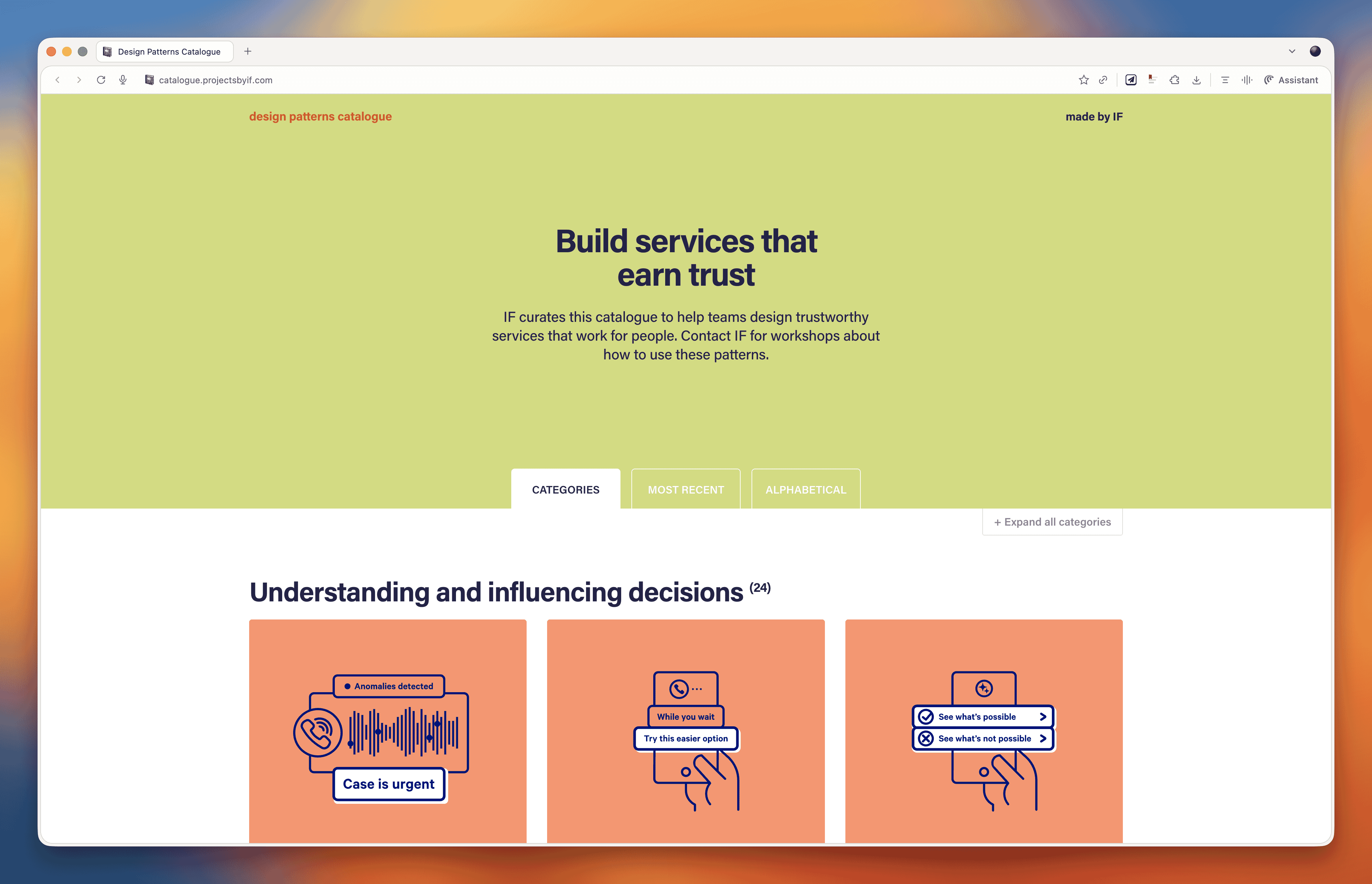
Paul found this while working on Bleet, a tool that automatically extracts advice from your recorded meetings and turns it into social media content. The trust challenge there is obvious: you're uploading client meetings with confidential information, so finding patterns for building that trust was essential.
Marcus's Joke
"I dropped a tub of margarine on my foot two weeks ago. I can't believe it's not better."
The AI-powered Podcast Player

