Exploring Ventilation Strategies for ARDS: Insights from a Landmark Trial
This chapter explores a pivotal trial published in 2000 that investigated various ventilation methods for ARDS patients. It highlights the historical context of mechanical ventilation, concerns over lung injury, and the progression of pulmonary critical care practices.
Play episode from 03:03
chevron_right
Transcript
chevron_right
Transcript
Episode notes
This episode is launching our 2024 Rapid Fire Journal Club summer series on ARDS! This summer we will be talking about landmark ARDS trials that have defined the literature and shaped patient care. Journal clubs often focus on new trials, and so learners may have a less thorough understanding of the baseline literature that defines many of our ICU practices. The goal of this series is to provide a quick, but in-depth look at these papers so that learners understand the modern landscape of ARDS.
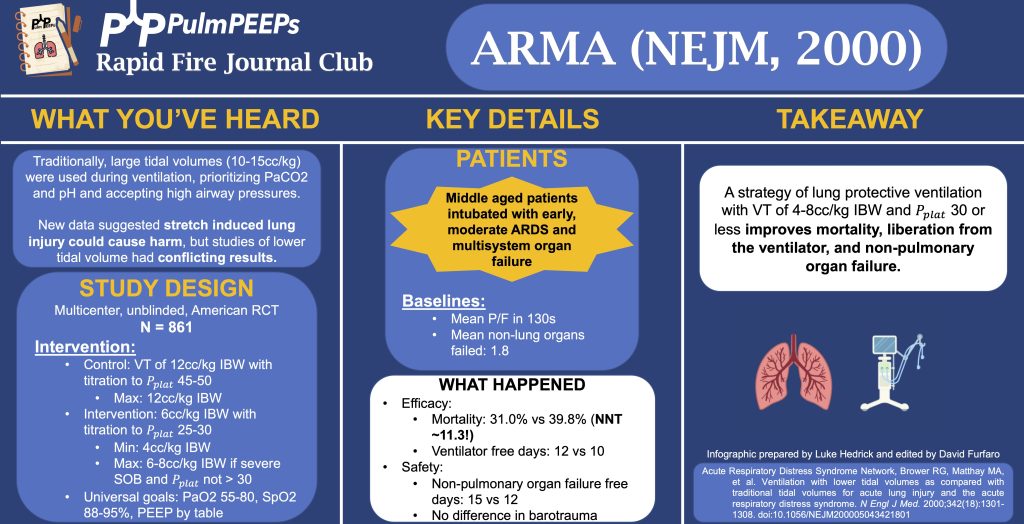
We’re talking about the ARMA trial today which examined “Ventilation with Lower Tidal Volumes as Compared with Traditional Tidal Volumes for Acute Lung Injury and the Acute Respiratory Distress Syndrome.”
We mention a step-wise titration of tidal volume in the control group to achieve Pplats of 45-50. To clarify, there was no adjustment of Vt in the traditional Vt group unless Pplat > 50. If Vt had been decreased in the traditional Vt group because Pplat was > 50, it would not be subsequently increased back to 12 unless Pplat < 45 (to avoid a cycle of corrections and re-adjustments). Similarly in the lower Vt group, there was no adjustment (“titration”) of Vt unless Pplat > 30, and there was a similar protocol in place not to increase the Vt again unless the Pplat was < 25.
The AI-powered Podcast Player
Save insights by tapping your headphones, chat with episodes, discover the best highlights - and more!